Tag Archive for: invisible dog fence

How to stop my dog running away - max the lab running off

How Do I Stop My Dog Running Away?

How Do I Stop My Dog Running Away?

How do I stop my dog running away? Start by working out why your dog is escaping, secure the weak points around your garden and combine a reliable boundary with appropriate training, exercise and mental stimulation. Dogs may run away because of prey drive, boredom, fear, mating instincts or simply because they have discovered an easy escape route.

For some dogs, repairing fences and improving recall is enough. For determined escape artists that jump, dig, squeeze through gaps or bolt through gates and driveways, a more consistent containment solution may be needed.
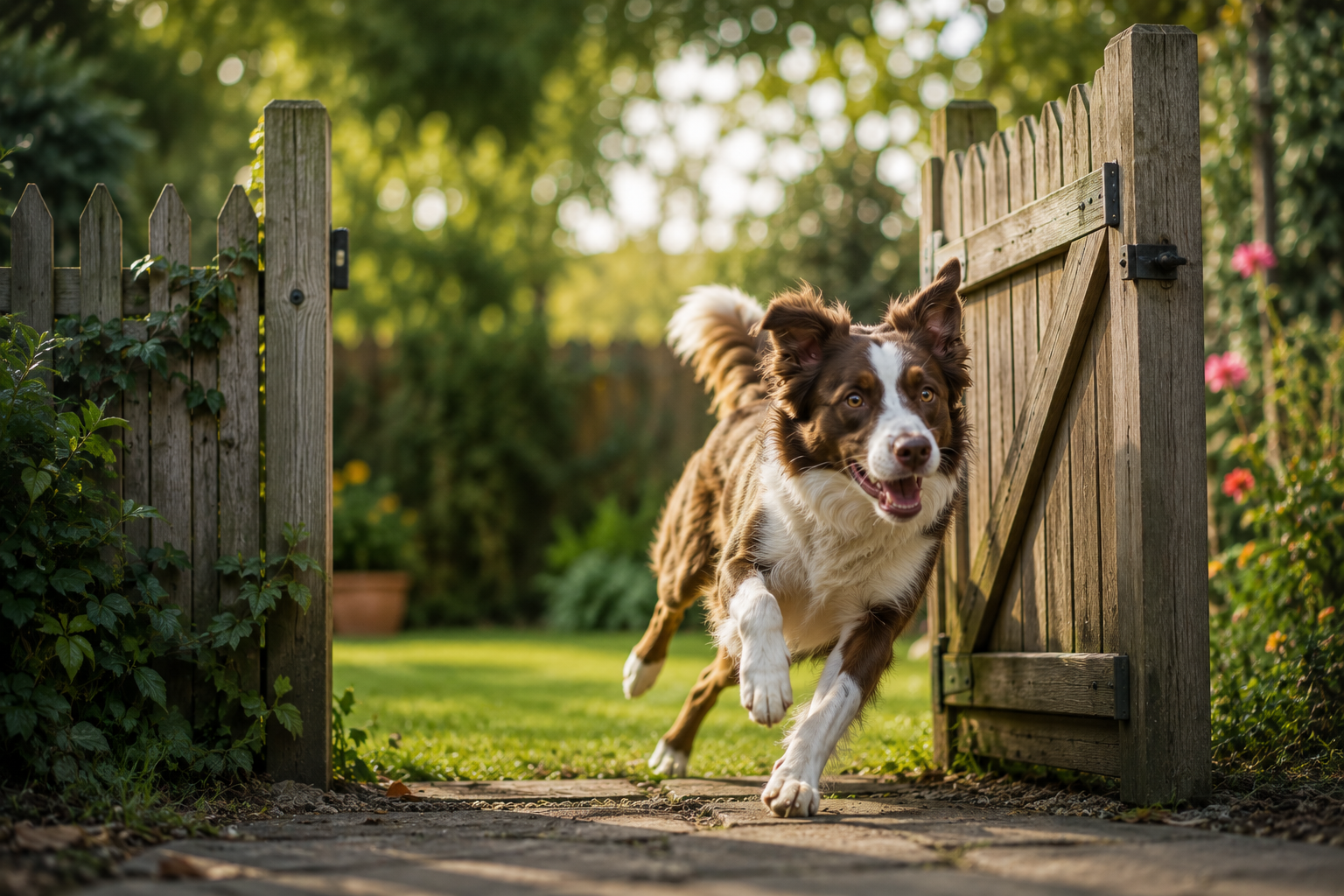
Dog running away through an open garden gate

Quick Answer: How to Stop a Dog Escaping

If your dog keeps escaping, work through these steps:

    • Identify what is triggering the escape behaviour.
  • Check fences, gates, hedges and boundaries for weak points.
  • Prevent digging underneath or climbing over physical fencing.
  • Increase exercise, enrichment and mental stimulation.
  • Work on recall and boundary training.
  • Remove easy escape opportunities such as open gates and gaps.
  • Consider a dedicated dog containment system if conventional fencing is not working.

The best solution usually combines management, training and a secure boundary. Fixing only one part of the problem can leave a determined dog free to find another escape route.

Why Does My Dog Keep Running Away?

Before you can stop repeated escapes, it helps to understand what is motivating your dog. Different causes need slightly different solutions.

Prey Drive, Wildlife and Interesting Scents

For many dogs, the temptation on the other side of the boundary is simply more exciting than staying in the garden. Rabbits, deer, foxes, livestock, neighbouring dogs and interesting scent trails can trigger an instinctive chase response.

Terriers, spaniels, hounds and many working breeds can be particularly persistent once something catches their attention. A dog may ignore excellent recall when their prey drive takes over.

If scents and wildlife are a major trigger, you may also find our guide to how to dog proof your garden useful.

Boredom and Lack of Stimulation

A dog left with too little exercise or mental stimulation may start creating their own entertainment. Digging, climbing, testing fence panels and searching for gaps can all become rewarding activities.

Young dogs and highly intelligent breeds are especially good at discovering weaknesses around a property. More exercise, scent work, structured play and enrichment can substantially reduce escape attempts caused by boredom.

Fear, Fireworks and Sudden Noise

Not every escape is driven by curiosity. Some dogs run because they are frightened.

Fireworks, thunderstorms, gunshots, construction noise or unfamiliar activity can trigger a flight response. A dog that normally respects the garden boundary may suddenly try to climb, dig or force their way out when panicked.

If your dog only escapes during particular events or seasons, addressing the underlying fear is just as important as securing the boundary.

Roaming and Mating Instincts

Hormonal behaviour can make some dogs extremely determined to roam. An unneutered dog may travel surprising distances if they detect another dog in season.

If this is a recurring problem, read our guide to stopping a dog escaping when in season.

My Dog Keeps Escaping the Garden – What Should I Check First?

Walk around the entire boundary and look at it from your dog’s point of view.

  • Are there gaps underneath fencing?
  • Are any panels loose or damaged?
  • Can your dog squeeze between a gate and fence post?
  • Are bins, sheds or garden furniture being used as climbing aids?
  • Can your dog jump the existing fence?
  • Does an electric or automatic gate create an open escape route?
  • Can your dog push through hedging?

A determined dog often needs only one weak point. Fixing obvious gaps is therefore an important first step.

If digging is the main problem, see our guide to fencing for dogs that dig or escape.
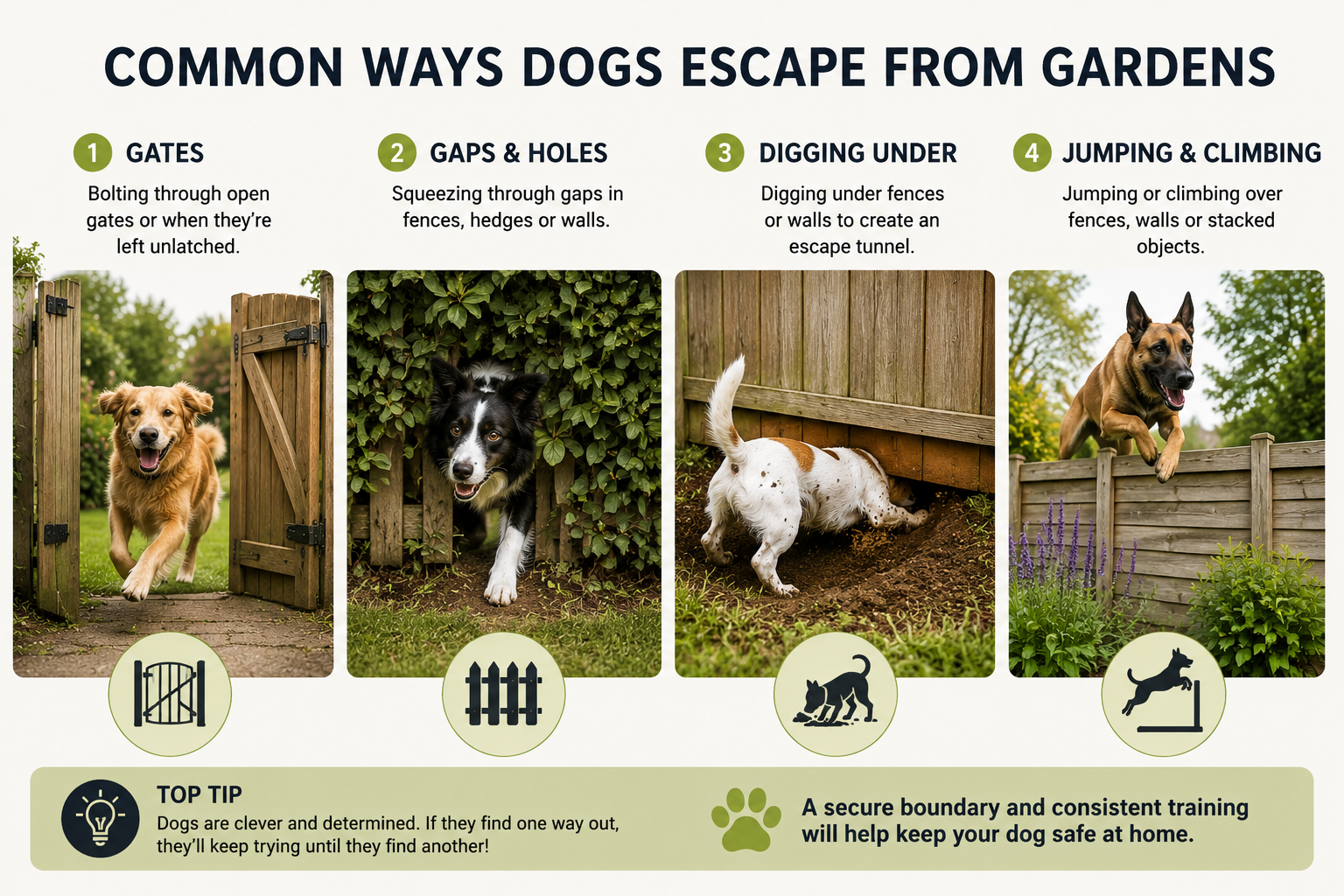
Common ways dogs escape from gardens including gates, gaps, digging and jumping fences

Stop Dog Escaping Garden Boundaries: Practical Solutions

1. Increase Exercise and Mental Stimulation

A physically and mentally satisfied dog is generally less motivated to go looking for entertainment elsewhere.

Daily walks, scent games, training sessions, puzzle feeders and interactive play can all help reduce escape behaviour caused by boredom or excess energy.

2. Secure Fences and Gates

Repair damaged fencing, close gaps and make sure gates latch securely. Dogs that dig may need the base of a physical fence reinforced, while dogs that jump may require a higher or differently designed boundary.

You can also read our guide on how high a dog fence should be.

3. Train a Reliable Recall

Recall training remains important even when you have a secure garden.

  • Begin in a low-distraction environment.
  • Reward your dog generously for returning.
  • Never punish a delayed return.
  • Increase distractions gradually.

Recall provides another layer of safety, but for a persistent escape artist it should not be relied upon as the only form of containment.

4. Identify the Trigger

Keep a note of when escapes happen. Is it when wildlife appears? When your dog is alone? During fireworks? When a gate opens?

Finding the pattern often makes the solution much clearer.

Dog Running Away Through Gates and Driveways

Open driveways and entrances are particularly difficult because they cannot always be secured with a permanent physical barrier.

Dogs may learn that the gate opening, a delivery arriving or somebody driving away creates a brief opportunity to bolt. Even a dog that normally stays close can be tempted by another dog, wildlife or activity across the road.

A containment boundary can be designed across driveways, gates and other access points without preventing people or vehicles from entering and leaving the property.

Dog Keeps Running Away Even After Training?

If you have improved recall, increased exercise and secured obvious weaknesses but your dog still escapes, it may be time to look at the boundary itself.

Some dogs become extremely skilled at defeating conventional fencing. They climb, jump, dig, squeeze through gaps or simply wait until somebody opens a gate.

In these cases, the problem may not be a lack of training. The physical boundary may simply be giving the dog too many opportunities.

Escape Proof Fence for Dogs: What Are the Options?

No physical fence is completely escape proof for every dog. Tall fencing may stop a jumper but still allow a determined digger underneath. Solid fencing may prevent squeezing through gaps but can be unsuitable for open rural properties, long boundaries, driveways or attractive gardens where owners do not want high fencing.

The right solution depends on:

  • your dog’s size, breed and temperament;
  • how your dog currently escapes;
  • the size and layout of your property;
  • whether you have gates or open driveways;
  • whether conventional fencing is practical or permitted.

Dog Fence for Dogs That Escape

If traditional fencing, gates and training have not solved the problem, a dedicated dog fence for dogs that escape can create a consistent boundary around the property.

DogFence uses a discreet boundary wire together with a lightweight receiver collar and structured training. Your dog learns where the safe boundary lies while still being able to enjoy the garden freely.

The boundary can be designed around:

  • gardens and lawns;
  • hedges and woodland;
  • open driveways;
  • electric gates;
  • large or rural properties;
  • areas where conventional fencing is difficult or undesirable.

DogFence systems can also accommodate multiple pets, including dogs and cats, with individual receiver settings for each animal.
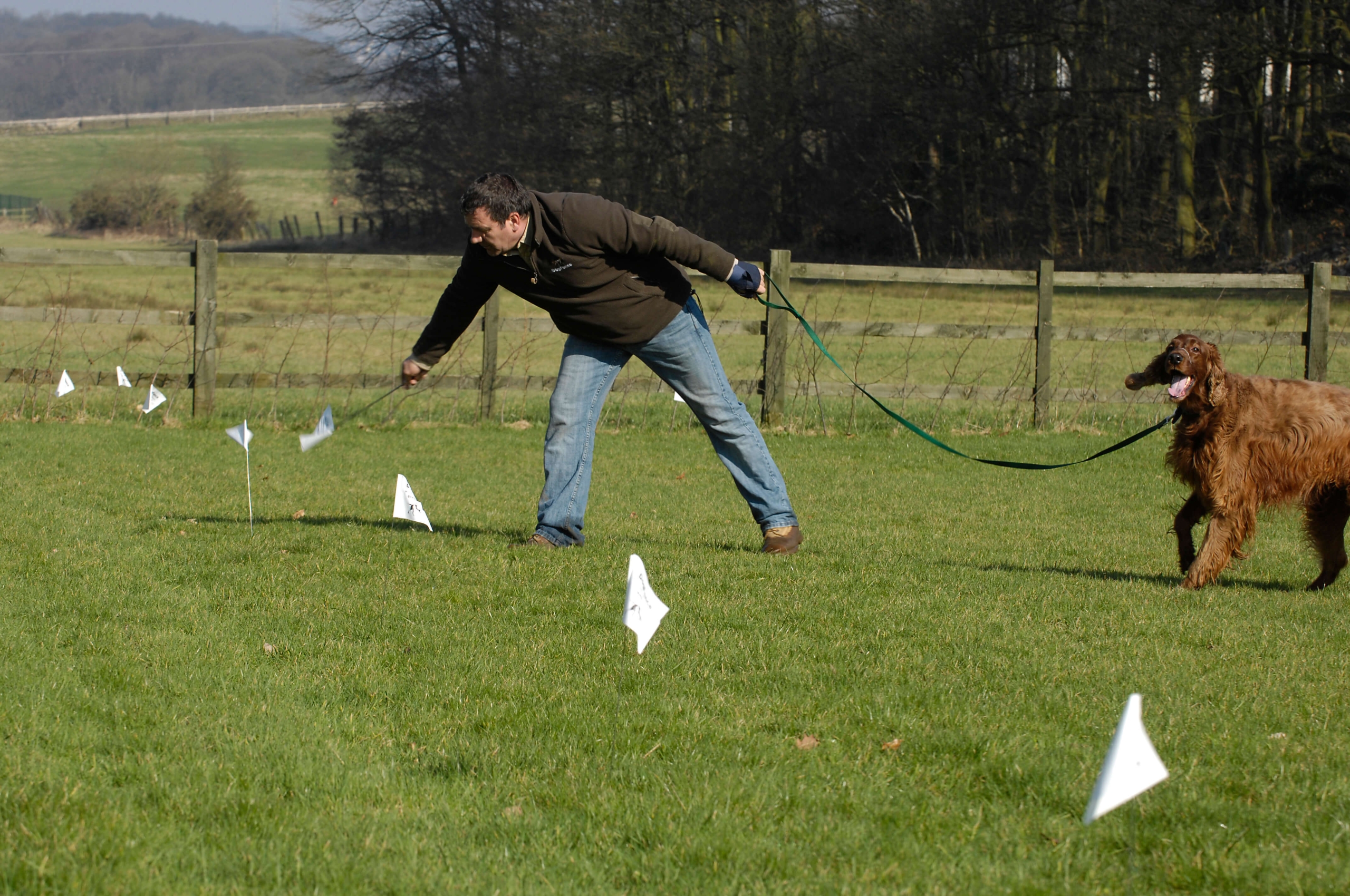
DogFence training session teaching a dog to recognise hidden fence boundary flags

A Real Escape Artist: Max’s Story

Max, a lively Labrador from Hampshire, developed a habit of escaping from his garden. His owners repeatedly blocked holes and reinforced panels, but each time Max discovered another route out.

His motivation was food. Max had discovered the local pub garden and the generous supply of snacks available there.

For a while his owners knew where he was going, but one day Max ran across a busy road during one of his excursions and narrowly avoided being hit by a car. He was eventually picked up and taken to a local vet.

That close call changed everything.

His owners installed a professionally designed DogFence and Max was trained to recognise his new boundary. His unsupervised trips to the pub stopped — and as an unexpected bonus, without the extra chips and treats, Max lost 3kg too.

Max is a good example of why continually repairing individual escape points does not always solve the underlying problem. Some dogs simply move on and find the next weak spot.

How to Stop a Dog Escaping Without Building Higher Fences

If you do not want to surround your property with taller fencing, or if fencing is impractical because of the layout, a hidden dog fence provides another option.

The aim is not simply to create another physical obstacle. Instead, the dog is taught to recognise a consistent boundary around the area in which they are free to roam.

This can be particularly useful on larger properties, rural homes, landscaped gardens and properties with open entrances.

Find out more about how DogFence can help stop your dog escaping.
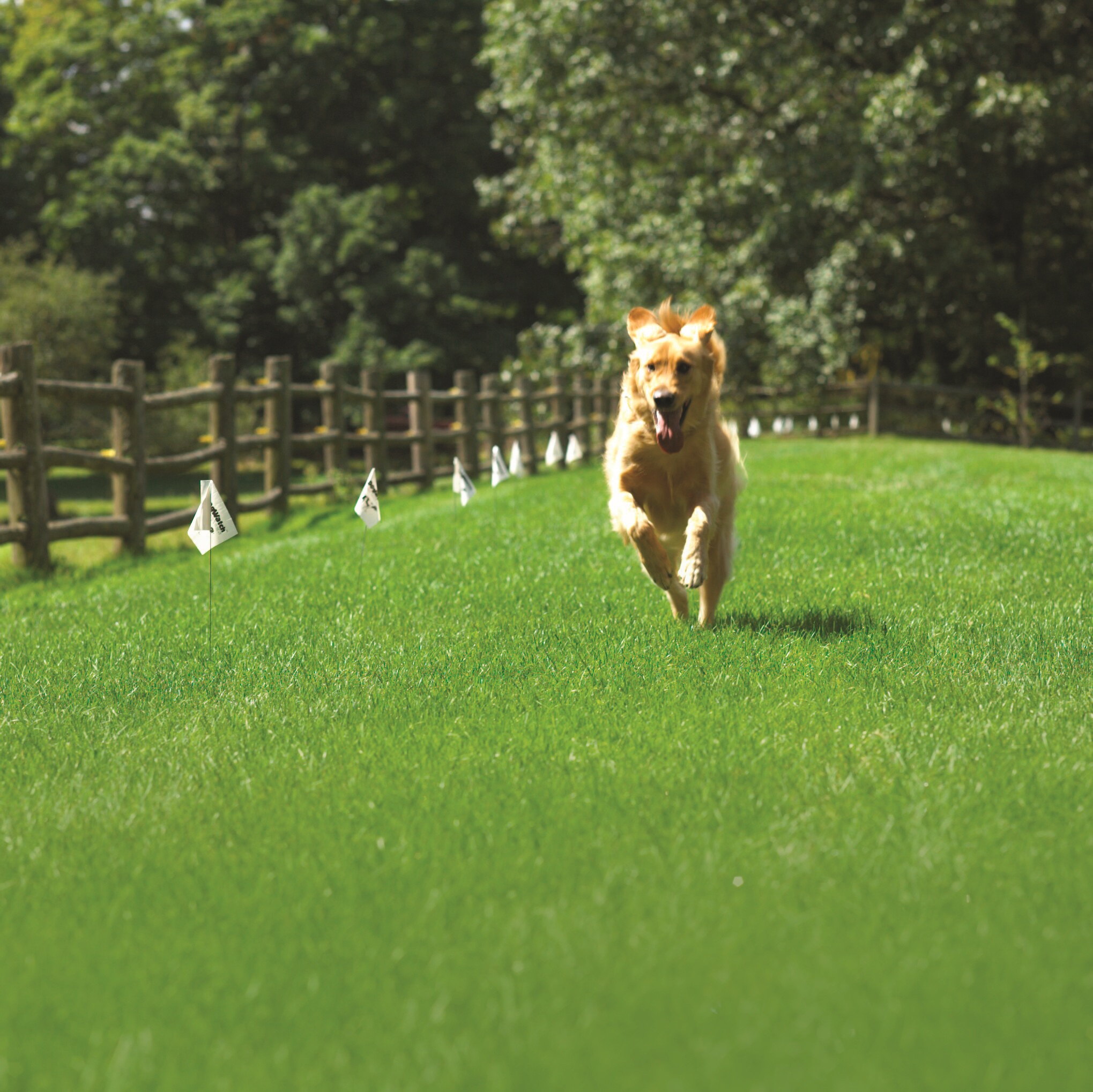
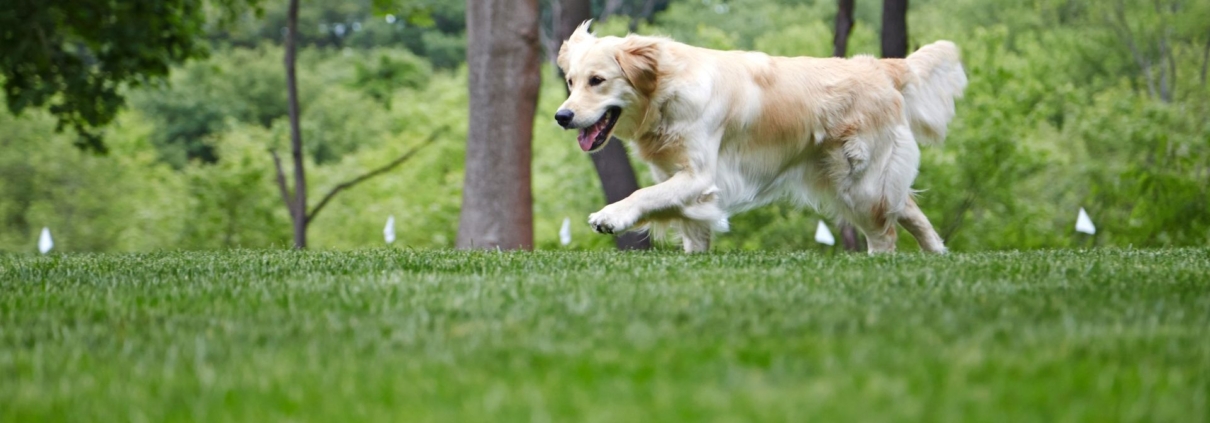
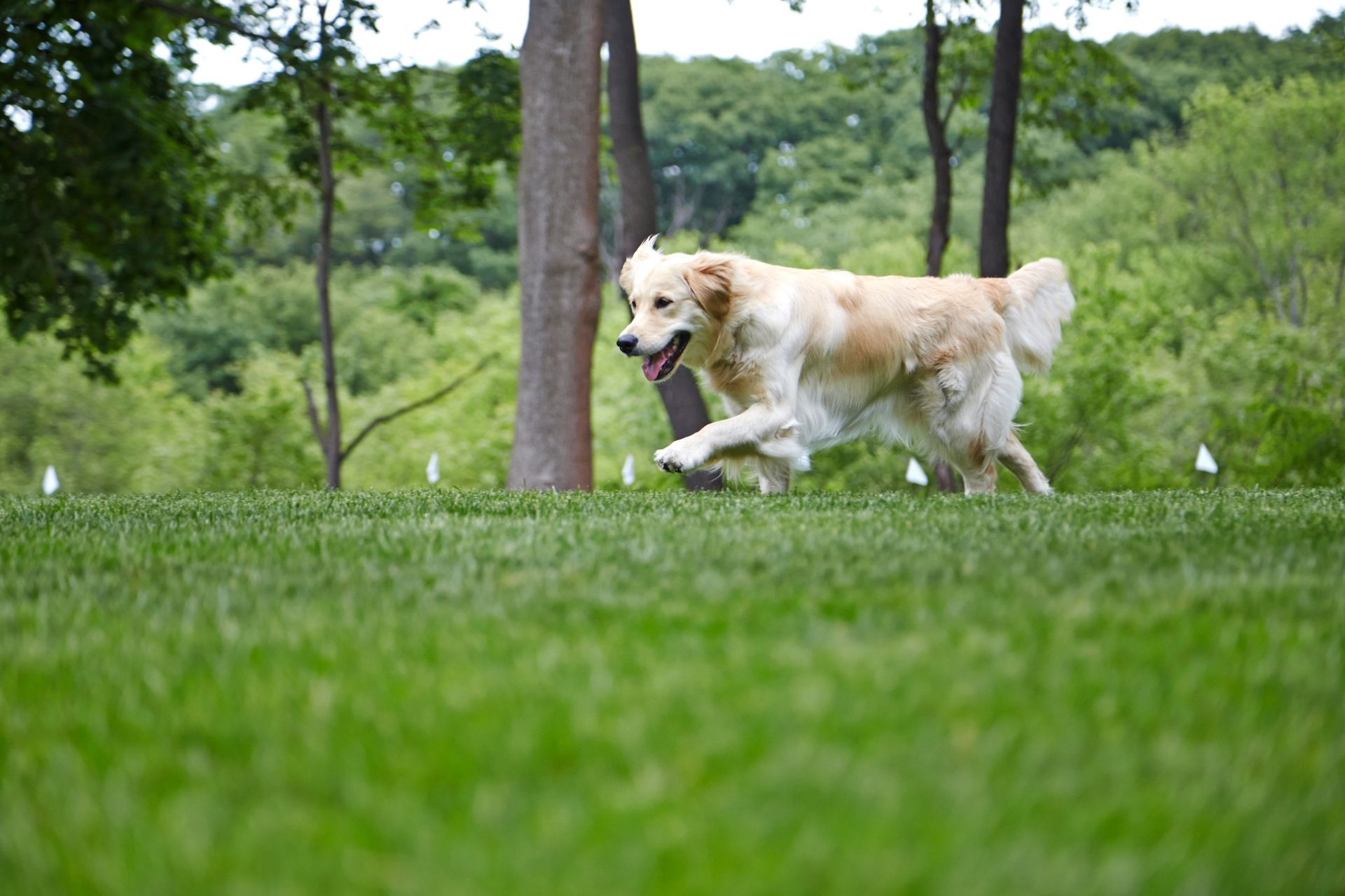
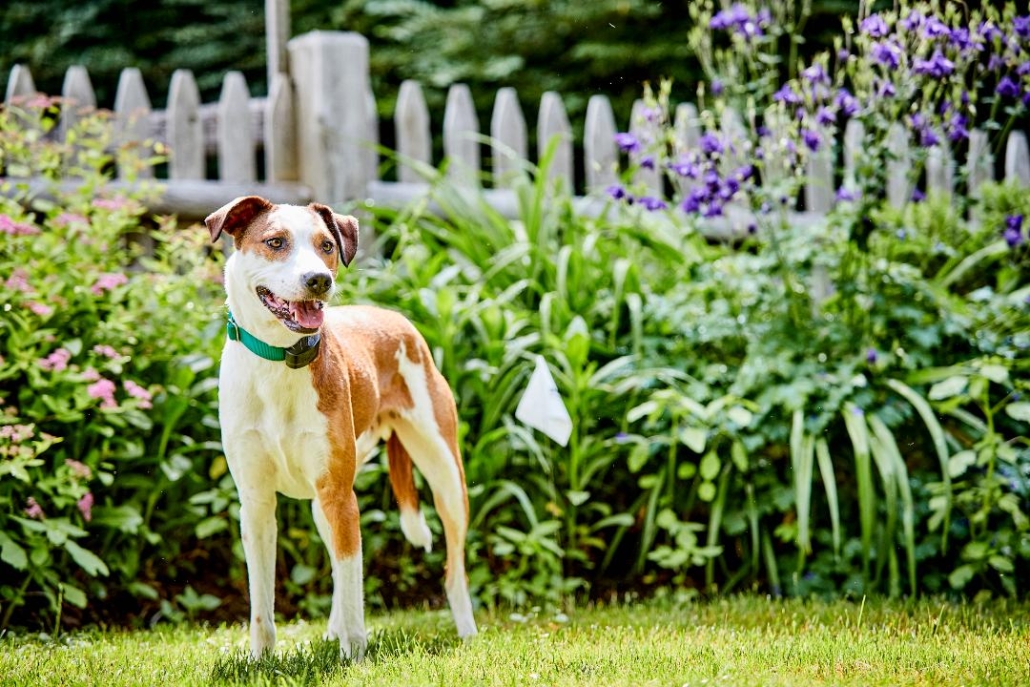
How do I stop my dog running away? Retriever running alongside a DogFence boundary marked with training flags

After gentle, consistent training, dogs gain confidence and freedom — safely contained within their DogFence boundary.

Frequently Asked Questions About Dogs Running Away

Why does my dog keep escaping from the garden?

Common causes include prey drive, boredom, fear, mating instincts, lack of exercise and discovering an easy escape route. Identifying the trigger will help you decide whether the priority is training, environmental management, physical repairs or improved containment.

How can I stop my dog digging under the fence?

Start by identifying why your dog is digging and reinforce obvious weak points. Determined diggers may simply move to another part of the boundary, so a containment system can be useful where repeatedly reinforcing fencing has failed.

How can I stop my dog jumping the fence?

Remove nearby objects that can be used as launch points and assess whether the fence is high enough for your dog’s size and athletic ability. Dogs capable of repeatedly clearing conventional fencing may benefit from an alternative boundary system.

Will a DogFence stop my dog escaping?

A correctly installed system combined with appropriate training is designed to teach your dog to remain within the selected boundary. The system can work across gates, driveways, hedges and areas where traditional fencing may have weak points.

Can a DogFence be used for more than one dog?

Yes. One boundary can be used for multiple pets. Each dog has their own receiver collar, which can be individually adjusted. DogFence can also be used for cats of different sizes, breeds and ages.

Can I install a DogFence myself?

Yes. DIY DogFence systems are available, or you can choose professional installation and training by our experienced team.

Can I take my DogFence with me if I move?

Yes. The main DogFence equipment can be taken to your new home. A new boundary wire can then be installed to suit the new property and your dog can be retrained to recognise the new boundary.

Related Guides for Dogs That Escape

If your dog has a particular escape technique, these guides may help:


Still Asking “How Do I Stop My Dog Running Away?”

If your dog keeps escaping, you do not have to choose between keeping them shut indoors and constantly worrying about where they have gone.

DogFence has been helping owners keep dogs safely at home since 2003. Whether your dog jumps fences, digs underneath them, squeezes through gaps or bolts through an open driveway, we can help you create a boundary designed around your dog and your property.

Give your dog the freedom to enjoy the garden — without the constant worry of them escaping.

How Do I Stop My Dog Running Away?

If you’re asking “how do I stop my dog running away?”, talk to our experienced team. We’ll help you understand how your dog is escaping and recommend the best way to secure your garden — tailored to your dog and your property.

Get expert advice on securing your garden and preventing escape

Call us on
01628 476475
|
Message us on WhatsApp
|
Request a Free Quote Online



Golden retriever trained to electric fence for dogs boundary in UK garden

Electric fence for dogs. What You Need To Know!

Electric Fence for Dogs: What It Really Means in the UK

An electric fence for dogs is an electronic containment system that uses a buried boundary wire and a receiver collar to create a safe, invisible perimeter. It does not electrify fencing panels or deliver a live electric current, in fact an electric fence for dogs is a commonly used term for what is actually an electronic containment system for dogs. Despite the name, an electric fencing for dogs does not electrify physical fencing or send a live current through your garden. Instead, it uses a buried radio boundary wire and a lightweight receiver collar to create a safe, invisible perimeter. For this reason they are often referred to as underground dog fences.

In the UK, most modern systems described as an electric fencing for dogs are professionally installed electronic dog containment systems designed to keep pets safely at home while preserving freedom in the garden.

Golden retriever trained to electric fence for dogs boundary in UK garden


What Is a Pet Containment System and How Does It Work?

An electric fence for dogs works by transmitting a low-level radio signal through a boundary wire installed around the perimeter of your property.

Your dog wears a small computer receiver collar. As they approach the boundary:

  • The collar emits a warning tone.
  • If the dog continues forward, a brief, programmable static impulse is delivered.
  • The correction stops immediately once the dog returns to the safe zone.

Although many people search for an “electric fence for dogs,” these systems are electronic rather than agricultural electric fencing. Our guide to electric fence systems for dogs explains how modern containment technology works in practice.


Is an Electric Fence for Dogs Actually Electric?

No.

The term electric fence for dogs is misleading. These systems do not electrify fencing panels, gates or the ground. There is no exposed live wire and no risk to children or other animals touching the boundary. The “fence” is an invisible underground dog fence.

They use a contained radio signal combined with static correction technology — similar in sensation to everyday static discharge.

If you are concerned about welfare, we explore the evidence and research in depth in our guide to whether electric dog fences are cruel or kind, as well as in our wider discussion on the controversy surrounding dog fences and whether they are cruel or harmful


Boundary Wire System vs Traditional Fencing

A boundary wire system for dogs is often chosen when traditional fencing fails.

Common scenarios include:

  • Dogs jumping 6ft panels
  • Digging under boundaries
  • Escaping through damaged fencing
  • Rural properties where physical fencing is impractical
  • Planning restrictions preventing tall panels

Unlike visible fencing, an invisible dog fence system creates a psychological boundary rather than a physical one.

This means dogs are trained not to approach the perimeter at all.


Can an Underground Dog Fence Be Installed on Any Property?

In most cases, yes.

A professionally installed underground dog fence for dogs can:

  • Cross driveways
  • Run under patios and pathways
  • Follow complex boundary shapes
  • Cover large rural estates
  • Navigate wooded areas

If you are unsure whether professional installation is required, you may find our comparison of dog fence installation: DIY vs hiring a professional helpful.

Professional installation ensures correct cable placement, precise programming and tailored training suited to your individual pet.

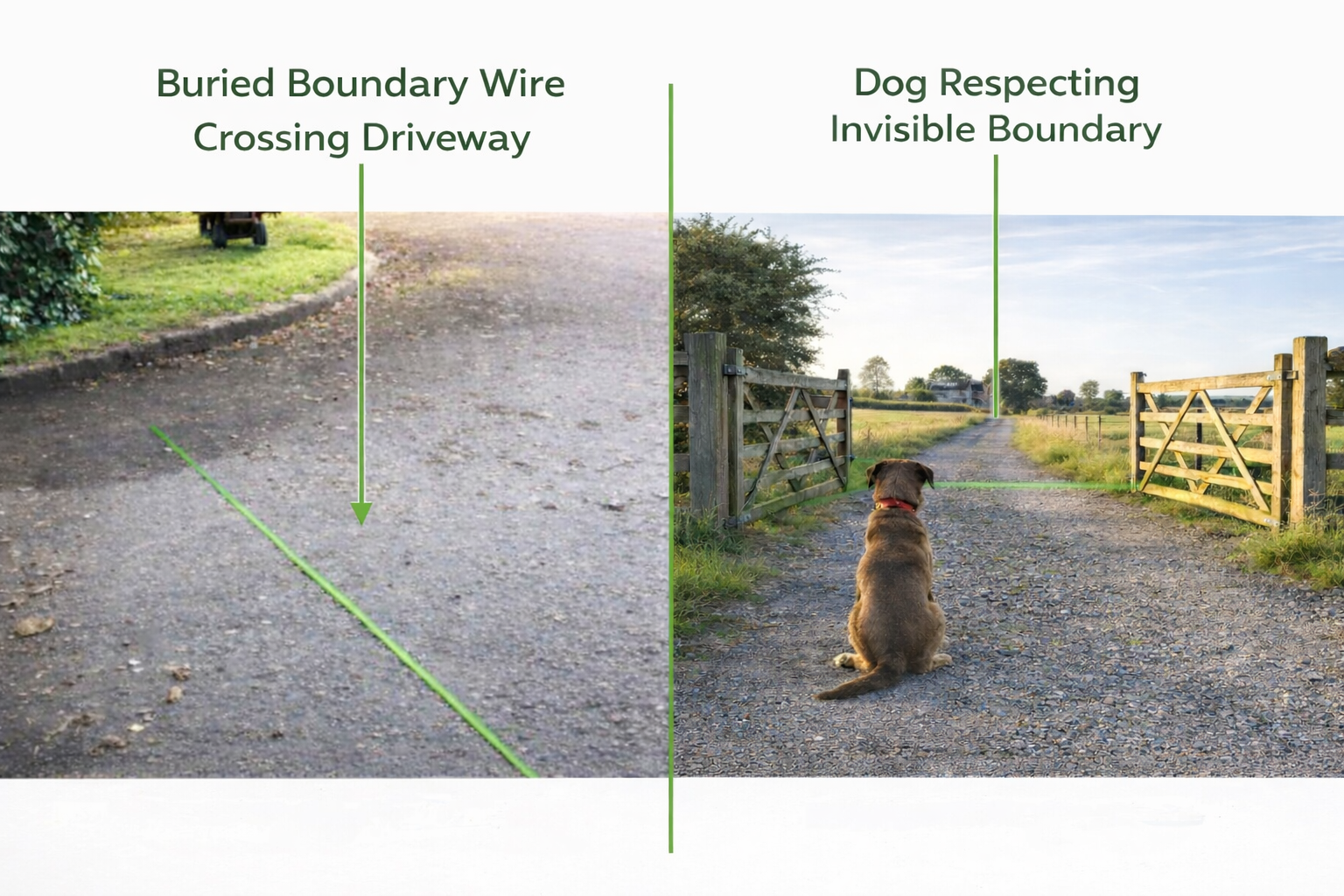
electric fence for dogs buried boundary wire crossing driveway with trained dog sitting inside open gate

Buried boundary wire crossing a driveway and a trained dog calmly respecting the invisible boundary — even with the gate open.


Is an Invisible Dog Fence Safe?

When installed correctly and used responsibly, an electric fence for dogs is designed for safety and containment — not punishment.

Modern systems include:

  • Adjustable static levels
  • Warning tone before correction
  • Automatic safety shut-off
  • Waterproof receiver collars
  • Tailored training for each pet

Because the term “electric fence” is often misunderstood, questions about safety frequently arise. If you’re exploring the welfare discussion in more depth, our guide on whether electric dog fences are cruel or kind examines the research and practical evidence.


Frequently Asked Questions About an Electric Fence for Dogs

Do electric fences for dogs give a shock?

No. They deliver a brief static impulse only if a dog ignores the warning tone.


Do Invisible Fences for dogs hurt?

When properly installed and programmed, the sensation is mild and momentary. Most dogs learn to respond to the warning tone alone.


Are electronic fences for dogs legal in the UK?

Yes. Electronic dog containment systems are legal in England when used responsibly.


Will a hidden dog fence stop my dog jumping over a fence?

Yes. Because the boundary is psychological rather than physical, dogs are trained not to approach the perimeter at all.


Is a Dog Containment System Right for You?

A containment fence for dogs may be suitable if:

  • Traditional fencing has failed
  • Your dog repeatedly escapes
  • You live in a rural area with livestock nearby
  • You want safety without visual barriers

At DogFence Ltd, we have been installing containment solutions for dogs across England — from small suburban gardens to 350-acre estates.

Our goal is simple: keeping pets safe while preserving their natural freedom at home.

Thinking About Safe Dog Fence Solutions?

Speak to a UK specialist in safe, humane electronic pet containment systems.

Call us on
01628 476475
|
Message us on WhatsApp
|
Request a Free Quote Online
electronic dog fence installation info graphic

Electronic dog fence – FAQ’s for new customers

So you found our electronic dog fence online and made an enquiry. We don’t need to visit your property to give you an estimate. Using our online mapping tool, similar to google earth, we can locate your property and measure out your boundary. Our office team will usually try to contact you as well to chat through your questions and discuss any areas of the property that might need extra attention.

Booking a dog fence installation

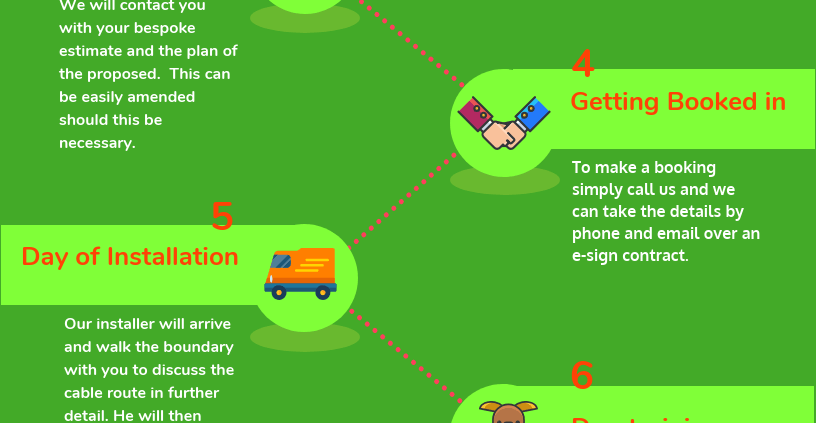
Booking your dog fence installation is simple. Our team will have sent over an estimate with the proposed boundary image. They will have also discussed the different systems with you, Pro Fence 1200, Performance Series and Smart Fence. Once you have agreed on a date and the system they will take some further information about your dog. A deposit is paid to secure the dog fence installation date and a confirmation of the booking will be sent over. Our office team and Dog Fence Installers are here for every step of the journey to answer your questions regarding our electronic dog fences and support you as you transition to giving your pet a happier, safer life.

Dog fence day

As a general rule, we commence the dog fence Installation will commence circa 07.30am! Interestingly this is to avoid rush-hour traffic and maximize daylight during the winter months. Our Installer will walk the boundary with your to fine-tune the electronic dog fence route. Once this has been agreed we should not need your attention again until we commence the dog fence training.

Our unique trenching equipment will bury the cable directly into the ground. We endeavour to bury boundary cables but if the terrain or an area is not suitable we can install cable above ground. Of course, the installation duration will vary depending on the size and the terrain but as a general rule, we will be ready to train your dog in the afternoon.

Electronic dog fence training

Now for the magic! We will not hook your dog up to the mains, we will not hurt your dog, we will train your dog using a recognised protocol. Actually, the training is very subtle and for some dogs, the scariest part is the temporary training flags. These little “flag” aliens can be quite scary to some dogs and others will play or stalk them. As with people, all dogs are different as we will treat them as individuals.  The flags are a vital part of the training and will give the dog a visual for the electronic dog fence boundary.

Don’t worry! Your Installer will look after your pet, he will involve you in the training and you will be amazed at how quick and simple the training is. All our Installers are trained to offer the full Dog Fence Installation & Training program. They will find the level suitable for your pet and work to ensure that he or she understands the fence.

Hopefully, he will answer all your questions but if you forget anything or you have a query you can call the office after the installation. The notes from the day will be electronically uploaded so we can access the training info and answer your questions.

Does the electronic dog fence come with a guarantee?

Absolutely! DogFence offers the most comprehensive guarantee worldwide. Our lifetime hardware warranty covers the transmitter & computer collar for life and even extends to dog chews. But more importantly, we offer a Containment Promise on professionally installed, outdoor systems.

Should your system break down for any reason you can also schedule a service appointment and one of our engineers will test or repair your entire fence or train any new pets that you may have acquired.

Is there any ongoing maintenance for the fence?

Naturally, it is important to check the fence from time to time. At DogFence we recommend testing the electronic fence monthly. This would include checking the battery and collar fit and takes less than 5 minutes. The electronic dog fence collars will alert you when you require a battery. After the dog fence installation, you will be invited to sign up to our battery program. If you decide to purchase batteries on an ad-hoc basis that’s fine.  But it is important to remember that when the battery runs out the pet can run out! Other than the battery and checking the collar fit there is no ongoing maintenance required.

How often do I replace the battery in my dog’s Computer Collar?

Of course, we all lead busy lives but once you see the red flashing light on your electronic dog fence collar you need to take action. The schedule for the battery changes is as follows:

  • R12m & R7m (mini) collars – every 6 months
  • R12 & R9 (standard collars – every 18 – 24 months

The green status light will change from a steady flash every forty seconds to a rapid flash every 10 seconds. At this point, you have approx 2 weeks to change the battery.

Where can I buy Batteries?

DogFence offers a few different options for customers to replace batteries.

  • You can call us
  • You can purchase online
  • Sign up for the battery programme

How often should I remove the electronic collar?

VVIP – the collar needs to be removed every day! Leaving the collar on the dog can cause a skin irritation. We strongly recommend that you remove the collar for a minimum of 6 hours every day but we recommend 8 hours. On the day of the dog fence installation, you will be given all this information again together with a continuation sheet to assist you in the early days’ post installation.

If you would like to know more about our electronic dog fence please call us. We can chat to you and pop together an estimate for the dog fence installation03450 623623 or info@dogfence.co.uk.


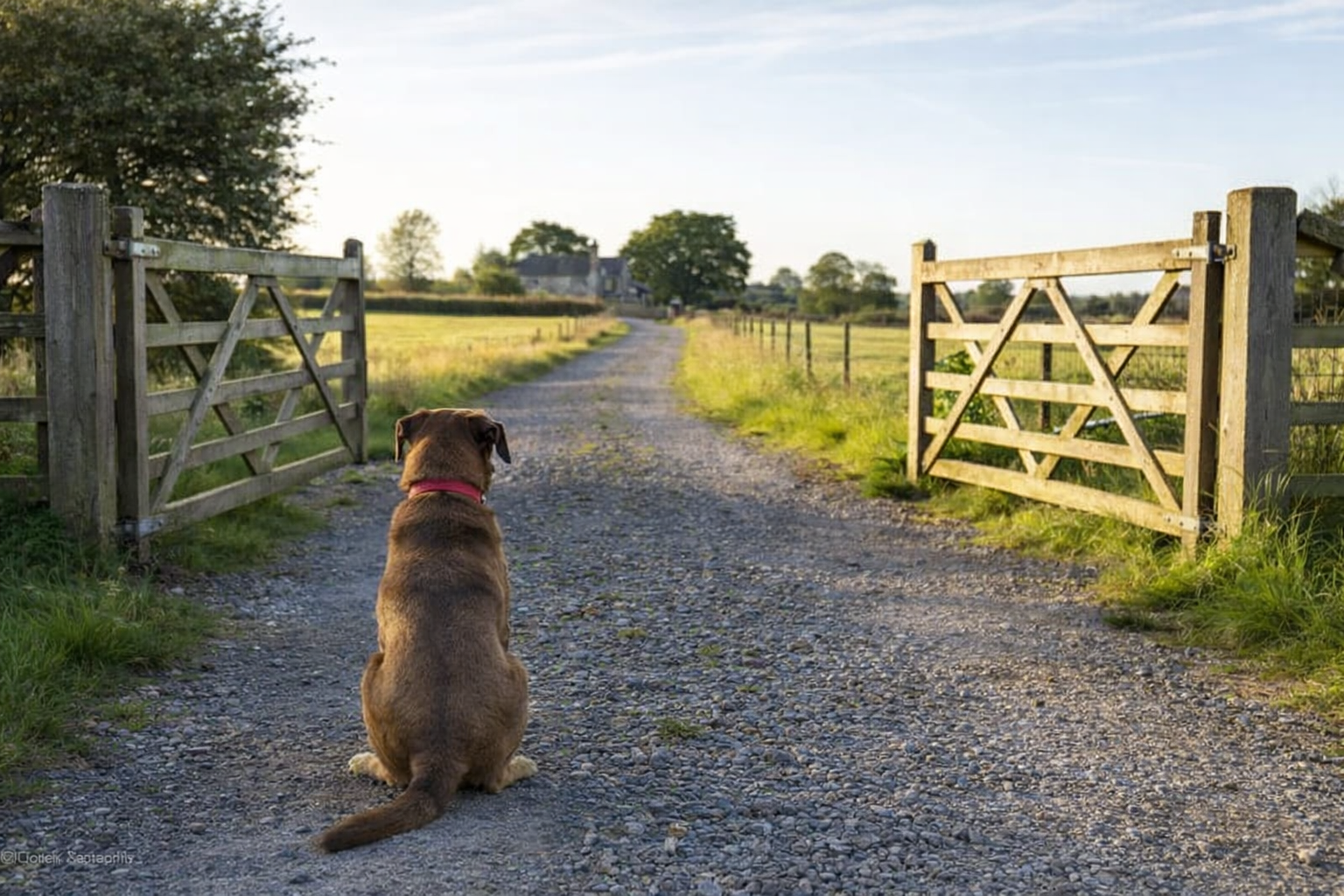
invisible dog fence to stop dog going through gate

Invisible dog fence – can pets out run them?

Can dogs run out of an invisible dog fence?

When looking into purchasing an invisible dog fence one of the most commons concerns is will it work? Can the dog run out of the containment fence? Of course, just a like an ordinary fence if the fence is broken or poorly installed it won’t work. So as with any product, an invisible dog fence needs to be correctly installed but more importantly, both the dog and owner need to know how to use it.

If the fence is correctly fitted and both the pet and owner are trained then a “dog out” will rarely happen. In fact, at DogFence we are so confident we even offer a containment promise on our fully installed dog fences.

So what are the reasons that a dog may outrun a dog fence system?

1. Dead Battery

Unlike other brands of containment fences, our Invisible Dog Fences have a long battery life. However, it is still important to check the battery using the tester every 6 months on our mini collars or 18 months on our larger collars. Consistency is the key to the successful use of an invisible dog fence. If the battery runs out the dog can run out. As a rule, we find that 60% of our troubleshooting is down to a dead battery. Using an invisible dog fence is similar to using your car, it requires fuel to operate and needs topping up and checking once in a while.

2. Loose Collar

As with all brands of containment fence, collar fit is crucial. If the collar is dangling around the dog’s neck like a necklace then it will be completely ineffective! Whilst it is true that once trained 90% of dogs will never receive a collar stimulation again the impulse may need to be activated if the dog is in a high drive moment. If the dog enters the zone and carries onto in the avoidance area with no consequence he or she will quickly learn to challenge the fence. A loose collar = a dog on the lose. We always advise checking the collar fit regularly – your pet may lose or gain weight so checking the collar monthly is extremely important. Our handy troubleshooting guide shows how to test the battery and check the collar fit.

3. Invisible Dog Fence Training – lack of Training

As with anything in life you only get out what you put in! When it comes to containment fencing Training is the keyword. If your pet is not correctly trained to use the fence then it will not work for you or your pet.

DogFence is the only UK Company to offer full onsite training within the package. In 2018 the UK Government announced that they would introduce new legislation to ensure that all dog fences are sold with an installation package. At present, the legislation is still pending. It is hoped that through this legislation there will be a standardized certification program. As a small part of our customer base chose to self-install a DIY Dog Fence we offer full support. Naturally, unlike a total mail order Company, our years in the field mean that we can offer expert guidance and support to those who chose to self-install.

When is come to containment training there are 4 critical elements:

  1. Warning flag & audible only familiarisation
  2. Introduction to correction (impulse)
  3. Distraction Training
  4. Reinforcing Training

Warning Beep Training

All invisible dog fences should be sold with flags – at DogFence we use a min of 20 per 100m. The collar should be set to audible only and the pet should be introduced to the training flags. It is with warming beep that will stop the pet in a red mist or high drive moment.

Introduction to correction

The pet must be on a lead through phases 1 – 3 at all times. This is part of the training where the correct impulse level is determined for each pet. It is important to start on the lowest possible level and look for any signs of recognition/reaction to the impulse. This could be as subtle as a flick of the ear of a small flinch. All good containment fence collars should have flexible training levels.

Distraction Training

Once the pet is avoiding the training flags it will be necessary to create some distractions. These can be getting a game going with the pet, having someone else walk through the flags or bringing another dog to the property. Our DogFence Installers will usually involve the customer as part of the distraction and it’s a great way for the owner to really get involved.

Reinforcing Training

Once the pet fully understands the containment fence it is important that he or she associates it with the property and not the installer. The installer will leave full written instructions on how to carry on and when to allow the dog off the lead (cat training is carried out internally).

Freedom!

Once trained the pet has complete freedom and the owner has peace of mind.


4. Faulty equipment – Not all Containment Fences are the same!

Dogs will be dogs and the invisible dog fence collar goes through a lot of wear and tear. Many brands of containment fences are Chinese made and the quality is poor. Our invisible dog fences are high-quality but even these can go wrong. Recognizing that consistency is king DogFence offer a Lifetime Warranty on our professionally installed fences. The warranty covers both the transmitter and the computer collars. And because dogs will be dogs we add in a warranty to cover dog chews on the computer collar as well!

As with a car, it is important to check things are working. Our Installers will show you how to carry out the simple monthly checks using the testing tool. Using the correct battery is extremely important. A good quality containment fence collar should alert when a battery is required. At DogFence we recognize that people are busy so we also offer an automatic battery renewal programme.

Similary boundary wire quality is vitally important. If the boundary wire is too thin it will be very prone to damage. DogFence uses a high-quality heavy-duty boundary wire which is 25 times heavier than most DIY brands supply.  When looking for an invisible dog fence look for the following:

  • Long Battery life containment fence giving cockapoo freedom in the garden
  • Lifetime Warranty on Transmitter & Collars
  • Heavy-duty wire
  • Professional Installation & Training
  • Full after sales service

Escaping dogs will always be a problem as they can cause road accidents, kill or harm livestock or wildlife. Using a containment fence is an excellent way of giving the pet freedom but keeping them safe at home. Not all containment fences are the same and not all containment fence suppliers offer the same level of service. If you would like to receive some professional advice and information call us on 03450 623623.


dog with lead - no dog fence collar on

How do I take my dog for walk if I use a dog fence?

How do I take my dog for a walk if I use a dog fence?

After you have had your dog fence installation one of the most common questions we get asked at DogFence is “how do I take the dog for a walk?”.

It’s actually really simple. The DogFence installer will have trained your dog or cat to stay within the dog fence boundary.  This is a reverse training protocol and usually takes the dog approx 7 – 10 days to feel fully comfortable with leaving the property.

There are 2 main points to observe:

  • Never allow your dog to cross the boundary unless he has contact with you. This could be with the lead or by carrying him or simply having a hand on his shoulder.
  • Never allow your dog to cross the boundary with his fence collar on – even with the system turned off.

To cross the boundary:

  1. Remove the dog fence collar and put it in a safe place. Do not turn off the fence.
  2. Pop him on his lead and walk him up to the exit.
  3. Ask him to sit or stop him before the boundary line (only for the first week).
  4. Give the command to walk and walk slowly out of the property.
  5. Give him praise when you have crossed the boundary.
  6. Repeat the process when you re-enter the property.

The best way to see how it works is to watch the lovely Lionel demonstrating how it’s done:

When we install a dog fence for you we will run through how to take your dog for a walk after. As with any new training, it may take your dog a few days to adjust to going out for a walk. If you would like to learn more about how we can give your dog freedom in the garden check why not call us today on 01628 476475?


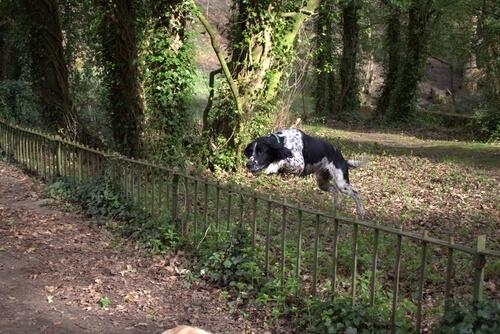
dog fencing idea gone wrong - Collie leaping over net fence in countryside

Dog Fencing Ideas – how to keep Fido home!

Dog Fence Solutions: Rural vs Urban Challenges

Dogs will be dogs so exploring different dog fence solutions is a must for any canine owner. Having spent 17 years fencing dogs we have come across many different ideas. As with people no two dogs are the same and of course they all live in different locations.

Why Dogs Escape (and Why Fencing Matters)

Many rural locations are difficult to fence. Understandably this could be because of the terrain being very hilly, wooded or prohibitively large. Furthermore most rural properties are surrounded by hedgerows. Hedgerows may be a deterrent for a dog with a low prey drive but for many it’s an open avenue of escape.

Rural Dog Fence Options

What are the dog fence options for rural homes? Rural homes have always been difficult and expensive to fence and terrain and size will naturally affect what type of fencing can be installed.

Stock Fencing

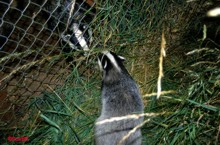
Stock Fencing is not a good dog proof fencing idea as badgers can make holes and crawl through

Badgers are not deterred by Stock Fences

Stock fencing is a traditional dog fence solution for rural properties. Used to contain livestock it is adaptable for use in rural gardens. For many dogs this will give enough of barrier to prevent the dog jumping  out of the property. The downside is that this type of fencing is it is costly, unsightly and can be damaged by wildlife. Badgers and foxes will often make holes in this type of fencing and thus some rural owners find this dog fencing idea a temporary fix. Also the cost of such fencing can work out extremely expensive; starting around £8.00 p/m + gates etc it can a costly exercise.

Deer Fencing

Deer Fencing; again another great rural solution but sadly it is extremely obtrusive more expensive than stock fencing. Again, the downside with this fencing is that badgers and small mammals will make holes that then become an escape avenue for your dog!

Electronic dog fencing

Electronic dog fencing; you may not be familiar with this product even though this type of dog fencing idea has been around for over 40 years. Using a boundary wire, transmitter and a computer collar worn by the pet this type of fencing can be used on any terrain. Electronic dog fences do need to be professionally installed. This is because the pets need training but they a more cost effective solution than traditional methods. As a guide price an rural installation of approx 2 acres for 2 dogs would be circa £1300.00.

The advantage of this type of dog fencing solution is that it can be used cost effectively on very large properties (up to 350 acres) and can be removed if the owner moves house. It is also invisible so will not affect any planning restrictions or spoil the view!

Kennels and dog runs

Kennels and dog runs are full proof method for dog containment and are often an option for rural homes The downside of installing a run is that many dogs become bored and exercise is limited. The cost of installing Kennels can be high but equally these can be relocated to a new property.

Urban Dog Fence Options

When it comes to urban dog fencing there are certainly more options but prices are often prohibitively high. Of course, most urban gardens are fenced in some way but these may not all be dog proof! Some new sites have planning restrictions on fence heights and even open plan. Many properties use Picket or Rail type fencing which dogs can easily jump over or squeeze through.

Planning permission is not usually required in urban areas.  Fences must be no more than 2m high or 1m high  near roads. The most popular type of fencing is for urban houses is Close Board fencing.

Close Board Fencing

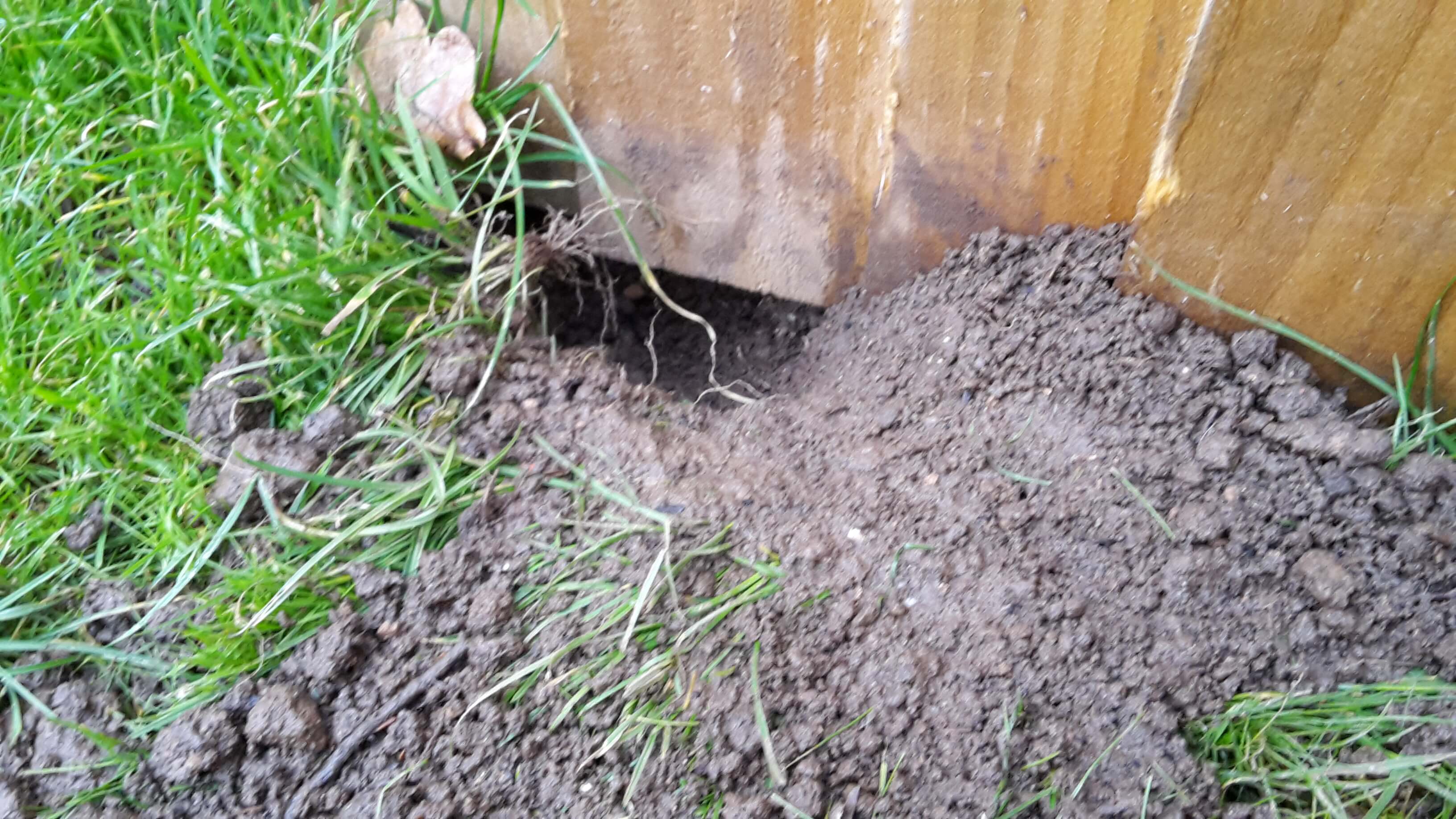
dog fencing ideas can go wrong when the dog digs under the close board fence and makes a hole!

Dogs can dig under traditional fences

Close board fencing is a great dog fencing solution for many urban owners. It is generally tall enough to stop jumping dogs and quick to install. This type of fencing comes in varying heights and can be installed by most handymen. The downside is that some dogs will dig under and there may be restrictions to installing this type of fencing on some new estates. As a rough cost to install on a small rear garden it would be approx £1200.00.

Electronic dog fencing – no need to install gates!

As with the rural properties this type of fencing is a very cost effective solution. These types of dog fencing solutions also gives the owner the possibility of protecting the drive within the price. It is true that the larger the property for more cost effective the electronic dog fence becomes but small properties can also be fenced with this product.

Many owners may already have a Close Board or Picket fence installed and need additional backup. The electronic dog fence can be run around the existing fence if the traditional method is not working. Our Installers can place the cable to prevent the dog jumping over or digging under the existing fence. The cable can even be run under the drive to protect this area. Most owners are concerned that this means digging up the drive but the installation is both neat and discreet.  A typical urban property would cost less £1000 to fence and this would include a driveway loop.

If you’re looking for affordable ways to secure your garden, check out our guide to cheap dog fence ideas.

Cat Runs

Interestingly cat runs can be used to keep both dogs and cats safe. These type of structures can prove expensive if they are professionally installed and may not be aesthetically pleasing. A cat run suitable for a dog would usually cost from £750.00 upwards depending on the size.

If you’re a cat owner too, our invisible cat fence systems provide the same safe, effective containment as our dog fences — keeping adventurous cats close to home without restricting their freedom.

Unusual DIY Attempts (What We’ve Seen Over the Years!)

A DogFence Ltd we have been Professionally installing electronic dog fences for over 17 years. The dog fencing solutions that some owners come up with to keep their pets at home can often be amusing. Over the years we have seen:

  • Old Fireplaces in the hedge!
  • Old garage doors down one boundary!
  • Orange builders netting – not attractive or effective!
  • Hundreds of dogs on tie out stakes – who have wound themselves up to the pole 🙁
  • Electric horse fencing – Harsh and not fall proof!

If you would like to learn more about how we can keep your dog safe at home please call us or visit our web site. We offer bespoke Quotes using our online measuring tool – simple, accurate and effective. 01628 476475 or info@dogfence.co.uk


dog fence dogs

Fencing For Dogs Who Escape

What Is the Best Fence for Dogs That Escape?

The best fence for dogs that escape depends on how your dog is getting out. A dog that jumps needs a different solution from one that digs, squeezes through gaps or bolts through an open gate. For persistent escape artists, simply making a physical fence higher or stronger may not solve the problem.

In this guide, we look at the main fencing options for escaping dogs, their advantages and limitations, and what to consider when choosing a secure boundary for your garden.

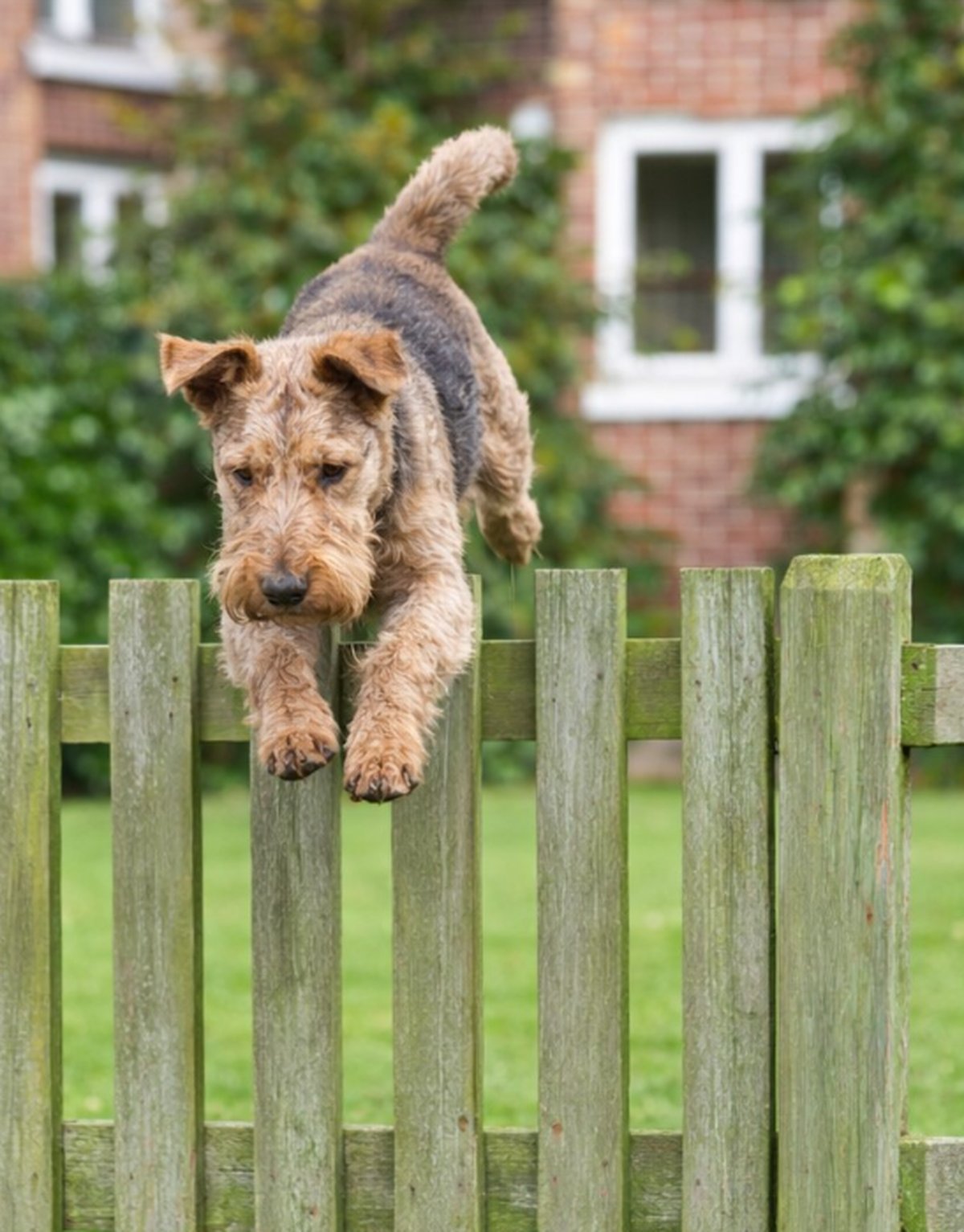
Fencing for dogs who escape – dog jumping over a garden fence

Quick Answer: What Is the Best Fence for Dogs That Escape?

For many dogs, a secure physical fence with no gaps and sufficient height will work perfectly well. However, dogs that repeatedly jump, climb, dig or escape through gates may need a different approach.

The main options are:

  • Solid wooden fencing – useful for dogs distracted by what they can see outside the garden.
  • Mesh or wire fencing – practical for larger gardens and rural properties.
  • Dig-proof fencing – designed for dogs that tunnel underneath boundaries.
  • Higher fencing – potentially useful for athletic dogs that jump.
  • A hidden dog fence – creates a consistent boundary that can work across fences, hedges, gates and driveways.

The right choice depends on your dog, how they escape and the layout of your property.

Why Do Some Dogs Escape Conventional Fencing?

Some dogs are remarkably good at finding weaknesses in garden boundaries. Fix one escape route and they simply start looking for another.

Common escape methods include:

  • jumping over fences;
  • climbing mesh or timber fencing;
  • digging underneath;
  • squeezing through small gaps;
  • pushing through hedges;
  • escaping when gates are opened;
  • bolting down open driveways.

Before spending money on new fencing, identify exactly how your dog is escaping. This will help you choose a solution that addresses the actual problem rather than just one particular escape point.

If you are not sure why your dog keeps getting out, read our guide to why dogs escape gardens.

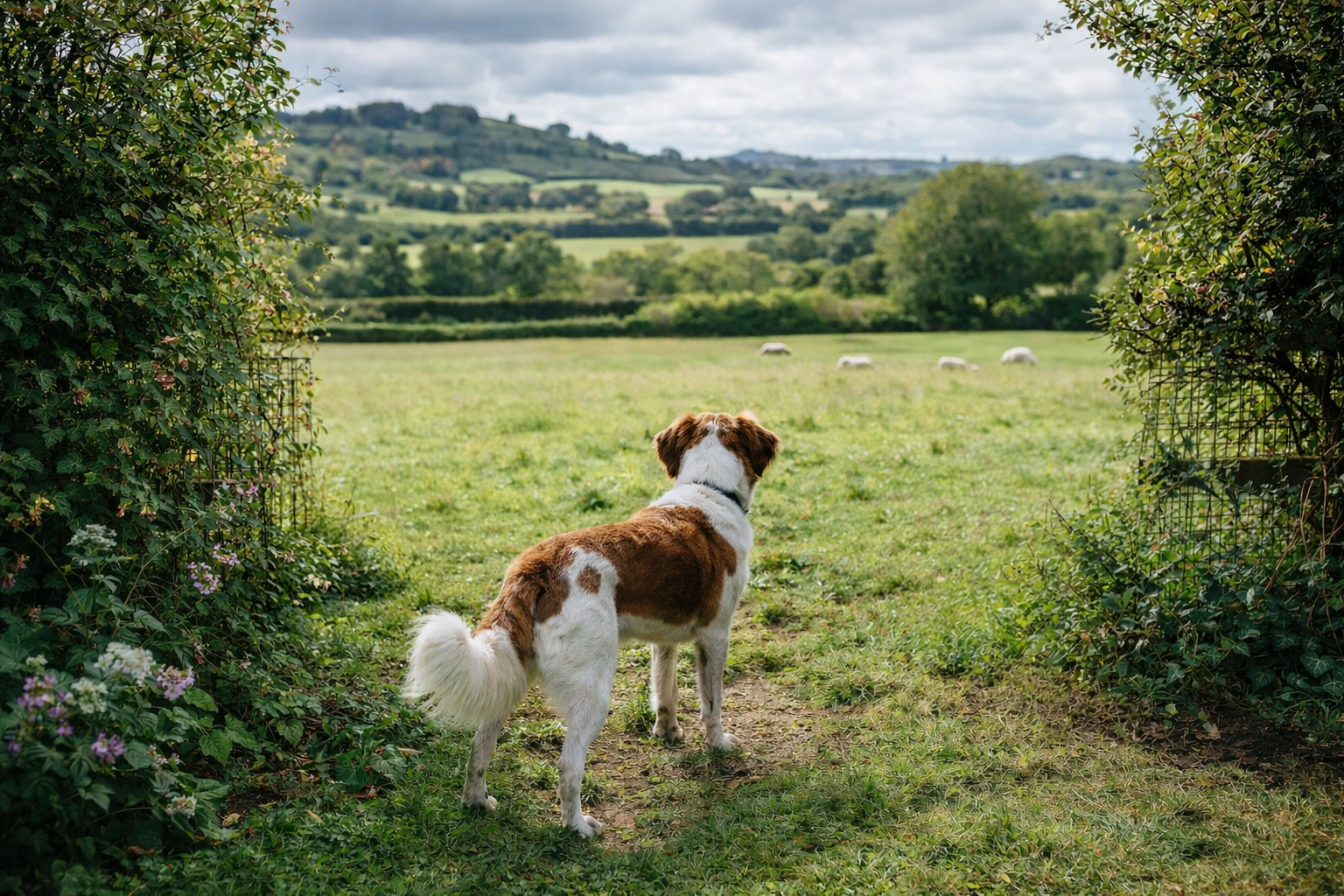
Fencing for dogs who escape – dog looking through an open garden boundary

Escape Proof Fence for Dogs: Does One Exist?

There is no single physical fence that can honestly be described as completely escape proof for every dog.

A six-foot fence may stop one dog but another may climb it. Reinforcing the bottom may prevent digging, while still leaving a gate or driveway as an escape route.

That is why the best escape proof fence for dogs is the one designed around both the dog’s behaviour and the individual property.

1. Wooden Fencing for Dogs That Escape

Solid wooden fencing is one of the most common choices for gardens. It provides a visible physical barrier and can also prevent a dog seeing distractions such as passing dogs, people or wildlife.

Advantages:

  • Creates a solid visual barrier.
  • Available in different heights.
  • Can reduce visual triggers outside the garden.
  • Works well for many ordinary residential gardens.

Potential problems:

  • Dogs can dig underneath it.
  • Athletic dogs may jump over it.
  • Some dogs learn to climb panels or nearby structures.
  • Damaged panels can create escape gaps.
  • It cannot normally solve an open driveway or frequently opened gate.

2. How High Should Fencing Be for an Escape Artist Dog?

If your dog jumps, increasing fence height may seem like the obvious answer. For some dogs, it is.

However, jumping ability varies enormously according to size, breed, athleticism and motivation. There isn’t one fence height that guarantees every dog will remain inside.

Also check for bins, sheds, walls, garden furniture and raised flower beds close to the fence. A dog may be using these as a launch point.

For more detail, see how high a dog fence should be and our guide answering can a dog jump a 6ft fence?

3. Dog Proof Fencing for Dogs That Dig

For a determined digger, fence height is largely irrelevant. The weak point is underneath the boundary.

Physical fencing may need to be extended or reinforced at ground level to make digging underneath more difficult. Regularly inspect the perimeter because some dogs simply move along the fence and start digging somewhere else.

If this sounds familiar, our guide to how to stop a dog digging under a fence looks specifically at this problem.

4. Mesh and Wire Fencing for Dogs

Mesh fencing can be a practical choice for large gardens, paddocks and rural properties where installing solid timber fencing around the entire boundary would be expensive or visually intrusive.

However, the mesh size and construction matter. Small dogs may squeeze through larger openings and some dogs are surprisingly capable climbers.

Large properties also introduce another challenge: the longer the boundary, the more potential weak points there are to maintain.

Owners of larger properties may find our guide to dog proof fencing for rural properties useful.

5. What About Gates and Open Driveways?

This is where conventional fencing often becomes difficult.

You may have excellent fencing around the entire garden but still need vehicles, deliveries and visitors to enter through a gate or open driveway.

A dog can quickly learn that an opening gate creates an opportunity to escape. For some owners, permanently closing or physically fencing an entrance simply isn’t practical.

A hidden dog fence can create a boundary across a driveway or gate without physically preventing vehicles or people from passing through.

Escape proof fence for dogs – dog sitting beside an open driveway gate

6. Hidden Dog Fence for Dogs That Escape

For dogs that repeatedly defeat conventional fencing, a professionally installed hidden dog fence provides another option.

Rather than relying solely on the height or strength of a physical barrier, DogFence creates a consistent boundary that your dog is trained to recognise.

A discreet boundary wire is installed around the selected area of the property. Your dog wears a lightweight receiver collar and is introduced to the boundary through a structured training programme.

The boundary can be designed around:

  • existing fencing;
  • hedges;
  • gardens and lawns;
  • woodland;
  • open driveways;
  • electric gates;
  • large and rural properties;
  • specific areas within a garden.

If you have a persistent escape artist, see our dedicated dog fence for dogs that escape page for more information about how the system works for dogs that jump, dig, squeeze through gaps or bolt through entrances.

Wired or Wireless Dog Fence: Which Is Better?

Hidden dog fences can use either a wired boundary or a wireless system, but they do not provide the same flexibility.

A wired system allows the boundary to be designed around the individual property. It can follow irregular gardens, encompass larger areas and be positioned around existing landscaping, gates and driveways.

Wireless systems generally create a predetermined signal area around a transmitter. This can make them convenient in some circumstances, but the boundary shape is less flexible.

DogFence uses a professionally designed wired boundary because it allows us to tailor the layout to the dog and the property rather than asking the property to fit a predetermined boundary.

How Does a Hidden Dog Fence Work?

The principle is straightforward:

  1. A discreet boundary wire is installed around the area in which your dog can safely roam.
  2. The wire carries a radio signal.
  3. Your dog wears a lightweight receiver collar.
  4. Temporary training flags provide a visual reference during training.
  5. The collar gives an audible warning as your dog approaches the boundary.
  6. Your dog is taught to recognise the warning and move back into the safe area.
  7. The training flags are gradually removed once your dog understands the boundary.

The system is designed to work alongside appropriate training rather than simply relying on the equipment itself.

What Is the Best Dog Fence for a Large Garden?

For a large garden, acreage or rural property, the cost and practicality of installing traditional fencing around the entire perimeter can become significant.

A hidden dog fence can cover substantial and irregular areas without blocking views or requiring a high physical fence around the property.

It can also follow boundaries through hedges, woodland and other areas where conventional fencing may be difficult or undesirable.

What Is the Best Fence for a Dog That Jumps AND Digs?

This is where simply modifying a physical fence can become frustrating.

If you make the fence higher, your dog may start digging underneath it. Reinforce the bottom and they may discover a gap beside the gate. Block the gap and they may simply wait for somebody to open the driveway.

For dogs with several different escape techniques, a DogFence hidden dog fence can provide a different solution. Rather than trying to physically block every possible escape route, the DogFence creates a consistent boundary around the area where you want your dog to remain.

A discreet boundary wire is installed around the property and your dog wears a lightweight receiver collar. As your dog approaches the boundary, the collar gives an audible warning. During professional training, your dog learns to recognise that warning and retreat back into the safe area.

This means the same hidden dog fence can protect areas where a dog might otherwise jump over fencing, dig underneath it, squeeze through gaps or escape through an open driveway.

Importantly, a DogFence can also work alongside your existing garden fence, hedge, wall or gates. You do not necessarily need to remove the fencing you already have – the hidden boundary provides an additional layer of security for a determined escape artist.

For a dog that both jumps and digs, this can be particularly useful because you are creating one consistent dog boundary rather than continually trying to anticipate the next way your dog might escape.

See how it works on our dog fence for dogs that escape page.

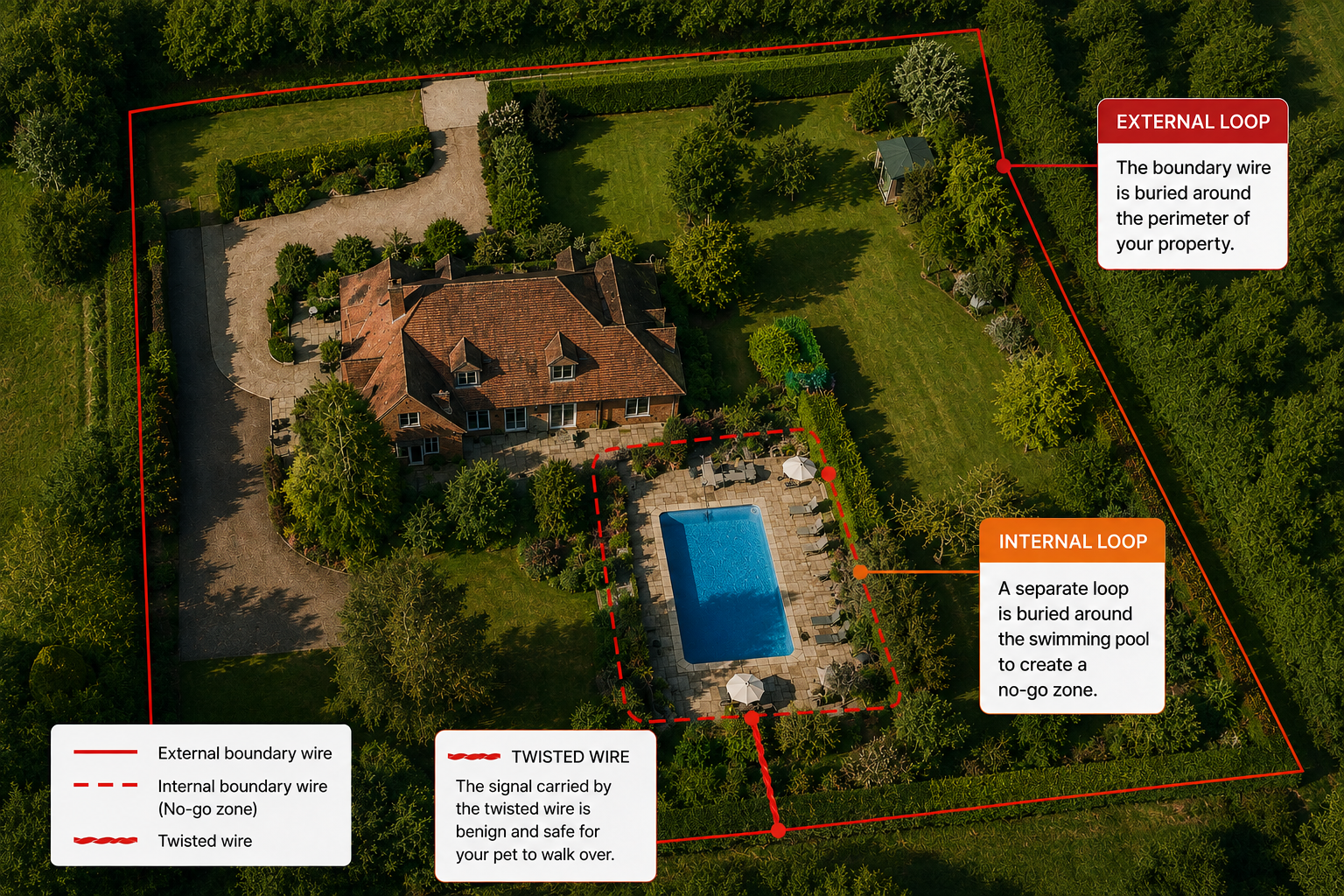
Aerial view of Escape-proof fencing for dogs showing a hidden boundary around the garden and a separate no-go zone around the swimming pool

A hidden dog fence can create both an external garden boundary and an internal no-go zone around your swimming pool. The twisted wire safely connects the two boundaries, allowing your dog to cross it without receiving a warning.

How Do I Choose the Best Fencing for My Dog?

Ask yourself five questions:

  1. How is my dog escaping? Jumping, digging, climbing, squeezing or bolting?
  2. Where are they escaping? Fence, hedge, gate or driveway?
  3. How large is the area? A small enclosed garden and a rural property require very different solutions.
  4. Do I want a visible physical fence? Appearance and planning considerations may influence your choice.
  5. Has my dog already defeated conventional fencing? If so, simply replacing it with something similar may not address the underlying problem.

The best fencing solution should suit your dog, your garden and the way you use your property.

Frequently Asked Questions About Fencing for Dogs That Escape

What is the best fence for dogs that escape?

The best fence depends on how the dog escapes. Solid fencing can suit many gardens, while diggers may need ground-level reinforcement and jumpers may need greater height. Dogs that repeatedly defeat physical fencing or escape through gates and driveways may benefit from a hidden dog fence combined with appropriate training.

What is the best escape proof fence for dogs?

No physical fence can be guaranteed escape proof for every dog. Determined dogs may jump, climb, dig or find gaps. The most appropriate solution is one designed around the dog’s particular escape behaviour and the property’s layout.

What fencing is best for a dog that digs?

A physical fence needs to be secure at ground level and regularly checked for new digging points. A hidden boundary can also be considered for persistent diggers that continually find new places to tunnel underneath conventional fencing.

What fencing is best for dogs that jump?

Increasing physical fence height can help, but the required height depends on the dog’s size and athletic ability. Remove objects that can act as launch points and consider whether the dog is likely to find another escape method if jumping is prevented.

Can a hidden dog fence cross a driveway?

Yes. A professionally designed wired boundary can cross driveways and entrances, allowing vehicles and people to continue using them while the dog is trained to recognise the boundary.

Can I use a DogFence with an existing fence?

Yes. A DogFence can work alongside existing timber, mesh or other garden fencing. It can provide an additional consistent boundary where a dog has learned to jump, dig underneath or exploit gaps in the existing fence.

Can one DogFence be used for several dogs?

Yes. Multiple pets can use the same boundary with individual receiver collars appropriate to each animal.

Which Fence Should I Choose for My Escape Artist?

If your existing fence already keeps your dog safely in the garden, there may be no reason to replace it.

But if you are continually blocking holes, increasing fence height, repairing gaps or worrying every time somebody opens the gate, it may be worth considering a different approach.

DogFence has been helping UK owners keep their dogs safely at home since 2003. We design boundaries around the individual dog and the individual property, including difficult gardens, driveways and large rural areas.

Looking for the Best Fence for a Dog That Escapes?

If your dog jumps, digs, squeezes through gaps or bolts through gates, talk to our experienced team. We’ll help you find the best way to secure your garden — tailored to your dog and your property.

Give your dog freedom in the garden — without constantly worrying about them escaping.

Call us on
01628 476475

|
Message us on WhatsApp

|
Request a Free Quote Online
Related posts

dog fence ideas - dog with question mark

Dog Fence Options Compared: Wooden, Mesh & Invisible Systems

Dog Fence Options Compared: Wooden, Mesh, and Invisible Systems

When you’re researching dog fence options, you’ll quickly see there are many different choices — from traditional wooden panels and wire mesh to modern invisible dog fences. But not all solutions are equal when it comes to keeping your dog safe and secure.

In this guide, we’ll compare the most common types of dog fence options, their pros and cons, and explain why an invisible FM frequency fence is often the safest and most cost-effective choice.

Why Do You Need A Fence?

Most pet owners will experience a dog that loves to escape — whether it’s jumping a 6ft fence, digging under the hedge, or simply heading off on an unplanned walk. While this may seem harmless, an escaping dog can:

  • Put themselves in danger from cars, livestock, or poisoning.

  • Cause accidents on the road.

  • Knock over or frighten strangers.

  • Risk unexpected vet bills or even fines from the dog warden.

A secure fence isn’t just about protecting your dog — it protects others too and gives you peace of mind.

Dog escaping over wooden fence showing need for secure dog fence options

Some dogs see traditional fences as just another challenge.


Wooden Panel Fencing

Wooden fencing may look sturdy, but it isn’t fool-proof.

  • Panels often sit slightly above the ground, making it easy for dogs to dig underneath.

  • Athletic dogs may simply jump over, even if the fence is 6ft tall.

  • Regular maintenance is required to stop rotting or repair storm damage.

  • Costs can quickly mount if you need to replace panels or add extra barriers.

For determined dogs, wooden fencing can be little more than a temporary fix.


Wire Mesh Fencing

Wire mesh is another common option, but it often causes more problems than it solves:

  • Dogs can see through the mesh, leading to barking, fence-running, and frustration.

  • Neighbours or passers-by can tease or even harm your dog.

  • Digging under is still possible.

While affordable, wire mesh is rarely a long-term solution for escape-prone dogs.


Why Chaining Is Never the Answer

Some owners resort to chaining a dog when fences fail. But chaining:

  • Severely restricts exercise.

  • Causes stress, boredom, and frustration.

  • Increases aggression and behavioural problems.

It’s unsafe and unfair for the dog — and definitely not a recommended containment method.


Wireless & Invisible Dog Fences

This is where technology offers a smarter solution. Invisible fences use a boundary wire, transmitter, and a computer collar to create a safe containment zone. But not all systems are equal.

AM Frequency Fences (Old Technology)

  • Can be disrupted by Wi-Fi, TVs, or even light dimmers.

  • Slow response times mean pets can “outrun” the signal.

  • Risk of false activations, shocking your dog unnecessarily.

FM Frequency Fences (Modern Technology)

  • Use secure, fast, digital signals that ignore interference.

  • Quick reaction time keeps pets safely contained.

  • Safety cut-off prevents over-correction.

  • Can be installed around any property size — from small gardens to estates of 350+ acres.

  • Invisible and planning-friendly.

Learn more about how an invisible dog fence system works.


Why FM Invisible Fences Are the Best Option

Compared to traditional fencing, an FM invisible fence:

  • Costs a fraction of installing tall panels or mesh.

  • Works on all terrains, including driveways, hedges, and wooded areas.

  • Is safe, proven, and recommended by vets.

  • Gives your dog freedom within safe boundaries.

Learn more about how an invisible dog fence system works.

Dog safely contained with an invisible dog fence system

Invisible dog fences keep pets safe without changing your view.


The Benefits of Secure Fencing

Choosing the right dog fence isn’t just about stopping escapes — it brings peace of mind and real protection for both your pet and the wider community:

  • Your dog stays safe from roads, poisons, livestock, and other dangers.

  • Others are protected — no risk of your dog knocking someone over or frightening passers-by.

  • Lower costs — avoid dog warden fees (often £50+ per incident) and unexpected vet bills.

  • Prevent accidents — escaped dogs can cause road traffic collisions, which are sadly on the rise.

  • No unwanted litters if your dog hasn’t been neutered.

  • Protect other animals — you won’t be liable for injuries to neighbouring pets or livestock.

  • Peace of mind knowing your dog can enjoy freedom without escaping.

If you also own cats, our cat fence system is designed to keep them safely contained too.

Cat sitting on a garden statue – safe alternatives to roaming with a cat fence system

Even adventurous cats need safe boundaries — our cat fence system keeps them secure without restricting freedom.

Final Thoughts

If you want complete peace of mind, an FM invisible fence is the safest and most reliable option to stop escapes and keep your dog secure.

Call us today on 01628 476475

Request a Free Quote

  Message us on WhatsApp

our mini receiver R7m is suitable for Pomeranian dogs

Electronic dog fences – are they safe for small dogs?

Are electronic dog fences safe to use for small dogs?

Electronic dog fences have been around for over 40 years. Unsurprisingly in the early years this type of electronic dog fencing was most certainly not suitable for small dogs. Why were they not suitable? Size and weight of the computer collars!  Many of the early collars used a 9 volt battery to power the collar which was both bulky and heavy. As with mobile phones recent advances in technology have enabled the size and weight of the computer collars to be dramatically decreased.

At DogFence we are proud to be able to offer the smallest and lightest electronic dog fence collars on the market today. Our mini computer collars weigh only 30g including the small 3.0 volt battery. Our electronic dog fence collars are suitable for all breeds of dogs and cats and with the increasing popularity of toy breeds our sales of mini collars has risen significantly in the last 5 years.

Bengal cat wearing R7m mini electronic dog fence collar

Small enough for cats too!

Will the electronic dog fence hurt my dog?

Naturally a common concern is that the “correction” or impulse will hurt the dog. Naturally, at DogFence we are all dog lovers and the last thing we would want to do is inflict pain or suffering onto any dog or cat. The impulse level is set to each dog or cats personality. People often asks does it hurt? can I feel it?  In reality, once they feel the impulse the next reaction is usually “how will that keep my dog in?” or “oh it’s not that bad!”.

Electronic dog fences have been tested by leading Universities and pet professionals across the world. The results have proved that these fences are safe to use with both dogs and cats. The amount of impulse delivered is not determined by the size of the pet but their personality. The average setting for most dogs is level 2 this would equate to some 250 times lower that a cattle of electric stock fence.

Interesting, the impulse is generally only received during the training phase. All our electronic dog fence collars give out a warning beep prior to giving out the impulse. During the training phase the pet also has a visual marker with training flags. If the training is carried out correctly the pet will rarely receive any activation after the initial period. All our DogFence installers are qualified to train your dog or cat to the containment system. DogFence is a member of the IACP an international organisation set up for training dogs using electronic stimulation alongside conventional training protocols.

Will I have to use the electronic dog fence forever?

This is always a difficult question to answer. It really depends on your dog’s personality and hunting drive. As a rule we find that dogs and cats that are trained before the escaping behavior begins will train quickly and easily and never challenge the fence. However, if you have livestock or game birds nearby and a dog with a high drive then it is advisable to use the system everyday. With electronic dog fencing consistency is king. If every time the dog enters the zone they hear the warning beep they will not “challenge” the fence. Issues can arise  if they can go through the zone one day because they are not wearing the electronic dog fence collar and not on another day it becomes confusing to the pet.

What do the Experts Say?

Professor Daniel Mills headed the study into the use of electronic dog fences

Prof. Daniel Mills
RCVS

Recent studies through Lincoln University, headed by the well revered Prof. Daniel Mills, and the Governments research have proved that electronic dog fences are  only safe and also save the lives of dogs and cats. With modern technology size is no longer a barrier to pet containment with an electronic dog fence. Read more about what the experts say on our web site.

If you would like to learn more about how an electronic dog fence can keep your pet safe contact us on 01628 476475 or email us @ info@dogfence.co.uk.