Escape Artist Dog: Jumpers vs Diggers & The Science of Containment
If you’re living with an escape artist dog, you’ll know how quickly an ordinary garden can start to feel insecure. Whether you’re trying to stop dog jumping fence panels or stop dog digging under fence boundaries, the issue is rarely just faulty timber. Creating a truly secure garden for dogs means understanding what’s driving the behaviour in the first place. Determined dogs are motivated by instinct and learned success — which is why long-term results often require structured dog containment solutions, not just higher panels or reinforced bases.
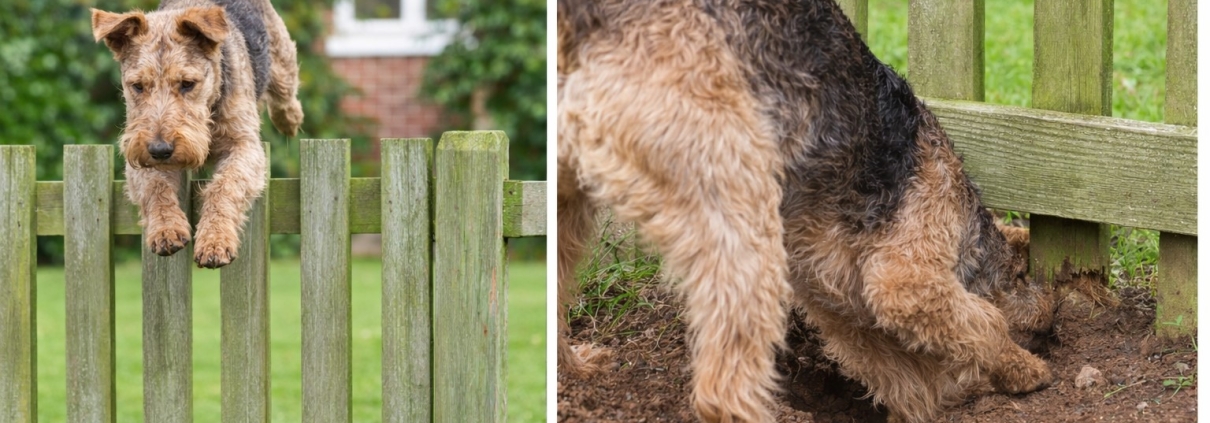
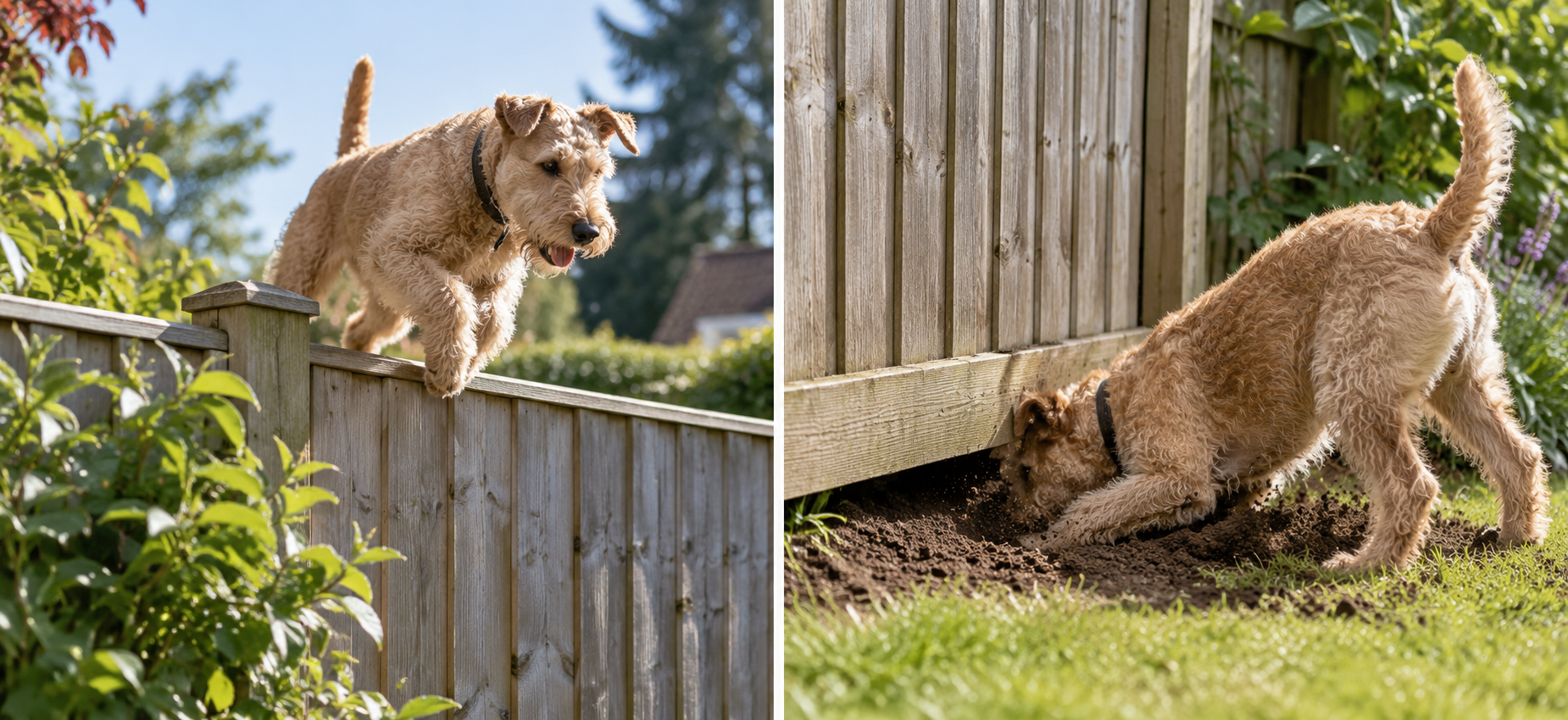
Some dogs squeeze through gaps. Some climb. Some dig.
And some become what owners quickly describe as an escape artist dog — turning an ordinary garden fence into a daily challenge.
If your dog keeps escaping — whether by jumping panels or tunnelling under the boundary — you’re not dealing with a “bad” dog. You’re dealing with instinct, motivation, and learned behaviour.
Understanding whether you have a jumper, a digger, or both is the first step in solving the problem safely and permanently.
The Escape Artist Dog Who Jumps: Why Fence Height Isn’t Always Enough
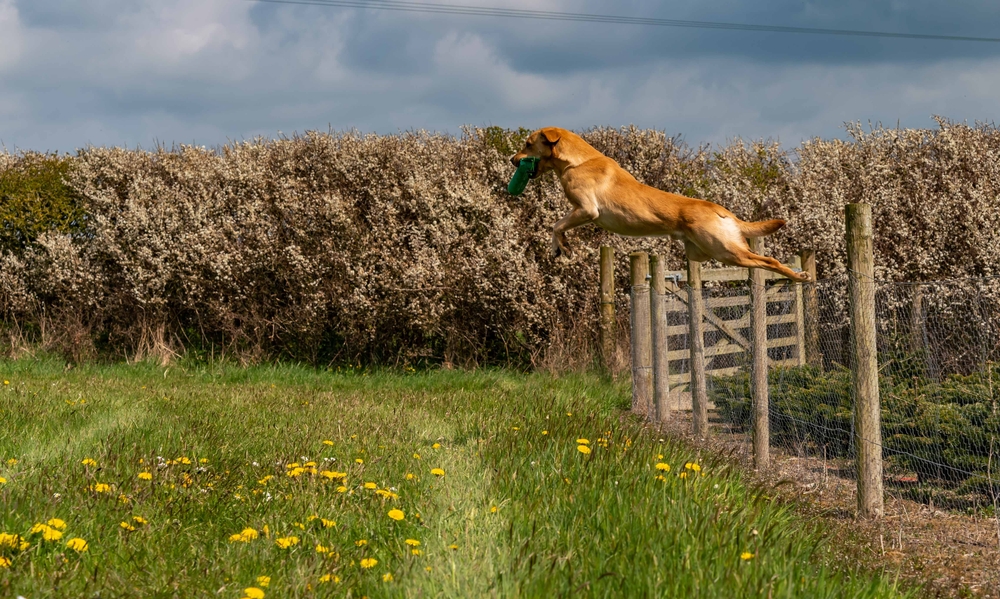
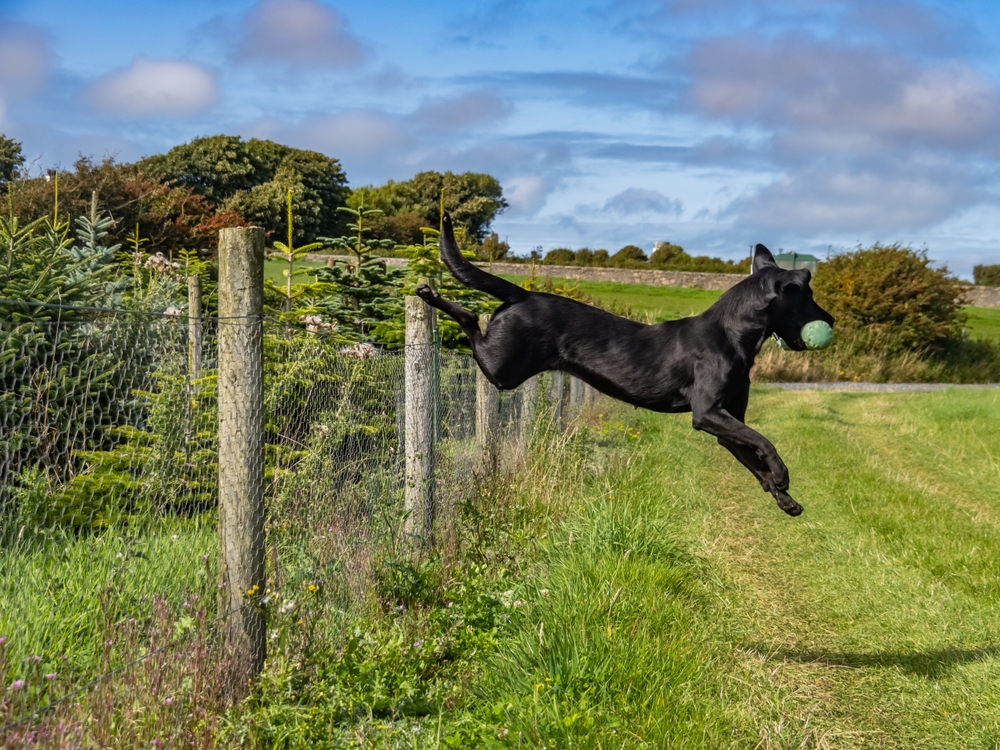
Athletic breeds — Labradors, Spaniels, Collies, Shepherds — are capable of clearing surprising heights when sufficiently motivated.
Prey drive, territorial behaviour, boredom, or separation anxiety can all trigger fence jumping.
Many owners assume:
“I’ll just make the fence higher.”
But height alone doesn’t guarantee containment.
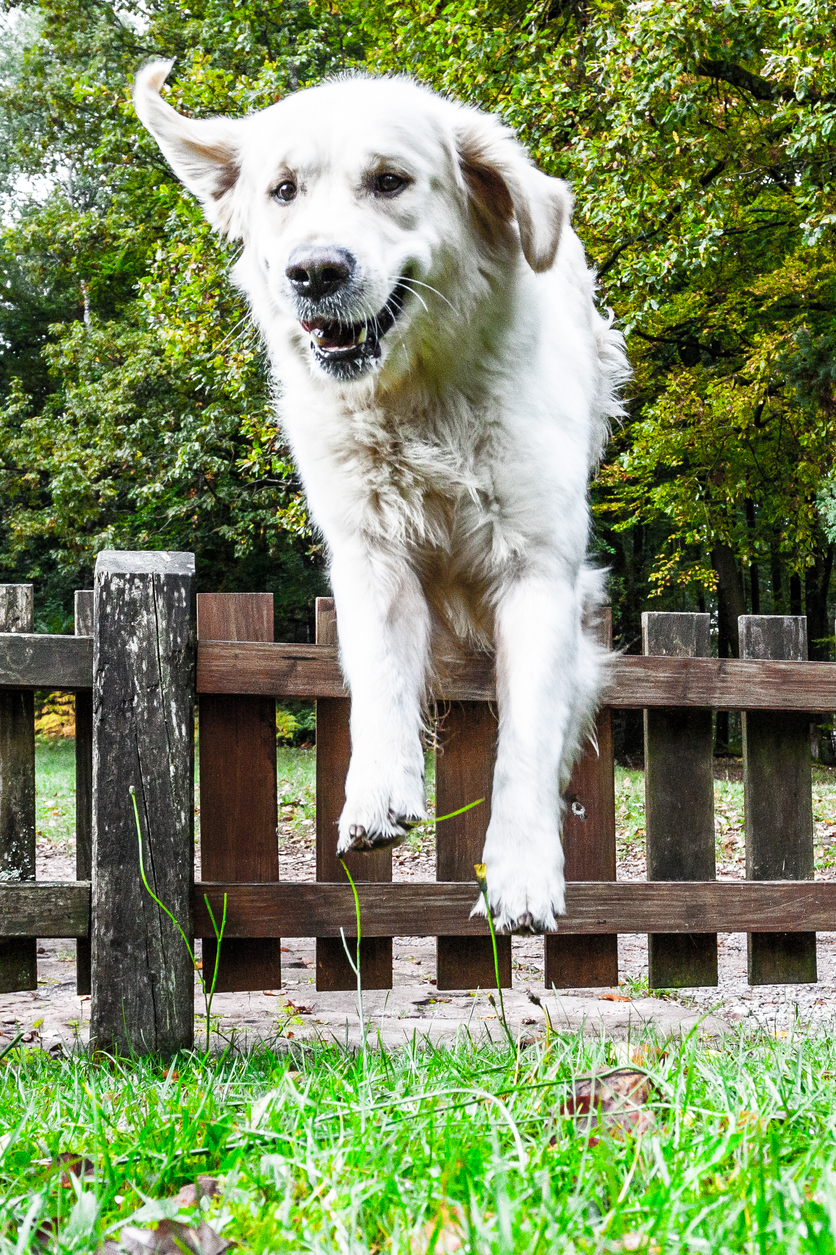
In fact, we regularly speak to owners whose dogs have cleared 6ft panels with ease.
In most UK homes, 6ft is considered the “safe” benchmark.
But can a determined dog jump a 6ft fence?
Yes — many can.
Large breeds can power-jump. Some dogs climb horizontal slats like ladders. Others use nearby objects for launch leverage.
If your dog has already cleared that height, increasing panels further may only delay the problem.
At that point, the issue is no longer about fencing — it’s about behavioural containment.
How to Stop Dog Jumping Fence Behaviour Safely
If you’re searching for ways to stop dog jumping fence behaviour, it’s important to look beyond height alone. Jumping is usually driven by motivation — whether that’s excitement, prey drive, or anxiety.
Raising panels may help temporarily, but long-term solutions focus on reducing the reward of escape and creating a clear boundary your dog understands and respects. Many owners searching for ways to stop dog jumping fence behaviour focus on height alone, but without addressing motivation, the problem often repeats.
The Escape Artist Dog Who Digs: Why Reinforcement Alone Fails
Digging is instinctive.
Terriers were bred to tunnel. Spaniels follow scent. Huskies dig for temperature regulation.
But when digging focuses along the boundary line, it usually means one thing:
Your dog is trying to get out.
Owners often respond by:
Filling the hole
Laying slabs
Burying wire mesh
Adding gravel boards
Sometimes that works temporarily.
Often, the digging simply moves sideways. Digging behaviour is often linked to scent tracking and prey drive, as explained by the RSPCA’s guidance on understanding dog behaviour.
How to Stop Dog Digging Under Fence Repeatedly
When owners try to stop dog digging under fence attempts, they often reinforce the same area repeatedly. But determined dogs simply shift location.
Effective prevention combines structural reinforcement with behavioural clarity — so the dog no longer sees the boundary as an opportunity to escape. If your dog is repeatedly tunnelling under panels, our step-by-step guide on See our boundary protection advice explains practical prevention methods as well as when reinforcement alone is unlikely to succeed
Why Traditional Fencing Fails an Escape Artist Dog
Most garden fencing systems are built for privacy — not determined containment.
Digging along the boundary usually indicates an attempt to escape, often driven by scent, boredom, anxiety, or prey drive.
What is the most reliable way to stop a dog escaping the garden?
Long-term solutions combine clear boundary communication with consistent containment, rather than relying solely on physical barriers.
Conclusion
Many owners repairing panels eventually realise they’re not dealing with faulty fencing — they’re living with an escape artist dog. And solving that requires behavioural clarity, not just stronger timber.
About the Author
Sam Chapman has worked in professional pet containment since 2003 and is part of one of the UK’s longest-established electronic boundary specialists. With over two decades of experience and thousands of installations across England, DogFence systems focus on safety, training clarity, and long-term containment rather than temporary fixes.
Escape Artist Dog? Let’s Stop the Jumping & Digging — For Good.
Get expert help creating a secure garden boundary with a proven pet containment system and calm, structured training.
https://dogfence.co.uk/wp-content/uploads/2025/12/Escaping-Lakeland-Terrier-in-action.jpg10241536Sam Folleyhttps://www.dogfence.co.uk/wp-content/uploads/2015/10/dogfences_logo_main_cats_orange2.pngSam Folley2026-03-27 07:00:152026-03-03 09:21:44Escape Artist Dog: How to Stop Jumping & Digging Under Fences
That heart-stopping moment when you realise the garden is silent, and your beloved dog is nowhere to be seen, is a fear every owner shares. While the promise of a DIY solution is appealing, it often comes with its own anxieties-from the confusion of tangled wires to a deep-seated concern for your pet’s comfort and safety. But what if you could achieve professional-grade security on your own terms? A correctly fitted self-install dog fence is more than just a boundary; it’s a gateway to true freedom for your dog and absolute peace of mind for you.
In this complete 2026 guide, we will expertly navigate you through the entire process. You will discover how to select the right system for your unique garden layout, correctly lay the boundary wire, and implement the gentle training that ensures your dog happily learns their new limits. Prepare to transform your garden into a secure, invisible haven that preserves its beauty while giving your cherished companion the safe, off-leash happiness they deserve.
Key Takeaways
Understand the core technology of a hidden fence to provide your dog with “freedom within boundaries” while keeping your landscape pristine.
Learn to evaluate essential kit components, from heavy-duty wire suited to the British weather to a receiver collar matched to your dog’s specific needs.
Follow our expert guide to correctly map and install your self-install dog fence, ensuring a secure boundary by avoiding common issues like signal cancellation.
Recognise why the quality of the signal technology is non-negotiable for guaranteeing your pet’s safety and your own peace of mind.
What is a Self-Install Dog Fence and Is It Right for Your Property?
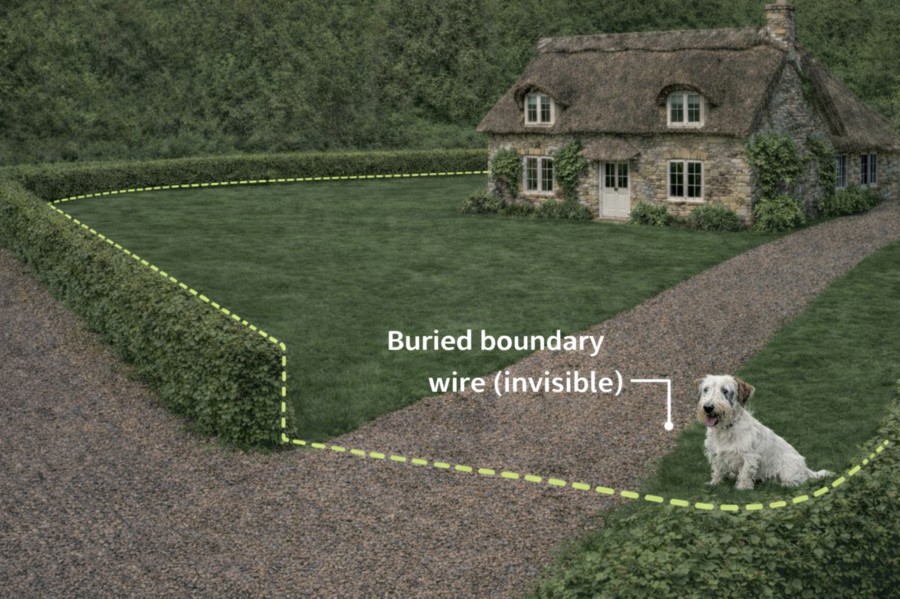
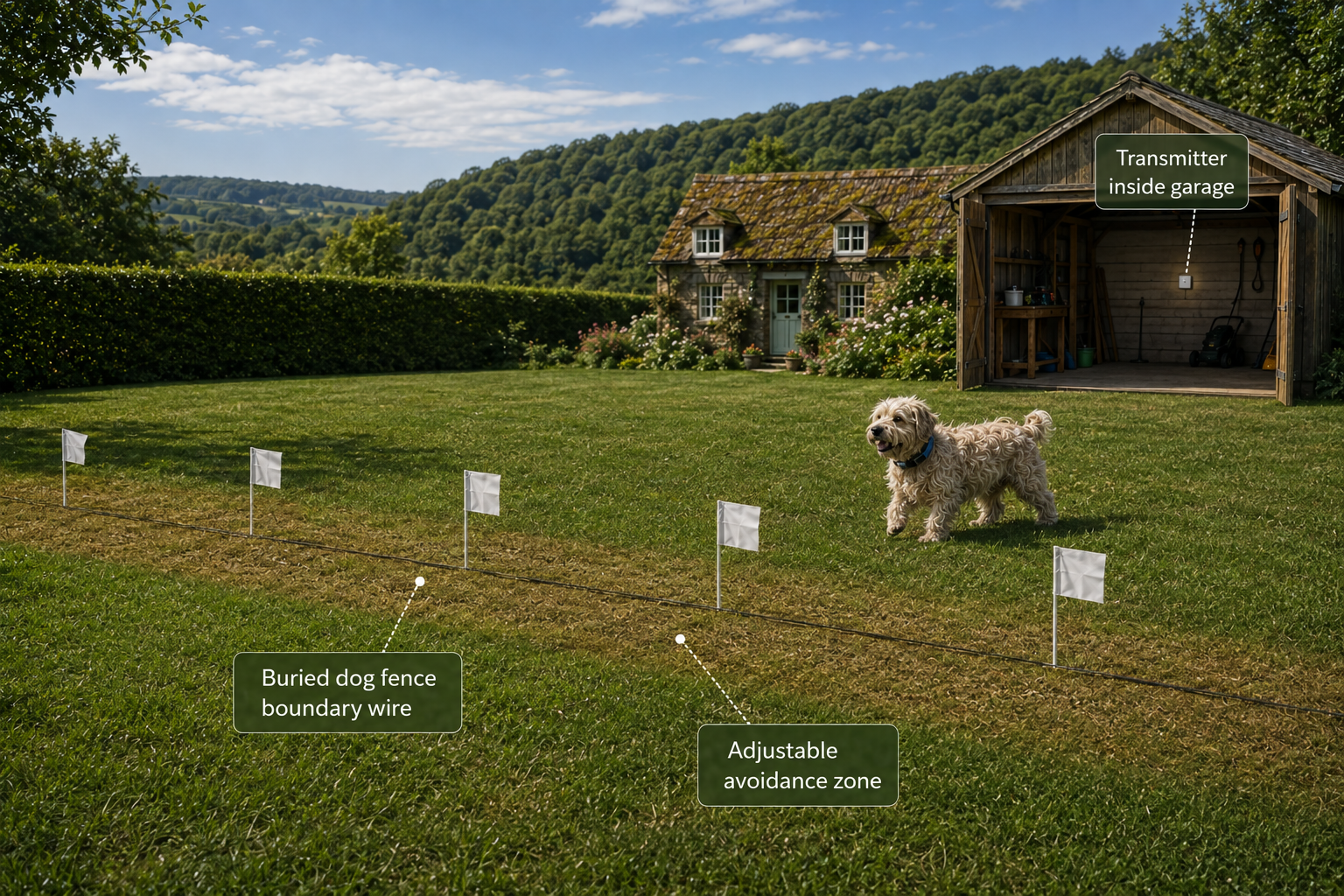
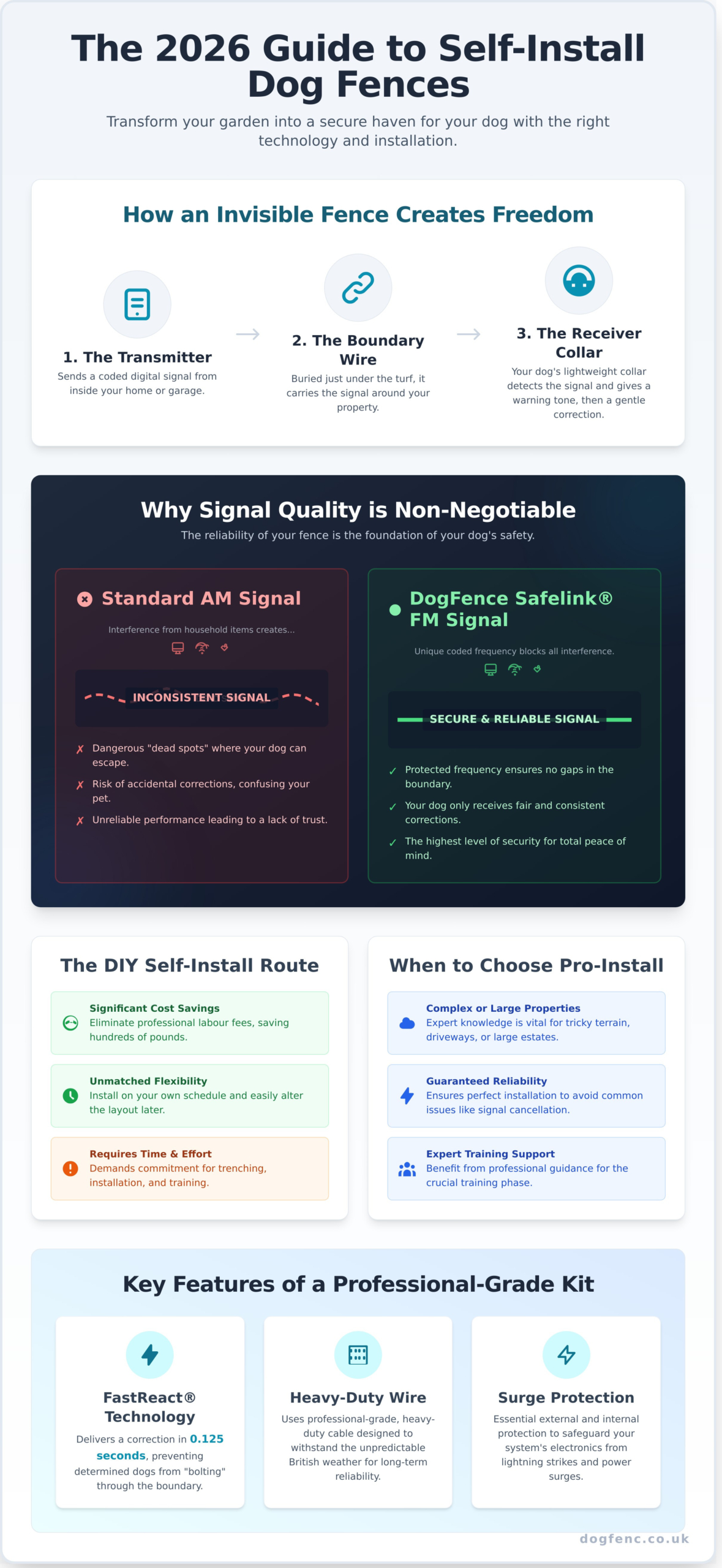
For many UK homeowners, providing a safe space for their beloved dog to roam is a top priority. A hidden dog fence, often known as one of several types of electronic pet containment systems, offers an elegant solution. The system is comprised of three core components: a boundary wire buried just beneath the turf, a transmitter that sends a harmless digital signal through the wire, and a lightweight receiver collar worn by your dog. Together, they create an invisible boundary, giving your pet the ultimate gift: freedom within safe limits, all without spoiling your garden views with traditional fencing.
The primary decision you face is whether to opt for a self-install dog fence or a professional installation. The DIY route offers considerable cost savings by eliminating labour fees, but it demands a significant commitment of your time for trenching, installation, and training. This choice often depends on your property. A simple, flat lawn in a suburban garden may be manageable for a competent DIYer. However, larger estates, properties with complex terrain, or those crossing driveways and pathways present challenges that require expert knowledge to ensure the system’s reliability and your pet’s safety.
Why Homeowners Choose the DIY Route
The appeal of a DIY installation is understandable. The most significant factor is cost-effectiveness, as you can save several hundred pounds on professional labour while often using the same high-quality hardware. This route also offers unmatched flexibility, allowing you to easily expand or alter the boundary if you redesign your garden or add an extension. Furthermore, many owners find that personally managing the training process creates a powerful bonding experience, strengthening the trust and communication between them and their dog.
The “Hidden” Advantages of Invisible Fencing
Regardless of the installation method, the benefits of an invisible fence provide unparalleled peace of mind. These systems offer distinct advantages over traditional barriers:
Aesthetic Preservation: Your home’s kerb appeal and beautiful landscape views remain completely unobstructed. There are no unsightly timber panels or metal railings to maintain or peer through.
Unfailing Reliability: A physical gate can be left open by a visitor, a delivery driver, or even the wind, creating a serious safety risk. A hidden fence is always active, providing a constant and reliable boundary.
Complete Versatility: The boundary wire can be routed to protect specific areas within your property. You can easily section off flowerbeds, vegetable patches, ponds, or driveways, keeping your dog safe and your garden pristine.
The Technology: Why Signal Quality is Non-Negotiable
At the heart of any hidden dog fence is a simple yet elegant concept: a transmitter sends a coded radio signal through a boundary wire, and a lightweight receiver collar worn by your dog detects it. However, the reliability of this technology is what truly separates a professional system from a standard self-install dog fence kit. The quality of that signal is the foundation of your dog’s safety and your peace of mind.
Many budget systems rely on a basic AM radio signal, which is highly susceptible to interference from common household electronics like televisions, dimmer switches, and garage door openers. This can lead to dangerous “dead spots” in the boundary or, far worse, accidental corrections that can confuse and frighten your beloved pet. A professional system, in contrast, utilizes a superior, coded FM signal to create a secure and completely reliable boundary.
For dogs that might test the boundary with a quick dash, our industry-leading FastReact® technology ensures the correction is delivered in just 0.125 seconds. This rapid response time is critical for preventing determined dogs from “bolting” through the line, safely reinforcing the boundary without fail.
FM Safelink vs. Standard Digital Signals
Our exclusive DogWatch system uses Safelink®, a patented FM digital signal that provides the highest level of security. This unique, protected frequency ensures that your system will not be affected by stray radio signals from your neighbour’s WiFi or electric gates. The safety benefit is profound: your dog will only ever receive a correction when they are actually approaching the hidden boundary. This reliability is paramount, as ensuring a system is fair and consistent is a key consideration within the UK government guidance on electronic collars, which distinguishes between containment systems and remote training devices.
Lightning and Surge Protection
Given the UK’s unpredictable weather, robust protection against power surges is not a luxury-it’s a necessity. A nearby lightning strike can send a powerful electrical surge along the underground boundary wire, potentially damaging the transmitter and your home’s internal wiring. Our professional installation includes comprehensive lightning and surge protection to safeguard your investment and your home. A professional-grade surge protector diverts excess voltage into the ground before it can reach your transmitter. This vital component, often overlooked in a basic self-install dog fence, offers an essential layer of security for your entire property.
Choosing the Best Self-Install Dog Fence Kit for 2026
Once you’ve decided to take the DIY route, selecting the right equipment is the most critical step towards ensuring your pet’s safety and your own peace of mind. Not all kits are created equal, and the quality of the components directly impacts the system’s reliability and longevity. For a self-install dog fence to be successful, especially in the UK, you must look beyond the price tag and evaluate the core technology.
Key factors to consider include:
Wire Grade: The UK’s damp soil can degrade inferior wiring quickly, leading to breaks and signal loss. It is essential to choose a kit with heavy-duty, direct-burial grade boundary wire designed to withstand moisture and ground movement for years of uninterrupted performance.
Collar Sizing & Correction: A one-size-fits-all approach is not safe for pets. The receiver collar must be appropriate for your dog’s weight, size, and temperament. Properly matching the correction level is a critical step in mitigating the potential welfare risks of electronic fences, ensuring the system serves as a gentle guide, not a source of distress.
Battery Life: While rechargeable collars may seem convenient, they often require daily charging and can fail unexpectedly, leaving your pet unprotected. A long-life battery, lasting up to 2 years, offers far greater security and consistency.
System Capacity: Your transmitter is the heart of the fence. Ensure it has the power to energise your entire boundary, whether it’s a small urban garden or a multi-acre paddock, without any weak spots in the signal.
The 1200Fence System: The Gold Standard for DIY
For those seeking professional-grade results from a self-install dog fence, the 1200Fence System is the definitive choice. It features a user-friendly transmitter that allows for precise customisation, including the ability to narrow the “warning zone” width-an invaluable feature for smaller properties. Crucially, it comes with a comprehensive warranty and access to a UK-based helpline, providing expert guidance whenever you need it.
Collar Options: R12 vs. R12m
The 1200Fence system is compatible with our market-leading receiver collars, ensuring a perfect fit for any pet. The R12 is a robust, durable option for medium to large dogs, with multiple intensity levels to suit their individual temperament. For smaller dogs, toy breeds, and even cats, the lightweight R12m offers a discreet and comfortable fit for all-day wear. Both models are fully waterproof, ready for any puddle, pond, or downpour the British weather can deliver.
Step-by-Step Installation and Training Guide
Embarking on a self-install dog fence project requires careful planning and patience. The ultimate goal is not just to lay a wire, but to create a safe, reliable boundary that your dog understands and respects. Success hinges on two distinct phases: the physical installation and, most importantly, the compassionate training that follows.
Before you break ground, map your boundary meticulously. Plan a continuous loop starting and ending at your transmitter. To create protected ‘islands’ within your garden, such as flowerbeds or a swimming pool, run the wire out to the area and loop around it, then twist the outgoing and returning wires tightly together. This twisting cancels the signal, allowing your dog to cross the twisted pair without receiving a correction. This same principle prevents signal cancellation where the main loop wires run parallel to each other.
Laying the Wire and Crossing Driveways
The physical installation is the most labour-intensive part. For lawns, use a garden edger or spade to create a shallow trench, typically 1 to 3 inches deep, to bury and protect the boundary wire. When encountering hard surfaces like a tarmac or concrete driveway, look for a natural expansion joint. You can often tuck the wire securely into this gap and seal it with a suitable, weatherproof sealant, avoiding the need for cutting into the surface and ensuring the wire remains protected from vehicle traffic.
The Art of Dog Fence Training
The flags are the most critical component of your kit; they provide the essential visual cue your dog needs to learn their new limits. The training process should be positive, patient, and consistent. Before ever putting the collar on your dog, test the system with the provided test light tool to confirm the boundary is active. Once confirmed, you can begin the gentle introduction process, which is fundamental to achieving freedom for your pet and peace of mind for you.
Step 1: Introduction to the Flags. With the collar in ‘audible only’ mode, walk your leashed dog around the inside of the boundary. As you approach the flags and the collar beeps, use a gentle command like “back” or “leave it” and guide them away from the boundary. Reward them with praise and treats when they retreat.
Step 2: Teaching the Retreat. Continue these short, positive sessions over a few days. Your dog will quickly associate the sight of the flags and the sound of the beep with the need to turn back into the safe zone. This builds their understanding without causing fear or anxiety.
Step 3: Supervised Freedom. Once your dog reliably retreats from the boundary upon hearing the audible warning, you can begin supervised off-lead time. Remain in the garden with them, ready to offer praise and reinforce the training, ensuring they fully comprehend their new-found freedom.
While a DIY installation can be rewarding, the precision required for both the layout and the training can be demanding. For a guaranteed safe and effective result tailored to your dog’s unique temperament, consider our professional installation and training service.
Why DogFence Ltd is Your Partner in Pet Safety
Choosing the right containment solution is a significant decision for any pet owner. With over 20 years of dedicated experience in the UK pet containment market, DogFence Ltd understands that your ultimate goal is peace of mind. Whether you opt for a professional installation or a DIY approach, our commitment to your pet’s safety and freedom remains the same. This is why we’ve engineered our systems to bridge the gap between DIY and professional-grade quality.
Unlike standard off-the-shelf options, our Self-Install Kits feature the very same core technology, transmitters, and collars used by our expert installers. This means you receive a professional-grade hidden fence, backed by our unparalleled, long-term support. From ensuring you have a steady supply of DogWatch Batteries to providing technical call-outs if needed, we are with you for the lifetime of your pet. Our British-based team of experts is always ready to help, ensuring your beloved dog can enjoy their garden safely.
Professional Support for the DIYer
When you choose a DogFence Ltd self-install dog fence, you are never alone. We provide the robust support network you need to install and maintain your system with complete confidence. This includes:
Expert Guidance: Direct access to our UK-based helpline for troubleshooting everything from wire breaks to training hurdles.
System Longevity: A full inventory of accessories, including Replacement Collar Straps and expansion kits for larger properties or additional pets.
Unmatched Quality: A lifetime equipment warranty on our premium transmitters, a testament to the durability and reliability built into every system we offer.
Final Checklist Before You Buy
To ensure our system is the perfect fit for your family, we encourage you to consider a few final points. This responsible approach guarantees the best outcome for you and your dog.
Canine Health & Age: Our systems are designed for the safety of dogs aged 6 months and older. Please confirm your dog is in good health and ready for training.
Long-Term Value: When reviewing the Invisible Dog Fence Cost UK, consider the lasting value of a reliable, professional-grade system and lifetime support versus the potential pitfalls of inferior alternatives.
Ready to give your dog the freedom they deserve with the security you need? Explore our ProFence 1200 DIY Kit today and discover the DogFence Ltd difference.
Secure Your Garden, Unleash Their Happiness
Choosing the right self-install dog fence is a significant step towards ensuring your pet’s safety while granting them precious freedom. This guide has shown that success hinges on two key factors: selecting a system with superior signal technology to prevent false activations, and committing to the step-by-step installation and training process. When these elements are in place, you create a secure, invisible boundary that protects your beloved companion without compromising the beauty of your property.
At DogFence, we bring over 20 years of UK pet safety experience directly to you. Our professional-grade kits, featuring the exclusive DogWatch FM technology, are designed for ultimate reliability and are backed by a lifetime equipment warranty. We are your trusted partner in creating a safe haven for your dog. Take the first step towards a safer, happier life for your pet today.
Frequently Asked Questions About Dog Fence Installation
Can I really install a dog fence myself on a large property?
While it is possible, installing a fence on a large property-typically over an acre-is a significant physical undertaking. The process involves laying and often burying hundreds of metres of boundary wire, which can be strenuous and time-consuming without specialised equipment. A professional installation ensures the wire is laid correctly and efficiently, guaranteeing a consistent signal and robust boundary for your pet’s safety, giving you complete peace of mind without the intensive labour.
Is a self-install dog fence safe for small breeds or puppies?
Safety for smaller pets is a primary concern. Many DIY kits use a one-size-fits-all approach, with collars that can be too heavy or bulky for small breeds or young puppies. The key to safety is a lightweight, correctly fitted collar and a meticulously calibrated stimulation level. Professional systems offer a range of collars and expert setup, ensuring the experience is gentle and appropriate for your pet’s specific size and temperament, avoiding unnecessary distress.
What happens if the boundary wire gets broken during gardening?
A break in the boundary wire will cause the system to deactivate, leaving your pet unprotected. Your transmitter will usually sound an alarm to alert you to the fault. With a DIY kit, you must then locate the break along the perimeter and splice it yourself, which can be a difficult task. Our professional-grade, heavy-duty wire is far more resilient, and in the rare event of a break, our technicians can locate and repair it swiftly.
Do I need to bury the wire, or can it sit on top of the ground?
For maximum safety and system longevity, the boundary wire should always be buried. Leaving it on the surface creates a significant trip hazard and exposes it to damage from lawnmowers, garden tools, and even wildlife. Burying the wire just a few centimetres underground protects the system’s integrity and preserves the aesthetic of your garden, providing a truly invisible and reliable containment solution that you can depend on for years to come.
How long does it take to train a dog to use a self-install fence?
With consistent daily sessions, most dogs can learn their new boundaries within one to two weeks. The success of the training is highly dependent on using the correct, positive reinforcement techniques. Rushing the process or using improper methods can cause fear and confusion. Our professional installation includes a proven, humane training protocol delivered by an expert, ensuring your dog understands and respects the boundary happily and without anxiety.
Will the fence work if I have a very stubborn or high-prey-drive dog?
This is where professional-grade systems demonstrate their true value. While a basic DIY system may not provide a sufficient deterrent for a determined dog, our systems feature patented FM digital signals that cannot be outrun and have multiple, adjustable correction levels. We can customise the system and training to match your dog’s specific temperament, ensuring the boundary is always respected, even with the highest prey drive or most stubborn personality.
Can I use one system for both my dog and my cat?
Yes, it is possible to contain both dogs and cats on the same system, but it requires specialised equipment. Most standard DIY kits are unsuitable for felines. Our professional systems are designed to be versatile, offering a range of lightweight receiver collars specifically engineered for cats. Each pet’s collar is programmed for their individual size and temperament, ensuring safe, reliable, and humane containment for all your beloved animals on a single boundary.
What is the typical battery life for a self-install receiver collar?
The battery life in DIY receiver collars can be inconsistent, often ranging from just one to three months. This variability requires frequent checking and can create a potential safety gap if a battery fails unexpectedly. In contrast, our professional-grade receiver collars are engineered for superior reliability and efficiency. They feature a typical battery life of up to two years, providing long-term, dependable protection and greater peace of mind for you.
https://dogfence.co.uk/wp-content/uploads/2026/03/Self-Install-Dog-Fence-UK-The-Complete-Guide-to-DIY-Pet-Containment-2026-Hero-Image.jpg7681344Sam Folleyhttps://www.dogfence.co.uk/wp-content/uploads/2015/10/dogfences_logo_main_cats_orange2.pngSam Folley2026-03-04 13:00:002026-03-30 14:08:33Self-Install Dog Fence UK: The Complete Guide to DIY Pet Containment (2026)
How High Should a Fence Be to Stop a Dog Jumping? (UK Guide)
How high should a fence be to stop a dog jumping? In most UK homes, a fence needs to be at least 6ft high to stop an average adult dog jumping over it — but breed, motivation, and garden layout all influence the correct fence height for dogs.
If your dog is jumping over the fence, simply increasing the height may not be enough. Choosing the right fence height for dogs must go hand in hand with understanding why your dog is attempting to escape in the first place.
For broader guidance on training, boundary reinforcement and long-term prevention learn exactly how high a fence should be for a dog based on size, breed, and athletic ability.
How high should a fence be to stop a dog jumping?
In most UK homes, a fence needs to be at least 6ft (1.8 metres) high to prevent an average adult dog from jumping over it. However, athletic breeds, strong prey drive, sloping ground or nearby launch points may require fencing higher than 6ft or an alternative containment solution
For most medium to large breeds:
4ft fencing – suitable only for small, low-energy dogs
5ft fencing – may stop many dogs, but not athletic breeds
6ft fencing – generally recommended minimum for larger or active dogs
Over 6ft fencing – required for highly motivated or athletic escape artists
For many owners asking how high should a fence be to stop a dog jumping, 6ft is the realistic starting point — particularly for working or high-drive breeds. If you’re unsure whether 6ft is actually enough for your dog, read our guide on can a dog jump a 6ft fence? to understand the real risks.
What Is the Best Fence Height for Labrador and Other Large Breeds?
The best fence height for Labrador types and similar large breeds is typically 6ft or higher.
Labradors, Border Collies, Spaniels and other athletic breeds can clear surprising heights when sufficiently motivated. If your dog is repeatedly jumping over fence panels, the issue may be both physical ability and environmental trigger.
Creating a secure garden for large dogs often requires more than just increasing panel height.
Why Is My Dog Jumping Over the Fence?
If you are researching how high should a fence be to stop a dog jumping, your dog may already be testing boundaries.
Some athletic or highly driven dogs can clear 6ft when chasing wildlife or reacting to external triggers. If the motivation remains strong, simply increasing fence height may not permanently prevent dog jumping over fence panels.
Is There an Alternative to Increasing Fence Height?
When introduced with structured training, most dogs quickly understand their boundary and stop attempting to jump altogether.
Final Answer: How High Should a Fence Be to Stop a Dog Jumping?
So, how high should a fence be to stop a dog jumping?
For most medium to large breeds, 6ft is the recommended minimum. However, true containment depends on motivation, environment, and consistent boundary clarity — not just height.
Small dogs: 4–5ft may be sufficient
Medium dogs: minimum 5–6ft
Large or athletic breeds: 6ft+ recommended
Highly motivated escape artists: height alone may not be enough
At DogFence, we regularly see cases where increasing fence height alone doesn’t resolve escape behaviour. When a clear perimeter is introduced and properly trained, jumping behaviour often settles — even in athletic or highly motivated dogs.
If you’d like tailored advice on creating a secure garden for large dogs, speak to our team for a free, no-obligation assessment.
Is Your Dog Jumping the Fence?
If increasing fence height isn’t stopping your dog jumping, we can help you create a properly secure boundary tailored to your property and your dog’s temperament.
https://dogfence.co.uk/wp-content/uploads/2026/02/large-dog-testing-garden-fence-height.jpg1255836Sam Folleyhttps://www.dogfence.co.uk/wp-content/uploads/2015/10/dogfences_logo_main_cats_orange2.pngSam Folley2026-02-19 14:38:282026-03-02 12:02:35How High Should a Fence Be to Stop a Dog Jumping? (UK Guide)
How to Stop Dog Escaping When in Season (UK Guide)
Stop dog escaping when in season early, and you can prevent a stressful and potentially dangerous situation for both you and your dog.
When a dog in season is trying to escape — or when a male dog is escaping because a nearby female is in heat — behaviour can change dramatically and very quickly. Even normally calm, well-trained dogs can become persistent, focused, and surprisingly determined.
Understanding why this happens — and how to secure your garden properly — is key to preventing dog running away during heat.
For broader guidance on preventing escape behaviour in all situations, read our complete guide on how to stop a dog running away, which explains how training, boundary security and containment work together.
Why Do Dogs Try to Escape When in Season?
To stop dog escaping when in season, it helps to understand the biological drive behind it.
Female dogs release powerful pheromones during their heat cycle. These scents can travel significant distances, especially in rural or open areas. Male dogs may detect them from streets away and begin searching for the source.
This can lead to:
Persistent fence-line pacing
Digging under boundaries
Jumping or climbing panels
Squeezing through weak points
Increased vocalisation or agitation
A dog in season trying to escape is not being disobedient — they are responding to instinct.
The Blue Cross provides helpful guidance on understanding the heat cycle and behaviour changes during this time</a>.
How Long Does a Dog Stay in Season?
A typical heat cycle lasts around 2–3 weeks.
However, heightened escape behaviour often peaks during the most fertile stage, which usually occurs around days 10–14.
If you are trying to stop dog escaping when in season, it’s important to increase supervision and security for the entire cycle — not just when symptoms first appear.
How to Stop Dog Escaping When in Season
Preventing dog running away during heat requires temporary management combined with secure containment.
1. Supervise Outdoor Time
Never leave a dog in season unattended in the garden.
Even a secure boundary can be tested repeatedly during this period.
Supervised outdoor access dramatically reduces the risk of escape.
If you live in a rural or semi-rural area, you may notice male dog escaping when female in season behaviour nearby as well.
Neighbouring dogs may attempt to enter your property, which is why simply “keeping her in” is sometimes not enough.
Creating a truly secure garden for dog in season situations means considering both outbound and inbound risk.
If broader roaming is becoming an issue, read our complete guide on how to stop your dog running away.
4. Increase Mental Stimulation Indoors
During peak fertility days, limiting unsupervised garden time and increasing indoor enrichment can help:
Scent games
Puzzle feeders
Short training sessions
Calm structured interaction
Reducing frustration reduces escape attempts.
Will Neutering Stop Dog Escaping When in Season?
Neutering male dogs may reduce hormone-driven roaming behaviour, but it does not eliminate instinct entirely.
Female dogs in season will still attract attention, and unneutered males may remain highly motivated.
If seasonal escape attempts are persistent, long-term boundary clarity becomes essential.
What If Fencing Isn’t Enough?
Traditional fencing can struggle during seasonal escape behaviour.
Digging, climbing, squeezing and repeated testing can escalate quickly when instinct overrides training.
If you are trying to stop dog escaping when in season on a larger property, driveway boundary, or post-and-rail setup, you may need a more consistent perimeter solution.
Hormone-driven roaming is just one escape trigger — our article on why dogs escape gardens explores the full range of behavioural causes.
A professionally installed electronic dog fence system can secure the full boundary — including hedges, open driveways, and uneven terrain — without altering the appearance of your garden.
When paired with structured training, most dogs quickly understand their limits, even during hormonally heightened periods.
When Should You Be Concerned?
Take action immediately if:
Your dog has already escaped once during a season
You live near a road
Livestock or public footpaths are nearby
Male dogs are gathering outside your boundary
Seasonal escape attempts can escalate rapidly.
Stopping dog escaping when in season early prevents the behaviour becoming learned and repeated in future cycles.
Final Thoughts: Secure Containment During Heat Cycles
To stop dog escaping when in season safely and responsibly, you must combine supervision, management, and reliable containment.
At DogFence, we’ve worked with countless rural and semi-rural UK properties where traditional fencing alone wasn’t enough during heat cycles. When the full boundary is clearly defined and properly introduced, escape attempts typically settle quickly — even during hormonally heightened periods.
If you’d like tailored advice on creating a secure garden for dog in season situations, our team can assess your property and recommend the most appropriate containment solution.
Worried About Your Dog Escaping During a Season?
If your dog is in season — or reacting to one nearby — we can help you secure your garden properly and prevent escape attempts before they happen.
https://dogfence.co.uk/wp-content/uploads/2026/02/Dog-in-Season-at-Garden-Boundary-scaled.jpg25601441Sam Folleyhttps://www.dogfence.co.uk/wp-content/uploads/2015/10/dogfences_logo_main_cats_orange2.pngSam Folley2026-02-19 14:28:042026-03-02 12:05:08Stop Dog Escaping When in Season (UK Guide for Secure Gardens)
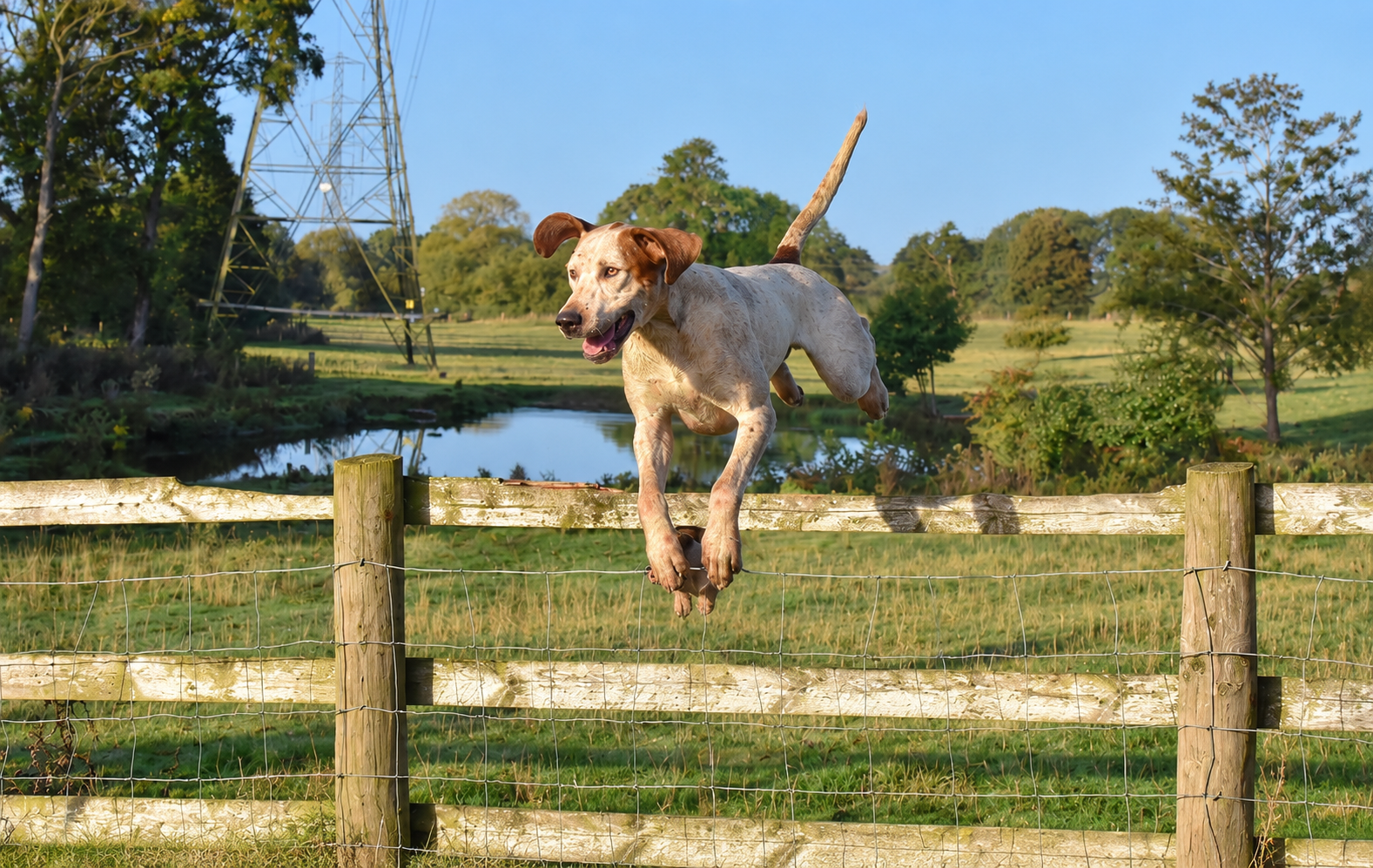
Can a dog jump a 6ft fence? Yes — many dogs can jump or climb a 6ft fence if they are sufficiently motivated.
While 6ft fencing is often recommended as a minimum height for medium and large breeds, it does not guarantee containment. Athletic ability, adrenaline, instinct and environmental triggers all play a role. If you’re trying to prevent dog jumping over fence panels, understanding your dog’s ability and motivation is crucial.
People often assume only large breeds can clear 6ft. In reality, smaller dogs can be just as capable — especially if they climb rather than leap.
Breeds commonly capable of jumping or scaling fencing include:
Border Collies
Labradors
German Shepherds
Huskies
Lurchers
Jack Russells
Spaniels
Motivation matters more than size.
Dogs may jump higher when:
Chasing wildlife
Reacting to other dogs
Escaping boredom
Experiencing separation anxiety
Responding to hormonal drives
If you’re considering fence height more generally, see our guide on how high should a fence be to stop a dog jumping.
A Real Example: When 6ft Wasn’t Enough
We were once asked to visit a neighbour of an existing customer who needed help with two small Jack Russell Terriers.
Their half-acre garden was completely surrounded by a 6ft chain link fence — and to make matters worse, an extension had been added to increase the height even further.
On paper, it looked escape-proof.
In reality, it wasn’t.
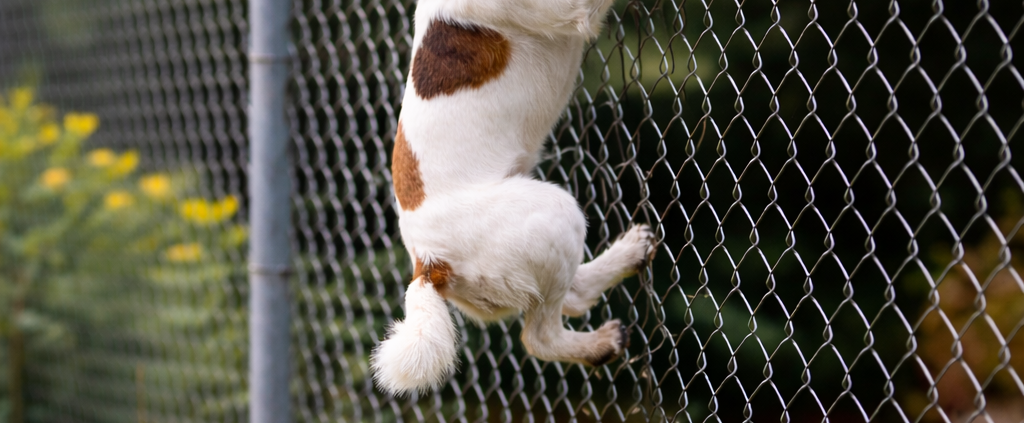
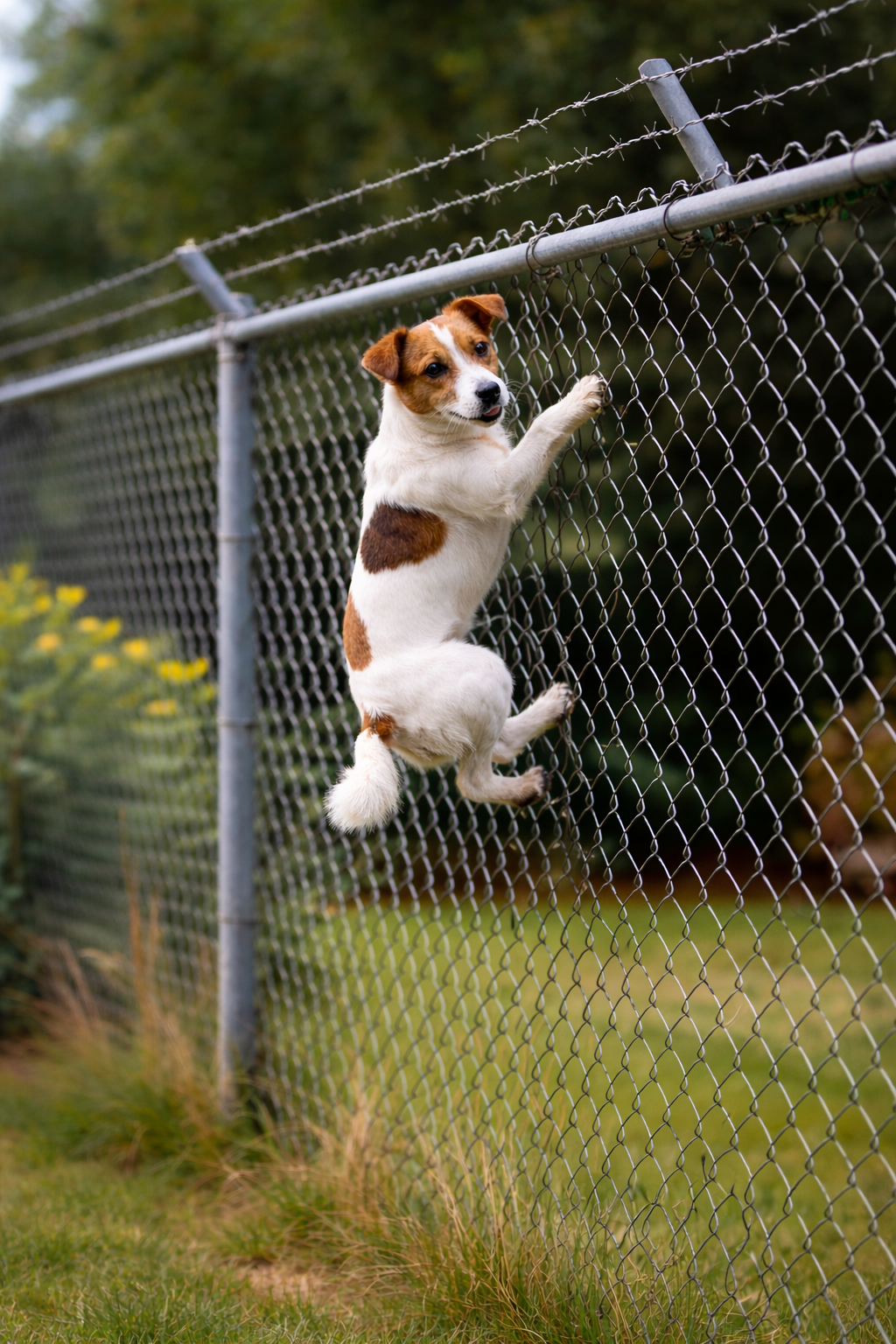
The owner described how, the moment the back door opened, one of the Jack Russell’s would sprint out at lightning speed, scale the chain link and be over the top within seconds. It wasn’t jumping — it was climbing.
Fortunately, his wife would often be waiting on the other side to catch the dog. But the couple were unable to let their dogs out into their own garden unless they were attached to tie-outs.
The solution wasn’t to keep raising the fence.
After installing a professionally designed electronic dog fence system and completing structured boundary training, both dogs were safely enjoying freedom within a week.
Several months later, the owner joked that “the Berlin Wall came down” — the extended fencing was removed entirely.
Height hadn’t been the real issue.
Clarity of boundary had been.
AI-generated illustration showing how a dog can jump a 6ft fence — even small breeds like Jack Russells can scale chain-link fencing when highly motivated.
Why 6ft Fence for Dogs Isn’t Always Enough
Simply increasing fence height doesn’t always prevent dog jumping over fence panels if the dog is highly motivated or able to climb. Even if a dog cannot leap 6ft vertically, they may:
Climb chain link fencing
Use horizontal rails as ladders
Launch from raised ground
Push off furniture or bins
This means the effective fence height may be lower than expected.
Physical height alone does not address the motivation to leave.
How to Prevent Dog Jumping Over a 6ft Fence
To prevent dog jumping over fence panels:
Remove climb points
Increase supervision
Address behavioural triggers
Reinforce recall
Consider inward extensions
However, when escape behaviour is driven by strong motivation, simply increasing fence height may not permanently solve the problem. If you’re trying to determine the safest boundary height for your property, read our guide on ways to reduce fence escapes for practical UK recommendations.
Rather than relying purely on vertical barriers, the system teaches the dog exactly where the perimeter lies. Once understood, most dogs stop testing physical fencing altogether.
Can a dog jump a 6ft fence? Yes — many breeds can climb or clear 6ft fencing. In fact, dog jumping over garden fence panels is more common than many owners realise, especially with athletic or determined breeds. If you’re trying to prevent dog jumping over fence boundaries, understanding how and why dogs escape is essential.
While 6ft fencing is a strong starting point, true containment depends on behaviour, environment and boundary clarity — not height alone.
If you’d like advice tailored to your property and breed, speak to our team for a free assessment.
Is Your 6ft Fence Still Not Enough?
If your dog is jumping, climbing or clearing a 6ft fence, simply making it higher may not solve the problem. True containment comes from clear boundary training — not just panel height.
Our professionally installed electronic dog fence systems provide reliable, discreet containment for escape artists of all sizes — from determined Jack Russell’s to athletic working breeds.
https://dogfence.co.uk/wp-content/uploads/2026/02/Jack-Russell-Climbing-a-6ft-Chain-Link-Fence.png15361024Sam Folleyhttps://www.dogfence.co.uk/wp-content/uploads/2015/10/dogfences_logo_main_cats_orange2.pngSam Folley2026-02-19 14:16:322026-03-02 19:04:30Can a Dog Jump a 6ft Fence? (UK Guide)
How to Stop a Dog Squeezing Through a Gate (UK Guide)
Stop dog squeezing through gate behaviour early, and you can prevent a full escape before it becomes a habit.
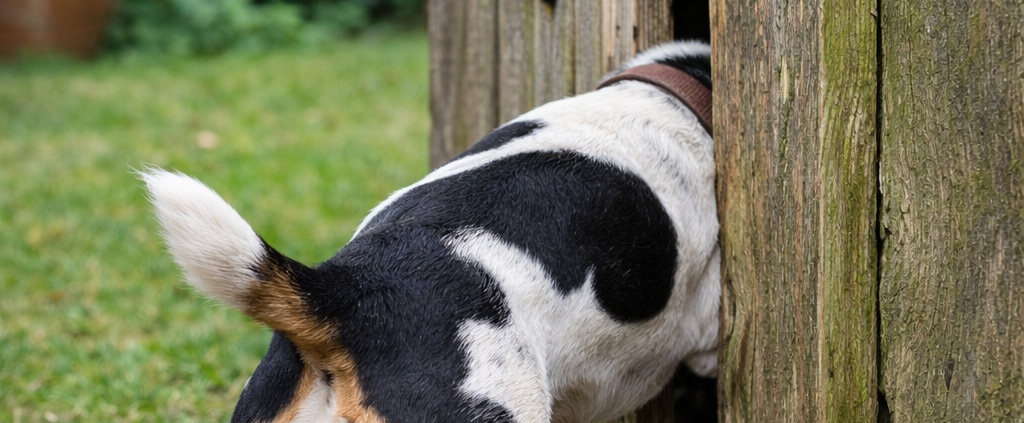
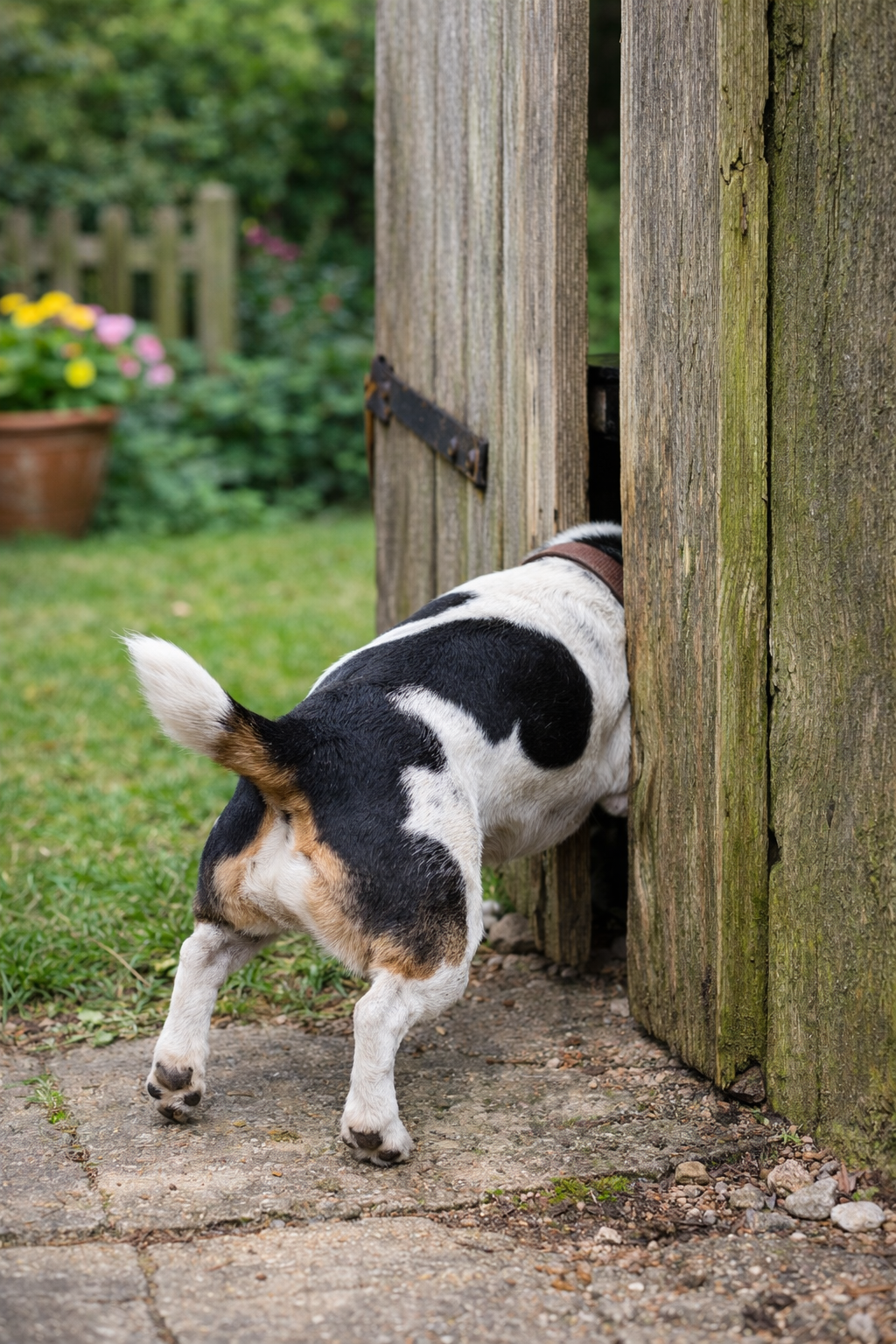
If your dog is escaping through a gate gap or fitting through a small gap in the fence, the issue is rarely obedience — it’s opportunity. Many UK garden gates leave small gaps at the sides, base, or hinge area that a determined dog can exploit.
When trying to stop dog squeezing through gate gaps, both motivation and physical weakness must be addressed.
If you’re dealing with repeated escape attempts, our complete guide on how to stop a dog running away explains how behaviour, boundary security and consistent training work together to prevent it long term
Why Is My Dog Squeezing Through the Gate?
If you need to stop dog squeezing through gate gaps, first consider what is driving the behaviour.
Common triggers include:
Wildlife or livestock beyond the boundary
Other dogs nearby
Boredom or excess energy
Separation anxiety
Seasonal behaviour
Once a dog succeeds at escaping through gate gap weaknesses, the behaviour quickly becomes reinforced.
Final Thoughts: Securing Gate Weak Points Properly
To stop dog squeezing through gate vulnerabilities permanently, you must remove both the opportunity and the motivation.
Small gaps often seem harmless — until a dog proves otherwise.
At DogFence, we frequently work with properties where driveway gates and rural boundaries leave hidden weak points. When a clear perimeter is properly introduced, escape attempts typically settle — even in determined dogs.
If you’d like tailored advice on securing your driveway gate for dogs, contact our team for a free assessment.
Is Your Dog Squeezing Through a Gate Gap?
If blocking small gaps isn’t stopping your dog escaping, we can help you create a properly secure boundary — including driveways, gates and weak points — tailored to your property.
Dog proof fencing for rural properties requires more than standard garden panels — countryside environments present unique escape risks that demand stronger, smarter solutions.
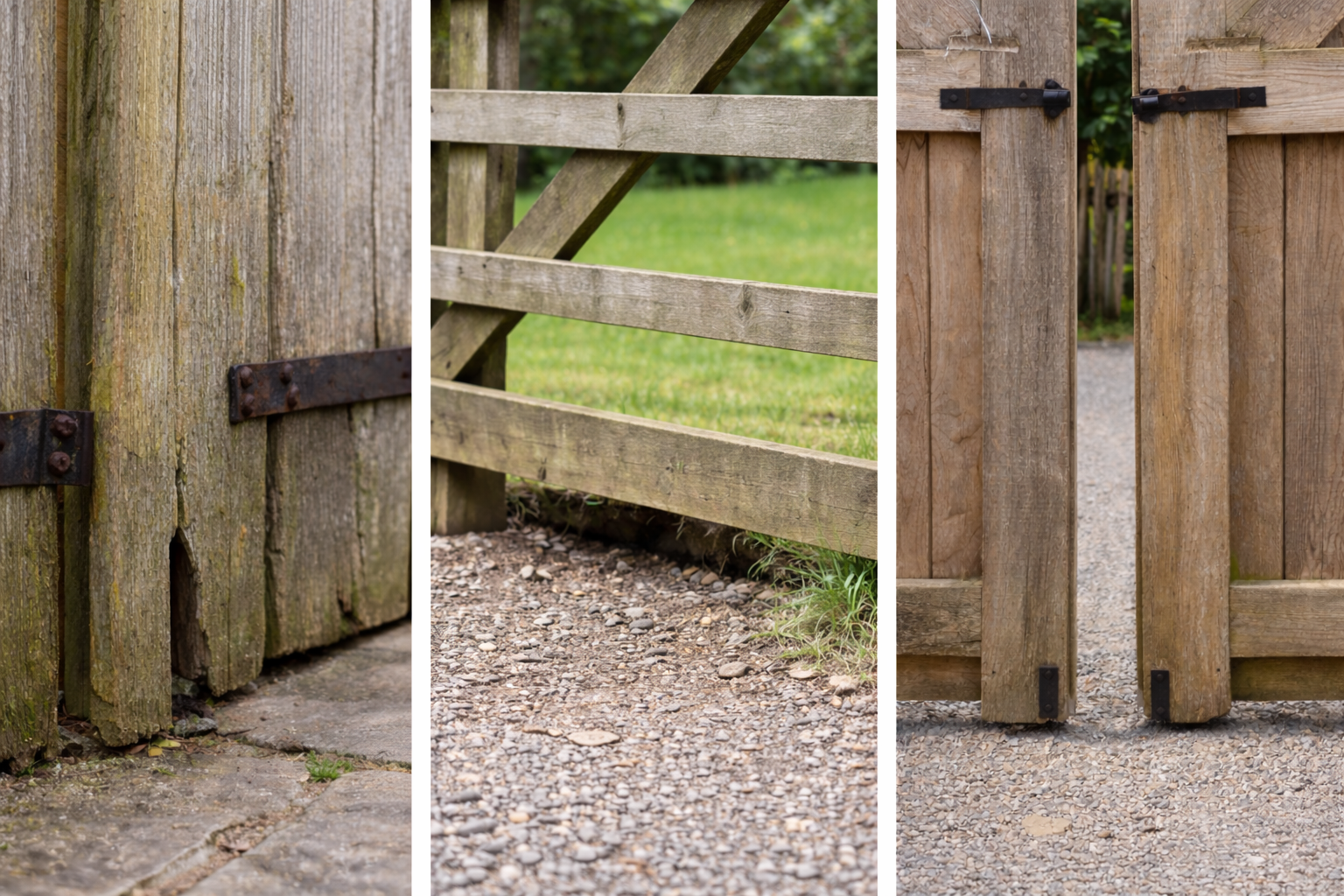
Unlike suburban gardens, rural homes often have post-and-rail fencing, five bar gates, livestock boundaries and long driveways. These features look beautiful — but they can create gaps, weak points and climb opportunities for determined dogs.
Wildlife Damage: The Hidden Weak Point in Rural Fencing
In rural settings, dog proof fencing for rural properties must also account for wildlife.
Badgers, foxes and deer frequently push through or damage wire fencing, especially along field boundaries and hedgerows. Over time, this creates gaps, lifted sections or weakened posts — often unnoticed until a dog finds them.
Even well-maintained rural fencing can deteriorate quickly when wildlife regularly passes through it. A small opening created overnight can become a reliable escape route for a determined dog.
This is particularly common with:
Stock fencing and wire mesh
Post-and-rail boundaries with wire backing
Hedge lines with hidden gaps
Sloping ground where soil shifts beneath fencing
In countryside properties, fencing isn’t static — it is constantly tested by both wildlife and weather.
Wildlife regularly damages stock and wire fencing in rural areas, often creating hidden gaps that become escape routes for dogs.
Post and Rail Dog Containment Challenges
Post and rail fencing is common in the countryside but leaves large open sections underneath and between rails.
To improve secure rural fencing for dogs, owners often:
Add mesh infill
Install kickboards
Bury ground barriers
Increase height
However, reinforcing hundreds of metres of boundary can become expensive and visually intrusive.
If you’re unsure whether your current boundary is high enough, read our guide on can a dog jump a 6ft fence? to understand which breeds and situations pose the highest escape risk.
Five Bar Gate Dog Proofing Solutions
Five bar gates are a frequent weak point in rural dog escape prevention.
Common problems include:
Wide hinge gaps
Open bottoms
Uneven ground beneath gates
Temporary fixes may include:
Timber boards
Mesh panels
Automatic gate closers
But these do not always prevent highly motivated dogs from testing boundaries.
Driveways: The Most Overlooked Escape Route
Long gravel driveways and open entrances are one of the biggest rural containment challenges.
Dog proof fencing for rural properties must account for:
Vehicles entering and exiting
Gates left open
Deliveries
Visitors unfamiliar with gate routines
For many countryside homes, fully enclosing long driveways is impractical. In these situations, a professionally installed electronic dog fence offers a practical alternative. Instead of relying on physical barriers, the containment boundary can be laid discreetly across open driveway entrances, wide gateways and even irregular ground. This means your dog remains safely contained — even when gates are open for deliveries or vehicles — without altering the appearance of your property or installing intrusive fencing across large rural spaces.
Effective dog proof fencing for rural properties requires:
Structural reinforcement
Behaviour understanding
Clear perimeter definition
At DogFence, we’ve worked with rural homes across England for over two decades. When the full perimeter is clearly defined and properly introduced, escape attempts typically settle — even in high-drive breeds.
If you’d like tailored advice on rural dog containment solutions, contact our team for a free, no-obligation assessment.
Need Dog Proof Fencing for a Rural Property?
If you have post-and-rail fencing, five bar gates or open driveways, we can help you create secure rural fencing for dogs without altering the appearance of your countryside home.
Our professionally installed electronic dog fence systems cover open areas, long driveways and uneven ground — giving you reliable rural dog containment and complete peace of mind.
Stop dog digging under fence behaviour quickly and it can save you from a much bigger escape problem later.
Dog digging under a garden fence — a common cause of escape in UK homes.
If your dog has started tunnelling along the boundary, it’s rarely random. In most cases, digging at the fence line means your dog is trying to get out. What begins as one small hole can quickly turn into repeated attempts at escaping under the fence — especially once they realise it works.
Before you can prevent dog digging out for good, you need to understand what’s driving it. If you’re unsure what motivates escape behaviour, read our guide on How Do I Stop My Dog Running Away (for good)here.
Whether your dog is digging along the fence to get out or has already managed to escape once, the real solution begins with understanding what’s driving the behaviour.
For many UK owners — particularly those with larger or rural properties — creating a truly secure garden for digging dog breeds requires more than just filling in the hole.
Why Is My Dog Digging Under the Fence?
When you need to stop dog digging under fence behaviour, the first step is identifying the motivation.
Fence-line digging almost always has a purpose.
Digging to Escape the Garden
If your dog is consistently digging along the boundary, this is classic dog digging to escape garden behaviour.
Common triggers include:
Wildlife beyond the fence (deer, rabbits, squirrels)
Livestock in neighbouring fields
Other dogs nearby
Public footpaths
Separation anxiety (the RSPCA offers helpful guidance on recognising and managing anxiety-related behaviours).
Once a dog succeeds at escaping under a fence, the behaviour becomes reinforced. Freedom becomes the reward.
Breed Instinct (Terriers & Working Dogs)
Some breeds are naturally wired to dig.
Terriers, for example, were bred to hunt prey underground. For these dogs, digging isn’t disobedience — it’s instinct.
A dog attempting to dig under a garden fence — a common early sign of escape-driven behaviour.
If you have a determined digging breed, standard fencing alone may not be enough to prevent dog digging out long term.
Digging to Stay Cool in Summer
In warmer weather, some dogs dig shallow pits to lie in cooler soil.
These holes are usually:
Away from the boundary
In shaded areas
Not tunnel-shaped
If your goal is to stop dog digging under fence, but the holes are central in the garden, temperature may be the real cause.
Boredom and Excess Energy
Young, intelligent or high-drive dogs may dig simply because it’s stimulating.
Without:
Structured walks
Mental enrichment
Training interaction
Scent work
Digging becomes self-rewarding entertainment.
However, boredom digging rarely focuses repeatedly on the fence line — persistent boundary digging usually indicates escape motivation.
How to Stop Dog Digging Under Fence
Now let’s look at practical ways to prevent dog digging out and restore control of your boundary.
Increase Exercise and Mental Stimulation
A tired dog is far less motivated to test boundaries.
Consider:
Daily structured walks (not just garden access)
Short training sessions
Puzzle feeders
Rotating toys
Scent games
This helps reduce boredom-driven digging but may not fully stop dog digging under fence if escape is the primary motivation.
Improve Shade and Cooling Options
If your dog is digging to regulate temperature:
Provide shaded shelter
Ensure constant fresh water
Use a heavy-duty paddling pool
Avoid inflatable pools (easily punctured)
When comfort improves, digging often reduces.
Reinforce the Base of Your Fence
Traditional methods to prevent dog digging out include:
Burying chicken wire
Installing gravel boards
Digging trench footings
L-shaped underground barriers
These approaches can work in smaller gardens. However, in larger rural properties, reinforcing every metre of boundary can be costly and disruptive.
Some determined dogs will simply move along the fence line until they find a weaker point. Before investing in higher panels or reinforcements, it’s important to understand why dogs escape gardens — because escape behaviour is usually driven by motivation, not just opportunity.
Address Hormonal or Seasonal Escape Behaviour
Male dogs may become highly motivated to dig if they detect a nearby female in season. Female dogs may also attempt to leave the garden during this period.
While neutering may reduce some drive, it is not a guaranteed way to stop dog digging under fence behaviour if the underlying motivation remains strong.
During these periods, creating a truly secure garden for digging dog breeds becomes especially important.
Will Burying Wire or Concrete Stop a Dog Escaping Under Fence Panels?
Sometimes — but not always.
If the desire to leave the property remains strong, dogs may continue testing different sections.
Blocking one hole may simply shift the problem further down the boundary.
To genuinely stop dog digging under fence, the reward for escaping must disappear.
The Most Reliable Way to Stop Dog Escaping Under Fence
When digging is driven by escape motivation, behaviour usually changes when the dog clearly understands where the boundary lies.
A professionally installed pet containment system creates a consistent perimeter around the entire property — including weak points, hedges, gates and uneven ground.
When introduced with calm, structured training, most dogs quickly learn the boundary and stop attempting to dig under it.
For properties with:
Post-and-rail fencing
Hedge boundaries
Large rural perimeters
Sloping or uneven terrain
This approach often provides more reliable long-term prevention than repeated physical reinforcement alone.
When Should You Be Concerned?
If your dog has already succeeded in escaping under fence panels once, the risk increases significantly.
Escaping dogs face:
Road traffic
Livestock incidents
Getting lost
Legal liability
Fence-line digging is often an early warning sign that your current setup is not secure enough.
Final Thoughts: How to Stop Dog Digging Under Fence for Good
To stop dog digging under fence permanently, you must address both:
The reason your dog wants to leave
The weakness in the boundary
Digging is communication.
Your dog may be saying:
I’m bored
I’m anxious
I’m too hot
I want what’s on the other side
When you understand the motivation and secure the full perimeter — not just the hole — most dogs stop trying to escape.
And your garden — and peace of mind — can finally recover. If you’re looking for broader guidance on how to stop a dog running away, see our complete guide here.
Over the past two decades, we’ve seen that when the full boundary is clearly defined and properly introduced, digging behaviour almost always settles. Rather than constantly repairing panels or burying wire, a professionally installed containment system can addresses the root cause — removing the reward for escape and restoring safety to the entire property.
Tired of Repairing Fence Holes?
If your dog keeps digging under the fence, let’s secure your boundary properly and stop escape attempts for good.
https://dogfence.co.uk/wp-content/uploads/2018/10/husky-escape.jpg501808Sam Folleyhttps://www.dogfence.co.uk/wp-content/uploads/2015/10/dogfences_logo_main_cats_orange2.pngSam Folley2026-02-19 12:57:482026-03-02 12:10:46How to Stop Dog Digging Under Fence (UK Guide)
Why Dogs Escape Gardens (And How to Stop a Dog Running Away)
If you’re wondering why dogs escape gardens, you’re not alone. Every week we speak to owners whose dog escaping garden behaviour has become stressful and dangerous. Understanding why dogs escape gardens is the first step in learning how to stop a dog running away safely and permanently. Creating a secure garden for dogs starts with understanding why dogs escape gardens in the first place.
Dogs escape gardens because of boredom, prey drive, anxiety, mating instincts, fear triggers, or weaknesses in fencing. When something outside the boundary feels more rewarding than staying inside, even a well-loved dog may attempt to leave.
If your dog keeps digging under panels, squeezing through gaps or testing the fence line, this guide explains:
Why dogs escape gardens
The most common escape routes
How to stop a dog running away
And how to create a truly secure garden for dogs
At DogFence, we’ve been helping owners across England by anwering the question of “How do I stop my dog running away?” since 2003. In almost every case, the solution starts with understanding motivation — not just building a higher fence.
Quick Summary: Why Dogs Escape Gardens
Dogs escape gardens mainly because of:
Boredom or lack of mental stimulation
Strong prey drive (wildlife, livestock, scents)
Separation anxiety
Fear triggers such as fireworks or loud noises
Mating instincts (especially unneutered dogs)
Weak fencing or poorly secured gates
Learned escape behaviour after a successful attempt
If your dog escaping garden behaviour has become a regular problem, identifying the trigger is essential. Stopping a dog running away requires both behaviour management and a secure boundary.
According to RSPCA advice on dog behaviour, dogs are naturally exploratory animals and will investigate sounds, scents and movement beyond their garden boundary.
Loose latches are responsible for many preventable escapes.
Install:
Self-closing hinges
Lockable latches
Double gate security in larger gardens
How to Stop a Dog Escaping and Running Away?
Stopping escape behaviour requires a layered approach:
Identify why your dog is escaping.
Remove weak points in fencing and gates.
Increase physical and mental stimulation.
Reinforce recall and boundary awareness training.
Establish a clear, consistent containment boundary.
When motivation to leave decreases and boundaries are reliable, most dogs stop testing escape routes.
Why Traditional Fencing Alone Often Fails
We regularly visit properties where thousands have been spent on timber fencing — yet the dog still escapes.
This happens because:
Dogs adapt their strategy (jumping becomes digging).
Anxiety overrides physical barriers.
Rural gardens are difficult to enclose completely.
Motivation outside the boundary is stronger than the barrier itself.
A fence creates a physical barrier. A trained boundary creates understanding.
That difference is critical.
The Three Essentials to Prevent Dog Escape Behaviour
1. Behaviour Training
Reinforce recall positively
Avoid chasing your dog
Reward calm behaviour outdoors
Practice boundary awareness
Training supports containment — but does not replace it.
2. Environmental Enrichment
Many escape attempts are boredom-driven.
Provide:
Structured play
Mental stimulation
Supervised garden time
Problem-solving activities
A mentally satisfied dog is less motivated to roam.
3. Secure Garden Boundaries
Effective garden security should include:
Adequate fence height
Anti-dig protection
Secure gates
Removal of climb aids
Clear perimeter definition
Creating a truly safe garden setup for your dog means combining strong physical boundaries with consistent behavioural training. A secure garden for dogs is not just about height — it’s about removing weak points and giving your dog a clear, understood perimeter.
However, even reinforced fencing can fail with determined escape artists.
If your dog repeatedly escapes despite stronger fencing, understanding how an electronic dog fence works can help you see how a defined boundary supports consistent training. Often referred to as “invisible dog fences,” these systems create a fixed perimeter without altering the appearance of your garden — ideal for both rural properties and urban spaces.
How to Stop a Dog Escaping Repeatedly
To stop a dog escaping repeatedly, combine secure fencing, structured recall training and consistent boundary reinforcement.
When a Professional Dog Fence Becomes the Safer Solution
If your dog repeatedly escapes despite improved fencing, a defined containment boundary may be the safest long-term solution.
A professionally installed electronic dog fence creates a consistent perimeter around your garden. Unlike GPS collars (which rely on signal strength and can drift), wired containment systems establish a fixed boundary line and support structured training.
DogFence systems:
Have operated in the UK since 2003
Have safely contained over 20,000 pets
Are DEFRA-tested
Include safety shut-off features
Are fully waterproof and durable
Include professional installation and owner training
If you’re concerned about your dog running away, for larger rural properties, installing a professionally fitted electronic dog fence in the UK can provide a clearly defined boundary without changing the look of your garden.
If you’re worried about how to stop dog running away behaviour before it leads to an accident, you can: 👉 Request a Free Quote Here
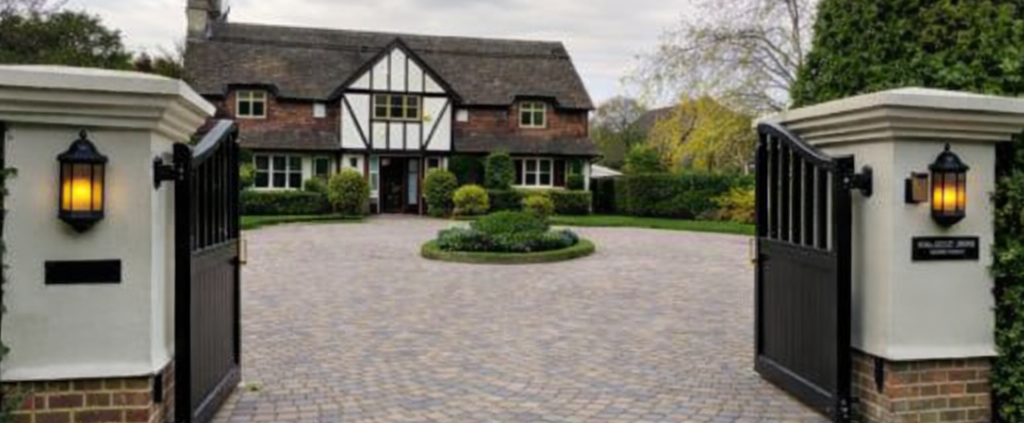
Clear, secure garden boundaries help dogs relax and reduce escape behaviour.
Do Dogs Escape Gardens More in Winter?
Yes — dog escape behaviour can increase during certain seasons.
Winter boredom, shorter daylight hours and anxiety triggers can increase escape attempts.
Spring and summer can also increase roaming behaviour due to scent and breeding activity.
Garden Security Checklist
If you want to prevent your dog running away, check:
Fence height suitable for your breed
No gaps under panels
Secure, self-closing gates
No climb aids near boundaries
Adequate daily stimulation
Consistent boundary reinforcement
Prevention requires regular inspection and proactive management.
Frequently Asked Questions
Why does my dog keep escaping the garden?
Dogs escape due to instinct, boredom, anxiety, or weak boundaries. Repeated success reinforces the behaviour, making it more likely to happen again.
How high should a fence be to stop a dog escaping?
6ft is a common minimum, though athletic breeds may require additional measures such as anti-climb extensions or boundary reinforcement.
Is an electronic dog fence safe?
Modern professionally installed containment systems include safety shut-off features and structured training protocols designed to prioritise pet welfare.
Why Dog Escaping Garden Behaviour Gets Worse Over Time
When a dog escaping garden attempt is successful, the behaviour becomes reinforced.
Each time your dog escapes:
Confidence increases
Boundaries feel weaker
The outside world becomes more rewarding
This is why learning how to stop a dog escaping early is critical. The longer escape behaviour continues, the harder it becomes to correct.
Preventing dog escaping garden behaviour requires consistency, supervision, and a clearly defined secure garden for dogs that removes opportunity altogether.
Final Thoughts:
Dogs escape gardens when something outside the boundary becomes more compelling than staying inside.
The solution isn’t simply a taller fence.
It’s:
Understanding motivation
Removing weak escape routes
Providing mental and physical fulfilment
Creating a reliable, clearly defined boundary
If your dog keeps escaping and you’re worried about roads, livestock, or neighbouring land, the DogFence team can help you create a secure outdoor space without compromising your garden’s appearance.
Because freedom should never come at the expense of safety.
Worried Your Dog Will Escape Again?
Don’t wait for a near miss with a road or livestock. Speak to the experts at DogFence about creating a secure, reliable boundary for your garden.
https://dogfence.co.uk/wp-content/uploads/2026/02/why-dogs-escape-gardens-uk-scaled.jpeg25601920Sam Folleyhttps://www.dogfence.co.uk/wp-content/uploads/2015/10/dogfences_logo_main_cats_orange2.pngSam Folley2026-02-19 11:06:292026-03-02 12:39:24Why Dogs Escape Gardens (And How to Stop a Dog Running Away)
A Valentine’s Day Tribute: Why Dogs are Truly Man’s Best Friend
This Valentine’s Day, while many are focused on roses and chocolates, let’s celebrate the most loyal relationship in history: the bond between humans and dogs. For over 15,000 years, dogs have been our protectors, workers, and most importantly, our family.
At DogFence Ltd, we specialise in electronic dog containment systems that allow your pet to enjoy the garden safely. We, believe the ultimate way to show your dog love is by balancing dog safety and freedom. In this tribute, we explore the history of “man’s best friend” and how we can repay their loyalty by upholding their fundamental rights through professional dog training and secure boundaries.
A History of Loyalty: From Wolves to Valentines
The connection between humans and dogs began in the Ice Age. From ancient Egyptian deities like Anubis to the working dogs of Medieval Britain, our history is intertwined.
Today, dogs have evolved from hunters to essential modern partners. Whether they are serving in the military or providing emotional support, their role as man’s best friend has never been more vital. To keep these modern heroes safe, our hidden fence technology ensures they stay within the safety of your home.
Extraordinary Ways Dogs Help Us
Medical Assistance: Dogs like Labradors and Golden Retrievers are trained to detect seizures or low blood sugar before they happen.
Police & Military Heroes: The Belgian Malinois, like Cairo of the Navy SEALs, provides bravery that saves human lives in high-risk zones.
Support for Independence:Guide Dogs UK empower the visually impaired to navigate busy streets like London or Manchester with total confidence.
Why “Man’s Best Friend” is More Than Just a Phrase
The title “man’s best friend” isn’t just a cliché; it is backed by the depth of their devotion.
Unconditional Love: A dog doesn’t care about your job title. This bond is proven to lower blood pressure and reduce human stress.
Emotional Intelligence: Dogs sense our grief and anxiety. A simple nuzzle or a wagging tail can provide more comfort than words.
The Gift of Presence: Dogs teach us to find joy in the “now,” whether it’s a walk in the park or playing in a securely fenced garden.
Protecting the “Five Freedoms” of Your Dog
As dog lovers, we must ensure our pets live by the Five Freedoms, the gold standard of animal welfare. This Valentine’s Day, consider how your home environment supports these:
Freedom from Hunger & Thirst: High-quality nutrition and constant fresh water.
Freedom from Discomfort: A warm bed and a secure environment.
Freedom from Pain & Disease: Regular vet checks and preventing accidents.
Freedom to Express Normal Behaviour: This is where dog safety and freedom intersect. Dogs need to run and sniff safely. Our DIY Dog Fence options or professionally installed systems make this possible.
Freedom from Fear: A predictable, secure routine.
Our electronic dog containment solutions help uphold the freedom to express normal behavior by providing a secure boundary.
A secure garden allows dogs to relax, play, and interact confidently with the people around them.
Electronic Dog Containment: Enhancing Freedom in the UK
Traditional fences can be unsightly or ineffective for “escape artists.” This is why many UK owners turn to electronic dog containment.
In 2018, DogFence Ltd was consulted by DEFRA regarding electronic fences. The conclusion recognised that, when combined with professional training, our FM Safelink systems save lives by preventing road accidents and livestock worrying.
Our invisible dog fencing UK solutions allow your dog to roam your entire garden—whether it’s a small patch or a sprawling estate—without the risk of them bolting into traffic.
Show Your Dog Love This Valentine’s Day
Valentine’s Day is the perfect time to upgrade your dog’s lifestyle. Give them the gift of the great outdoors without the worry of them wandering off.
Why Choose DogFence Ltd?
20+ Years of Experience: We are the UK’s trusted experts in pet containment.
Over 20,000 pets safely contained
DEFRA approved systems
Professional Training: We don’t just install; we teach your dog their boundaries humanely.
https://dogfence.co.uk/wp-content/uploads/2026/01/mans-best-friend-dog-rolling-in-grass.jpg8361254Sam Folleyhttps://www.dogfence.co.uk/wp-content/uploads/2015/10/dogfences_logo_main_cats_orange2.pngSam Folley2026-02-13 07:00:162026-03-02 12:48:44A Valentine’s Day Tribute: Celebrating the Mans’ Best Friend