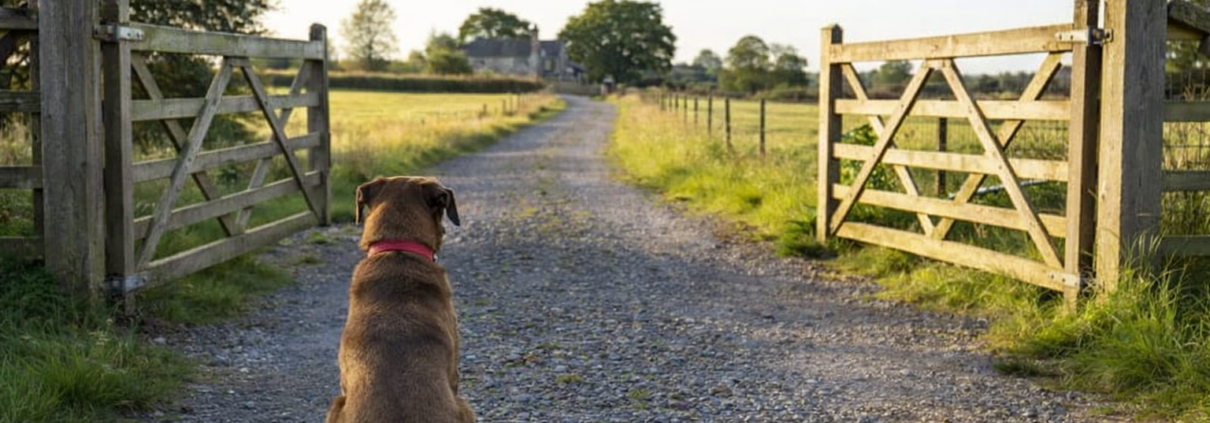
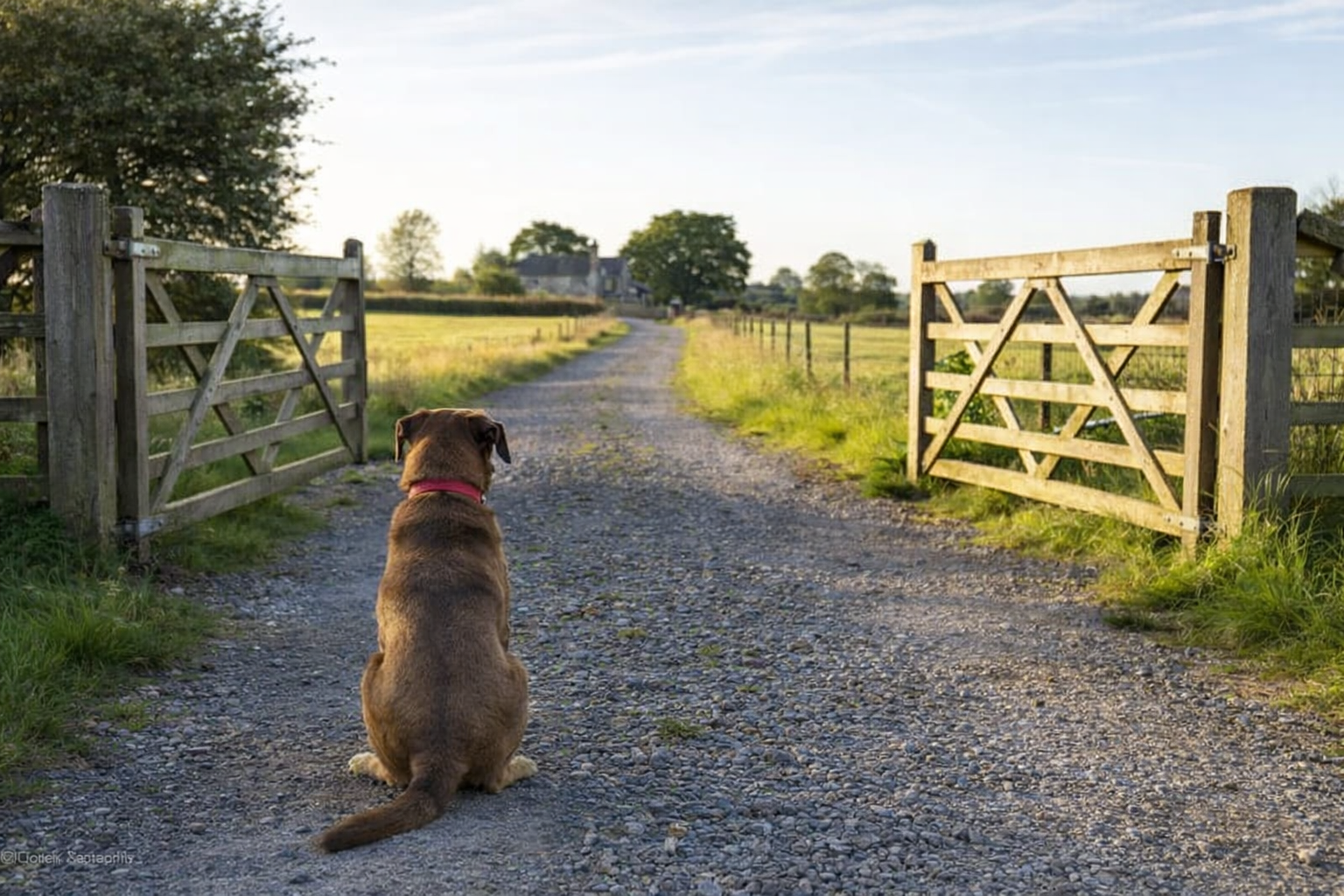
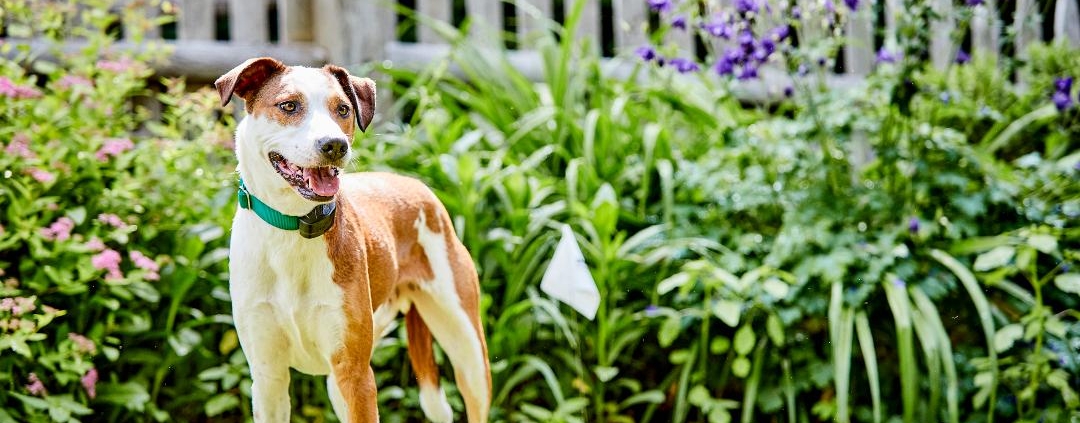
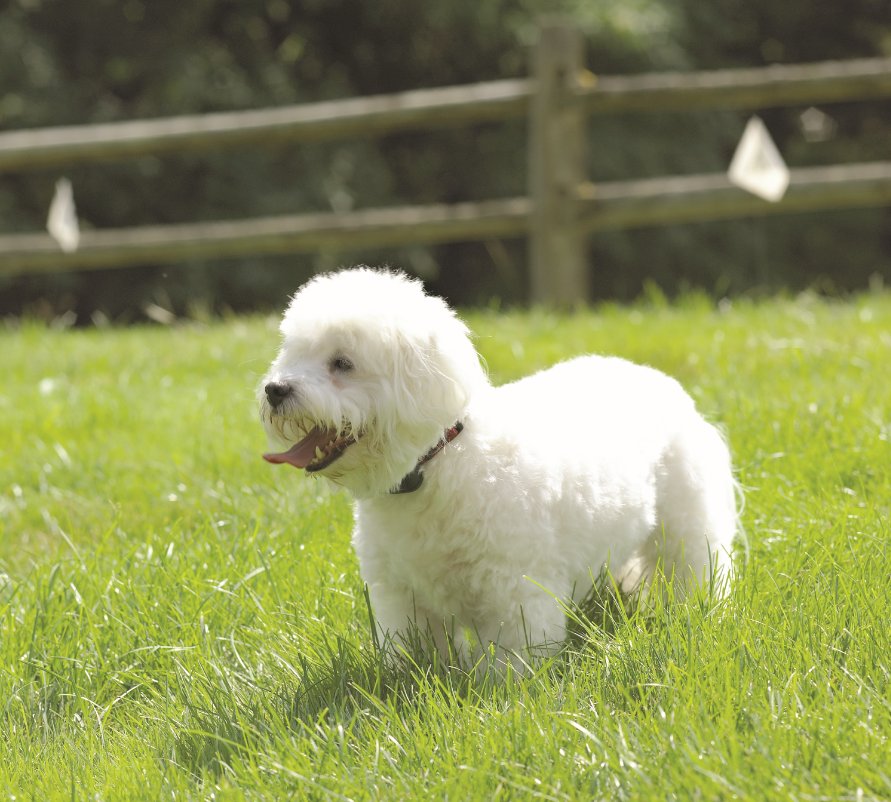
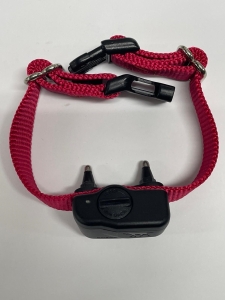
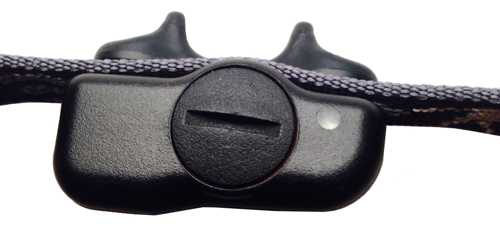
Dog proof fencing for rural properties requires more than standard garden panels — countryside environments present unique escape risks that demand stronger, smarter solutions.
Unlike suburban gardens, rural homes often have post-and-rail fencing, five bar gates, livestock boundaries and long driveways. These features look beautiful — but they can create gaps, weak points and climb opportunities for determined dogs.
Wildlife Damage: The Hidden Weak Point in Rural Fencing
In rural settings, dog proof fencing for rural properties must also account for wildlife.
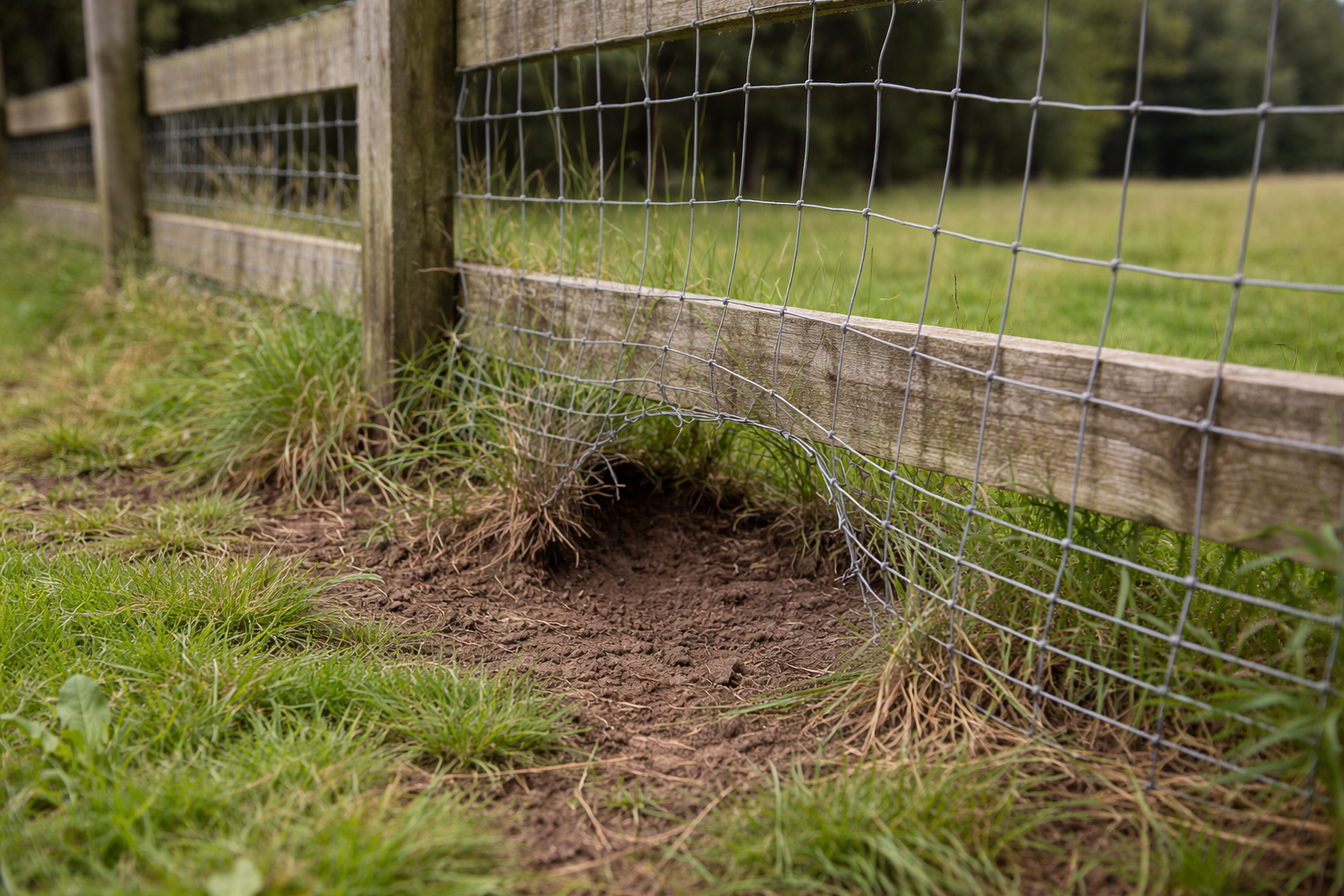
Badgers, foxes and deer frequently push through or damage wire fencing, especially along field boundaries and hedgerows. Over time, this creates gaps, lifted sections or weakened posts — often unnoticed until a dog finds them.
Even well-maintained rural fencing can deteriorate quickly when wildlife regularly passes through it. A small opening created overnight can become a reliable escape route for a determined dog.
This is particularly common with:
Stock fencing and wire mesh
Post-and-rail boundaries with wire backing
Hedge lines with hidden gaps
Sloping ground where soil shifts beneath fencing
In countryside properties, fencing isn’t static — it is constantly tested by both wildlife and weather.
Wildlife regularly damages stock and wire fencing in rural areas, often creating hidden gaps that become escape routes for dogs.
Post and Rail Dog Containment Challenges
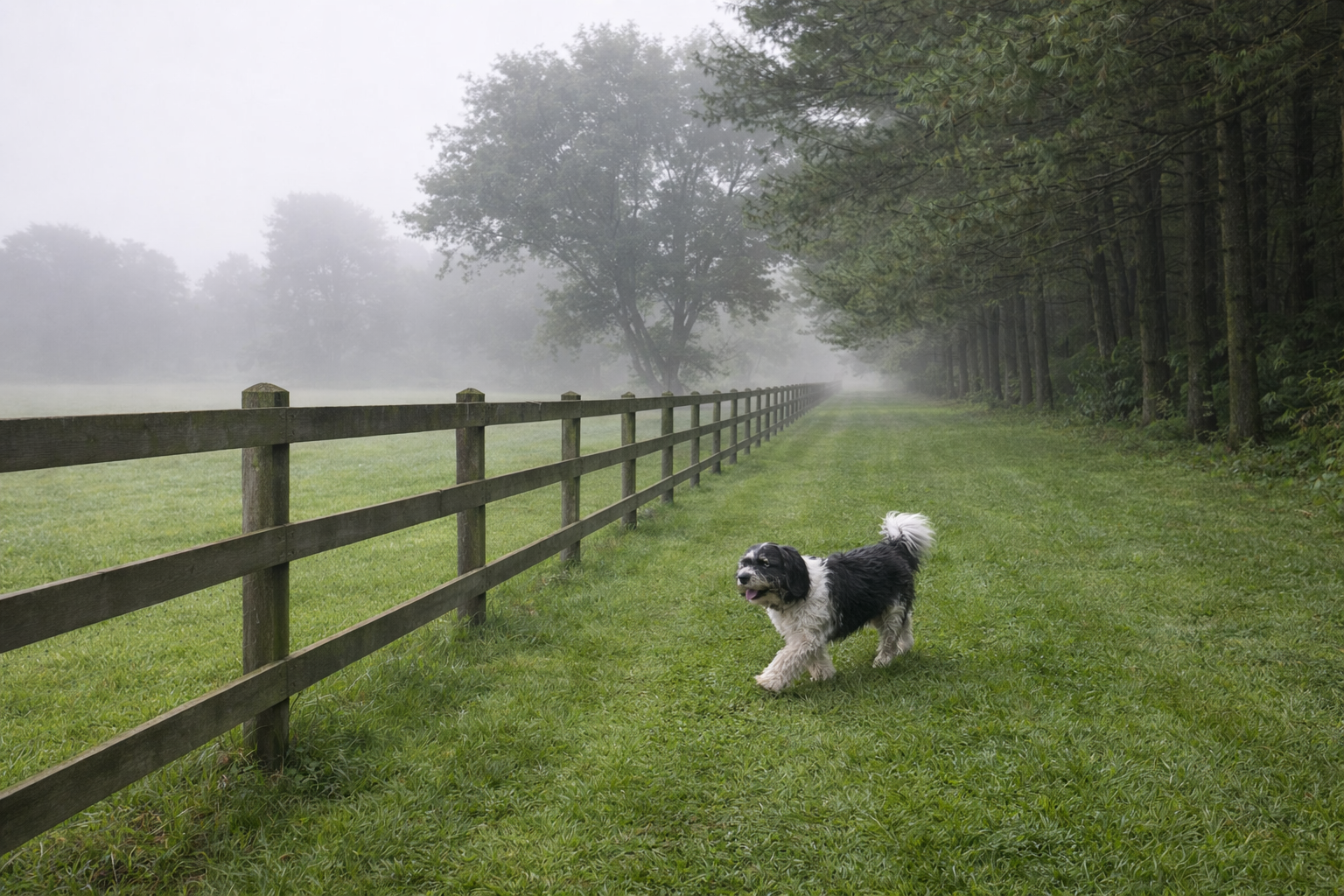
Post and rail fencing is common in the countryside but leaves large open sections underneath and between rails.
To improve secure rural fencing for dogs, owners often:
Add mesh infill
Install kickboards
Bury ground barriers
Increase height
However, reinforcing hundreds of metres of boundary can become expensive and visually intrusive.
If you’re unsure whether your current boundary is high enough, read our guide on can a dog jump a 6ft fence? to understand which breeds and situations pose the highest escape risk.
Five Bar Gate Dog Proofing Solutions
Five bar gates are a frequent weak point in rural dog escape prevention.
Common problems include:
Wide hinge gaps
Open bottoms
Uneven ground beneath gates
Temporary fixes may include:
Timber boards
Mesh panels
Automatic gate closers
But these do not always prevent highly motivated dogs from testing boundaries.
Driveways: The Most Overlooked Escape Route
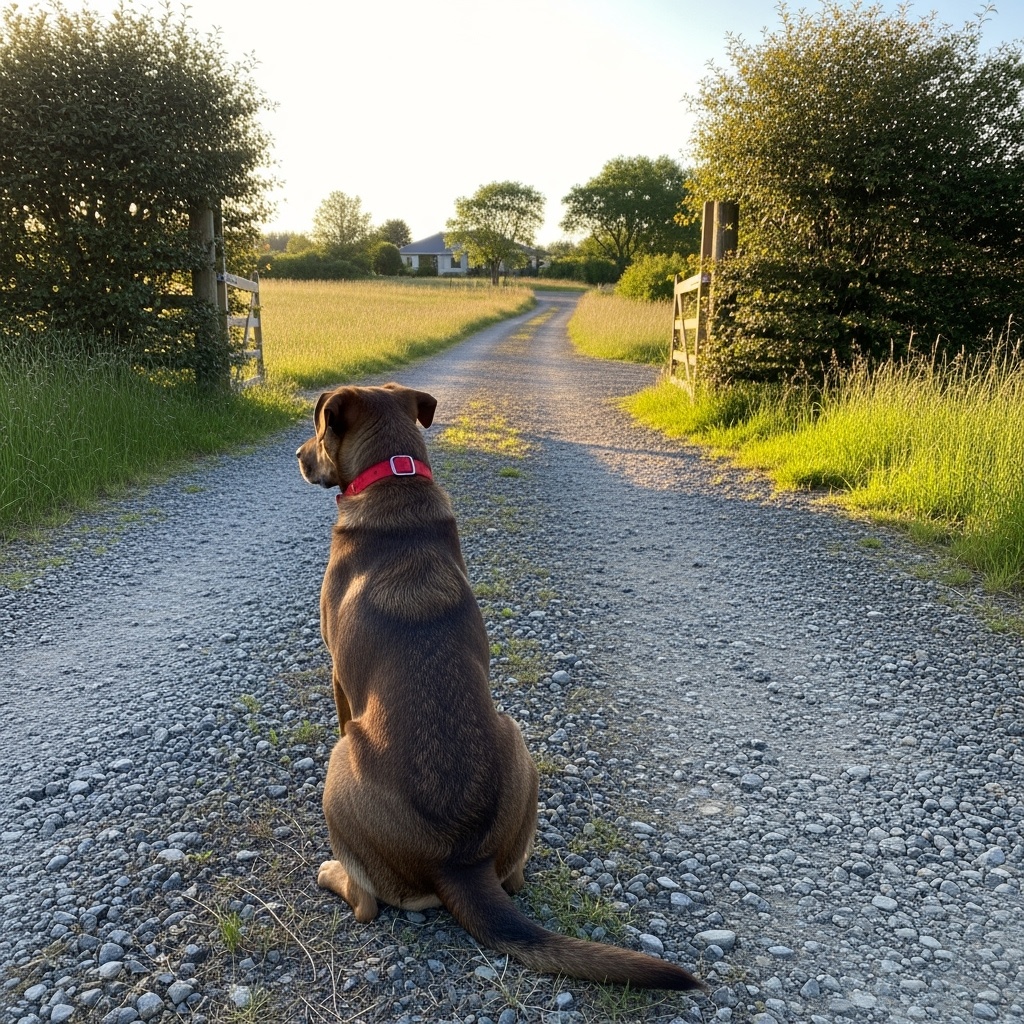
Long gravel driveways and open entrances are one of the biggest rural containment challenges.
Dog proof fencing for rural properties must account for:
Vehicles entering and exiting
Gates left open
Deliveries
Visitors unfamiliar with gate routines
For many countryside homes, fully enclosing long driveways is impractical. In these situations, a professionally installed electronic dog fence offers a practical alternative. Instead of relying on physical barriers, the containment boundary can be laid discreetly across open driveway entrances, wide gateways and even irregular ground. This means your dog remains safely contained — even when gates are open for deliveries or vehicles — without altering the appearance of your property or installing intrusive fencing across large rural spaces.
Effective dog proof fencing for rural properties requires:
Structural reinforcement
Behaviour understanding
Clear perimeter definition
At DogFence, we’ve worked with rural homes across England for over two decades. When the full perimeter is clearly defined and properly introduced, escape attempts typically settle — even in high-drive breeds.
If you’d like tailored advice on rural dog containment solutions, contact our team for a free, no-obligation assessment.
Need Dog Proof Fencing for a Rural Property?
If you have post-and-rail fencing, five bar gates or open driveways, we can help you create secure rural fencing for dogs without altering the appearance of your countryside home.
Our professionally installed electronic dog fence systems cover open areas, long driveways and uneven ground — giving you reliable rural dog containment and complete peace of mind.
19 February 2026 / in Dog Safety and Containment / by Sam Folley
Stop dog digging under fence behaviour quickly, and it can save you from a much bigger escape problem later. In most cases, digging along the fence line means your dog is trying to get out — reinforcing the boundary properly, rather than just filling in the hole, is what actually stops it for good.
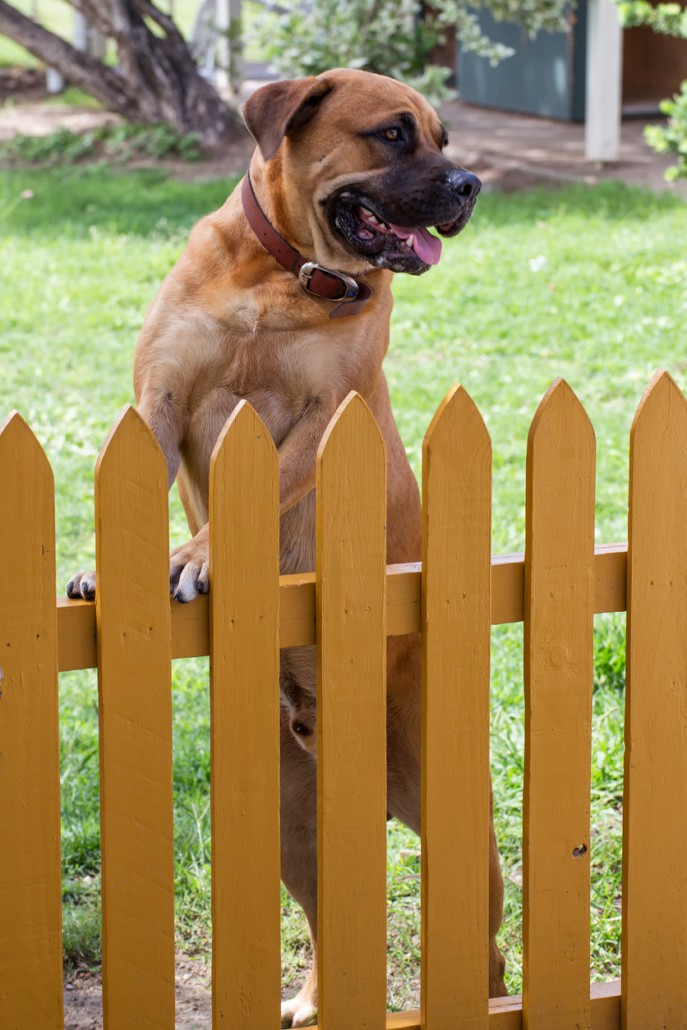
Some dogs will stop at nothing to escape – the best dog fence designs prevent digging with hidden underground protection.
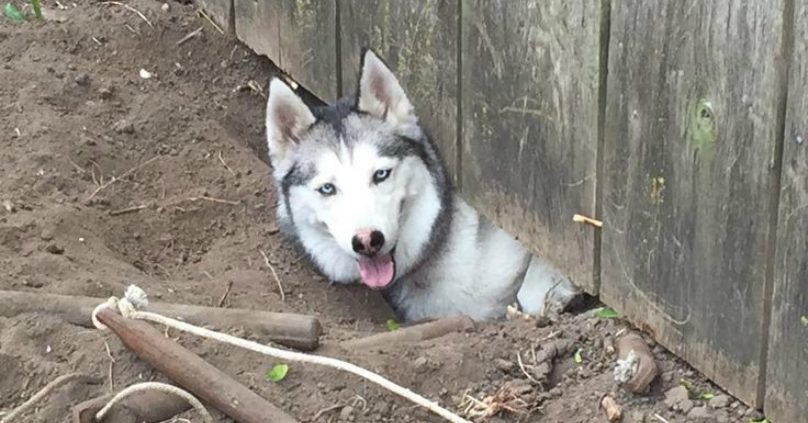
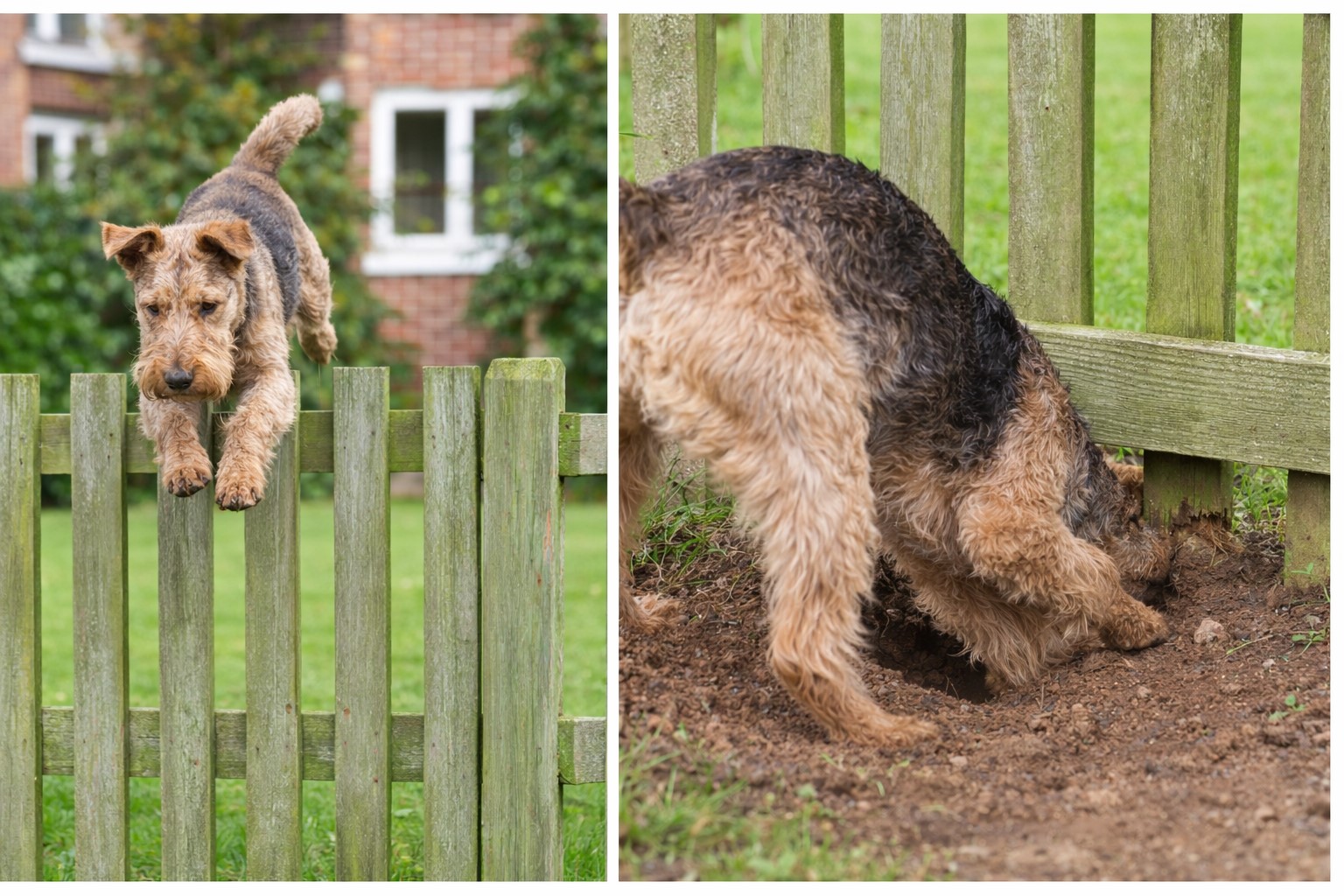
Dog digging under a garden fence — a common cause of escape in UK homes.
If your dog has started tunnelling along the boundary, it’s rarely random. What begins as one small hole can quickly turn into repeated attempts at escaping under the fence — especially once they realise it works.
Before you can prevent dog digging out for good, you need to understand what’s driving it. If you’re unsure what motivates escape behaviour more broadly, read our complete guide on how to stop your dog escaping from the garden.
For many UK owners — particularly those with larger or rural properties — creating a truly secure garden for digging dog breeds requires more than just filling in the hole. Our guide on how to dog proof your garden properly covers the wider approach if digging isn’t the only escape route you’re dealing with. This guide focuses specifically on digging, and on how DogFence can offer a permanent alternative once you’ve already tried the obvious fixes.
Why Is My Dog Digging Under the Fence?
When you need to stop dog digging under fence behaviour, the first step is identifying the motivation. Fence-line digging almost always has a purpose.
Digging to Escape the Garden
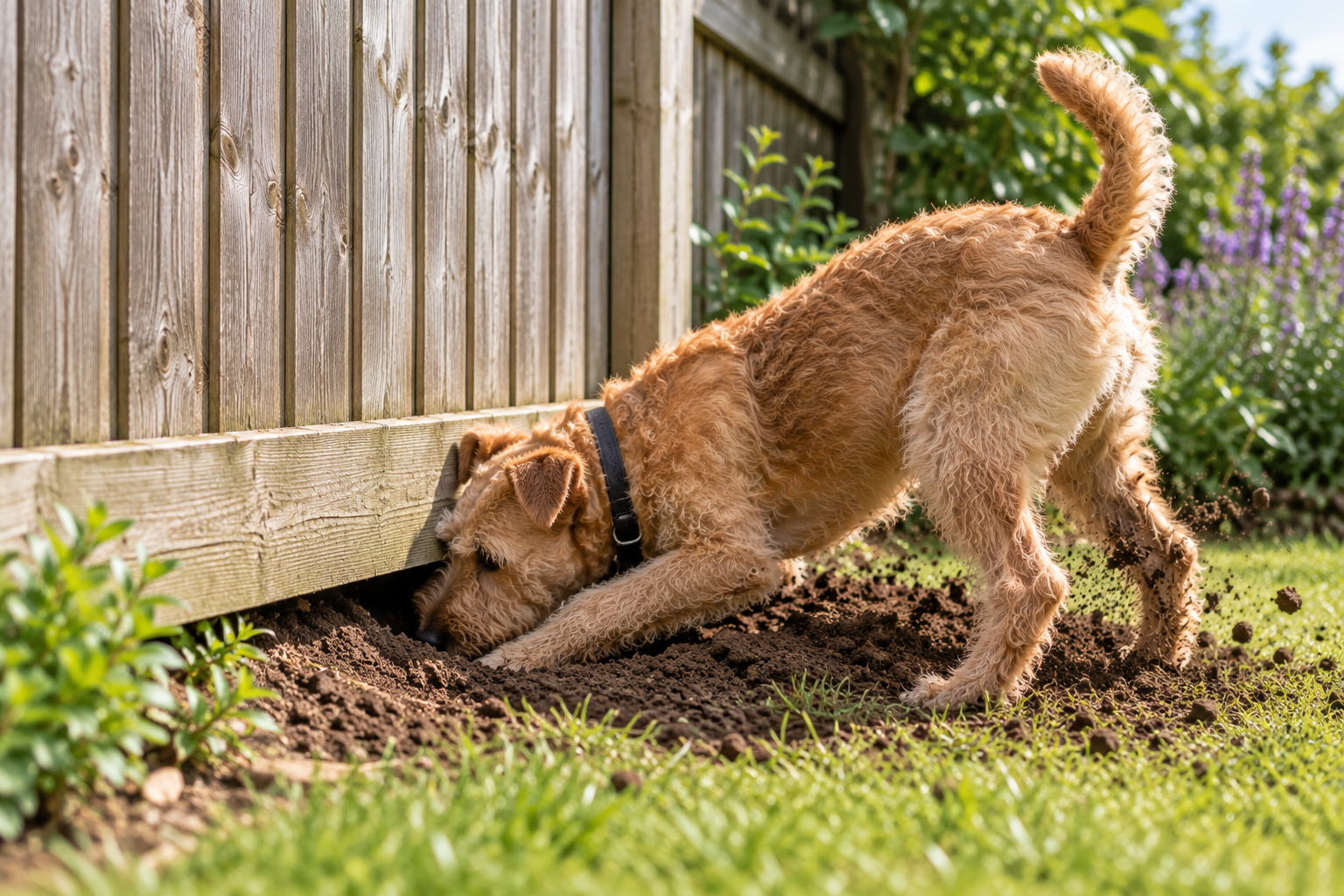
A Lakeland Terrier digging under a garden fence — a common early sign of escape-driven behaviour.
If your dog is consistently digging along the boundary, this is classic dog-digging-to-escape-garden behaviour.
Common triggers include:
Wildlife beyond the fence (deer, rabbits, squirrels)
Once a dog succeeds at escaping under a fence, the behaviour becomes reinforced. Freedom becomes the reward.
Breed Instinct (Terriers & Working Dogs)
Some breeds are naturally wired to dig. Terriers, for example, were bred to hunt prey underground. For these dogs, digging isn’t disobedience — it’s instinct.
If you have a determined digging breed, standard fencing alone may not be enough to prevent dog digging out long term — this is exactly the kind of persistent case where DogFence tends to outperform repeated physical repairs.
Digging to Stay Cool in Summer
In warmer weather, some dogs dig shallow pits to lie in cooler soil. These holes are usually:
Away from the boundary
In shaded areas
Not tunnel-shaped
If your goal is to stop dog digging under fence, but the holes are central in the garden, temperature may be the real cause.
Boredom and Excess Energy
Young, intelligent or high-drive dogs may dig simply because it’s stimulating. Without structured walks, mental enrichment, training interaction or scent work, digging becomes self-rewarding entertainment.
However, boredom digging rarely focuses repeatedly on the fence line — persistent boundary digging usually indicates escape motivation instead.
Why the Obvious Fixes Don’t Last
If you’ve already tried burying chicken wire, adding gravel boards, or blocking a hole with a paving slab — you’ll know the frustration. It works for a few days, then your dog either reopens the same spot or moves 30cm along and starts again.
That’s because these methods only ever address where the last hole was, not why your dog is trying to leave. A genuinely determined dog will keep testing the boundary until the motivation itself is dealt with.
Did you know there’s another way? Instead of repeatedly reinforcing the fence itself, you can train your dog to stay away from the boundary altogether — and it’s a lot more straightforward, affordable and flexible than most owners expect.
The Most Reliable Way to Stop Dog Escaping Under Fence
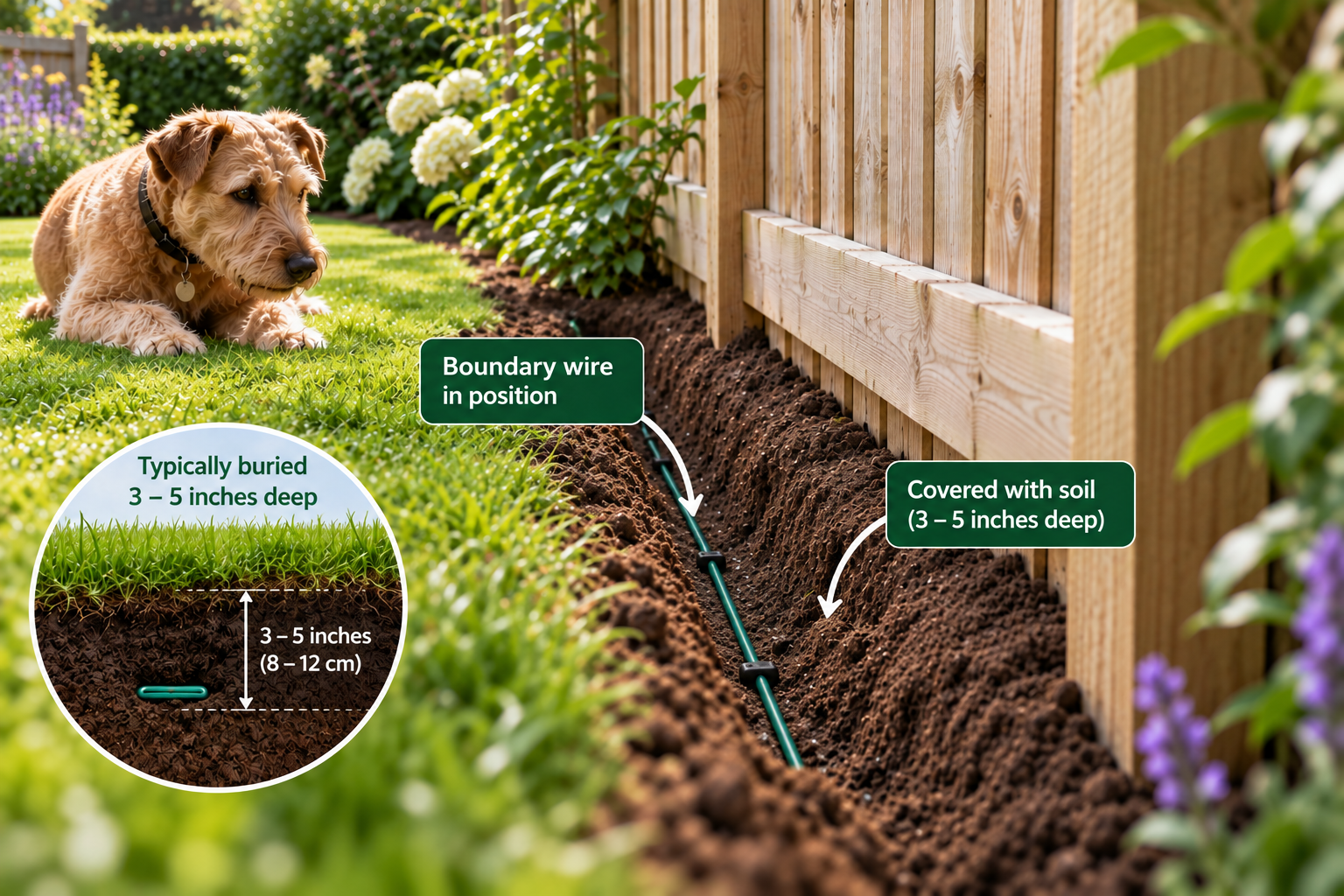
A DogFence hidden boundary runs inside the physical fence line, teaching the dog to stay clear of the edge entirely.
DogFence is the UK’s leading invisible dog fence specialist, helping owners create a secure dog fence for their garden without relying on ever-taller panels or buried mesh. Since 2003, we’ve installed hidden dog boundary fences for thousands of UK gardens — from small suburban plots to large rural properties where a conventional fence was never going to be practical.
Rather than trying to out-build a determined digger, our invisible dog fence changes how your dog relates to the boundary altogether.
How It Works
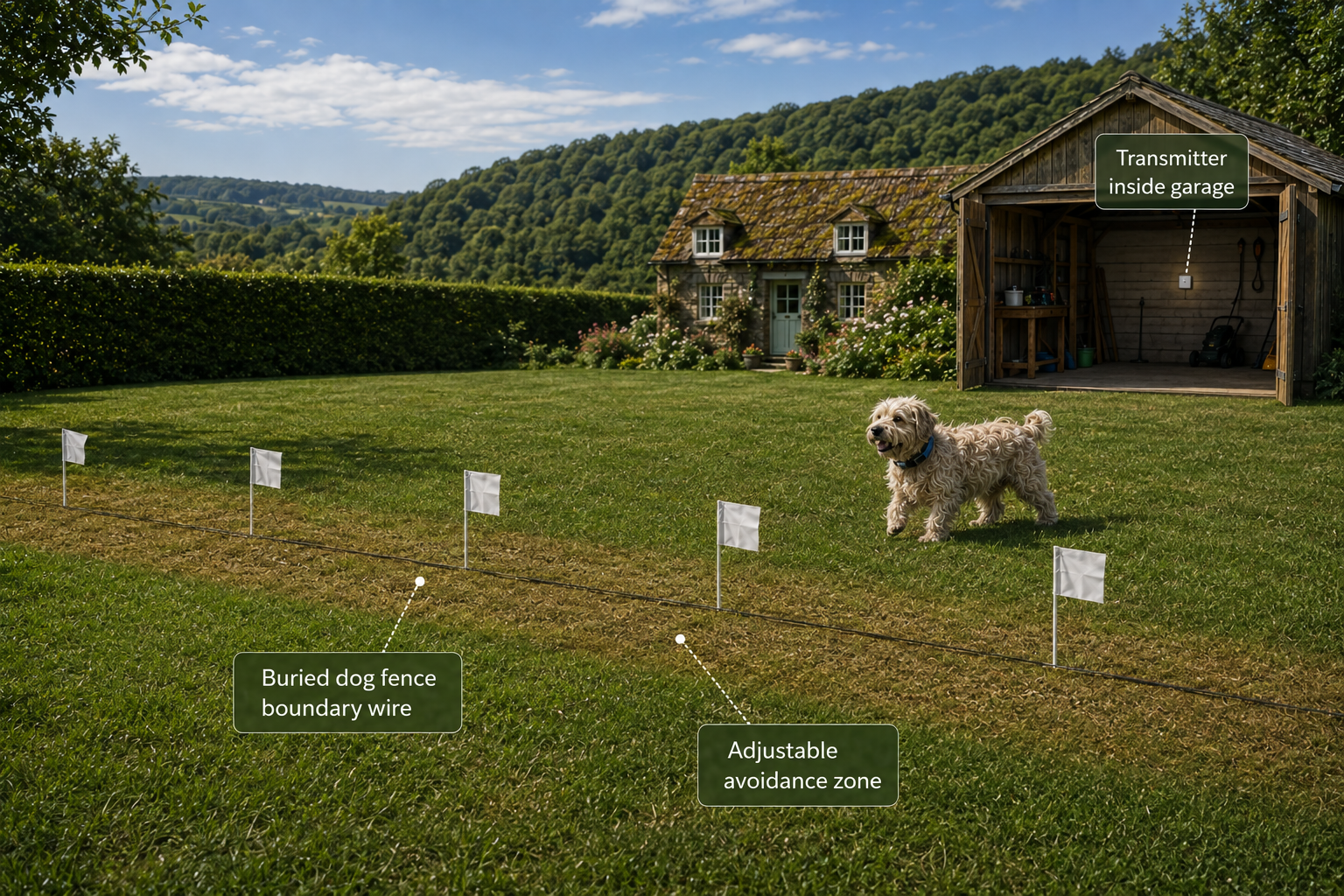
A boundary wire is buried discreetly around your garden and connected to a small transmitter. Your dog wears a lightweight receiver collar. As they approach the trained boundary — well before the physical fence — the collar gives a clear audible warning. With consistent, professional training, most dogs quickly learn to turn away at that point rather than testing the fence at all. There’s no gravel board to dig past and no gap to find, because the dog stops approaching the edge in the first place.
Training is built into every installation, not left for you to work out afterwards. Our installers introduce your dog to the boundary using temporary training flags and short, structured sessions, so they understand the new limits with confidence.
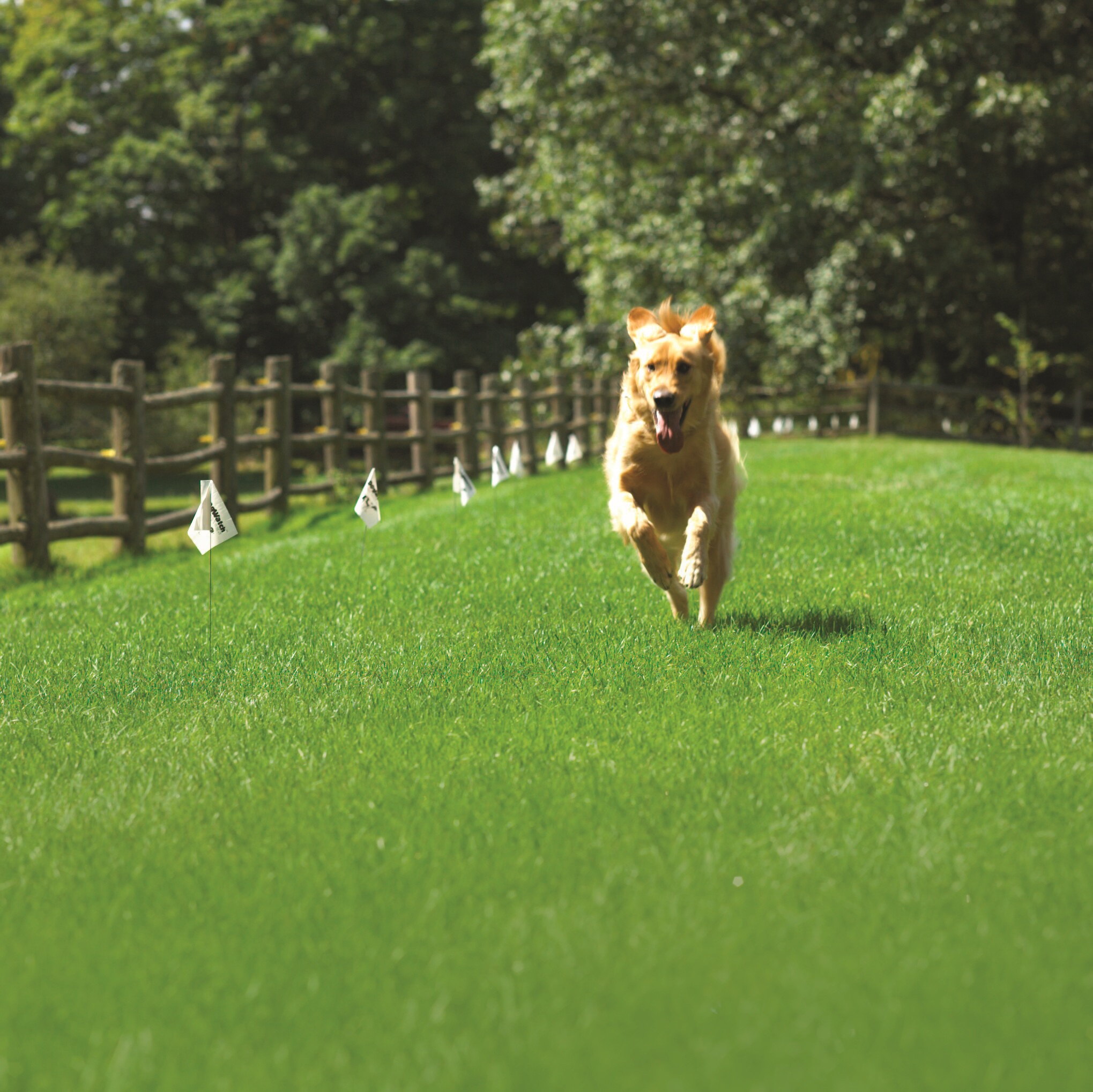
The DogFence system uses a buried boundary wire, training flags and a receiver collar to create a safe, clearly defined area for your dog.
Quicker and Cheaper Than You’d Think
Most gardens can be fitted with a DogFence system in a single visit, with no groundworks, trenching, or lengthy construction. Compared with the cost of replacing or reinforcing fence panels — particularly across a large or awkward boundary — an invisible dog fence is typically a more affordable option, and there’s no ongoing repair bill every time a section of wire mesh gets dug up or a gravel board rots.
It Covers Driveways and Awkward Boundaries Too
A physical fence has to stop somewhere — usually at a driveway, gate, or awkward corner where a solid barrier isn’t practical. A dog boundary fence from DogFence doesn’t have that problem. The wire can be routed straight across an open driveway or entrance, so your dog is contained without needing a gate that someone might forget to close.
It Moves With You
Because the system isn’t built into your fence, it isn’t tied to your house either. If you move home, the equipment can be taken with you and reinstalled at your new property — unlike a fence, which stays behind with the house you’re leaving.
This combination makes DogFence particularly effective for:
Post-and-rail fencing or hedge boundaries, where there’s no solid base to reinforce
Large rural perimeters, where burying wire mesh along every metre is impractical or prohibitively expensive
Sloping or uneven terrain, where gaps naturally reappear as the ground shifts
Open driveways and entrances, where a physical gate isn’t wanted or practical
Determined digging breeds that will simply relocate to a new spot once one is blocked
Because the boundary is invisible, you’re also not compromising the look of your garden with trenches, wire mesh, or reinforced panels — your fence, hedge or wall stays exactly as it is.
Find out more about how the system works on our How DogFence Works page.
Already tried the DIY fixes without success? Let DogFence assess your garden and dog’s specific pattern for free.
If your dog has already succeeded in escaping under fence panels once, the risk increases significantly. Escaping dogs face road traffic, livestock incidents, getting lost, and legal liability.
Fence-line digging is often an early warning sign that your current setup is not secure enough — and a good moment to consider whether DogFence could close that gap permanently.
Frequently Asked Questions About Dogs Digging Under Fences
Why has my dog suddenly started digging under the fence?
Look for a change: new wildlife or livestock nearby, another dog, a female in season, hot weather, or increased boredom. Persistent digging concentrated on the boundary line usually points to escape motivation rather than a one-off habit.
I’ve already tried gravel boards and wire mesh — why isn’t it working?
These methods block a specific spot, but a motivated dog will usually just move along the fence line and try again nearby. DogFence takes a different approach: rather than reinforcing the physical fence, it trains the dog to stay away from the whole boundary, so there’s no gap left to find.
How long does a DogFence installation take?
Most gardens can be fitted in a single visit, with no trenching or major groundworks required, followed by a structured training period so your dog learns the new boundary confidently.
Is a hidden fence cheaper than replacing my fencing?
Often, yes — particularly on larger or awkward boundaries where reinforcing every metre of physical fence would be costly. It also avoids the ongoing cost of repairing dug-up mesh or rotted gravel boards.
Can DogFence cover my driveway or an open gate?
Yes. The boundary wire can be routed across a driveway or entrance, keeping your dog contained without needing a gate that could be left open.
Can I take the system with me if I move house?
Yes. Unlike a fence, the DogFence equipment isn’t fixed to the property — it can be uninstalled and set up again at your new home.
Are certain breeds more likely to dig under fences?
Yes. Terriers and other breeds developed to hunt underground have a strong natural instinct to dig, so standard fencing reinforcement alone is often not enough for these dogs long-term. DogFence is a popular choice for owners of persistent digging breeds for this reason.
Should I get my dog neutered to stop the digging?
Neutering may reduce hormone-driven escape attempts in some dogs, but it isn’t a guaranteed fix if the dog has other strong motivations to leave the garden.
Final Thoughts: How to Stop Dog Digging Under Fence for Good
To stop dog digging under fence permanently, you need to address both the reason your dog wants to leave and the weakness in the boundary.
Digging is communication. Your dog may be saying they’re bored, anxious, too hot, or that they want what’s on the other side. When you understand the motivation and secure the full perimeter — not just the hole — most dogs stop trying to escape.
And your garden, and your peace of mind, can finally recover.
Over the past two decades, DogFence has seen that when the full boundary is clearly defined and properly introduced, digging behaviour almost always settles. Rather than constantly repairing panels or burying wire, a professionally installed DogFence system addresses the root cause — removing the reward for escape and restoring safety to the entire property.
Tired of Repairing Fence Holes?
If your dog keeps digging under the fence, let DogFence secure your boundary properly and stop escape attempts for good.
Dog Proof Fencing for Rural Properties – advice for large gardens, post-and-rail fencing, five-bar gates, open driveways and uneven countryside properties.
For a complete explanation of the system itself, visit How DogFence Works.
Tags: digging dog behaviour, dog digging to escape garden, dog escaping under fence, Dog Fence Solutions, prevent dog digging out, rural dog containment, secure garden for dogs, stop dog digging under fence
Some images used in this article are AI-generated or stock photography used to illustrate typical scenarios and are not necessarily taken at real DogFence installations.
https://dogfence.co.uk/wp-content/uploads/2018/10/husky-escape.jpg501808Sam Folleyhttps://www.dogfence.co.uk/wp-content/uploads/2015/10/dogfences_logo_main_cats_orange2.pngSam Folley2026-02-19 12:57:482026-09-08 13:01:50How to Stop Dog Digging Under Fence (UK Guide)
Why Dogs Escape Gardens (And How to Stop a Dog Running Away)
If you’re wondering why dogs escape gardens, you’re not alone. Every week we speak to owners whose dog escaping garden behaviour has become stressful and dangerous. Understanding why dogs escape gardens is the first step in learning how to stop a dog running away safely and permanently. Creating a secure garden for dogs starts with understanding why dogs escape gardens in the first place.
Dogs escape gardens because of boredom, prey drive, anxiety, mating instincts, fear triggers, or weaknesses in fencing. When something outside the boundary feels more rewarding than staying inside, even a well-loved dog may attempt to leave.
If your dog keeps digging under panels, squeezing through gaps or testing the fence line, this guide explains:
Why dogs escape gardens
The most common escape routes
How to stop a dog running away
And how to create a truly secure garden for dogs
At DogFence, we’ve been helping owners across England by anwering the question of “How do I stop my dog running away?” since 2003. In almost every case, the solution starts with understanding motivation — not just building a higher fence.
Quick Summary: Why Dogs Escape Gardens
Dogs escape gardens mainly because of:
Boredom or lack of mental stimulation
Strong prey drive (wildlife, livestock, scents)
Separation anxiety
Fear triggers such as fireworks or loud noises
Mating instincts (especially unneutered dogs)
Weak fencing or poorly secured gates
Learned escape behaviour after a successful attempt
If your dog escaping garden behaviour has become a regular problem, identifying the trigger is essential. Stopping a dog running away requires both behaviour management and a secure boundary.
According to RSPCA advice on dog behaviour, dogs are naturally exploratory animals and will investigate sounds, scents and movement beyond their garden boundary.
Loose latches are responsible for many preventable escapes.
Install:
Self-closing hinges
Lockable latches
Double gate security in larger gardens
How to Stop a Dog Escaping and Running Away?
Stopping escape behaviour requires a layered approach:
Identify why your dog is escaping.
Remove weak points in fencing and gates.
Increase physical and mental stimulation.
Reinforce recall and boundary awareness training.
Establish a clear, consistent containment boundary.
When motivation to leave decreases and boundaries are reliable, most dogs stop testing escape routes.
Why Traditional Fencing Alone Often Fails
We regularly visit properties where thousands have been spent on timber fencing — yet the dog still escapes.
This happens because:
Dogs adapt their strategy (jumping becomes digging).
Anxiety overrides physical barriers.
Rural gardens are difficult to enclose completely.
Motivation outside the boundary is stronger than the barrier itself.
A fence creates a physical barrier. A trained boundary creates understanding.
That difference is critical.
The Three Essentials to Prevent Dog Escape Behaviour
1. Behaviour Training
Reinforce recall positively
Avoid chasing your dog
Reward calm behaviour outdoors
Practice boundary awareness
Training supports containment — but does not replace it.
2. Environmental Enrichment
Many escape attempts are boredom-driven.
Provide:
Structured play
Mental stimulation
Supervised garden time
Problem-solving activities
A mentally satisfied dog is less motivated to roam.
3. Secure Garden Boundaries
Effective garden security should include:
Adequate fence height
Anti-dig protection
Secure gates
Removal of climb aids
Clear perimeter definition
Creating a truly safe garden setup for your dog means combining strong physical boundaries with consistent behavioural training. A secure garden for dogs is not just about height — it’s about removing weak points and giving your dog a clear, understood perimeter.
However, even reinforced fencing can fail with determined escape artists.
If your dog repeatedly escapes despite stronger fencing, understanding how an electronic dog fence works can help you see how a defined boundary supports consistent training. Often referred to as “invisible dog fences,” these systems create a fixed perimeter without altering the appearance of your garden — ideal for both rural properties and urban spaces.
How to Stop a Dog Escaping Repeatedly
To stop a dog escaping repeatedly, combine secure fencing, structured recall training and consistent boundary reinforcement.
When a Professional Dog Fence Becomes the Safer Solution
If your dog repeatedly escapes despite improved fencing, a defined containment boundary may be the safest long-term solution.
A professionally installed electronic dog fence creates a consistent perimeter around your garden. Unlike GPS collars (which rely on signal strength and can drift), wired containment systems establish a fixed boundary line and support structured training.
DogFence systems:
Have operated in the UK since 2003
Have safely contained over 20,000 pets
Are DEFRA-tested
Include safety shut-off features
Are fully waterproof and durable
Include professional installation and owner training
If you’re concerned about your dog running away, for larger rural properties, installing a professionally fitted electronic dog fence in the UK can provide a clearly defined boundary without changing the look of your garden.
Spring and summer can also increase roaming behaviour due to scent and breeding activity.
Garden Security Checklist
If you want to prevent your dog running away, check:
Fence height suitable for your breed
No gaps under panels
Secure, self-closing gates
No climb aids near boundaries
Adequate daily stimulation
Consistent boundary reinforcement
Prevention requires regular inspection and proactive management.
Frequently Asked Questions
Why does my dog keep escaping the garden?
Dogs escape due to instinct, boredom, anxiety, or weak boundaries. Repeated success reinforces the behaviour, making it more likely to happen again.
How high should a fence be to stop a dog escaping?
6ft is a common minimum, though athletic breeds may require additional measures such as anti-climb extensions or boundary reinforcement.
Is an electronic dog fence safe?
Modern professionally installed containment systems include safety shut-off features and structured training protocols designed to prioritise pet welfare.
Why Dog Escaping Garden Behaviour Gets Worse Over Time
When a dog escaping garden attempt is successful, the behaviour becomes reinforced.
Each time your dog escapes:
Confidence increases
Boundaries feel weaker
The outside world becomes more rewarding
This is why learning how to stop a dog escaping early is critical. The longer escape behaviour continues, the harder it becomes to correct.
Preventing dog escaping garden behaviour requires consistency, supervision, and a clearly defined secure garden for dogs that removes opportunity altogether.
Final Thoughts:
Dogs escape gardens when something outside the boundary becomes more compelling than staying inside.
The solution isn’t simply a taller fence.
It’s:
Understanding motivation
Removing weak escape routes
Providing mental and physical fulfilment
Creating a reliable, clearly defined boundary
If you’ve identified why your dog is escaping and need a reliable way to secure your garden, discover how our dog fence for escaping dogs can create a hidden boundary around your property without building a new physical fence.
Because freedom should never come at the expense of safety.
Worried Your Dog Will Escape Again?
Don’t wait for a near miss with a road or livestock. Speak to the experts at DogFence about creating a secure, reliable boundary for your garden.
https://dogfence.co.uk/wp-content/uploads/2026/02/why-dogs-escape-gardens-uk-scaled.jpeg25601920Sam Folleyhttps://www.dogfence.co.uk/wp-content/uploads/2015/10/dogfences_logo_main_cats_orange2.pngSam Folley2026-02-19 11:06:292026-09-17 18:24:39Why Dogs Escape Gardens (And How to Stop a Dog Running Away)
A Valentine’s Day Tribute: Why Dogs are Truly Man’s Best Friend
This Valentine’s Day, while many are focused on roses and chocolates, let’s celebrate the most loyal relationship in history: the bond between humans and dogs. For over 15,000 years, dogs have been our protectors, workers, and most importantly, our family.
At DogFence Ltd, we specialise in electronic dog containment systems that allow your pet to enjoy the garden safely. We, believe the ultimate way to show your dog love is by balancing dog safety and freedom. In this tribute, we explore the history of “man’s best friend” and how we can repay their loyalty by upholding their fundamental rights through professional dog training and secure boundaries.
A History of Loyalty: From Wolves to Valentines
The connection between humans and dogs began in the Ice Age. From ancient Egyptian deities like Anubis to the working dogs of Medieval Britain, our history is intertwined.
Today, dogs have evolved from hunters to essential modern partners. Whether they are serving in the military or providing emotional support, their role as man’s best friend has never been more vital. To keep these modern heroes safe, our hidden fence technology ensures they stay within the safety of your home.
Extraordinary Ways Dogs Help Us
Medical Assistance: Dogs like Labradors and Golden Retrievers are trained to detect seizures or low blood sugar before they happen.
Police & Military Heroes: The Belgian Malinois, like Cairo of the Navy SEALs, provides bravery that saves human lives in high-risk zones.
Support for Independence:Guide Dogs UK empower the visually impaired to navigate busy streets like London or Manchester with total confidence.
Why “Man’s Best Friend” is More Than Just a Phrase
The title “man’s best friend” isn’t just a cliché; it is backed by the depth of their devotion.
Unconditional Love: A dog doesn’t care about your job title. This bond is proven to lower blood pressure and reduce human stress.
Emotional Intelligence: Dogs sense our grief and anxiety. A simple nuzzle or a wagging tail can provide more comfort than words.
The Gift of Presence: Dogs teach us to find joy in the “now,” whether it’s a walk in the park or playing in a securely fenced garden.
Protecting the “Five Freedoms” of Your Dog
As dog lovers, we must ensure our pets live by the Five Freedoms, the gold standard of animal welfare. This Valentine’s Day, consider how your home environment supports these:
Freedom from Hunger & Thirst: High-quality nutrition and constant fresh water.
Freedom from Discomfort: A warm bed and a secure environment.
Freedom from Pain & Disease: Regular vet checks and preventing accidents.
Freedom to Express Normal Behaviour: This is where dog safety and freedom intersect. Dogs need to run and sniff safely. Our DIY Dog Fence options or professionally installed systems make this possible.
Freedom from Fear: A predictable, secure routine.
Our electronic dog containment solutions help uphold the freedom to express normal behavior by providing a secure boundary.
A secure garden allows dogs to relax, play, and interact confidently with the people around them.
Electronic Dog Containment: Enhancing Freedom in the UK
Traditional fences can be unsightly or ineffective for “escape artists.” This is why many UK owners turn to electronic dog containment.
In 2018, DogFence Ltd was consulted by DEFRA regarding electronic fences. The conclusion recognised that, when combined with professional training, our FM Safelink systems save lives by preventing road accidents and livestock worrying.
Our invisible dog fencing UK solutions allow your dog to roam your entire garden—whether it’s a small patch or a sprawling estate—without the risk of them bolting into traffic.
Show Your Dog Love This Valentine’s Day
Valentine’s Day is the perfect time to upgrade your dog’s lifestyle. Give them the gift of the great outdoors without the worry of them wandering off.
Why Choose DogFence Ltd?
20+ Years of Experience: We are the UK’s trusted experts in pet containment.
Over 20,000 pets safely contained
DEFRA approved systems
Professional Training: We don’t just install; we teach your dog their boundaries humanely.
https://dogfence.co.uk/wp-content/uploads/2026/01/mans-best-friend-dog-rolling-in-grass.jpg8361254Sam Folleyhttps://www.dogfence.co.uk/wp-content/uploads/2015/10/dogfences_logo_main_cats_orange2.pngSam Folley2026-02-13 07:00:162026-03-02 12:48:44A Valentine’s Day Tribute: Celebrating the Mans’ Best Friend
Why Dogs Escape More in Winter: Scent, Wildlife & Boundary Testing Explained
Winter is one of the most common times we hear the phrase:
“He’s never escaped before — and suddenly he’s gone.”
For many dog owners, winter escapes come as a complete shock. The garden hasn’t changed. The fence is still standing. The dog is older, trained, and normally reliable.
Cold, damp winter conditions can intensify scent trails, encouraging dogs to test garden boundaries
So what’s going on?
The answer lies in scent, seasonal wildlife movement, and instinct-driven boundary testing — not bad behaviour or failed training. For many owners, learning how electronic dog fences work helps explain why behaviour-led boundaries are often more effective for instinct-driven dogs than traditional fencing alone.
Cold Weather Makes Scents Stronger (Not Weaker)
One of the biggest myths about winter is that dogs are less stimulated outdoors. In reality, the opposite is true.
Cold, damp air holds scent closer to the ground, rather than allowing it to disperse. Wet soil, fallen leaves, frost, and reduced sunlight all help scent trails linger longer and travel further.
For scent-led breeds — and many non-hounds too — this can turn an ordinary garden into a sensory overload.
A fox passing through at dawn. A deer crossing a nearby field overnight. A badger trail along a hedge line.
To a dog, these scents can feel urgent, fresh, and impossible to ignore.
Winter Wildlife Movement Increases Temptation
Winter forces wildlife to move differently.
Deer travel wider in search of food
Foxes become bolder and closer to homes
Small mammals shelter near fences, sheds, and compost areas
This means more wildlife activity closer to your boundary lines, exactly where dogs spend time patrolling.
Even dogs that have never shown interest before may suddenly begin:
Fixating on fence lines
Pacing specific areas
Digging or pushing at weak spots
Ignoring recall when something catches their nose
This isn’t disobedience — it’s instinct taking over.
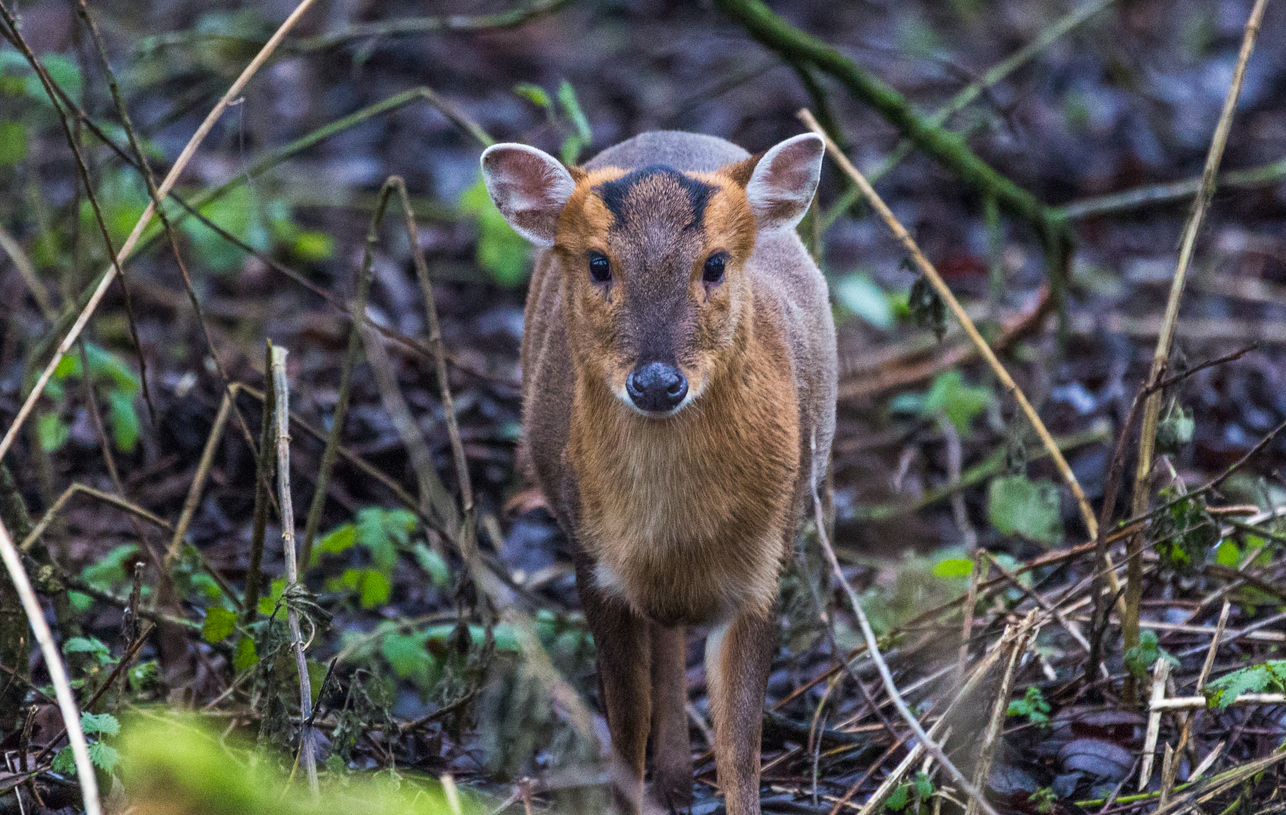
Deer such as muntjac leave powerful scent trails that linger in cold, damp winter conditions and can draw dogs towards boundary lines.
Why Physical Garden Fences Often Fail in Winter
Traditional fencing relies on visual and physical barriers, but winter exposes their weaknesses.
Common winter fence failures include:
Soft or waterlogged ground under panels
Gates swelling or warping
Reduced visibility from darkness and fog
Gaps forming where soil shifts
More importantly, fences don’t communicate boundaries — they only block them.
When a dog is following scent, height often doesn’t matter. If the motivation is strong enough, dogs will climb, dig, squeeze, or simply run through weak points they previously ignored.
According to the RSPCA, dogs that roam or escape unsupervised face increased risks from roads, wildlife encounters and becoming lost — risks that are heightened during darker winter months.
Boundary Testing Is Normal (Even in “Good” Dogs)
When environmental conditions change, some dogs test boundaries by jumping or investigating fence lines.
Dogs constantly assess their environment. Winter is a major environmental change.
Owners often blame themselves — but this behaviour is predictable, explainable, and preventable.
ust as puppies learn where their boundaries begin, even adult dogs will re-test limits when conditions change — whether it’s winter scent or seasonal wildlife movement. Learn more about how young dogs learn boundaries in our detailed guide for puppies
Why Training Matters More Than Fence Height
The most reliable containment systems don’t rely on physical barriers alone. They teach dogs where their boundary is, not just where a fence happens to be.
When dogs understand a boundary:
They stop testing it
They disengage from scent earlier
They remain calmer and more confident
They stay safe even when highly stimulated
This is why many owners find that electronic containment used alongside training works where traditional fencing fails — especially during high-instinct seasons like winter.
The boundary becomes clear, consistent, and independent of weather, light, or ground conditions.
Winter Escapes Are a Warning Sign — Not a Phase
If your dog has started escaping, or seems suddenly “different” in the garden, it’s rarely something they’ll simply grow out of.
In fact, once a dog has:
Successfully escaped once
Followed a scent beyond the boundary
Experienced the reward of exploration
They are more likely to try again, not less.
Addressing the cause early protects your dog from:
Road accidents
Getting lost while tracking scent
Injury or wildlife confrontation
Stress and anxiety from repeated escapes
Helping Your Dog Stay Safe This Winter
If winter has changed your dog’s behaviour outdoors, you’re not alone — and you’re not doing anything wrong.
Understanding how seasonal scent, instinct, and boundaries interact is the first step toward keeping your dog safe, calm, and contained all year round.
If you’d like advice tailored to your dog, your garden, and your location, speak to a team that understands both behaviour and containment, not just products.
Are Dog Fence Collars Safe for Dogs? A Complete Expert Guide
Are dog fence collars safe is one of the most common questions dog owners ask when researching an invisible dog fence. With so much conflicting information online, it’s natural to want straightforward, fact-based reassurance. The truth is that dog fence collars are safe when used correctly, professionally installed, and fitted properly. At DogFence Ltd, we have safely contained more than 20,000 dogs and cats, and our system has been independently tested by the UK Government, confirming there are no adverse effects when used as intended.
This guide explains how the collar works, why the technology is safe, and how correct fitting ensures comfort, humane training, and long-term reliability.
Gentle DogFence training helps even small or sensitive dogs enjoy their garden safely and confidently
Are Dog Fence Collars Safe? (The Short Answer)
Yes — dog fence collars are safe. They use a gentle, momentary static sensation that feels similar to a light TENS machine pulse rather than a “shock”. It is not painful, not harmful, and the training process is designed to be calm, controlled, and dog-friendly.
Scientific research — including multiple Government studies and DEFRA-funded research from Newcastle University (Cooper et al.) — shows that properly used electronic containment collars:
Do not cause physical harm
Do not create long-term stress
Do not cause behavioural problems
Are not associated with anxiety or fear when used correctly
In fact, many owners report calmer, happier dogs because they can enjoy safe outdoor freedom without constant supervision. Our How It Works page explains more about why invisible fencing is both safe and effective.
How Do Dog Fence Collars Work?
A dog fence collar works together with a boundary wire and a small transmitter unit, which is usually installed in a garage, shed, or outbuilding. The transmitter sends a coded FM radio signal through the buried wire, creating a precise, stable boundary around your garden.
When your dog approaches the boundary during training, the collar responds in a predictable sequence:
Warning beep – alerts the dog that they are nearing the boundary.
Gentle static sensation – similar to a light TENS pulse, and only if they continue forward.
Retreat behaviour – with training, your dog learns to step back to turn off the warning.
This combination of sound + mild sensation teaches your dog to retreat calmly and consistently. The goal is not to “correct” the dog repeatedly — it is to teach them where the safe area is. Most dogs learn this within a few training sessions.
More detail on the technology is available on our How It Works page.
Why Dog Fence Collars Are Safe (Backed by Independent Research)
The question “are dog fence collars safe?” has been thoroughly examined by scientists, veterinarians, and behaviour specialists. DEFRA-funded research, including the well-known Cooper et al. study, concluded that electronic containment systems:
did not increase long-term cortisol (stress hormone) levels
did not cause behavioural signs of distress
were used successfully without negative welfare impact
The Government’s own summary confirmed the same findings. When used correctly, dog fence collars are safe, humane, and effective.
Modern Safety Features Built Into Our Collars
Our collars use advanced DogWatch FM technology, which is specifically designed for safety, reliability, and fast response. This ensures clean communication between the collar and boundary wire without interference or false activations — issues more commonly seen with AM or GPS-based systems.
Key safety features include:
Soft-start training levels for timid or sensitive dogs
15-second safety shut-off to prevent continuous activation
Anti-linger mode to avoid unnecessary corrections
Fail-safe radio encoding to prevent interference
Waterproof and robust collar casings
This combination ensures the system remains humane, predictable, and safe for long-term use.
Contact Posts: Why Proper Fit Matters for Safety
As with a TENS machine used for humans, the gentle static sensation needs light contact with the skin. The rounded stainless-steel contact posts on the collar simply ensure this connection — they may look like prongs but they sit comfortably when the collar is fitted correctly— they are smooth and rounded probes and designed simply to reach through the coat so the collar can communicate correctly.
The DogFence collar uses rounded stainless steel contact posts to provide safe, consistent skin contact for gentle boundary training
The probe length is chosen to suit your dog’s coat type:
Short-coated dogs use standard contacts
Long-coated dogs may need slightly longer contacts so they reach the skin
When the collar is fitted correctly and snugly, the contact is consistent, comfortable, and does not cause rubbing. A well-fitted collar also means the training level can be set lower, because the signal is clearer and more reliable.
Smooth Comfort Contacts for short-coated or smooth-coated dogs
We also offer Smooth Comfort Contacts — conductive plastic probes designed to look softer and more discreet. They deliver the same gentle training sensation but offer a more aesthetically pleasing option for owners of smooth-coated breeds. We can advise whether your dog is suitable during your installation or consultation.
Smooth Comfort Contacts provide gentle, reliable skin contact, helping to ensure dog fence collars are safe and effective for pets
Why Professional Installation Makes Dog Fence Collars Safer
The safety of a dog fence collar depends heavily on the quality of the installation, the layout design, and the training. That’s why DogFence Ltd provides:
On-site boundary surveys
Professional training tailored to your dog’s personality
Correct collar fitting guidance
Support for nervous or sensitive dogs
Follow-up assistance whenever required
Our exclusive Containment Guarantee
This ensures your dog learns calmly, confidently, and safely. More information is available on our Professional Installation page.
The Benefits of Using a Dog Fence Collar
Because dog fence collars are safe and humane, they offer significant real-world advantages:
Prevents escapes and road accidents
Stops livestock chasing
Allows safe off-lead freedom
Works where traditional fences fail
Ideal for large, awkward, or open gardens
More accurate and reliable than GPS collars
Most importantly, dogs gain the freedom to enjoy their garden while staying safely within your boundary.
https://dogfence.co.uk/wp-content/uploads/2025/07/DogFence-solution-provided-to-safeguard-your-precious-pet.jpeg7201080Sam Folleyhttps://www.dogfence.co.uk/wp-content/uploads/2015/10/dogfences_logo_main_cats_orange2.pngSam Folley2025-12-05 11:35:052026-09-02 14:58:02Are Dog Fence Collars Safe? What Owners Should Know
Training a Nervous Dog to a Dog Fence: Common Mistakes and How to Fix Them
Training a nervous or anxious dog to a dog fence can feel stressful, especially if your pet is shy, timid, or easily startled. While a dog fence can be a brilliant way to keep sensitive dogs safe in the garden, some common training mistakes can accidentally increase their anxiety or slow down progress. In this guide, we’ll walk through the most frequent issues owners face when training a nervous dog to a dog fence – and how to fix them with gentle, confidence-building methods.
Why Nervous Dogs Need a Different Training Approach
Nervous, fearful, or anxious dogs often react strongly to new sensations, sounds, and changes in their environment. A dog who is already worried about the outside world may find boundary training overwhelming if it’s rushed or inconsistent.
That’s why gentle dog fence training for anxious dogs needs to be:
Slow and structured – lots of small, positive steps rather than one long session.
Predictable – clear boundaries, clear signals, and calm reactions from their owner.
Supportive – using treats, praise, and reassurance to build confidence.
Positive – Always be positive and upbeat with your dog
With the right approach, a dog fence can actually help nervous dogs feel safer because they understand exactly where their secure zone ends.
7 Common Mistakes When Training Nervous Dogs to a Dog Fence
Mistake 1: Going Too Fast on Day One
One of the biggest mistakes is trying to “get it done” in a single long session. For a nervous or timid dog, this can be overwhelming and may make them anxious about the garden itself.
How to fix it: Keep sessions short and gentle – around 3–5 minutes at a time is ideal. Aim for several calm, successful sessions over a few days rather than one big push.
Mistake 2: Skipping Familiarisation Time
Some owners put the collar on and start training straight away. For sensitive dogs, this can feel like too much change all at once.
How to fix it: Spend a day or two simply letting your dog explore the garden on a loose lead without any collar activity. Then introduce the receiver collar switched off so they get used to wearing it comfortably before the fence is active.
Mistake 3: Poor Collar Fit or Incorrect Level
If the receiver collar is too loose or the contact posts aren’t touching the coat properly, the dog may not feel the gentle correction at all – or only feel it unpredictably. On the other hand, setting the level too high can be unfair for a nervous dog.
How to fix it: Make sure the collar fits snugly (you should be able to slide one finger under the strap). With our DogFence collars, start at the lowest suitable level for your dog’s size and temperament and adjust gently if needed. If you’re unsure, speak to our team for guidance.
Mistake 4: Inconsistent Use of Training Flags
Flags are a vital visual aid, especially for anxious dogs who rely on clear, consistent cues. Taking them away too soon or placing them randomly can confuse your dog.
How to fix it: Mark the boundary clearly with flags, spaced evenly. During training, always guide your dog back from the flags using the same word, such as “back” or “wait”. Only begin to remove flags once your dog is consistently responding to the warning beep.
Mistake 5: Training When You’re Rushed or Stressed
Nervous dogs are very good at picking up their owner’s mood. If you’re tense, in a hurry, or feeling frustrated, they may associate training with stress.
How to fix it: Choose a quiet time of day when you can stay calm and patient. Use a soft voice, relaxed body language, and plenty of praise. If either of you feels frazzled, stop and try again later.
Mistake 6: Making Sessions Too Long
Long training sessions can easily tip nervous or easily overstimulated dogs into shutdown or frantic behaviour.
How to fix it: Short, frequent sessions work best. A few minutes of successful training, followed by play or a cuddle, will build your dog’s confidence far more effectively than a long, intense session.
Mistake 7: Not Checking the Equipment Regularly
If the collar battery is flat, the collar is damaged, or the boundary wire has been cut, the system can’t do its job. Owners may think the fence has “failed” when in reality it needs a simple check.
How to fix it: Test the system regularly and check the collar’s battery, fit, and condition at least once a month. Our DogWatch FM technology is extremely reliable, but like any safety system, it needs basic maintenance.
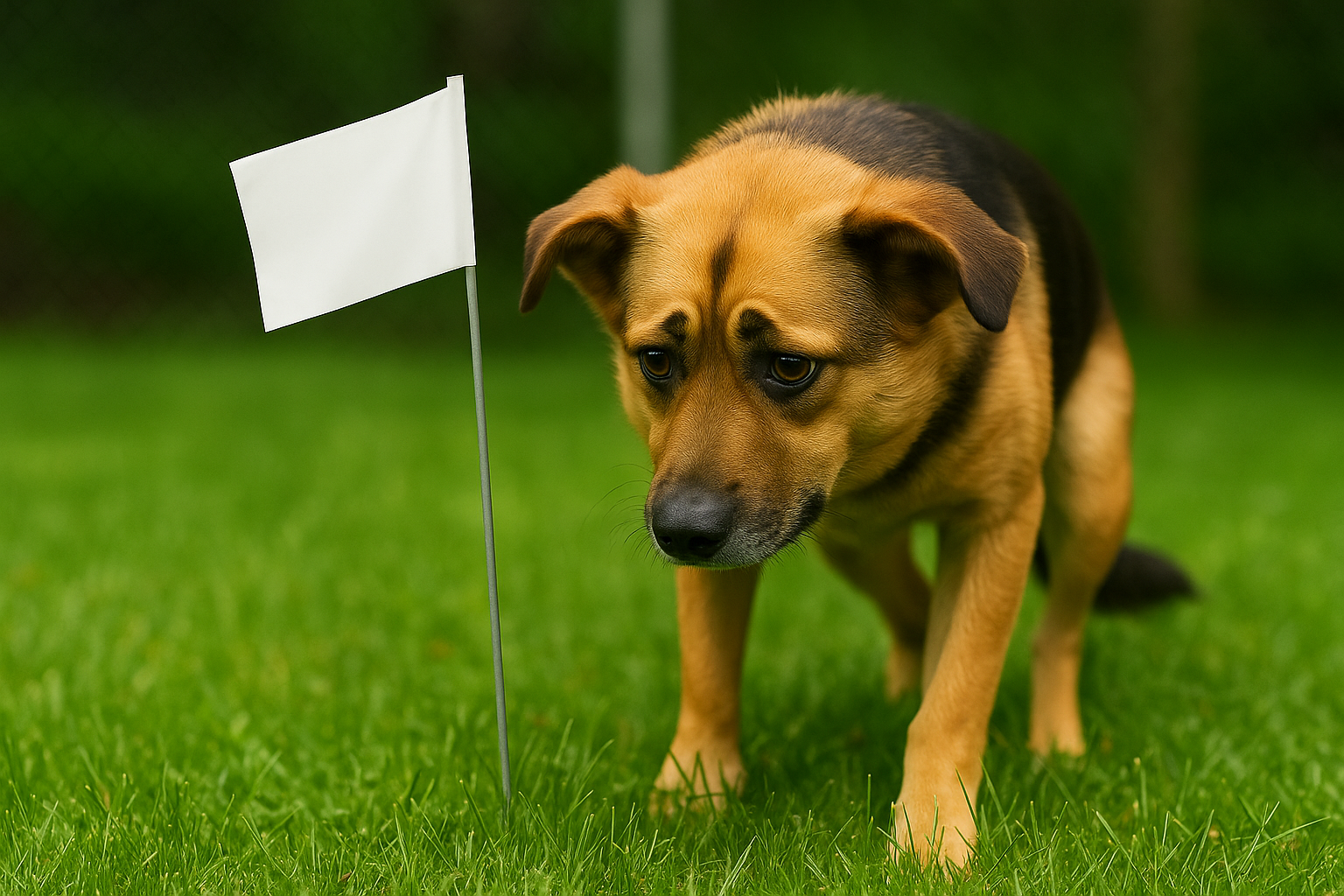
Training flags to mark the boundary essential for gentle dog fence training
Gentle DogFence Training Checklist for Anxious Dogs
Allow calm familiarisation time in the garden before activating the system.
Introduce the collar gradually, pairing it with treats and praise.
Use training flags to make the boundary clear and visible.
Start with the warning beep only, then add the gentle correction when your dog understands the flags.
Keep sessions short, positive, and consistent.
Always guide your dog back into the safe zone with calm reassurance.
Celebrate successes – nervous dogs thrive on confident, happy feedback from you.
When to Ask for Professional Help
Every nervous dog is different. Some adapt quickly with a little reassurance; others need a more tailored approach. If your dog has a history of severe anxiety, is a very nervous rescue, or you’re simply unsure where to start, it can be reassuring to have expert support.
At DogFence Ltd, our installers are experienced in working with anxious, timid, and sensitive dogs. We’ll help you choose the correct settings, show you exactly how to introduce the system gently, and support you through the training process so both you and your dog feel confident. If you’d like expert help from the start, our professional installation service (https://dogfence.co.uk/installation/) ensures the system is set up correctly and your nervous dog receives gentle, confidence-building training.
Our professional DogFence installers are highly experienced in training nervous and sensitive dogs—helping them gain confidence and enjoy safe freedom in the garden.
https://dogfence.co.uk/wp-content/uploads/2025/11/nervous-dog-training-white-flag-dog-fence.png10241536Sam Folleyhttps://www.dogfence.co.uk/wp-content/uploads/2015/10/dogfences_logo_main_cats_orange2.pngSam Folley2025-11-28 07:00:162026-09-02 14:48:07Training a Nervous Dog to a Dog Fence: 7 Common Mistakes
Can anxious dogs use an invisible dog fence? Absolutely — when introduced with gentle, structured training, an invisible fence can help anxious dogs feel calm, confident, and secure outdoors. At DogFence Ltd, we specialise in training that builds trust, using our humane FM-based containment system to guide rather than startle your pet.
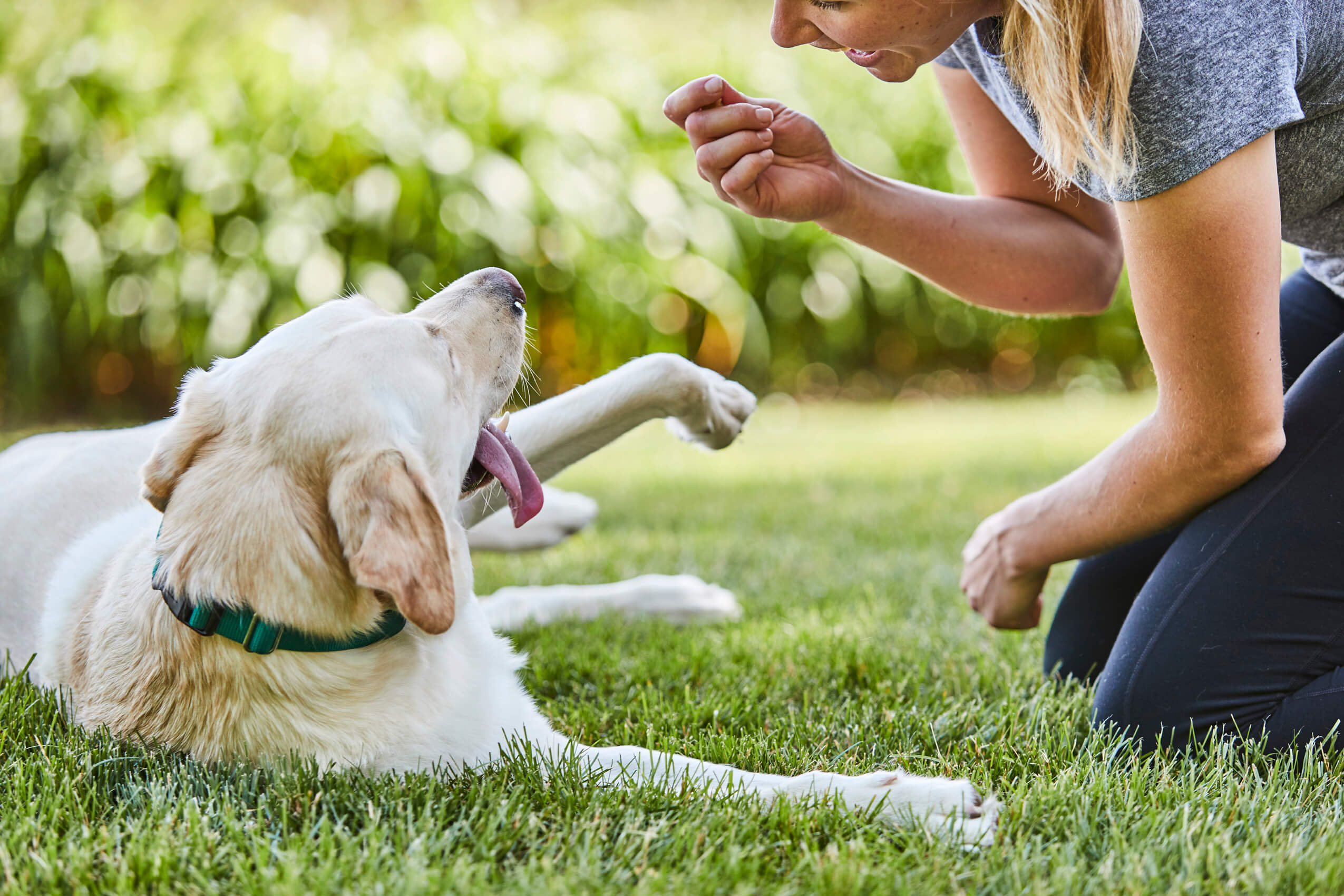
Calm, positive training helps anxious dogs feel safe and confident when learning their invisible fence boundary.
Understanding Anxiety in Dogs
Just like people, dogs can experience anxiety for many reasons — new environments, loud noises, separation, or a lack of clear boundaries. When asking yourself, can anxious dogs use an invisible dog fence safely, it’s important to remember that the success lies in calm, consistent training that gives your dog a sense of predictability and security.
At DogFence Ltd, we’ve worked with thousands of sensitive and anxious dogs across the UK. Our approach focuses on clear communication, trust, and repetition — the key ingredients for helping anxious pets feel calm and in control.
How an Invisible Dog Fence Works for Anxious Dogs
An invisible dog fence, sometimes called a hidden or wireless containment system, uses a boundary wire carrying a harmless FM radio signal. Your dog wears a lightweight collar that picks up the signal and emits a warning beep as they approach the boundary. If they continue forward, the collar delivers a brief, mild static pulse — similar to a light static tap — to remind them to step back into the safe area.
The goal is not punishment but communication. With careful training, anxious dogs learn to associate the warning beep with retreating to safety, giving them clear, reliable feedback every time.
Gentle Training: The Key to Success
When people ask, can anxious dogs use an invisible dog fence without feeling frightened, our answer is yes — provided the training is slow, positive, and supportive. Our installers use a calm, step-by-step method that introduces the boundary gradually using training flags, voice cues, and praise. Sessions are short to prevent overstimulation and ensure every experience builds confidence.
If your dog tends to be nervous, read our related post Are Electric Fences OK for Nervous Dogs? to learn how similar gentle principles help sensitive pets adjust safely.
Gentle invisible dog fence training helps dogs build confidence and enjoy safe freedom outdoors.
Behavioural Benefits for Anxious Dogs
Invisible dog fences provide more than containment — they offer structure and clarity. When anxious dogs understand exactly where their boundaries are, their anxiety often decreases. Over time, this clear structure helps them relax, explore, and play confidently within the safe zone.
We’ve seen countless examples of anxious rescue dogs that initially feared open spaces, but with patient DogFence training, began to enjoy their gardens freely and calmly. Predictability builds trust, and trust reduces anxiety.
Safety and Welfare Recognition
DogFence systems are DEFRA-tested and recognised as safe and humane when used correctly. Our FM-based technology ensures there are no false activations, unlike cheaper AM systems. Every collar is individually programmed to your dog’s size and temperament, and the correction shuts off automatically after 15 seconds for complete peace of mind.
Even for anxious or sensitive dogs, this system provides consistent feedback without fear or confusion — a key factor in responsible, welfare-friendly training.
Can Anxious Dogs Use an Invisible Dog fence Outdoors?
So, can anxious dogs use an invisible dog fence? Absolutely. With gentle introduction and calm reinforcement, the fence becomes a reassuring guide rather than a source of worry. The result is a happier, more confident dog who understands their boundaries and enjoys outdoor freedom safely.
If you’d like advice on whether an invisible dog fence is suitable for your pet, visit our Dog Fence FAQ page or speak with our experienced team — we’re always happy to help.
After gentle training, anxious dogs relax and feel secure within their invisible dog fence boundary.
https://dogfence.co.uk/wp-content/uploads/2025/10/Retriever-and-lady.jpg17002550Sam Folleyhttps://www.dogfence.co.uk/wp-content/uploads/2015/10/dogfences_logo_main_cats_orange2.pngSam Folley2025-10-24 07:00:052026-03-02 13:28:29Can Anxious Dogs Use an Invisible Dog Fence? | by DogFence Ltd
A radio dog fence works by sending either a coded AM or FM signal through a small boundary wire that’s laid around your garden or designated safe zone. The system does not carry any electric current in the wire — it’s completely safe to touch, even if the wire is cut or damaged.
Instead, the boundary wire acts as an antenna, carrying the AM or FM radio signal from the transmitter. This creates an invisible 360-degree signal field around the wire. The width of that field — known as the avoidance zone — can be adjusted to suit the size of your garden, your pet’s temperament, and the layout of your property. An average setting is around 4 ft on either side of the wire.
Your pet wears a receiver collar that’s programmed to recognise only the unique AM or FM signal produced by your DogFence transmitter. As your pet moves towards the boundary:
The collar emits a warning beep as they enter the avoidance zone.
If they continue forward, the collar delivers a gentle impulse alongside the beep.
At DogFence all our systems use a digital FM signal.
With professional training, your pet quickly learns that the warning tone means “stop and return to the safe area.” Once your pet moves back into the safe zone, our FM receiver collar instantly shuts down — there’s no lingering correction or delay.
In contrast, AM-based systems typically have a slower response and hang-on time (often 2–5 seconds), meaning the correction can continue even after the pet has turned back. The FM system avoids this issue entirely, offering a faster, safer, and more reliable response.
The result? A containment fence that offers both freedom and safety for your pets — and peace of mind for you.
DogFence uses FM technology because it’s safer, faster (up to 15 times faster in some cases), and more consistent than AM:
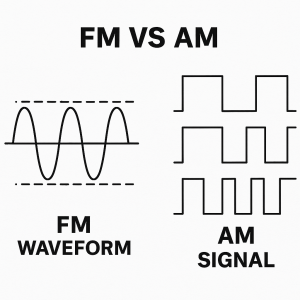
✅ No weak spots — FM signals are continuous (wave form, not step form).
✅ Fewer false activations — corrections happen only at the boundary (FM signals do not pick up interference).
✅ Faster reaction — collars check once, not twice (faster start up and shut down).
✅ Gentler training — pets learn quickly when the boundary is clear.
With an FM system, your pet gains freedom without confusion.
AM (Amplitude Modulation) systems have to check for two separate signals — a carrier and a modulation pulse — before reacting. This makes them slower and creates brief “gaps” in the signal where interference from Wi-Fi, garage doors, or electric gates can slip through.
FM systems like DogFence need to recognise only one smooth, continuous waveform, so the collar responds almost instantly and isn’t confused by external signals.
Because FM operates in a wave form rather than a step pattern, it’s both faster and more stable. That means your dog’s collar activates at the correct point — every time — giving precise correction only at the true boundary, nowhere else.
FM vs AM radio dog fence signals – FM uses a smooth, continuous waveform while AM uses a step signal that can cause interference and false activations.
What are the important elements of radio dog fence training?
Training flags for clear visual markers. A visual for you pet to see.
Audible tones as early warnings. An audible tone for your pet to hear
Short daily sessions of 5–10 minutes. Little and often – we all learn better in bite size chunks!
Custom settings suited to your pet’s breed and temperament. Impulse something to feel.
Most pets understand their new radio dog fence within a week. Many people think a radio dog fence is only for dogs, but with the right technology and smaller receiver collars, these systems are also ideal for safely containing cat
Not quite. Some suppliers advertise “digital” systems, but:
Digital AM is still AM — step signals, weak points, interference risk.
Digital FM combines programmable digital collars with a strong, interference-free FM signal.
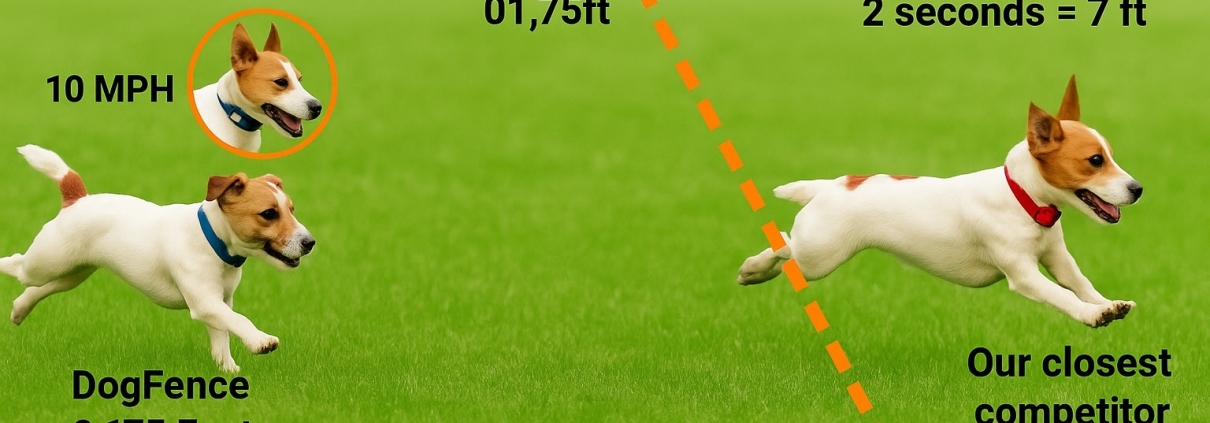
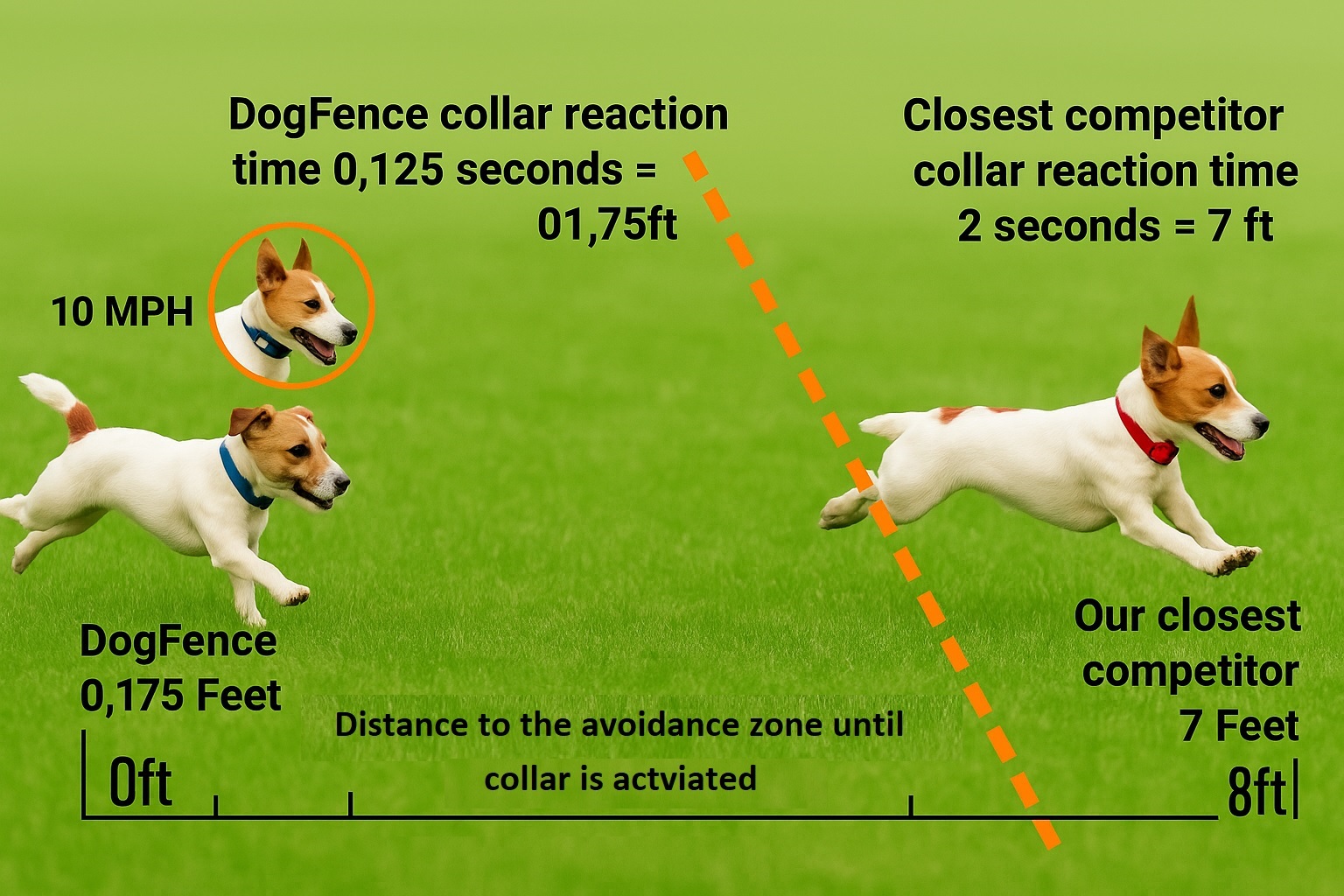
DogFence only uses FM digital radio dog fences — the safest option for UK gardens. Our FM dog fences react almost instantly — up to ten times faster than AM fences. That means if your dog is running at 10mph, they’ll stop about 7 feet sooner, keeping them safely inside your garden.”
At 10mph, DogFence’s FM collar reacts in just 0.125 seconds—stopping your dog after only 1.75ft. The nearest competitor reacts in 2 seconds, allowing a 7ft run into the avoidance zone
DogFence: Trusted UK Experts
DogFence Ltd has been installing radio dog fences across England since 2003. We were proud to be the only UK company consulted by DEFRA during the government’s review of electronic collars, where our input helped secure the official exemption of pet containment systems.
This exemption recognised not only the importance of correct training and professional installation, but also the built-in safety features unique to our DogFence system.
When announcing the exclusion of containment fences from the wider e-collar ban, the government also indicated plans to introduce legislation requiring all electronic pet fences to be professionally installed. At the time of writing, these proposed changes — along with the formal e-collar ban — have not yet been enacted into law.
Why are dog fence are the best option to install your electronic pet fence?
Over 22 years’ experience
Trusted by 20,000+ pets
Lifetime warranty & containment promise on installed systems
Want to learn more about how to install a radio dog fence or keep your pet safely contained?
Join thousands of UK pet owners who trust DogFence to keep their dogs and cats safe at home.
Our systems are proven, reliable, and backed by a lifetime warranty.
https://dogfence.co.uk/wp-content/uploads/2025/10/dogfence-fm-vs-am-collar-reaction-speed-comparison.jpg10241536Sam Folleyhttps://www.dogfence.co.uk/wp-content/uploads/2015/10/dogfences_logo_main_cats_orange2.pngSam Folley2025-10-17 07:00:382026-03-02 13:32:58What is a Radio Dog Fence: FM vs AM Explained | DogFence Ltd
Many owners ask are electric dog fences OK for nervous dogs and can they really be used safely — the answer is yes, when introduced gently and correctly. At DogFence Ltd, we specialise in helping nervous or anxious dogs build confidence and enjoy freedom outdoors using our safe, FM-based containment system.
Just like people, every dog has its own personality and confidence level. Some dogs are naturally bold and curious, while others can be shy, anxious, or easily startled by new sounds or experiences. These “nervous” dogs often need extra reassurance and consistency — especially when introducing new boundaries or training tools.
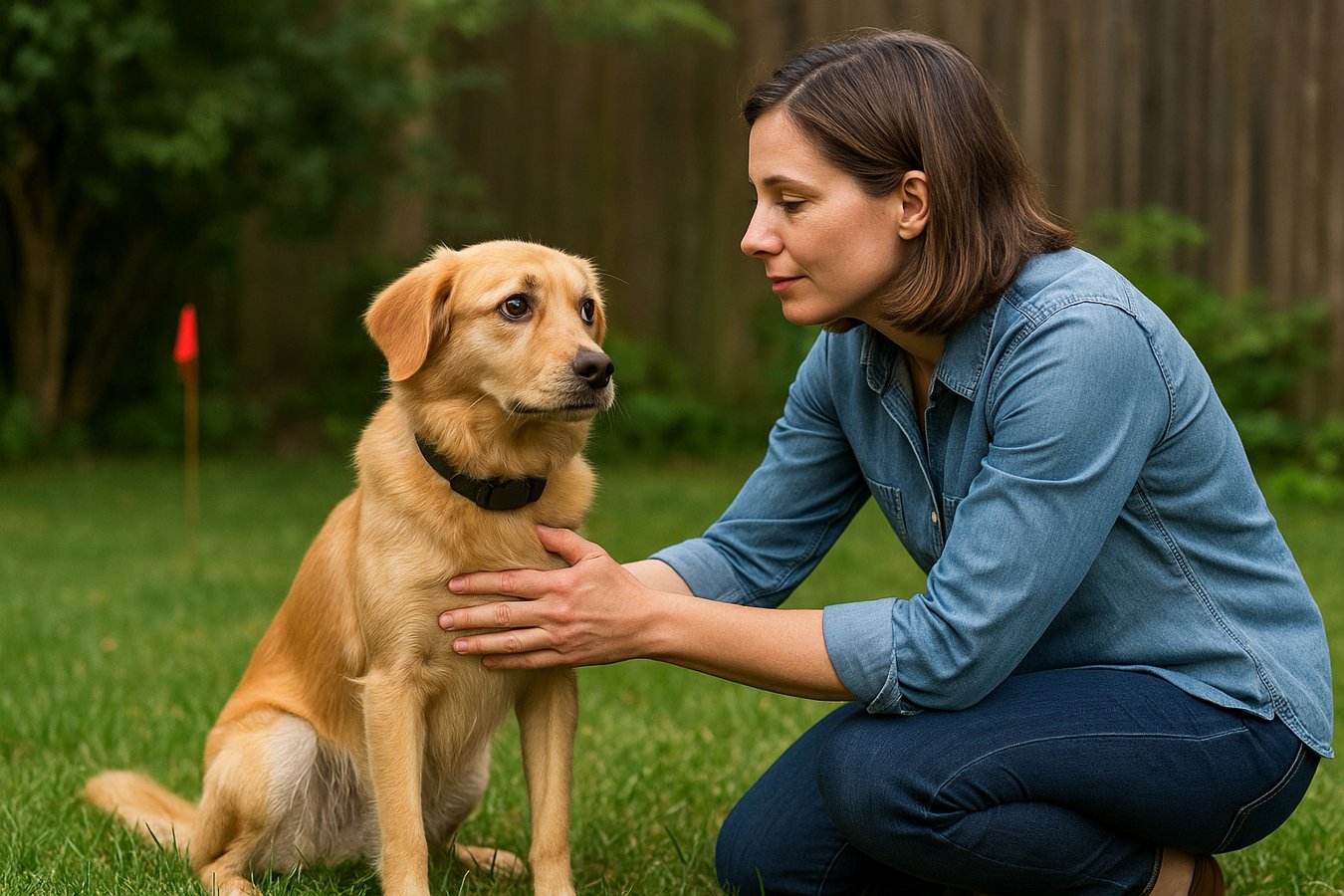
A calm, reassuring training moment between an owner and her nervous dog — showing how gentle, FM-based DogFence training builds confidence and trust outdoors.
At DogFence Ltd, we’ve worked with thousands of nervous and sensitive dogs across the UK. From timid rescues to easily startled spaniels, we’ve seen first-hand how calm, consistent training helps build confidence. The key is always gentle guidance and positive reinforcement, never fear.
How Our Dog Fences Work for Nervous Dogs
A common misconception is that electronic dog fences “shock” or frighten pets. In reality, our FM-based DogWatch® systems work through gentle conditioning and clear communication:
A hidden boundary wire carries a harmless FM radio signal around your garden.
Your dog wears a lightweight receiver collar, which picks up that signal.
As your dog approaches the boundary, the collar emits a warning beep.
If they continue forward, the collar gives a brief, mild static pulse — similar to a light static tap from a jumper.
They key to this is our gentle training programme.
UK veterinary behaviour experts, including Professor Daniel Mills, have explained that a dog’s experience of the mild static sensation from a modern electronic fence can be compared to touching a warm oven by accident — it’s a brief, harmless surprise that teaches awareness, not fear. Just as that moment wouldn’t stop a person from going back into the kitchen, a nervous or sensitive dog doesn’t become afraid of the garden after training. The key is gentle, steady guidance so your dog learns what to do and where to go with confidence.
Professor Daniel Mills, University of Lincoln, has conducted extensive research into canine learning, welfare, and behavioural medicine, helping owners and professionals better understand how dogs and cats respond to different forms of training.
Many owners ask us, are electric fences OK for nervous dogs? In our experience, the answer depends on the training approach, not the technology itself.
Most dogs learn from the audio cue alone, and never trigger a correction again once training is complete. The goal is to help your pet understand where they can safely play, not to punish them.
Our systems include advanced features that make them ideal for nervous dogs:
Programmable correction levels – tailored to your pet’s size and temperament.
Gentle learning curve – structured training plan designed to build confidence.
Auto shut-off safety – collar stops correcting after 15 seconds if the dog remains near the line.
FM technology – avoids false activation and interference common with cheaper AM systems.
Gentle DogFence training helps even sensitive dogs enjoy their garden safely and confidently.
Behavioural Benefits for Anxious or Sensitive Dogs
For nervous or anxious dogs, clear boundaries create a sense of security. Once they understand where they can go safely, their confidence grows rapidly. With a DogFence system, they quickly learn the limits of their outdoor freedom and begin to feel more secure — not less. The process mirrors how dogs learn to sit, stay, or walk on a lead: through consistency and repetition.
During training, our installers use calm body language, reward-based praise, and step-by-step introduction. This method helps anxious pets connect the warning tone with retreating to safety — a behaviour that soon becomes automatic. Once your dog understands the fence, you’ll likely notice them becoming more relaxed and confident outdoors. They can enjoy freedom without the constant worry of escaping or getting into danger — and you’ll have peace of mind knowing they’re protected.
What About Nervous Rescue Dogs?
Rescue dogs often arrive with unpredictable backgrounds and fears, which can make traditional fencing or recall training difficult. Our trainers adapt the DogFence introduction to each dog’s pace — starting with visual markers like flags and calm, leash-led practice sessions.
Many rescue owners tell us their dogs actually become calmer after fence training, because they finally understand where they’re allowed to roam. The fence becomes a source of security, not anxiety.
Is It Humane and DEFRA-Recognised?
Yes. DogFence systems are DEFRA-tested and recognised as a safe, humane training aid when used correctly. They’re specifically designed to reinforce learning, not to cause pain or distress. The static correction is mild, momentary, and fully adjustable — and the system is completely safe to touch, even if the wire is damaged.
We’ve successfully contained more than 20,000 pets across England, with many owners reporting that their previously nervous dogs became more confident and relaxed once they understood their safe zone.
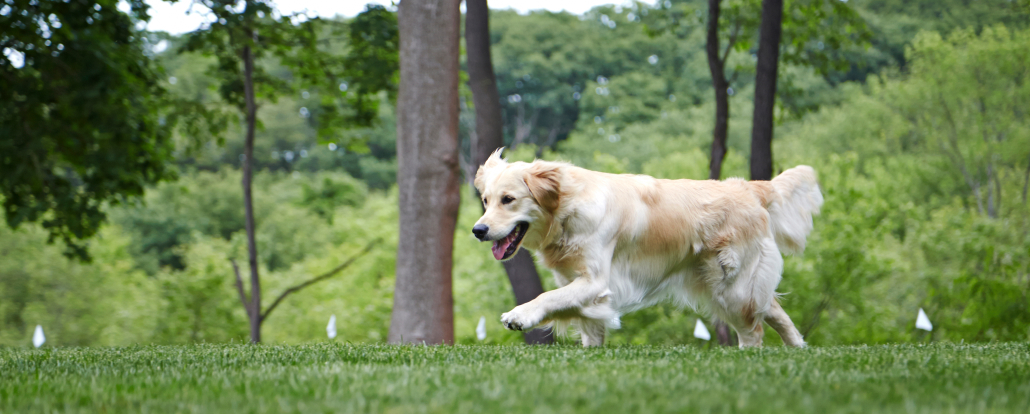
After gentle, consistent training, dogs gain confidence and freedom — safely contained within their DogFence boundary.
Want to Learn More?
If you’re wondering how an electronic dog fence could help your nervous or anxious pet, take a look at our full FAQ:
https://dogfence.co.uk/wp-content/uploads/2025/10/dogfence-nervous-dog-training.jpg9001350Sam Folleyhttps://www.dogfence.co.uk/wp-content/uploads/2015/10/dogfences_logo_main_cats_orange2.pngSam Folley2025-10-13 12:30:332026-09-02 15:19:49Are Electric Dog Fences OK for Nervous Dogs? | by DogFence Ltd