How to Stop Dog Digging Under Fence (UK Guide)
How to Stop Dog Digging Under Fence (UK Guide)
Stop dog digging under fence behaviour quickly, and it can save you from a much bigger escape problem later. In most cases, digging along the fence line means your dog is trying to get out — reinforcing the boundary properly, rather than just filling in the hole, is what actually stops it for good.

Some dogs will stop at nothing to escape – the best dog fence designs prevent digging with hidden underground protection.
If your dog has started tunnelling along the boundary, it’s rarely random. What begins as one small hole can quickly turn into repeated attempts at escaping under the fence — especially once they realise it works.
Before you can prevent dog digging out for good, you need to understand what’s driving it. If you’re unsure what motivates escape behaviour more broadly, read our complete guide on how to stop your dog escaping from the garden.
For many UK owners — particularly those with larger or rural properties — creating a truly secure garden for digging dog breeds requires more than just filling in the hole. Our guide on how to dog proof your garden properly covers the wider approach if digging isn’t the only escape route you’re dealing with. This guide focuses specifically on digging, and on how DogFence can offer a permanent alternative once you’ve already tried the obvious fixes.
Why Is My Dog Digging Under the Fence?
When you need to stop dog digging under fence behaviour, the first step is identifying the motivation. Fence-line digging almost always has a purpose.
Digging to Escape the Garden
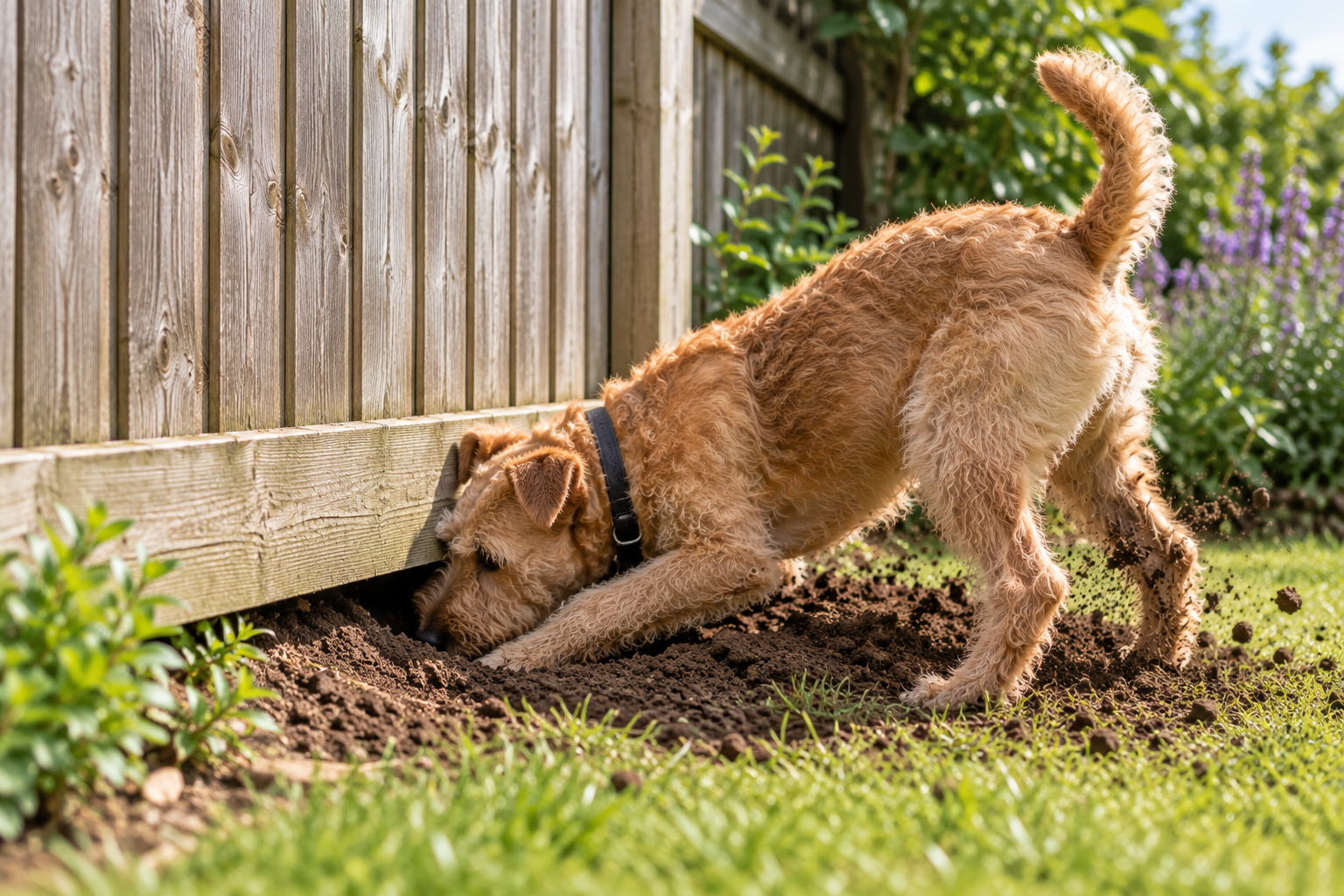
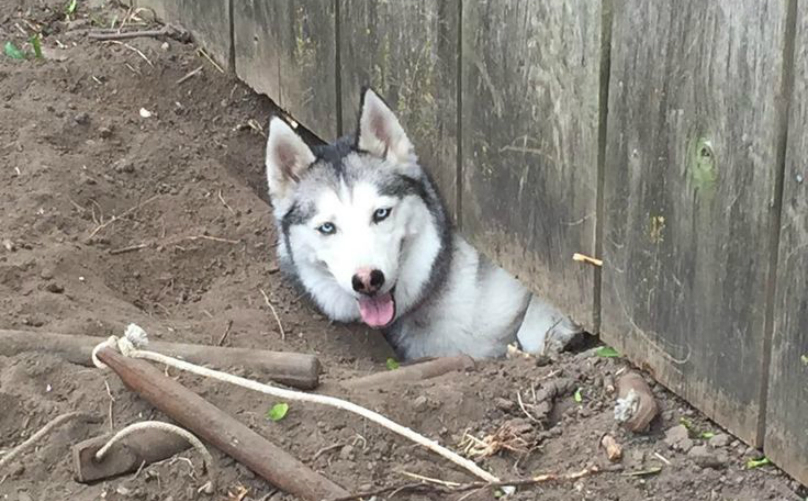
A Lakeland Terrier digging under a garden fence — a common early sign of escape-driven behaviour.
If your dog is consistently digging along the boundary, this is classic dog-digging-to-escape-garden behaviour.
Common triggers include:
- Wildlife beyond the fence (deer, rabbits, squirrels)
- Livestock in neighbouring fields
- Other dogs nearby
- Public footpaths
- Separation anxiety (the RSPCA offers helpful guidance on recognising and managing anxiety-related behaviours)
Once a dog succeeds at escaping under a fence, the behaviour becomes reinforced. Freedom becomes the reward.
Breed Instinct (Terriers & Working Dogs)
Some breeds are naturally wired to dig. Terriers, for example, were bred to hunt prey underground. For these dogs, digging isn’t disobedience — it’s instinct.
If you have a determined digging breed, standard fencing alone may not be enough to prevent dog digging out long term — this is exactly the kind of persistent case where DogFence tends to outperform repeated physical repairs.
Digging to Stay Cool in Summer
In warmer weather, some dogs dig shallow pits to lie in cooler soil. These holes are usually:
- Away from the boundary
- In shaded areas
- Not tunnel-shaped
If your goal is to stop dog digging under fence, but the holes are central in the garden, temperature may be the real cause.
Boredom and Excess Energy
Young, intelligent or high-drive dogs may dig simply because it’s stimulating. Without structured walks, mental enrichment, training interaction or scent work, digging becomes self-rewarding entertainment.
However, boredom digging rarely focuses repeatedly on the fence line — persistent boundary digging usually indicates escape motivation instead.
Why the Obvious Fixes Don’t Last
If you’ve already tried burying chicken wire, adding gravel boards, or blocking a hole with a paving slab — you’ll know the frustration. It works for a few days, then your dog either reopens the same spot or moves 30cm along and starts again.
That’s because these methods only ever address where the last hole was, not why your dog is trying to leave. A genuinely determined dog will keep testing the boundary until the motivation itself is dealt with.
Did you know there’s another way? Instead of repeatedly reinforcing the fence itself, you can train your dog to stay away from the boundary altogether — and it’s a lot more straightforward, affordable and flexible than most owners expect.
The Most Reliable Way to Stop Dog Escaping Under Fence
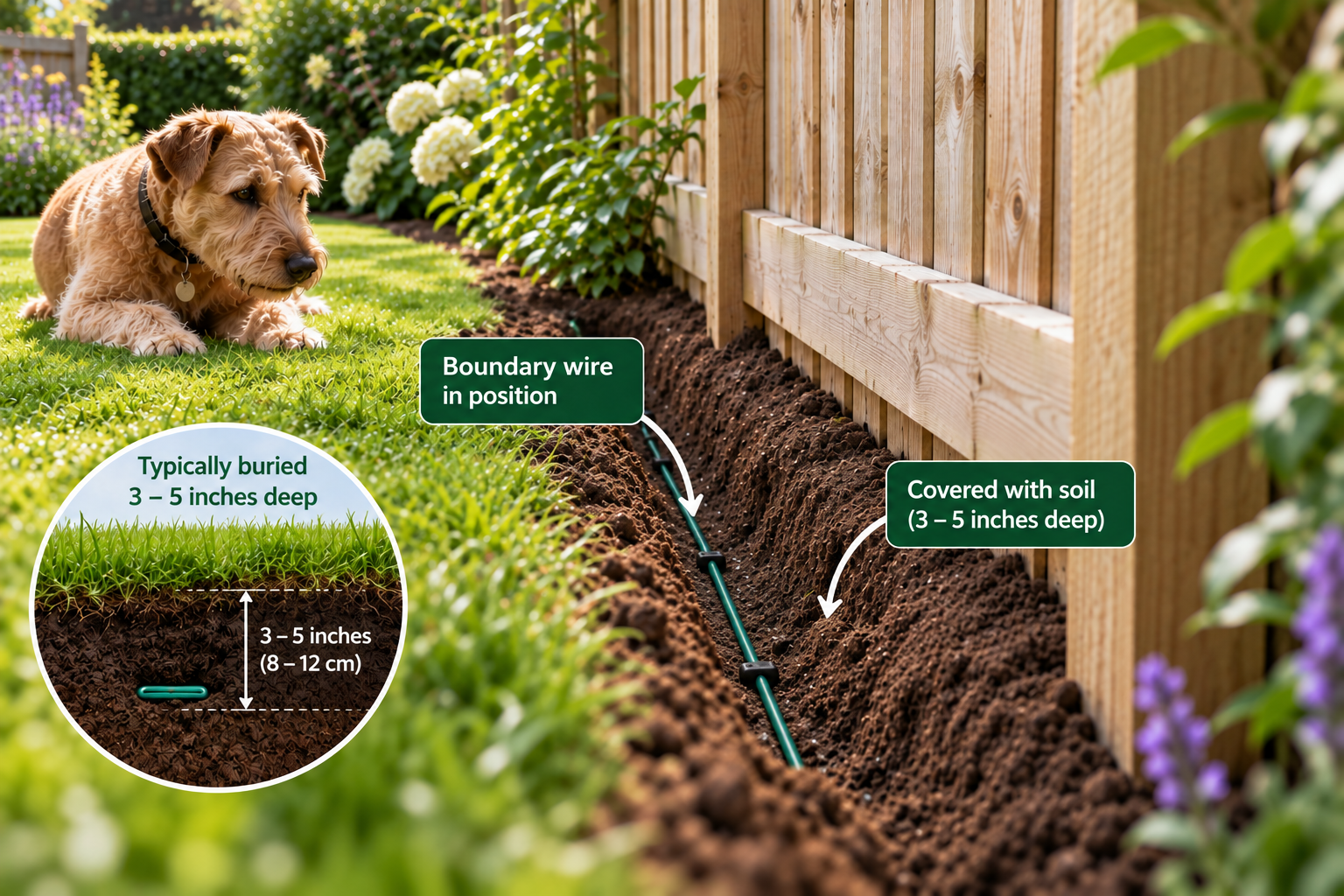
DogFence is the UK’s leading invisible dog fence specialist, helping owners create a secure dog fence for their garden without relying on ever-taller panels or buried mesh. Since 2003, we’ve installed hidden dog boundary fences for thousands of UK gardens — from small suburban plots to large rural properties where a conventional fence was never going to be practical.
Rather than trying to out-build a determined digger, our invisible dog fence changes how your dog relates to the boundary altogether.
How It Works
A boundary wire is buried discreetly around your garden and connected to a small transmitter. Your dog wears a lightweight receiver collar. As they approach the trained boundary — well before the physical fence — the collar gives a clear audible warning. With consistent, professional training, most dogs quickly learn to turn away at that point rather than testing the fence at all. There’s no gravel board to dig past and no gap to find, because the dog stops approaching the edge in the first place.
Training is built into every installation, not left for you to work out afterwards. Our installers introduce your dog to the boundary using temporary training flags and short, structured sessions, so they understand the new limits with confidence.
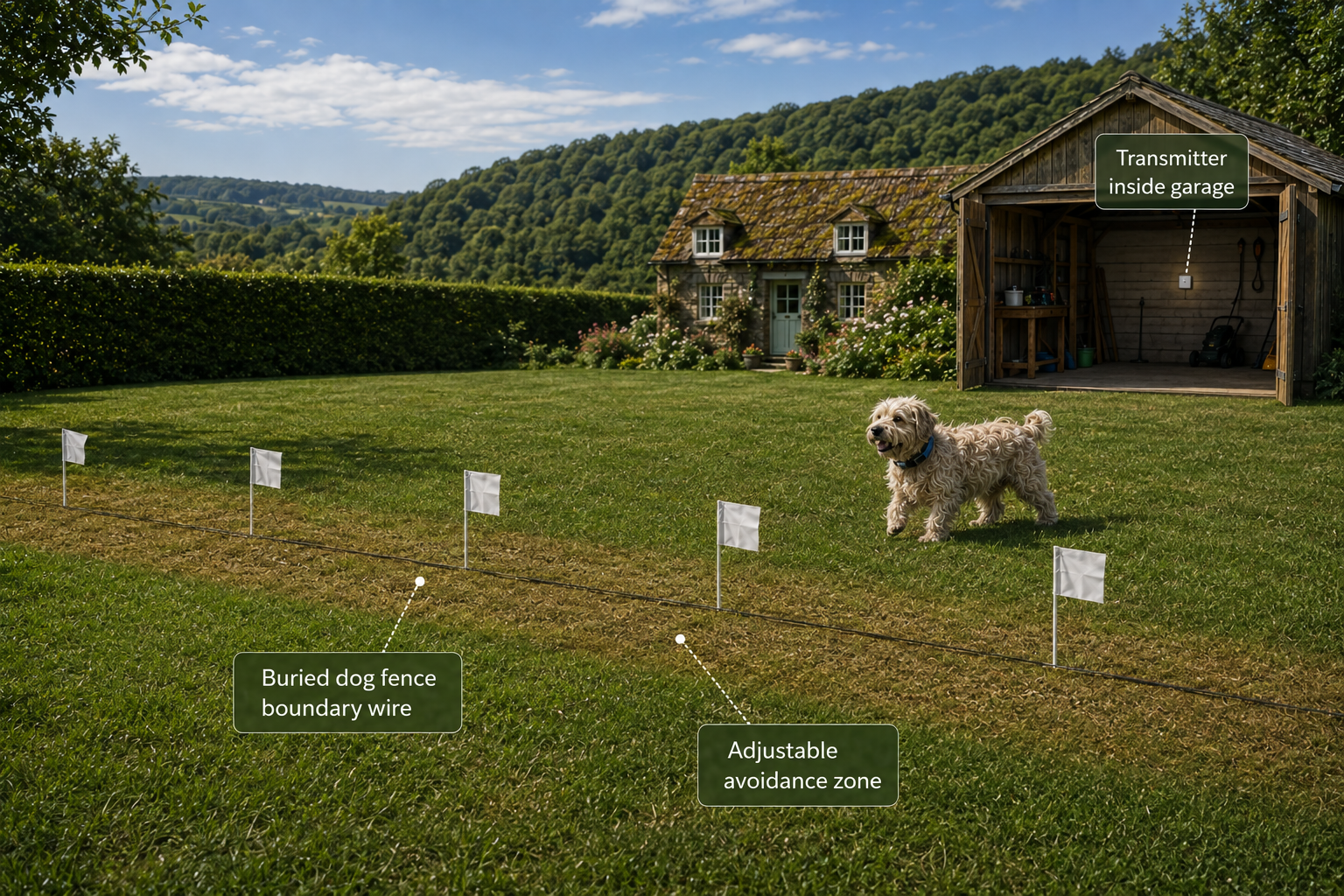
The DogFence system uses a buried boundary wire, training flags and a receiver collar to create a safe, clearly defined area for your dog.
Quicker and Cheaper Than You’d Think
Most gardens can be fitted with a DogFence system in a single visit, with no groundworks, trenching, or lengthy construction. Compared with the cost of replacing or reinforcing fence panels — particularly across a large or awkward boundary — an invisible dog fence is typically a more affordable option, and there’s no ongoing repair bill every time a section of wire mesh gets dug up or a gravel board rots.
It Covers Driveways and Awkward Boundaries Too
A physical fence has to stop somewhere — usually at a driveway, gate, or awkward corner where a solid barrier isn’t practical. A dog boundary fence from DogFence doesn’t have that problem. The wire can be routed straight across an open driveway or entrance, so your dog is contained without needing a gate that someone might forget to close.
It Moves With You
Because the system isn’t built into your fence, it isn’t tied to your house either. If you move home, the equipment can be taken with you and reinstalled at your new property — unlike a fence, which stays behind with the house you’re leaving.
This combination makes DogFence particularly effective for:
- Post-and-rail fencing or hedge boundaries, where there’s no solid base to reinforce
- Large rural perimeters, where burying wire mesh along every metre is impractical or prohibitively expensive
- Sloping or uneven terrain, where gaps naturally reappear as the ground shifts
- Open driveways and entrances, where a physical gate isn’t wanted or practical
- Determined digging breeds that will simply relocate to a new spot once one is blocked
Because the boundary is invisible, you’re also not compromising the look of your garden with trenches, wire mesh, or reinforced panels — your fence, hedge or wall stays exactly as it is.
Find out more about how the system works on our How DogFence Works page.
Already tried the DIY fixes without success? Let DogFence assess your garden and dog’s specific pattern for free.
When Should You Be Concerned?
If your dog has already succeeded in escaping under fence panels once, the risk increases significantly. Escaping dogs face road traffic, livestock incidents, getting lost, and legal liability.
Fence-line digging is often an early warning sign that your current setup is not secure enough — and a good moment to consider whether DogFence could close that gap permanently.
Frequently Asked Questions About Dogs Digging Under Fences
Why has my dog suddenly started digging under the fence?
Look for a change: new wildlife or livestock nearby, another dog, a female in season, hot weather, or increased boredom. Persistent digging concentrated on the boundary line usually points to escape motivation rather than a one-off habit.
I’ve already tried gravel boards and wire mesh — why isn’t it working?
These methods block a specific spot, but a motivated dog will usually just move along the fence line and try again nearby. DogFence takes a different approach: rather than reinforcing the physical fence, it trains the dog to stay away from the whole boundary, so there’s no gap left to find.
How long does a DogFence installation take?
Most gardens can be fitted in a single visit, with no trenching or major groundworks required, followed by a structured training period so your dog learns the new boundary confidently.
Is a hidden fence cheaper than replacing my fencing?
Often, yes — particularly on larger or awkward boundaries where reinforcing every metre of physical fence would be costly. It also avoids the ongoing cost of repairing dug-up mesh or rotted gravel boards.
Can DogFence cover my driveway or an open gate?
Yes. The boundary wire can be routed across a driveway or entrance, keeping your dog contained without needing a gate that could be left open.
Can I take the system with me if I move house?
Yes. Unlike a fence, the DogFence equipment isn’t fixed to the property — it can be uninstalled and set up again at your new home.
Are certain breeds more likely to dig under fences?
Yes. Terriers and other breeds developed to hunt underground have a strong natural instinct to dig, so standard fencing reinforcement alone is often not enough for these dogs long-term. DogFence is a popular choice for owners of persistent digging breeds for this reason.
Should I get my dog neutered to stop the digging?
Neutering may reduce hormone-driven escape attempts in some dogs, but it isn’t a guaranteed fix if the dog has other strong motivations to leave the garden.
Final Thoughts: How to Stop Dog Digging Under Fence for Good
To stop dog digging under fence permanently, you need to address both the reason your dog wants to leave and the weakness in the boundary.
Digging is communication. Your dog may be saying they’re bored, anxious, too hot, or that they want what’s on the other side. When you understand the motivation and secure the full perimeter — not just the hole — most dogs stop trying to escape.
And your garden, and your peace of mind, can finally recover.
Over the past two decades, DogFence has seen that when the full boundary is clearly defined and properly introduced, digging behaviour almost always settles. Rather than constantly repairing panels or burying wire, a professionally installed DogFence system addresses the root cause — removing the reward for escape and restoring safety to the entire property.
Tired of Repairing Fence Holes?
If your dog keeps digging under the fence, let DogFence secure your boundary properly and stop escape attempts for good.
Call us: 01628 476475 | WhatsApp: Message us | Request a Free Quote Online
More Dog-Proofing Advice
Every dog and garden is different. If you’re dealing with a particular escape route or problem area, these DogFence guides will help:
- How to Stop Your Dog Escaping from the Garden – practical solutions for dogs that jump, dig, squeeze through gaps or run through open entrances.
- How to Dog Proof Your Garden Properly – a complete garden-by-garden approach to creating a safer, more secure space.
- How to Stop Your Dog Jumping the Fence – what to do if your dog can jump or climb your existing garden fence.
- How to Stop a Dog Running Out of an Open Driveway or Electric Gate – ways to secure one of the most difficult escape points without blocking vehicle access.
- Dog Proof Fencing for Rural Properties – advice for large gardens, post-and-rail fencing, five-bar gates, open driveways and uneven countryside properties.
For a complete explanation of the system itself, visit How DogFence Works.
Some images used in this article are AI-generated or stock photography used to illustrate typical scenarios and are not necessarily taken at real DogFence installations.