Tag Archive for: invisible dog fence

dog with lead - no dog fence collar on

How do I take my dog for walk if I use a dog fence?

How do I take my dog for a walk if I use a dog fence?

After you have had your dog fence installation one of the most common questions we get asked at DogFence is “how do I take the dog for a walk?”.

It’s actually really simple. The DogFence installer will have trained your dog or cat to stay within the dog fence boundary.  This is a reverse training protocol and usually takes the dog approx 7 – 10 days to feel fully comfortable with leaving the property.

There are 2 main points to observe:

  • Never allow your dog to cross the boundary unless he has contact with you. This could be with the lead or by carrying him or simply having a hand on his shoulder.
  • Never allow your dog to cross the boundary with his fence collar on – even with the system turned off.

To cross the boundary:

  1. Remove the dog fence collar and put it in a safe place. Do not turn off the fence.
  2. Pop him on his lead and walk him up to the exit.
  3. Ask him to sit or stop him before the boundary line (only for the first week).
  4. Give the command to walk and walk slowly out of the property.
  5. Give him praise when you have crossed the boundary.
  6. Repeat the process when you re-enter the property.

The best way to see how it works is to watch the lovely Lionel demonstrating how it’s done:

When we install a dog fence for you we will run through how to take your dog for a walk after. As with any new training, it may take your dog a few days to adjust to going out for a walk. If you would like to learn more about how we can give your dog freedom in the garden check why not call us today on 01628 476475?


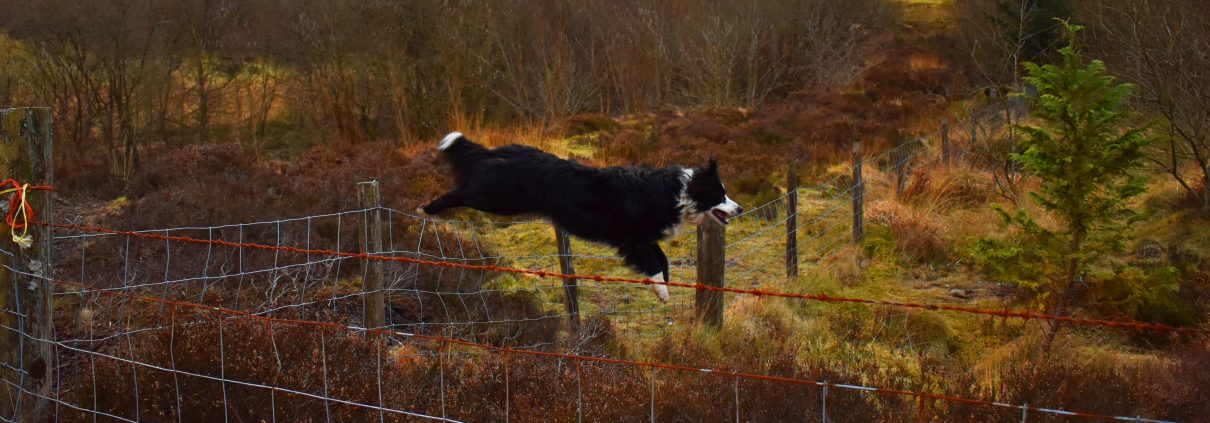
dog fencing idea gone wrong - Collie leaping over net fence in countryside

Dog Fence Solutions: Rural vs Urban Challenges

Dog Fence Solutions: Rural vs Urban Challenges

Finding the right dog fence solution is not always straightforward. A fence that works perfectly for one dog may be completely unsuitable for another. Some dogs jump, others dig, and determined escapees can find their way through surprisingly small gaps.

Where you live makes a difference too. A rural property with several acres, woodland and hedgerows presents very different challenges from a suburban garden with close board fencing and an open driveway.

At DogFence UK, we have been helping owners contain their dogs since 2003. Over more than 23 years, we have encountered almost every type of garden, boundary and escape attempt imaginable.

In this guide, we compare traditional and electronic dog fence solutions for rural and urban homes, including their advantages, limitations and the practical considerations that matter before you invest.

Rural vs urban dog fence solutions showing a Golden Retriever in a countryside garden with stock fencing and a terrier beside a wooden fence in a suburban garden.

Why Dogs Escape (and Why Fencing Matters)

Dogs escape for many reasons. Some are motivated by wildlife, interesting smells or other dogs. Others are bored, anxious, highly energetic or simply determined to explore beyond the garden.

Even a substantial fence may not solve the problem if a dog has learned to jump over it, dig underneath it or squeeze through gaps.

For rural owners, hedgerows can be particularly deceptive. A thick hedge might look like a secure boundary, but rabbits, foxes and badgers can create openings that quickly become escape routes.

Urban gardens have their own problems, including low fencing, neighbouring gardens, open-plan frontages and driveways that cannot easily be gated.

If your dog regularly finds a way out, our guide to affordable dog fencing options explores alternative ways of securing your property.

Rural Dog Fence Options

Rural properties are often among the most challenging to fence. Uneven ground, steep slopes, streams, woodland and long boundaries can make conventional fencing expensive to install and maintain.

The right solution depends on the size and layout of the land, your dog’s behaviour, the presence of livestock or wildlife, and whether a physical barrier is essential.

1. Stock Fencing
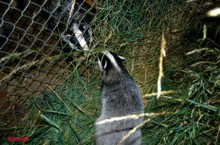
Badger digging beneath rural stock fencing, creating a potential escape route for dogs

Wildlife can create gaps beneath stock fencing that dogs may use to escape.

Stock fencing is a familiar sight across the British countryside. Originally designed for livestock, it can also provide a practical boundary for dogs, particularly where there is already an established fence line.

However, stock fencing is not automatically dog-proof. Smaller dogs may squeeze through the mesh, athletic dogs may jump it, and determined diggers can escape underneath.

Wildlife can also compromise the boundary. Badgers and foxes may create gaps beneath fencing, leaving openings that owners do not notice until their dog has disappeared.

Advantages: A physical barrier, suitable for long rural boundaries and useful where livestock also need containment.

Limitations: Installation and maintenance costs, potential wildlife damage, and the need for additional protection against digging or jumping.

2. Deer Fencing

Deer fencing is another option for larger rural gardens and estates. Its height can make it more effective than ordinary stock fencing for dogs that jump.

However, tall deer fencing can be visually intrusive, particularly around landscaped gardens or properties with attractive countryside views.

It can also be expensive across long boundaries. Although it provides a physical barrier, gaps at ground level or damage caused by wildlife can still create escape opportunities.

Advantages: Greater height, physical separation and suitability for certain rural boundaries.

Limitations: High installation costs, visual impact, ongoing maintenance and possible escape routes underneath.

3. Electronic Dog Fencing

For properties where traditional fencing is impractical, a professionally installed electronic dog fence can offer a discreet alternative.

Unlike a physical fence, an electronic dog fence uses a boundary wire, transmitter and receiver collar to establish a designated containment area.

The cable can follow irregular boundaries, run through hedgerows and woodland, and cross suitable driveway surfaces without the need for a visible fence along every section.

During training, temporary flags mark the boundary. The dog learns to recognise the receiver collar’s audible warning and return towards the safe area. If the dog continues into the correction zone, the collar can deliver an adjustable static correction.

Professional assessment and structured training are essential. An electronic boundary is not a physical barrier, will not exclude wildlife or other dogs, and may not be suitable for every animal.

For larger properties, electronic containment can be particularly attractive because installation costs are not necessarily proportional to the acreage in the same way as conventional fencing.

Our guide to dog fencing for large properties explains how hidden boundaries can be designed around fields, woodland, slopes and complex rural layouts.

Advantages: Discreet installation, flexible boundary design, potential cost savings on large properties and the ability to incorporate open driveways.
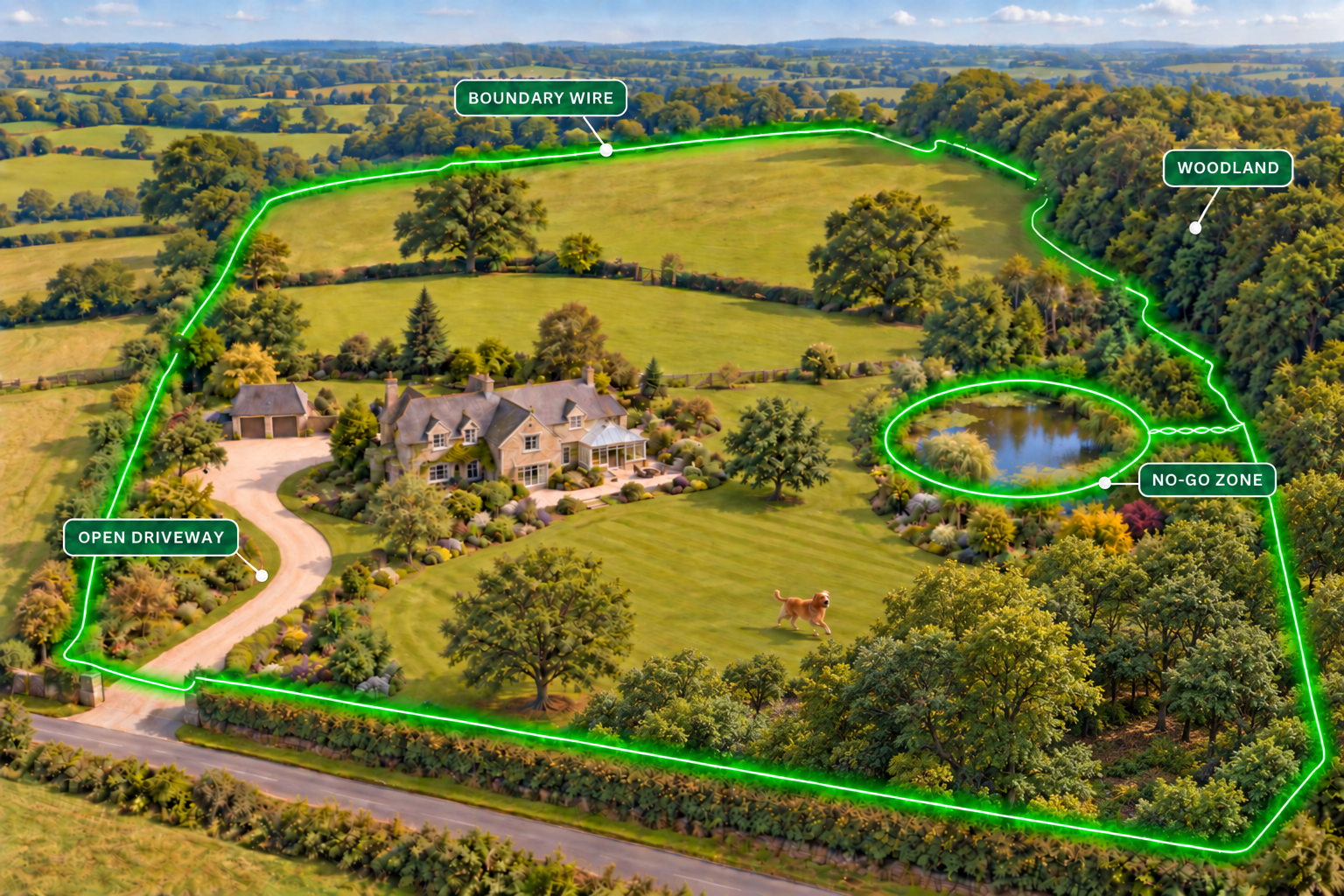
Underground dog fence for several acres with driveway,woodland and pond exclusion zone

4. Kennels and Dog Runs

A secure kennel or enclosed dog run can provide a useful containment option for rural properties, particularly when dogs need a supervised or temporary outdoor area.

A properly constructed run with secure sides, suitable roofing where necessary and protection against digging can provide physical containment without relying on an electronic collar.

However, the size and design matter. A small run is not a substitute for regular exercise, enrichment, companionship or opportunities to explore.

For dogs that spend significant time outdoors, sufficient space, shelter, shade, water and stimulation are essential.

Advantages: Physical containment, controlled access and suitability for specific situations.

Limitations: Restricted space, potential boredom, construction costs and ongoing cleaning and maintenance.

Urban Dog Fence Options

Urban gardens are often smaller than rural properties, but that does not necessarily make them easier to secure.

Many homes already have fences, walls or hedges, yet these may not prevent a determined dog from escaping. Low picket fencing, gaps beneath gates and open driveways are particularly common weaknesses.

Planning restrictions can also influence your choices. In England, fences and walls generally have permitted development height limits of 2 metres, or 1 metre where adjacent to a highway used by vehicles, although additional restrictions and exceptions apply. Always check the rules for your individual property before installing or raising a fence.

1. Close Board and Picket Fencing

Close board and picket fencing are some of the most popular choices for British gardens. Its solid construction provides privacy and, when correctly installed, can prevent many dogs from escaping.

It is available in different heights and can be adapted to suit a variety of garden layouts.

However, close board fencing is not always sufficient for persistent escapees. Some dogs dig beneath the panels, while others climb or jump over them.

Rotten posts, loose gravel boards and gaps around gates can also compromise an otherwise secure garden.

Advantages: Privacy, physical containment, familiar appearance and widespread availability.

Limitations: Can be expensive to replace, may restrict views, and does not automatically prevent digging or jumping.

For further comparisons, read our cheap dog fence ideas guide, which explains why the lowest initial price does not always provide the best long-term solution.
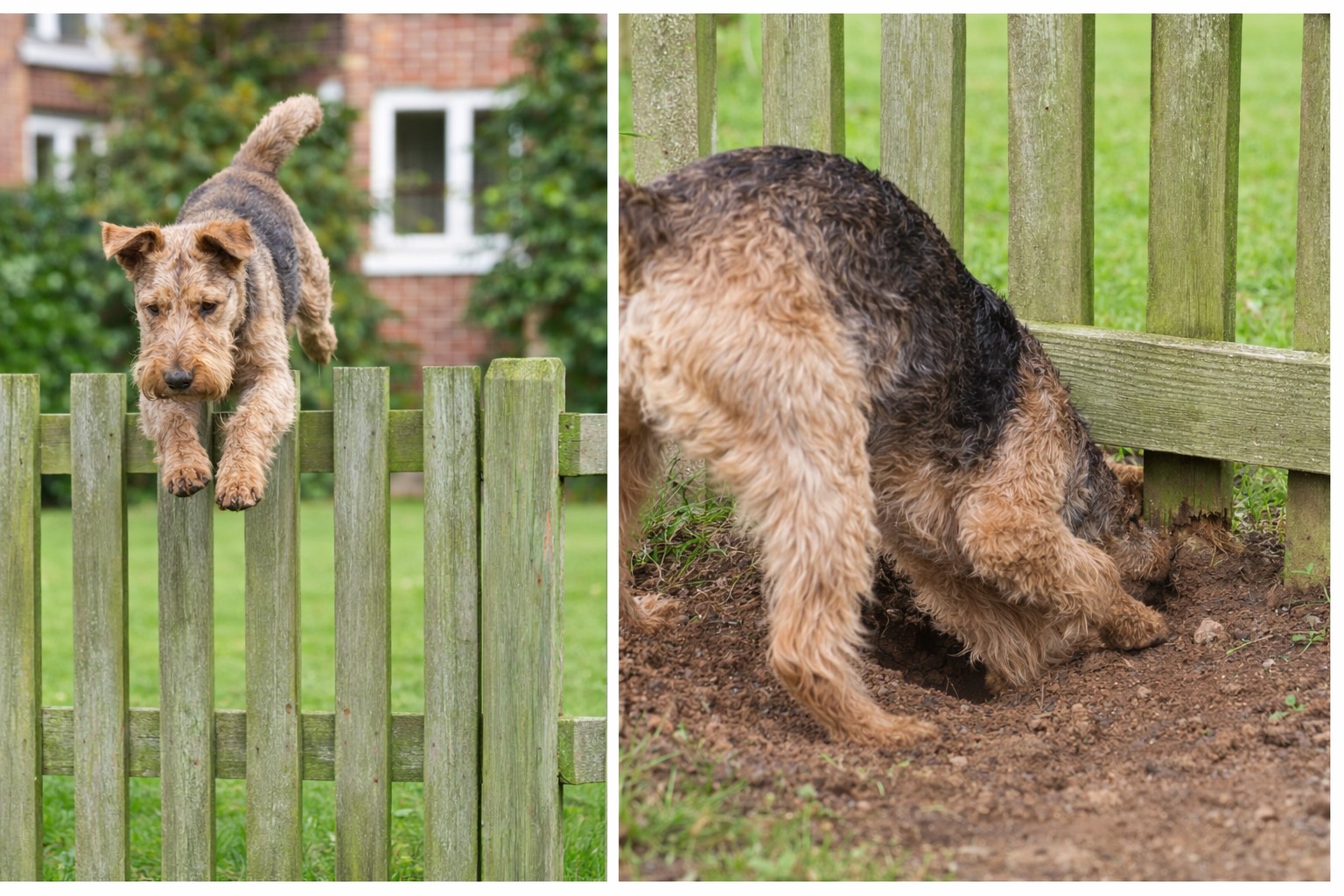
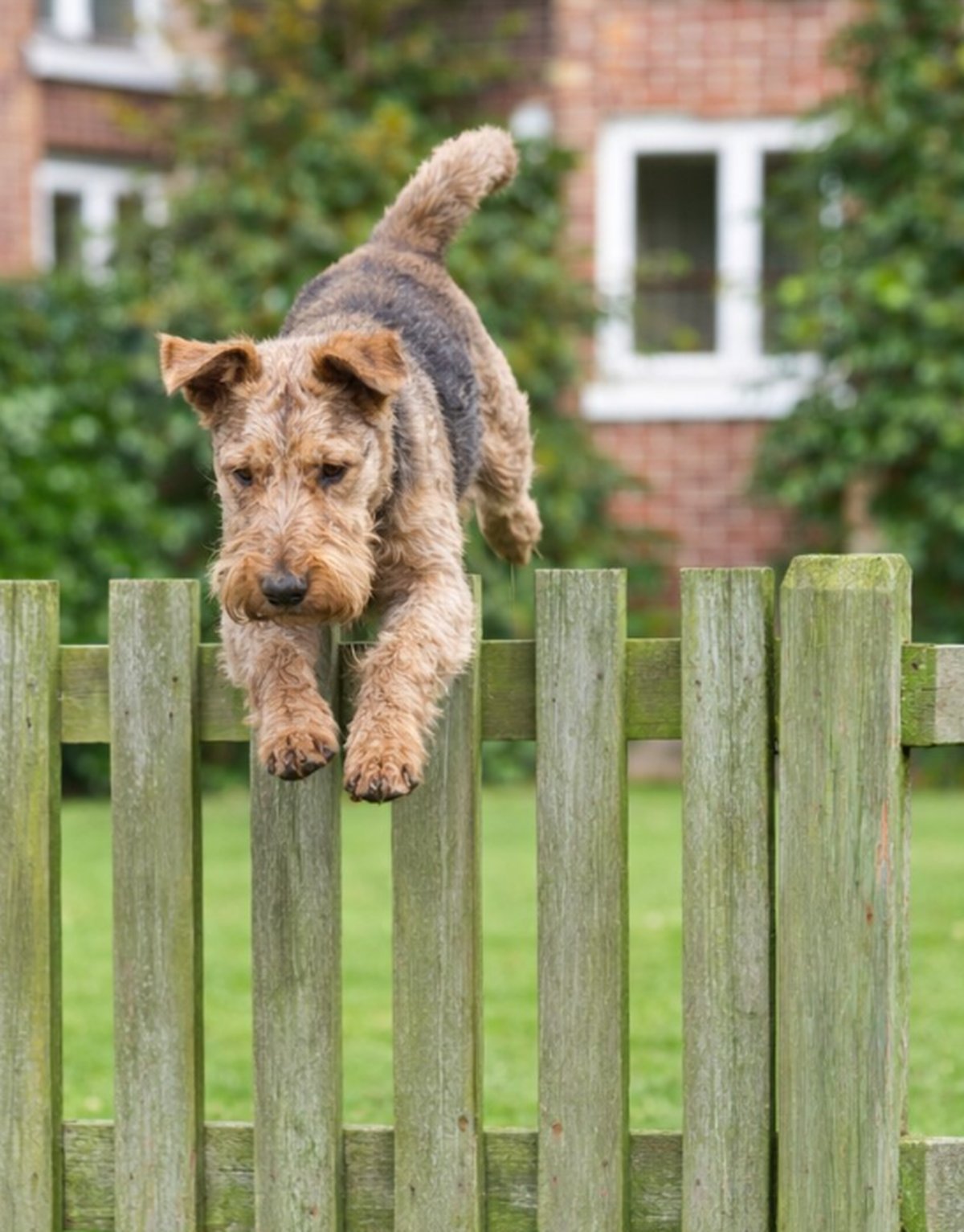
Airdale Terrier digging and jumping over a wooden fence

Instinct-driven behaviours like digging and jumping are not defiance — they’re rooted in how working dogs were bred to interact with their environment.

2. Electronic Dog Fencing – Without Installing Gates

Electronic dog fencing is not just for large country properties. It can also be useful for suburban homes, especially where a traditional fence already exists but is not keeping the dog contained.

For example, an electronic boundary can be installed inside an existing close board fence to help discourage a dog from jumping over or digging underneath it.

It can also be designed around an open driveway, allowing owners to establish a containment boundary without necessarily installing physical gates.

The cable can be routed discreetly around the garden and across suitable driveway surfaces, although the installation method will depend on the ground conditions and layout.

Our advanced electronic dog fence systems offer options for different garden sizes and dog requirements.

For owners of persistent escapees, a professionally designed boundary may provide an additional layer of containment where conventional fencing has repeatedly failed.

However, the dog must be trained to recognise the boundary. A collar alone will not teach a dog where it should stop.

Advantages: Can complement existing fencing, protect open driveways and preserve the appearance of the garden.

Limitations: Requires careful training and maintenance; does not stop other animals or people entering the property.
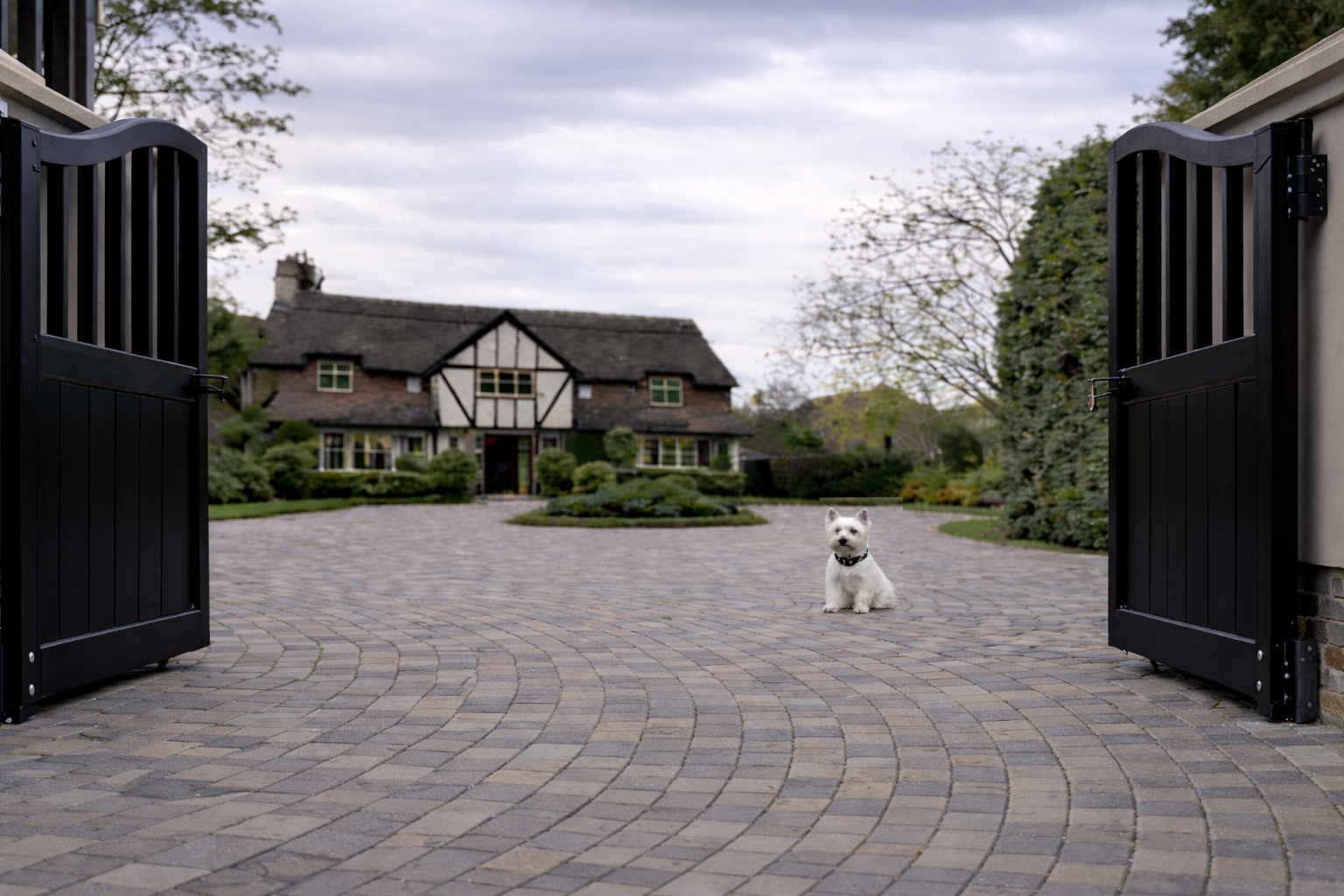
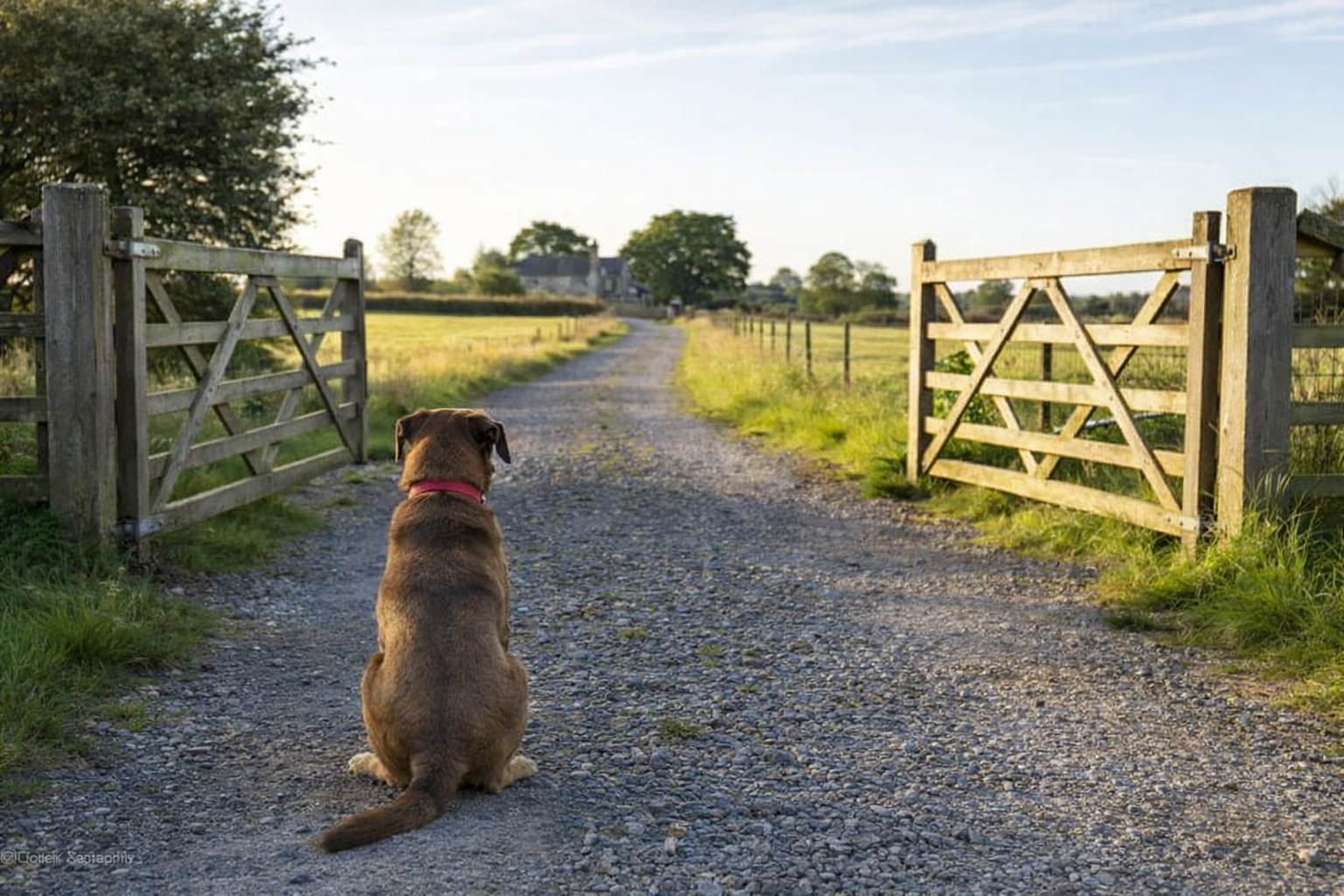
dog sitting on driveway but will not leave due to electronic dog fence

3. Cat Runs and Enclosed Garden Areas

Although primarily associated with cats, enclosed garden runs can sometimes be adapted for smaller dogs or for pets requiring a dedicated outdoor area.

These structures may be useful where the owner wants a physical enclosure without fencing the entire garden.

However, they can be costly, visually prominent and restrictive if the enclosed area is too small.

If you also own cats, our cat fence systems provide another containment option, subject to an individual assessment and suitable training.

Rural vs Urban Dog Fencing: Which Solution Is Best?

There is no single dog fence that suits every property. The most appropriate option depends on your dog’s behaviour, the size of your garden, your budget and whether you need a physical barrier.

Dog Fence SolutionBest Suited ToMain Consideration
Stock fencingRural properties and fieldsGaps, digging and wildlife damage
Deer fencingLarge rural gardens and estatesHeight, cost and visual impact
Close board fencingUrban and suburban gardensJumping, digging and maintenance
Electronic dog fencingRural and urban propertiesTraining, suitability and maintenance
Kennels and enclosed runsDedicated secure outdoor areasSpace, exercise and enrichment

Unusual DIY Dog Fencing Attempts We’ve Seen Over the Years

After more than two decades of installing dog fences, our team has encountered some remarkably inventive attempts to keep dogs at home.

Among the more unusual solutions we have seen are:

  • Old fireplaces used to block gaps in hedgerows.
  • Garage doors positioned along garden boundaries.
  • Bright orange builders’ netting used as a temporary fence.
  • Dogs tethered to stakes, only to become tangled around them.
  • Electric horse fencing used in an attempt to contain dogs.

While some of these approaches may have seemed like quick fixes, they can create new safety problems or fail to address the reason the dog is escaping.

In particular, tethering can create entanglement and injury risks, while livestock electric fencing is not designed as a substitute for a properly assessed domestic dog containment system.

Rather than repeatedly patching escape routes, it is worth identifying how and why your dog is getting out and choosing a solution designed for that behaviour.

Why Professional Dog Fence Training Matters

Whether you live in a small urban garden or on a large rural estate, successful electronic containment depends on more than the equipment.

Dogs need to understand where the boundary is and what the warning signal means. This is why DogFence includes personalised training with its professional installations.

Temporary flags make the boundary visible during the learning process. The dog is gradually introduced to the warning tone and taught to return confidently towards the safe area.

The training should be appropriate for the individual dog’s age, temperament, health and behaviour. Not every dog will be suitable for electronic containment, and a professional assessment can help identify concerns before installation.
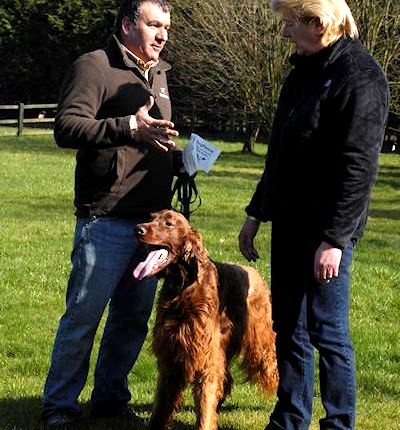
Dog Fence Trainer talking to customer about how to train a dog to an invisible dog fence

Frequently Asked Questions About Dog Fence Solutions

What is the best dog fence for a rural property?

For rural properties, the best solution depends on acreage, terrain, wildlife, livestock and the dog’s behaviour. Stock fencing and deer fencing provide physical barriers, while a professionally installed electronic dog fence can offer a discreet alternative for large or irregular boundaries.

What is the best dog fence for a small garden?

Close board fencing is a popular physical option for smaller gardens. Where a dog jumps, digs or escapes through an open driveway, a professionally designed electronic dog fence may be worth considering as an additional containment measure.

Can a dog fence stop a dog digging underneath fencing?

A secure physical fence with appropriate ground-level protection can help prevent digging escapes. An electronic dog fence can also be positioned inside an existing boundary, with training to help the dog recognise and avoid the designated area.

Can an electronic dog fence cross a driveway?

Yes. Professionally installed wired dog fences can incorporate many gravel, tarmac and block-paved driveways. The installation method depends on the surface, layout and required boundary design.

Is electronic dog fencing cheaper than traditional fencing?

It can be, particularly on larger properties with long or difficult boundaries. However, the final cost depends on perimeter length, ground conditions, number of dogs and installation requirements. Comparing like-for-like quotations is the best approach.

Does an electronic dog fence work for every dog?

No. Suitability depends on the dog’s individual temperament, health, behaviour and ability to learn the boundary. Appropriate training and professional guidance are important, and some dogs may be better suited to a secure physical enclosure.

Need Help Choosing the Right Dog Fence for Your Property?

Every dog and every garden is different. Whether you are trying to secure several acres of countryside, protect an open driveway or stop a determined digger escaping beneath an existing fence, DogFence can help you assess the options.

We have been professionally installing dog containment systems in the UK since 2003, combining individually designed boundaries with personalised dog training and ongoing support.

DOGFENCE UK • SINCE 2003

Every Garden Is Different. So Is Every Dog.

From rural estates to suburban gardens, discover a professionally designed dog fence solution that works for your property and your dog.


GET MY FREE DOG FENCE QUOTE →


☎ CALL US
01628 476475

✉ WHATSAPP
Chat with our team

Some images in this article may be AI-generated for illustrative purposes.

dog fence dogs

Fencing For Dogs Who Escape

What Is the Best Fence for Dogs That Escape?

The best fence for dogs that escape depends on how your dog is getting out. A dog that jumps needs a different solution from one that digs, squeezes through gaps or bolts through an open gate. For persistent escape artists, simply making a physical fence higher or stronger may not solve the problem.

In this guide, we look at the main fencing options for escaping dogs, their advantages and limitations, and what to consider when choosing a secure boundary for your garden.

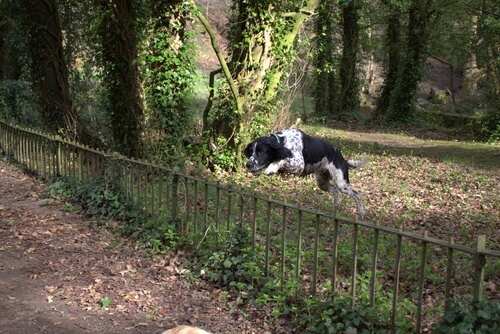
Fencing for dogs who escape – dog jumping over a garden fence

Quick Answer: What Is the Best Fence for Dogs That Escape?

For many dogs, a secure physical fence with no gaps and sufficient height will work perfectly well. However, dogs that repeatedly jump, climb, dig or escape through gates may need a different approach.

The main options are:

  • Solid wooden fencing – useful for dogs distracted by what they can see outside the garden.
  • Mesh or wire fencing – practical for larger gardens and rural properties.
  • Dig-proof fencing – designed for dogs that tunnel underneath boundaries.
  • Higher fencing – potentially useful for athletic dogs that jump.
  • A hidden dog fence – creates a consistent boundary that can work across fences, hedges, gates and driveways.

The right choice depends on your dog, how they escape and the layout of your property.

Why Do Some Dogs Escape Conventional Fencing?

Some dogs are remarkably good at finding weaknesses in garden boundaries. Fix one escape route and they simply start looking for another.

Common escape methods include:

  • jumping over fences;
  • climbing mesh or timber fencing;
  • digging underneath;
  • squeezing through small gaps;
  • pushing through hedges;
  • escaping when gates are opened;
  • bolting down open driveways.

Before spending money on new fencing, identify exactly how your dog is escaping. This will help you choose a solution that addresses the actual problem rather than just one particular escape point.

If you are not sure why your dog keeps getting out, read our guide to why dogs escape gardens.

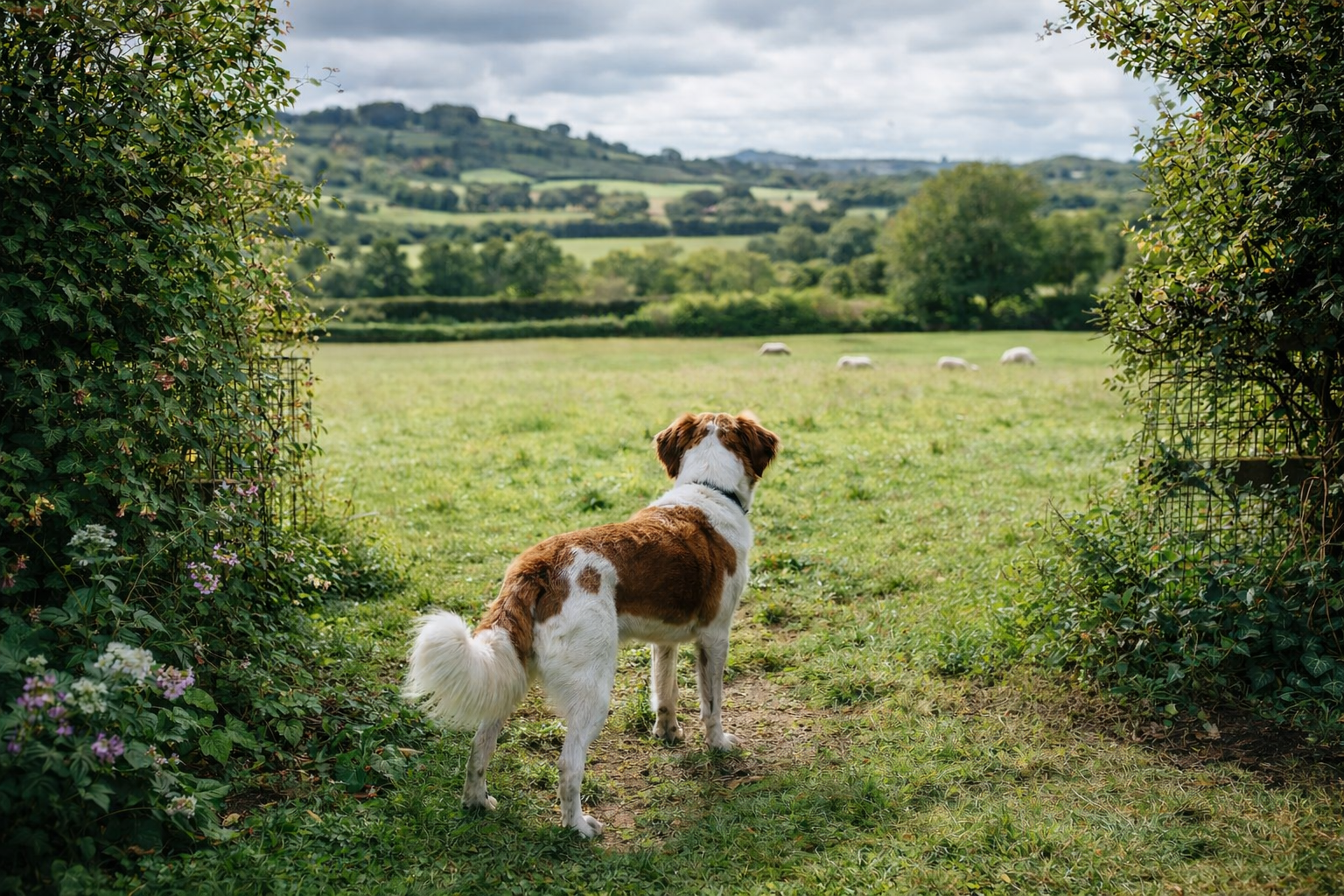
Fencing for dogs who escape – dog looking through an open garden boundary

Escape Proof Fence for Dogs: Does One Exist?

There is no single physical fence that can honestly be described as completely escape proof for every dog.

A six-foot fence may stop one dog but another may climb it. Reinforcing the bottom may prevent digging, while still leaving a gate or driveway as an escape route.

That is why the best escape proof fence for dogs is the one designed around both the dog’s behaviour and the individual property.

1. Wooden Fencing for Dogs That Escape

Solid wooden fencing is one of the most common choices for gardens. It provides a visible physical barrier and can also prevent a dog seeing distractions such as passing dogs, people or wildlife.

Advantages:

  • Creates a solid visual barrier.
  • Available in different heights.
  • Can reduce visual triggers outside the garden.
  • Works well for many ordinary residential gardens.

Potential problems:

  • Dogs can dig underneath it.
  • Athletic dogs may jump over it.
  • Some dogs learn to climb panels or nearby structures.
  • Damaged panels can create escape gaps.
  • It cannot normally solve an open driveway or frequently opened gate.

2. How High Should Fencing Be for an Escape Artist Dog?

If your dog jumps, increasing fence height may seem like the obvious answer. For some dogs, it is.

However, jumping ability varies enormously according to size, breed, athleticism and motivation. There isn’t one fence height that guarantees every dog will remain inside.

Also check for bins, sheds, walls, garden furniture and raised flower beds close to the fence. A dog may be using these as a launch point.

For more detail, see how high a dog fence should be and our guide answering can a dog jump a 6ft fence?

3. Dog Proof Fencing for Dogs That Dig

For a determined digger, fence height is largely irrelevant. The weak point is underneath the boundary.

Physical fencing may need to be extended or reinforced at ground level to make digging underneath more difficult. Regularly inspect the perimeter because some dogs simply move along the fence and start digging somewhere else.

If this sounds familiar, our guide to how to stop a dog digging under a fence looks specifically at this problem.

4. Mesh and Wire Fencing for Dogs

Mesh fencing can be a practical choice for large gardens, paddocks and rural properties where installing solid timber fencing around the entire boundary would be expensive or visually intrusive.

However, the mesh size and construction matter. Small dogs may squeeze through larger openings and some dogs are surprisingly capable climbers.

Large properties also introduce another challenge: the longer the boundary, the more potential weak points there are to maintain.

Owners of larger properties may find our guide to dog proof fencing for rural properties useful.

5. What About Gates and Open Driveways?

This is where conventional fencing often becomes difficult.

You may have excellent fencing around the entire garden but still need vehicles, deliveries and visitors to enter through a gate or open driveway.

A dog can quickly learn that an opening gate creates an opportunity to escape. For some owners, permanently closing or physically fencing an entrance simply isn’t practical.

A hidden dog fence can create a boundary across a driveway or gate without physically preventing vehicles or people from passing through.

Escape proof fence for dogs – dog sitting beside an open driveway gate

6. Hidden Dog Fence for Dogs That Escape

For dogs that repeatedly defeat conventional fencing, a professionally installed hidden dog fence provides another option.

Rather than relying solely on the height or strength of a physical barrier, DogFence creates a consistent boundary that your dog is trained to recognise.

A discreet boundary wire is installed around the selected area of the property. Your dog wears a lightweight receiver collar and is introduced to the boundary through a structured training programme.

The boundary can be designed around:

  • existing fencing;
  • hedges;
  • gardens and lawns;
  • woodland;
  • open driveways;
  • electric gates;
  • large and rural properties;
  • specific areas within a garden.

If you have a persistent escape artist, see our dedicated dog fence for dogs that escape page for more information about how the system works for dogs that jump, dig, squeeze through gaps or bolt through entrances.

Wired or Wireless Dog Fence: Which Is Better?

Hidden dog fences can use either a wired boundary or a wireless system, but they do not provide the same flexibility.

A wired system allows the boundary to be designed around the individual property. It can follow irregular gardens, encompass larger areas and be positioned around existing landscaping, gates and driveways.

Wireless systems generally create a predetermined signal area around a transmitter. This can make them convenient in some circumstances, but the boundary shape is less flexible.

DogFence uses a professionally designed wired boundary because it allows us to tailor the layout to the dog and the property rather than asking the property to fit a predetermined boundary.

How Does a Hidden Dog Fence Work?

The principle is straightforward:

  1. A discreet boundary wire is installed around the area in which your dog can safely roam.
  2. The wire carries a radio signal.
  3. Your dog wears a lightweight receiver collar.
  4. Temporary training flags provide a visual reference during training.
  5. The collar gives an audible warning as your dog approaches the boundary.
  6. Your dog is taught to recognise the warning and move back into the safe area.
  7. The training flags are gradually removed once your dog understands the boundary.

The system is designed to work alongside appropriate training rather than simply relying on the equipment itself.

What Is the Best Dog Fence for a Large Garden?

For a large garden, acreage or rural property, the cost and practicality of installing traditional fencing around the entire perimeter can become significant.

A hidden dog fence can cover substantial and irregular areas without blocking views or requiring a high physical fence around the property.

It can also follow boundaries through hedges, woodland and other areas where conventional fencing may be difficult or undesirable.

What Is the Best Fence for a Dog That Jumps AND Digs?

This is where simply modifying a physical fence can become frustrating.

If you make the fence higher, your dog may start digging underneath it. Reinforce the bottom and they may discover a gap beside the gate. Block the gap and they may simply wait for somebody to open the driveway.

For dogs with several different escape techniques, a DogFence hidden dog fence can provide a different solution. Rather than trying to physically block every possible escape route, the DogFence creates a consistent boundary around the area where you want your dog to remain.

A discreet boundary wire is installed around the property and your dog wears a lightweight receiver collar. As your dog approaches the boundary, the collar gives an audible warning. During professional training, your dog learns to recognise that warning and retreat back into the safe area.

This means the same hidden dog fence can protect areas where a dog might otherwise jump over fencing, dig underneath it, squeeze through gaps or escape through an open driveway.

Importantly, a DogFence can also work alongside your existing garden fence, hedge, wall or gates. You do not necessarily need to remove the fencing you already have – the hidden boundary provides an additional layer of security for a determined escape artist.

For a dog that both jumps and digs, this can be particularly useful because you are creating one consistent dog boundary rather than continually trying to anticipate the next way your dog might escape.

See how it works on our dog fence for dogs that escape page.

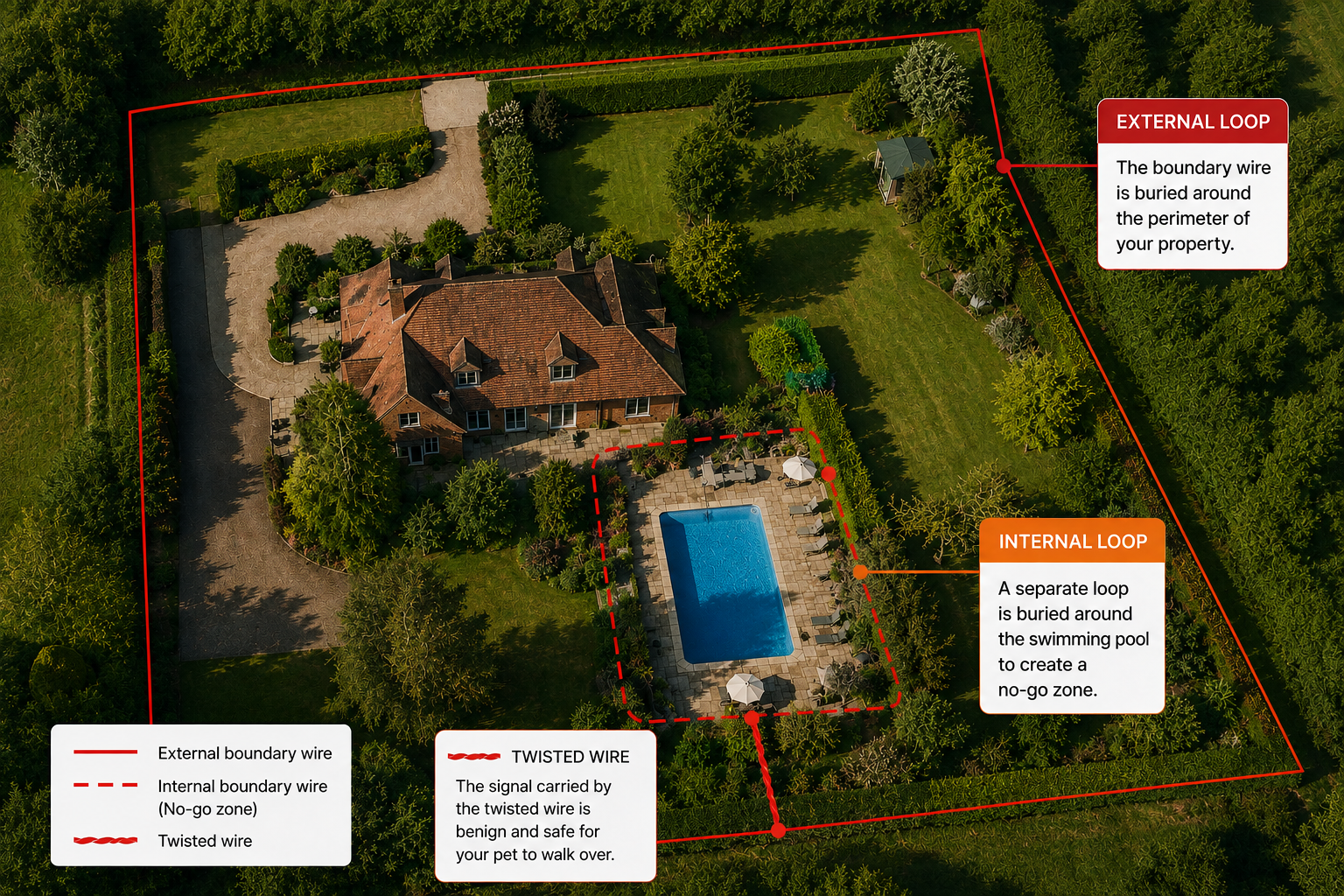
Aerial view of Escape-proof fencing for dogs showing a hidden boundary around the garden and a separate no-go zone around the swimming pool

A hidden dog fence can create both an external garden boundary and an internal no-go zone around your swimming pool. The twisted wire safely connects the two boundaries, allowing your dog to cross it without receiving a warning.

How Do I Choose the Best Fencing for My Dog?

Ask yourself five questions:

  1. How is my dog escaping? Jumping, digging, climbing, squeezing or bolting?
  2. Where are they escaping? Fence, hedge, gate or driveway?
  3. How large is the area? A small enclosed garden and a rural property require very different solutions.
  4. Do I want a visible physical fence? Appearance and planning considerations may influence your choice.
  5. Has my dog already defeated conventional fencing? If so, simply replacing it with something similar may not address the underlying problem.

The best fencing solution should suit your dog, your garden and the way you use your property.

Frequently Asked Questions About Fencing for Dogs That Escape

What is the best fence for dogs that escape?

The best fence depends on how the dog escapes. Solid fencing can suit many gardens, while diggers may need ground-level reinforcement and jumpers may need greater height. Dogs that repeatedly defeat physical fencing or escape through gates and driveways may benefit from a hidden dog fence combined with appropriate training.

What is the best escape proof fence for dogs?

No physical fence can be guaranteed escape proof for every dog. Determined dogs may jump, climb, dig or find gaps. The most appropriate solution is one designed around the dog’s particular escape behaviour and the property’s layout.

What fencing is best for a dog that digs?

A physical fence needs to be secure at ground level and regularly checked for new digging points. A hidden boundary can also be considered for persistent diggers that continually find new places to tunnel underneath conventional fencing.

What fencing is best for dogs that jump?

Increasing physical fence height can help, but the required height depends on the dog’s size and athletic ability. Remove objects that can act as launch points and consider whether the dog is likely to find another escape method if jumping is prevented.

Can a hidden dog fence cross a driveway?

Yes. A professionally designed wired boundary can cross driveways and entrances, allowing vehicles and people to continue using them while the dog is trained to recognise the boundary.

Can I use a DogFence with an existing fence?

Yes. A DogFence can work alongside existing timber, mesh or other garden fencing. It can provide an additional consistent boundary where a dog has learned to jump, dig underneath or exploit gaps in the existing fence.

Can one DogFence be used for several dogs?

Yes. Multiple pets can use the same boundary with individual receiver collars appropriate to each animal.

Which Fence Should I Choose for My Escape Artist?

If your existing fence already keeps your dog safely in the garden, there may be no reason to replace it.

But if you are continually blocking holes, increasing fence height, repairing gaps or worrying every time somebody opens the gate, it may be worth considering a different approach.

DogFence has been helping UK owners keep their dogs safely at home since 2003. We design boundaries around the individual dog and the individual property, including difficult gardens, driveways and large rural areas.

Looking for the Best Fence for a Dog That Escapes?

If your dog jumps, digs, squeezes through gaps or bolts through gates, talk to our experienced team. We’ll help you find the best way to secure your garden — tailored to your dog and your property.

Give your dog freedom in the garden — without constantly worrying about them escaping.

Call us on
01628 476475

|
Message us on WhatsApp

|
Request a Free Quote Online

Related posts

dog fence ideas - dog with question mark

Dog Fence Options Compared: Wooden, Mesh & Invisible Systems

Dog Fence Options Compared: Wooden, Mesh, and Invisible Systems

When you’re researching dog fence options, you’ll quickly see there are many different choices — from traditional wooden panels and wire mesh to modern invisible dog fences. But not all solutions are equal when it comes to keeping your dog safe and secure.

In this guide, we’ll compare the most common types of dog fence options, their pros and cons, and explain why an invisible FM frequency fence is often the safest and most cost-effective choice.

Why Do You Need A Fence?

Most pet owners will experience a dog that loves to escape — whether it’s jumping a 6ft fence, digging under the hedge, or simply heading off on an unplanned walk. While this may seem harmless, an escaping dog can:

  • Put themselves in danger from cars, livestock, or poisoning.

  • Cause accidents on the road.

  • Knock over or frighten strangers.

  • Risk unexpected vet bills or even fines from the dog warden.

A secure fence isn’t just about protecting your dog — it protects others too and gives you peace of mind.

Dog escaping over wooden fence showing need for secure dog fence options

Some dogs see traditional fences as just another challenge.


Wooden Panel Fencing

Wooden fencing may look sturdy, but it isn’t fool-proof.

  • Panels often sit slightly above the ground, making it easy for dogs to dig underneath.

  • Athletic dogs may simply jump over, even if the fence is 6ft tall.

  • Regular maintenance is required to stop rotting or repair storm damage.

  • Costs can quickly mount if you need to replace panels or add extra barriers.

For determined dogs, wooden fencing can be little more than a temporary fix.


Wire Mesh Fencing

Wire mesh is another common option, but it often causes more problems than it solves:

  • Dogs can see through the mesh, leading to barking, fence-running, and frustration.

  • Neighbours or passers-by can tease or even harm your dog.

  • Digging under is still possible.

While affordable, wire mesh is rarely a long-term solution for escape-prone dogs.


Why Chaining Is Never the Answer

Some owners resort to chaining a dog when fences fail. But chaining:

  • Severely restricts exercise.

  • Causes stress, boredom, and frustration.

  • Increases aggression and behavioural problems.

It’s unsafe and unfair for the dog — and definitely not a recommended containment method.


Wireless & Invisible Dog Fences

This is where technology offers a smarter solution. Invisible fences use a boundary wire, transmitter, and a computer collar to create a safe containment zone. But not all systems are equal.

AM Frequency Fences (Old Technology)

  • Can be disrupted by Wi-Fi, TVs, or even light dimmers.

  • Slow response times mean pets can “outrun” the signal.

  • Risk of false activations, shocking your dog unnecessarily.

FM Frequency Fences (Modern Technology)

  • Use secure, fast, digital signals that ignore interference.

  • Quick reaction time keeps pets safely contained.

  • Safety cut-off prevents over-correction.

  • Can be installed around any property size — from small gardens to estates of 350+ acres.

  • Invisible and planning-friendly.

Learn more about how an invisible dog fence system works.


Why FM Invisible Fences Are the Best Option

Compared to traditional fencing, an FM invisible fence:

  • Costs a fraction of installing tall panels or mesh.

  • Works on all terrains, including driveways, hedges, and wooded areas.

  • Is safe, proven, and recommended by vets.

  • Gives your dog freedom within safe boundaries.

Learn more about how an invisible dog fence system works.

Dog safely contained with an invisible dog fence system

Invisible dog fences keep pets safe without changing your view.


The Benefits of Secure Fencing

Choosing the right dog fence isn’t just about stopping escapes — it brings peace of mind and real protection for both your pet and the wider community:

  • Your dog stays safe from roads, poisons, livestock, and other dangers.

  • Others are protected — no risk of your dog knocking someone over or frightening passers-by.

  • Lower costs — avoid dog warden fees (often £50+ per incident) and unexpected vet bills.

  • Prevent accidents — escaped dogs can cause road traffic collisions, which are sadly on the rise.

  • No unwanted litters if your dog hasn’t been neutered.

  • Protect other animals — you won’t be liable for injuries to neighbouring pets or livestock.

  • Peace of mind knowing your dog can enjoy freedom without escaping.

If you also own cats, our cat fence system is designed to keep them safely contained too.

Cat sitting on a garden statue – safe alternatives to roaming with a cat fence system

Even adventurous cats need safe boundaries — our cat fence system keeps them secure without restricting freedom.

Final Thoughts

If you want complete peace of mind, an FM invisible fence is the safest and most reliable option to stop escapes and keep your dog secure.

Call us today on 01628 476475

Request a Free Quote

  Message us on WhatsApp

our mini receiver R7m is suitable for Pomeranian dogs

Electronic dog fences – are they safe for small dogs?

Are electronic dog fences safe to use for small dogs?

Electronic dog fences have been around for over 40 years. Unsurprisingly in the early years this type of electronic dog fencing was most certainly not suitable for small dogs. Why were they not suitable? Size and weight of the computer collars!  Many of the early collars used a 9 volt battery to power the collar which was both bulky and heavy. As with mobile phones recent advances in technology have enabled the size and weight of the computer collars to be dramatically decreased.

At DogFence we are proud to be able to offer the smallest and lightest electronic dog fence collars on the market today. Our mini computer collars weigh only 30g including the small 3.0 volt battery. Our electronic dog fence collars are suitable for all breeds of dogs and cats and with the increasing popularity of toy breeds our sales of mini collars has risen significantly in the last 5 years.

Bengal cat wearing R7m mini electronic dog fence collar

Small enough for cats too!

Will the electronic dog fence hurt my dog?

Naturally a common concern is that the “correction” or impulse will hurt the dog. Naturally, at DogFence we are all dog lovers and the last thing we would want to do is inflict pain or suffering onto any dog or cat. The impulse level is set to each dog or cats personality. People often asks does it hurt? can I feel it?  In reality, once they feel the impulse the next reaction is usually “how will that keep my dog in?” or “oh it’s not that bad!”.

Electronic dog fences have been tested by leading Universities and pet professionals across the world. The results have proved that these fences are safe to use with both dogs and cats. The amount of impulse delivered is not determined by the size of the pet but their personality. The average setting for most dogs is level 2 this would equate to some 250 times lower that a cattle of electric stock fence.

Interesting, the impulse is generally only received during the training phase. All our electronic dog fence collars give out a warning beep prior to giving out the impulse. During the training phase the pet also has a visual marker with training flags. If the training is carried out correctly the pet will rarely receive any activation after the initial period. All our DogFence installers are qualified to train your dog or cat to the containment system. DogFence is a member of the IACP an international organisation set up for training dogs using electronic stimulation alongside conventional training protocols.

Will I have to use the electronic dog fence forever?

This is always a difficult question to answer. It really depends on your dog’s personality and hunting drive. As a rule we find that dogs and cats that are trained before the escaping behavior begins will train quickly and easily and never challenge the fence. However, if you have livestock or game birds nearby and a dog with a high drive then it is advisable to use the system everyday. With electronic dog fencing consistency is king. If every time the dog enters the zone they hear the warning beep they will not “challenge” the fence. Issues can arise  if they can go through the zone one day because they are not wearing the electronic dog fence collar and not on another day it becomes confusing to the pet.

What do the Experts Say?

Professor Daniel Mills headed the study into the use of electronic dog fences

Prof. Daniel Mills
RCVS

Recent studies through Lincoln University, headed by the well revered Prof. Daniel Mills, and the Governments research have proved that electronic dog fences are  only safe and also save the lives of dogs and cats. With modern technology size is no longer a barrier to pet containment with an electronic dog fence. Read more about what the experts say on our web site.

If you would like to learn more about how an electronic dog fence can keep your pet safe contact us on 01628 476475 or email us @ info@dogfence.co.uk.


dog fence most reliable hidden fence worldwide

Freedom Fence vs. DogFence: How Does a Freedom Fence Work? (2025 Guide)

Freedom Fence vs. DogFence: How Does a Freedom Fence Work? (2025 Guide)

Introduction
A freedom fence is an electronic containment system designed to keep dogs within a designated area without a physical barrier. It uses a transmitter connected to a buried boundary wire to create a radio-signal “no‑go zone”. When your dog, wearing a receiver collar, approaches this zone it first emits a warning beep followed by a static correction. With consistent training, most dogs learn to stay within the safe zone.

If you are researching freedom fences you may have also come across Invisible Fence® and generic dog fence systems. While all of these devices share a similar principle, there are important differences in technology, speed and safety. This guide explains how a freedom fence works and why DogFence’s digital FM systems offer a quicker reaction time and safer containment for your pet.

Disclaimer: “Freedom Fence” is a brand name used by one of our competitors. DogFence Ltd is an independent company and is not affiliated with, endorsed by or authorised by Freedom Fence Ltd or its parent company. The comparisons in this guide are provided for informational purposes only.


How does a freedom fence work?

  1. Transmitter and boundary wire – A transmitter is installed at your property and connected to a boundary wire that carries a continuous radio signal around the containment area. The signal must start and finish at the transmitter to complete the loop.

  2. Receiver collar – Your dog wears a receiver collar programmed to detect the signal. When the collar enters the signal zone it beeps, then delivers a mild static correction to discourage crossing the boundary.

  3. Training flags – During training, temporary boundary flags help your dog visualise the invisible line and learn the safe zone.

Freedom fence vs. DogFence: key differences

Signal technology

  • Freedom Fence: Uses a digital AM radio signal. AM is prone to false activations from other household electronics, so the collar checks for two signals before activating, slowing reaction time.

  • DogFence (our solution): Uses a digital FM signal which is immune to interference. The collar only checks for one signal, so it reacts 15 times faster than a freedom fence.

Reaction time

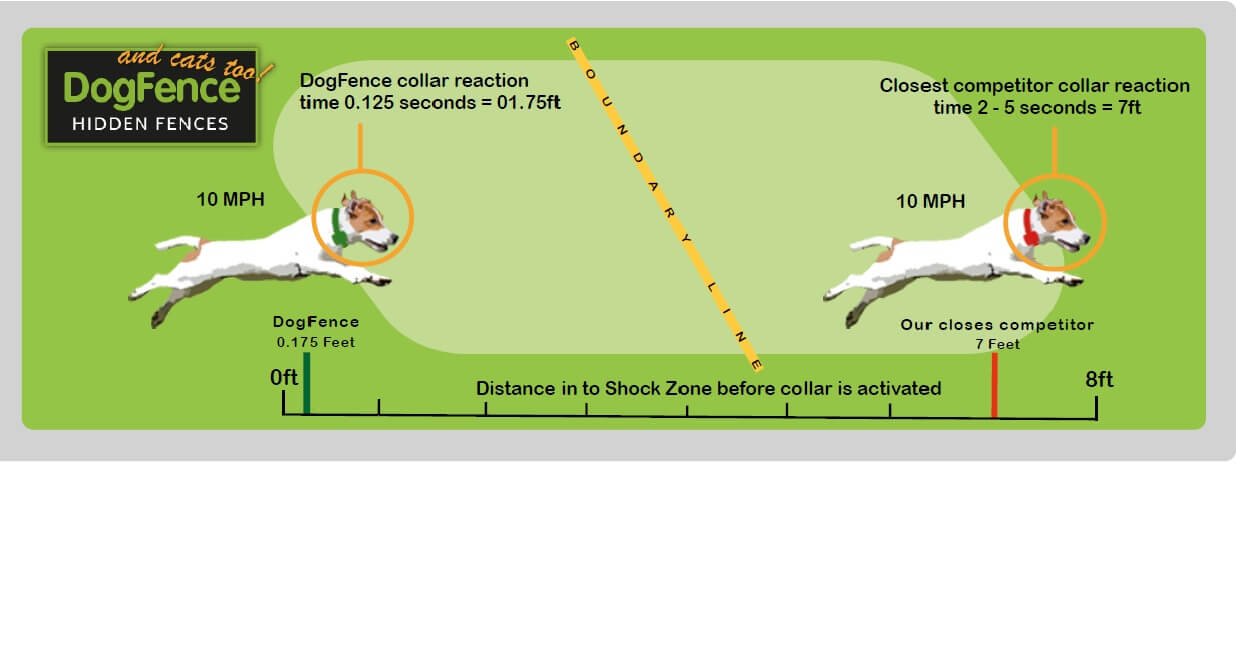
  • Freedom Fence: A dog running at 10 mph could travel up to 7 feet into the no‑go zone before the correction activates. The collar’s shutdown can take 2–5 seconds.

  • DogFence (our solution): The DogFence collar reacts almost instantly – at 10 mph a dog will only enter the zone by 0.125 ft before activation, and the shut‑down time is less than one second.

Warranty & durability

  • Freedom Fence: Limited lifetime warranty that excludes lightning strikes, electrical surges and damage from dog chewing. Manufacturing moved to China around 10 years ago.

  • DogFence (our solution): Full lifetime warranty covering lightning strikes, surges, chewing and accidental damage. Each unit is individually tested at DogWatch HQ in Boston.

Support & training

  • Freedom Fence: Installation and training may vary by dealer; often limited to basic set‑up.

  • DogFence (our solution): Professional installation is performed by our internal team and includes tailored pet training so your dog adapts quickly and safely. This is all backed up by our containment guarantee where applicable.

Battery life & maintenance

  • Freedom Fence: Shorter battery life (3 months max); replacement costs add up.

  • DogFence (our solution): Longer battery life (6 months or 2 years depending on collar type) and optional service plans to minimise maintenance.

How do I train my dog to the invisible (freedom) fence?

We provide on‑site training for your pet and cannot emphasise enough how important the training flags are. The trainer places flags around the boundary to give your dog a clear visual marker. We start with the collar in warning‑beep only mode, walking your dog on a lead around the boundary, tapping each flag and using a command word. This teaches your dog that the flag is a boundary and the beep is a cue to turn back. Only when your dog understands the visual and auditory cues do we introduce the mild static correction. The combination of the flag and beep training, the trainer’s vocal guidance and the gentle impulse helps your dog learn the boundary reliably and humanely. Our professional installers and trainers will guide you through this process and provide post‑installation support.

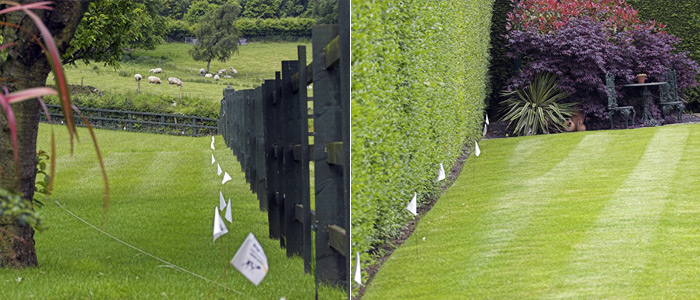
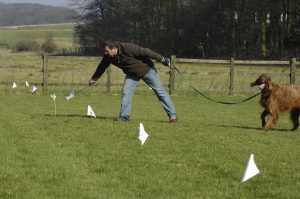
Training flags marking the boundary of an invisible dog fence in a garden

Training flags mark the hidden boundary – giving your dog a clear visual cue during freedom‑fence training.

Frequently asked questions (FAQs)

Is a freedom fence the same as an invisible fence?
“Freedom Fence” is often used generically for underground pet containment, but it’s also a specific product brand. “Invisible Fence®” is a separate brand that invented the technology more than 50 years ago. Both use buried wires and radio signals, but DogFence’s digital FM technology provides quicker, safer corrections than older AM systems.

Is it safe for my dog?
When used correctly, electronic pet fences are safe and humane. The static correction is mild and designed to surprise rather than punish. The key to success is consistent training. DogFence’s professional trainers help your dog learn boundaries quickly and avoid confusion, and the FM signal ensures there are no false activations.

What happens if my dog ignores the signal?
If your dog is highly driven (for example, chasing a squirrel), the reaction time of the collar matters. In freedom fence systems, the delay allows dogs to travel further into the no‑go zone. DogFence’s fast reaction time (15× quicker) corrects the dog before momentum carries them across the boundary, improving containment.

Infographic comparing DogFence and Freedom Fence collar reaction times—when a dog runs at 10 mph into the boundary, the DogFence collar activates in about 0.125 seconds (stopping the dog within roughly 0.175 ft), whereas a Freedom Fence collar takes 2–5 seconds, letting the dog travel up to 7 ft into the no‑go zoneResponse Hang‑On Time: Why Shutdown Speed Matters

Many people focus on how quickly a collar activates, but the shutdown time is just as important. With DogFence, the collar reacts almost instantly in both directions: when your dog crosses the boundary it triggers in about 0.125 s, and when your dog retreats back into the safe zone it switches off just as quickly. In contrast, Freedom Fence collars can take 2–5 seconds to shut down (a delay known as response hang‑on time). That means even if your dog does the right thing and stops or turns around, the collar may continue to beep and deliver a correction for several seconds. Our FM technology avoids this unfair “extra” correction, giving your pet clear feedback and a true safe zone.

Quality & Warranty: Built to Last, Covered When It Counts

Manufacturing and warranty policies are often overlooked, yet they reveal a lot about the quality of a system. Freedom Fence systems were originally made in the USA but production moved to China about a decade ago, and their limited lifetime warranty excludes many common issues. For example, lightning strikes or power surges aren’t covered, nor are dog chews or accidental damage, and the equipment itself is only covered for around three years.

By contrast, every DogFence unit is hand‑tested at DogWatch HQ in Boston and assigned a unique identification number. Our lifetime warranty includes what most pet owners worry about:

  • Lightning strikes & surges: the transmitter is fully covered even if a surge box is fitted.

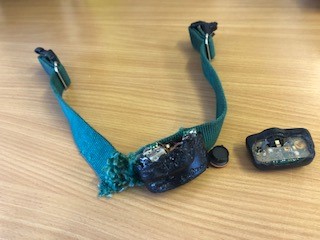
  • Dog chews: if your pet chews the receiver collar, we’ll repair or replace it.

  • Accidental damage: dogs will be dogs; we expect wear and tear and stand behind our products.

Chewed DogFence receiver collar covered under warranty.

Chewed collar covered by DogFence’s warranty – competitors’ limited warranties don’t cover damage caused by dog chews.

This level of coverage—paired with individual quality testing—means DogFence systems are designed to withstand real‑world use and give you peace of mind for the life of your fence.

What about cats or multiple pets?


DogFence systems can be customised for cats and multi‑pet households. Each collar is individually programmed for your pet’s size, temperament and training level, and our FM signal eliminates crosstalk between collars.

Receiver Collar Size & Weight: DogFence vs. Freedom Fence

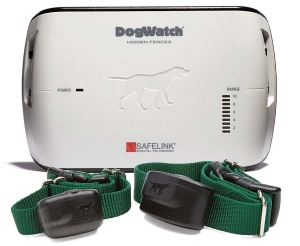
For owners of small dogs or cats, the size and weight of the receiver collar matter a lot. Our DogFence mini receiver is one of the smallest on the market and weighs just 30 g, battery included. Even our standard collar comes in at 48 g, whereas the comparable Freedom Fence collar weighs around 54 g. That difference might not sound like much, but when it’s hanging around a tiny pet’s neck all day, every gram counts. If you’re choosing between a DogFence or a Freedom Fence system, size and comfort are areas where we really stand out.

DogFence SafeLink transmitter with two lightweight receiver collars; mini collar weighs 30 g and standard collar 48 g.

DogFence SafeLink transmitter and receiver collars – the mini collar weighs just 30 g and the standard 48 g, compared with around 54 g for a Freedom Fence collar

Boundary Wire: Heavy‑Duty Protection vs. Freedom Fence’s Wire

The boundary wire is the lifeline of any hidden fence—it carries the signal that keeps your dog safe. Freedom Fence kits typically include a 1.5 mm wire, which is adequate but thinner than our heavy‑grade options. DogFence systems offer 2.5 mm and 4 mm gauge wires; the thicker the wire, the less prone it is to damage once it’s buried. A heavier grade wire resists corrosion and accidental breaks far better, meaning fewer disruptions and less maintenance over the life of your freedom‑fence‑style system.

Why choose DogFence?

With over two decades of experience, DogFence provides modern, reliable hidden fence systems that keep your pets safe while giving them the freedom to enjoy your garden. Our FM technology reacts quickly, avoids false activations and comes with a lifetime warranty that covers lightning, surges and chewing. We offer professional installation and training, ensuring your pet learns the boundaries confidently.

Ready to protect your dog with the latest hidden fence technology? Get a free quote from DogFence and discover how our system can give your pet the freedom they deserve – safely.

Professional Installation: DogFence vs. Freedom Fence

Both DogFence and Freedom Fence offer professional installation, but the level of service is very different. DogFence’s installers are full‑time employees—they’re fully trained, IACP‑approved and work from vans equipped with cable‑burial trenchers and wire‑detection systems. We also have a dedicated cat‑fence team because training felines requires a different approach.

By comparison, Freedom Fence relies on subcontracted installers. They’re trained on the product, but many work part‑time and only some have trenching equipment. The result is a less consistent installation experience. When you choose DogFence, you get a specialist team with the right tools and expertise for your property and your pet.

SmartFence: Real‑Time Monitoring Sets DogFence Apart from a Freedom Fence

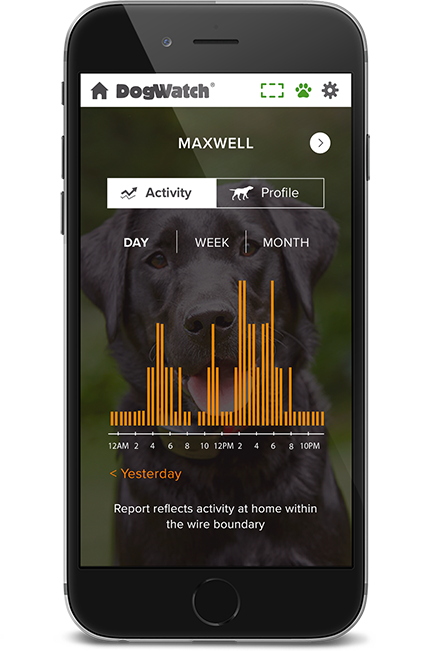
DogFence has continued to innovate beyond basic “freedom fence” technology. In 2018 we launched the UK’s first hidden pet‑containment system with two‑way communication. Our SmartFence uses an app to feed real‑time information back to a base station so you can monitor your dog’s movements and check the system status wherever you are. This level of insight isn’t available with standard Freedom Fence systems and underscores how DogFence keeps pushing the boundaries of pet safety technology.

SmartFence app displayed on a smartphone, showing a dog’s activity graph and system status — highlighting DogFence’s two‑way communication and real‑time monitoring

SmartFence app displaying a dog’s activity – DogFence’s two‑way communication system lets you monitor movements and fence status in real time

Conclusion
For more than two decades, DogFence has been helping UK pet owners keep their dogs and cats safely contained. Our digital FM technology reacts faster and shuts down quicker than older AM systems, our boundary wires are tougher, and our lifetime warranty even covers dog chews and accidental damage. With professional installation, tailored training and innovative SmartFence app monitoring, DogFence offers the safest and most reliable solution on the market.

Ready to see how a modern hidden fence can work for your property?

Call us on 01628 476475 or WhatsApp us on 07917 034256 for a free, no‑obligation quote, or fill in our quote form. We look forward to giving your pets the freedom they deserve – safely.

Related posts:


containment fence lets dog run free in field

Dog fences are NOT banned!

Dog fences & Cat fences are not banned!

After the government bought containment fences to a public consultation, it was decided that Dog fences are NOT banned. This landmark decision also has had a positive impact for all you cat lovers – Cat fences are not banned either! Considering the statistics of cats that are injured and killed on the UK’s roads each year this is fantastic decision. Farmers are also relieved that dog fences (aka containment fences) are exempt from the proposed e-collar ban. In the last few years dog attacks on livestock have risen dramatically.

So what is a Dog fence?

A dog fence is an invisible fence that will give your pets freedom in your garden. As pet owners, it gives you peace-of-mind knowing your pet is not escaping, chasing livestock or getting onto the roads. It works silently, invisibly 24/7 covering all boundaries including driveways and open areas. Dog fences have been around for over 40 years. Sadly the modern systems are often maligned without people really understanding how they work.

How do Containment fences work?

dog fence wire layout, cat fence wire layout

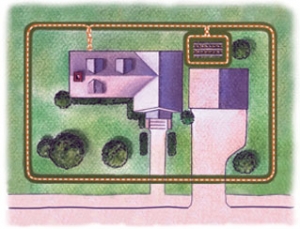
Typical boundary wire layout for dog fence

A central control box is connected to a boundary wire that usually runs around the perimeter of the property. The control box sends a coded radio signal through the boundary wire that has been laid around the property. The size of the signal emitted by the control box can be enlarged or reduced according to the customers’ requirements.

The collar that your pet wears, houses a tiny FM receiver.  As the pet moves towards the signal the collar emits an audible signal to indicate to stop. If the pet continues towards the wire the collar gives a small “corrective impulse” set to the pet’s individual requirements. To some this idea is unthinkable but the impulse is akin to a static shock that you might get if you touch a door knob. When considering a cat fences the containment fences are the only option for giving cats complete freedom and safety in one package.

Why is it so important that Containment fences are not Banned?

With Dog’s & Cats accounting for 16% of reported animal deaths on major roads in the UK over the past 24 months, it is more important than ever to keep your pets safe at home. With over 80% of the people surveyed admitting that they would swerve to avoid hitting a Dog, the question would then be – By swerving what others accidents could this cause? Nobody wants to see Dogs killed on our roads and this is why the message of “Dog fences are not banned” is critical.

And its not just the roads which will be a safer place – Farmers around the UK are also celebrating. Dogs form a critical function on the farms, including companionship, protection and the herding of animals. Just as important though – properties that border the farms with livestock generally use these containment fences to stop the dogs entering the fields and attacking the livestock.

Containment fences are NOT banned! Why Not?

The Consultation lasted 6 weeks ending in April’18 and it was clear that banning containment fences would be a mistake. The public spoke and Over 64% of all the responses received were in favour of retaining Containment fences. The study by Lincoln University which was published in 2016 gave cat fences a positive thumbs up.

In a letter from DEFRA dated February’18 (Before the announcement of the consultation) it was stated:

“The evidence from the studies was not strong enough to support a ban on the devices under the Animal Welfare Act 2006. The claim that electronic training aids may be no more effective than other training methods is not in itself a reason to introduce a ban or to impose restrictions on their use. Having said that, our advice is that electronic training aids should only be used as a last resort and on the recommendation of a professional such as a vet, a suitably qualified dog behaviourist, or a dog trainer, and should only be used by competent operators.”

If nothing else the consultation into the use of containment fences has proved that they are a valuable and effective system. Thankfully thousands of owners submitted stories of how the dog fence or cat fence had saved their pets life. It goes without saying that these positive stories were instrumental in assisting the Government to exempt dog fences.

Changes to dog fence legislation

The Government has announced that they will implement new regulations into the installation of dog fences. These regulations will be to  ensure that dog fences and cat fences are correctly installed and that the owners are given the correct training for their pets. DEFRA consulted with DogFence Ltd as our Company pioneered the full installation and training service to the UK. Since 2003 DogFence Ltd have been offering full installation with training for their pets to the dog fence or cat fence systems.

dog fence training with trainer and flags

Dog in training

Where can I find out more about Dog fences?

DogFence Ltd are the UK leading installers of containment fences offering full installation and training for your pets. If you would like more information about the system and the costs call us on (01628) 476475 or click here. 

Electric dog fences will give keep dogs free to run

Are electric dog fences legal?

Can I Use an Electric Dog Fence in the UK? 2026 Guide

Can I use an electric dog fence in the UK? Yes, electronic dog containment fences are not specifically banned in England as of October 2026. However, the law differs across the UK. Wales prohibits shock-delivering electronic containment collars, while Scottish Government guidance advises against electronic containment systems. In England, owners must still comply with animal welfare legislation and consider whether a hidden dog fence is suitable for their pet.

At DogFence, we have been supplying and professionally installing DogWatch hidden dog fences since 2003. In this guide, we explain how electronic dog fences work, whether professional installation is compulsory, how boundary training works and what to consider before choosing a system.

Last reviewed: October 2026.

What Is an Electric Dog Fence and How Does It Work?

An electric dog fence, also known as an invisible dog fence or electronic dog containment system, creates a hidden boundary around a garden or property.

Unlike traditional electric livestock fencing, an underground dog fence does not electrify the boundary wire. Instead, a cable transmits a radio signal which is detected by a receiver collar worn by the dog.

With a typical DogWatch wired system:

  1. Boundary installation: A cable is installed around the area where the dog is to be contained.
  2. Radio signal: The transmitter sends an FM radio signal through the boundary cable.
  3. Audible warning: The receiver collar emits a warning tone as the dog approaches the boundary.
  4. Static stimulus: If the dog continues towards the boundary, the receiver may deliver a brief static correction.
  5. Boundary training: Training flags and structured sessions help the dog learn where the boundary lies.

The aim is to teach the dog to recognise and respect the designated boundary rather than relying on a physical barrier.

However, no electronic containment system can guarantee that a dog will never cross the boundary.

Can I Legally Use an Electric Dog Fence in England?

Yes. Electronic dog containment fences are not specifically prohibited in England as of October 2026.

The Animal Welfare Act 2006 nevertheless requires owners to meet their dogs’ welfare needs and protect them from unnecessary suffering.

This means that owners should consider:

  • Whether the system is appropriate for their dog’s temperament, age and health.
  • Whether the dog can understand the boundary through suitable training.
  • Whether the receiver collar fits correctly.
  • Whether the dog shows signs of fear, anxiety or distress.
  • Whether physical fencing or another form of containment would be more suitable.

For a detailed explanation of the legal differences between England, Wales, Scotland and Northern Ireland, read our UK Dog Fence Law guide.

Do Electric Dog Fences Have to Be Professionally Installed?

No. Professional installation is not a general legal requirement in England.

In 2018, Defra announced proposals concerning electronic dog training collars and discussed safeguards for electronic containment systems, including professional installation and training.

However, the proposed requirement for professional installation did not become law.

Although DIY systems are available, professional installation can offer important practical advantages.

Why Choose Professional Dog Fence Installation?

A professionally installed dog fence can be designed around the individual property, taking into account the dog’s behaviour, access points, driveways, existing boundaries and areas that should remain off-limits.

At DogFence, our installation service includes:

  • Property assessment: Planning the boundary layout around gardens, driveways and other features.
  • Boundary cable installation: Installing the cable in a suitable position, normally underground where practical.
  • Equipment setup: Selecting and fitting the receiver collar for the individual pet.
  • Personalised training: Introducing the dog to the boundary using temporary training flags and a structured programme.
  • Aftercare: Providing guidance on maintenance, batteries and ongoing training.

Professional installation does not remove all welfare risks or guarantee containment, but it can help owners understand the equipment and the importance of appropriate training.

What Safety Features Should an Electronic Dog Fence Have?

When comparing electronic dog fences, owners should look beyond the initial purchase price and consider the quality of the equipment, reliability and available support.

Automatic Safety Shut-Off

DogWatch systems incorporate safety features designed to prevent continuous stimulation if a dog remains near the boundary. Owners should understand how these features operate and follow the manufacturer’s instructions.

Audible Boundary Warning

An audible warning allows a trained dog to recognise that it is approaching the boundary before a static stimulus is delivered.

Receiver Battery Monitoring

A receiver collar depends on a functioning battery. Owners should check battery condition and replace batteries at the recommended intervals.

Reliable Boundary Signal

DogWatch uses FM radio technology to transmit the boundary signal. Correct installation and maintenance are important to help maintain consistent operation.

Backup Power

A battery backup can help keep a compatible wired system operating during a temporary mains power interruption. Owners should check the backup capacity and understand its limitations.

How Long Does It Take to Train a Dog to an Invisible Fence?

Boundary training is one of the most important parts of introducing an electronic dog fence.

At DogFence, we generally advise allowing approximately 7 to 10 days for a dog’s initial boundary training, although individual dogs may need longer.

Training normally involves:

  1. Introducing temporary flags to show the boundary position.
  2. Teaching the dog to recognise the warning area.
  3. Using positive reinforcement to encourage the dog to move back into the safe area.
  4. Gradually introducing everyday distractions at a level the dog can manage.
  5. Continuing supervision until the dog demonstrates a reliable understanding of the boundary.

Owners should never force a frightened dog towards a boundary or assume that every dog will respond in the same way.

Read more in our dog training and containment advice articles.

Can I Install an Electric Dog Fence Myself?

DIY electronic dog fence systems are available, and self-installation is not generally prohibited in England.

However, there are several important considerations before attempting an installation.

  • The cable must be positioned correctly to establish the intended boundary.
  • Driveways, paths and other obstacles may require specialist installation methods.
  • Incorrect cable layouts can create unintended signal areas.
  • Collar settings and fitting must be appropriate for the dog.
  • The owner must understand the training programme and equipment limitations.
  • Existing underground services should be identified before digging.

Professional installation may be particularly useful for larger properties, complicated garden layouts and owners who want ongoing technical support.

Can Electric Dog Fences Be Used on Large Rural Properties?

Wired electronic containment systems can be designed for properties ranging from small gardens to substantial rural estates, depending on the equipment and site conditions.

They may be considered where traditional fencing is difficult because of:

  • Long or irregular property boundaries.
  • Open driveways and access routes.
  • Woodland, slopes and uneven ground.
  • Existing hedges or walls.
  • Large gardens and paddocks.

However, electronic containment does not provide a physical barrier and should not be relied upon as the sole protection against every hazard, particularly around livestock or busy roads.

Learn more about underground dog fences for large properties.

Are Electric Dog Fences Suitable for Every Dog?

No. Every dog is different, and an electronic containment system may not be appropriate for some animals.

Particular care is needed with dogs that are highly fearful, anxious, reactive or have relevant health or behavioural concerns.

Owners should also consider whether a physical fence, supervised outdoor access or reward-based training without an electronic collar would better meet their dog’s needs.

Electronic containment is a subject of animal welfare debate. Some owners value its potential to reduce escapes, while welfare organisations raise concerns about aversive stimuli and possible stress.

DogFence recommends considering each dog’s circumstances before selecting a containment solution.

Are Electric Dog Fences Legal Throughout the UK?

No. The legal position is not identical across the four nations.

CountryPosition
EnglandElectronic containment fences are not specifically banned. Animal welfare legislation applies.
WalesShock-delivering electronic containment collars are prohibited.
ScotlandGovernment guidance advises against electronic containment systems.
Northern IrelandNo specific electronic containment collar prohibition identified; general animal welfare law applies.

For the complete legal explanation, see Are Dog Fences Legal in the UK?.

Frequently Asked Questions About Using an Electric Dog Fence

Can I use an electric dog fence in my garden?

In England, electronic dog containment fences are not specifically banned. Owners must comply with animal welfare legislation and consider whether the system is suitable for their dog and property.

Do I need permission to install an underground dog fence?

A buried boundary wire will not normally require planning permission simply because it is installed in a garden. However, property restrictions, protected sites, underground services and other circumstances may require additional checks or consent.

Can I use a dog fence with an open driveway?

A wired containment boundary can be designed to cross a driveway without installing a physical gate. However, a hidden fence is not a physical barrier, so the dog’s training and the reliability of the system are particularly important.

Will an electric dog fence work if my dog digs under fencing?

A hidden boundary may be considered for dogs that dig beneath existing fences because it does not depend on the height or depth of the physical fence. However, effectiveness varies and no system guarantees containment.

Can an electric dog fence work alongside my existing garden fence?

Yes. In suitable circumstances, an electronic containment system can be installed alongside existing fencing, walls or hedges. The physical fence remains in place while the electronic system provides a trained boundary.

Read our guide to using an invisible dog fence with an existing fence.

Is a professional installation legally required?

No. Professional installation is not a general statutory requirement in England. It was discussed during the 2018 policy process, but the proposal did not become law.

What happens if there is a power cut?

A wired system normally requires electrical power. Compatible battery backup equipment can provide temporary operation during a power cut, but its duration is limited and should be checked.

Should I Choose a Professionally Installed Electric Dog Fence?

If you are considering an electronic dog containment system in England, it is worth assessing your dog’s individual needs, the layout of your property and the alternatives available.

DogFence has been installing DogWatch hidden dog fence systems since 2003. Our team can explain the equipment, installation process, boundary training and ongoing maintenance requirements.

We believe that understanding the system properly is essential before deciding whether it is suitable for your dog.

Give Your Dog Freedom. Keep Them Safe.

Thinking about an electric dog fence for your property? Speak to our experienced team about professional installation, personalised training and the right boundary solution for your dog.

Get Your Free Dog Fence Quote

Call 01628 476475WhatsApp Us

Some images in this article may be AI-generated for illustrative purposes.

This article provides general information and is not a substitute for professional legal or veterinary advice. Legislation and official guidance may change.