Tag Archive for: dog fence training

Are dog fences legal in the UK overview of relevant legislation including Dangerous Dogs Act and Animals Act

UK Dog Fence Law: Your 2025 Guide to Legal Compliance

UK Dog Fence Law: Are Dog Fences Legal in the UK? (2025 Guide)

Are Dog Fences Legal in the UK?

Yes. Electronic dog fences are legal in the UK.

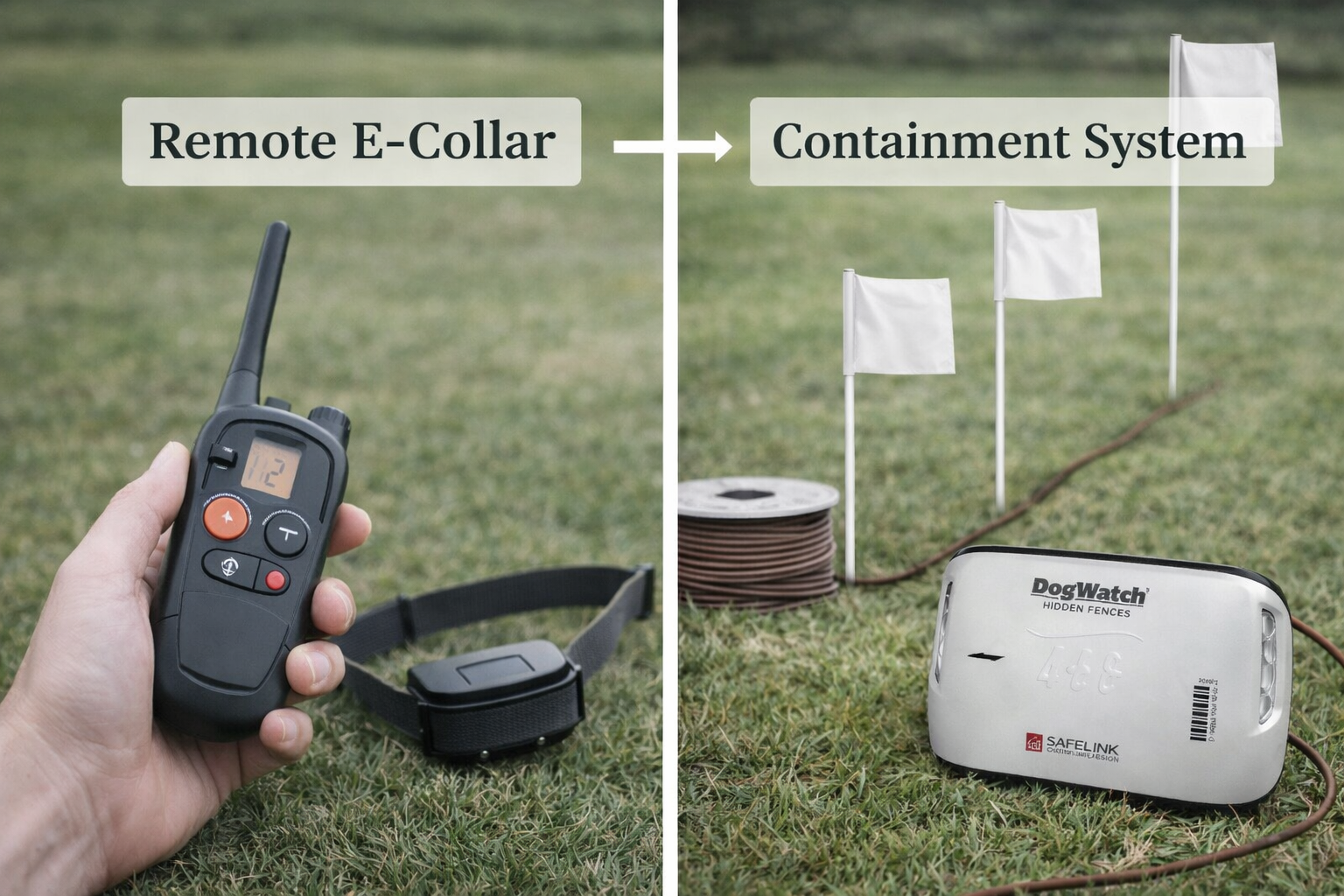
Electronic containment systems — often called invisible dog fences or underground dog fences — are not banned under UK law. The confusion arises from legislation that banned certain hand-held remote training collars, not containment systems.

Understanding UK dog fence law is essential before installing any boundary system. This guide explains what is legal, what is banned, and how responsible containment fits within UK animal welfare legislation. Many owners also ask, are invisible fences humane, particularly in light of the UK electric collar ban.

Comparison between remote e-collar and electronic dog fence containment system with brown boundary wire and white training flags


What Does the UK Electric Collar Ban Actually Cover?

In 2018, the UK government announced a ban on hand-held remote controlled e-collars under amendments to the Animal Welfare Act 2006.

The key distinction:

  • ❌ Hand-held remote training collars (designed to deliver a stimulus at the press of a button) — restricted.
  • ✅ Electronic containment systems (automatic boundary systems triggered by crossing a defined line) — not banned.

The government stated clearly it did not intend to ban invisible fencing containment systems.

This is the critical legal distinction many articles fail to explain.


What Law Governs Dog Fences in the UK?

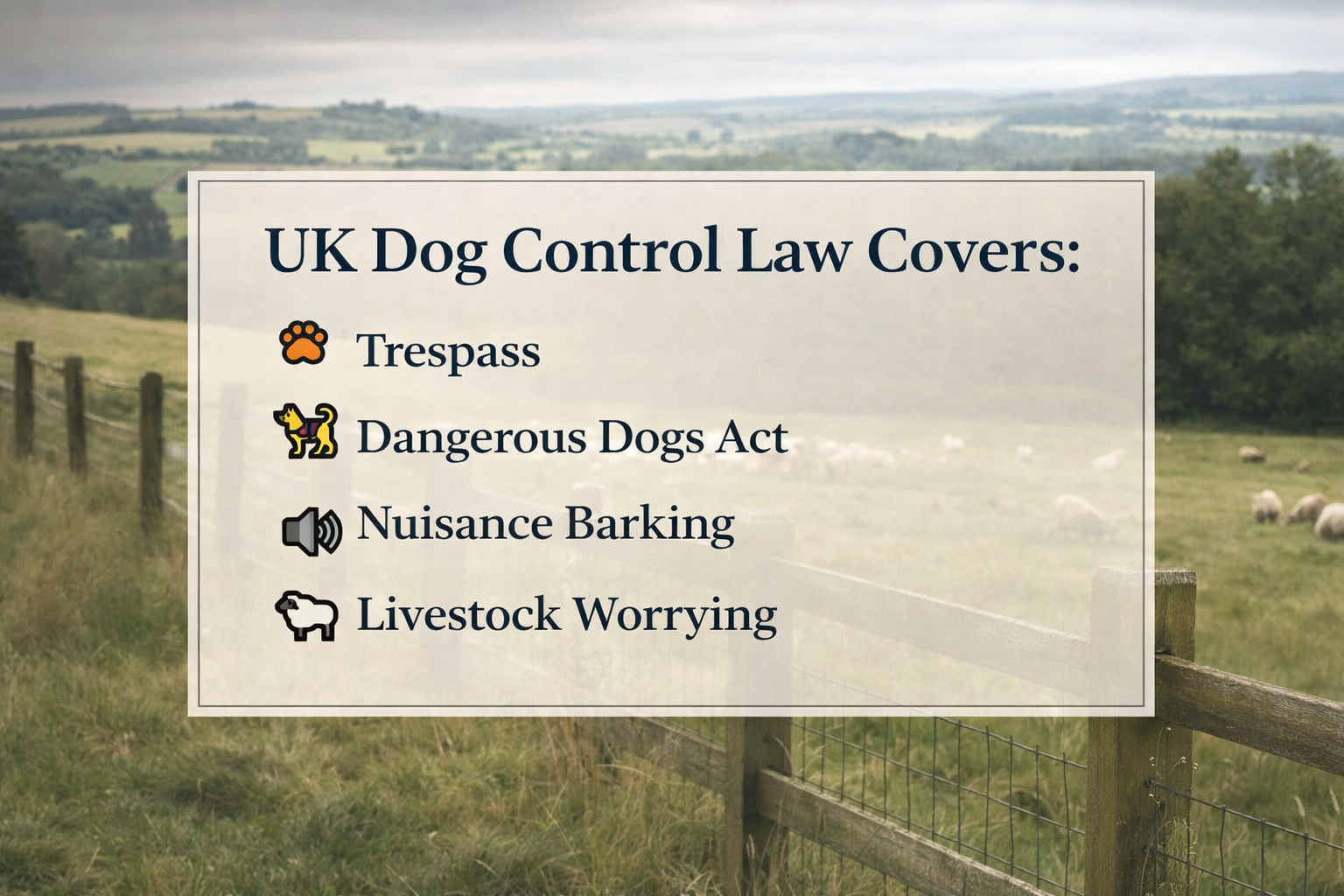
Several areas of UK legislation apply when considering whether dog fences are legal in the UK. Electronic containment systems are not regulated by a single “dog fence law”, but instead fall under broader animal welfare, dog control, and livestock protection legislation. Understanding how these laws interact helps clarify the legal status of invisible and electric dog fences in England. Dog fences fall under general animal welfare and control legislation, including:

Graphic outlining UK dog control law including trespass, Dangerous Dogs Act, nuisance barking and livestock worrying

  • Animal Welfare Act 2006
  • Dangerous Dogs Act 1991
  • Dogs Act 1871
  • Animals Act 1971
  • Protection of Livestock Act 1953

None of these prohibit containment systems.

However, owners remain legally responsible for:

  • Keeping their dog under control
  • Preventing livestock worrying
  • Preventing injury to people or property

A containment fence can support compliance — but it does not replace responsible ownership. Owners regularly ask, “Can I use an electric dog fence in the UK?” The answer is yes — provided it is used responsibly and in line with animal welfare legislation.


Are Electric Dog Fences Illegal?

No. Electric dog fences are legal in England.

They are classed as containment systems, not remote punishment devices.

The key legal and welfare factors are:

  • The system must be used responsibly
  • Training must be appropriate
  • The dog must not suffer unnecessary harm
  • The system must be suitable for the dog’s size and temperament

Poor installation or misuse could raise welfare concerns under the Animal Welfare Act 2006 — but the system itself is not unlawful.


Are Invisible Fences Humane?

When professionally installed and correctly introduced, containment systems are widely considered humane because they:

  • Use a warning tone before correction
  • Deliver a brief, proportionate static stimulus (not a continuous shock)
  • Stop correction immediately once the dog retreats
  • Create a predictable, consistent boundary

The differences between an invisible dog fence over an electric collar:

  • Use a warning tone before correction
  • Deliver a brief static stimulus (not continuous shock)
  • Stop correction once the dog retreats
  • Prevent dogs entering dangerous areas

In rural settings especially, containment can help prevent:

  • Road accidents
  • Livestock worrying offences
  • Legal disputes with neighbouring landowners

Used correctly, they function as a boundary training tool rather than a punishment device.


Do I Need Planning Permission for a Dog Fence?

Underground containment systems do not require planning permission because they involve no visible structure and do not alter boundary height.

  • There is no visible physical structure
  • No permanent fence panels are erected
  • No height restrictions apply

This makes containment particularly attractive in:

  • Conservation areas
  • Listed properties
  • Open countryside
  • Large rural estates

What About Rural Properties and Livestock Law?

Under the Protection of Livestock Act 1953 and Animals Act 1971, dog owners are legally responsible if their dog worries livestock.

A secure boundary system can significantly reduce the risk of:

  • Criminal prosecution
  • Civil compensation claims
  • A farmer exercising legal defence rights

In this context, containment systems often act as a preventative legal safeguard rather than merely a convenience.


Can Using a Dog Fence Help Me Stay Within the Law?

Yes — if used correctly.

A well-installed containment system can:

  • Demonstrate proactive control measures
  • Reduce escape risk
  • Protect livestock
  • Protect neighbouring property
  • Support responsible ownership

However, no system removes your legal responsibility entirely.

You must still:

  • Train your dog
  • Maintain equipment
  • Supervise appropriately

Common Questions About UK Dog Fence Law

Are dog fences banned in England?

No.

Are invisible fences illegal?

No.

Is the UK electric collar ban the same thing?

No. The ban relates to hand-held remote trainers, not automatic containment boundaries.

Can I install one myself?

Yes, but professional installation ensures correct calibration and welfare compliance.


The Bottom Line on UK Dog Fence Law

Electronic dog fences are legal in the UK. The UK electric collar ban did not include electronic containment systems.

They are not included in the electric collar ban and remain lawful when used responsibly under existing animal welfare legislation. Much of the confusion comes from misunderstanding the difference between remote training collars and fixed containment systems.

When professionally installed and correctly introduced, a containment fence can:

  • Improve safety by preventing escapes
  • Reduce legal risk and potential liability
  • Support compliance with UK dog control and livestock laws
  • Protect neighbouring property and livestock
  • Give owners peace of mind in both rural and residential settings

However, no system replaces responsible ownership. Proper training, correct collar fitting, and ongoing management are essential to ensure both legal compliance and animal welfare.

A well-implemented containment system is not about restriction — it is about creating safe, clear boundaries that protect dogs, livestock, and owners alike.

Stay Safe. Stay Legal. Protect Your Dog.

If you’re unsure whether a dog fence is legal for your property, or want to ensure full compliance with UK dog fence law, our experienced team can guide you clearly and responsibly.

Call us on
01628 476475
|
Message us on WhatsApp
|
Request a Free Quote Online

Dog Fencing for Active Breeds how to stop a jack russell jumping a fence

Dog Fencing for Active Breeds | Keep High-Energy Dogs Safe

Dog Fencing for Active Breeds: How to Keep High-Energy Dogs Safe

If you own a high-energy dog – think Cocker Spaniel, Jack Russell Terriers, Wire-Haired Dachshund or working breeds like Labradors and Springers – you’ll know their zest for life often comes with an equally strong desire to explore. Finding suitable dog fencing for active breeds can feel impossible.  Traditional fencing  is a real challenge, especially for dogs who love to run, jump or dig or have a high prey drive.

That’s why many owners ask:
“What’s the best dog fencing for active breeds?”

The good news is — with the right system and training, you absolutely can keep your high-energy companion safe at home.

Understanding the High-Energy Dog’s Mindset

High-energy breeds thrive on activity, mental stimulation, and often possess a strong prey drive. A passing squirrel, a rabbit scent, or even a distant sound can trigger an instinctual chase. Energetic dogs like Labradors often thrive with invisible containment—it’s the reason our Labrador Dog Fence story resonates.”

This powerful impulse is exactly what an electronic fence system must be able to interrupt – gently, but firmly and consistently – to keep your dog safe and secure within the garden. There is no room for error or unreliability with a highly prey-driven dog.

High-energy dog with strong prey drive chasing a badger — example of why dog fencing for active breeds is important

“Why dog fencing for active breeds matters — high-energy dogs with strong prey drive can easily chase wildlife like badgers without proper containment.”

Key Considerations for High-Energy Breeds

The basic principles of electronic dog fence training apply to all breeds but there are some important factors to focus on when working with a more energetic or driven dog:

1. Robust Adjustable Correction Levels for Highly Active Dogs

The challenge: A focused, high-drive dog may simply “run through” a “one size fits all” correction if fixated on a distraction.

The solution: Choose an electronic dog fence system with a wide range of adjustable correction levels. You may need a slightly higher setting for a strong-willed or excitable dog to effectively break their concentration as they approach the boundary.

Remember: The aim is never to cause distress, but simply to get their attention. It’s not about the “size” of the correction matching the “size” of the dog; it’s about the personality and the system’s ability to interrupt a dog’s train of thought. We’ve seen tiny Tea Cup Yorkies respond to a level 4 correction while two large Rottweilers trained perfectly on a very low level 2. This perfectly illustrates that it’s not about brute force, but tailored feedback.

Training tip: Start low, monitor your dog’s response, and increase only if necessary. A small head turn or ear flick is often enough to signal success.

Learn more about how electronic dog fences work

2. Comprehensive and Consistent Training is Essential

The challenge: Intelligent, high-energy dogs can quickly learn patterns and test boundaries if training is inconsistent.

The solution: Follow the recommended DogFence training protocol diligently:

  • Short, regular sessions
  • Use of training flags
  • Positive reinforcement
  • Gradual introduction of distractions

High-energy breeds often benefit from more repetitions in a variety of scenarios to fully grasp the concept of staying within the boundary.

Read our DogFence training guides

3. Meet Their Physical & Mental Stimulation Needs

The challenge: An electronic fence prevents escapes, but it doesn’t fulfil a high-energy dog’s need for exercise and stimulation. Without this, dogs may become bored, frustrated, or even destructive.

The solution: Make sure your dog receives:

  • Daily walks and runs outside of the fence area
  • Playtime, interactive games, and training
  • Activities like agility or puzzle toys

A mentally and physically satisfied dog is far less likely to seek escape.

See the PDSA guide to meeting your dog’s exercise needs

4. How to Choose Dog Fencing for Active Breeds?

The challenge: Cheap or poorly designed systems can easily fail when tested by a determined, fast-moving dog. Consistency is the key. An intelligent and highly motivated dog who “challenges the boundary” must always receive the same message. If the “fence” is unreliable this will ultimately lead to more challenges and a “breakout”.

The solution: Invest in a high-quality, professional-grade electronic dog fence – like those supplied and installed by DogFence UK. Our systems are trusted by thousands of owners of high-drive breeds.

What makes our dog fence collars different?

Our collars differ significantly from many others. It’s not just the static level that changes; with higher settings, the pulses per second increase, making the impulse feel different and more effective at breaking concentration. Think of it like someone gently but persistently tapping you on the head while you’re deeply absorbed in a task – it forces you to momentarily forget where you are and re-focus. This unique pulse modulation is designed specifically to interrupt the dog’s focus, even on a high-prey drive.

Can a highly active dog “out-run” a dog fence?

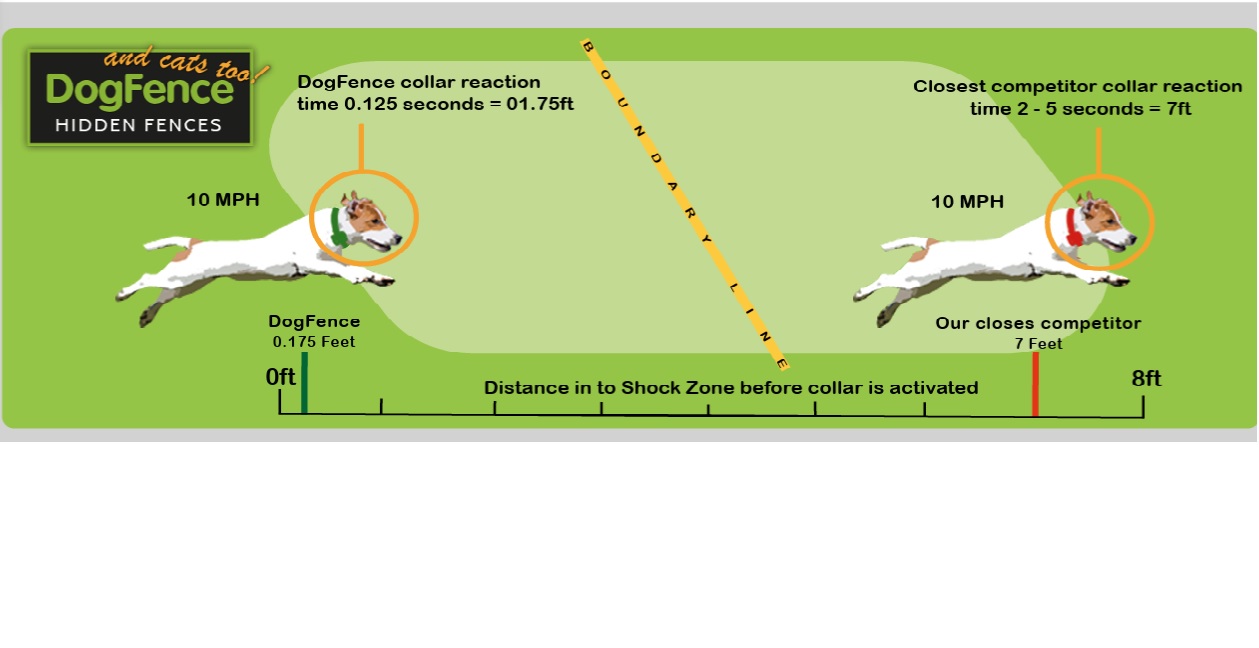
Furthermore, our fence system is designed to be quicker than the dog. When considering dog fencing for active breeds owners need to understand about collar reaction times. Our technology is up to 10 times faster than many other electronic dog fences on the market, especially slower GPS and wireless systems. This speed is critical because a fast, determined dog can often outrun and “break through” a slower system before the correction is properly delivered. With DogFence UK, your dog cannot outrun our system.

There’s also the crucial “flip side”: the dog needs to be correctly rewarded for doing the “right thing.” Our system features an incredibly fast shut-down time – less than a second – once the dog stops and retreats from the boundary. This immediate cessation of the correction is vital for positive reinforcement. In contrast, many DIY, GPS, and wireless systems have a significant “response hang-on time” of 2–5 seconds, meaning the collar is still correcting even though the dog has already retreated, making a difference of 7 – 10ft. This can cause confusion and undermine the training. Our rapid shut-down ensures your dog quickly learns that retreating makes the stimulus stop, reinforcing the correct behaviour instantly.

“Faster collar reaction time helps prevent escape — DogFence UK system vs slower competitor electronic dog fences.”

“Faster collar reaction time helps prevent escape — DogFence UK system vs slower competitor electronic dog fences.”

Our systems are trusted thanks to:

  • Strong, consistent signal
  • Durable heavy-grade wire
  • Robust and durable receiver collars – warranted against dog chews
  • Industry-leading battery life – because when the battery runs out, guess who else runs out?
  • Collar options designed for both large and small high-energy breeds

Compare our electronic dog fence systems

Success Stories: Dog Fencing for Active Breeds Thriving with DogFence

Many owners of high-energy breeds report excellent success with our systems. An electronic dog fence provides a safe environment where these dogs can burn off steam, explore their garden freely, and remain safely contained – with no risk of digging under or jumping over a physical fence.

You’ll find many happy owners of:

  • Border Collies
  • Spaniels
  • Labradors
  • Pointers
  • Salukis
  • Border Terriers
  • Cockapoos

But don’t just take our word for it.

Here’s what some of our customers, facing unique challenges with their active breeds, have to say:

“Exceptional Containment in a Challenging Rural Environment!”

“I bought this dog fence for my Whippet x Saluki because I moved to a rural area on the Orkney Islands and my house is surrounded by sheep and cows. My neighbour has over 200 chickens which are free to roam in his garden, but I was worried the fence system would not be as good as it is. Although my dog has a sweet nature when it comes to other animals if it moves she thinks it is her right to hunt it, and being a whippet she is extremely fast. Installing the fence was easy to do, and the dog trained in a week. The dog has not been able to get out of our land which is 1 acre. I cannot recommend this system highly enough; the dog can run freely on our land and the animals in the neighbouring fields are safe. I would be only too happy to talk to anyone who is thinking of buying a dog fence but may be wary that it might not work as well as it does. Also when I have rung you to talk about something, I get through to a real person, not an option menu, which is a nice change. 10 out of 10 for the product and service.”

Neil Hannant – Orkney Islands

“Complete Peace of Mind with My Working Cocker!”

“I had a DogFence containment fence installed back in March of this year and have waited until now to see how effective it was. Now I write to express my complete satisfaction with the system. Quickly and efficiently installed around an acre of ground and the dogs trained so effectively that they refused for a couple of days to go into the garden but eventually they carefully ventured out and after a few days were content to stay well inside the fence. I thought we may have a problem with the dogs chasing the deer that come into the garden, however, they have respected the fence and are content to stay within the boundary. With a working cocker, that is saying something! And it gives me complete peace of mind. My thanks to you all for a friendly, efficient, and economical service.”
David Holt – Southampton

See more customer testimonials

Is an Electronic Fence Right for Your High-Energy Dog?

If you’re the proud owner of a lively, energetic breed and you’re struggling with traditional fencing, we can help.

At DogFence UK, we have more than 22 years’ experience successfully training and containing all types of dogs – including the most athletic and determined escape artists.

Our expert team will guide you in choosing the right system, professionally install it for maximum safety, and provide full training for you and your dog.

Get in touch today to find out how we can help!

Call us on 01628 476475
WhatsApp us on 07917 034256
Email us: info@dogfence.co.uk
Request a personalised quote online

Ready to Give Your Dog More Freedom?

Whether you’re dealing with a determined Border Collie, a clever Jack Russell or an energetic Labrador, an electronic dog fence could be the perfect solution.

Call 01628 476475 now
Or message us on WhatsApp – we’ll be happy to advise.


Dog wearing a hidden fence collar enjoying freedom in a secure UK garden, with training flags marking the boundary – illustrating dog fence cost UK value and effectiveness

Electronic Dog Fence Training Troubleshooting | DogFence UK

Overcoming Common Training Challenges with Your Electronic Dog Fence: An In-Depth Guide

At DogFence we know that training most dogs to confidently respect an electronic containment system is usually a smooth process, offering  freedom and safety. However, like any training endeavour, if you encounter a few bumps with electronic dog fence training along the way, don’t worry! Many common challenges have straightforward, actionable solutions. This guide will help you understand, troubleshoot, and effectively resolve these issues, ensuring your furry friend thrives within their new, secure boundaries.

A dog in training on a DogFence electronic dog fence systems

Training the dog using the training flags

Understanding the Basics of electronic dog fence training: Patience and Consistency are Non-Negotiable

Before diving into specific issues, it’s crucial to remember that successful electronic fence training hinges on two fundamental pillars: patience and consistency. Every dog is an individual and learns at their own pace. If you’ve been consistent with your initial training steps as outlined in your DogFence handbook, understanding the root cause behind a setback is the first and most critical step towards resolution. Rushing the process or being inconsistent can create confusion and undo progress.

Hitting a Snag: Common Training Problems and In-Depth Solutions

Even with the best intentions and diligent initial training, dogs can sometimes misunderstand the boundaries or react unexpectedly. Here’s how to address the most frequent and frustrating issues, along with detailed solutions:

Problem 1: My Dog Runs Through the Boundary!

This is perhaps the most common and concerning issue for any owner. It usually stems from one of three core reasons: a lack of understanding, overwhelming distraction, or a system issue.

1.1. Inconsistent Correction or Boundary Awareness

  • The Problem: This is always a training issue. Your dog might not have fully grasped that the warning tone always precedes the impulse correction, or they haven’t firmly associated the tone and correction with the physical training flags. They might simply be testing the boundary’s limits and need further training. It could be that the collar is too lose, check the collar fit.
  • The Solution: Back to Basics with Purpose: Go back to the very first stages of training. Re-establish short, highly supervised training sessions (5-10 minutes, 3-5 times a day). Walk your dog on a non-retractable lead (about 6-foot) directly to the boundary flags. As soon as they hear the warning tone, immediately and consistently guide them back into the safe zone, using a firm but calm “Careful!” command. Praise them lavishly only when they are back in the safe zone. Ensure the correction level is appropriate for your dog’s temperament and the collar fit is correct. For long-coated dogs ensure that the correct sized contact posts have been fitted (very important for thick-coated breeds like Huskies or Old English Sheepdogs).
    • Actionable Tip: Reduce distractions during these “back to basics” sessions. Start in the quietest part of your garden before re-introducing any tempting elements. Use high-value treats to reward successful retreats from the boundary.
    • Common Mistake: Owners often move too quickly past the flag training stage, assuming the dog understands after a few successful repetitions. Dogs need many repetitions in various scenarios to truly generalise the boundary concept.

1.2. Over-Excitement or High Drive Overpowering the Correction

  • The Problem: A compelling external distraction – a squirrel, a neighbourhood cat, a child’s ball, or even a passing cyclist – can create such a strong impulse that your dog’s focus becomes singular, causing them to “run through” the boundary, temporarily overriding or ignoring the static correction. This is common in breeds with high prey drive or strong chase instincts.
  • The Solution: Proofing Under Distraction: This requires specific “proofing” training.
    • Controlled Distractions: Begin by introducing controlled distractions while on a long training lead (e.g., 20-30ft) within the safe zone, slowly moving closer to the boundary. Have a helper walk a bike or throw a ball outside the boundary while you work on strong recall and “leave it” commands inside.
    • Increasing Correction (Carefully): You may need to slightly increase the correction level (one step at a time) to ensure it effectively breaks your dog’s concentration when they approach the boundary during high-distraction scenarios. The goal is to interrupt the impulse, not to cause fear or pain. Observe your dog’s reaction closely – a slight head turn, ear flick, or momentary stop is usually enough.
    • Further Reading: For more in-depth guidance on initial training steps and proofing techniques, visit our comprehensive Dog Fence Touble page which outlines the fundamental techniques for various dog types.

1.3. Low Battery or Collar Malfunction

  • The Problem: The collar might not be delivering a consistent correction (or any correction at all) due to a low battery, a loose fit, dirty contact points, or an internal issue with the receiver. Your dog might be receiving an inconsistent signal or no signal at all, leading them to believe the fence isn’t “on.”
  • The Solution: System Check & Maintenance:
    • Battery Check: Always check the battery status of your dog’s collar receiver immediately. Replace batteries regularly (even if they seem to be working).
    • Fit & Contacts: Ensure the collar is snug enough for the contact points to touch your dog’s skin, but not so tight as to cause discomfort. Inspect the contact points for dirt, corrosion, or damage and clean them with rubbing alcohol or a soft cloth. Ensure you are using the correct length of contact points for your dog’s coat type.
    • Field Test: Use the system’s test light/tool (provided with your system) to walk the boundary yourself and ensure the collar is beeping and correcting as it should.
  • Expert Tip: If you’ve checked the battery, fit, and contact points, and the system still isn’t functioning correctly, refer to your DogFence system’s manual for specific troubleshooting, or contact DogFence UK customer support. We’re here to help diagnose and resolve any equipment issues.


Problem 2: My Dog is Scared of the Garden/Fence Area!

Occasionally, a dog might become overly apprehensive after initial training, refusing to enter the garden or sticking only to areas far from the boundary, even within the safe zone. This is easily overcome and is not a long term negative association.

2.1. Incorrect Correction Level

  • The Problem: The correction level might have been set too high during initial training. This can create a fear of the boundary or even the entire garden. Always start on the lowest level.
  • The Solution: Reduce & Rebuild Confidence: Immediately reduce the correction level to the lowest effective setting. The aim is to get your dog’s attention, not to cause fear or trauma. Observe your dog’s subtle reactions – a slight head turn, ear flick, or momentary stop is usually enough.
  • Actionable Tip: If your dog shows signs of severe stress (tucked tail, shaking, excessive panting, urinating), stop training immediately. Give them a break, reduce the level, and consider working with a professional dog behaviourist or trainer.

2.2. Fear of the Boundary due to the Electronic dog fence Training Flags

  • The Problem:  The dog sees the flags and is scared to go in the garden! The Training Flags are doing their job. Your dog goes into the garden and see the flags and naturally associates them with the garden itself. He heeds to learn to understand that these are only at the boundary and that the remaining area of the garden is a safe place. The flags are there to help him learn the “invisible boundary”.
  • The Solution: Rebuild Positive Associations & Fun:
    • Play & Praise: Rebuild positive associations by taking your dog on a lead into the garden without the collar active initially. Play games, offer high-value treats, engage in joyful praise, and make the garden a fun, rewarding, and safe place to be. Do this repeatedly, moving closer to the boundary only when your dog is relaxed. If you roll a ball, roll it back towards the house and not into the boundary.
    • Short, Sweet Sessions: If you reintroduce the collar, make sessions extremely short and positive. End on a high note with abundant praise and treats whenever your dog correctly retreats from the boundary or simply enjoys being in the safe zone.
    • Feed your dog outside: If your dog is scared to go outside feed him outside, initially just outside the door and allow him to make the decision to go outside. Do not pull or drag him, let him do the work and this will help reinforce the garden as a safe place. If you are concerned call us and one of helpful team will talk you through the process.
    • Book a Professional Training Visit: Call us today and arrange a Professional assessment and training visit for your property and dog. We will check the placement of both your boundary cable, training flags and carry out the training with your and your dog (charge dependant on location and size of boundary). Call today for quote.
  • Garden boundary marked with dog fence training flags

    Visible boundary for the pet with flags.

Problem 3: My Dog is Barking Excessively at the Boundary!

  • The Problem: Your dog might be frustrated by the boundary, barking at things outside it they can see but not reach, or barking in an attempt to alleviate the correction.
  • The Solution:
    • “Quiet” Command: Practise a “Quiet” command within the safe zone, rewarding calm behaviour.
    • Distraction Management: If they are barking at external stimuli, try to reduce visibility (e.g., temporary screening along that section of the fence) or work on desensitisation training.
    • Review Correction Level: Ensure the correction is not too low (leading to frustration) or too high (leading to anxiety-induced barking).

Benefits of Overcoming These Challenges: Why It Matters So Much

Successfully navigating these training challenges ensures your electronic dog fence truly becomes a cornerstone of your pet’s safety and well-being.

  • Unparalleled Freedom: Your dog gains the freedom to roam and play safely within your property, enjoying fresh air and exercise without being tied up or confined to a small kennel.
  • Your Peace of Mind: You gain the confidence that your dog is secure, preventing costly escapes, potential injuries from traffic, or distressing incidents like worrying livestock (a significant concern in rural UK).
  • Stronger Bond: A well-trained dog is a happier dog, and successful training deepens the trust and understanding between you and your pet.
  • Protection of Your Investment: Proper use and maintenance of your DogFence system ensures its longevity and effectiveness, protecting your initial investment.
Dog Safe with Dog Fence

Freedom and Safety with an electronic dog fence


How DogFence UK Systems Aid in Training Success

While generic “invisible fence” systems might exist, DogFence UK prides itself on professional-grade technology designed with real-world scenarios and varying dog temperaments in mind. Our systems typically feature:

  • Multiple, Adjustable Correction Levels: Allowing precise calibration for your dog’s sensitivity and drive, which is crucial for troubleshooting.
  • Dedicated Training Support: We provide comprehensive guides and expert advice, recognising that the technology is only as good as the training behind it.
  • Reliable Components: Our robust collars and transmitters are built for consistent performance, minimising failures that could undermine training.
  • Lifetime Equipment Guarantees: Reflecting our confidence in the durability and reliability that supports long-term training success.
    • Ready to invest in a reliable solution? View our full range of DogFence systems and find the perfect fit for your home and dog.

Frequently Asked Questions (FAQs) About Electronic Dog Fence Training

Q1: How long does it typically take to train a dog to an electronic fence?

A1: Most dogs understand the basics within 1-2 weeks of consistent training sessions (5-10 minutes, 3-5 times daily). However, achieving true “proofing” under distraction can take several weeks, depending on the dog’s temperament and your consistency.

Q2: Can I use an electronic fence on a very young puppy?

A2: It’s generally recommended to wait until a puppy is at least 4-6 months old, depending on their maturity and comprehension. They need to be old enough to understand cause and effect and adhere to basic verbal commands. Call DogFence first and we are happy to advise.

Q3: What if my dog seems completely unfazed by the correction?

A3: First, check the battery and collar fit. Ensure the contact points are making good contact with the skin. If it’s a thick-coated dog, you might need longer contact points. Then, gradually increase the correction level one step at a time, observing your dog’s reaction for the lowest effective setting. Some dogs are very stubborn or have high pain thresholds.

Q4: My dog got through once, will they keep doing it?

A4: Not necessarily. A single “run through” means your training needs reinforcement. Go back to basics, increase consistency, and potentially proof under distraction more intensely. It’s an opportunity to strengthen their understanding, not a sign of failure.

Q5: What if my dog ignores the warning tone?

A5: This usually means they haven’t learned to associate the tone with the flags and the correction. Go back to the initial flag training phase. Every time they hear the tone and experience the corretion, immediately guide them back into the safe zone, followed by the “careful” command.


When to Seek Professional Help

If you’ve diligently applied these troubleshooting tips, been consistent with your electronic dog fence training, and are still facing significant or persistent challenges, please don’t hesitate to reach out. Your DogFence UK team is always ready to offer personalised advice, system checks, or connect you with professional trainers who specialise in electronic fence integration. Sometimes, a fresh pair of eyes or a professional trainer’s guidance can make all the difference in achieving long-term success and peace of mind.


Don’t let training hurdles stand in the way of your dog’s freedom and safety. Need personalised advice or ready to upgrade your system?

Call us today on 01628 476475 or Request a Free Quote!


Man installing a physical dog fence

Physical vs Electronic Dog Fences: Which Is Right?

Comparing Physical and Electronic Dog Fences: Which is Right for Your Pet?

Ensuring your dog’s safety is a paramount responsibility for any pet owner. One critical decision revolves around containment: should you opt for traditional physical dog fences or embrace modern electronic dog fences? Whether you’ve just welcomed a lively pup into your family or are seeking a better way to keep an older dog secure, choosing the right fencing solution can be transformative.

Physical Dog Fences: The Tried and Tested Option

Advantages of Physical Fences

  • Visual Boundary: Clearly marks the edge of your property, serving as a visual cue for your dog and a deterrent for trespassers.
  • Multipurpose Use: Provides privacy, enhances security, and prevents wildlife from entering your garden.
  • Durability: High-quality materials like steel or composite wood can stand the test of time with proper maintenance.

Drawbacks of Physical Fences

  • High Costs: Installation can cost £25–£300 per metre, depending on materials and design.
  • Maintenance: Wooden fences require painting and sealing; metal fences may rust and need treatment.
  • Escape Risks: Determined dogs can dig beneath or jump over traditional fences.
  • Gate Weaknesses: Gates can be expensive, difficult to secure, and may be left open, creating weak points.

Who Benefits Most from Physical Fences?

  • Homeowners seeking privacy or additional security.
  • Urban or suburban properties where aesthetic appeal is a priority.
  • Dogs less inclined to escape or dig.

Cost Breakdown for Traditional Fencing Options

  • High Wooden Fencing: £40–£100 per metre, plus installation.
  • Chain-Link Fencing: £25–£50 per metre; cost-effective but less attractive.
  • Stone Walls: £100–£300 per metre; durable but costly.
  • Dig-Proof Fencing: £50–£80 per metre; includes buried mesh or concrete footer.

Electronic Dog Fences: The Innovative Alternative

Advantages of Electronic Dog Fences

  • Preserves Your View: Maintains the natural beauty of your surroundings without imposing physical barriers.
  • Adaptable Design: Can cover irregularly shaped areas, including ponds, gardens, or wooded areas.
  • Cost-Effective: Priced at £6–£10 per metre, including installation; budget-friendly for larger properties.
  • Customised Training: Modern systems like those offered by DogFence.co.uk come with tailored training programmes to ensure dogs understand boundaries without stress.
  • No Gates Required: Covers driveways, eliminating the need for expensive gates that can be left open.

Drawbacks of Electronic Dog Fences

  • No Physical Barrier: While effective at keeping your dog in, electronic fences won’t prevent other animals or intruders from entering your property.
  • Dependence on Technology: Requires ongoing maintenance, including checking the collar battery and ensuring the transmitter functions correctly.
  • Training Commitment: Success relies on proper training; pet owners must invest time in helping their dog adjust to the new system.

Who Benefits Most from Electronic Fences?

  • Rural properties with larger grounds (½ acre or more).
  • Dogs prone to jumping over or digging under traditional fences.
  • Owners prioritising unobstructed views or flexibility in boundary placement.
  • Owners living near livestock or main roads.
  • Owners who have physical fencing but need added dog-proof fencing.

Comparing Costs: Traditional vs. Electronic Fencing

Traditional Fencing: £25–£300 per metre, depending on material and design.

Electronic Fencing: £6–£10 per metre, covering large areas affordably and effectively.

For larger properties, electronic fences offer a practical and budget-friendly solution, saving thousands in upfront costs while ensuring your dog’s safety.

Installation Times: Traditional Fencing vs. Electronic Dog Fences

Traditional Physical Fencing: A 5-acre site typically requires substantial preparation, including leveling ground, digging post holes, and securely fixing materials like wood or chain link. This process can take 1–2 weeks or more, depending on terrain, weather conditions, and design complexity.

Electronic Dog Fences: Can cover up to 10 acres in a single day, including professional installation and boundary training setup. The process is streamlined and minimally invasive, making it a fast and efficient solution for pet owners.

Choosing an electronic dog fence not only saves time but also reduces the hassle and labour involved in securing your property.

Did You Know? The Facts About Dog Containment

  • Over 85% of pet owners report feeling more confident about their dog’s safety after installing an electronic containment system.
  • Studies show that dogs trained with modern electronic fences adapt to their boundaries within 2–4 weeks when training is implemented correctly.
  • Traditional fences can cost up to £200 per metre for premium materials, whereas electronic fences cover larger areas at a fraction of the cost.

How DogFence.co.uk Can Help

At DogFence.co.uk, we specialise in bespoke electronic containment systems designed to suit every property and pet. With over two decades of experience, we provide:

  • Customised consultations to determine the best solution for your needs.
  • Professional installation to ensure seamless operation.
  • Comprehensive training programmes to help your dog understand and adapt to their new boundaries.

With our systems, you’ll join thousands of pet owners across the UK who trust DogFence.co.uk to keep their dogs safe while preserving the beauty and integrity of their properties.

Supporting Responsible Dog Ownership

It’s important to note that some organisations, like the RSPCA, oppose the use of electronic dog fences. However, groups such as the Association of Responsible Dog Owners (ARDO) advocate for the responsible use of electronic training aids, including containment systems. ARDO’s mission is to educate and support dog owners in making informed decisions that ensure the safety and well-being of their pets.

Take the Next Step Towards Peace of Mind

Choosing the right fence isn’t just about practicality—it’s about safeguarding the bond between you and your pet. Let us help you find the perfect solution.

Ready to Protect Your Dog?

At DogFence Ltd, we’ve helped thousands of pet owners across the UK find safe, humane, and cost-effective containment solutions for their dogs and cats.Call us today to receive a quote:

Or request a quote online.


Dog running freely and safely in open garden with no visible fencing

How Electronic Dog Fences Can Save Lives

{
“@context”: “https://schema.org”,
“@type”: “LocalBusiness”,
“name”: “DogFence Ltd”,
“url”: “https://dogfence.co.uk”,
“logo”: “https://dogfence.co.uk/logo.png”,
“image”: “https://dogfence.co.uk/dog-fence-image.jpg”,
“description”: “Invisible dog fence installation in the UK. We specialize in electronic pet fences to keep your dog safe while preserving the beauty of your property.”,
“address”: {
“@type”: “PostalAddress”,
“streetAddress”: “DogFence Ltd, Marlow, Buckinghamshire”,
“addressLocality”: “Marlow”,
“addressRegion”: “Buckinghamshire”,
“postalCode”: “SL7 2DF”,
“addressCountry”: “GB”
},
“telephone”: “+44-1628-476475”,
“sameAs”: [
“https://www.facebook.com/DogFenceLtd”,
“https://twitter.com/DogFenceLtd”,
“https://www.instagram.com/DogFenceLtd”
],
“areaServed”: “England”,
“serviceType”: “Invisible Dog Fence Installation, Dog Containment Systems, Electronic Pet Fences”,
“priceRange”: “££”,
“contactPoint”: {
“@type”: “ContactPoint”,
“telephone”: “+44-1628-476475”,
“contactType”: “Customer Service”,
“areaServed”: “GB”,
“availableLanguage”: “English”
},
“sameAs”: “https://dogfence.co.uk”
}

A comparison of physical and electronic dog fences to help pet owners choose the best fencing solution for safety and security.

“Comparing physical and electronic dog fences to help you choose the right solution for your pet’s safety.”

Comparing Physical and Electronic Dog Fences: Which is Right for Your Pet?

Ensuring your dog’s safety is one of the most important responsibilities as a pet owner. A primary concern for any owner is choosing the right type of fence—should it be a traditional physical dog fence or perhaps the modern electronic dog fence (also known as a containment system)? Whether you’ve just welcomed a lively pup into your family or you’re seeking a more effective way to secure an older dog, selecting the right fencing solution can be a game-changer.

In this article, we explore the key differences between traditional physical dog fences and modern electronic dog fences. By examining the advantages, drawbacks, and suitability of each, you’ll be well-equipped to decide what’s best for your canine friend and your home.

Physical Dog Fences: The Tried and Tested Option

Advantages of Physical Fences

  • Visual Boundary: A physical fence clearly marks the edge of your property, serving as a visual cue for your dog and a deterrent for would-be trespassers.
  • Multipurpose Use: Beyond keeping pets contained, physical fences also provide privacy, enhance security, and prevent wildlife from entering your garden.
  • Durability: With materials like steel or composite wood, physical fences are built to last if properly maintained.

Drawbacks of Physical Fences

  • High Costs: Installing a fence can cost £25–£300 per metre, depending on materials and design. Larger properties can face significant expenses.
  • Maintenance: Wooden fences require painting, sealing, and repairs over time, while metal fences may rust and need treatment.
  • Escape Risks: Determined dogs can dig beneath or jump over traditional fences. Agile breeds such as Border Collies or Jack Russells are known escape artists.
  • Gate Weaknesses: Installing dog-proof gates can be expensive, and gates can be left open, creating weak points.

Who Benefits Most from Physical Fences?

  • Homeowners seeking privacy or additional security.
  • Urban or suburban properties where aesthetic appeal is a priority.
  • Dogs less inclined to escape or dig.

Electronic Dog Fences: The Innovative Alternative

Advantages of Electronic Dog Fences

  • Preserves Your View: For those with countryside or scenic properties, electronic fences maintain the natural beauty of your surroundings without imposing physical barriers.
  • Adaptable Design: Unlike physical fences, which can be restricted by terrain or property layout, electronic fences can cover irregularly shaped areas such as ponds, gardens, or wooded areas.
  • Cost-Effective: At £6–£10 per metre, including installation, electronic fences are a more affordable option for larger properties.
  • Customised Training: Systems like those offered by DogFence.co.uk come with tailored training programs to help your dog understand the boundaries without stress or discomfort.
  • No Gates Required: Electronic fences can cover driveways, removing the need for expensive gates, which may be left open.
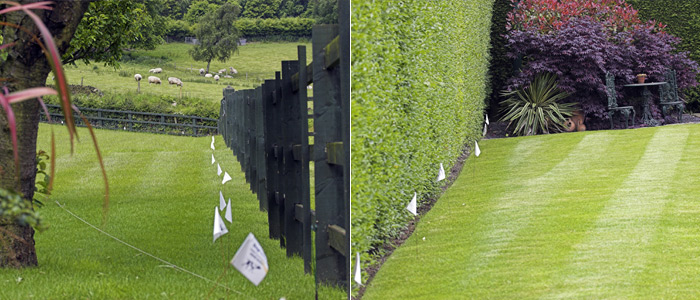
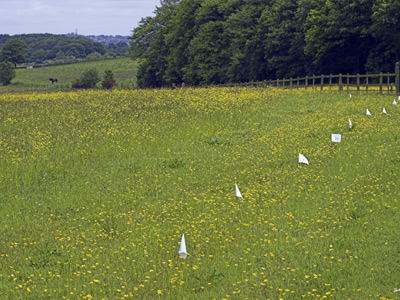
Invisible dog fence flags are installed around the boundary

Max boundary size is 350 acres.

Drawbacks of Electronic Dog Fences

  • No Physical Barrier: While they are effective at keeping your dog inside, they won’t prevent other animals or intruders from entering your property.
  • Dependence on Technology: As with anything electronic the system requires some maintenance, ie, checking collar batteries and ensuring the transmitter is functioning correctly. Easily facilitated as part of a weekly or monthly routine,
  • Training Commitment: Success with an electronic dog fence depends on proper training. Pet owners must be willing to invest time in helping their dog adjust to the new system. That is why at DogFence Ltd we offer onsite training for you and your dog together with our containment promise.

Who Benefits Most from Electronic Fences?

  • Rural properties with larger grounds (1/2 acre or more).
  • Dogs prone to jumping over or digging under traditional fences.
  • Owners prioritising unobstructed views or flexibility in boundary placement.
  • Homes near livestock or main roads.
  • Owners who have existing physical fencing but need added dog-proof containment.

Comparing Costs: Traditional vs. Electronic Fencing

  • Traditional Fencing: £25–£300 per metre, depending on material and design.
  • Electronic Fencing: £6–£10 per metre, covering large areas affordably and effectively.

For larger properties, electronic fences offer a practical and budget-friendly solution, saving thousands of pounds in upfront costs while ensuring your dog’s safety.

Installation Times: Traditional vs. Electronic Dog Fences

The installation time for a dog-proof fence can vary significantly depending on the type of fence you choose. For traditional physical fencing, a 5-acre site typically requires substantial preparation, including leveling the ground, digging post holes, and securely fixing materials like wood or chain link. This process can take 1–2 weeks or more, depending on terrain, weather conditions, and design complexity.

In contrast, an electronic dog fence can cover up to 10 acres in a single day, including professional installation and boundary training setup. The process is streamlined and minimally invasive, making it a fast and efficient solution for pet owners who want to ensure their dog’s safety without weeks of disruption.

Did You Know?

The Facts About Dog Containment

  • Over 85% of pet owners report feeling more confident about their dog’s safety after installing an electronic containment system.
  • Studies show that dogs trained with modern electronic fences adapt to their boundaries within 2–4 weeks when training is implemented correctly.
  • Traditional fences can cost up to £200 per metre for premium materials, whereas electronic fences cover larger areas at a fraction of the cost.

How DogFence.co.uk Can Help

At DogFence.co.uk, we specialise in bespoke electronic containment systems designed to suit every property and pet. With over 20 years of experience, we provide:

  • Customised consultations to assess your property and dog’s needs.
  • Expert installation by certified professionals.
  • Ongoing support and training to ensure the system works effectively.

Want to find out which fence is right for you? Call us or request a free quote today!


dog fencing options

Affordable dog fencing – what are the options?

Affordable dog fencing

When it comes to affordable dog fencing there aren’t many options as fencing is actually quite expensive.  As with everything you get what you pay for and it depends on whether you want to get your hands dirty. Naturally, these fencing options are based on how large an area you need to fence. The landscape that you need to fence. And also the breed of the dog that requires the dog fencing!

Dog fencing for small areas

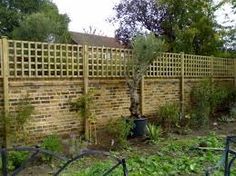
If you are looking to fence a small back garden then it is likely that you already have a fence or wall but it isn’t meeting your needs. Watch your dog and see if he is using something to climb up and scrabble over or is he climbing or digging. Consider installing trellis above your fence. This can be bought from any good DIY store and is relatively quick to install. If you have a digger add a concrete footer below your fence by pouring concrete along the edge of the fence and sinking the bottom of the fence into the concrete before it dries.  This is naturally a labour intensive job but should do the trick!

dog fencing using trellis on wall

Trellis placed on top of wall

If you are not sure where he is getting out then one of our DIY dog fences is going to be the cheapest way forward. These fences are under £250.00 and will cover a small urban garden. If you compare the price of re-fencing a complete rear garden versus adding an electronic dog fence the dog fence will win on price all day long!

For small gardens with low fences, you may be able to upgrade your fence to a close board fence. These fences start at around £38.00 per metre fully installed. You will need to check that you can install a fence of this height before ripping out the old fence.

Rural gardens and small paddocks

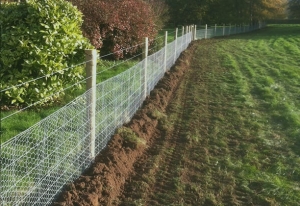
It goes without saying that dog fencing for rural areas can be a headache. Not only are you trying to stop your dog going out but the local wildlife is busy pushing its way in. If you have an issue with rabbits and small dogs then this could be a good option for you but it is not the cheapest! Rabbit fencing starts at approx £130.00 per 50m without installation! If you are covering a 1-acre site this will cost in the region of £690.00 just for the galvanised mesh without any posts of labour. Also unless it is extremely well-installed rabbit fencing can be damaged by larger mammals such as Badgers, Muntjack and larger Deer.

dog fencing for rabbits

Rabbit fence used as dog fencing

If you have hedges or areas with no existing fences then the cheapest form of fencing will be either a stock fence or an electronic dog fence. If you have horses or livestock then you will need to look at stock fencing options. Of course, if it is only a dog or a cat that needs containing then an electronic dog fence is by far the cheapest option.

Our DIY dog fence can be expanded up to an acre for an additional £100.00 and a Professionally Installed dog fence will cost in the region of £1000.00 depending on the location and number of dogs. This would work out more cost-effective than the galvanized or stock fencing and would also protect the driveways. Installing gates can also be very costly and of course, this relies on people shutting the gate when they come or go! Our Professionally installed fences have a lifetime warranty on the hardware and a containment promise for the dog.

Large estates and difficult terrains

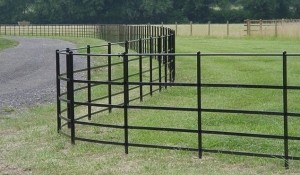
If it aesthetics then Estate fencing is most certainly the winner but you will need deep pockets to install this timeless classic! At around £80.00 per 2m panel + installation, it will very soon add up, especially on the large country estate! Again, you will need to think about gates and this type of fencing is not dog secure. Other popular types of fencing are post and rail with stock fencing below or chain link fencing. Chain link fencing is probably the cheapest starting from around £2500 for 1 acre + installation. Whereas if you are looking at fencing 10 acres using our Performance Series on a 10-acre site the cost would be circa £1800.00 including installation & training.

dog fencing used as estate fencing

Estate fencing

Riverbanks and Undulating Terrain

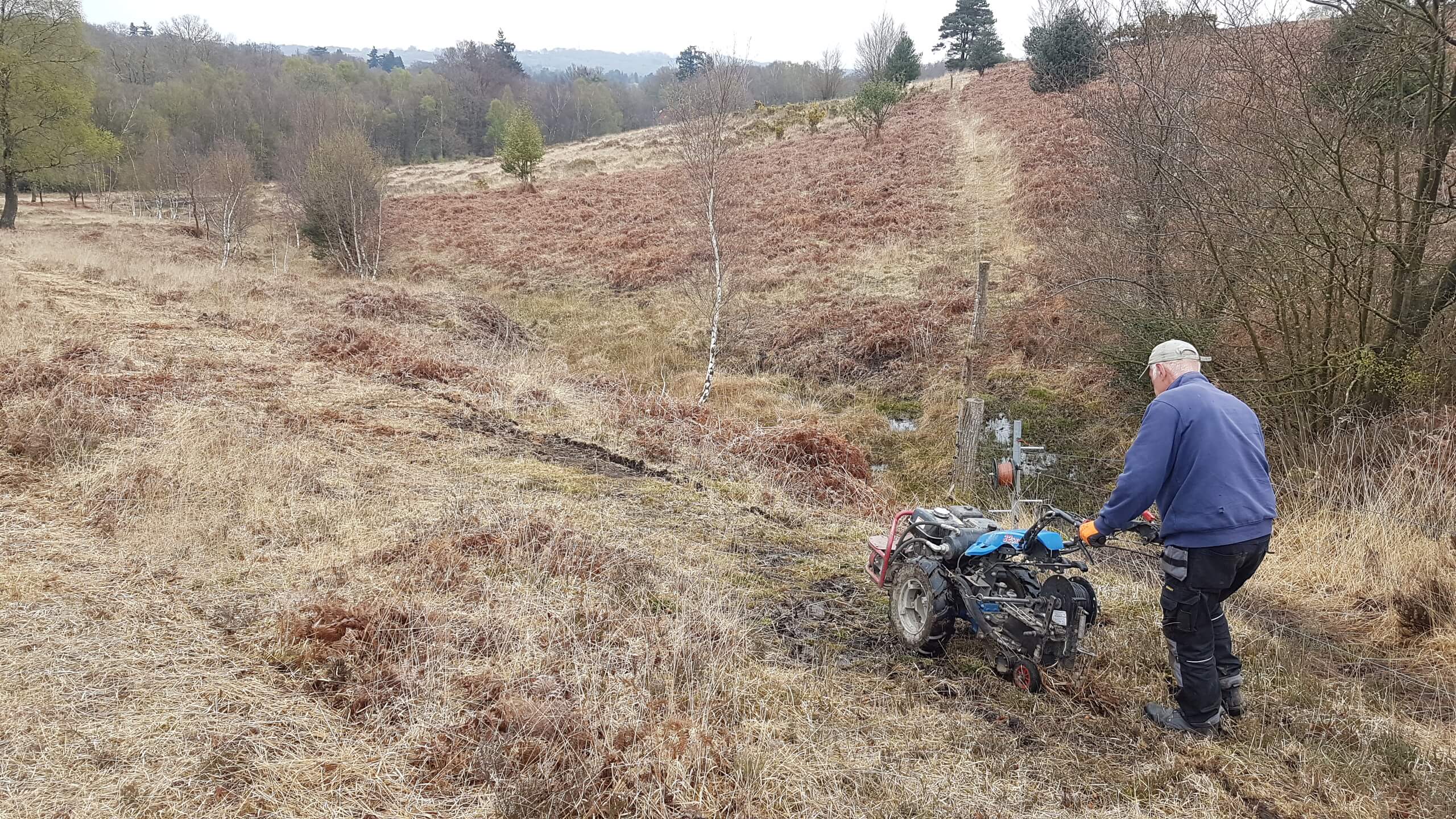
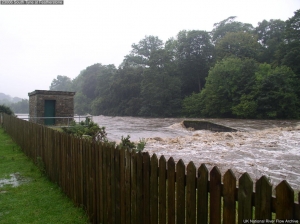
If your property goes down to the river you may be able to install a small picket fence. These will not stop all dogs as they tend to only be a 90 cm – 100cm high. Prices for Picket fencing start at around £12.00 per metre plus installation.  Alternatively, you can use our dog fence to run along the boundary. This will keep your dog out of the river without disrupting the view. If you have very undulating terrain then you will probably need to install a stock fence but there would be a hefty surge-charge to install this! Again, an invisible fence can be installed for a fraction of the cost.  The trencher used to install the invisible dog fence is extremely adaptable and be operated in both steep and undulating terrain. Images of the dog fence trencher can be seen on our installation & training page.

dog fencing by river using picket fence

Picket fence along river bank


Dog Fencing price summary

Based on an acre (and excluding gates)

    • Electronic dog fence (1 dog fully installed – covers gateways as well) – from £3.50 per metre installed.
    • Stock Fencing (no gates) – from £7.00 per metre installed
    • Rabbit Fencing (no gates) – from £8.00 per metre installed
    • Stock Fencing with post and rail (no gates) – from £12.00 per metre
    • Picket fencing (no gate) – from £20.00 per metre
    • Close board fence (no gate) – from £35.00 per metre installed
    • Estate fencing (no gate) from £40.00 per metre installed

Prices have been based on submissions from Companies in Berkshire (2019). Prices are based on properties in the local area and are a guide.

If you have been searching for dog fencing options then read our testimonials on our Trust Pilot reviews. If you would like more information or prices call us today on 03450 623623 or complete our quote form.


Dog wearing DogFence electronic dog fence collar in garden

Containment Fences Explained

What are electronic Containment Fences and how do they work?

Containment fences hit the news earlier this year when the Government declared that they intended to ban e-collars for training dogs.

Sadly, the media jumped in with both feet first and declared that containment fences were also to be banned. At DogFence we were horrified having Professionally installed containment fences for over 17 years we had no idea why! For our customers that already used a containment fence there was outrage. How could the Government even consider banning a fence that had saved their pets life and given them back their freedom?  For those that had not heard about containment fences there was intrigue. What is a containment fence and why do they want to ban them?basset hound enjoying freedom with containment fences

Even the MP that called for the ban didn’t know if the containment fence was to be included within any ban and the officials at DEFRA did not know how containment fences worked! As experts in the field for containment fencing DogFence were invited to meet with officials from DEFRA and demonstrate the fence.

The comments from the DEFRA team were as we suspected “it’s not that bad” and “it’s not what I imagined”.

So what is a containment fence?

It’s actually an invisible fence or virtual fence which is created by a radio signal. Originally invented to keep dogs safe at home in the USA where gardens are traditionally unfenced their popularity has grown in recent years.

A containment fence is actually a very simple and unobtrusive system which can be installed on virtually any property at a fraction of the cost of traditional fencing. It also offers for safety than conventional fencing as the pet can’t dig under or jump over the fence and it protects open areas such as driveways.

A boundary wire is placed around the property boundary which transmits a coded radio signal to a collar worn by the pet. When the pet approaches the boundary wire a high pitched warning beep alerts the pet to go back. If the pet continues forward, an electrical impulse is given through the collar (this is often referred to as a correction or static shock) and the pet retreats back into the safe area.

How does the pet know where to go?

Every pet undergoes a training programme which usually takes 2 – 5 days. When training to a containment fence it is important that the boundary is flagged to give a good visual of where the virtual fence starts. The flags stay in the ground as a visual marker for approx. 2 – 3 weeks. Containment fences can be used for dogs over the age of 12 weeks and cats 16 weeks or over.

The trainer will take the dog outside and set the collar to “beep only” mode. Using some voice commands, he will introduce the dog to the containment fence training flags and later he will allow the dog to enter the “no go area” of his own accord. By re-focusing the dog back into the safe area with the assistance of the warning beep and vocal commands the pet will quickly learn where he can or can’t go. Following the beep only session the training moves onto to assess the correct level of impulse (correction) required for the pet.  If the owner has more than one pet the likelihood is that they will each have a different training level.

containment fences are marked with training flags

Visible boundary for the pet with flags.


With cats the training is carried out internally following the Dog Fence Cat protocol. This training protocol was used as part of the Lincoln Cat Containment Fence study.


Will the containment fence hurt my pet?

Of course the thought of giving any impulse or shock to your pet can be abhorrent. It is important to note though that the impulse is very low and is usually only felt during the training phase. The sad scenario is that the pain felt from a car is almost unimaginable and the discomfort of containment fence is no worse than an annual vaccination. Also for dog owners there is always the threat of a shot gun as dog attacks on sheep are rising annually.

What areas of the garden will the containment fence cover?

Interestingly, containment fences can cover the entire garden including the driveway. The largest installation that we have installed at Dog Fence is 450 acres. Usually the fence wire is dug directly into the ground (approx. 3 – 5” below the surface) but it can be attached to existing physical boundaries. It is not uncommon for the fence wire to be attached to post and rail fences, stone walls, run through hedges, ditches or streams and even the odd moat! When it comes to the driveway any surface can be crossed except Resin bonded drives which require special attention.

Containment Fence Collars

The original containment fences from the early 80’s used heavy bulky collars but as with the mobile phone technology everything has been scaled down in recent years. Not only have the collars become smaller and lighter but the battery life has also increased.

At Dog Fence we can boast the smallest and lightest collars worldwide. Our mini containment fence collar only weighs 30g but still features an incredible 6-month battery life. Incredibly our standard collar has a 2-year battery life and weighs in at only 48g which is still the 3rd lightest collar available worldwide!

How much do containment fences cost?

A containment fence costs a fraction of the cost of installing a traditional fence or driveway gates. Unlike a wooden or stock fence a containment fence becomes more cost effective the larger the area. Naturally the price is dependent on the owner’s location and the number of dog or cats that they have. There is no need to visit a property to give an estimate for the containment fence; this can all be carried out via our online survey tool.

Summary

Thankfully, the Government looked at the evidence, research and responses from containment fence owners and deemed these lifesaving systems safe to use. Indeed, Michael Gove stood up and supported the life-saving fences in Parliament.

If you are interested in receiving a quick free quote contact us today on 01628 476475 or fill in our quote form https://dogfence.co.uk/quote/

Girl comforting dog wearing electric dog fence collar in UK garden

Electric dog fences cruel or kind?

Are Electric Dog Fences Cruel or Kind? The Evidence Explained (UK Guide)

Are electric dog fences cruel or kind? It’s one of the most common and emotionally charged questions dog owners ask when considering ways to keep their pet safe at home.

The word “electric” can sound alarming. Many owners understandably worry about welfare, pain, or long-term stress. But modern electronic containment systems are very different from what people often imagine.

In this guide, we explain how electric dog fences work, what independent research says, and whether they are truly cruel — or in fact a responsible solution for protecting dogs in the UK.


What Is an Electric Dog Fence?

Despite the name, an electric dog fence is not the same as a livestock electric fence. It is an electronic containment system designed specifically for domestic pets.

If you would like to see the full specification of a professionally installed system, you can read more about our electric fence for dogs solutions on our dedicated product page.

Modern systems consist of:

  • A central transmitter
  • A boundary wire (for wired systems)
  • A lightweight receiver collar worn by the dog

The boundary wire carries a coded radio signal around the perimeter of your property. If you’d like a full technical explanation, you can read more about how our electronic dog fence systems work.

When a dog approaches the boundary:

  • The collar emits a warning beep.
  • If the dog continues forward, a brief, programmable static impulse is delivered.

The impulse is not a continuous electric shock. It is a controlled, momentary static correction, adjusted to suit your dog’s size, temperament and sensitivity.


Types of Electric Dog Fence Systems

Understanding system types is important when asking, are electric dog fences cruel or kind?

Wired Dog Fences

A wired system involves installing a boundary wire around your property. The wire is typically buried a few inches underground for protection.

Wired systems are:

  • Flexible in shape and layout
  • Suitable for slopes and uneven ground
  • Able to create “no-go zones” around ponds or driveways
  • Reliable in complex UK gardens

At DogFence Ltd, we specialise in wired systems because they offer superior reliability and safety. You can learn more about our professional dog fence installation and training process.

Wireless Dog Fences

Wireless systems create a circular signal from a central base unit.

They are generally only suitable for:

  • Flat, open spaces
  • Clear line-of-sight environments
  • Simple garden layouts

They cannot adapt easily to buildings, trees or irregular boundaries, which makes them less suitable for many UK properties.


How Does an Electric Dog Fence Work?

The boundary wire acts as an antenna, transmitting a coded radio signal around your garden.

The receiver collar:

  • Detects proximity to the boundary
  • Emits a warning tone
  • Delivers a brief static impulse only if necessary

The correction level is individually programmed. It is never “one size fits all.”

With structured training, most dogs quickly learn to respond to the warning beep alone. After the initial learning phase, many rarely experience the static correction.


Are Electric Dog Fences Cruel or Kind? Looking at Welfare

So, are electric dog fences cruel or kind?

When professionally installed and properly introduced through training, modern electronic containment systems are designed to prioritise safety and welfare.

The static impulse is comparable to the mild static sensation you might experience when touching a metal car door after walking across carpet — momentary and surprising, but not harmful.

Importantly, the goal of the system is not punishment. It is boundary awareness.

What Does Research Say About Whether Electric Dog Fences Are Cruel or Kind?

Researchers at the University of Lincoln found no evidence of long-term welfare problems in cats living with electronic containment systems compared to animals able to roam freely.

You can read the published findings on the official University of Lincoln website.

When asking whether electric dog fences are cruel or kind, it’s important to compare them with the real-world risks dogs face without reliable containment.


What Happens When Dogs Escape?

Dogs are naturally curious. Some will dig, jump or squeeze through traditional fencing.

Common consequences of escape include:

  • Road traffic accidents
  • Livestock chasing (which can lead to prosecution or fatal outcomes)
  • Injury from other animals
  • Getting lost
  • Legal liability for property damage
  • Neighbour disputes

In rural and semi-rural England, livestock incidents can have devastating consequences for both farmer and dog.

Responsible containment is often about prevention — protecting the dog, livestock and the wider community.


How Dogs Learn to Respect the Boundary

Professional training is essential to humane use.

During installation:

  • Visual training flags are positioned along the boundary
  • Dogs are introduced on lead
  • The warning tone becomes the primary cue
  • The static impulse is introduced only if necessary

Most customers report that after training, their dog rarely triggers more than the warning beep.

If you still have questions about suitability or safety, our Dog Fence FAQs page  answers many of the most common concerns.

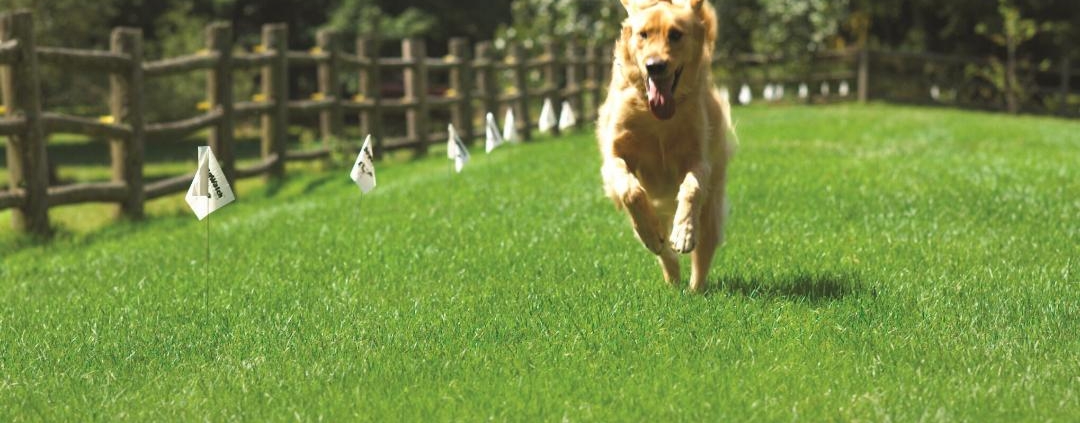
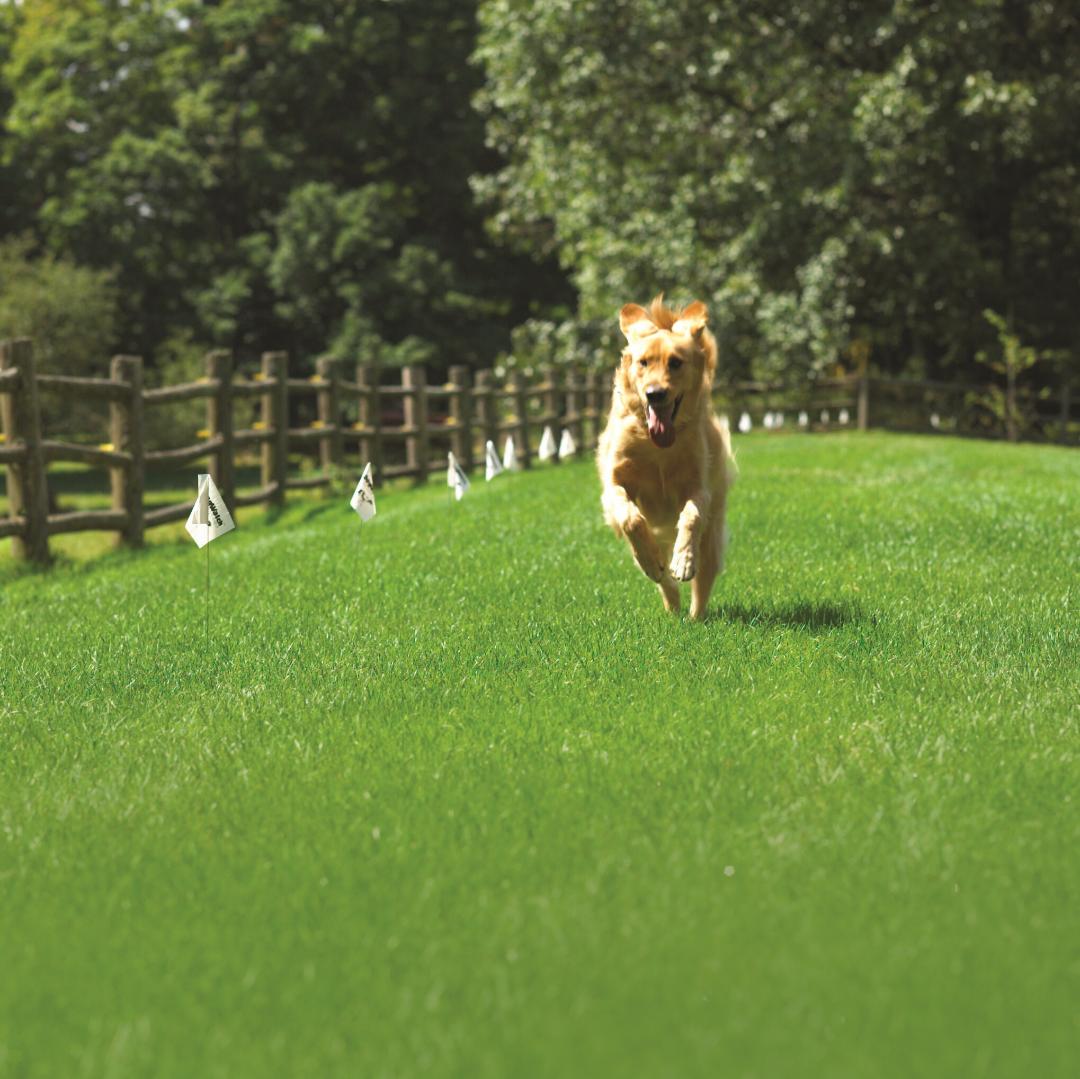
Golden retriever trained to electric dog fence boundary with flags

With professional training, most dogs quickly learn to recognise boundary flags and respond to the warning tone alone.


When Electric Dog Fences May Not Be Suitable

To answer honestly whether electric dog fences are cruel or kind, it’s important to acknowledge that they are not suitable in every case.

They may not be appropriate for:

  • Extremely anxious or highly nervous dogs
  • Situations without professional training
  • Owners unwilling to follow structured guidance

Used incorrectly, any training tool can cause confusion. Used responsibly, electronic containment systems are predictable, consistent and safe.

This is one reason professional installation is so important. Poorly installed systems, incorrect collar settings, or inconsistent training can undermine both safety and welfare. If you are weighing up your options, our guide on dog fence installation: DIY vs hiring a professional explains the key differences and risks to consider.


So, Are Electric Dog Fences Cruel or Kind?

When professionally installed, carefully programmed and supported with structured training, electric dog fences are a responsible containment solution.

They allow dogs to:

  • Enjoy freedom within their own garden
  • Display natural behaviour
  • Avoid roads and livestock
  • Remain safely at home

For over 22 years, DogFence Ltd has installed systems across England — from compact gardens to 350-acre estates — always prioritising safety, welfare and responsible ownership.

Experience matters. Training matters. Quality matters.

While some critics remain concerned, the debate around electronic containment has been ongoing for years. If you would like to explore both sides of the discussion in more depth, you can read our article on the controversy surrounding dog fences and whether they are cruel or harmful


FAQs: Are Electric Dog Fences Cruel or Kind?

Do electric dog fences give dogs an electric shock?

No. Despite the name, these systems do not deliver a continuous electric shock. They use a warning beep first, followed (only if the dog ignores the warning) by a brief, programmable static impulse.

Do electric dog fences hurt dogs?

When set correctly for the individual dog and introduced through professional training, the sensation is mild and momentary. Most dogs learn to respond to the warning beep and rarely need more than the audible cue.

Are electric dog fences legal in the UK?

Yes. Electronic dog containment systems are legal in the UK. As with any training tool, they must be used responsibly, with appropriate set-up and training.

Will an electric dog fence stop my dog running out of the garden?

A professionally installed wired system is designed to contain dogs within the boundary you set. Success depends on correct installation, correct collar programming, and training that teaches the dog what the warning beep means.

Are wireless dog fences as reliable as wired systems?

Wireless systems can work in very open, flat areas, but they are usually less flexible and less reliable in typical UK gardens with buildings, trees, slopes or complex boundaries. Wired systems are generally the safer, more consistent option.

How long does it take to train a dog to an electric dog fence?

Most dogs learn the boundary quickly with structured sessions over several days. The key is consistency: flags, lead work, the warning tone and positive reinforcement.

Final Thoughts

If you are still wondering are electric dog fences cruel or kind, the answer lies in how the system is installed, programmed and introduced. When professionally fitted and supported by structured training, modern electronic containment systems are designed to protect both welfare and safety.

With over 22 years of experience installing wired dog fences across England, DogFence Ltd focuses on responsible containment that allows dogs freedom within safe boundaries.


Ready to Keep Your Pet Safe?

Call us on
01628 476475
|
Message us on WhatsApp
|
Request a Free Quote Online

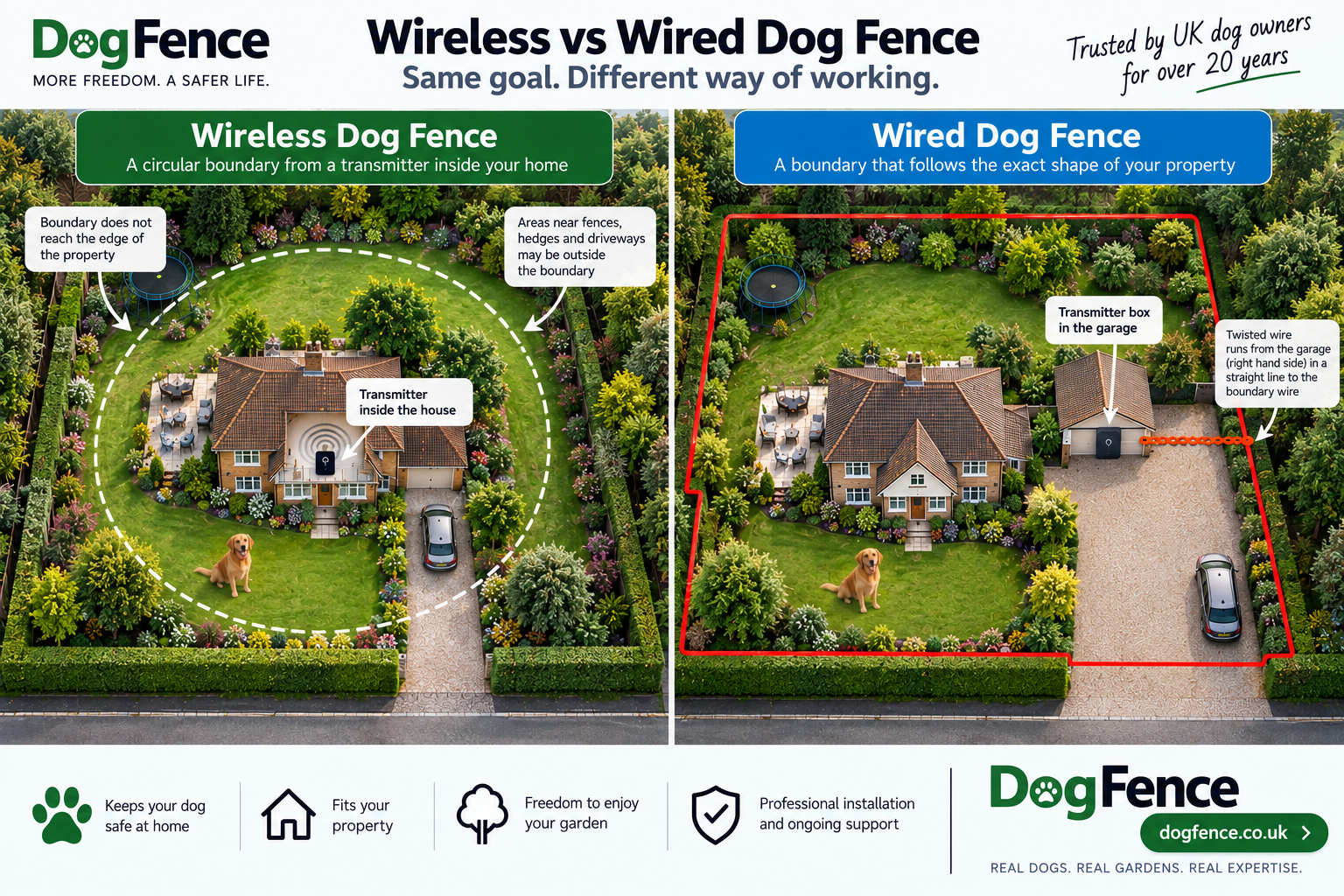
Wireless dog fence vs wired dog fence showing a circular wireless boundary compared with a wired boundary following the full garden perimeter

Wireless dog fence – the truth – do they work?

Wireless Dog Fence vs Wired Dog Fence: Which Is Best for Your Garden?

A wireless dog fence and a wired dog fence are both designed to help keep a dog safely within a defined area, but they create that boundary in very different ways. A wireless dog fence generally creates a circular boundary around a transmitter, while a wired dog fence follows a boundary cable positioned around the actual shape of your garden.

That difference can be particularly important in UK gardens, where boundaries are rarely perfect circles and properties may include slopes, woodland, outbuildings, open driveways or neighbouring roads. Your dog’s personality, behaviour and drive also matter when choosing any form of electronic dog containment.

At DogFence, we have specialised in electronic pet containment in the UK for more than 20 years and professionally install wired dog fence systems. We don’t believe one solution is right for every dog or every property, so this guide explains the practical differences between a wireless dog fence and a wired dog fence – including situations where a wireless system may be perfectly suitable.
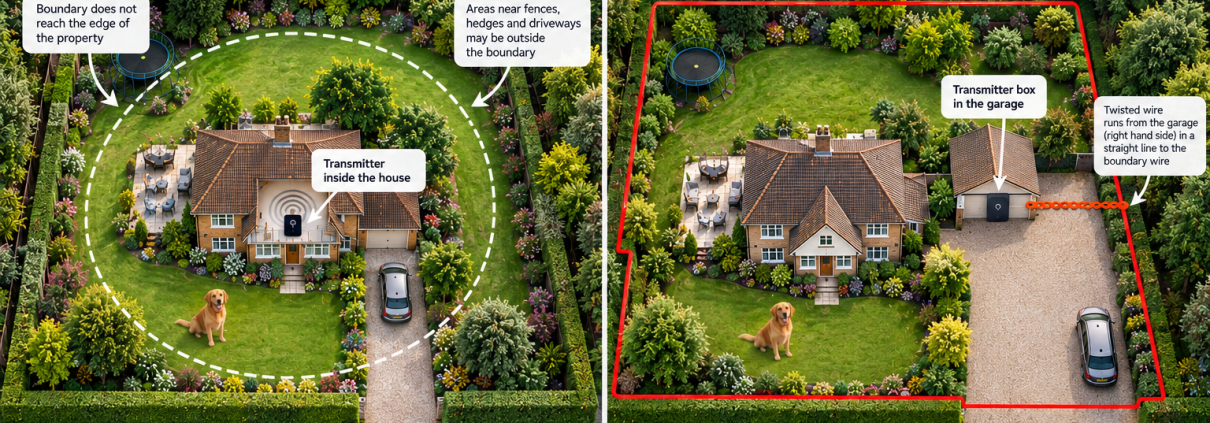
Wireless dog fence vs wired dog fence showing a circular wireless boundary compared with a wired boundary following the full garden perimeter

Wireless vs wired dog fence: a wireless system typically creates a circular boundary around the transmitter, while a wired dog fence can follow the full shape of your property, including gardens, hedges and driveways.


What is a wireless dog fence?

A wireless dog fence uses a transmitter to create an electronic containment area without installing a boundary wire around the perimeter of the property.

The transmitter is normally positioned inside the property and sends out a radio signal. The dog wears a compatible receiver collar and is trained to recognise the warning given as it approaches the edge of the permitted area.

Because there is no perimeter wire to install, wireless dog fences can be relatively quick and simple to set up. For the right dog and the right property, this can be a significant advantage.

However, a traditional wireless dog fence generally creates a circular or radial boundary around the transmitter. The electronic boundary therefore does not necessarily follow your fences, hedges, driveway or actual property line.

Wireless systems can also be more affected by the environment in which they are used. Uneven or undulating ground, dense woodland, trees and buildings can potentially affect how consistently a wireless signal reaches different parts of a property.

What is a wired dog fence?

A wired dog fence uses a boundary cable to establish the containment area. The cable can be positioned around the perimeter of the garden or property, allowing the electronic boundary to follow its actual shape.

The dog wears a receiver collar and, just as with a wireless dog fence, must be properly trained to recognise the boundary and respond appropriately to its warning.

Because the boundary is determined by the position of the wire rather than the transmission of a wireless signal across the whole property, a wired electric dog fence can be designed around:

  • irregularly shaped gardens
  • existing fences and hedges
  • driveways and entrance gates
  • long or narrow gardens
  • woodland and heavily wooded areas
  • undulating or sloping ground
  • outbuildings
  • large gardens and rural properties
  • farms and equestrian properties
  • areas within the property where the dog should not have access
  • ponds, swimming pools and other exclusion zones

This flexibility is one of the principal reasons DogFence specialises in professionally installed wired dog fence systems.

Wireless vs wired dog fence: what’s the difference?

Wireless dog fence vs wired dog fence UK comparison showing differences in boundary shape, uneven terrain, woodland, buildings and driveways

Wireless vs wired dog fence comparison. Wireless systems typically create a circular radio boundary, while a wired dog fence can follow the actual shape of a property, including irregular gardens, woodland, slopes, driveways and outbuildings.

Neither type of electronic dog fence is automatically right for every dog or every property. The most appropriate system depends on the layout of the land, nearby hazards, terrain, buildings and how accurately the containment boundary needs to be positioned. Your dog’s personality, behaviour and drive are equally important considerations.

When can a wireless dog fence work well?

A wireless dog fence can be a practical option where the property has plenty of relatively level, open space and a circular containment area can be positioned safely away from roads and other hazards.

It may also appeal to owners who want a system that can be installed relatively quickly without laying a boundary cable.

The important question is not simply whether a wireless dog fence works. It is whether the boundary created by that particular system works for your property and your dog’s personality, behaviour and drive.

If the permitted wireless area fits comfortably within the safe part of the garden and the property is suitable for a radio-based boundary, a wireless dog fence may be sufficient.

When is a wired dog fence more suitable?

A wired dog fence can be particularly useful when the electronic boundary needs to follow the actual shape and features of the property.

This is common in UK properties where a garden may have hedges on one side, fencing on another, an open driveway at the front, neighbouring properties nearby or uneven ground.

Instead of fitting the garden inside a predetermined wireless containment area, the wired boundary can be designed around the property.

A wired dog fence can be particularly suitable for:

  • long or narrow gardens
  • L-shaped or irregular plots
  • open driveways
  • properties bordered by roads
  • dogs escaping through hedges
  • dogs digging underneath existing fencing
  • dogs jumping or climbing physical fences
  • properties requiring specific exclusion areas
  • properties with undulating or sloping ground
  • properties with outbuildings
  • woodland and heavily wooded properties
  • farms and equestrian properties
DogFence wired dog fence installation across steep and undulating ground

Unlike wireless systems, a wired dog fence can follow the contours of steep and undulating ground. Here, the DogFence boundary wire is being installed across challenging rural terrain.

Can a wireless dog fence follow the shape of my garden?

A traditional wireless dog fence generally cannot follow an irregular property boundary in the same way as a wired dog fence. Its containment area is determined by the radio signal produced by the transmitter and is typically circular or radial.

This may not matter on a large, open property. However, it becomes much more important when the safe boundary needs to run close to fences, hedges, roads, neighbouring gardens or an open driveway.

A wired dog fence provides greater control because the boundary is established by the position of the cable.

Can a dog fence create exclusion zones within the garden?

One of the advantages of a properly designed wired dog fence is the ability to create boundaries around specific areas within a property, not just around its outer perimeter.

Depending on the system design, dogs can be kept away from areas such as swimming pools, ponds, children’s play areas, vegetable gardens, flower beds or other places where you don’t want them to go.

This can be particularly useful on larger or more complex properties where the dog can have considerable freedom without necessarily having access to every part of the land.

Read more about using DogFence to create dog exclusion zones around areas of your garden.

Can wireless and wired dog fences work with existing fencing?

Yes. An electronic dog fence does not necessarily replace an existing fence or hedge.

Many DogFence customers already have physical boundaries but have a dog that has discovered a way to escape – perhaps by digging underneath a fence, jumping or climbing it, squeezing through gaps or pushing through a hedge.

In these situations, a wired dog fence can be positioned to work alongside the existing physical boundary and provide an additional layer of containment.

Read our guide to dog-proofing your garden and preventing common escape routes.

Can I install a wireless dog fence myself?

Yes. Many wireless dog fences are specifically designed for DIY installation, and this is one of their main attractions. Some wired dog fence systems can also be self-installed, while others are supplied as part of a professional installation and training service.

However, installing the equipment is only one part of establishing a successful electronic containment system. The position of the boundary is important, but training is one of the most important parts of any dog fence set-up.

Whether the dog fence is wired or wireless, the complete recommended training programme should be carried out. The dog needs to learn where the boundary is, understand the warning and know exactly how to respond to it. Good training helps create a successful outcome in which the dog can confidently enjoy the freedom available within its safe area.

If you are installing a system yourself, check that it is supplied with enough training flags to mark the boundary clearly. As a practical guide, we recommend at least 20 training flags for every 100 metres of boundary, together with comprehensive, easy-to-follow training instructions.

Support is also worth considering before choosing where to buy your dog fence. If purchasing through a general third-party online retailer, check what specialist dog-fence training and technical support will actually be available after purchase. A reputable specialist dog fence supplier should be able to help not only with the initial set-up and training, but also with questions and ongoing support after the system has been installed.

At DogFence, our professionally installed systems include an assessment of the property, boundary design, installation and structured training with the dog and owner, together with ongoing support.

Why is training so important with a wireless or wired dog fence?

Training is fundamental whether you choose a wireless dog fence or a wired dog fence. The technology establishes the boundary, but the training teaches the dog what that boundary means.

A receiver collar should never simply be placed on a dog and the dog left to discover the boundary for itself. The dog should be introduced to the boundary in a structured way so that it learns to recognise the warning and retreat confidently into the safe area.

DogFence has always regarded training as part of the containment system rather than an optional extra.
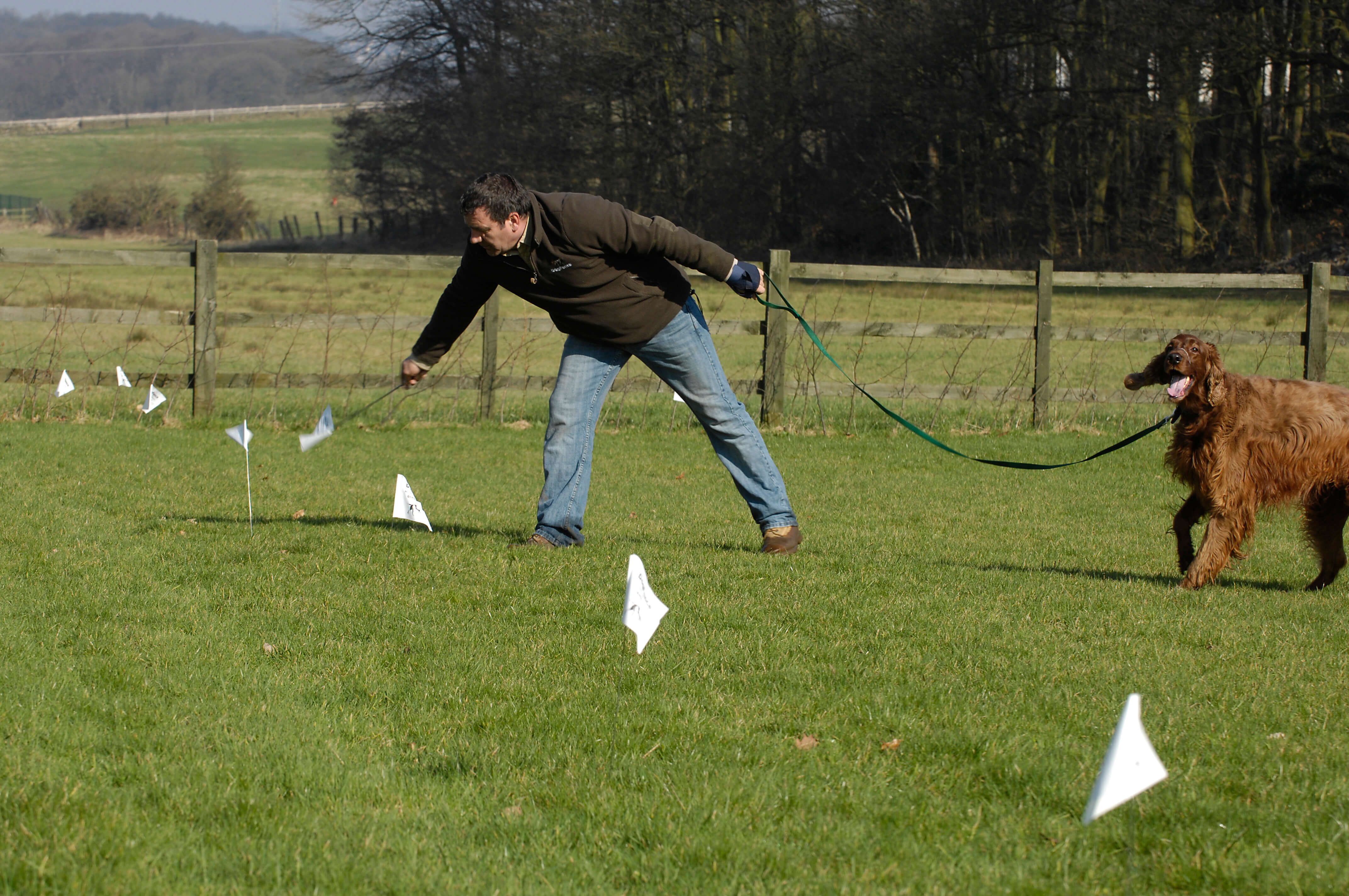
A dog in training on a DogFence electronic dog fence systems

Training the dog using the marker flags

DogFence and the UK Government: why installation and training matter

DogFence consulted directly with the UK Government in 2018 during discussions surrounding electronic training collars and electronic containment fences.

At that time, the Government’s proposals envisaged electronic containment systems being supplied with professional installation and training, reflecting the importance placed on correct system set-up and proper training when using this type of containment.

That principle remains central to the way DogFence works today. When an electronic dog fence is correctly specified, installed and introduced through appropriate training, it can help prevent dogs escaping from their property, becoming lost or reaching hazards such as nearby roads, while allowing them greater freedom to enjoy their garden.

Whether you choose a wired or wireless dog fence, the technology is only part of the solution. Correct boundary design and thorough training are fundamental to a successful outcome and a confident, happy dog.

Can a dog run through a wireless or wired dog fence?

Because neither a wireless nor a wired electronic boundary is a physical barrier, a dog can technically cross it. Effective electronic containment therefore depends on appropriate system design and, importantly, the dog learning where the boundary is and how to respond to its warning.

The objective is for the dog to recognise the warning and turn back before crossing the containment boundary.

The dog’s personality and drive also need to be considered. A dog with a strong chase instinct, for example, needs to be assessed and trained appropriately rather than assuming that simply installing a dog fence will solve the problem.

Read our full guide: Can a Dog Run Through an Invisible Fence?

Why does DogFence use a wired dog fence?

DogFence has specialised in electronic pet containment in the UK for more than 20 years. We use professionally installed wired dog fence technology because it allows us to design the containment boundary around the individual property rather than requiring the property to fit within a predetermined wireless boundary.

That can be particularly important around roads, driveways, neighbouring properties, woodland, undulating terrain, outbuildings, irregular garden boundaries and areas within the property where access needs to be restricted.

For farms, equestrian properties and larger rural homes, it also means the containment boundary can be designed around the way the property is actually used.

But we don’t believe that means everyone should buy a wired DogFence.

A wireless dog fence may be perfectly adequate for some dogs and properties. Equally, there are dogs and circumstances where we may advise that an electronic containment system isn’t appropriate at all.

Find out when an electronic dog fence may not be suitable for your dog.

Wireless dog fence vs wired dog fence: which should I choose?

If you have a large, relatively level and open area where a circular containment zone can sit comfortably inside the safe part of your property, a wireless dog fence may offer a convenient solution without installing a boundary cable.

If your garden is irregularly shaped, has an open driveway, sits close to a road, contains woodland or outbuildings, has undulating ground, or you need the electronic boundary to follow existing fences and hedges accurately, a wired dog fence offers considerably more flexibility over where the boundary can be positioned.

The most important consideration is not simply whether the system is wireless or wired. It is whether the containment system, boundary design and training programme are appropriate for your dog, your dog’s drive and personality, your property and the hazards around it. 

Wireless vs wired dog fence FAQs

Is a wired dog fence better than a wireless dog fence?

Not in every situation. A wired dog fence offers much greater flexibility over the shape and position of the containment boundary. A wireless dog fence can be quicker to set up and may work well on a relatively level, open property where a circular containment area is appropriate.

What is the main disadvantage of a wireless dog fence?

One of the principal limitations of a traditional wireless dog fence is the shape and consistency of its containment area. Because the boundary is created by a radio signal from a transmitter, it cannot normally follow an irregular garden perimeter as precisely as a wired boundary, and terrain, trees or buildings may affect some systems.

What is the main advantage of a wired dog fence?

A wired dog fence allows the containment boundary to be designed around the actual shape and features of the property. This provides greater flexibility around fences, hedges, driveways, gates, woodland, uneven ground and outbuildings.

Does a wired dog fence have to be underground?

Not necessarily. Although wired systems are sometimes called underground dog fences, the purpose of the boundary cable is to establish the electronic boundary. The most appropriate installation method depends on the property and the particular system.

Do wireless dog fences work in UK gardens?

Yes. A wireless dog fence can work in a UK garden where its containment area can be positioned safely within the property and the site conditions are appropriate. For irregularly shaped gardens, woodland, undulating ground or properties where the boundary needs to follow existing fences, hedges or driveways closely, a wired system may provide greater flexibility.

How many training flags do I need for a dog fence?

The boundary should be clearly marked during training so that the dog has a strong visual reference while learning where it is. As a practical guide, DogFence recommends at least 20 training flags per 100 metres of boundary. Follow the training programme supplied with your particular system and make sure you have enough flags before beginning.

Are wireless and wired dog fences suitable for every dog?

No. No dog containment method is appropriate for every dog. The dog’s age, health, temperament, behaviour, personality and drive, together with the property itself, should all be considered before choosing an electronic dog fence.

The aim of any dog fence is to give your dog freedom while keeping them safe. DogFence has been surrounding pets with freedom since 2003 and has safely contained more than 20,000 pets – real-world evidence that hidden dog fencing can work effectively when it is correctly set up and supported by thorough training and ongoing support.

Golden Retriever running towards an invisible dog fence boundary

Dog running freely within a hidden dog fence boundary marked by training flags

Wireless or wired? Not sure what’s right for your dog?

Tell us about your dog, your garden and what you’re trying to achieve. With more than 20 years’ experience in pet containment, we’ll tell you whether we think a DogFence is suitable – and we’ll tell you if we don’t.

📞 Call us on 01628 476475
💬 Chat to us on WhatsApp


GET MY FREE QUOTE

No pressure. No one-size-fits-all solution. Just experienced advice about the safest way to give your dog more freedom.

Image note: Some images used in this article may be AI-generated for illustrative purposes. They are not intended to show a specific DogFence installation, product or individual dog. All advice and information in this article is written and reviewed by DogFence based on more than 20 years’ experience in electronic pet containment.