Stop dogs digging up flower bed with a hidden dog fence

Can I Keep My Dog Out of Flower Beds?

Can I Keep My Dog Out of Flower Beds?

Yes. A hidden dog fence can keep your dog out of flower beds by creating a discreet no-go zone around your planted areas. Your dog can still enjoy the rest of the garden while learning that your flower beds are off limits.

Unlike low fencing or temporary barriers, a hidden dog fence protects your flower beds without changing the appearance of your garden.

At a Glance

  • ✔ Keeps dogs out of flower beds without visible fencing
  • ✔ Suitable for new and existing DogFence systems
  • ✔ Protects flowers, shrubs and newly planted borders
  • ✔ Allows dogs to enjoy the rest of the garden
  • ✔ Professionally installed and individually designed

A hidden dog fence creates a discreet no-go zone to help keep dogs out of flower beds while preserving the appearance of your garden.

Keep dog out of flower beds with a hidden dog fence

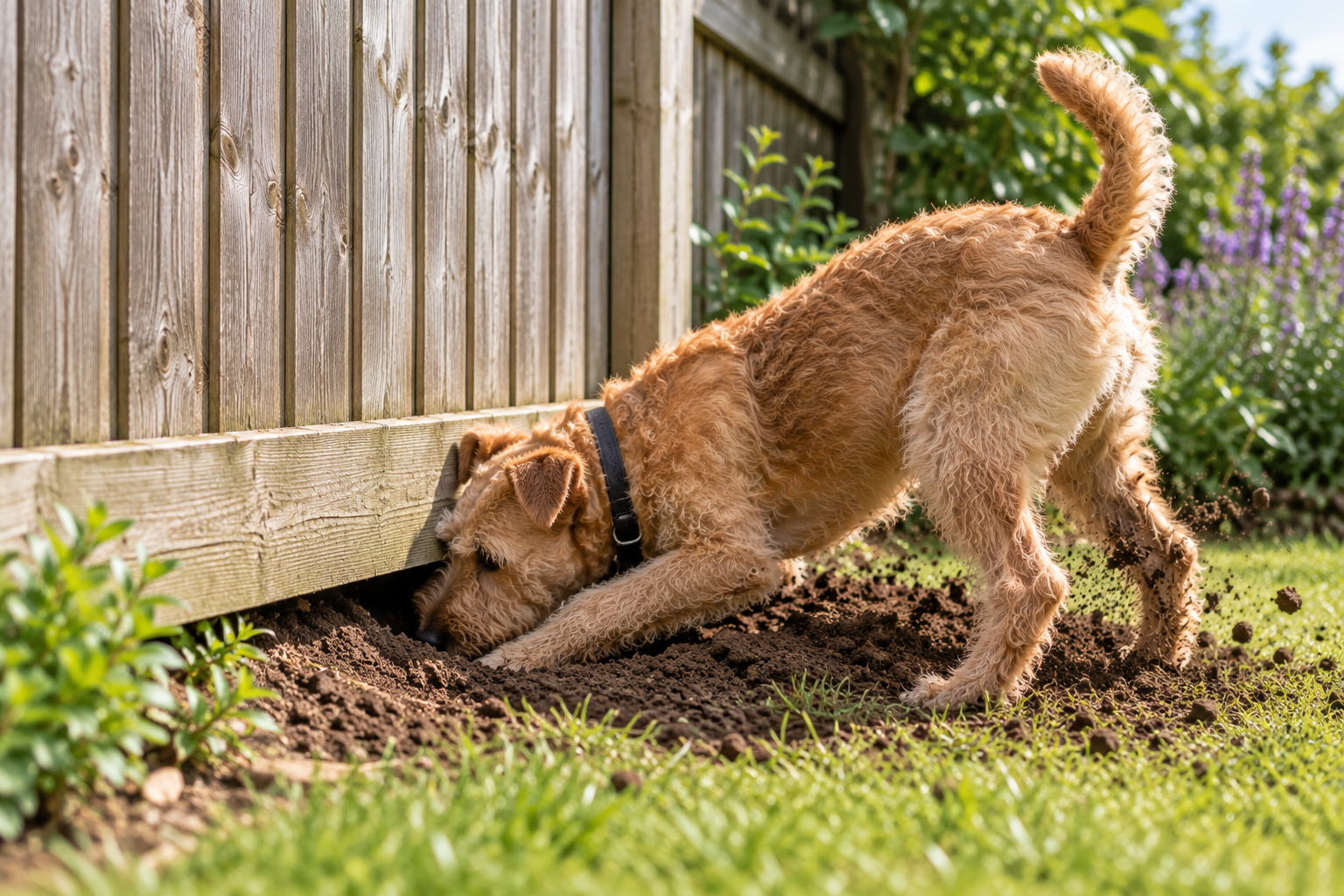
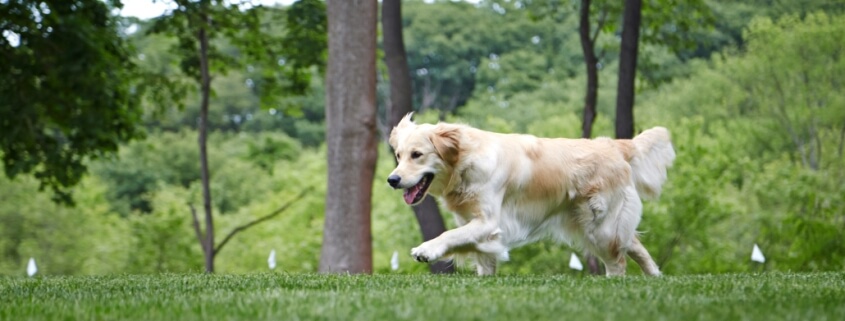
A hidden dog fence helps stop dogs digging up flower beds while allowing them to enjoy the rest of the garden.

Why Keep Dogs Out of Flower Beds?

Many dogs naturally enjoy digging, sniffing and exploring flower beds. While this is normal behaviour, it can quickly damage plants and spoil carefully maintained borders.

Common reasons for creating a flower bed exclusion zone include:

  • Protecting newly planted flowers and shrubs
  • Preventing digging and damaged borders
  • Keeping dogs away from delicate or valuable plants
  • Preventing muddy paw prints through planted areas
  • Protecting bulbs before they have established
  • Keeping dogs away from plants that may be harmful if chewed

Creating a flower bed exclusion zone helps protect your planting while allowing your dog to continue enjoying the rest of the garden. At DogFence, we’ve designed bespoke exclusion zones for hundreds of gardens, with every installation tailored to the property’s layout and the areas each owner wants to protect.

Keep dog out of vegetable garden with a hidden dog fence

How Does It Work?

Whether you’re a new customer or already have a DogFence installed, it’s usually possible to create a discreet no-go zone around one or more flower beds.

New DogFence Customers

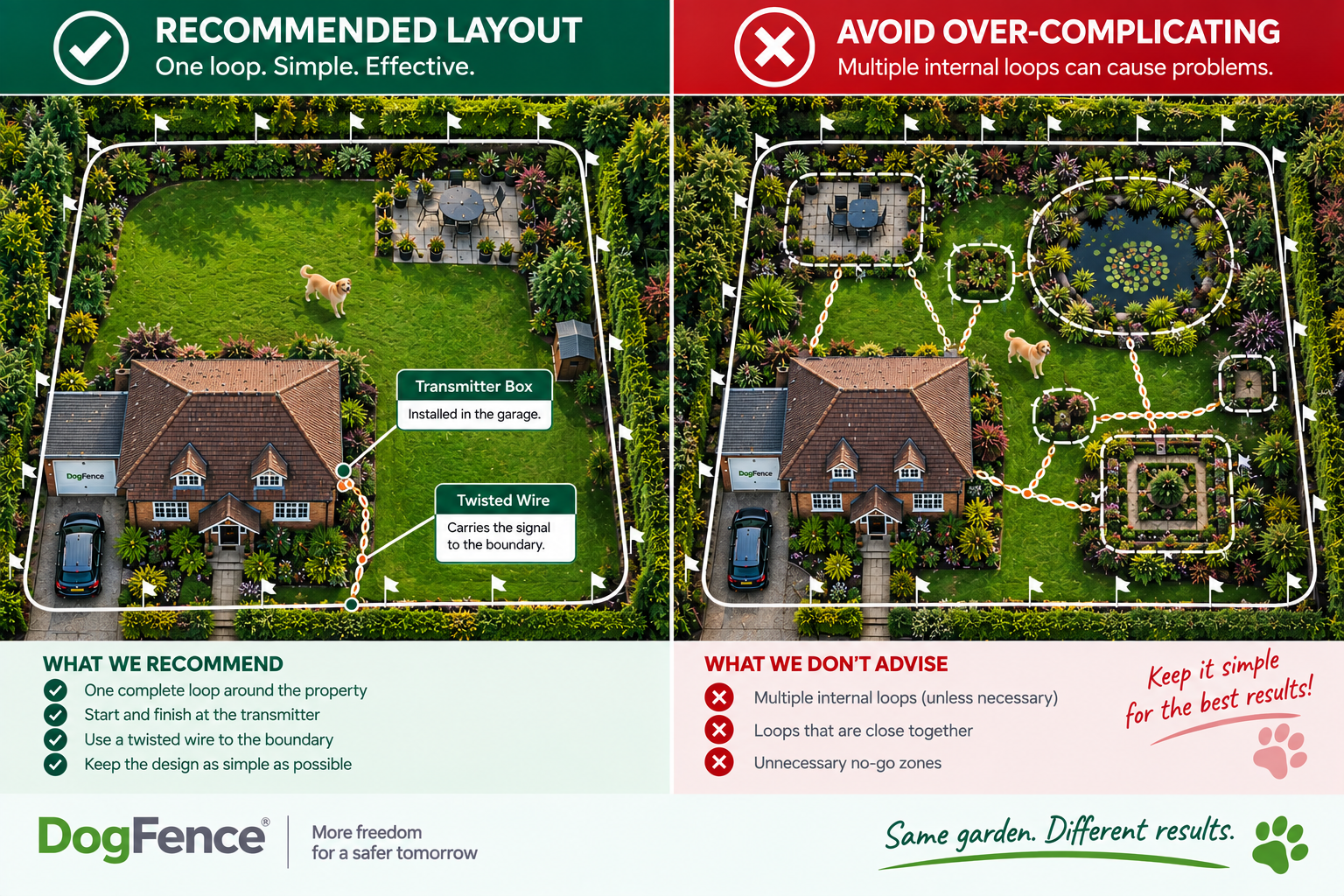
If your garden is already securely enclosed with fencing or walls, there’s no need to install a full garden boundary. We can install a dedicated exclusion loop around your flower beds.

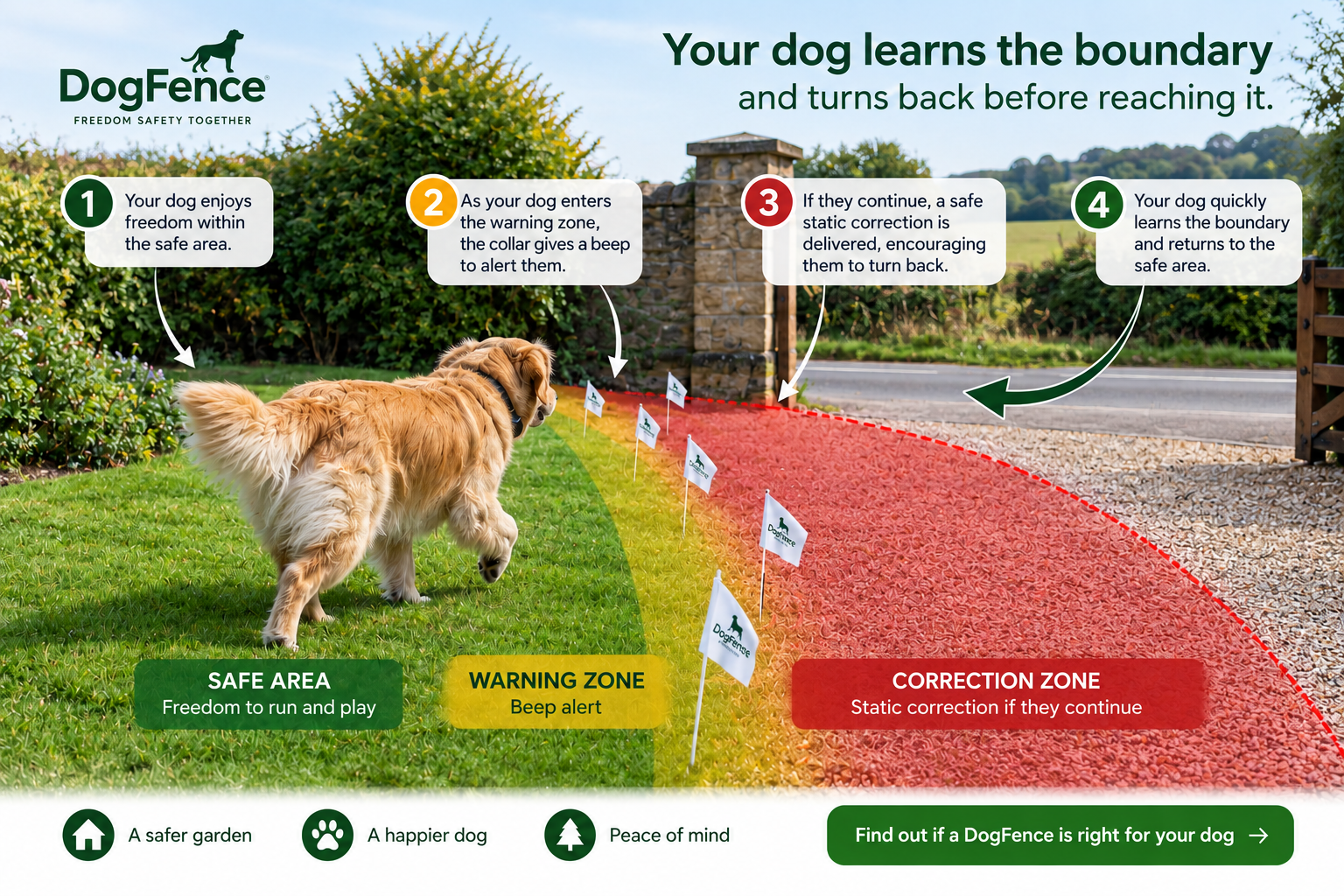
A hidden boundary wire is buried around the planted area and connected to the DogFence transmitter. Your dog wears a lightweight receiver collar that provides an audible warning as they approach the flower bed. If they continue towards the boundary, the collar delivers a brief training correction, helping them understand that the area is out of bounds.

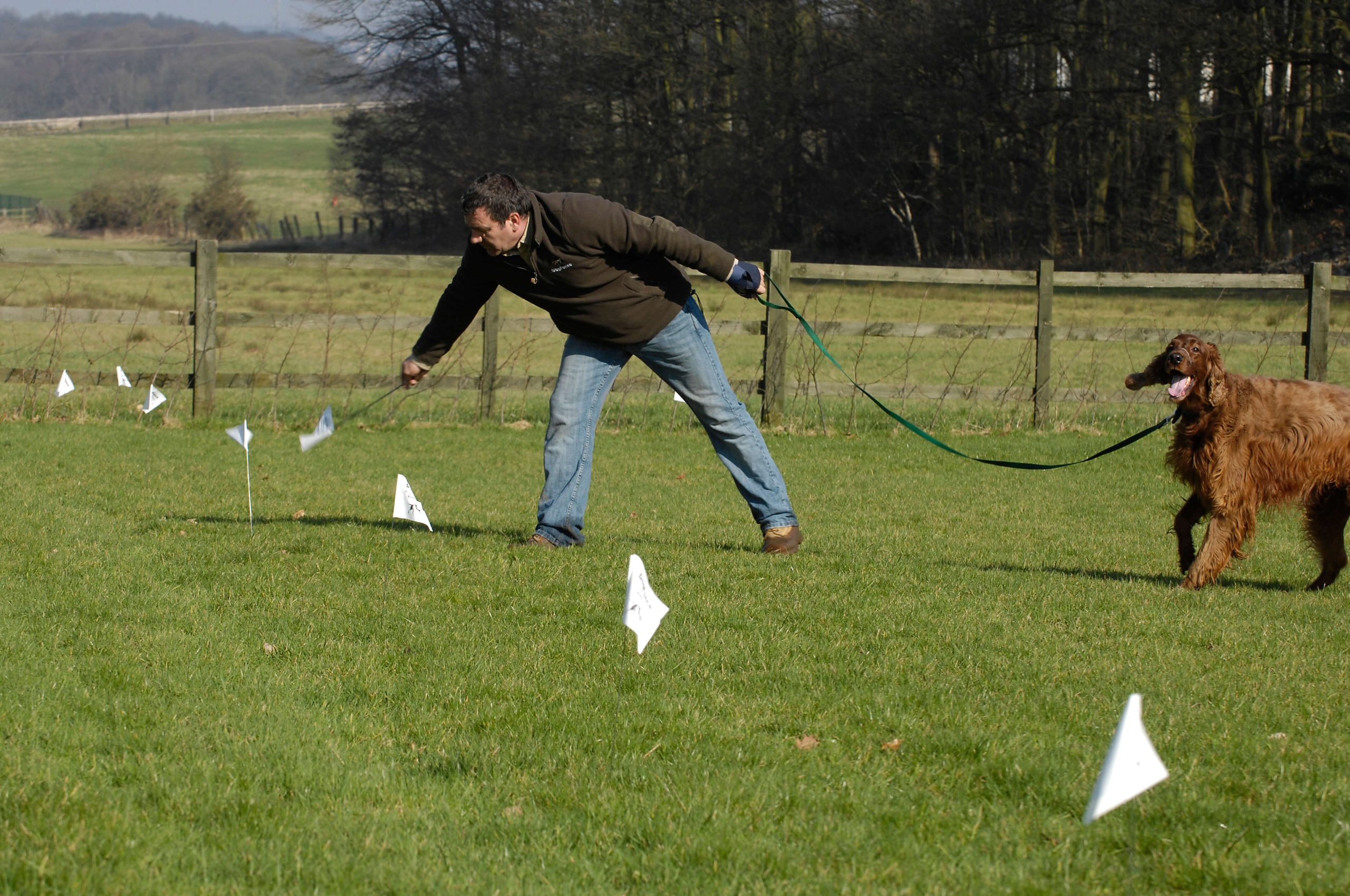
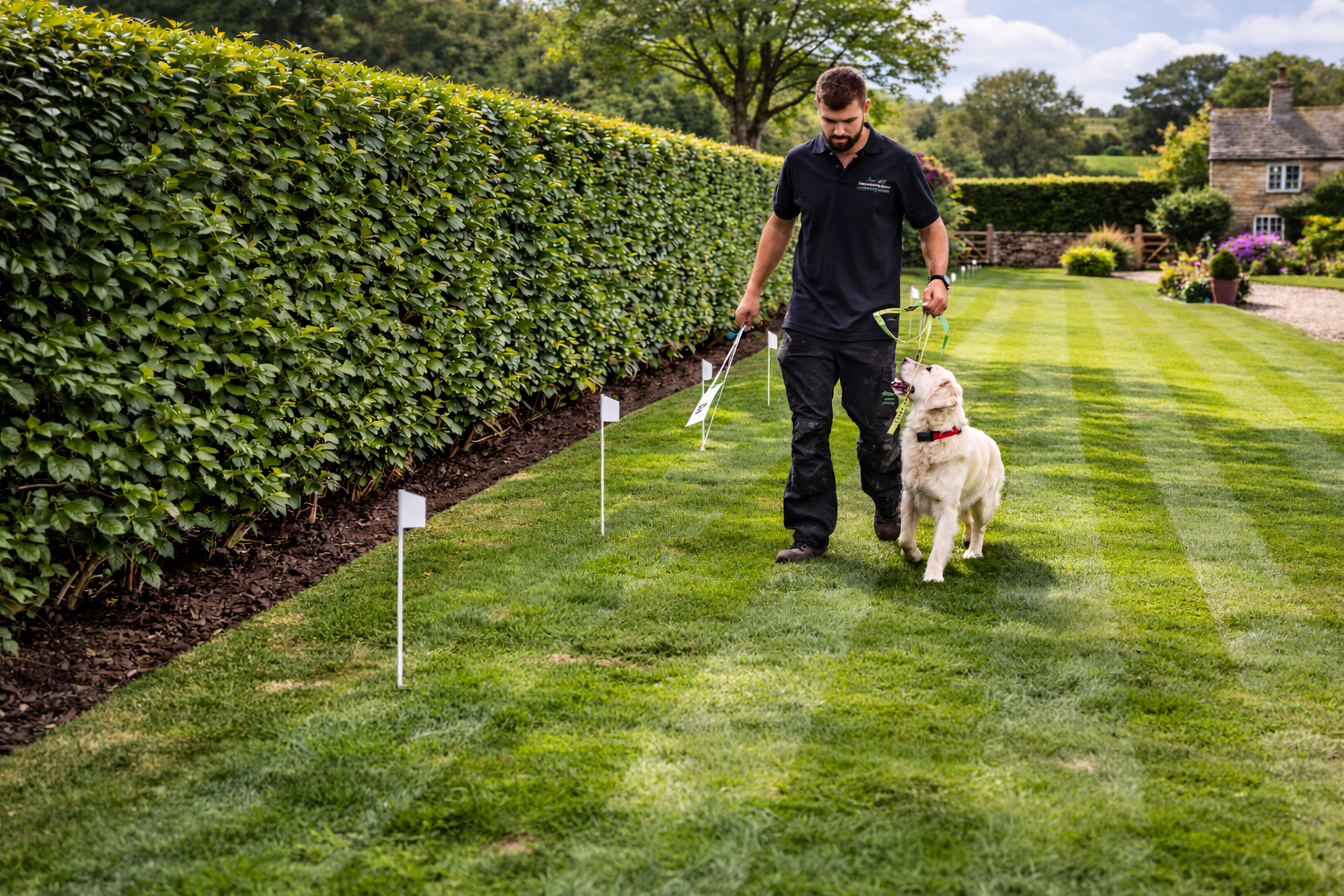
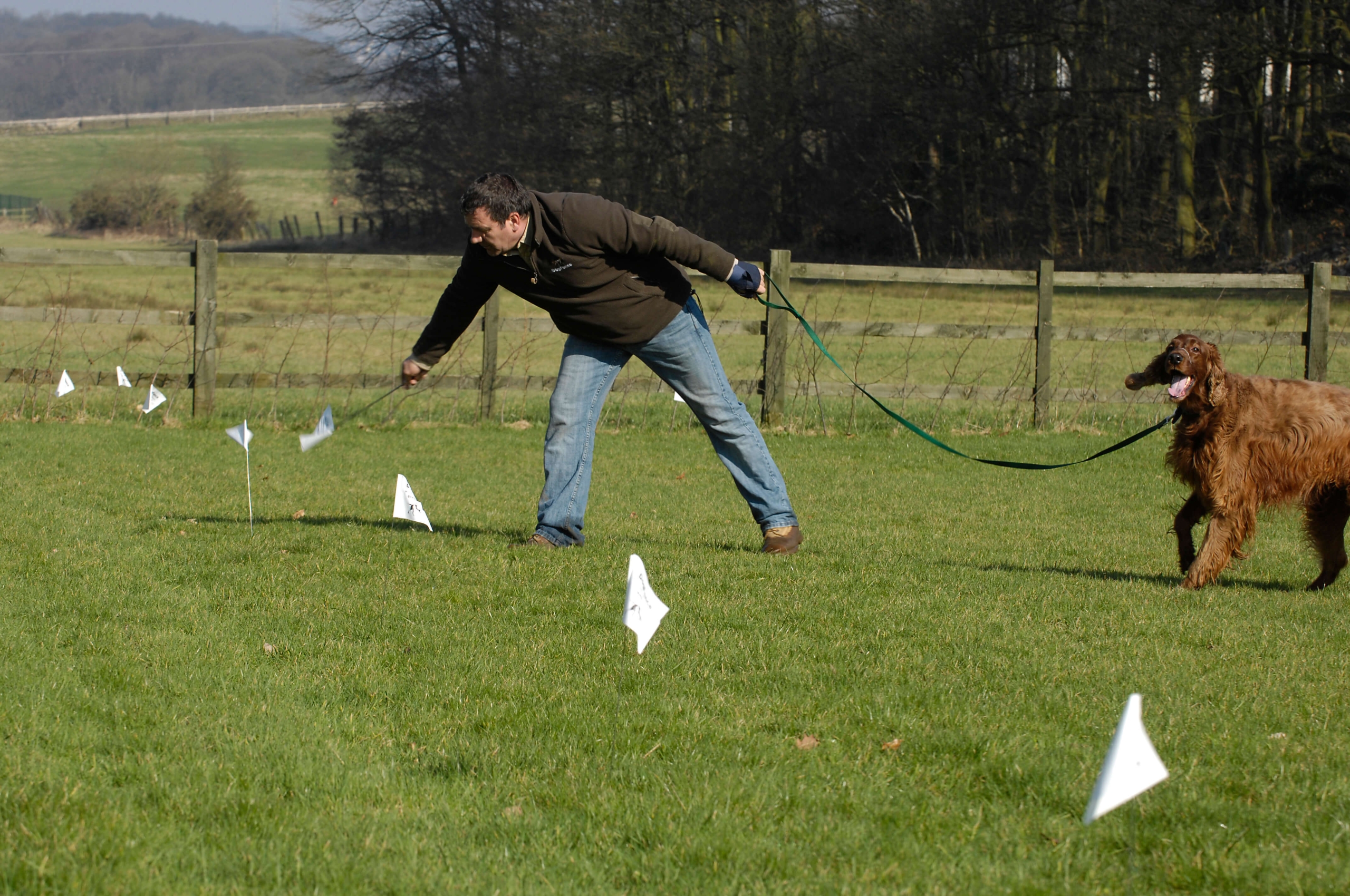
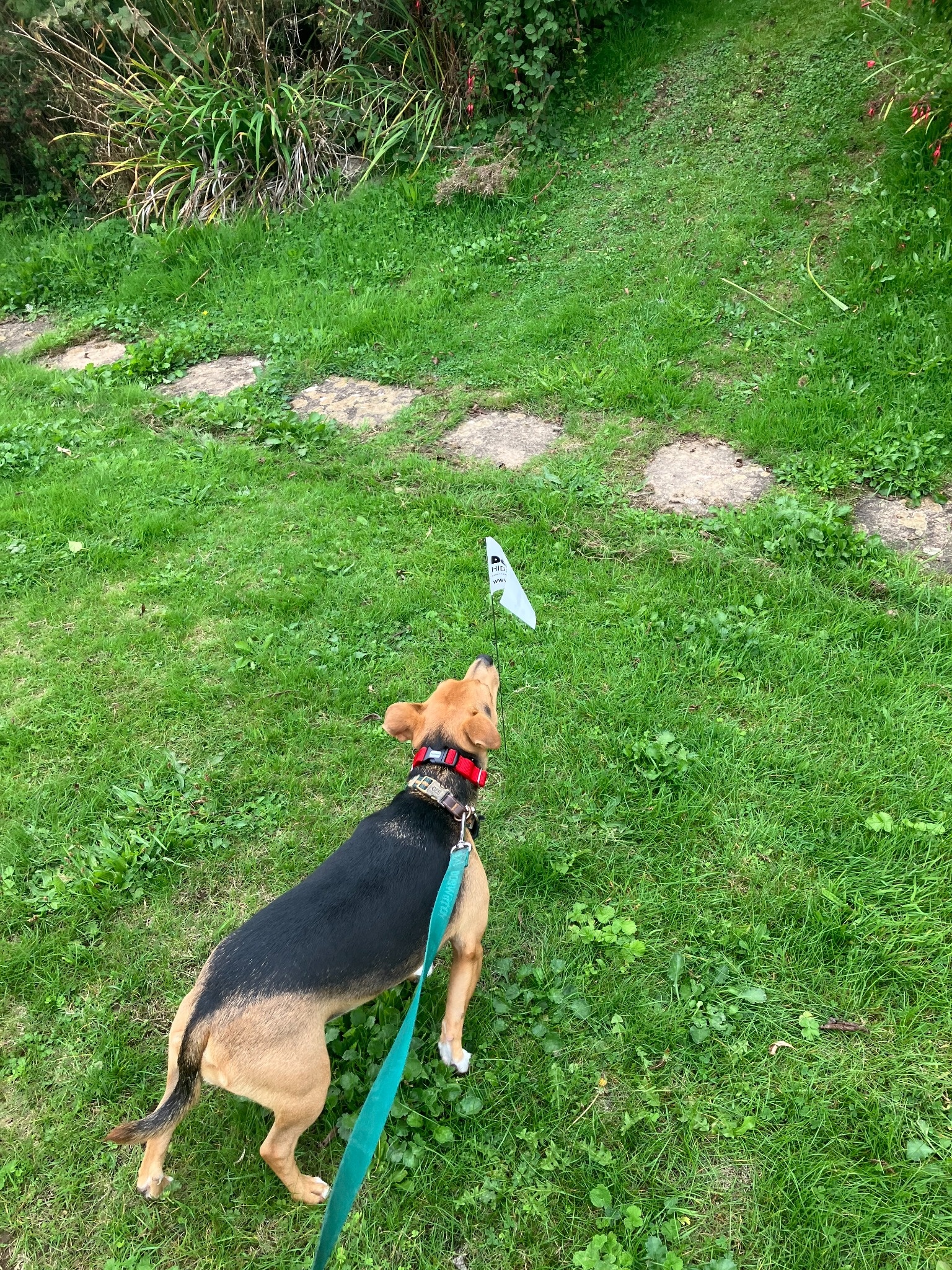
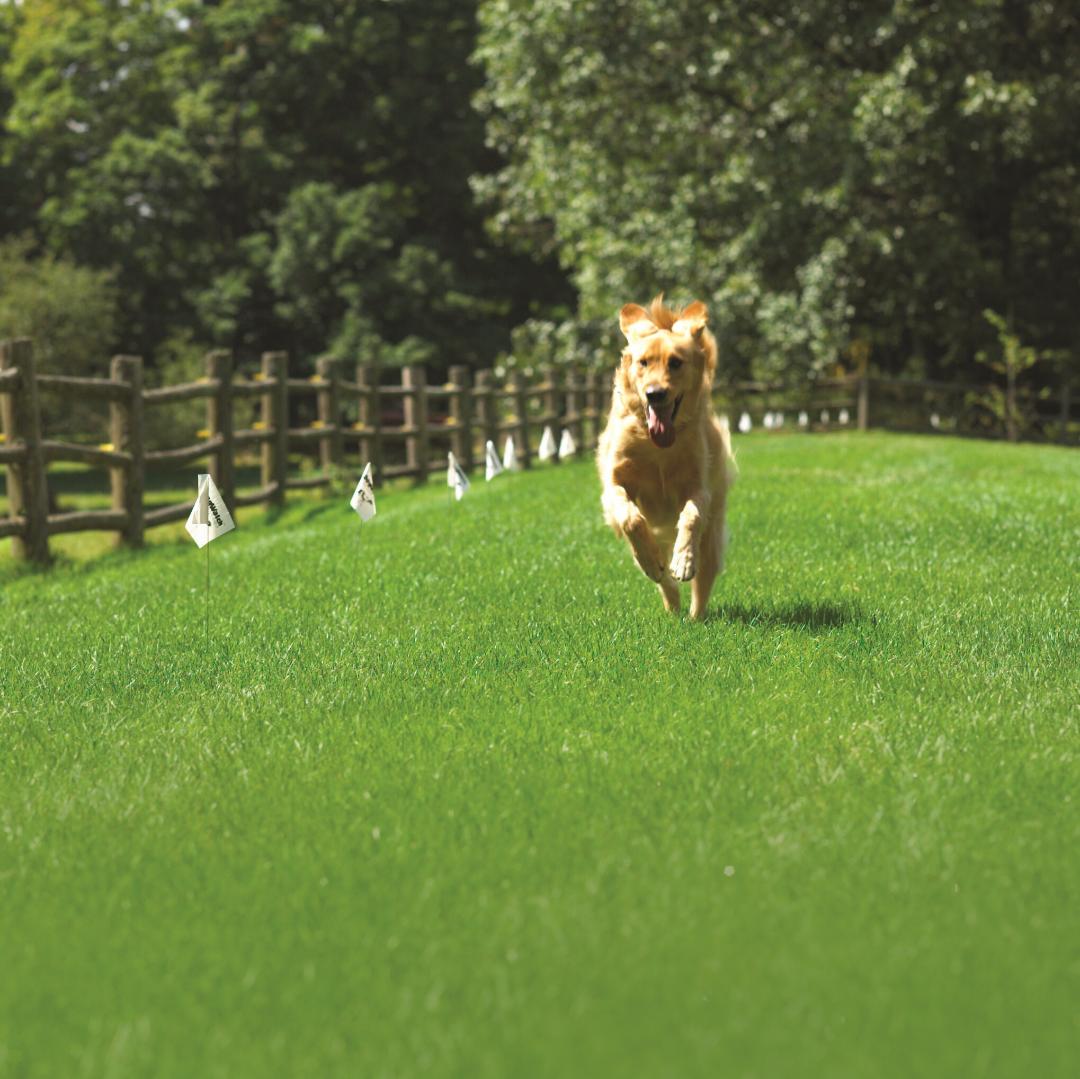
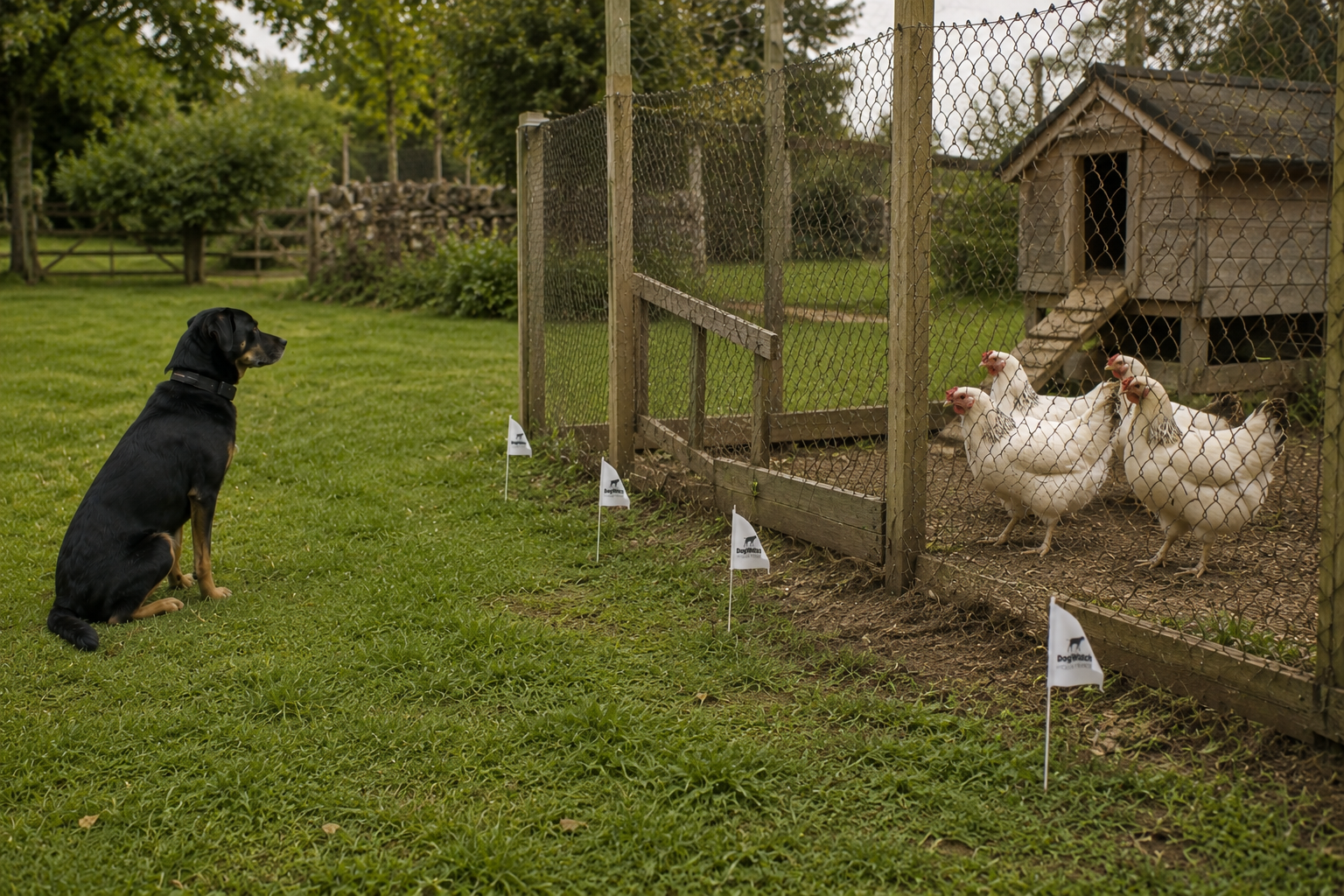
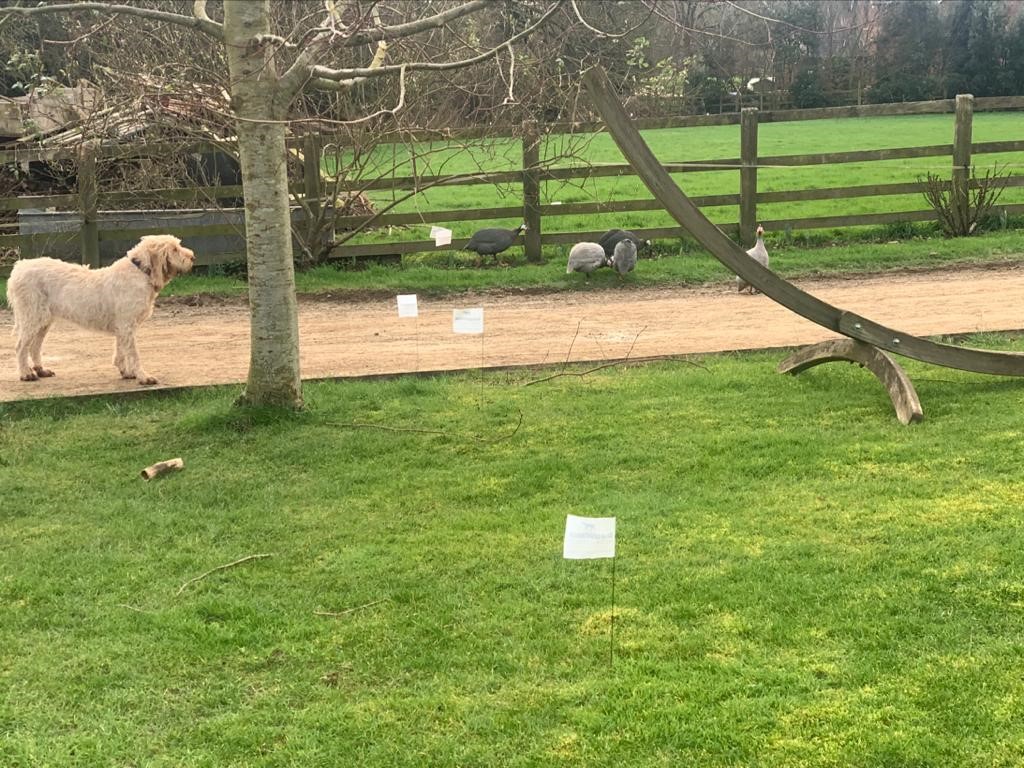
Training flags are used initially to provide a clear visual guide. Following our short, professional and humane training programme, most dogs quickly learn to avoid the flower beds while continuing to enjoy unrestricted access to the rest of the garden.

The same approach can also be used to protect vegetable gardens, newly seeded lawns and other sensitive areas.

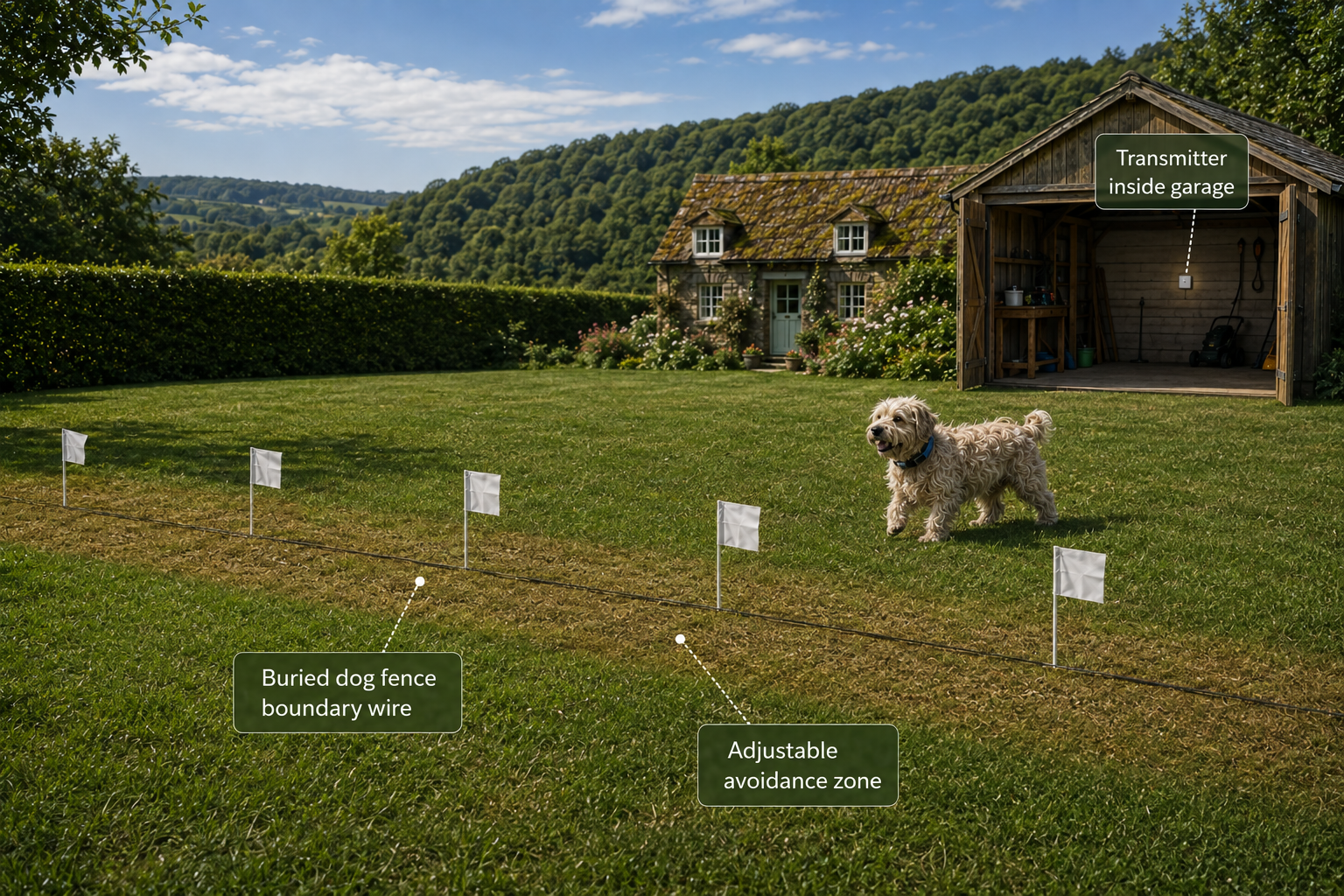
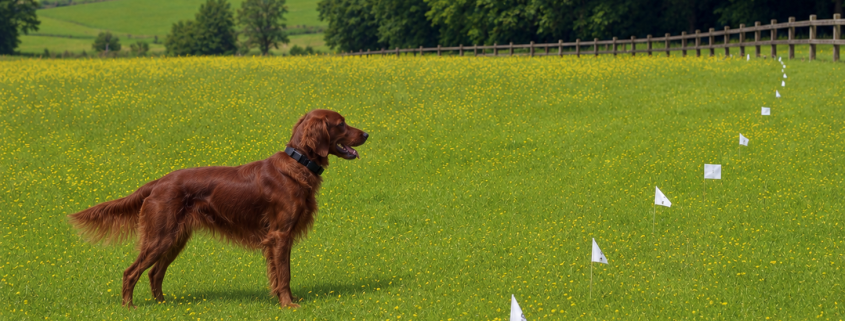
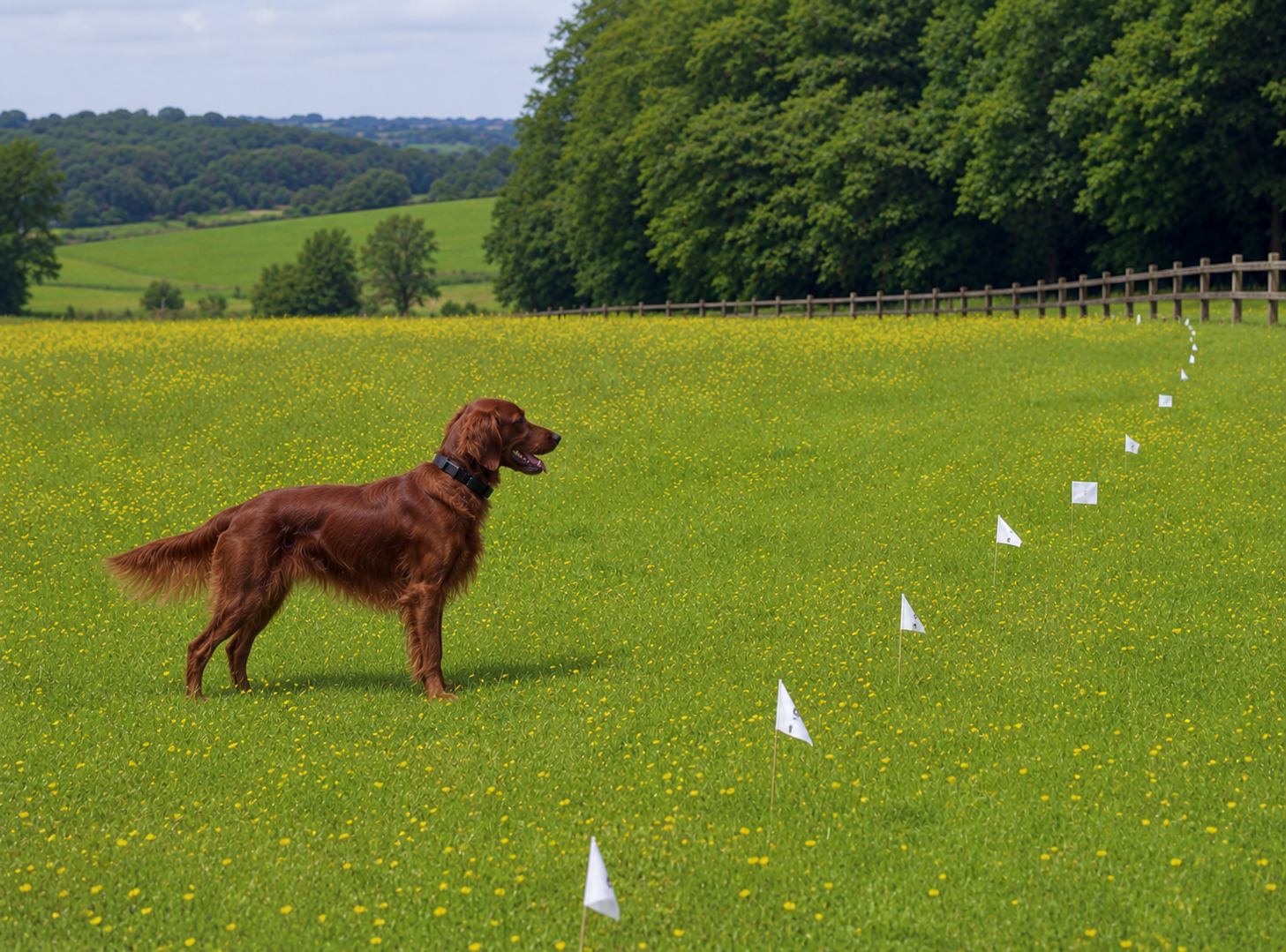
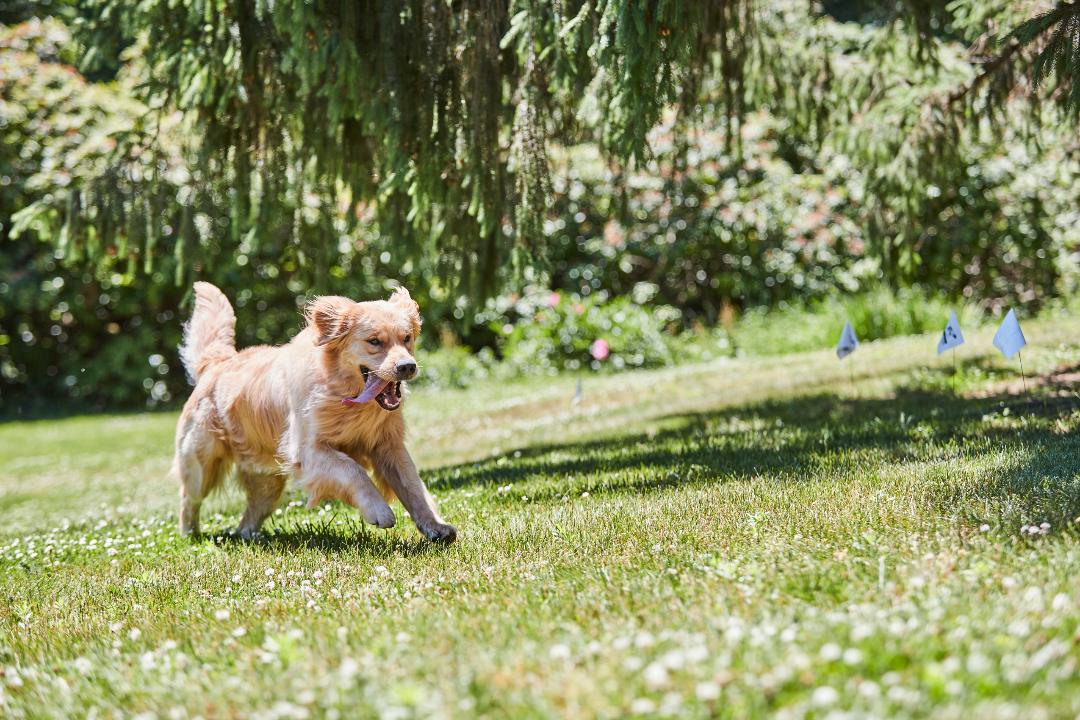
Training flags mark the hidden dog fence boundary, helping your dog learn to stay out of flower beds while enjoying the rest of the garden.

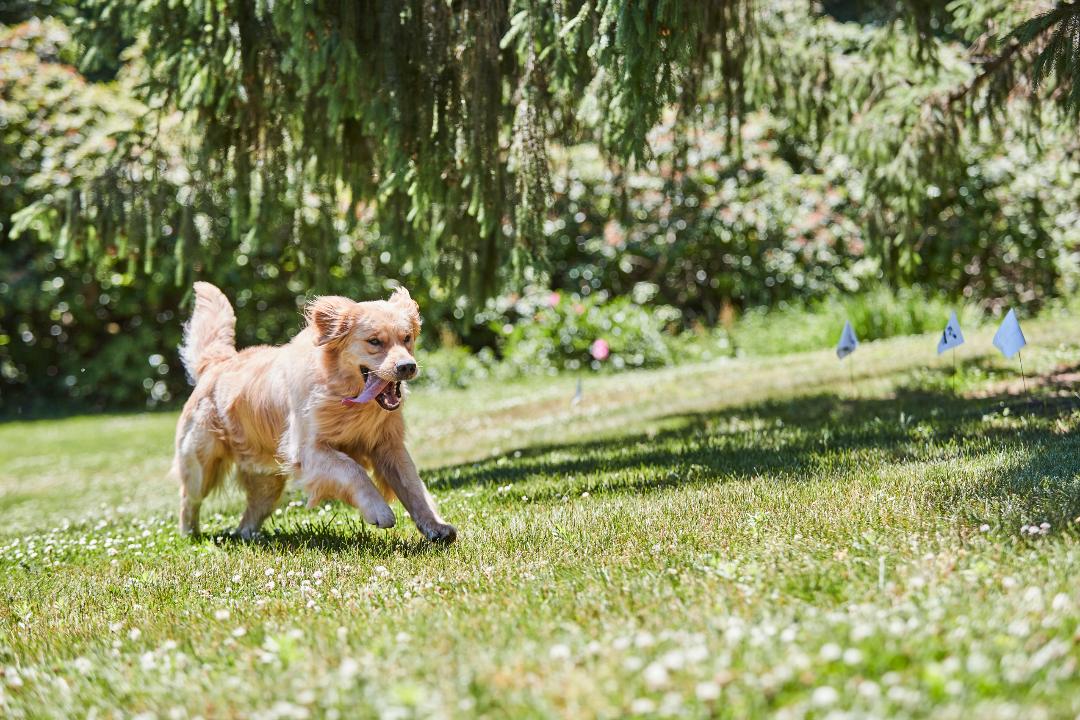
A hidden dog fence creates a discreet flower bed exclusion zone, allowing your dog to enjoy the lawn while protecting flowers and planted borders.

Can an Existing DogFence Be Updated?

Yes. If you already have a DogFence installed, an internal flower bed exclusion zone can usually be added without replacing your existing system.

Every garden is different, so we’ll assess the best cable route before installation. Read our How It Works guide to see how a DogFence can be customised to suit your garden.

Flower beds are just one example of areas that can be protected. Hidden dog fences can also create exclusion zones around ponds, vegetable gardens, children’s play areas and other sensitive parts of your property.

Read our complete guide: Can I Create a No-Go Zone with a Hidden Dog Fence?

If you’re also looking to protect vegetable patches and edible planting areas, you may also like our guide: Can I Keep My Dog Out of My Vegetable Garden?

Frequently Asked Questions

Will my dog still be able to use the rest of the garden?

Yes. Only the flower beds become a no-go zone, leaving the remainder of your garden available for your dog to enjoy.

Will the hidden dog fence affect the appearance of my garden?

No. The boundary wire is buried underground, so there are no visible fences or barriers around your flower beds.

Can I protect more than one flower bed?

Yes. Multiple flower beds can often be incorporated into the same DogFence installation. We’ll design the most suitable cable layout for your garden during your site assessment.

Tell us where your dog can go, show us where they cannot, and we’ll design a discreet boundary that brings the two together.

Ready to Protect Your Flower Beds?

Whether you’re trying to stop your dog digging up flower beds, protect newly planted borders or keep valuable plants safe, every DogFence installation is individually designed around your garden and your dog’s needs. Our experienced team will recommend the best layout to create a discreet flower bed exclusion zone while giving your dog as much freedom as possible.

Contact us today for a free, no-obligation quote.

Call us on
01628 476475
|
Message us on WhatsApp
|
Request a Free Quote

Illustration Notice

Some images within this guide are AI-generated illustrations designed to show typical hidden dog fence layouts and training flag positions. They are included to help explain how the system works and are not photographs of actual installations. Every DogFence installation is individually designed to suit your garden, your property boundaries and your dog’s requirements.

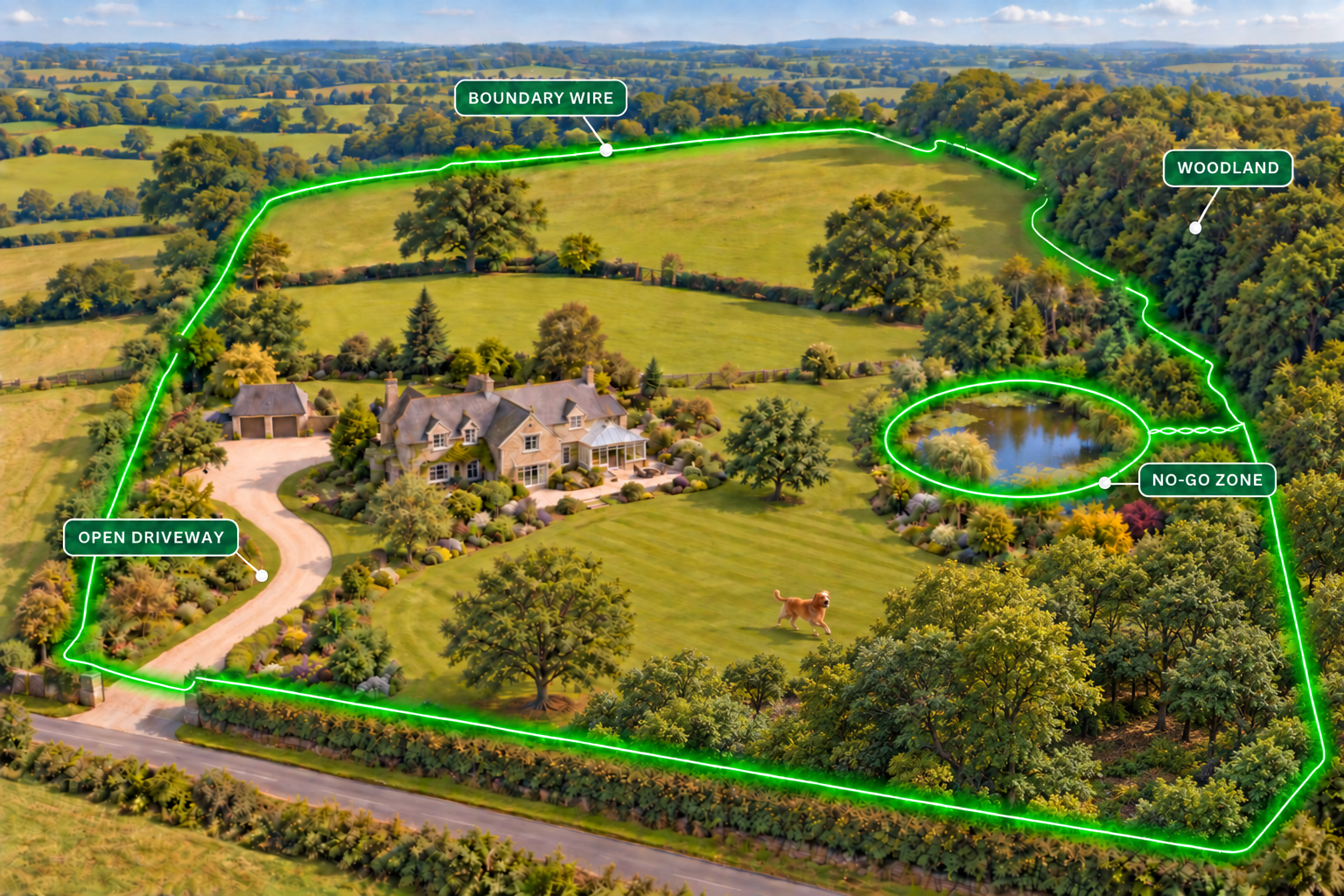
Hidden dog fence no-go zone protecting a garden pond with an internal dog exclusion zone

Can I Create a No-Go Zone with a Hidden Dog Fence?

Can I Create a No-Go Zone with a Hidden Dog Fence?

Can I create a no-go zone with a hidden dog fence? Yes. A professionally designed hidden dog fence can create an internal boundary around a particular part of your garden, helping your dog learn which areas are out of bounds while still allowing them to enjoy the rest of the property.

This type of dog exclusion zone can be designed around ponds, swimming pools, flower beds, vegetable patches, children’s play areas and other garden features. It provides a discreet way to keep dogs away from garden features without surrounding each area with visible fencing.

Can I create a no-go zone with a hidden dog fence? Illustration of a hidden dog fence creating dog exclusion zones around a pond and patio.

Example of a hidden dog fence creating internal no-go zones around a pond and patio while allowing the dog to enjoy the rest of the garden.

What Is a Dog Exclusion Zone?

A dog exclusion zone is an area within your property that your dog is trained not to enter. Unlike the main boundary, which helps prevent your dog from leaving the property, an internal no-go zone is used to protect areas of the garden from dogs.

The size and shape of the zone can be adapted to the feature being protected. It could surround a small flower bed, follow the edge of a swimming pool or create a larger boundary around a wildlife area.

How Does a Hidden Dog Fence Create a No-Go Zone?

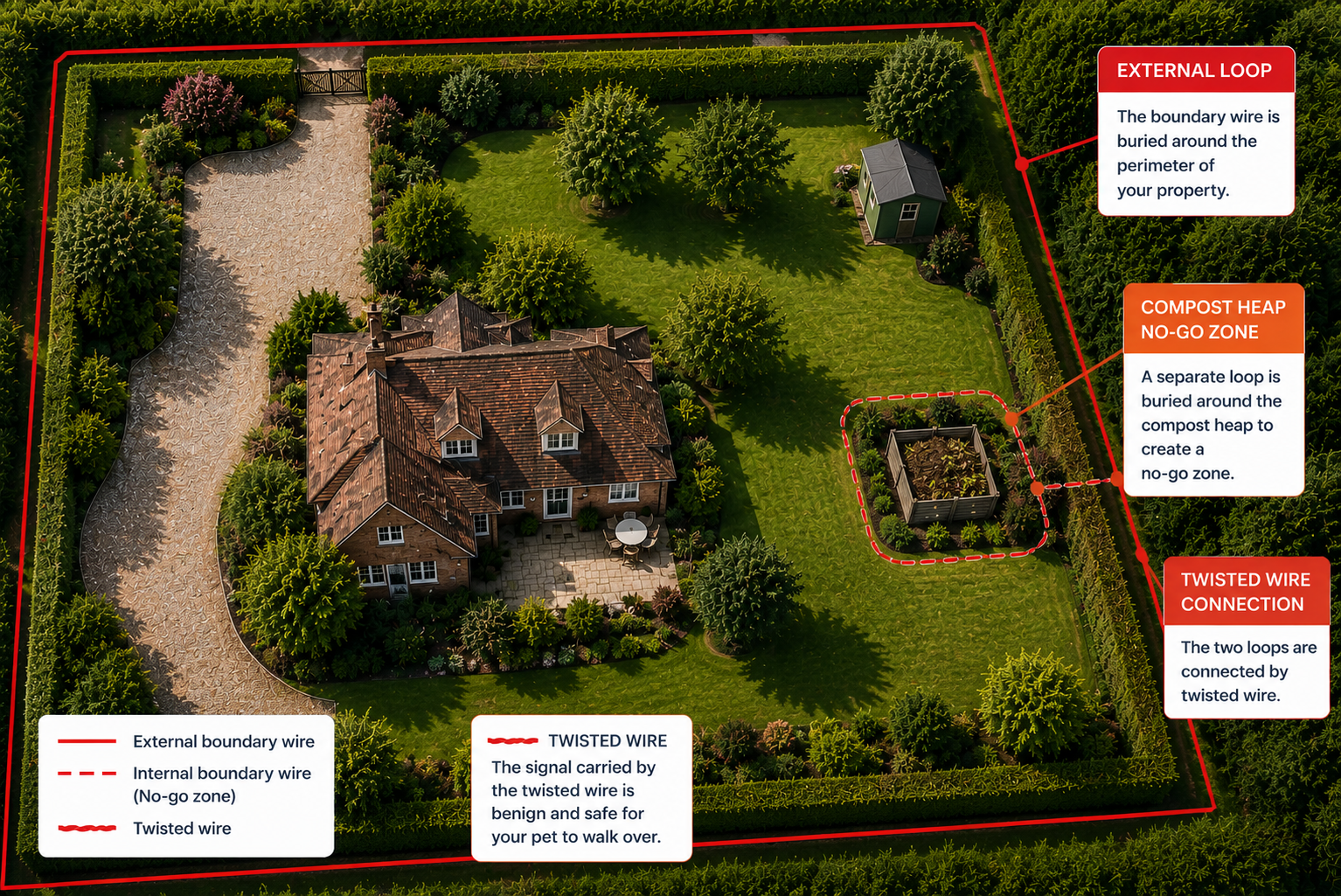
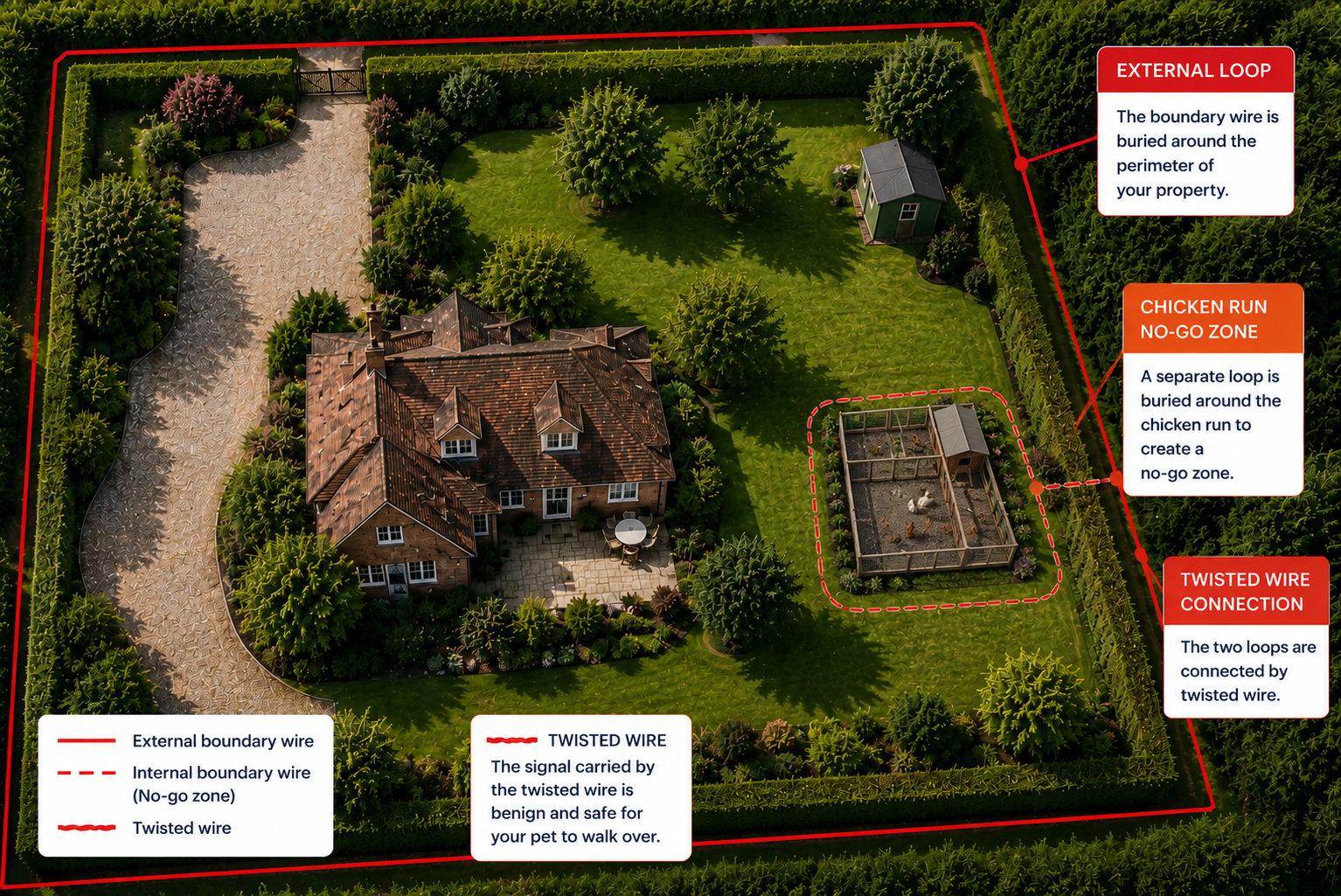
Hidden dog fence exclusion zone is created by installing an additional loop of boundary cable around the area your dog needs to avoid. This internal boundary is connected to the main DogFence system and designed specifically around the layout of your garden.

One of the clever features of a professionally installed hidden dog fence is that the same boundary cable is used to create both your main garden boundary and any internal dog exclusion zones. There is no need for a separate system.

To create a no-go zone, the cable is taken from the main garden boundary to the area you want to protect as a tightly twisted pair. Although the signal is still travelling through the cable, the twisting prevents the boundary signal from being broadcast, allowing your dog to cross this section safely without receiving a warning.

Once the cable reaches the area you want to protect, such as a pond, flower bed or vegetable garden, the wires separate to create an active boundary around that feature. This creates a discreet dog exclusion zone, helping to protect specific areas of your garden while still giving your dog the freedom to enjoy the remaining space.

This clever design allows you to protect areas of the garden from dogs while still giving them the freedom to enjoy the rest of the garden.

Your dog wears the same lightweight receiver collar used for the main property boundary. When they approach the dog garden exclusion area, the collar gives an audible warning. If they continue towards the boundary, the collar provides a brief correction that encourages them to move back into the permitted part of the garden.

As with the main boundary, professional training helps your dog understand where the new limit is located. You can learn more about the boundary, collar and training process on our How the Dog Fence Works page.
What Areas Can a Hidden Dog Fence Exclusion Zone Protect?

A hidden dog fence exclusion zone may be suitable for keeping dogs away from:

  • Garden ponds and swimming pools
  • Streams and other water features
  • Flower beds and planted borders
  • Vegetable gardens and fruit patches
  • Newly seeded lawns
  • Children’s play areas
  • Wildlife areas and nesting sites
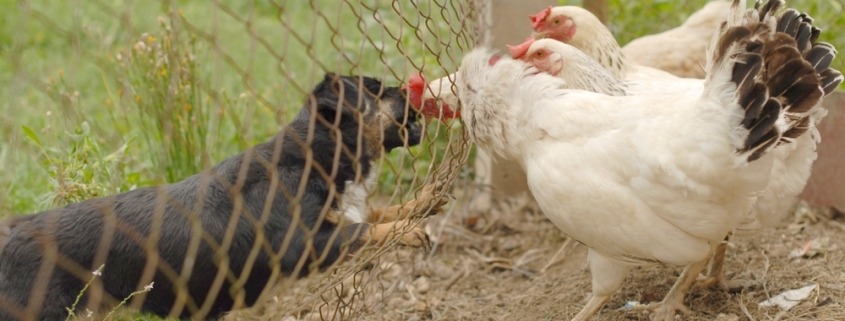
  • Chicken runs, beehives or small animal enclosures
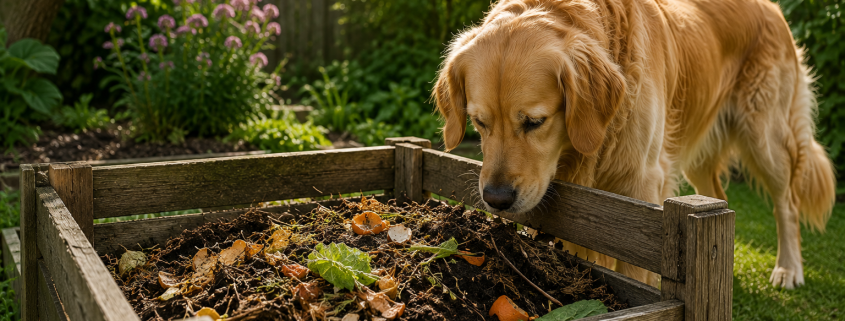
  • Compost heaps and garden machinery

Every property is different, so the most suitable cable layout will depend on the position of the feature, the main garden boundary and the areas your dog still needs to access.

Can I create a no-go zone with a hidden dog fence? Border Collie beside a hidden dog fence protecting a garden pond with an internal dog exclusion zone.

A hidden dog fence creates a discreet no-go zone around a garden pond, allowing the dog to enjoy the rest of the garden safely.

Can a No-Go Zone Keep My Dog Away from Water?

Yes. An internal dog garden exclusion area can often be created around a pond, pool, stream or water feature. This may be particularly helpful for puppies, older dogs, dogs that cannot swim confidently or dogs that repeatedly enter muddy water.

For more information about designing boundaries around natural garden features, read our guide to installing an invisible dog fence around trees, streams and woodland.

Can I Keep Dogs Away from Garden Features Without Building Another Fence?

In many cases, yes. One of the main advantages of an internal boundary is that it can keep dogs away from garden features without adding panels, gates or wire fencing within the garden.

This allows you to preserve your view and maintain the natural appearance of the property. It can be especially useful in landscaped, rural or open gardens where a physical barrier would be expensive, intrusive or difficult to install.

Can I Create More Than One Dog Garden Exclusion Area?

Depending on the property layout, it is nearly always possible to create more than one dog garden exclusion area. For example, you may want to protect a pond in one part of the garden and a vegetable patch in another. The zones will all be connected by a series buried of twisted wires that link back to the main outer loop.

The system must be professionally planned so that the internal loops work correctly alongside the main boundary. Our team will discuss which areas you want your dog to enjoy and which areas need to remain out of bounds before recommending the most appropriate layout.

Why Use a Hidden Boundary to Protect Areas of the Garden from Dogs?

Creating internal boundaries can help protect areas of the garden from dogs while avoiding the need to restrict their access to the whole garden.

Your dog can still run, play and explore within the permitted space, while more vulnerable or potentially hazardous areas remain protected. It offers a flexible solution for owners who want to keep dogs away from garden features without reducing their overall freedom unnecessarily.
Frequently Asked Questions

Can I create a no-go zone with a hidden dog fence?

Yes. A professionally designed DogFence can create an internal dog exclusion zone around certain areas of your garden while allowing your dog to use the remaining space.

Will my dog understand an internal no-go zone?

Yes. Your dog is introduced to the boundary through the same structured training process used for the main DogFence. Training flags will be used initially to make the new boundary clear and easy to understand.

Can the exclusion zone be added to an existing DogFence?

Yes in most cases, an internal loop can be added to an existing system. The installation will need to be assessed to confirm the most suitable cable route and ensure that the hidden dog fence exclusion zone works correctly with the original boundary.

Can a no-go zone protect flower beds and vegetable gardens?

Yes. Internal boundaries can be designed to protect areas of the garden from dogs, including planted borders, flower beds, vegetable patches and newly landscaped areas.

Ready to Decide Which Parts of Your Garden Are for Paws—and Which Are Not?

Your dog can enjoy freedom without having access to every pond, border, vegetable patch or sensitive garden area. At DogFence, every installation is individually designed around your property, your priorities and your dog.

Tell us where your dog can go, show us where they cannot, and we’ll design a discreet boundary that brings the two together.


Ready to Create a No-Go Zone in Your Garden?

Whether you want to protect a pond, flower beds, a vegetable garden or another part of your property, every DogFence installation is individually designed around your garden and your dog’s needs. Our experienced team will recommend the best layout to create safe, discreet dog exclusion zones while giving your dog as much freedom as possible. Contact us today for a free, no-obligation quote.

Call us on
01628 476475
|
Message us on WhatsApp
|
Request a Free Quote


Long grass cut before a hidden dog fence installation to allow safe and efficient cable installation

How to Prepare for Your Hidden Dog Fence Installation

How to Prepare for Your Hidden Dog Fence Installation

Many customers ask, “How do I prepare my garden for a hidden dog fence?” Fortunately, there’s very little you need to do.Once you’ve booked your DogFence installation, a little preparation can help our installers work more efficiently and ensure the best possible result.

Every property is different. While many installations are straightforward, rural gardens, woodland boundaries and more natural landscapes may need a little preparation before our installer arrives.

Preparing the proposed cable route helps our team work safely and efficiently while ensuring your hidden dog fence is installed to the highest possible standard.

Cut Long Grass Before We Arrive

One of the simplest ways you can help is by cutting any long grass along the proposed installation route.

Ideally, grass should be less than 12 inches (30cm) high.

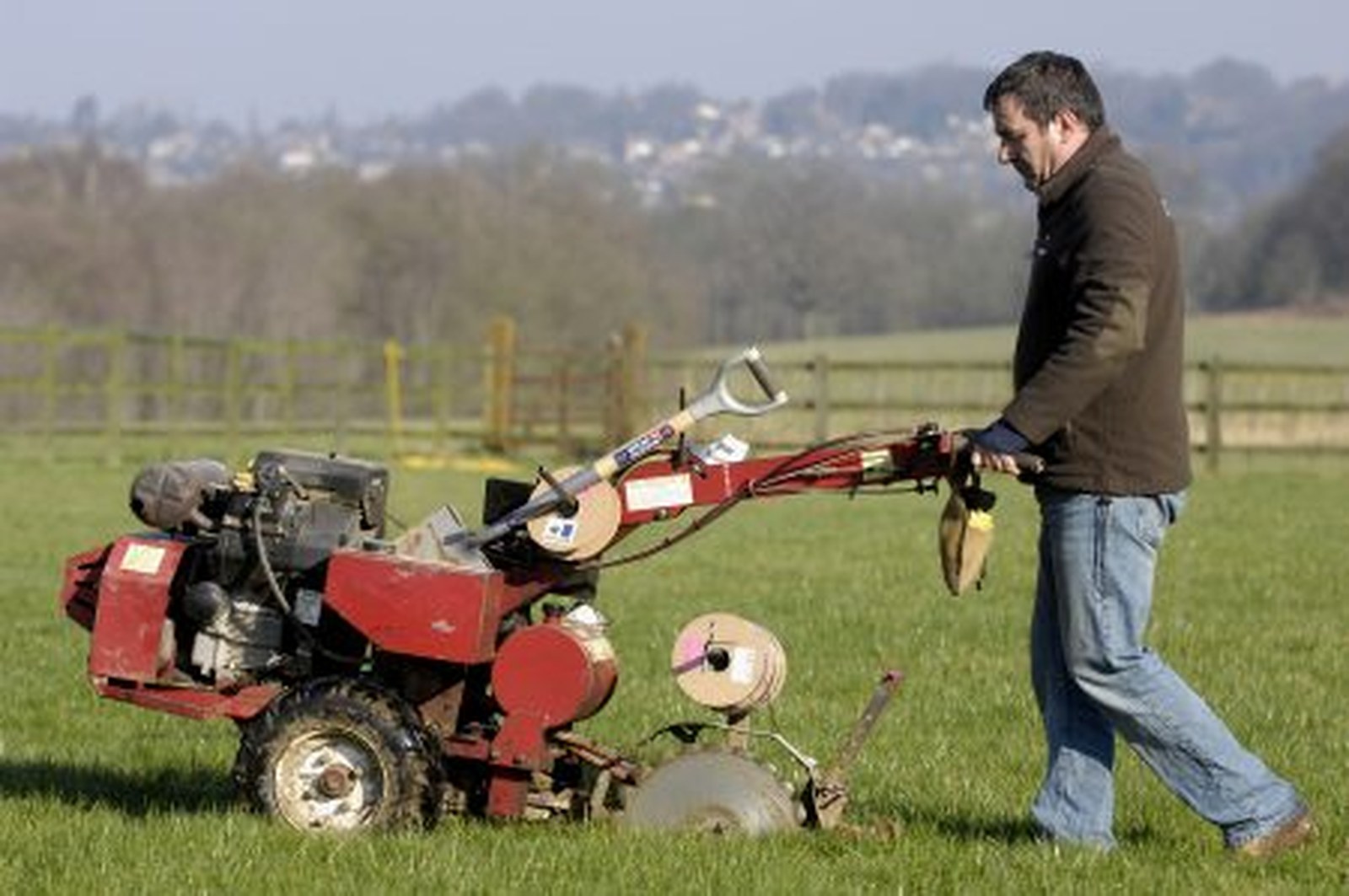
Our installers use specialist trenching equipment to bury the boundary wire at the correct depth. Very long grass can become tangled around the machine, making it difficult to see the ground clearly and preventing the equipment from working as efficiently as it should.

There’s no need to mow the entire garden—just the areas where the boundary cable is likely to be installed.
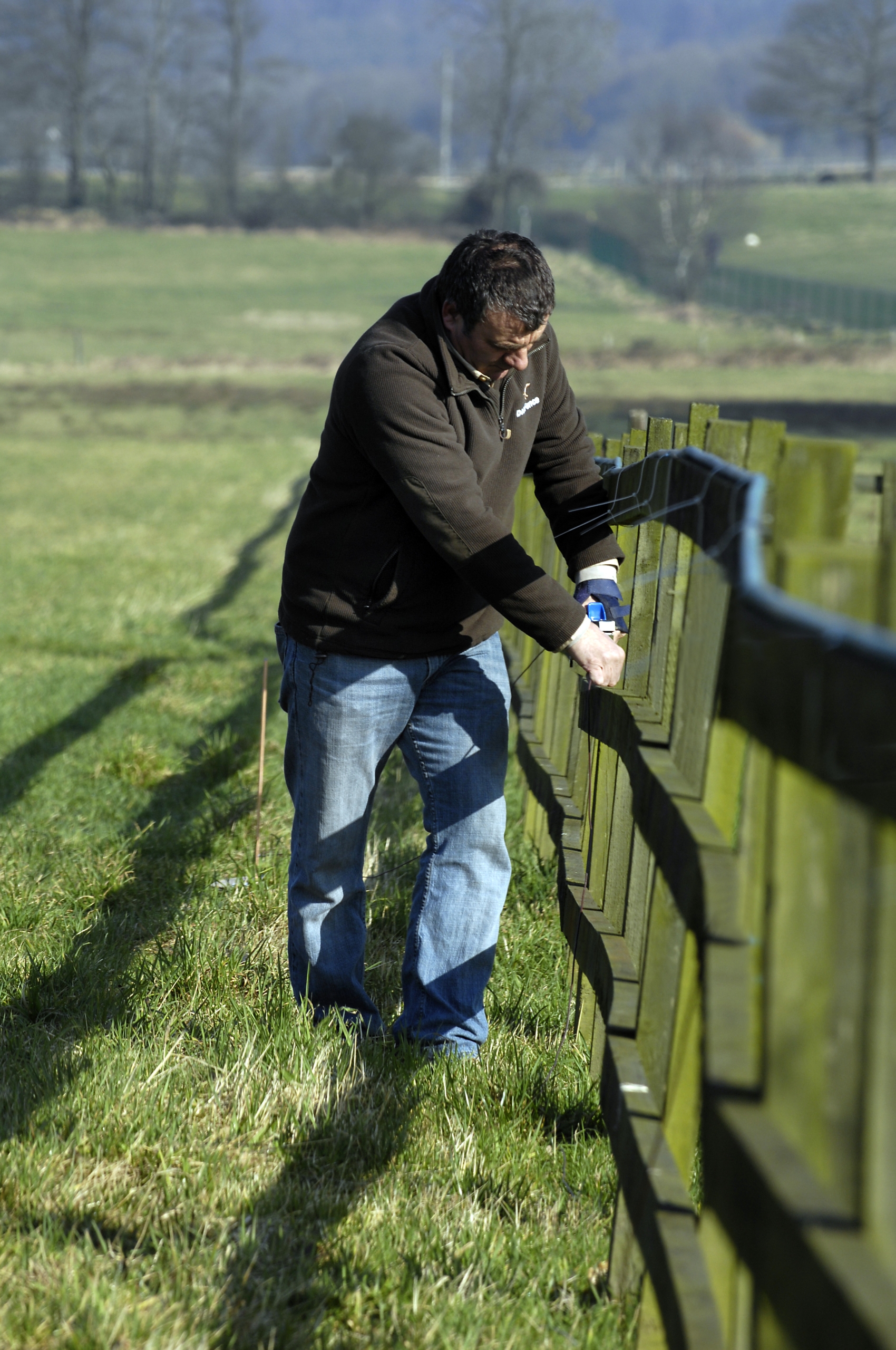
Long grass cut before a hidden dog fence installation to allow safe and efficient cable installation

Keeping long grass below 12 inches along the installation route helps ensure your hidden dog fence can be installed safely and efficiently.

Clear Brambles and Dense Vegetation

One of the biggest advantages of a hidden dog fence is that it can often follow natural boundaries where traditional fencing simply isn’t practical.

However, our installers still need safe access to the installation route.

If your boundary has become heavily overgrown with brambles, nettles, thick shrubs or fallen branches, we recommend clearing these before installation day.

As a guide, allowing around 2 feet (60cm) of clear access along the cable route helps us complete the installation safely and efficiently.

This doesn’t mean clearing everything back to bare ground—just enough space for our installer and equipment to work comfortably.

Remove Fallen Branches and Garden Debris

Logs, piles of branches, old fencing materials and other obstacles can slow down an installation.

Removing these beforehand allows us to maintain a smooth cable route and complete your installation more efficiently.

Let Us Know About Underground Services

If you’re aware of any underground services, please let us know before installation.

These might include:

  • Irrigation systems
  • Garden lighting cables
  • Robot lawn mower boundary wires
  • Water pipes
  • Recently planted trees or shrubs
  • Internet Cables (if known)

We’ll always discuss the proposed cable route with you before work begins.

Overgrown garden boundary cleared before a hidden dog fence installation

Dense vegetation and overgrown boundaries should be cleared back before installation, allowing our installers to safely follow the boundary line and install your hidden dog fence as accurately and efficiently as possible.

Keep Dogs Safely Indoors

Installation day involves specialist equipment and our installer moving around your property.

For everyone’s safety, we recommend keeping your dog indoors or in another secure area until the installation has been completed and it’s time to begin the training process.

Every Garden Is Different

We regularly install hidden dog fences in:

  • Rural properties
  • Farms and smallholdings
  • Woodland gardens
  • Large country gardens
  • Gardens with mature trees and natural boundaries
  • Gardens with small streams

Some properties require very little preparation, while others may benefit from a little clearing before installation day.

If you own a larger or more challenging property, you may also find our guide Is a Hidden Dog Fence Suitable for Rural Properties?</a> helpful. It explains how hidden dog fences can be installed across fields, woodland, streams and other natural features.

If you’re unsure whether your garden needs any preparation, simply ask. We’re always happy to offer advice before your installation.

Every gate installation is different, so any information you can provide beforehand is always appreciated and helps us plan the best installation for your property.


A Little Preparation Makes a Big Difference

Preparing your garden doesn’t need to be a major project.

Cutting long grass, clearing heavy vegetation and providing good access along the proposed boundary allows us to work more efficiently and helps us deliver the highest quality installation possible.

Our aim is always the same—to leave you with a professionally installed hidden dog fence that blends naturally into your garden and provides years of reliable protection for your dog.


What About Electric Gates?

If your property has electric gates, there’s no need to worry. We install hidden dog fences on properties with automated gates every week.

When you book your installation, we’ll ask if you have electric gates so we can make a note of them. On the day, your installer will assess the gate area and may ask you a few additional questions to ensure your hidden dog fence works perfectly alongside your existing gate system.

Every gate installation is different, so any information you can provide beforehand is always appreciated and helps us plan the best installation for your property.

If your installation also needs to cross a driveway, let us know in advance so we can plan the most suitable cable route. You can also read our guide on how-will-the-dog-fence-wire-cross-my-driveway to see how we install across different driveway surfaces.

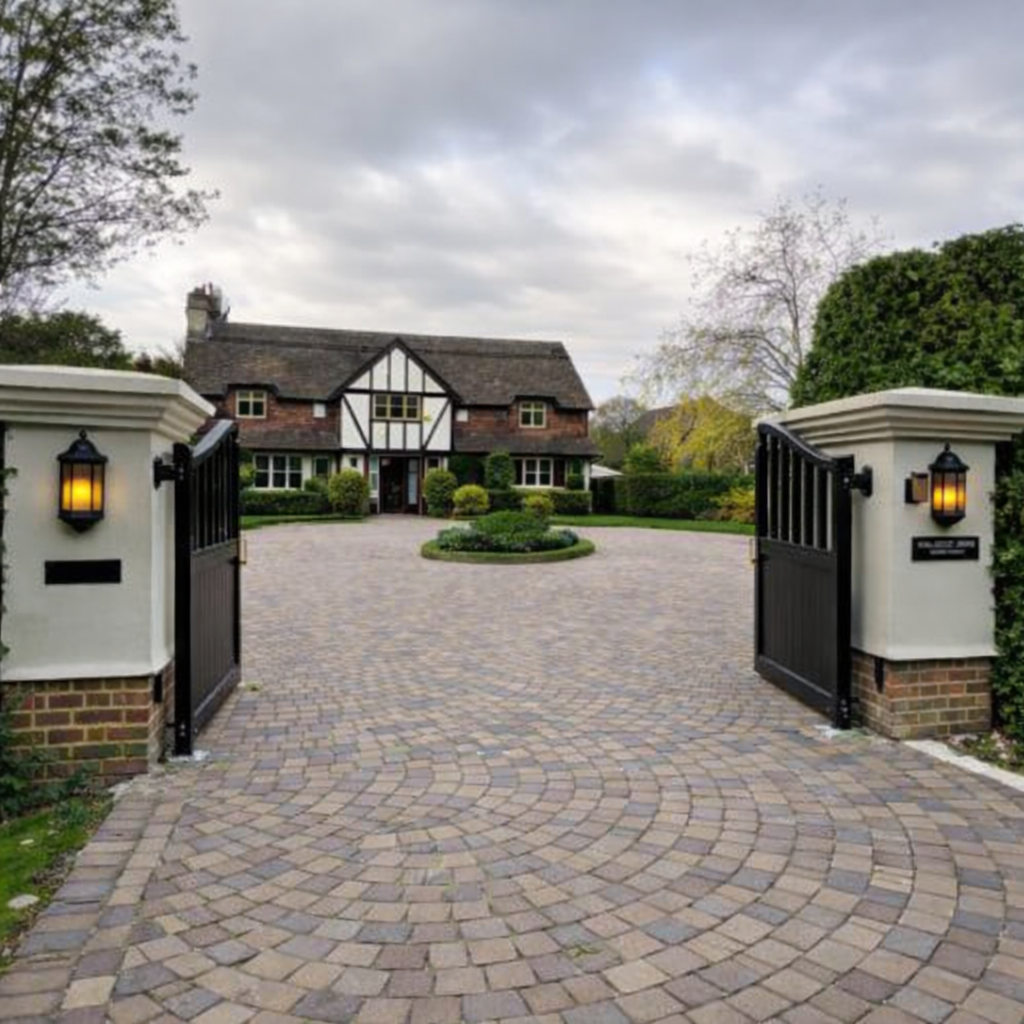
block paved driveway with electric gates showing where invisible dog fence cable can be installed across driveway entrance

Open electric gates and a circular block-paved driveway can create an easy escape route for dogs if there is no boundary in place.


What If I Have a Robotic Lawn Mower?

Having a robotic lawn mower doesn’t usually prevent you from having a hidden dog fence installed.
Robot mowers vary from manufacturer to manufacturer, but in most cases, as long as we keep our boundary wire approximately 2–3 feet (60–90cm) away from your mower’s boundary wire, there should be no issues.
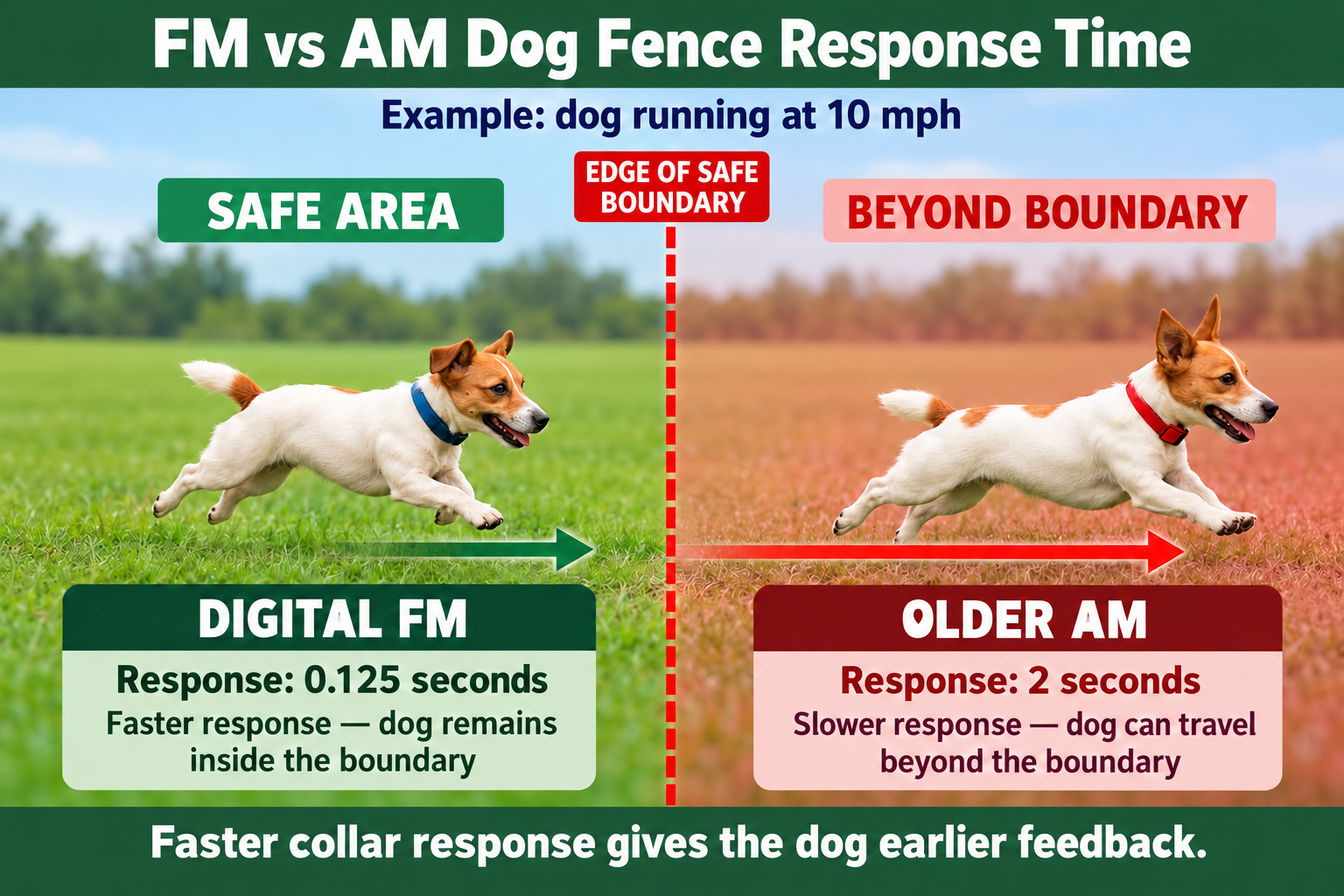
The two systems cannot share the same cable. Most robotic mowers use an AM signal to detect their boundary wire and, if the cables are installed too close together, the mower may try to detect the signal from the hidden dog fence instead.

If you have a robotic mower, simply let us know when you book your installation. Our installer will discuss the layout with you on the day and make sure both systems work together reliably.

Robotic lawn mower operating in a garden with a hidden dog fence boundary

See a DogFence Installation in Action

Wondering what a hidden dog fence installation actually looks like?

Watch our short video below to see how a typical installation is carried out and hear some helpful advice on preparing your garden before installation day.

▶️ Watch here: https://www.youtube.com/watch?v=BzPLobnxzHc

Frequently Asked Questions

How do I prepare my garden for a hidden dog fence?

Simply cut long grass, clear heavy brambles along the cable route and let us know if you have electric gates or a robotic lawn mower.

Do I need to clear my whole garden?

No. We only need access along the planned installation route.

How short should the grass be?

Ideally, less than 12 inches (30cm) high where the boundary wire will be installed.

How much should I clear?

If possible, allow around 2 feet (60cm) of clear access along the installation route by cutting back heavy brambles and dense vegetation.

Can the Dog Fence be installed with electric gates?

Yes. In most cases, absolutely. We regularly install hidden dog fences on properties with electric gates and will assess your setup during installation to ensure everything works together correctly.

Hopefully this guide has answered the question, “How do I prepare my garden for a hidden dog fence?” but if you have any questions call us and one our team will be happy to answer any queries.


Ready for Your Hidden Dog Fence Installation??

A little preparation before installation day can make a big difference. Cutting long grass, clearing heavy vegetation and letting us know about features such as electric gates or robotic lawn mowers helps our installers work efficiently and achieve the highest standard of installation. If you have any questions before your installation, our friendly team is always happy to help

Call us on
01628 476475
|
Message us on WhatsApp
|
Request a Free Quote

How to keep a dog safe in the garden

How to Keep Your Dog Safe in the Garden

How to Keep a Dog Safe in the Garden

How to keep a dog safe in the garden starts with creating a secure outdoor space, checking for escape routes and hazards, and giving your dog clear boundaries. Good dog garden safety allows your dog to run, play and explore while reducing the risk of them escaping, reaching a road or wandering into areas where they could be at risk.

Every dog owner wants to see their dog enjoying the garden without constantly worrying about an open gate, a gap in the hedge or a tempting escape route. But every property – and every dog – is different. A determined digger needs a different approach from a dog that bolts through an open driveway, while rural properties can present completely different challenges from smaller suburban gardens.

The good news is that effective garden security for dogs doesn’t have to mean restricting their freedom. By identifying the risks around your property and creating boundaries your dog understands, you can work towards a safe off-lead garden where your dog has the freedom to enjoy being outdoors while remaining safely at home.

Happy dog running freely in a safe garden wearing a hidden dog fence collar

Quick Answer: How to Keep a Dog Safe in the Garden

To improve dog garden safety:

  • Check fences, walls, hedges and gates for potential escape routes.
  • Look for gaps where your dog could squeeze through or dig underneath.
  • Consider how your dog is secured when driveways or electric gates are open.
  • Identify ponds, pools and other areas that could present a risk.
  • Provide shade and fresh drinking water.
  • Supervise puppies, rescue dogs and dogs that are new to the property.
  • Consider nearby roads, wildlife and livestock when assessing your boundary.
  • Train your dog to understand where they can safely roam.
  • Consider a professionally installed hidden dog fence if you need additional security.

The aim is simple: create a secure garden that gives your dog as much safe outdoor freedom as possible.

Start Dog Garden Safety at the Boundary

The first step in learning how to keep a dog safe in the garden is to look at your property from your dog’s point of view.

Dogs are naturally curious, and some become remarkably good escape artists once they discover a weak spot. A tiny gap in a hedge may not look significant to you, but to an adventurous dog it could be an invitation to explore.

Walk around your entire garden and check for:

  • Gaps under fences and gates.
  • Loose or damaged fence panels.
  • Low walls or hedges that could be jumped.
  • Soft ground where your dog could dig underneath a boundary.
  • Open driveways and vehicle entrances.
  • Gaps leading into neighbouring gardens.
  • Areas where garden furniture or bins could help a dog climb over a fence.

Fixing a small problem before your dog discovers it is usually much easier than persuading an experienced escape artist to give up their new adventure.

If your dog already has a habit of disappearing beyond the garden, read our complete guide on how to stop your dog running away and prevent roaming.

Why Do Dogs Escape from Gardens?

Understanding why your dog wants to leave can be just as important as finding the physical escape route.

Dogs may escape because they are:

  • Following an interesting scent.
  • Chasing wildlife.
  • Trying to reach another dog or person.
  • Exploring beyond the property.
  • Frightened by an unexpected noise.
  • Bored or looking for stimulation.
  • Able to see an easy route out.

Some dogs are also simply more determined to explore than others.

Training and enrichment can help address some of these behaviours, but they don’t remove the need for a secure boundary. Even a dog with good recall can become distracted by something particularly exciting on the other side of the garden.

If your dog is regularly trying to leave the garden, understanding the reason behind the behaviour can help you choose the right solution. Read our guide on: Why Dogs Escape and How to Stop a Dog Running Away.  for a closer look at the most common causes of escaping, roaming and boundary-testing behaviour.

Garden Security for Dogs with Open Driveways and Electric Gates

One of the biggest challenges for garden security for dogs is an entrance that needs to remain open.

You may have secure fencing, walls or hedges around most of your property, but if the driveway is open, your dog still has a direct route to the road.

Electric gates can create a similar problem. A dog may only need a few seconds to slip through while the gates are opening for a car, delivery driver or visitor.

A professionally installed hidden dog fence can create a discreet boundary across an open driveway or work alongside existing electric gates. Your dog is trained to understand the boundary while cars, visitors and deliveries can continue to access the property normally.

For more information, read our guide to keeping dogs safe around open driveways and electric gates.

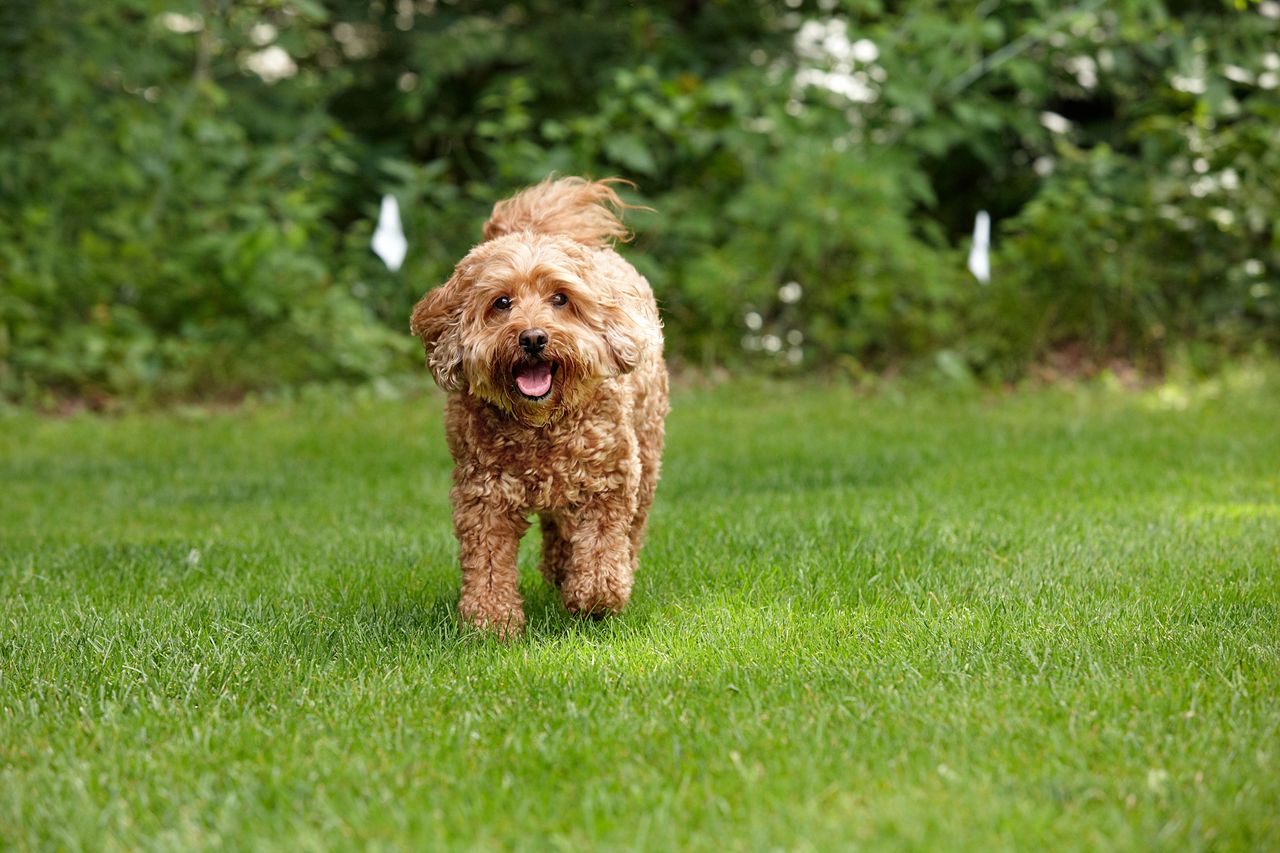
Cockapoo running safely in a garden with an open driveway and white boundary training flags

Can You Create a Safe Garden Without a Physical Fence?

Yes. Where conventional fencing is impractical, unsuitable or does not prevent a particular dog from escaping, a professionally installed hidden dog fence can create a secure boundary that the dog is trained to understand.

A hidden dog fence can also work alongside the physical boundaries you already have.

For example, your garden may already have fences, walls and hedges, but your dog might:

  • Dig underneath them.
  • Jump or climb over them.
  • Squeeze through small gaps.
  • Escape through an open driveway.
  • Run through electric gates as they open.

In these situations, the hidden boundary can provide an additional layer of garden security for dogs without replacing the existing features of the property.

If you’d like to understand the technology behind the boundary, visit our How DogFence Works page.

How to Create a Safe Off-Lead Garden

A safe off-lead garden is a secure outdoor area where your dog can run, sniff, play and explore without being permanently attached to a lead.

For many owners, this is the real goal of improving garden security: not to restrict their dog, but to give them more freedom.

A clearly defined boundary can allow a dog to enjoy a much larger area than they might otherwise have access to. This can be particularly valuable for dogs that would need to be kept on a long line or closely supervised whenever they went outside because of the risk of escape.

Creating a safe off-lead garden means finding the right balance between freedom and security. Your dog gets space to enjoy being a dog, while you have greater confidence that they will remain within their designated area.

Keeping Dogs Safe Around Garden Hazards

Dog garden safety isn’t only about preventing escapes. Some areas within a property may also need to remain out of bounds.

Depending on your garden, these could include:

  • Ponds and swimming pools.
  • Flower beds and vegetable gardens.
  • Wildlife areas.
  • Driveways and vehicle access.
  • Outbuildings.
  • Woodland or streams.
  • Boundaries adjoining farmland or livestock.

Depending on the layout of the property, a professionally designed DogFence can sometimes include exclusion zones around areas you don’t want your dog to enter.

This means you don’t necessarily have to restrict your dog’s access to the entire garden simply because one particular area needs protection.

What About Ponds and Swimming Pools?

Water can present a particular concern for some dog owners. Puppies, older dogs and dogs that are not confident swimmers may require additional care around ponds, swimming pools and other water features.

A professionally designed hidden dog fence may be able to create an exclusion zone around the water while leaving the rest of the garden available for your dog to enjoy.

For more advice, read our guide to keeping dogs safely away from ponds and swimming pools.

Dog Garden Safety Around Trees, Streams and Woodland

Large gardens and rural properties often contain natural features that don’t fit neatly behind a conventional garden fence.

Trees, streams, woodland and uneven terrain can all affect how a secure dog boundary needs to be designed.

One advantage of a professionally installed hidden dog fence is that the boundary can be designed around the individual property rather than requiring the landscape to be divided by additional physical fencing.

If your garden includes natural features, read our guide to installing an invisible dog fence around trees, streams and woodland.

Dog Garden Safety in Rural Properties

Rural properties can present very different challenges when trying to keep a dog safe.

Large gardens may include fields, hedges, woodland, uneven terrain and open driveways. Installing conventional fencing around several acres can also be expensive or impractical.

There may be more temptation beyond the boundary too. Rabbits, deer, pheasants and neighbouring livestock can all attract a dog’s attention.

Creating a clearly defined boundary can help prevent dogs from roaming beyond the property while still allowing them to enjoy the space available at home.

Our guide to dog-proof fencing and dog safety in rural areas looks more closely at securing dogs on countryside properties.

Keeping Dogs Safe Around Wildlife and Livestock

For dogs living near woodland, farmland or open countryside, wildlife can be an irresistible distraction.

A rabbit disappearing through a hedge or a deer crossing a neighbouring field can be enough to make even a normally responsive dog forget their recall.

Keeping your dog securely within their property can reduce opportunities for chasing and unwanted encounters. It can also help keep dogs away from neighbouring livestock.

A secure dog boundary can therefore protect more than your own pet. It may also help reduce disturbance to the animals living around you.

Read our guide to how to protect wildlife from dogs while giving your dog safe outdoor freedom.

What Makes a Dog-Friendly Garden?

A secure garden and a dog-friendly garden are closely connected, but they are not quite the same thing.

A secure garden focuses on preventing your dog from escaping and keeping them away from potential hazards.

A dog-friendly garden also considers how enjoyable and enriching the outdoor space is for your dog, including access to shade, fresh water and opportunities to sniff, explore and relax.

Ideally, your garden should be both safe and enjoyable.

According to the RSPCA’s guidance on dog welfare, dogs need appropriate opportunities for exercise and to behave naturally.

We’ve covered garden design and enrichment separately in our complete guide to creating a dog-friendly garden, including practical ideas for making your outdoor space safer and more enjoyable for your dog.

Why Training Is Essential for Dog Garden Safety

A hidden dog fence isn’t simply installed and left for the dog to work out. Training is a crucial part of creating a boundary your dog understands.

During the initial training period, the boundary is marked using visible training flags. Your dog is gradually introduced to the boundary so they learn where they can safely roam.

Every dog is different, which is why training should take account of the individual dog’s temperament, age and confidence.

As the dog learns where the boundary lies, they can become increasingly confident about the area in which they are free to run, play and explore.

The goal is a safe off-lead garden where your dog understands their boundaries and can enjoy outdoor freedom with greater confidence.

If you’re unsure whether DogFence could be suitable for your dog, our Frequently Asked Questions answer many of the questions owners ask before installation.

Labrador learning a safe garden boundary during DogFence training with white boundary flags

Frequently Asked Questions About Dog Garden Safety

How do you keep a dog safe in the garden?

To keep a dog safe in the garden, check for escape routes, secure vulnerable entrances, identify potential hazards and make sure your dog understands their boundaries. Where conventional fencing does not provide adequate security, a professionally installed hidden dog fence can provide an additional secure boundary.

How do I stop my dog escaping the garden?

Check for gaps, damaged fencing and places where your dog can dig, climb or jump. Pay particular attention to gates and open driveways. Understanding why your dog escapes and creating a secure boundary can help prevent future escapes.

Can I keep my dog safe without a physical fence?

Yes. A professionally installed hidden dog fence can create a secure boundary where conventional fencing is impractical or unsuitable. It can also work alongside existing fences, hedges, walls and gates.

What is a safe off-lead garden?

A safe off-lead garden is a secure outdoor area where a dog can run, play and explore without being permanently attached to a lead. It should have clearly defined boundaries that help prevent the dog from leaving the property.

Can a hidden dog fence work with existing fencing?

Yes. A hidden dog fence can work alongside existing physical fences, walls, hedges and gates to provide additional security, particularly for dogs that dig underneath, jump over or find gaps in conventional boundaries.

Can a hidden dog fence work in a large or rural garden?

Yes. A professionally designed hidden dog fence can be particularly useful for large and rural properties where conventional fencing may be difficult, expensive or visually intrusive. The boundary can be designed around the individual layout of the property.

Can I keep my dog away from certain parts of the garden?

Depending on the property layout, a professionally designed DogFence may be able to create exclusion zones around ponds, swimming pools, flower beds or other areas you want your dog to avoid while allowing them to enjoy the rest of the garden.

Enjoy More Freedom with Greater Peace of Mind

Learning how to keep a dog safe in the garden doesn’t mean limiting their freedom.

By identifying escape routes, securing vulnerable boundaries and providing appropriate training, you can create a secure outdoor space where your dog can run, play and relax with confidence.

Whether your property has conventional fencing, an open driveway, rural boundaries or several acres of land, the goal is the same: effective garden security for dogs that allows them to enjoy as much safe freedom as possible.

A professionally installed DogFence creates a discreet boundary designed around your individual property and your dog, helping you create a secure, safe off-lead garden without unnecessarily restricting their freedom.


Want to Keep Your Dog Safe in the Garden?

Every dog deserves the freedom to run, play and explore safely. A professionally installed DogFence creates a discreet hidden boundary, helping keep your dog safely contained while preserving the natural look of your garden.

Call us on
01628 476475
|
Message us on WhatsApp
|
Request a Free Quot


Invisible dog fence with a stream in a rural UK garden

Invisible Dog Fence Around Trees, Streams & Woodland | DogFence UK

Can an Invisible Dog Fence Be Installed Around Trees, Streams and Woodland?

An invisible dog fence around trees, streams and woodland can usually be professionally installed without spoiling the look of your garden. Hidden dog fences, underground dog fences and electronic dog fence systems are designed to work with natural landscapes, including mature trees, wooded areas, ponds, streams, sloping ground and large rural gardens.

If you have a garden that is difficult to fence traditionally, an invisible dog fence may be one of the most practical ways to keep your dog safely contained while preserving the natural appearance of your property. Rather than relying on visible fence panels, posts or gates, the system uses a discreet boundary wire and structured training to teach your dog where they can and cannot go.

At DogFence, we have been helping UK dog owners keep pets safely contained since 2003. Our systems are particularly useful for country homes, woodland gardens, large properties, paddocks and homes where traditional fencing would be expensive, unattractive or difficult to install.

Invisible dog fence installed around trees and woodland in a UK garden

Why an Invisible Dog Fence Works Well Around Trees, Streams and Woodland

One of the biggest advantages of an invisible dog fence is flexibility. A traditional fence usually needs straight runs, posts, level ground and physical access for installation. A hidden dog fence is different because the boundary can follow the natural shape of your property.

This makes invisible dog fencing suitable for many gardens with:

  • Mature trees
  • Woodland paths
  • Streams and ponds
  • Sloping lawns
  • Banks and ditches
  • Large rural gardens
  • Paddocks and open land
  • Orchards and natural landscaping

Because the boundary wire is usually buried just below the surface, the finished result is discreet. Your garden still looks like your garden, but your dog learns a clear, safe boundary.

If you are new to this type of system, you may find our guide to how the DogFence system works helpful before deciding whether it is right for your property.

Can an Invisible Dog Fence Go Around Trees?

Yes, an invisible dog fence can usually go around trees. In many gardens, trees are not a problem at all. The boundary wire can be routed carefully around wooded areas, through natural paths or along existing garden edges without the need to remove trees or install visible fencing.

During a professional installation, care is taken to avoid major roots where possible. The route of the underground dog fence can be adjusted to suit the natural features of the garden, meaning mature trees can often remain completely undisturbed.

This is especially useful for owners who want their dogs to enjoy woodland areas safely. Instead of fencing off the trees, an invisible dog fence can include the woodland within the safe containment area, giving your dog space to explore while helping to stop them wandering beyond your boundary.

Can an Underground Dog Fence Cross Streams or Wet Ground?

In many cases, yes. An underground dog fence can often cross shallow streams, damp ground and other natural wet areas using suitable installation techniques. Water itself is not usually the deciding factor; the important point is choosing the right route and installation method for the property.

Every garden is different. A small stream in a rural garden may be simple to work with, while deeper water, moving banks or very boggy areas may need a more considered approach. That is why a professional survey is so valuable. It allows the installer to assess the safest and most reliable route for the boundary wire.

For properties with ponds, lakes or streams, the system can also be used to create internal avoidance zones. This means your dog can enjoy the garden but be trained to stay away from water hazards if needed.

Invisible dog fence with a stream in a rural UK garden

Dog Fence can be used to exclude dogs from streams or even run through small streams

Invisible Dog Fences for Woodland Gardens and Rural Properties

Woodland gardens and rural properties are often difficult and expensive to secure with traditional fencing. They may have uneven ground, dense planting, natural boundaries, wildlife corridors or planning considerations that make visible fencing less attractive.

An invisible dog fence for woodland gives owners a way to create a safe dog containment area without changing the character of the landscape. The boundary can often follow paths, hedgerows, tree lines or the edge of a property, depending on the layout.

This is one reason hidden dog fences are popular for:

  • Country houses
  • Large gardens
  • Homes with woodland
  • Rural estates
  • Properties near fields or livestock
  • Gardens where visible fencing would spoil the view

For larger or more complex properties, professional design is important. You can read more about our professional dog fence installation service and how we install systems across England.

Do Invisible Dog Fences Work on Slopes, Banks and Uneven Ground?

Yes. Sloping ground and uneven gardens are normally well suited to invisible dog fencing. Unlike timber fencing or metal panels, a hidden dog fence does not need the land to be level. The wire can follow the contours of the garden and can often be installed around awkward features that would make traditional fencing more difficult.

This makes an electronic dog fence a practical solution for gardens with:

  • Hills and banks
  • Ditches and dips
  • Raised lawns
  • Woodland paths
  • Terraced garden areas
  • Uneven rural boundaries

If you are comparing your options, our guide to installing dog fences on uneven ground, slopes and woodland gives more detail on why hidden fencing can be useful for challenging gardens.

dog fence installer using his trencher on heavy terrain in the Ashdown Forest

Dog Fences can be installed on even ground and slopes

Can an Invisible Dog Fence Protect Ponds, Streams, Flower Beds and Driveways?

Yes. An invisible dog fence does not only have to run around the outer edge of a garden. It can also be designed to keep dogs away from specific areas inside the property.

These internal avoidance zones are useful around:

  • Streams
  • Garden ponds
  • Swimming pools
  • Flower beds
  • Vegetable gardens
  • Children’s play areas
  • Open driveways
  • Electric gates

This allows your dog to enjoy more freedom while helping reduce the risk of accidents. For owners worried about dogs bolting through gates or driveways, our guide on keeping dogs safe around open driveways and electric gates explains how boundary training can help in high-risk areas.

Why Hidden Dog Fences Are Often Better Than Traditional Fencing in Natural Gardens

Traditional fencing can work well in some gardens, but it is not always the best solution for natural or rural properties. Timber fencing can be expensive over long distances, may need ongoing maintenance and can alter the appearance of the garden. It can also be difficult to install through woodland or around streams.

A hidden dog fence keeps the landscape open. There are no large panels blocking the view, no need to fence off attractive areas and no obvious change to the style of the property.

For owners of rural homes, this can be a major advantage. You can keep the natural look of the garden while still creating a reliable dog containment system. If appearance is one of your concerns, our article on how to secure your dog without ruining your garden’s curb appeal may also be useful.

How Professional Installation Helps on Complex Properties

Although some simple gardens may be suitable for DIY installation, more complex properties usually benefit from professional design and installation. Trees, streams, banks, driveways, outbuildings and multiple garden zones all need to be planned carefully.

A professional DogFence installation considers:

  • The safest boundary route
  • Where your dog naturally runs or explores
  • Access points, gates and driveways
  • Natural hazards such as water or drops
  • How to avoid major tree roots
  • Whether internal exclusion zones are needed
  • The correct training approach for your dog

Training is just as important as the equipment. Dogs need to understand the boundary calmly and consistently. Our guide to training your dog to an electronic fence the right way explains why correct training makes such a difference.

Young dog in training to invisible dog fence

When we install your dog fence we also train your dog as part of our service

Is an Invisible Dog Fence Safe and Humane?

When used responsibly, professionally installed and supported with proper training, invisible dog fences are designed to help keep dogs safe within their home environment. The aim is not to frighten the dog, but to teach a clear boundary using a warning tone first, followed by a brief static correction only if the dog continues towards the boundary.

Most dogs quickly learn to respond to the warning tone and avoid the boundary. The system should always be introduced gradually and carefully, with guidance suited to the individual dog.

If welfare is a concern, you can read our full guide: Are Invisible Dog Fences Humane? Safety, Welfare and UK Law. For wider independent advice on responsible dog ownership and welfare, you can also visit the RSPCA dog care advice.

Frequently Asked Questions About Invisible Dog Fences Around Trees, Streams and Woodland

Can an invisible dog fence be installed in woodland?

Yes. An invisible dog fence can usually be installed in woodland because the boundary wire can follow natural paths, tree lines and existing garden edges. This allows dogs to enjoy wooded areas while remaining safely contained.

Can an invisible dog fence go around trees?

Yes. Trees are normally easy to work around. The boundary wire can be routed carefully to avoid major roots while still creating a reliable hidden dog fence around the garden.

Will tree roots damage the dog fence wire?

Tree roots do not usually damage the wire when the system is installed correctly. A professional installer will choose a route that avoids unnecessary disturbance to major roots and protects the long-term reliability of the boundary.

Can an underground dog fence cross a stream?

In many cases, yes. An underground dog fence can often cross shallow streams or damp areas using suitable installation methods. The best approach depends on the depth, banks and overall layout of the property.

Can an invisible dog fence keep my dog away from a pond?

Yes. Internal avoidance zones can be created around ponds, streams, swimming pools or other water features to help train your dog to stay away from those areas.

Does uneven ground affect an invisible dog fence?

No. Uneven ground, slopes and banks do not normally affect how an invisible dog fence works. The boundary wire can usually follow the natural contours of the land.

Is an invisible dog fence suitable for large gardens?

Yes. Invisible dog fences are often particularly suitable for large gardens, rural properties and country homes where traditional fencing would be expensive, impractical or visually intrusive.

Can I install an invisible dog fence myself in woodland?

Some practical owners can install simple systems themselves, but woodland, streams and uneven ground usually benefit from professional planning. If you are considering DIY, our self-installing dog fence guide explains what is involved.

Will an invisible dog fence spoil the look of my garden?

No. Once installed, the boundary is discreet and usually hidden from view. This is one of the main reasons owners choose hidden dog fencing for landscaped gardens, woodland and rural properties.

Why Choose DogFence for Woodland and Rural Dog Containment?

DogFence has been supplying and installing professional hidden dog fence systems across the UK since 2003. Our systems are designed for real homes, real gardens and real dogs, including properties with trees, streams, slopes, woodland and complex boundaries.

We can help you decide whether your property is suitable, where the boundary should run and whether any internal avoidance zones would be helpful. We also provide training guidance so your dog learns the system safely and confidently.

If you are looking for an invisible dog fence around trees, a hidden dog fence for woodland or an underground dog fence for a rural property, DogFence can help design a solution around your garden.

Ready to find out what is possible? Visit our professional installation page, read our Dog Fence FAQs, or contact DogFence for friendly advice.

Related Reading

“`html

🌳 Think Your Garden Is Too Difficult?

Trees. Woodland. Streams. Slopes.
We’ve installed invisible dog fences in all of them.

Talk to our experts before you rule it out.

“`

block paved driveway with electric gates showing where invisible dog fence cable can be installed across driveway entrance

Keeping Dogs Safe Around Open Driveways and Electric Gates in the UK

How to Stop a Dog Running Out of an Open Driveway or Electric Gate

The issue of a dog escaping an open driveway is particularly common in areas such as Surrey, Sussex and the wider Home Counties including Berkshire, Oxfordshire and Hampshire. While these features create an elegant entrance to the property, they can also lead to a surprisingly common problem — a dog running out of the driveway when visitors arrive or when the electric gate opens.

Dogs quickly learn the sound of a buzzer, gate motor or approaching vehicle. Before long, some begin escaping through an open driveway whenever the opportunity appears. If you are trying to stop a dog running out of a gate, dealing with a dog escaping an electric gate, or looking for ways to secure a driveway for dogs without installing large fences, understanding why this behaviour happens is the first step toward preventing it

For many homeowners, the garden itself feels secure — but the driveway entrance can unintentionally become the weakest point in the boundary.

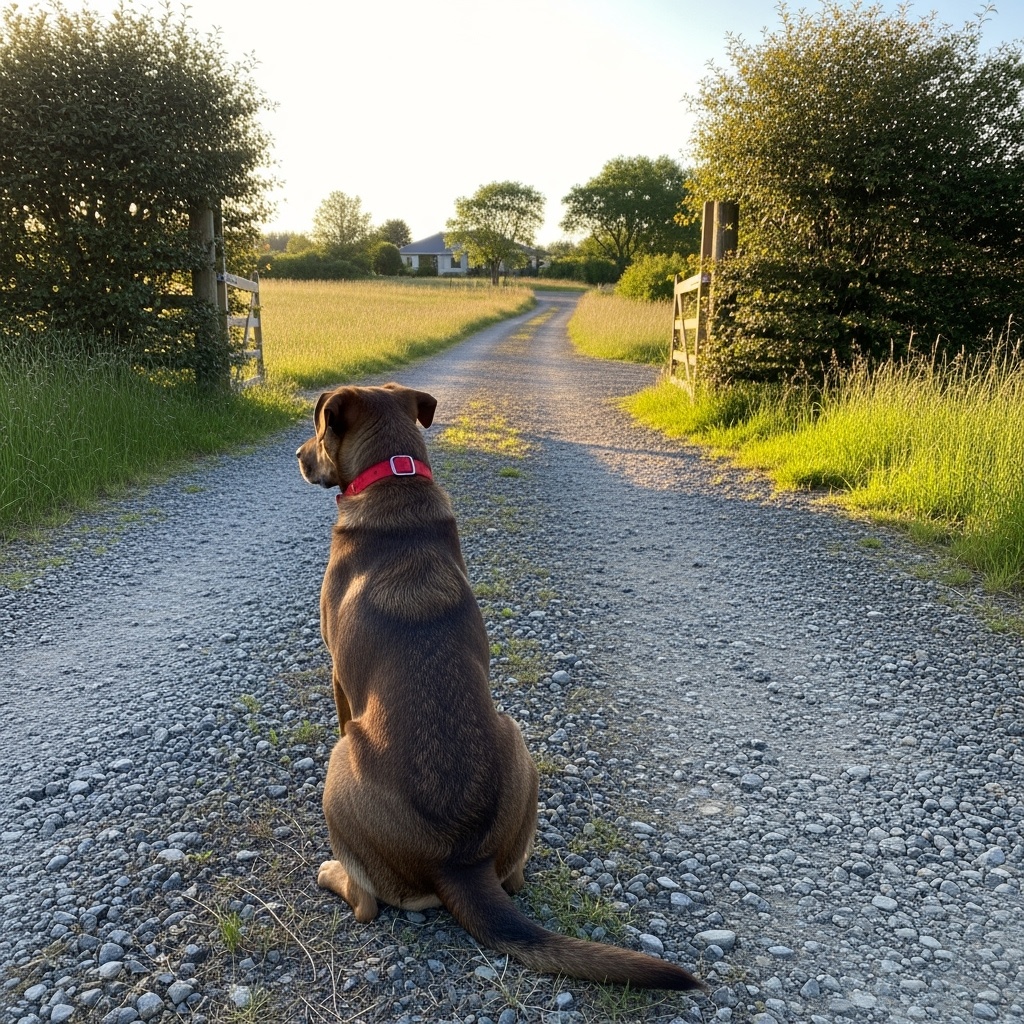
open electric gates leading to circular block paved driveway at large countryside home

Open electric gates and a circular block-paved driveway can create an easy escape route for dogs if there is no boundary in place.


Why does my dog run out of the driveway when the gate opens?

Many dogs learn to associate the sound of a gate motor, driveway buzzer or approaching vehicle with excitement or activity. When the gate opens, curiosity can lead them to investigate beyond the property boundary. Dogs are naturally territorial and inquisitive, so an open entrance can feel like an invitation to explore.

Once a dog successfully leaves the driveway, the behaviour can quickly become a habit. The dog may begin waiting near the gate whenever it hears visitors arriving.


Are electric gates enough to stop dogs escaping?

Electric gates improve security for vehicles and property access, but they are not designed to contain pets. Once the gate opens for a vehicle or visitor, dogs can easily walk or run through the entrance.

For properties with open driveways or automated gates, a secondary boundary solution is often needed to keep dogs safely contained within the garden.


How can I secure my driveway so my dog cannot escape?

The safest way to secure a driveway without installing visible fencing is to create a clear boundary that dogs can understand and respect.

Solutions may include:

  • improving gate management and supervision
  • strengthening garden boundaries
  • using discreet containment systems along the driveway edge

With proper training, most dogs quickly learn where they are allowed to roam and will stop before reaching the driveway exit.


Why Dogs Run Out of Open Driveways

A dog running out of a driveway is rarely about stubbornness or bad behaviour. In most cases, it is a natural response to activity near the boundary of the home.

Dogs are instinctively curious and alert to movement. When something happens at the entrance of the property — a delivery van arriving, a visitor approaching or wildlife passing by — they often feel compelled to investigate.

Common triggers include:

  • excitement when family members return home
  • curiosity about visitors or delivery drivers
  • chasing squirrels, cats or passing dogs
  • guarding behaviour around the property boundary

Once a dog discovers it can leave the property through the driveway, the behaviour can quickly become habitual. Many owners notice their dog beginning to wait near the gate whenever they hear the intercom or gate motor.


Dog Escaping Electric Gates

Automated gates are designed to improve security and convenience, but they are not intended to act as a pet barrier.

A dog escaping an electric gate usually occurs because the gate opens frequently throughout the day. Every time a visitor arrives, the gate may slide open automatically, creating a clear route out of the garden.

Some common situations include:

  • delivery drivers triggering the intercom
  • visitors arriving throughout the day
  • gardeners or tradespeople entering the property
  • family members coming and going

Dogs are quick learners. Many soon associate the sound of the gate motor with activity outside the property and will run towards the driveway as soon as they hear it.

Even normally calm dogs may be tempted to explore beyond the boundary once the gate opens.

West Highland Terrier walking out through open electric gates on block paved driveway

A curious Westie walking through open electric gates — a common situation where dogs wander out of driveways when gates open for visitors.


Dog Escaping Open Driveways in the Home Counties

The issue of a dog escaping an open driveway is particularly common in areas such as Surrey, Sussex, Berkshire, Oxfordshire and Hampshire.

Properties in these areas often share several design features:

  • large landscaped front gardens
  • open plan frontage without fencing
  • long gravel or paved driveways
  • electric sliding or swing gates

Many homeowners intentionally avoid installing visible fencing at the front of the property because they want to maintain the appearance of the garden and approach to the house.

While this creates a beautiful entrance, it also means that once the gate opens there may be no physical barrier preventing a dog from leaving the property.


Why Driveway Escapes Can Be Dangerous

A dog leaving the driveway may seem harmless at first. However, it can quickly lead to dangerous situations.

Potential risks include:

  • dogs running into nearby roads
  • approaching unfamiliar people or other dogs
  • chasing cyclists or pedestrians
  • becoming lost or disoriented

Even well-behaved dogs can become unpredictable once they leave the safety of the property.

According to guidance from the PDSA on keeping dogs safe, dogs that escape from gardens are at increased risk of injury, traffic accidents and becoming lost.

For many owners, the first escape is enough to realise that the driveway entrance needs better protection.


How to Secure a Driveway for Dogs Without Visible Fencing

One of the biggest challenges for homeowners is how to secure a driveway for dogs without changing the appearance of the property.

Traditional fencing across the front of the garden can sometimes feel intrusive, especially on properties with long driveways or landscaped entrances.

An increasingly popular alternative is a discreet underground containment system.

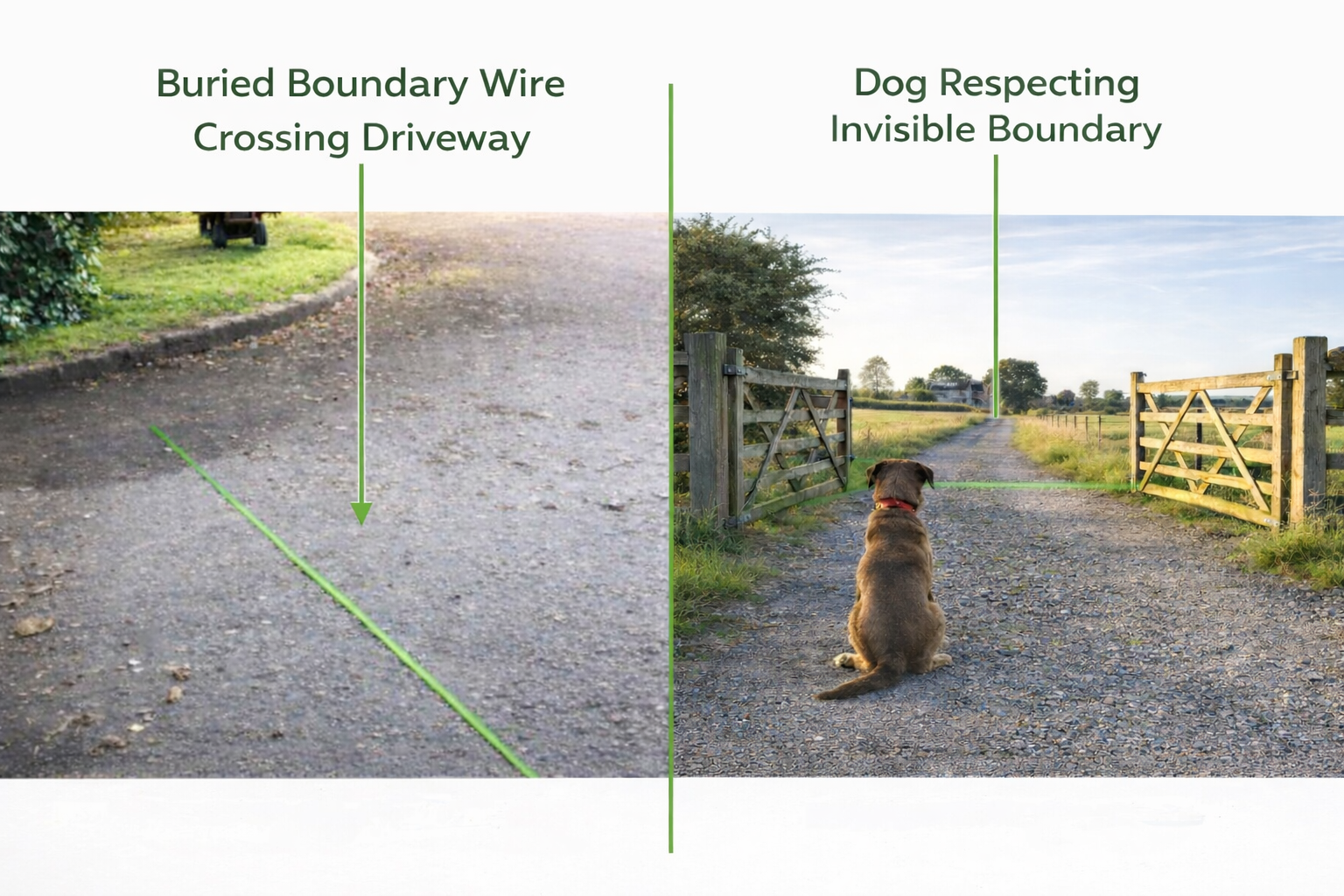
A boundary wire can be installed along the edge of the driveway or front boundary, creating an invisible containment area for the dog. This allows the garden to remain visually open while still preventing dogs from leaving the property.

When combined with proper training, dogs quickly learn where the boundary lies and will stop before reaching the driveway entrance — even when the gate opens.

At DogFence, we frequently see this situation in large properties across Surrey, Sussex and the Home Counties where electric gates create an unintentional escape point for curious dogs.


Training Dogs to Respect the Driveway Boundary

Training plays an important role in teaching dogs where they can safely roam.

Most boundary systems use a simple and structured training approach involving:

  • temporary training flags along the boundary
  • guided walks along the safe area
  • consistent reinforcement during training sessions

Over time, dogs begin to recognise the boundary markers and understand where they should stop.

This approach allows dogs to enjoy the freedom of the garden while remaining safely contained within the property.


Check for Other Garden Escape Routes

If your dog is escaping through the driveway, it is also worth checking for other potential weak points around your garden boundary.

For example, some dogs escape through small gaps in gates or fencing. If that sounds familiar, our guide explaining how to stop a dog squeezing through a gate can help identify the problem and possible solutions.

Other dogs attempt to leave the garden by jumping over fences. Our article on why dogs jump fences and how to stop them explores the behavioural reasons behind this escape behaviour.

If your dog regularly attempts to leave the garden entirely, you may also find our complete guide on how to stop a dog running away from the garden useful.

Understanding every possible escape route helps ensure your garden remains safe and secure.


FAQs: Dogs Escaping Driveways and Gates

Why does my dog run out of the driveway when the gate opens?

Dogs often associate the sound of the gate motor or buzzer with excitement, visitors or activity outside the property. Curiosity and territorial behaviour can lead them to investigate beyond the boundary.


Are electric gates safe for dogs?

Electric gates provide security for vehicles but they do not act as a reliable barrier for pets. Once the gate opens, dogs can easily walk through the entrance.


How do I stop my dog running out of the gate?

Consistent training, improving boundary security and using discreet containment systems can help prevent dogs leaving the driveway when the gate opens.


Can dogs be trained not to leave the driveway?

Yes. With clear boundaries and consistent training, most dogs quickly learn where the safe area ends and will avoid crossing that boundary.


Keeping Dogs Safe Around Open Driveways and Electric Gates in the UK

For many homeowners across Surrey, Sussex and the Home Counties, open driveways and electric gates are part of what makes their property feel spacious and welcoming. But these same features can unintentionally create the perfect opportunity for a dog running out of the driveway when the gate opens for visitors or deliveries.

If your dog has already started escaping an open driveway or attempting to follow cars through the entrance, it’s important to address the issue early before the behaviour becomes a habit. Once dogs learn that the driveway leads to the outside world, they may begin waiting for the moment the gate opens.

Understanding why dogs leave the garden, improving boundary awareness and choosing the right containment solution can help stop dogs running out of gates while still preserving the appearance of your property.

With the right approach, it’s entirely possible to secure a driveway for dogs without installing large or intrusive fencing. That means your dog can continue to enjoy the freedom of the garden — while you enjoy the peace of mind that they remain safely within it. For many families, solving the driveway escape problem restores confidence that their dog can safely enjoy the garden without constant supervision.

Westie sitting safely inside open electric gates wearing invisible dog fence collar on circular driveway

Thanks to training and the invisible dog fence boundary, this Westie stays safely inside the property even when the electric gates are open.

Worried Your Dog Could Run Out of the Driveway?

Many of our customers have beautiful homes with open driveways or electric gates — but once the gate opens, curious dogs can easily wander out.
A professionally installed DogFence creates a discreet boundary along your driveway or garden edge, keeping your dog safely contained without changing the look of your property.

Call us on
01628 476475
|
Message us on WhatsApp
|
Request a Free Quote

vizsla sitting safely in coastal garden near cliff edge overlooking the sea

Cliff-Top Dog Safety: Protecting Dogs in Coastal Gardens

Cliff-Top Dog Safety: Protecting Dogs in Coastal Gardens

Living by the sea is one of the great joys of the UK. From the dramatic cliffs of Cornwall and Devon to the Jurassic Coast in Dorset, the white cliffs of East Sussex, and the rugged coastal paths of Northumberland, many homes enjoy spectacular sea views.

But for dog owners, those views can come with a hidden risk. Coastal dog safety is becoming an increasing concern for homeowners in cliff-top locations, including areas such as Cornwall, Devon, Dorset and the Isle of Wight, where gardens may sit close to steep coastal drops.

For properties located near these edges, cliff top dog safety becomes an important consideration. Curious dogs following scents, chasing seabirds, or exploring unfamiliar ground can easily wander too close to dangerous cliff edges. Owners are continually searching solutions to prevent dogs falling from cliffs.

Unlike inland gardens, coastal properties often have natural boundaries rather than fences, which can increase the risk of dogs reaching cliff edges. Cliff top garden containment is nightmare scenario for both dog and cat owners.

Many owners only start researching boundaries after dealing with escape attempts. If your dog has already shown signs of testing the garden limits, our guide How to Stop a Dog Running Away explains why dogs escape and how consistent training and secure boundaries can prevent it long-term.

vizsla sitting safely in coastal garden near cliff edge overlooking the sea


What Is Cliff Top Dog Safety?

Cliff top dog safety refers to protecting dogs from dangerous cliff edges, steep coastal drops, and unstable ground near coastal homes and gardens.

For homeowners living near cliffs, this usually involves combining secure boundaries, training, and safe garden design so dogs can enjoy the outdoors without the risk of falling.

Because dogs rely heavily on scent and movement, they can easily follow wildlife or new smells toward dangerous terrain.


Why Cliff-Top Gardens Can Be Dangerous for Dogs

Coastal gardens often present challenges that aren’t found in typical suburban gardens.

Cliff-top homes may have:

  • Sloping land leading toward the cliff edge
  • Natural boundaries rather than fences
  • Long grass hiding sudden drops
  • Rabbits, seabirds or other wildlife attracting dogs

This is why dog safety near cliffs is such an important issue for coastal homeowners.

Dogs don’t naturally understand the danger of height in the way humans do. A rabbit or gull moving toward the edge can quickly trigger instinctive chasing behaviour.


Why Dogs Sometimes Fall from Coastal Cliffs

Sadly, incidents involving dogs falling from cliffs happen every year around the UK coastline.

Common causes include:

  • Dogs chasing seabirds or rabbits
  • Loose or eroding cliff edges
  • Unfenced garden boundaries
  • Dogs exploring unfamiliar coastal terrain

Even well-trained dogs can react instinctively when wildlife appears.

Some dogs may even attempt to leap over low garden barriers while chasing birds or rabbits. If you’re unsure what height dogs can clear, our guide Can a Dog Jump a 6ft Fence? explains how surprisingly athletic many dogs can be.

Taking steps to prevent dogs falling from cliffs is therefore essential for properties located near steep coastal terrain.

Alt Tagdog walking close to cliff edge on coastal path highlighting cliff top dog safety risks

Curious dogs following scents or wildlife can easily wander too close to cliff edges along coastal paths


Challenges of Fencing Cliff-Top Gardens

Traditional fencing is not always suitable for cliff-top properties.

Many coastal homeowners face challenges such as:

  • Planning restrictions in conservation areas
  • Fragile ground where fence posts cannot be installed
  • Uneven or sloping terrain
  • The desire to preserve uninterrupted sea views
  • Large fence panels can also spoil the natural landscape of coastal gardens.

For this reason, many homeowners look for solutions focused on coastal garden dog safety without installing bulky physical fencing.


Creating Safe Boundaries Without Blocking the View

Modern containment systems allow homeowners to create safe boundaries without visible fencing.

Instead of installing panels or rails, a buried boundary wire can define the safe area of the garden and train dogs where it is safe to roam.

This approach works particularly well for cliff top garden dog containment, because it:

  • Preserves coastal views
  • Works on uneven ground
  • Follows irregular garden shapes
  • Prevents access to dangerous edges

If your dog regularly tests physical boundaries or jumps fences, you may also find our guide How to Stop a Dog Jumping a Fence
helpful for understanding the behaviour and training process.


Coastal Areas Where Dog Safety Is a Growing Concern

Cliff-top homes across the UK — from St Ives and Newquay in Cornwall to Lulworth Cove in Dorset and Whitby on the Yorkshire coast — often have gardens that slope towards the sea, making dog safety near cliffs particularly important. Areas that are of a particular concern are:

Interest in containment systems is increasing in coastal regions including:

  • Cornwall (St Ives, Newquay, Padstow)
  • Devon (Salcombe, Ilfracombe, Woolacombe)
  • Dorset’s Jurassic Coast (Lyme Regis, Lulworth, Swanage)
  • Isle of Wight coastal homes
  • Northumberland villages along the coastal path

Many cliff-top homeowners are looking for ways to allow their dogs to enjoy the garden while improving dog safety near cliffs and reducing the risk of dangerous falls.


Peace of Mind for Coastal Dog Owners

For most owners, the goal isn’t restricting freedom.

Instead, it’s about allowing dogs to enjoy the garden safely.

A carefully designed boundary system allows dogs to run, explore, and relax while preventing them from reaching dangerous edges — dramatically improving cliff top dog safety for coastal homes.


FAQs: Cliff-Top Dog Safety

How can I improve cliff top dog safety at home?

The safest approach is to create a secure boundary between your dog and the cliff edge. This may involve training, traditional fencing where suitable, or containment systems designed for uneven terrain.


Can dogs really fall from cliffs near homes?

Yes. Dogs often chase birds or wildlife without recognising the danger of steep drops. Coastal rescue teams regularly report incidents involving dogs falling from cliffs.


Are fences allowed near coastal cliffs?

Sometimes planning restrictions apply in conservation areas or protected landscapes. Many homeowners therefore look for discreet solutions that protect dogs without changing the appearance of the property.


What is the best way to prevent dogs falling from cliffs?

Creating a secure garden boundary and training dogs to recognise safe areas is the most reliable way to prevent dogs falling from cliffs while still allowing them to enjoy outdoor space.


Protecting Dogs in Cliff-Top Gardens

Cliff-top homes offer some of the most beautiful views in the UK — from the rugged coastline of Cornwall and Devon to the dramatic cliffs of Dorset and the sweeping sea views of Northumberland. But for dog owners, those landscapes can also present hidden dangers.

Improving cliff top dog safety doesn’t mean restricting your dog’s freedom. Instead, it’s about creating a garden where your dog can run, explore, and enjoy the outdoors without the risk of reaching dangerous cliff edges.

Over the years, we’ve spoken to many dog owners who only realise the risk after a near miss — a dog chasing seabirds, following a scent trail, or simply wandering too close to the edge of a coastal garden. In many cases, the issue isn’t behaviour or training. The boundary simply isn’t clear to the dog.

We’ve even installed containment systems for homes in cliff-top locations where owners wanted to protect both dogs and cats from accessing steep coastal drops while still allowing them the freedom to enjoy the garden safely.

With the right combination of training, secure boundaries, and thoughtful garden design, most pets quickly learn where it is safe to roam.

If you live in a coastal property and are concerned about cliff top dog safety, creating a clear boundary may be one of the simplest ways to protect your pet.

vizsla relaxing in coastal garden safely set back from cliff edge overlooking the sea

A Vizsla relaxing in a cliff-top garden where clear boundaries allow pets to enjoy coastal views safely

Live by the Sea? Protect Your Dog (and Cat) from Cliff-Edge Risks

If your garden sits near steep coastal drops, a clear boundary can dramatically improve cliff top dog safety
without blocking your sea view. We’ve installed systems for both dogs and cats in cliff-top locations across England.

Call
01628 476475
|
WhatsApp us
|
Request a Free Quote

Tell us your location and garden layout — we’ll recommend the safest boundary plan for your coastal property.

Labrador and cockapoo standing on a stone bridge outside a Cotswold cottage with low garden boundaries

Dog Fence Planning Permission UK: Do You Need Permission for Garden Fencing?

Dog Fence Planning Permission in AONB Areas: What Dog Owners in the Cotswolds Need to Know

If you’re wondering about dog fence planning permission UK, you’re not alone. Many countryside homeowners want to keep their dogs safe while preserving the natural beauty of their gardens. Because rural areas often include protected landscapes and conservation zones, planning rules around fencing can sometimes be more complex than many people expect.

Do Dog Fences Need Planning Permission in the UK?

In most cases, dog fences do not require planning permission in the UK if they fall within standard garden fence height limits. Generally, fences can be up to 2 metres high, or 1 metre if next to a highway, without planning approval. However, stricter rules may apply in conservation areas, protected countryside landscapes, or where fencing could affect public views or neighbouring properties.

Labrador and cockapoo standing on a stone bridge outside a Cotswold cottage with low garden boundaries


Dog Fence Planning Rules UK Homeowners Should Know

Areas of Outstanding Natural Beauty and other protected landscapes have planning controls designed to preserve the countryside. These dog fence planning rules UK often focus on visible structures that could alter the natural landscape. Local planning authorities may assess fencing applications to ensure they do not damage the natural appearance of the area. These AONB dog fencing rules often focus on visible structures that could alter the landscape. Planning guidance for protected landscapes is overseen by Natural England, which works to conserve the natural beauty of Areas of Outstanding Natural Beauty.

Planning officers may consider whether fencing:

• interrupts countryside views
• affects historic landscape features
• alters traditional field boundaries
• becomes visible from public footpaths or roads

For rural homes with open gardens or countryside views, installing high fencing or boundary structures can sometimes require planning permission.


Dog Fencing in Protected Landscapes: The Real Challenge

For properties with open views or traditional boundaries, installing large or visible fencing may raise planning concerns. This often leads dog owners to look for solutions that keep their pets secure without changing the character of the property. The difficulty with dog fencing in protected landscapes is that many countryside homes were never designed with secure garden boundaries.

Typical issues include:

• low dry-stone walls
• open gardens that blend into fields
• farmland boundaries that dogs can cross easily
• large properties with multiple escape routes

This means many dog owners face a dilemma: they want to keep their dog safe, but traditional fencing may not suit the property or the surrounding landscape.

If your dog already has a habit of escaping the garden, our guide on How to Stop a Dog Running Away explains the behavioural reasons dogs leave home and how owners can prevent it.


Dog Fence Planning Rules UK Homeowners Should Know

In many cases, planning permission for garden fences UK homeowners install is not required, but height limits and location rules can apply. Restrictions are more likely if the fence borders a highway, exceeds two metres in height, or is located within protected landscapes such as conservation areas. Across England, dog fence planning rules UK can vary depending on the location and height of the fence.

General planning guidance usually states:

• fences next to highways over 1 metre high may need permission
• fences elsewhere over 2 metres high may require permission
• stricter controls apply in conservation areas and AONB landscapes

Because of these restrictions, many countryside homeowners start looking for ways to create a secure boundary without installing tall physical fencing.


Invisible Dog Fence Countryside Properties Often Choose

For many invisible dog fence countryside properties, underground containment systems provide a discreet alternative.

Instead of building visible fencing, a boundary wire is buried underground around the garden. The dog is trained to recognise this boundary and remain safely within it.

The benefits include:

• no visible fencing panels
• no posts or structures altering the garden
• uninterrupted countryside views
• discreet containment that blends into the landscape

Because the system is underground, it usually avoids many of the visual planning issues associated with traditional fencing.

If maintaining the appearance of your property matters to you, our guide to Secure Garden Without Ugly Fencing explains how homeowners create safe gardens without compromising their landscape.

Diagram showing invisible dog fence boundary wire around a countryside cottage garden

Invisible dog fences use a buried boundary wire to create a secure garden for dogs without installing visible fencing.


Why Discreet Containment Works Well for Countryside Homes

Many rural gardens prioritise natural boundaries and uninterrupted views.

A discreet containment system allows homeowners to:

• protect their dog
• maintain the natural landscape
• avoid intrusive fencing structures
• preserve countryside views

For properties located in protected areas such as the Cotswolds, this balance can be particularly important.

If you are curious about how the system works in practice, you may also find our guide to Dog Fence Installation Guide helpful.


FAQs: Dog Fence Planning Permission in the UK

Do dog fences need planning permission in the UK?

In most cases, dog fences do not require planning permission in the UK if they stay within standard garden fence height limits. Typically, fences can be up to 2 metres high, or 1 metre next to a highway, without approval. However, additional restrictions may apply in conservation areas or protected countryside landscapes.

Are invisible dog fences legal in the UK?

Yes, invisible dog fences are legal in the UK. Because the boundary wire is buried underground and does not create a visible structure, these systems usually do not require planning permission. They are often chosen by homeowners who want to keep their dogs safe without installing traditional fencing.

What height fence can I build without planning permission in the UK?

In most cases, you can build a fence up to 2 metres high without planning permission. If the fence borders a road used by vehicles, the height limit without approval is usually 1 metre. Always check local council guidance if your property is in a conservation area or protected landscape.

Can I install a dog fence in the countryside?

Yes, many countryside homeowners install dog fences to keep pets safely contained. However, visible fencing may be restricted in some rural landscapes. Discreet solutions such as underground dog fences are often chosen because they provide containment without altering the appearance of the property.


Keeping Your Dog Safe Without Changing the Landscape

For many countryside homeowners, the goal is simple: keep their dog safe while protecting the beauty of the property and surrounding landscape.

A discreet containment system can help achieve this by creating a clear boundary for the dog without altering the natural appearance of the garden.

For homes in the Cotswolds and other Areas of Outstanding Natural Beauty, this approach often provides the safest and most practical solution.

Dog relaxing in countryside garden protected by invisible dog fence boundary

Invisible dog fences allow dogs to enjoy large countryside gardens without installing visible fencing.


Need a Discreet Dog Fence for Your Garden?

If you’re researching dog fence planning permission in the UK or looking for a way to keep your dog safe without installing visible fencing, we can help. Our professionally installed systems create a secure boundary while preserving the natural look of your garden.

Call us on
01628 476475
|
Message us on WhatsApp
|
Request a Free Quote Online

Terrier is secure garden with out ugly fencing to spoil the view

Secure Your Dog Without Ruining Your Garden’s Curb Appeal

Secure Garden Without Ugly Fencing | Discreet Dog Containment

For many UK homeowners, the garden isn’t just a space for the dog — it’s part of the home’s identity. If you’re trying to create a secure garden without ugly fencing, you’re not alone.. Across England, design-conscious homeowners are searching for a dog proof garden without high fences — one that protects their pet while preserving views, landscaping, and architectural character.  Homeowners are now choosing a discreet dog containment system that creates an invisible boundary for dogs while preserving the beauty of their outdoor space.…allowing you to maintain a secure garden design for dogs without altering the appearance of your outdoor space.

The challenge is clear: how do you secure your dog while preserving open views, clean lines, and architectural balance? The answer lies in choosing a containment approach that works quietly in the background — delivering safety without visual compromise.

Creating a secure garden without ugly fencing means your dog stays safe — and your landscaping stays beautiful.


Why Creating a Secure Garden Without Ugly Fencing Feels So Difficult

When a dog begins escaping, traditional fencing is usually the first solution people consider.

Homeowners often try:

  • Increasing fence height
  • Adding trellis toppers
  • Installing deer fencing or wire mesh
  • Reinforcing the bottom with concrete or gravel boards

But these fixes can:

  • Block natural light
  • Obstruct countryside views
  • Clash with garden design
  • Make properties look enclosed or defensive
  • Reduce kerb appeal from the front

For design-conscious homeowners, it quickly becomes a frustrating trade-off between safety and appearance.

It doesn’t have to be.


Why Traditional Fencing Prevents a Secure Garden Without Ugly Fencing

Good garden design relies on proportion, balance, and clean sightlines — principles long promoted by organisations such as the RHS. Most boundary fencing was designed to mark property lines — not to contain determined dogs.

When height extensions, mesh overlays, or internal barriers are added, the garden can start to feel:

  • Heavy and imposing
  • Out of character with rural homes
  • Visually cluttered
  • Disproportionate in smaller spaces

And for dogs who jump, dig, or squeeze through gaps, simply adding more timber rarely solves the underlying behaviour.

In fact, we explain in detail why traditional fencing fails for escape-artist dogs, particularly those with high drive or strong prey instincts.

Instead of building higher, it may be smarter to rethink the approach entirely.


How to Create a Secure Garden Without Ugly Fencing

An electronic dog fence UK system works differently from traditional fencing. The discreet dog containment system works by defining an invisible boundary for dogs around the perimeter, without adding visible structures.

Rather than creating a visible physical barrier, a discreet boundary wire defines the perimeter of your garden. Through structured introduction and training, your dog learns to recognise and respect that boundary.

There are:

  • No additional panels
  • No mesh extensions
  • No visual clutter
  • No blocked sightlines

From the outside, nothing changes. Your landscaping remains exactly as designed.

Many garden-proud homeowners choose an invisible dog fence UK system because it preserves the natural flow and balance of their outdoor space while still providing reliable containment.

Dog sitting in a secure garden without ugly fencing overlooking open countryside

A secure garden without ugly fencing preserves open countryside views while keeping dogs safely contained.


But Does It Actually Work?

Yes — when professionally installed and properly introduced, an electronic dog fence UK system provides consistent, reliable containment without altering your garden’s appearance. The key is structured training and precise boundary planning.

A professionally installed system offers:

  • Precise boundary control
  • Immediate, predictable feedback
  • Customisable layouts around flowerbeds, ponds, or driveways
  • Structured training to reinforce behaviour

For landscaped or irregular gardens, wired systems are significantly more reliable than wireless or satellite-based alternatives.

If you’re comparing systems, read our full breakdown of wired vs wireless vs GPS dog fences — what actually works to understand the differences in real UK conditions.

When choosing the best dog fence UK homeowners can trust, reliability matters far more than marketing claims. A system that works every single time is what keeps dogs safe.


Ideal for Garden-Proud Homes

This approach is particularly popular with:

  • Rural homeowners with open countryside views
  • Period properties with character fencing
  • Landscaped gardens with clean sightlines
  • Homes where front curb appeal matters

Instead of modifying your garden to control the dog, you teach the dog to respect the garden’s boundary.

For many owners, this feels like a far more elegant solution. Unlike visible barriers, a discreet dog containment system works by teaching your dog to respect a defined boundary, rather than relying on height or physical obstruction.


A Smarter Alternative to Garden Fencing

If reinforcing panels hasn’t worked, it may be time to explore alternatives to garden fencing that focus on training as well as containment. For homeowners seeking a dog proof garden without high fences, this approach offers safety without visual compromise.

Modern dog containment systems allow you to:

  • Keep open views across fields
  • Protect wildlife and livestock
  • Maintain design symmetry
  • Avoid expensive fencing alterations
  • Create a dog-safe garden without visible restrictions

Safety and aesthetics don’t have to compete.

If you’re still in research mode, our complete dog fence buying guide UK explains how different systems compare and which solution suits different property types. For many homeowners, achieving a secure garden design for dogs means balancing practical safety with architectural and landscaping integrity.

Golden retriever safely trained within a secure garden without ugly fencing in the UK


What About Cost?

One common assumption is that electronic containment must be expensive.

In reality, many larger gardens find it more cost-effective than replacing or extending physical fencing around the entire boundary.

If you’re weighing up investment options, our detailed guide to dog fence cost UK pricing breaks down what influences price and what to expect for DIY versus professional installation.


Are Electronic Dog Fences Humane?

This is understandably one of the most common concerns among UK dog owners.

Modern systems are not the same as outdated “shock collars.” They are designed with safety, adjustability, and structured training in mind.

They use:

  • An audible warning tone first
  • Adjustable correction levels
  • Automatic shut-off safety features
  • Structured training protocols that teach boundary awareness

When introduced correctly, most dogs quickly learn the boundary and rarely challenge it again.

For a balanced, evidence-based perspective, read our full discussion on the dog fence controversy — humane or harmful?, where we explain how modern systems differ from older misconceptions and why responsible installation matters.


When Is This Not the Right Solution?

Electronic containment isn’t appropriate for every dog without guidance. Very anxious or untrained dogs will usually require structured introduction and professional support.

That’s why expert advice matters.

Discussing your garden layout and your dog’s temperament before making changes ensures the solution is tailored properly. With careful planning, it’s entirely possible to achieve a secure garden design for dogs that prioritises safety without sacrificing aesthetics.


Final Thoughts: Style and Safety Can Co-Exist

You don’t have to choose between protecting your dog and preserving your garden’s beauty. With the right planning, you can achieve a secure garden without ugly fencing while maintaining open views and architectural balance. A discreet dog containment system allows you to secure the full perimeter of your property without altering fencing lines, sightlines, or landscaping symmetry.

For many UK homeowners, a discreet electronic dog fence UK solution provides reliable containment without altering the character of the property.

Because the best containment system is the one that works quietly in the background — letting your garden look exactly as it should.

Do you want to secure your garden today without ugly fencing?

If increasing fence height isn’t stopping your dog jumping, we can help you create a properly secure boundary tailored to your property and your dog’s temperament.

Call us on
01628 476475
|
Message us on WhatsApp
|
Request a Free Quote Online

woman showing how to walk dog over the driveway with a dog fence installed

How to Walk Your Dog with a Dog Fence | DogFence Ltd

How to Walk a Dog with a Dog Fence Installed (UK Step-by-Step Guide)

If you’re wondering how to walk a dog with a dog fence installed, you’re not alone. One of the most common questions we hear after installation is: can I walk my dog with an electric fence, and how do I safely cross the invisible dog fence boundary?

The good news is that learning how to walk a dog with a dog fence is simple when done correctly. Walking a dog through an invisible dog fence boundary becomes routine using a method called reverse training for dog fences. Your dog quickly learns that crossing the invisible dog fence is only allowed when the dog fence collar is removed and they are walking with you on a lead.

With consistent dog fence collar removal and a clear command routine, most dogs confidently learn how to walk with an electronic boundary fence in place within 7–10 days.


How Do You Walk a Dog with an Electric Fence?

To walk a dog with an electric fence, remove the dog fence collar, attach a lead, pause at the invisible boundary, give a consistent command, and calmly cross together. Never allow your dog to cross the invisible dog fence alone.

This is the golden rule for keeping your pet safe, confident and happy.


Can I Just Turn Off the Electric Fence Instead?

No. Turning off the system is not enough.

Proper dog fence collar removal is essential when learning how to walk a dog with a dog fence. The physical act of removing the collar signals to your dog that crossing the invisible dog fence boundary is now permitted under your control.

Dogs understand context extremely well. Collar off + lead on = walk time.


Why Reverse Training Matters for Your Dog Fence

A dog fence for gardens creates a safe, invisible boundary that keeps your pet contained. However, dogs are creatures of habit. If they’re taught never to cross the boundary, you risk confusing them when it’s time for their daily walk.

That’s why we use a specific method called reverse training.

Reverse training teaches your dog a clear distinction: crossing the invisible dog fence boundary is only permitted when:

  • The dog fence collar is removed
  • They are on a lead and under your direct control
  • They receive a clear, consistent command from you

This distinction allows your dog to safely enjoy their garden while still leaving confidently for walks.


Key Rules for Walking a Dog with an Electric Dog Fence

To ensure success and avoid confusion for your pet, remember these simple rules when crossing the driveway with your dog:

❌ Never allow your dog to cross the boundary alone.
✅ Always remove the dog fence collar before leaving the property.
✅ Always keep your dog on a lead when crossing the invisible dog fence boundary.
✅ Always use the same clear command each time (e.g., “Walkies” or “Let’s go”).
✅ Be consistent during the initial 7–10 days of training.

Dog walking calmly through invisible dog fence boundary after collar removal training

Walking your dog safely across the invisible dog fence boundary using reverse training and collar removal.


Step-by-Step Guide to Walking Your Dog Through the Electric Fence Boundary

Follow these steps consistently, and your dog will quickly understand how to walk off the property when you have a dog fence installed:

1. Remove the Dog Fence Collar

Before every walk, remove the receiver collar. Do not simply turn off the system. The physical removal of the collar is what signals the rule change.

2. Put Your Dog on a Lead

Attach their usual walking lead or harness. Routine builds clarity.

3. Pause at the Boundary

Stop just before the invisible boundary line. Ask your dog to sit or wait briefly. This reinforces that crossing is controlled.

4. Give the Command and Cross

Use your chosen command and calmly walk forward. Praise gently as your dog follows you across the invisible dog fence boundary.

5. Encourage and Reward

Once fully outside the containment area, use a happy tone, gentle praise, or a small treat. This builds positive association.

6. Repeat the Process When Returning

Pause at the boundary again, stay calm, and walk back in together. Consistency cements the rule that crossing only happens with you.

Watch our training video on how to walk a dog with a dog fence installed to see this method in action.


How Long Does It Take?

Most dogs become confident with walking through the invisible dog fence boundary within 7–10 days.

Some may take slightly longer, particularly sensitive or cautious dogs. The key to learning how to walk a dog with a dog fence is consistency, patience and clear repetition.


Common Mistakes to Avoid

Below are common mistakes owners make when learning how to walk a dog with a dog fence:

❌ Leaving the collar on — Never cross the invisible dog fence boundary with the collar fitted. This can confuse your dog and undermine training.

❌ Inconsistency — Changing commands or skipping the pause weakens clarity.

❌ Letting the dog cross alone — Even once can damage the boundary rule.


Why Professional Training Helps

At DogFence Ltd, we don’t just install an electric dog fence. We guide you through exactly how to walk a dog with a dog fence safely and confidently. Our professional installers guide you through every stage of our Dog Fence Training Programme, ensuring your dog understands how to leave the property with an electric fence safely and confidently.

Our professional installers:

  • Demonstrate reverse training
  • Show you how to cross the invisible dog fence boundary correctly
  • Provide written guidance
  • Support you after installation

That support ensures your dog understands the rules from day one. If your dog has a history of testing boundaries, you may also find our complete guide on how to stop a dog running away helpful for long-term training support.


Conclusion

Learning how to walk a dog with a hidden fence installed is straightforward when done correctly.

By consistently removing the dog fence collar, using a lead, pausing at the boundary and giving a clear command, your dog quickly understands: They may only cross the invisible dog fence boundary safely with you.

This balance provides safe garden freedom while maintaining the routine and enjoyment of daily walks. If you’re still researching whether invisible dog fences are humane, we’ve explained the training science and welfare considerations in detail.

Our professional dog fence installations include full training support so you and your dog feel completely confident from day one.

Need for help or advice?

Call us on
01628 476475
|
Message us on WhatsApp
|
Request a Free Quote Online