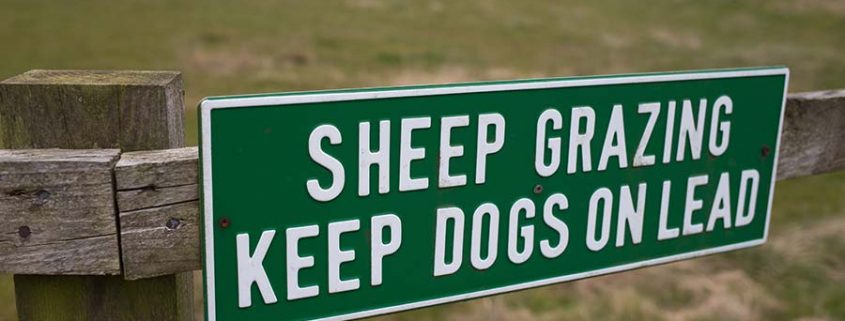

sheep grazing keep dogs on lead to stop dog sheep chasing sign

Escaping dogs in the country are a danger to sheep

Solutions to stop a dog chasing sheep

It’s getting to that time of year when the wildlife is waking up. In early Spring our most common call is I am concerned about my dog getting out and chasing sheep or livestock. Usually owners have tried everything, plugged the hedge, lifted the fence height and all to no avail. If a dog has a high interest in Sheep and has had no training sooner or later he or she will be in with the sheep. For some dogs it’s just the chase, for others it’s the kill. Also a dog with a high prey drive will probably have a high interest in cats or other livestock.

What are the penalties for a dog chasing sheep?

  • Ultimately his life – the farmer has the right to shoot if he considers that the dog is a threat to his flock and there are no reasonable means of preventing it.dog chasing sheep

So What steps can an owner take to prevent their dog chasing sheep?

  • Training – find a good trainer that has a proven track record in this field of expertise (see list below). As Company we recommend a Balanced Trainer. A Balanced Trainer will use multiple tools to train the dog, including an e-collar if necessary.
  • Ensure that the garden fencing is dog proof. If you are rural, even if you don’t have livestock nearby make sure your fence is secure. The wildlife may tempt him out but ultimately he may end up in trouble with a farmer or a vehicle.
  • Walking the dog on a lead where sheep are present. It’s good practice, no matter how good your dog is if there are sheep around pop him on a lead for a few minutes.

Training for sheep chasing

  • Balanced dog trainers will use a range of tools and methods to modify the dog’s behaviour and desire sheep. They will work with you and your dog in a controlled situation and will modify the dog’s desire and interest to chase sheep.
  • Many old school farmers will advocate putting the dog in a pen with an older Ewe. This can be a risky move as a large Ewe can cause considerable damage to a dog when cornered. It is most certainly a harsh method but may ultimately save the dogs life.
  • Some Trainers recommend reward only training. Many dogs will recall well in normal situations using this training method. The issue is if you have a dog with a high drive usually the treat is insufficient to divert the attention and so this method not always successful for sheep chasing.

How can I make my rural property dog proof?

  • Deer or stock fencing may be a solution but can be costly and unsightly. It is also not always effective as dogs will climb up and over or dig under the fence.
  • Electronic dog fences are a great solution as they will back up your current fencing.

Are Electronic Fences banned?

No, electronic fences are not banned and have not been included in the recent e-collar ban proposals. Electronic fences are a great way to give your dog freedom but also keep them safe in the garden. Unlike traditional fences if the dog is trained correctly then the fence will keep even the keenest dog at home. Interestingly, a dog fence can also often be installed on terrain that is not suitable for traditional fencing. A dog fence, often referred to as an electric dog fence, will also cover driveways and vulnerable open areas.

The word “electric” is actually incorrect as there is no electricity in the cable or the collar. As with an e-collar, it is a static impulse that is generated, very similar to a Tens machine. When a dog is trained to an “electric dog fence” he is conditioned to respond a warning beep. The training is gentle and effective, with many owners asking “when will he get the shock?” only to be told that the dog has already received the stimulation.

DogFence Ltd have been installing the hidden dog fences for over 16 years. We have fenced and contained many dogs on their last chance saloon. We offer a containment promise with our Professional Dog Fences but as with all dog ownership this does involve management from the owner.

  1. Put the collar on the dog every day – it’s useless in the draw!
  2. Make sure the collar is correctly fitted – a lose collar can equal a lose dog!
  3. Remember to change the battery at the correct interval – DogFence batteries last 6 months or 2 years depending on the collar and we even offer automatic renewal programmes so you don’t forget.

Conclusion

The majority of dog owners recognise that dogs need to be trained so that they can enjoy walking together. Sadly owners cannot be present 24/7 and it maybe that the dog escapes from the garden and ends up in a field full of sheep. Installing an electronic dog fence gives owners peace of mind whilst allowing the dog the freedom to enjoy the open air.

If you would like to know more about how DogFence can secure your garden give us a buzz. Our lovely office team can measure out your boundary and give options for the fence remotely. Call us today on 01628 476475 or click here for a quote.

Below is a list of Balanced Dog Trainers that we recommend for sheep chasing:

Take The Lead Training – Devon  – Jamie Penrith.

Dutiful Dogs – London & South East England – Nicky Bulter

Southend Dog Training – Essex – Adam Spivey

Paws in Nature – Cheshire – Andrew Lang


fencing for dogs

Fencing for dogs we explore the options for dog owners

Best fencing for dogs – what are the options?

When is comes to fencing for dogs it really depends on several important points. A big dog will need a big fence. A four foot fence is nothing to a big dog. Equally small dogs are excellent climbers. It is important to consider the dog breed when choosing a fence. Below are some points to consider when finding the best solution for your dog and environment. All dogs are different, your dog may be fine in your present home and then you move and something changes.  Ask yourself the following before choosing your dog fencing solution.

  1. Do you live in an urban area?
  2. Are you rural?
  3. What fencing do you currently have?
  4. What breed of dog do you have?
  5. Is the dog currently escaping?
  6. What size area requires fencing?

Below we have noted some of the most popular forms of fencing for dogs so that Fido stays safe at home where he should be!

Types of fencing for dogs

Chain Link Fences

Arguably this is not the prettiest type of fencing but it is one of the most economical. Chain link fencing can be built to varying heights and can also be used to construct a dog run or pen. The issue chain link dog fencing being climbed by dogthat people often have with chain link fencing is that other larger wild animals (foxes and badgers) can cause damage to this type of fence.  When the fence is damaged this gives the dog  an open avenue to the outside worldwide.

Interestingly Terriers are particularly good climbers and often see chain link fences as an easy ladder to escape. the lovely links make great foot holds for both large and small dogs. Chain link fences tend to be a popular choice for more rural customers as they can be softened with foliage. If you have a large breed of dog the fence height should be a minimum of 6ft to prevent a “climb out”.

Close Board Wooden Fences

This is probably the most popular type of fencing for urban areas. A Close Board fence can be a good option because the dog cannot see the rabbits and squirrels living on the other-side! This may curtail his desire to wander but in some cases can increase anxiety. If a dog can hear but not see what is the other side of the fence this may increase his territorial behavior and lead to excessive barking.

When it comes to fencing it’s a mid priced option if you have a small town garden. This type of fencing for dogs is usually sufficient but if your dog is a digger or a climber then this may not be the best solution. A 6ft close board fence is usually only installed in the rear of the garden so you may have to look at other options for the front of the property. Take note if your dog is a digger you should also concrete below ground!

Stock  and Deer Fencing

Stocking and Deer fencing is usually only installed on large rural properties. When installing this type of fencing it is usually best to get the fence dug into the ground to prevent the dog and wildlife digging under it. This can be a costly exercise for large areas and depending on the breed may need to be quite high to prevent a “climb out”. Stock fences can be installed in front of hedges to give a secondary barrier. If you have a very small dog then a stock fence will be ineffective as the dog can squeeze through the wire.

Electronic dog fence

Incredibly, this type of fencing for dogs has been around for over 40 years. It is a little known fencing solution for dog owners in the UK but widely used in the USA. The advantage of an electronic dog fence is that it can be used on both large or small properties. The electronic dog fence is invisible and so does not create any unsightly barriers. There are several advantages that electronic fencing has over traditional methods.

  1. The dog cannot dig under or jumper over the electronic dog fence.
  2. It is cheaper than traditional fences.
  3. Does not obstruct views and is not unsightly.
  4. Can be taken with you if you move.
  5. Protects the drive even if the gate is open.

Even on most standard urban gardens and electronic dog fence is a most cost effective solution. It is simple to install and offers a safe and effective solution. Having been rigorously tested by Lincoln University these fences are have been proved safe and effective.

If you are intrigued but think how our fence may not work for you why not read some of our customer testimonials. If you would like to know more our experienced professionals can chat to you. We can then put together a bespoke estimate for your dog, property and budget.

For an  for an estimate call or contact DogFence on 03450 623623 or info@dogfence.co.uk


dog fencing idea gone wrong - Collie leaping over net fence in countryside

Dog Fencing Ideas – how to keep Fido home!

Dog Fence Solutions: Rural vs Urban Challenges

Dogs will be dogs so exploring different dog fence solutions is a must for any canine owner. Having spent 17 years fencing dogs we have come across many different ideas. As with people no two dogs are the same and of course they all live in different locations.

Why Dogs Escape (and Why Fencing Matters)

Many rural locations are difficult to fence. Understandably this could be because of the terrain being very hilly, wooded or prohibitively large. Furthermore most rural properties are surrounded by hedgerows. Hedgerows may be a deterrent for a dog with a low prey drive but for many it’s an open avenue of escape.

Rural Dog Fence Options

What are the dog fence options for rural homes? Rural homes have always been difficult and expensive to fence and terrain and size will naturally affect what type of fencing can be installed.

Stock Fencing

Stock Fencing is not a good dog proof fencing idea as badgers can make holes and crawl through

Badgers are not deterred by Stock Fences

Stock fencing is a traditional dog fence solution for rural properties. Used to contain livestock it is adaptable for use in rural gardens. For many dogs this will give enough of barrier to prevent the dog jumping  out of the property. The downside is that this type of fencing is it is costly, unsightly and can be damaged by wildlife. Badgers and foxes will often make holes in this type of fencing and thus some rural owners find this dog fencing idea a temporary fix. Also the cost of such fencing can work out extremely expensive; starting around £8.00 p/m + gates etc it can a costly exercise.

Deer Fencing

Deer Fencing; again another great rural solution but sadly it is extremely obtrusive more expensive than stock fencing. Again, the downside with this fencing is that badgers and small mammals will make holes that then become an escape avenue for your dog!

Electronic dog fencing

Electronic dog fencing; you may not be familiar with this product even though this type of dog fencing idea has been around for over 40 years. Using a boundary wire, transmitter and a computer collar worn by the pet this type of fencing can be used on any terrain. Electronic dog fences do need to be professionally installed. This is because the pets need training but they a more cost effective solution than traditional methods. As a guide price an rural installation of approx 2 acres for 2 dogs would be circa £1300.00.

The advantage of this type of dog fencing solution is that it can be used cost effectively on very large properties (up to 350 acres) and can be removed if the owner moves house. It is also invisible so will not affect any planning restrictions or spoil the view!

Kennels and dog runs

Kennels and dog runs are full proof method for dog containment and are often an option for rural homes The downside of installing a run is that many dogs become bored and exercise is limited. The cost of installing Kennels can be high but equally these can be relocated to a new property.

Urban Dog Fence Options

When it comes to urban dog fencing there are certainly more options but prices are often prohibitively high. Of course, most urban gardens are fenced in some way but these may not all be dog proof! Some new sites have planning restrictions on fence heights and even open plan. Many properties use Picket or Rail type fencing which dogs can easily jump over or squeeze through.

Planning permission is not usually required in urban areas.  Fences must be no more than 2m high or 1m high  near roads. The most popular type of fencing is for urban houses is Close Board fencing.

Close Board Fencing

dog fencing ideas can go wrong when the dog digs under the close board fence and makes a hole!

Dogs can dig under traditional fences

Close board fencing is a great dog fencing solution for many urban owners. It is generally tall enough to stop jumping dogs and quick to install. This type of fencing comes in varying heights and can be installed by most handymen. The downside is that some dogs will dig under and there may be restrictions to installing this type of fencing on some new estates. As a rough cost to install on a small rear garden it would be approx £1200.00.

Electronic dog fencing – no need to install gates!

As with the rural properties this type of fencing is a very cost effective solution. These types of dog fencing solutions also gives the owner the possibility of protecting the drive within the price. It is true that the larger the property for more cost effective the electronic dog fence becomes but small properties can also be fenced with this product.

Many owners may already have a Close Board or Picket fence installed and need additional backup. The electronic dog fence can be run around the existing fence if the traditional method is not working. Our Installers can place the cable to prevent the dog jumping over or digging under the existing fence. The cable can even be run under the drive to protect this area. Most owners are concerned that this means digging up the drive but the installation is both neat and discreet.  A typical urban property would cost less £1000 to fence and this would include a driveway loop.

If you’re looking for affordable ways to secure your garden, check out our guide to cheap dog fence ideas.

Cat Runs

Interestingly cat runs can be used to keep both dogs and cats safe. These type of structures can prove expensive if they are professionally installed and may not be aesthetically pleasing. A cat run suitable for a dog would usually cost from £750.00 upwards depending on the size.

If you’re a cat owner too, our invisible cat fence systems provide the same safe, effective containment as our dog fences — keeping adventurous cats close to home without restricting their freedom.

Unusual DIY Attempts (What We’ve Seen Over the Years!)

A DogFence Ltd we have been Professionally installing electronic dog fences for over 17 years. The dog fencing solutions that some owners come up with to keep their pets at home can often be amusing. Over the years we have seen:

  • Old Fireplaces in the hedge!
  • Old garage doors down one boundary!
  • Orange builders netting – not attractive or effective!
  • Hundreds of dogs on tie out stakes – who have wound themselves up to the pole 🙁
  • Electric horse fencing – Harsh and not fall proof!

If you would like to learn more about how we can keep your dog safe at home please call us or visit our web site. We offer bespoke Quotes using our online measuring tool – simple, accurate and effective. 01628 476475 or info@dogfence.co.uk


dog fence boundary flags with dog in training

Electronic dog fence – How to train your dog.

Simple Steps for training your dog to an electronic dog fence

Before commencing electronic dog fence training:

  1. Ensure that you have the correct amount of training flags to cover the boundary. The training flags are the most important part of the training protocol for electronic dog fences. The training flags should be placed approx 8 – 10ft apart around the boundary. Use the collar to find the edge of the avoidance zone and place the flag in the ground in the area where the collar starts to beep.white electronic dog fence flags are placed around the boundary to give the dog a visual
  2. Using the dog fence tester – set the collar to beep only mode. This means that the collar will not give out an impulse just an audible tone.
  3. Place the electronic dog fence collar on the dog and check that it correctly adjusted. As a guide you should be able to get 2 fingers in the neck strap when the dog’s neck is down. See our Trouble Shooting page for handy tips.
  4. Leave the collar on the dog for at least 30 mins before commencing the initial training session.
  5. Find a long lead – 6ft and ideally not the dog’s usual walking lead.

Commencing the training

  1. Take the dog outside on the lead.
  2. Walk the dog around the boundary and tap the flag so that there is good movement.
  3. As you tap each flag use a command word – a good example is “Watch out”.
  4. Allow the dog to go past the training flags into the correction zone (this is the area of the electronic dog fence where the collar will give both a beep and impulse). Allow the dog to linger here and hear the warning beep then direct him back into the garden. Use the command word and tap the flag again.
  5. Repeat this around the boundary for several small sessions over 1 – 2 days.

Introduction to Correction

  1. Place the electronic dog fence collar on the dog approx 20 – 30 mins before starting the training.
  2. Using the tester – lift the level on the receiver from level 0 (beep only) to level 1.
  3. Repeat the process of walking around the boundary and tapping the flags. Always use the command word when tapping the flag.
  4. Allow the dog to go past the flags into the avoidance zone. Look for any signs that the dog is feeling the impulse (a small twitch of the ear, little shake of the head).
  5. Carry on around the boundary allowing the dog to walk into the avoidance zone of his own free will. Never call or drag the dog into the electronic dog fence zone.
  6. If the dog is not responding to the level – lift the level to level 2 and repeat the process. Always direct the dog back into the safe area and praise the dog when he is back in the safe zone.
  7. Once the dog is reacting to the stimulation make a note of the level.
  8. After training play with your dog, praise him and reward him. Do not allow the dog to be off the lead in the garden during the training phase.

Introduction to Distractions

It is important the dog fully understands the warning beep and how to retreat when he is in a high drive moment. By carrying out the distraction training your dog will learn the electronic dog fence so that it becomes second nature. This will ensure that even when he is in a high drive state he stops at the warning beep. The distraction training will require 2 people.

  1. Walk around the boundary, tapping the flags and then have the new person walk into the flags and well into the avoidance area. See if the dog continues or decides to stop.
  2. If the dog continues allow him well into the zone to receive the stimulation and guide him back to you in the safe area. Give him the command word whilst guiding him back to the safe area. Praise him in the safe area.
  3. If the dog stops before or at the flags guide him back and praise him.
  4. Continue walking around the boundary and repeating the process.
  5. Once the dog is making the right decision (not walking into the flagged area) move on and try this on the driveways or open areas.
  6. If the dog is making good progress you may wish to drop the lead and walk into the flagged area with the companion. If the dog endeavors to follow give the command in aloud and firm voice.
  7. A good indication that the dog is fully at home with the electronic dog fence is when he looks away from the flags.

Repeat this process over a couple of days.

Letting your dog off the lead

  1. Walk the dog around a couple of areas and tap the flag if possible. Usually by this stage the dog will not venture near the flags so just give the command word even if you are several feet away from the flag.
  2. Go to the centre of the property and face the dog away from boundary.
  3. Remove the lead and start to walk back towards the house or a safe area.
  4. Play with your dog outside – you can roll a ball but always roll away from the avoidance zone.
  5. Do not leave the dog unsupervised in the garden for the first few days.
  6. After 14 days you can start to remove the flags. Remove the flags every other flag, every other day until they are gone.

Keep the flags in a safe place as if you wish to add on another pet you will need to re-flag the boundary and if you change the layout this will need to be re-flagged to give the dog a visual.

Points To Remember

Training your dog to the electronic dog fence should be fun!

Never throw a stick or ball into the avoidance zone.

Small bit size sessions are often better.

Always remove the dog fence collar at night or for a period of 8 hours in every 24 hour period.

Check the fit for your electronic dog fence collar regularly.

Check the battery status on your collar monthly (using the tester supplied).

DogFence Ltd are the largest installers of electronic dog fences in the UK. Our professional installer/trainers can set up your dog fence for you and will train your pet to the system. We also offer a post installation service to train new pets to the system. If you would like more information please call us on 01628 476475 or email info@dogfence.co.uk.


A dog is for life!

A dog is for life – t’was the month before Xmas T’was a month before Christmas and all around the house the children were squealing we want a pet mouse; Or a hamster, a kitten, a dog or a horse. We PROMISE to look after it forever, of course! So straight onto Google the parents […]

dog fence dogs

Fencing For Dogs Who Escape

What Is the Best Fence for Dogs That Escape?

The best fence for dogs that escape depends on how your dog is getting out. A dog that jumps needs a different solution from one that digs, squeezes through gaps or bolts through an open gate. For persistent escape artists, simply making a physical fence higher or stronger may not solve the problem.

In this guide, we look at the main fencing options for escaping dogs, their advantages and limitations, and what to consider when choosing a secure boundary for your garden.

Fencing for dogs who escape – dog jumping over a garden fence

Quick Answer: What Is the Best Fence for Dogs That Escape?

For many dogs, a secure physical fence with no gaps and sufficient height will work perfectly well. However, dogs that repeatedly jump, climb, dig or escape through gates may need a different approach.

The main options are:

  • Solid wooden fencing – useful for dogs distracted by what they can see outside the garden.
  • Mesh or wire fencing – practical for larger gardens and rural properties.
  • Dig-proof fencing – designed for dogs that tunnel underneath boundaries.
  • Higher fencing – potentially useful for athletic dogs that jump.
  • A hidden dog fence – creates a consistent boundary that can work across fences, hedges, gates and driveways.

The right choice depends on your dog, how they escape and the layout of your property.

Why Do Some Dogs Escape Conventional Fencing?

Some dogs are remarkably good at finding weaknesses in garden boundaries. Fix one escape route and they simply start looking for another.

Common escape methods include:

  • jumping over fences;
  • climbing mesh or timber fencing;
  • digging underneath;
  • squeezing through small gaps;
  • pushing through hedges;
  • escaping when gates are opened;
  • bolting down open driveways.

Before spending money on new fencing, identify exactly how your dog is escaping. This will help you choose a solution that addresses the actual problem rather than just one particular escape point.

If you are not sure why your dog keeps getting out, read our guide to why dogs escape gardens.

Fencing for dogs who escape – dog looking through an open garden boundary

Escape Proof Fence for Dogs: Does One Exist?

There is no single physical fence that can honestly be described as completely escape proof for every dog.

A six-foot fence may stop one dog but another may climb it. Reinforcing the bottom may prevent digging, while still leaving a gate or driveway as an escape route.

That is why the best escape proof fence for dogs is the one designed around both the dog’s behaviour and the individual property.

1. Wooden Fencing for Dogs That Escape

Solid wooden fencing is one of the most common choices for gardens. It provides a visible physical barrier and can also prevent a dog seeing distractions such as passing dogs, people or wildlife.

Advantages:

  • Creates a solid visual barrier.
  • Available in different heights.
  • Can reduce visual triggers outside the garden.
  • Works well for many ordinary residential gardens.

Potential problems:

  • Dogs can dig underneath it.
  • Athletic dogs may jump over it.
  • Some dogs learn to climb panels or nearby structures.
  • Damaged panels can create escape gaps.
  • It cannot normally solve an open driveway or frequently opened gate.

2. How High Should Fencing Be for an Escape Artist Dog?

If your dog jumps, increasing fence height may seem like the obvious answer. For some dogs, it is.

However, jumping ability varies enormously according to size, breed, athleticism and motivation. There isn’t one fence height that guarantees every dog will remain inside.

Also check for bins, sheds, walls, garden furniture and raised flower beds close to the fence. A dog may be using these as a launch point.

For more detail, see how high a dog fence should be and our guide answering can a dog jump a 6ft fence?

3. Dog Proof Fencing for Dogs That Dig

For a determined digger, fence height is largely irrelevant. The weak point is underneath the boundary.

Physical fencing may need to be extended or reinforced at ground level to make digging underneath more difficult. Regularly inspect the perimeter because some dogs simply move along the fence and start digging somewhere else.

If this sounds familiar, our guide to how to stop a dog digging under a fence looks specifically at this problem.

4. Mesh and Wire Fencing for Dogs

Mesh fencing can be a practical choice for large gardens, paddocks and rural properties where installing solid timber fencing around the entire boundary would be expensive or visually intrusive.

However, the mesh size and construction matter. Small dogs may squeeze through larger openings and some dogs are surprisingly capable climbers.

Large properties also introduce another challenge: the longer the boundary, the more potential weak points there are to maintain.

Owners of larger properties may find our guide to dog proof fencing for rural properties useful.

5. What About Gates and Open Driveways?

This is where conventional fencing often becomes difficult.

You may have excellent fencing around the entire garden but still need vehicles, deliveries and visitors to enter through a gate or open driveway.

A dog can quickly learn that an opening gate creates an opportunity to escape. For some owners, permanently closing or physically fencing an entrance simply isn’t practical.

A hidden dog fence can create a boundary across a driveway or gate without physically preventing vehicles or people from passing through.

Escape proof fence for dogs – dog sitting beside an open driveway gate

6. Hidden Dog Fence for Dogs That Escape

For dogs that repeatedly defeat conventional fencing, a professionally installed hidden dog fence provides another option.

Rather than relying solely on the height or strength of a physical barrier, DogFence creates a consistent boundary that your dog is trained to recognise.

A discreet boundary wire is installed around the selected area of the property. Your dog wears a lightweight receiver collar and is introduced to the boundary through a structured training programme.

The boundary can be designed around:

  • existing fencing;
  • hedges;
  • gardens and lawns;
  • woodland;
  • open driveways;
  • electric gates;
  • large and rural properties;
  • specific areas within a garden.

If you have a persistent escape artist, see our dedicated dog fence for dogs that escape page for more information about how the system works for dogs that jump, dig, squeeze through gaps or bolt through entrances.

Wired or Wireless Dog Fence: Which Is Better?

Hidden dog fences can use either a wired boundary or a wireless system, but they do not provide the same flexibility.

A wired system allows the boundary to be designed around the individual property. It can follow irregular gardens, encompass larger areas and be positioned around existing landscaping, gates and driveways.

Wireless systems generally create a predetermined signal area around a transmitter. This can make them convenient in some circumstances, but the boundary shape is less flexible.

DogFence uses a professionally designed wired boundary because it allows us to tailor the layout to the dog and the property rather than asking the property to fit a predetermined boundary.

How Does a Hidden Dog Fence Work?

The principle is straightforward:

  1. A discreet boundary wire is installed around the area in which your dog can safely roam.
  2. The wire carries a radio signal.
  3. Your dog wears a lightweight receiver collar.
  4. Temporary training flags provide a visual reference during training.
  5. The collar gives an audible warning as your dog approaches the boundary.
  6. Your dog is taught to recognise the warning and move back into the safe area.
  7. The training flags are gradually removed once your dog understands the boundary.

The system is designed to work alongside appropriate training rather than simply relying on the equipment itself.

What Is the Best Dog Fence for a Large Garden?

For a large garden, acreage or rural property, the cost and practicality of installing traditional fencing around the entire perimeter can become significant.

A hidden dog fence can cover substantial and irregular areas without blocking views or requiring a high physical fence around the property.

It can also follow boundaries through hedges, woodland and other areas where conventional fencing may be difficult or undesirable.

What Is the Best Fence for a Dog That Jumps AND Digs?

This is where simply modifying a physical fence can become frustrating.

If you make the fence higher, your dog may start digging underneath it. Reinforce the bottom and they may discover a gap beside the gate. Block the gap and they may simply wait for somebody to open the driveway.

For dogs with several different escape techniques, a DogFence hidden dog fence can provide a different solution. Rather than trying to physically block every possible escape route, the DogFence creates a consistent boundary around the area where you want your dog to remain.

A discreet boundary wire is installed around the property and your dog wears a lightweight receiver collar. As your dog approaches the boundary, the collar gives an audible warning. During professional training, your dog learns to recognise that warning and retreat back into the safe area.

This means the same hidden dog fence can protect areas where a dog might otherwise jump over fencing, dig underneath it, squeeze through gaps or escape through an open driveway.

Importantly, a DogFence can also work alongside your existing garden fence, hedge, wall or gates. You do not necessarily need to remove the fencing you already have – the hidden boundary provides an additional layer of security for a determined escape artist.

For a dog that both jumps and digs, this can be particularly useful because you are creating one consistent dog boundary rather than continually trying to anticipate the next way your dog might escape.

See how it works on our dog fence for dogs that escape page.

Aerial view of Escape-proof fencing for dogs showing a hidden boundary around the garden and a separate no-go zone around the swimming pool

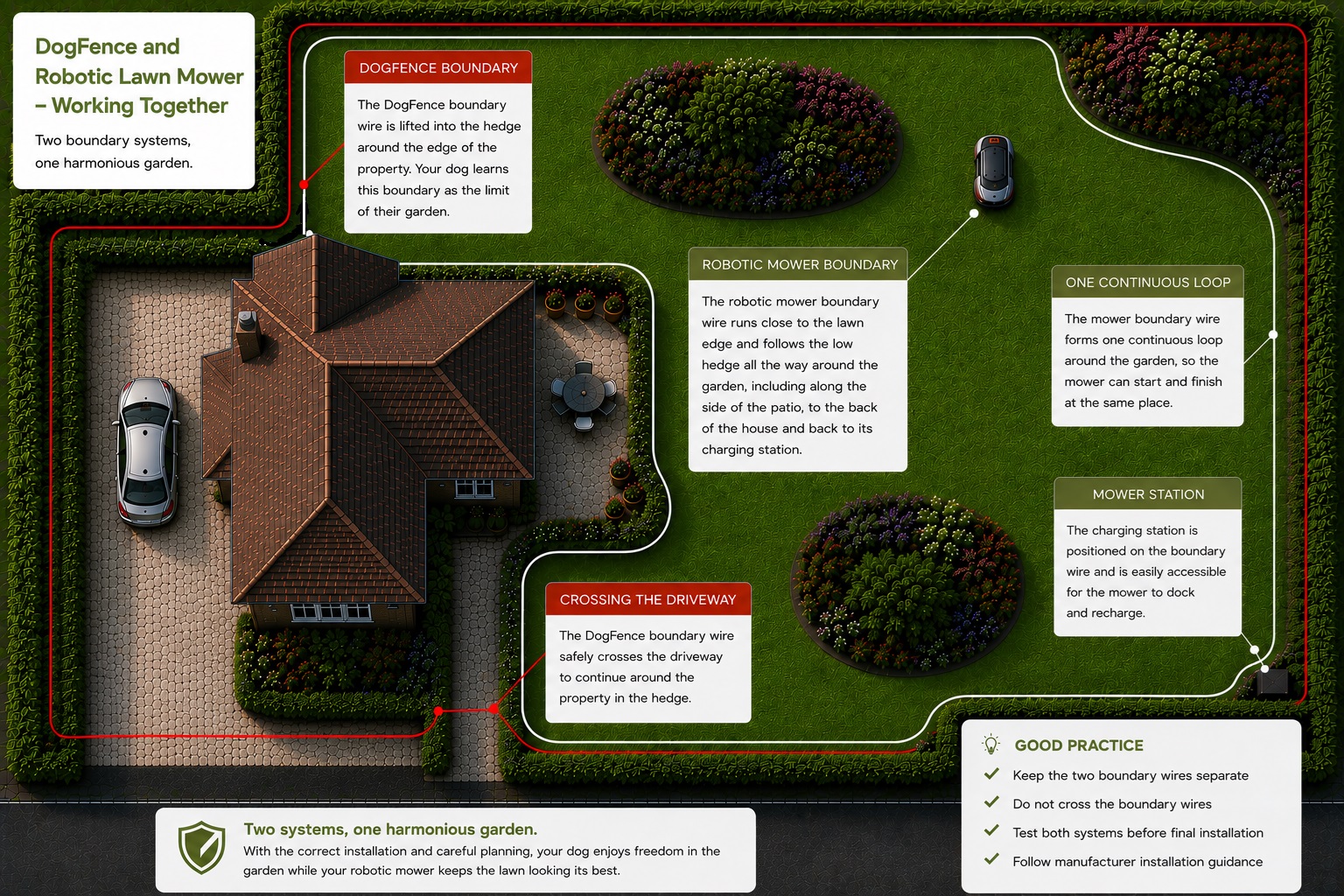
A hidden dog fence can create both an external garden boundary and an internal no-go zone around your swimming pool. The twisted wire safely connects the two boundaries, allowing your dog to cross it without receiving a warning.

How Do I Choose the Best Fencing for My Dog?

Ask yourself five questions:

  1. How is my dog escaping? Jumping, digging, climbing, squeezing or bolting?
  2. Where are they escaping? Fence, hedge, gate or driveway?
  3. How large is the area? A small enclosed garden and a rural property require very different solutions.
  4. Do I want a visible physical fence? Appearance and planning considerations may influence your choice.
  5. Has my dog already defeated conventional fencing? If so, simply replacing it with something similar may not address the underlying problem.

The best fencing solution should suit your dog, your garden and the way you use your property.

Frequently Asked Questions About Fencing for Dogs That Escape

What is the best fence for dogs that escape?

The best fence depends on how the dog escapes. Solid fencing can suit many gardens, while diggers may need ground-level reinforcement and jumpers may need greater height. Dogs that repeatedly defeat physical fencing or escape through gates and driveways may benefit from a hidden dog fence combined with appropriate training.

What is the best escape proof fence for dogs?

No physical fence can be guaranteed escape proof for every dog. Determined dogs may jump, climb, dig or find gaps. The most appropriate solution is one designed around the dog’s particular escape behaviour and the property’s layout.

What fencing is best for a dog that digs?

A physical fence needs to be secure at ground level and regularly checked for new digging points. A hidden boundary can also be considered for persistent diggers that continually find new places to tunnel underneath conventional fencing.

What fencing is best for dogs that jump?

Increasing physical fence height can help, but the required height depends on the dog’s size and athletic ability. Remove objects that can act as launch points and consider whether the dog is likely to find another escape method if jumping is prevented.

Can a hidden dog fence cross a driveway?

Yes. A professionally designed wired boundary can cross driveways and entrances, allowing vehicles and people to continue using them while the dog is trained to recognise the boundary.

Can I use a DogFence with an existing fence?

Yes. A DogFence can work alongside existing timber, mesh or other garden fencing. It can provide an additional consistent boundary where a dog has learned to jump, dig underneath or exploit gaps in the existing fence.

Can one DogFence be used for several dogs?

Yes. Multiple pets can use the same boundary with individual receiver collars appropriate to each animal.

Which Fence Should I Choose for My Escape Artist?

If your existing fence already keeps your dog safely in the garden, there may be no reason to replace it.

But if you are continually blocking holes, increasing fence height, repairing gaps or worrying every time somebody opens the gate, it may be worth considering a different approach.

DogFence has been helping UK owners keep their dogs safely at home since 2003. We design boundaries around the individual dog and the individual property, including difficult gardens, driveways and large rural areas.

Looking for the Best Fence for a Dog That Escapes?

If your dog jumps, digs, squeezes through gaps or bolts through gates, talk to our experienced team. We’ll help you find the best way to secure your garden — tailored to your dog and your property.

Give your dog freedom in the garden — without constantly worrying about them escaping.

Call us on
01628 476475

|
Message us on WhatsApp

|
Request a Free Quote Online

Related posts

dog fence ideas - dog with question mark

Dog Fence Options Compared: Wooden, Mesh & Invisible Systems

Dog Fence Options Compared: Wooden, Mesh, and Invisible Systems

When you’re researching dog fence options, you’ll quickly see there are many different choices — from traditional wooden panels and wire mesh to modern invisible dog fences. But not all solutions are equal when it comes to keeping your dog safe and secure.

In this guide, we’ll compare the most common types of dog fence options, their pros and cons, and explain why an invisible FM frequency fence is often the safest and most cost-effective choice.

Why Do You Need A Fence?

Most pet owners will experience a dog that loves to escape — whether it’s jumping a 6ft fence, digging under the hedge, or simply heading off on an unplanned walk. While this may seem harmless, an escaping dog can:

  • Put themselves in danger from cars, livestock, or poisoning.

  • Cause accidents on the road.

  • Knock over or frighten strangers.

  • Risk unexpected vet bills or even fines from the dog warden.

A secure fence isn’t just about protecting your dog — it protects others too and gives you peace of mind.

Dog escaping over wooden fence showing need for secure dog fence options

Some dogs see traditional fences as just another challenge.


Wooden Panel Fencing

Wooden fencing may look sturdy, but it isn’t fool-proof.

  • Panels often sit slightly above the ground, making it easy for dogs to dig underneath.

  • Athletic dogs may simply jump over, even if the fence is 6ft tall.

  • Regular maintenance is required to stop rotting or repair storm damage.

  • Costs can quickly mount if you need to replace panels or add extra barriers.

For determined dogs, wooden fencing can be little more than a temporary fix.


Wire Mesh Fencing

Wire mesh is another common option, but it often causes more problems than it solves:

  • Dogs can see through the mesh, leading to barking, fence-running, and frustration.

  • Neighbours or passers-by can tease or even harm your dog.

  • Digging under is still possible.

While affordable, wire mesh is rarely a long-term solution for escape-prone dogs.


Why Chaining Is Never the Answer

Some owners resort to chaining a dog when fences fail. But chaining:

  • Severely restricts exercise.

  • Causes stress, boredom, and frustration.

  • Increases aggression and behavioural problems.

It’s unsafe and unfair for the dog — and definitely not a recommended containment method.


Wireless & Invisible Dog Fences

This is where technology offers a smarter solution. Invisible fences use a boundary wire, transmitter, and a computer collar to create a safe containment zone. But not all systems are equal.

AM Frequency Fences (Old Technology)

  • Can be disrupted by Wi-Fi, TVs, or even light dimmers.

  • Slow response times mean pets can “outrun” the signal.

  • Risk of false activations, shocking your dog unnecessarily.

FM Frequency Fences (Modern Technology)

  • Use secure, fast, digital signals that ignore interference.

  • Quick reaction time keeps pets safely contained.

  • Safety cut-off prevents over-correction.

  • Can be installed around any property size — from small gardens to estates of 350+ acres.

  • Invisible and planning-friendly.

Learn more about how an invisible dog fence system works.


Why FM Invisible Fences Are the Best Option

Compared to traditional fencing, an FM invisible fence:

  • Costs a fraction of installing tall panels or mesh.

  • Works on all terrains, including driveways, hedges, and wooded areas.

  • Is safe, proven, and recommended by vets.

  • Gives your dog freedom within safe boundaries.

Learn more about how an invisible dog fence system works.

Dog safely contained with an invisible dog fence system

Invisible dog fences keep pets safe without changing your view.


The Benefits of Secure Fencing

Choosing the right dog fence isn’t just about stopping escapes — it brings peace of mind and real protection for both your pet and the wider community:

  • Your dog stays safe from roads, poisons, livestock, and other dangers.

  • Others are protected — no risk of your dog knocking someone over or frightening passers-by.

  • Lower costs — avoid dog warden fees (often £50+ per incident) and unexpected vet bills.

  • Prevent accidents — escaped dogs can cause road traffic collisions, which are sadly on the rise.

  • No unwanted litters if your dog hasn’t been neutered.

  • Protect other animals — you won’t be liable for injuries to neighbouring pets or livestock.

  • Peace of mind knowing your dog can enjoy freedom without escaping.

If you also own cats, our cat fence system is designed to keep them safely contained too.

Cat sitting on a garden statue – safe alternatives to roaming with a cat fence system

Even adventurous cats need safe boundaries — our cat fence system keeps them secure without restricting freedom.

Final Thoughts

If you want complete peace of mind, an FM invisible fence is the safest and most reliable option to stop escapes and keep your dog secure.

Call us today on 01628 476475

Request a Free Quote

  Message us on WhatsApp

Dog wearing DogFence electronic dog fence collar in garden

Containment Fences Explained

What are electronic Containment Fences and how do they work?

Containment fences hit the news earlier this year when the Government declared that they intended to ban e-collars for training dogs.

Sadly, the media jumped in with both feet first and declared that containment fences were also to be banned. At DogFence we were horrified having Professionally installed containment fences for over 17 years we had no idea why! For our customers that already used a containment fence there was outrage. How could the Government even consider banning a fence that had saved their pets life and given them back their freedom?  For those that had not heard about containment fences there was intrigue. What is a containment fence and why do they want to ban them?basset hound enjoying freedom with containment fences

Even the MP that called for the ban didn’t know if the containment fence was to be included within any ban and the officials at DEFRA did not know how containment fences worked! As experts in the field for containment fencing DogFence were invited to meet with officials from DEFRA and demonstrate the fence.

The comments from the DEFRA team were as we suspected “it’s not that bad” and “it’s not what I imagined”.

So what is a containment fence?

It’s actually an invisible fence or virtual fence which is created by a radio signal. Originally invented to keep dogs safe at home in the USA where gardens are traditionally unfenced their popularity has grown in recent years.

A containment fence is actually a very simple and unobtrusive system which can be installed on virtually any property at a fraction of the cost of traditional fencing. It also offers for safety than conventional fencing as the pet can’t dig under or jump over the fence and it protects open areas such as driveways.

A boundary wire is placed around the property boundary which transmits a coded radio signal to a collar worn by the pet. When the pet approaches the boundary wire a high pitched warning beep alerts the pet to go back. If the pet continues forward, an electrical impulse is given through the collar (this is often referred to as a correction or static shock) and the pet retreats back into the safe area.

How does the pet know where to go?

Every pet undergoes a training programme which usually takes 2 – 5 days. When training to a containment fence it is important that the boundary is flagged to give a good visual of where the virtual fence starts. The flags stay in the ground as a visual marker for approx. 2 – 3 weeks. Containment fences can be used for dogs over the age of 12 weeks and cats 16 weeks or over.

The trainer will take the dog outside and set the collar to “beep only” mode. Using some voice commands, he will introduce the dog to the containment fence training flags and later he will allow the dog to enter the “no go area” of his own accord. By re-focusing the dog back into the safe area with the assistance of the warning beep and vocal commands the pet will quickly learn where he can or can’t go. Following the beep only session the training moves onto to assess the correct level of impulse (correction) required for the pet.  If the owner has more than one pet the likelihood is that they will each have a different training level.

containment fences are marked with training flags

Visible boundary for the pet with flags.


With cats the training is carried out internally following the Dog Fence Cat protocol. This training protocol was used as part of the Lincoln Cat Containment Fence study.


Will the containment fence hurt my pet?

Of course the thought of giving any impulse or shock to your pet can be abhorrent. It is important to note though that the impulse is very low and is usually only felt during the training phase. The sad scenario is that the pain felt from a car is almost unimaginable and the discomfort of containment fence is no worse than an annual vaccination. Also for dog owners there is always the threat of a shot gun as dog attacks on sheep are rising annually.

What areas of the garden will the containment fence cover?

Interestingly, containment fences can cover the entire garden including the driveway. The largest installation that we have installed at Dog Fence is 450 acres. Usually the fence wire is dug directly into the ground (approx. 3 – 5” below the surface) but it can be attached to existing physical boundaries. It is not uncommon for the fence wire to be attached to post and rail fences, stone walls, run through hedges, ditches or streams and even the odd moat! When it comes to the driveway any surface can be crossed except Resin bonded drives which require special attention.

Containment Fence Collars

The original containment fences from the early 80’s used heavy bulky collars but as with the mobile phone technology everything has been scaled down in recent years. Not only have the collars become smaller and lighter but the battery life has also increased.

At Dog Fence we can boast the smallest and lightest collars worldwide. Our mini containment fence collar only weighs 30g but still features an incredible 6-month battery life. Incredibly our standard collar has a 2-year battery life and weighs in at only 48g which is still the 3rd lightest collar available worldwide!

How much do containment fences cost?

A containment fence costs a fraction of the cost of installing a traditional fence or driveway gates. Unlike a wooden or stock fence a containment fence becomes more cost effective the larger the area. Naturally the price is dependent on the owner’s location and the number of dog or cats that they have. There is no need to visit a property to give an estimate for the containment fence; this can all be carried out via our online survey tool.

Summary

Thankfully, the Government looked at the evidence, research and responses from containment fence owners and deemed these lifesaving systems safe to use. Indeed, Michael Gove stood up and supported the life-saving fences in Parliament.

If you are interested in receiving a quick free quote contact us today on 01628 476475 or fill in our quote form https://dogfence.co.uk/quote/

our mini receiver R7m is suitable for Pomeranian dogs

Electronic dog fences – are they safe for small dogs?

Are electronic dog fences safe to use for small dogs?

Electronic dog fences have been around for over 40 years. Unsurprisingly in the early years this type of electronic dog fencing was most certainly not suitable for small dogs. Why were they not suitable? Size and weight of the computer collars!  Many of the early collars used a 9 volt battery to power the collar which was both bulky and heavy. As with mobile phones recent advances in technology have enabled the size and weight of the computer collars to be dramatically decreased.

At DogFence we are proud to be able to offer the smallest and lightest electronic dog fence collars on the market today. Our mini computer collars weigh only 30g including the small 3.0 volt battery. Our electronic dog fence collars are suitable for all breeds of dogs and cats and with the increasing popularity of toy breeds our sales of mini collars has risen significantly in the last 5 years.

Bengal cat wearing R7m mini electronic dog fence collar

Small enough for cats too!

Will the electronic dog fence hurt my dog?

Naturally a common concern is that the “correction” or impulse will hurt the dog. Naturally, at DogFence we are all dog lovers and the last thing we would want to do is inflict pain or suffering onto any dog or cat. The impulse level is set to each dog or cats personality. People often asks does it hurt? can I feel it?  In reality, once they feel the impulse the next reaction is usually “how will that keep my dog in?” or “oh it’s not that bad!”.

Electronic dog fences have been tested by leading Universities and pet professionals across the world. The results have proved that these fences are safe to use with both dogs and cats. The amount of impulse delivered is not determined by the size of the pet but their personality. The average setting for most dogs is level 2 this would equate to some 250 times lower that a cattle of electric stock fence.

Interesting, the impulse is generally only received during the training phase. All our electronic dog fence collars give out a warning beep prior to giving out the impulse. During the training phase the pet also has a visual marker with training flags. If the training is carried out correctly the pet will rarely receive any activation after the initial period. All our DogFence installers are qualified to train your dog or cat to the containment system. DogFence is a member of the IACP an international organisation set up for training dogs using electronic stimulation alongside conventional training protocols.

Will I have to use the electronic dog fence forever?

This is always a difficult question to answer. It really depends on your dog’s personality and hunting drive. As a rule we find that dogs and cats that are trained before the escaping behavior begins will train quickly and easily and never challenge the fence. However, if you have livestock or game birds nearby and a dog with a high drive then it is advisable to use the system everyday. With electronic dog fencing consistency is king. If every time the dog enters the zone they hear the warning beep they will not “challenge” the fence. Issues can arise  if they can go through the zone one day because they are not wearing the electronic dog fence collar and not on another day it becomes confusing to the pet.

What do the Experts Say?

Professor Daniel Mills headed the study into the use of electronic dog fences

Prof. Daniel Mills
RCVS

Recent studies through Lincoln University, headed by the well revered Prof. Daniel Mills, and the Governments research have proved that electronic dog fences are  only safe and also save the lives of dogs and cats. With modern technology size is no longer a barrier to pet containment with an electronic dog fence. Read more about what the experts say on our web site.

If you would like to learn more about how an electronic dog fence can keep your pet safe contact us on 01628 476475 or email us @ info@dogfence.co.uk.


three poodle cross breeds wearing electric dog fences collars

Electric dog fences – Weighing up the pros and cons

Electric Dog Fences: Pros and Cons

Electric dog fences are both a safe and affordable solution to keep your dog safe at home whilst allowing them the freedom to roam and play within your properties boundary. In recent years due to their flexibility and effectiveness electric dog fencing has become increasingly popular for cats as well.

It goes without saying that electric dog fencing is not for everyone. It’s important to fully understand how the fences work and weigh up the pros and cons between electric dog fencing and traditional fencing.

How do electric dog fences work?

There are two types of electric dog fences, wired and wireless. The most popular and effective are wired systems.

Wired Fences

The fence consists of a transmitter box, a boundary wire and a small computer collar which is worn by the dog or cat.

The transmitter box is installed on-site and the boundary wire is connected to the transmitter box. The is buried around the perimeter of the property and wire carries the harmless low-level radio signal around the boundary.  The pet wears a computer collar that emits a warning beep followed by a mild stimulation (similar to a carpet shock) when he gets too close to the designated area. The no go area for the electric dog fence is marked with some temporary training flags to assist the pet with a visual. The dog fence Installer trains the pet to understand the avoidance area.

Wireless Fences

With the wireless dog fence, there is no boundary wire. The transmitter is located centrally around the area to be fenced. The transmitter sends out a circle of signal from the base station. Unfortunately, wireless dog fences are prone to false activation and are only effective for flat properties with no obstructions for the signal.

When it comes to the electric dog fence there are two types — wireless and in-ground. Even though they work in different ways, both systems consist of some sort of base unit that creates a hidden boundary around whatever area you want to contain your dog in. Read more about wireless dog fences here.

PROS OF ELECTRIC DOG FENCES

  • Price – an electric dog fence is far cheaper than a traditional fence and gate.
  • Dogs and cats can be allowed to roam freely – not kenneled or caged and exhibit natural behaviour.
  • Dog or cat cannot jump over or under and the signal is 360 degrees.
  • The driveway is protected so no worries about an open gate or slow electric gates.
  • Can be installed on terrains that are not suitable for traditional fencing. Can be used through streams, along towpaths, woodland, steep slopes and areas with planning restrictions.
  • Quicker to install than a traditional fence. Up to 10 acres installed in 1 day.
  • Electric dog fencing does not restrict views.
  • Can be used to keep pets out of areas – pools, play areas, flower beds.
  • Easier to maintain than a traditional fence.
  • Can be moved from house to house.
  • Electric dog Fence collar also works indoors to keep pets out of rooms or off furniture.

CONS:

  • Does not keep other dogs, cats or wildlife out of your garden.
  • Not recommended for aggressive dogs as with wireless or electric dog fencing there is no physical barrier.
  • Batteries in the dog’s collar must be changed every 3, 6 or 24 months (reputable Companies should offer an automatic renewal program).
  • If the power goes down the electric dog fence can go down – look for a system with a battery backup.
  • Not suitable for dogs in whelp or very old dogs.
  • Customer must assist with training so can take dogs up to 10 days to fully learn the fence.
  • Must make contractors aware of buried boundary wire if digging or landscaping to avoid damage.

Electric dog fences have been available in one form or another for over 40 years. Recent advances in technology have now brought these fences to another level and items listed in the “cons” list are now easily avoided with the higher specification systems.

The latest electric dog fences

In 2018 DogFence launched their new enabled fence. This new generation of electrical dog fencing gives the owner real-time information and notifications regarding the status of their system. The fence offers a new 2-way communication between the electric dog fence collar and the base station through an app.

Take a peek at our video which explains all the amazing features in the Smart Fence here.

  • Sends out an email alert for a wire break

    a new generation of electric dog fencing - smart fence uses 2 communication via wifi. Consists of a collar, portable and transmitter.

    The new Smart Fence

  • Sends out an email alert of a challenge to the fence by the pet
  • Send out an email alert regarding the battery level.
  • Activity tracker for each pet through the app.

These email alerts are also sent out to the DogFence office so we can contact the customer to book a service visit or arrange a replacement battery.

If you would like to know more about our Smart Fence or our other fences please contact us on 01628 476475 or email info@dogfence.co.uk.