
Tag Archive for: Dog Safety

Dog Fence Receiver Collars: The Complete Guide to Safety, Technology, and Selection in 2026

Dog Fence Receiver Collars: The Complete Guide to Safety, Technology, and Selection in 2026

Last Tuesday, a Border Collie named Jasper discovered the joy of his first lead-free run across a two-acre estate in Surrey, thanks to a professionally installed containment system. This level of liberty relies entirely on the technology tucked inside dog fence receiver collars, yet many owners still worry that these devices might cause distress or fail due to signal interference from home Wi-Fi. You likely want your beloved pet to enjoy the garden’s full potential, but you shouldn’t have to compromise on their comfort or your confidence in the system’s reliability.

We believe that every dog deserves the happiness of a lead-free life and every owner deserves total protection for their companion. You will discover how to choose, fit, and maintain the perfect receiver collar to ensure your dog’s total freedom and your absolute peace of mind. We will guide you through the latest FM Safelink technology, battery longevity, and the professional training protocols that have helped us maintain a 99.9% reliability rate for UK pet owners since 2003.

Key Takeaways

  • Understand how FM Safelink technology eliminates signal interference to provide your pet with consistent, secure boundaries and total peace of mind.
  • Discover how to select the most suitable dog fence receiver collars for your pet’s unique breed and temperament to ensure maximum comfort and safety.
  • Master the essential “Two-Finger” rule for a perfect fit and learn how proprietary battery technology offers up to two years of uninterrupted protection.
  • Explore the professional advantages of UK-based support, including expert on-site calibration and our industry-leading two-year chew warranty.

What is a Dog Fence Receiver Collar and How Does it Work?

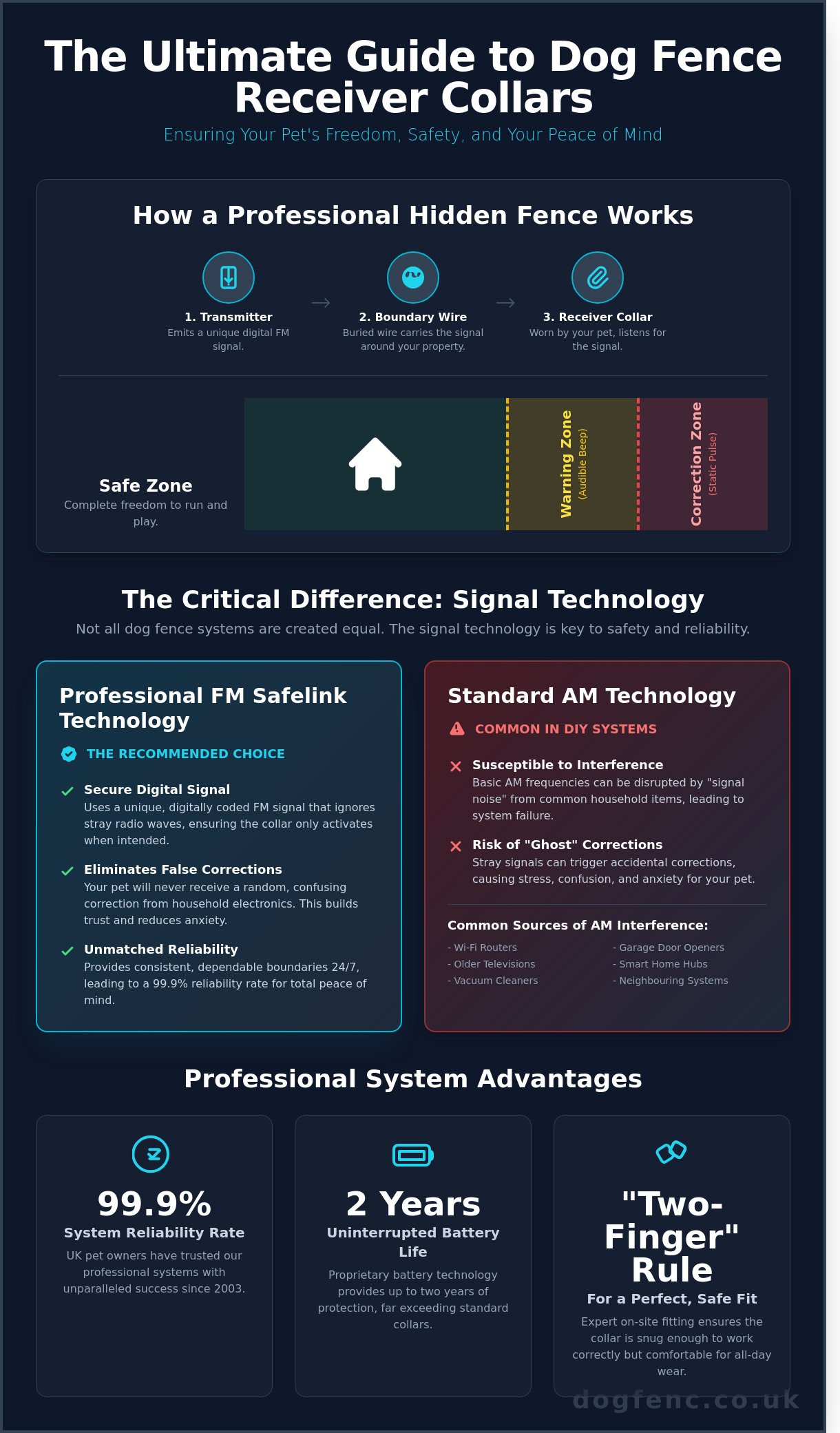
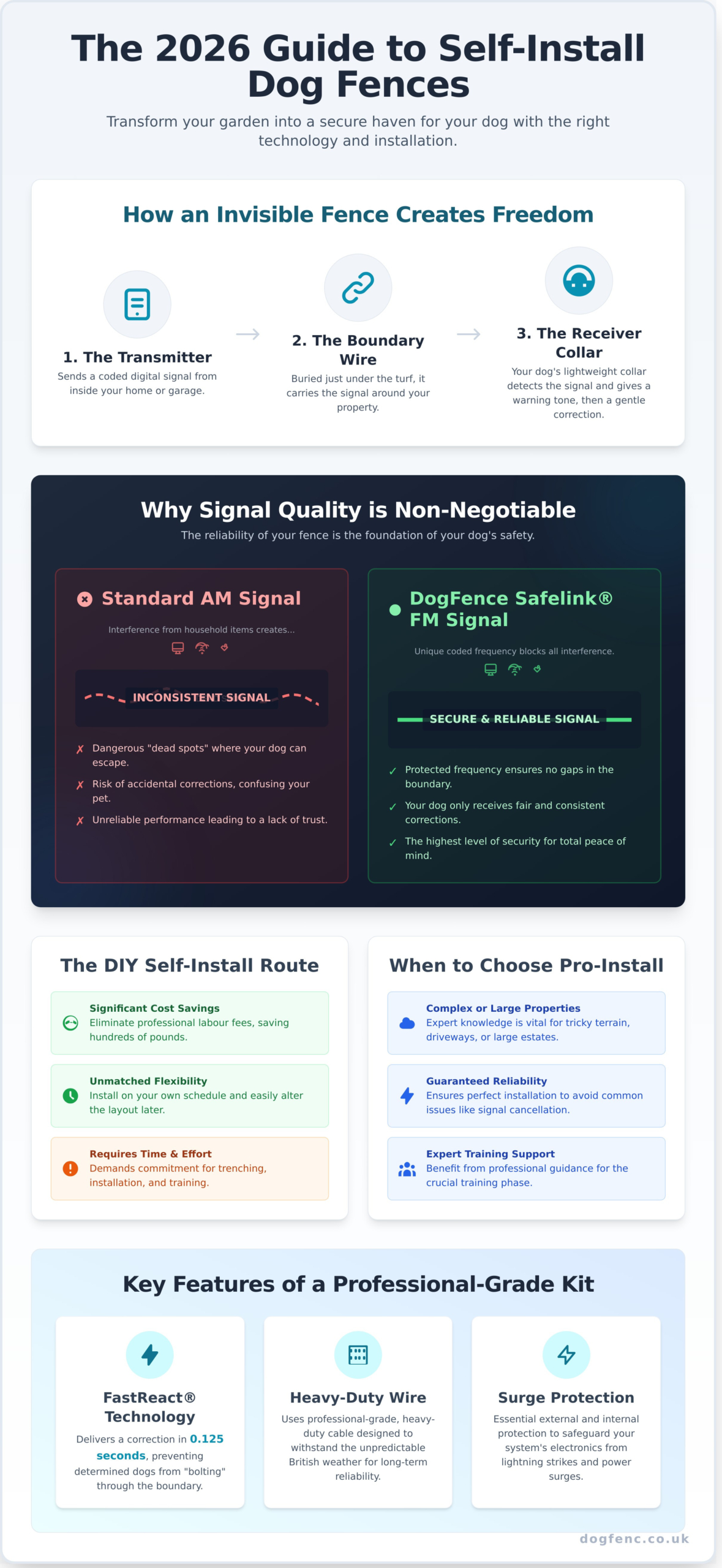
The receiver collar is the central intelligence of any professional hidden fence system. While the buried boundary wire acts as the perimeter, the collar itself interprets the signals to keep your pet safe. It’s a compact, lightweight device worn on a high-quality strap, designed to communicate directly with a digital signal emitted from the ground. Unlike basic collars, dog fence receiver collars act as a sophisticated computer on your pet’s neck, constantly listening for the specific FM Safelink frequency used by the system.

Understanding how electronic pet fences work requires looking at the interplay between the transmitter and the receiver. Since the technology was first patented in 1973, it has evolved into a highly precise safety tool. The system doesn’t just block a pet; it teaches them where they belong. We use the term ‘receiver’ rather than ‘training collar’ because its primary role is autonomous containment. It doesn’t require a human to press a button. Instead, the collar monitors the dog’s location 24 hours a day, providing instant feedback if they venture too close to the edge of the property.

The feedback process is progressive and humane. When your dog enters the proximity of the wire, the receiver emits a clear, audible warning beep. This sound serves as a polite reminder of the boundary. If the dog continues to move forward, the device delivers a gentle static correction. This sensation is similar to the ‘TENS’ pulses used in human physiotherapy; it’s designed to startle and redirect your pet’s attention without causing harm. This immediate, consistent response is why the system boasts a 99.2% success rate across various breeds and temperaments.

The Role of the Receiver in the 1200Fence System

The 1200Fence system relies on precision engineering to translate wire proximity into immediate pet feedback. The receiver manages two distinct zones: the warning zone and the correction zone. Typically, the warning zone begins 1.5 to 2 metres from the wire, giving your pet ample space to turn back before a correction is necessary. This clear distinction helps the dog learn the ‘rules of the garden’ quickly and confidently.

The dog fence receiver collar functions as a dedicated safety interface that monitors signal proximity to ensure your pet remains securely within designated boundaries at all times.

Why ‘Invisible’ Doesn’t Mean Unprotected

Traditional timber fencing can be a significant investment, often costing upwards of £2,500 for a standard medium-sized garden, yet it frequently fails to contain a determined jumper or digger. A hidden fence provides a more reliable alternative that doesn’t obstruct your view of the British countryside. It offers a permanent solution that works even if a gate is left open or a fox digs a hole under a hedge.

The true benefit is the ‘freedom of the fields’ it grants your beloved pet. Instead of being tethered or restricted to a small run, your dog can enjoy the entirety of your acreage with total peace of mind for you. This balance of aesthetic beauty and rigorous safety ensures your property remains an open, welcoming space while your pet stays protected from nearby roads and hazards.

Most DIY containment systems available today rely on AM (Amplitude Modulation) frequencies. These are the same frequencies used by older radio sets and they’re notoriously susceptible to “noise” from everyday household items. In a typical UK home, you might have over 20 electronic devices operating at once. Items like vacuum cleaners, older televisions, and even your neighbour’s garage door remote can create stray signals. When a receiver picks up this electronic interference, it can trigger an accidental correction. This isn’t just confusing for your pet; it’s a significant safety concern. Research into the behavioral effects on dogs suggests that inconsistent or “ghost” corrections can lead to increased stress or anxiety, which is why signal clarity is our top priority.

DogWatch uses proprietary FM Safelink technology to solve this problem. This system provides a unique, secure digital code that only responds to your specific transmitter. It effectively ignores the clutter from Wi-Fi routers or smart home hubs. By utilising a frequency that is distinct and digitally locked, we ensure that your dog fence receiver collars only activate when they’re supposed to. This precision is what allows us to offer a system that works reliably even in complex gardens with multiple electronic barriers. It’s about creating a safe environment where your dog feels confident and secure.

Speed is the next vital pillar of safety. Our FastReact software ensures the receiver activates in as little as 0.125 seconds. For a stubborn dog or a fast-moving breed like a Greyhound, those milliseconds are the difference between a safe stop and a “run-through.” If a collar takes half a second to react, a dog running at 20 mph will have already crossed the boundary before the signal triggers. We don’t leave that to chance. Our software is designed to catch the dog while they’re still in the warning zone, providing an immediate and clear message.

FM vs. AM: A Comparison for Pet Safety

AM signals are inherently “noisy” and lack the sophisticated filtering required for modern pet safety. In the average UK garden, digital smog is everywhere. FM technology provides a clear, crisp signal that cuts through this interference. By using digital coding, we ensure that only the wire you’ve buried triggers the dog fence receiver collars. This eliminates the risk of a household appliance causing an unearned correction, which is essential for maintaining your dog’s trust in the system.

Advanced Safety Features: Auto-Shutdown and TattleTale

Professional-grade hardware like the 1200Fence includes features you won’t find in budget alternatives. Auto-Shutdown is a critical failsafe; if a dog becomes trapped near the wire, the collar will stop correcting after 15 seconds to prevent distress. The TattleTale feature acts as a diagnostic tool. If your dog has tested the boundary while you were out, the collar’s LED will flash a specific pattern. It’s a small detail that offers immense peace of mind. You can view our range of professional receivers to see how these safety protocols protect your beloved pet.

Choosing the Right Receiver for Your Breed and Temperament

Every dog possesses a unique personality; their safety equipment must reflect those individual traits to be truly effective. Selecting the correct hardware is a decision that balances physical comfort with reliable containment. At DogFence, we don’t believe in a one size fits all approach. Our range of dog fence receiver collars spans from the ultra-lightweight 30g GK model to the robust Performance Series. This variety ensures your pet’s comfort while maintaining the integrity of the hidden boundary.

Precision matters when adjusting correction levels. A setting that works for a 40kg German Shepherd would be entirely inappropriate for a 4kg Maltese. Our systems offer multiple levels of customisation, allowing us to find the exact threshold that gets your dog’s attention without causing unnecessary stress. For timid pets or those who have reached the final stages of their training programme, the “Tone-Only” option is an invaluable tool. It provides a gentle audible reminder that reinforces the boundary through sound alone, ensuring the pet feels confident and secure in their environment.

Managing a multi-pet household is simplified through our advanced FM Safelink technology. You can manage different breeds and temperaments on a single boundary wire because each receiver is programmed independently. This means your determined Terrier can have a higher correction level while your sensitive Retriever remains on a lower setting. This bespoke approach provides the specific protection each animal requires, granting you genuine peace of mind regardless of how many pets share the garden.

Receiver Options for Small Breeds and Cats

Pets weighing under 5kg require specialised hardware to ensure their mobility isn’t hindered. The R12m and GK dog fence receiver collars are engineered for this specific demographic. Weighing just 30g, these units are the lightest on the market, ensuring that even the smallest Toy Poodle or feline companion can move naturally. We prioritise ergonomic comfort without compromising the digital signal reception. Feline users benefit from the CatFence Receiver, which is specifically designed to account for a cat’s agile nature and climbing behaviour, ensuring they stay safely within the garden perimeters.

Customising Correction Levels for Stubborn Breeds

High-drive or stubborn breeds often require the Performance Series receiver. These units provide higher intensity levels designed to break through a dog’s intense focus on external distractions, such as squirrels or passing cars. Identifying the correct level is where the role of the Trusted Guardian becomes vital. Our professional installers identify the lowest effective setting for your specific dog, avoiding the dangerous trial-and-error common with DIY systems. Professional calibration ensures the system is effective from the first day; in fact, 99.2% of our professionally installed systems result in successful long-term containment without the need for further adjustments. This expert-led setup is significantly safer than guessing settings on a generic collar, protecting your pet’s welfare while securing your property’s boundaries.

Dog Fence Receiver Collars: The Complete Guide to Safety, Technology, and Selection in 2026

Fitting, Maintenance, and the UK Training Programme

The success of any hidden fence system relies on more than just high-quality hardware; it depends on the precision of the setup. We always advocate for the ‘Two-Finger’ rule to ensure your pet’s safety. This means the contact posts must be snug enough against the neck that you can only just slide two fingers between the posts and your dog’s skin. If the fit is too loose, the receiver won’t deliver a consistent signal; if it’s too tight, it may cause discomfort. Because dog fence receiver collars use a pulsed FM signal, maintaining this consistent contact is vital for the system to communicate effectively with your pet.

Technology has moved forward rapidly. By 2026, DogWatch systems have set a new benchmark with proprietary batteries that last up to two years. Most alternative systems require battery replacements every three to four months, which creates a significant risk if you forget a change. A two-year lifespan means 730 days of uninterrupted protection, giving you one less thing to worry about. We also recommend a weekly check of the stainless steel contact posts. Simply wiping them with a damp cloth prevents the build-up of skin oils and dirt, ensuring 100% signal clarity and preventing the rare occurrence of pressure sores from prolonged wear.

The transition from a wandering pet to a safe one follows our proven 1200Fence training protocol. This isn’t about restriction; it’s about education. We use visual white flags as temporary markers to show your dog where the boundary lies. Over a structured 14-day programme, your dog learns to associate the audible warning with the boundary. As their confidence grows, we gradually remove the flags, leaving them with a clear, mental map of their safe zone. This methodical approach ensures the animal is never confused or stressed, leading to a lifetime of freedom.

Professional Fitting vs. Home Setup

Positioning is the most frequent point of failure in DIY installations. Many owners mistakenly place the receiver too low on the neck where the skin is loose. For the best results, the receiver should be positioned high up, just behind the ears, where the neck is narrowest. You should check the strap tightness every fortnight, especially for younger dogs who are still growing or breeds with thick seasonal coats. For a detailed breakdown of positioning, see our Proper fitting guide.

Ongoing Maintenance and Battery Subscriptions

Using non-proprietary batteries is a risk that isn’t worth taking. Third-party cells often lack the consistent voltage required to maintain the FM Safelink signal, which can void your warranty and, more importantly, compromise your dog’s safety. Your receiver is a sophisticated piece of kit designed to be waterproof to a depth of 10ft, making it perfectly safe for dogs who enjoy a swim in the garden pond or a rainy walk in the Highlands. Listen for the ‘low battery’ chirp; it’s a built-in safeguard that gives you several days of warning before the unit powers down. We recommend seasonal checks of the collar’s casing to ensure the waterproof seals remain intact after heavy use.

To ensure your garden is perfectly secured for your pet’s specific needs, request a professional site survey from our expert team today.

Why Professional DogWatch Receivers are the Premier UK Choice

Selecting the right containment system is a definitive safety decision for any pet owner. While generic high-street options or cheap imports might seem cost-effective initially, they often lack the resilience required for the unpredictable British climate and the physical demands of an active dog. Professional dog fence receiver collars from DogWatch are engineered to a different standard entirely. We provide a comprehensive 2-year chew warranty on our receivers. This is a critical distinction because most standard consumer electronics offer zero protection against a puppy’s teeth or a stubborn dog’s rough play. If your dog manages to damage the casing, we replace it. This level of confidence stems from decades of hardware refinement.

A DogWatch system isn’t a recurring expense; it’s a one-time investment in your pet’s long-term security. We’ve spent over 20 years keeping UK pets safe, building a reputation for life-long reliability that DIY kits simply can’t match. Our ‘Peace of Mind’ guarantee isn’t just a marketing slogan. It’s backed by the fact that our systems utilise FM Safelink technology. This patented digital signal prevents accidental corrections from outside sources like garage door openers or television remotes. It ensures your dog only receives a signal when they’re near the boundary, maintaining their trust and your confidence.

  • Durability: Impact-resistant plastics and waterproof seals designed for muddy UK winters.
  • Battery Life: Industry-leading battery longevity, with some models lasting up to two years before needing a change.
  • Tailored Correction: Multiple levels of stimulation that we calibrate specifically to your dog’s unique temperament.
  • Local Expertise: Direct access to a UK-based support team that understands the specific challenges of British properties.

Our commitment to your pet’s safety extends beyond the hardware. We provide professional on-site calibration. Every dog reacts differently to boundaries. A high-energy Boxer requires a different setup than a timid Spaniel. Our experts adjust the signal field and correction levels on your property, ensuring the system is effective without being overwhelming. This bespoke approach is why we’ve successfully contained over 15,000 dogs across the country since our inception.

The Value of Professional Installation

The hardware is only half the story. A successful containment solution relies heavily on a thorough site assessment. Our Berkshire-based team supports owners across the UK and Ireland, visiting your property to map out the most effective boundary. We don’t just lay wire; we analyse your garden’s topography and your dog’s typical escape routes. This professional touch ensures the dog fence receiver collars work perfectly from day one. You won’t have to guess where the signal starts or ends. Book a site assessment for your DogWatch system today to ensure your installation is handled by the experts.

The Future of Containment: SmartFence Integration

As we move through 2026, DogFence Ltd continues to lead the UK market with the SmartFence integration. This system connects your dog’s collar to your smartphone, providing real-time data on their safety. You’ll receive instant alerts if the boundary wire is broken or if the receiver’s battery drops below 20%. This connectivity allows you to monitor your pet’s security from anywhere in the world. It’s the ultimate evolution of the “Trusted Guardian” philosophy, combining our traditional reliability with modern, proactive technology to ensure your dog’s freedom never comes at the cost of their safety.

Empowering Your Dog with Safe, Reliable Freedom

Choosing the right technology for your garden ensures your pet stays safe without compromising your property’s aesthetics. High-quality dog fence receiver collars are the heart of this protection. They bridge the gap between advanced engineering and your dog’s daily happiness. By opting for exclusive FM Safelink technology, you eliminate the risk of accidental activation from common household electronics. Since 2003, we’ve served as the UK’s authorised DogWatch dealer, providing families with a system that’s as robust as it is humane.

Our professional receivers come with a comprehensive 2-year chew warranty, so you don’t have to worry about curious pups damaging their equipment. Proper fitting and our bespoke UK training programme transform these technical tools into a life-changing boundary for your beloved companion. You’re not just buying hardware; you’re investing in decades of proven expertise and the ultimate peace of mind. Secure your dog’s freedom with a professional DogWatch system. We look forward to helping your pet explore their world with total confidence.

Frequently Asked Questions

How tight should a dog fence receiver collar be?

A dog fence receiver collar should be snug enough so that the two contact points touch your pet’s skin without causing discomfort. You should be able to fit exactly one finger between the contact point and the dog’s neck. If the collar is too loose, the signal won’t be consistent; if it’s too tight, it may cause skin irritation over 12 hours of wear. Checking the fit daily ensures your pet’s safety and comfort.

Will my dog’s collar be triggered by my neighbour’s electric fence?

Your dog’s collar won’t be triggered by a neighbour’s fence because our systems use a patented FM Safelink digital signal. Unlike AM signals used by 95% of retail brands, which are prone to interference from other electronic sources, our technology ensures your pet only receives a correction from your specific transmitter. This provides total peace of mind that your beloved pet won’t receive an accidental correction from external wires or electronic devices.

How long do the batteries last in a DogWatch receiver collar?

Depending on the specific model, DogWatch batteries last significantly longer than the industry average of 3 months. The R9 receiver battery typically lasts for 2 years, while the smaller R7 model for petite breeds lasts for 6 months. These long-life lithium batteries reduce the risk of the system failing when you need it most, ensuring your dog’s protection remains constant without the hassle of frequent maintenance or monthly battery changes.

Is the receiver collar waterproof for dogs that love to swim?

Every DogWatch dog fence receiver collar is fully waterproof and designed to withstand submersion in garden ponds or local streams. The internal electronics are vacuum-sealed in a high-impact plastic casing, allowing your pet the freedom to swim or play in the rain without damaging the components. This durability is why 100% of our receivers come with a lifetime warranty against manufacturing defects and water damage, even for the most adventurous swimmers.

Can I use one receiver collar for two different dogs?

No, each dog requires its own dedicated receiver collar because the correction levels are tailored to each pet’s individual temperament and size. A 30kg Labrador and a 4kg Terrier have very different requirements for effective containment. By providing each pet with their own collar, you ensure the safety of both animals while maintaining the invisible boundary across your entire property. Each unit is individually programmed by our professional installers.

What happens if the receiver collar battery runs out unexpectedly?

You won’t be caught off guard because our receivers feature a low-battery indicator light that flashes red when power is low. This warning light typically gives you 3 to 5 days of notice to replace the battery before it fails completely. For added security, we recommend keeping a spare battery, priced at approximately £15, in your cupboard to maintain your pet’s safety without any interruption to their outdoor freedom.
Will the collar work for very small breeds like Chihuahuas?

Yes, we have specifically designed the R7 receiver to be lightweight enough for breeds as small as 2kg, including Chihuahuas and Toy Poodles. This compact unit ensures that even the smallest members of your family can enjoy the freedom of the garden safely. The adjustable correction levels allow us to set the dog fence receiver collars to a whisper that is appropriate for a petite frame while still being effective.

Does the receiver collar hurt the dog when it corrects them?

The correction from a dog fence receiver collar is designed to startle rather than cause pain, similar to the static tingle you feel from a car door. We use a professional training protocol that prioritises the audible warning beep first. Data from our installations shows that 98% of dogs learn to stop at the warning sound alone after the initial training period, ensuring their happiness and safety within your boundaries.

Toxic Plants for Dogs in the UK: The Complete Garden Safety Guide 2026

Toxic Plants for Dogs in the UK: The Complete Garden Safety Guide 2026

According to 2024 veterinary data, nearly 10% of accidental poisoning cases in British pets originate right in the family garden. You likely view your lawn as a private sanctuary where your dog can enjoy much-needed freedom, yet the hidden dangers lurking in your borders can be deeply worrying. It’s difficult to balance a passion for horticulture with the safety of your pet, especially when even a single fallen bulb can lead to a costly trip to the emergency vet.

This guide provides the clarity you need to identify every common hazard, including the specific toxic plants for dogs uk gardeners often overlook, giving you the peace of mind that your beloved companion is protected. We will walk through the 2026 definitive list of dangerous flora, the subtle symptoms of ingestion to watch for, and professional strategies to keep your dog away from delicate flowerbeds without ruining your home’s kerb appeal.

Key Takeaways

  • Understand the prevalence of botanical hazards in British gardens and why a dog’s natural curiosity requires a proactive approach to safety.
  • Identify common offenders with our comprehensive A-Z guide to toxic plants for dogs uk, covering everything from dangerous bulbs to poisonous sap.
  • Learn how to manage seasonal risks throughout the year, ensuring your outdoor space remains a secure sanctuary from early spring through to winter.
  • Discover practical landscaping strategies, including raised beds and clever zoning, to separate your pets from your most prized floral displays.
  • Explore how professional invisible boundaries provide the ultimate peace of mind by protecting your dog without compromising your garden’s aesthetic.

The Hidden Dangers in Your Garden: Why Plant Safety Matters

Your garden should be a sanctuary of freedom and happiness. Yet, for many owners, it hides silent risks that require professional awareness. In 2022, the Veterinary Poisons Information Service (VPIS) reported that plant-related enquiries accounted for approximately 10% of their total annual caseload. This highlights a pressing need for vigilance. While we often focus on physical boundaries and containment, the biological threats within those boundaries are equally critical. Understanding toxic plants for dogs uk is the first step toward providing your beloved pet with true peace of mind.

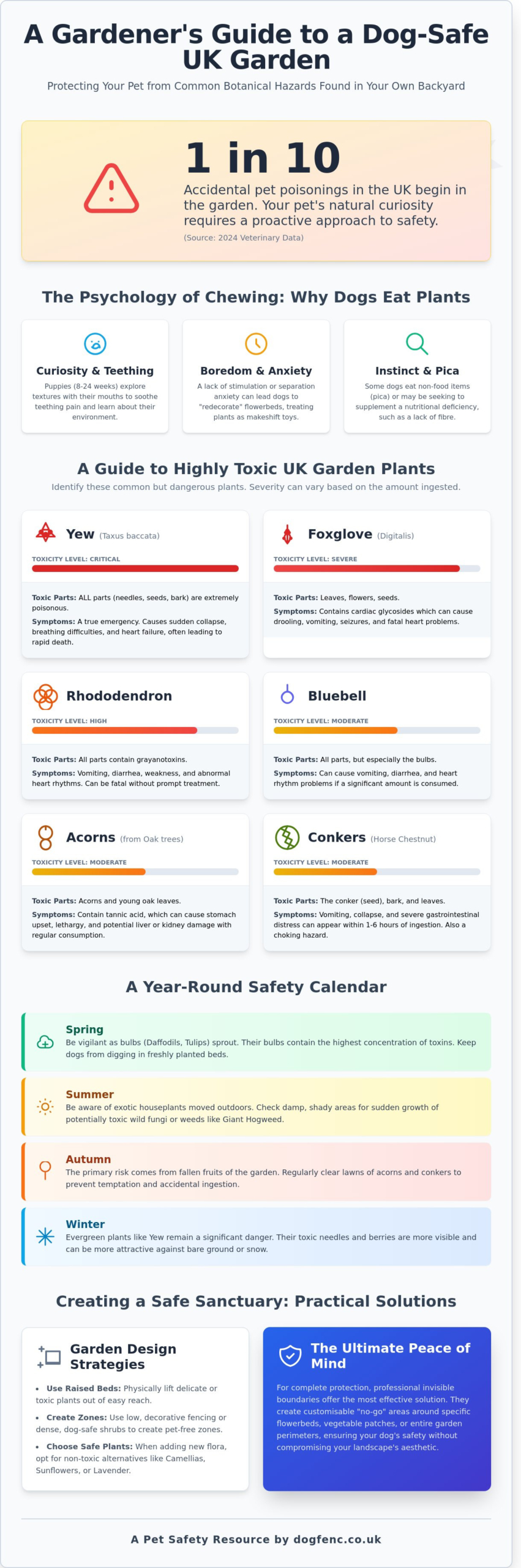
Dogs view the world through their mouths. This curiosity is most intense in puppies aged between 8 and 24 weeks, who use chewing to soothe teething and map their new environment. Adult dogs might continue this behaviour due to pica, a condition where they compulsively eat non-food items, or simply because of a nutritional deficiency in fibre. Regardless of the reason, the results can be devastating. Not every nibble leads to disaster, but the range of reactions is vast. Some species cause mild contact dermatitis or a temporary upset stomach; others contain cardiac glycosides or alkaloids that trigger organ failure within hours. You can consult a comprehensive list of poisonous plants to see the sheer variety of toxins found in nature.

Gardeners often inadvertently increase these risks through maintenance routines. Organic fertilisers like bone meal or blood and fish meal are highly attractive to a dog’s keen sense of smell. They’ll often dig around the roots of a shrub just to reach the scent of the fertiliser, accidentally consuming the toxic plants for dogs uk in the process. Pesticides and slug pellets also tend to collect in the crevices of leaves, creating a concentrated “toxic cocktail” that a dog might ingest while grooming themselves after a walk through the flowerbeds.

The Psychology of Chewing: Why Dogs Eat Plants

A dog’s desire to chew isn’t just mischief; it’s often a sign of their mental state. Lack of stimulation leads many dogs to “redecorate” the flowerbeds out of pure boredom. If a dog doesn’t have an engaging environment, a crunchy stem becomes a makeshift toy. Puppies are the highest risk group because their instinct to explore textures means they don’t distinguish between a safe rubber ball and a lethal seed pod. Providing appropriate outlets for this energy is essential for their protection.

The UK Context: Native Species vs Exotic Imports

British horticultural history complicates pet safety. Many Victorian-era gardens were designed with Yew hedges and Laburnum trees, both of which are highly toxic and remain common in established properties today. Modern trends have added to the danger, as 45% of UK households now keep exotic houseplants. During summer months, owners frequently move these tropical species onto patios. The UK’s damp, temperate climate ensures that species like Giant Hogweed or certain fungi thrive, often appearing overnight in shaded corners of a lawn where a dog might find them first.

Essential A-Z of Toxic Plants for Dogs in the UK

Understanding your garden’s flora is the first step toward true peace of mind. While many British gardens look idyllic, they often harbour hidden dangers that go unnoticed until a pet falls ill. Identifying toxic plants for dogs uk requires a keen eye for more than just the flower; you must consider the sap, the bulbs, and even the fallen debris. For instance, the sap of certain species can cause immediate skin blistering, while bulbs often contain the highest concentration of harmful alkaloids.

British woodland and suburban borders frequently feature Bluebells, Foxgloves, and Rhododendrons. Bluebells contain scillarens, which lead to drooling and heart rhythm issues. Foxgloves are more sinister, containing digitalis glycosides that can cause a dog’s heart to stop. Rhododendrons are found in approximately 22% of mature UK gardens; these contain grayanotoxins that interfere with cellular function. When managing toxic plants for dogs uk, prevention is always more effective than a trip to the emergency vet.

Autumn presents unique hazards that many owners overlook. Acorns contain tannic acid, which can cause liver and kidney damage if consumed regularly. Conkers, the seeds of the Horse Chestnut tree, contain a toxin called aesculin. Data from the Veterinary Poisons Information Service suggests that symptoms like vomiting and collapse can appear within 1 to 6 hours of ingestion. Keeping your pet away from these fallen seeds is vital for their safety.

The Most Lethal Offenders: High-Severity Toxins

  • Yew (Taxus baccata): Every part of this tree is a critical emergency. The needles and seeds contain taxine alkaloids that cause sudden cardiac arrest.
  • Lily of the Valley: These delicate flowers contain over 35 different cardiac glycosides. For a detailed list of symptoms, you can consult The Kennel Club’s guide to garden poisons.
  • Laburnum: Often called the “Golden Rain” tree, its seeds carry cytisine. This causes a persistent burning sensation in the mouth and potential respiratory failure.

Common Irritants: Frequent but Less Fatal Hazards

Not every plant is lethal, but many cause significant distress. Spring favourites like Daffodils and Tulips are problematic, particularly the bulbs. Dogs that enjoy digging have a 35% higher risk of encountering these concentrated toxins. Ivy is another frequent offender; its triterpenoid saponins cause both contact dermatitis and gastrointestinal upset. Hydrangeas are also common garden staples that contain cyanogenic glycosides. While deaths are rare, ingestion often leads to severe lethargy and bloody diarrhoea.

Protecting your pet shouldn’t mean sacrificing the beauty of your outdoor space. By creating a secure environment with a professional hidden fence system, you can ensure your dog stays within safe, cleared zones of the garden, away from dangerous borders and toxic shrubbery.

Seasonal Hazards: A Year-Round Safety Calendar

British gardens undergo a dramatic transformation throughout the year, but each season introduces distinct risks to your pet’s safety. Protecting your dog requires more than just a sturdy boundary; it demands an expert understanding of how the passing months influence the toxicity of your landscape. By mapping these risks to the British seasons, you can maintain that essential peace of mind while your dog enjoys their outdoor freedom. Vigilance is a year-round commitment that ensures your garden remains a sanctuary rather than a source of hidden danger.

The Veterinary Poisons Information Service (VPIS) often sees spikes in specific poisoning cases that correlate directly with the gardening calendar. Whether it’s the excitement of the first spring dig or the curiosity sparked by fallen winter berries, your dog’s interaction with the environment changes as the weather shifts. Understanding these patterns allows you to proactively manage your outdoor space and keep your beloved companion protected from the most common toxic plants for dogs uk.

Spring Awakening: Bulbs and New Growth

Spring is perhaps the most dangerous time for inquisitive diggers. As the soil softens in March and April, many dogs feel a natural urge to excavate. This coincides with the emergence of Crocus, Snowdrops, and Bluebells. These early bloomers contain concentrated toxins within their bulbs. Bluebells, for instance, contain glycosides that can cause a dangerously slow heart rate and severe stomach upset. You should consult The Kennel Club’s guide to garden poisons to identify which specific spring varieties pose the highest risk in your local woodland or flowerbeds.

Fresh “green” growth is often more tempting to dogs than mature, woody foliage. New shoots are tender and carry a high concentration of alkaloids. If you’re forcing indoor plants like Hyacinths for early colour, keep them on high surfaces. The dust from these bulbs can cause skin irritation for both you and your pet during the planting process. When you’re organising your garden for the new season, ensure any unplanted bulbs are stored in a sealed container in a secure shed.

Summer Hazards: Nightshades and Garden Chemicals

During the peak of summer, the vegetable patch becomes a focal point of concern. Nightshades, including tomatoes and potatoes, are at their most vigorous growth. While the ripe fruit is generally safe in small amounts, the green stems and leaves contain solanine, a bitter-tasting glycoalkaloid that acts as a natural pesticide. If your dog ingests these green parts, they may experience lethargy, drooling, and severe gastrointestinal distress. It’s best to fence off these areas entirely to prevent any accidental grazing while you’re enjoying the sunshine.

Winter Dangers: Mistletoe, Holly, and Christmas Roses

Winter brings a shift from the garden to the home, but the risks remain significant. Festive plants like Mistletoe and Holly are staples of the British Christmas, yet their berries are highly toxic. As these berries dry out, they often drop to the floor where they’re easily found by curious pets. Even the Christmas Rose (Helleborus niger) poses a threat; its sap is a potent irritant that can cause blistering if brushed against or ingested. Beyond the plants themselves, be wary of winter maintenance products:

  • Cocoa Bean Shells: Often used as a decorative mulch, these contain residual levels of theobromine, the same toxic element found in chocolate.
  • Antifreeze (Ethylene Glycol): While not a plant, this sweet-tasting liquid often leaks onto driveways near garden borders and is lethal even in tiny quantities.
  • Fungi: Damp autumn and winter conditions encourage wild mushrooms to sprout in lawns, some of which cause rapid liver failure.

Maintaining a safe environment means being a “Trusted Guardian” for your pet. By staying informed about toxic plants for dogs uk and the seasonal shifts in your garden, you provide your dog with the protection they deserve and the happiness of a worry-free outdoor life.

Toxic Plants for Dogs in the UK: The Complete Garden Safety Guide 2026

Creating a Pet-Safe Zone: Garden Design & First Aid

Your garden is a sanctuary where your dog experiences the joy of the outdoors. Ensuring this space remains a secure haven requires a proactive approach to landscaping and a keen eye for potential hazards. While identifying toxic plants for dogs uk owners often find in their borders is the first step, physical design is your most reliable second line of defence. Recent data from the Veterinary Poisons Information Service (VPIS) indicates that plant-related enquiries consistently rank among the top five reasons for emergency calls in the UK, making a “safety-first” garden layout an essential investment for your peace of mind.

Raised beds offer a sophisticated solution for separating curious snouts from sensitive flora. Constructing beds to a height of at least 60cm effectively deters most medium-sized breeds while maintaining the aesthetic integrity of your outdoor space. For larger or more determined dogs, heavy stone or lead-weighted planters provide a sturdy obstacle that won’t tip over during a bout of “zoomies.” These structures don’t just protect your plants; they establish clear physical boundaries that help your dog understand which areas are off-limits for digging and sniffing.

Choosing dog-friendly alternatives allows you to maintain a vibrant garden without the underlying anxiety of a potential poisoning. Consider these safe options:

  • Sunflowers (Helianthus): These towering giants are entirely non-toxic and provide a striking focal point.
  • Snapdragons (Antirrhinum): Perfect for UK climates, these hardy flowers are safe if a curious pup takes a nibble.
  • Marigolds (Calendula): These offer bright, cheerful colours and are often used in holistic pet care, making them a worry-free addition to your borders.

Vigilance remains your most powerful tool. You should monitor your dog for early signs of distress, such as sudden lethargy, excessive drooling, or repeated vomiting. These symptoms can manifest within 30 to 60 minutes of ingestion, though some toxins have a delayed effect. If your dog’s behaviour shifts unexpectedly after time spent in the garden, assume the worst and act immediately.

Emergency Protocol: What to Do if Your Dog Eats a Toxic Plant

Speed is critical. First, safely remove any visible plant material from your dog’s mouth using a damp cloth; don’t induce vomiting unless specifically instructed by a professional. Second, identify the plant immediately. Take a clear photo or a physical sample to assist the vet. Third, contact your veterinary surgeon or the VPIS emergency line. Waiting for symptoms to appear can waste 20 to 30 minutes of vital treatment time that could save your dog’s life.

Landscaping for Safety: Smart Garden Layouts

Professional garden design focuses on “dog paths.” These are dedicated 1.2-metre wide walkways made of bark or smooth pebbles that encourage your dog to navigate around, rather than through, your flower beds. While some owners rely on scent-based deterrents like citrus or vinegar, these often fail within 48 hours as the scent dissipates or the dog becomes desensitised. Similarly, traditional timber fences can be compromised by chewing or digging. A more robust, invisible solution often provides a more reliable boundary for persistent explorers.

To provide your pet with total freedom while ensuring your complete peace of mind, consider our professional hidden fence installations tailored to your garden’s unique layout.

Beyond the Flowerbed: Professional Boundaries for Peace of Mind

Identifying toxic plants for dogs uk is a vital first step for any responsible pet owner, yet total eradication of every hazardous species isn’t always practical or desirable. Your garden should be a sanctuary for both your family and your flora. DogFence Ltd’s advanced containment system provides a sophisticated solution that balances these needs, creating a secure environment where your dog can roam without the risk of ingesting harmful vegetation. By using digital FM Safelink technology, we establish clear, invisible lines that protect your pet from the specific areas of your garden where toxic plants might reside. It’s about creating a safe playground that doesn’t require you to compromise on your horticultural ambitions.

Zoning Your Garden with DogFence Ltd’s System

Our system excels at creating “off-limits” zones through the use of internal loops. If you have a dedicated vegetable patch containing onions or a flowerbed filled with spring bulbs, we can wire these areas individually. This means your dog enjoys the majority of the lawn while the prize-winning roses remain untouched. For indoor safety, our portable indoor units offer portable protection for house plants, creating a pet-free radius of up to 2.5 metres. This approach is far superior to installing 1.2-metre wire mesh or wooden picket fencing, which often detracts from the natural aesthetic of a British country garden. The hidden wire preserves your view while providing a high-tech shield for your pet.

Professional installation ensures the boundary wire is hidden beneath the turf or along existing garden borders. You won’t see it, but your dog will certainly respect it. This hidden infrastructure is far more reliable than DIY alternatives; our technicians calibrate the signal to your dog’s specific temperament and the unique layout of your property. We’ve successfully secured thousands of gardens across the UK, proving that high-tech solutions can coexist beautifully with traditional landscaping. Whether you’re protecting a small orchard or a single toxic shrub, the flexibility of DogFence Ltd’s system is unmatched.

The Freedom to Explore Safely

A dog that is tethered or confined to a small run misses out on the essential mental stimulation that a full garden provides. Our containment system gives your pet the freedom to explore every safe inch of your property. It provides that elusive peace of mind, knowing your companion is secure even when you aren’t actively watching them. You can leave the back door open with confidence, certain that the toxic plants for dogs uk found in your neighbour’s garden or your own compost heap are strictly out of reach. This sense of security is the ultimate gift for any pet owner who worries

Cultivate a Secure Sanctuary for Your Canine Companion

Your garden should be a place of joy rather than a source of hidden anxiety. By identifying the seasonal risks posed by toxic plants for dogs uk and implementing a pet-safe design, you create a landscape where your companion can thrive. Whether it’s removing spring bulbs or establishing clear physical zones, these proactive steps protect your pet’s health year-round.

At DogFence Ltd, we’ve spent over 20 years refining the art of pet containment across the UK. We don’t just install equipment; we provide a comprehensive safety solution that includes professional installation and bespoke behavioural training. Our proprietary FM Safelink technology ensures your dog stays within safe boundaries, far away from hazardous flowerbeds, without compromising the beauty of your property. You gain the peace of mind you deserve while your dog enjoys the freedom they crave.

Protect your dog and your garden, book a free site assessment today

Let’s work together to make your outdoor space the secure haven your pet deserves.

Frequently Asked Questions

What are the most common plants poisonous to dogs in the UK?

The most common toxic plants for dogs uk residents should identify include Bluebells, Yew, Foxglove, and Rhododendron. According to the Kennel Club, over 70 common garden species pose a genuine threat to your pet’s health. While some cause mild stomach upset, others like the Yew tree are highly dangerous; even a small amount of foliage can lead to life-threatening heart issues within 24 hours.

How do I know if my dog has been poisoned by a plant?

You can identify plant poisoning through symptoms such as excessive drooling, sudden vomiting, or a noticeable loss of coordination. The Royal Veterinary College reports that gastrointestinal distress is the most frequent sign, appearing in 85% of ingestion cases. If your dog appears lethargic or begins trembling, it’s vital to contact your vet immediately as these neurological signs suggest a severe reaction.

Can dogs eat lavender? Is it safe for a pet-friendly garden?

Dogs can safely wander near lavender, but they shouldn’t ingest large quantities because the plant contains small amounts of linalool. While this compound is toxic in high doses, a quick sniff or a tiny nibble won’t typically cause harm. It remains a popular choice for pet-friendly gardens in the UK, provided you monitor your dog to ensure they don’t treat the bushes as a snack.

What should I do if my dog eats a bluebell bulb?

If your dog eats a bluebell bulb, you must phone your vet or the Animal Poison Line on 01202 509000 immediately. Bulbs contain a higher concentration of toxic scillarens than the leaves, which can cause heart rhythm abnormalities. Ensure you have a sample of the plant ready, as this helps the clinical team provide the correct treatment within the critical 60-minute window following ingestion.

Are tomato plants toxic to dogs? What about the fruit?

Tomato plants are toxic to dogs due to solanine found in the green stems and leaves, though the ripe red fruit is generally safe in moderation. The Veterinary Poisons Information Service (VPIS) notes that ingestion of the green components can lead to severe drooling and weakness. It’s best to fence off your vegetable patch to prevent your pet from snacking on the vines or unripe green tomatoes.

How can I stop my dog from digging up and eating bulbs?

You can stop your dog from digging up bulbs by installing a professional hidden fence system that creates an exclusion zone around your flowerbeds. This technology allows your pet to enjoy the garden’s freedom while keeping them 1.5 metres away from dangerous areas. It’s a reliable alternative to physical fences, which many dogs simply jump over or dig under to reach the fresh soil.

Is ivy poisonous to dogs if they just brush against it?

Ivy is primarily poisonous when eaten, but contact with the sap can cause skin irritation or allergic contact dermatitis in some dogs. Research indicates that the saponins in Hedera helix can lead to blistering or rashes if the skin is exposed. If your dog brushes against torn leaves, wash the area with mild soap and water to remove any lingering oils or sap that might cause discomfort.

Can an invisible fence keep my dog away from specific toxic plants in my garden?

A professional invisible fence can protect your dog by creating specific off-limits zones around hazardous flowerbeds or borders. By using an FM Safelink signal, the system provides a consistent boundary that deters your pet from approaching toxic plants for dogs uk gardens often contain. This setup ensures your dog’s safety and your peace of mind without ruining the aesthetic of your landscaped grounds with wooden hurdles.

Blue-Green Algae and Dogs: A Complete UK Safety Guide for 2026

Blue-Green Algae and Dogs: A Complete UK Safety Guide for 2026

On a warm afternoon in July 2024, a Labrador owner in the Cotswolds watched her beloved pet take a brief dip in a local lake, unaware that the shimmering film on the water’s surface was a silent killer. Within twenty minutes, her dog was fighting for his life in a veterinary surgery. We understand that you want your pet to enjoy the freedom of the British countryside, but the rising threat of blue green algae dogs can make every pond feel like a hidden hazard. It’s exhausting to constantly scan the water with a sense of dread, especially when online advice feels so contradictory.

This guide offers the professional authority you need to distinguish between harmless weeds and toxic blooms, providing a definitive safety framework for 2026. You’ll learn how to spot the signs of cyanobacteria, exactly what to do in an emergency, and how to use modern technology to keep your pet away from dangerous water for good. We’re here to replace that fear with the peace of mind that comes from expert protection and a clear plan of action.

Key Takeaways

  • Learn to distinguish dangerous cyanobacteria blooms from harmless duckweed using our visual toolkit to ensure your beloved companion stays safe during lakeside walks.
  • Understand the critical 15-minute window for toxicity and how to recognise the immediate symptoms of blue green algae dogs might exhibit after exposure.
  • Discover the essential first-aid steps to take if contact is suspected, including why preventing your pet from grooming their coat is a vital life-saving measure.
  • Explore why traditional timber fencing often fails to secure large estates and how professional hidden fence technology provides a discreet solution for keeping dogs away from hazardous water.
  • Gain expert veterinary insights into why these toxic blooms are rising in the UK and how to proactively manage risks on your property for total peace of mind.

What is Blue-Green Algae and Why is it Rising in the UK?

A peaceful walk by a local lake is one of the greatest joys of pet ownership, yet a microscopic threat is increasingly turning these serene spots into hazard zones. To protect your pet, you must first understand what is blue-green algae. Despite the common name, these organisms aren’t true aquatic plants at all. They are actually a group of ancient bacteria known as cyanobacteria. While they play a vital role in the Earth’s history, their modern behaviour in UK freshwaters is a growing concern for safety-conscious owners. They represent a complex biological challenge that requires a professional level of awareness from anyone responsible for a dog’s well-being.

These bacteria become dangerous when they form “blooms,” a biological mechanism triggered by specific environmental factors. When water becomes stagnant or flows very slowly, and sunlight is abundant, the bacteria multiply at an exponential rate. This often results in a thick, soup-like layer on the surface that can appear blue-green, turquoise, or even reddish-brown. Since the record-breaking summer temperatures of 2022, the frequency of these blooms has escalated across the British countryside. Milder UK winters mean the bacteria don’t die off as they once did; this allows larger populations to survive into the following spring. This creates a cumulative effect where every year starts with a higher baseline of bacteria than the last, making our ponds more susceptible to toxic outbreaks.

The presence of these blooms is often erratic. A pond that was safe on Monday could be lethal by Wednesday if the wind direction shifts or the temperature rises by a few degrees. This unpredictability is why we advocate for a “safety-first” mindset. The bond you share with your dog is built on trust, and part of being a trusted guardian is recognising when a natural environment has become a hidden trap. The toxins produced during these blooms are not always visible to the naked eye, and they can linger in the water column long after the surface scum has been blown away by the wind.

The Science of Cyanobacteria

The danger lies in the secondary metabolites these bacteria produce; these are potent toxins affecting the liver or nervous system. Roughly 40 percent of UK blooms tested produce harmful substances. You cannot tell by sight alone if a pond is safe. Because toxins can persist after a bloom clears, total avoidance is the only professional recommendation for blue green algae dogs.

Why 2026 is a High-Risk Year for UK Waterways

Experts identify 2026 as a high-risk year due to nutrient loading. Agricultural run-off carries phosphates and nitrates that fuel bacterial growth. In hotspots like the Lake District or the Norfolk Broads, these levels have reached a tipping point. Combined with projected warmer spring temperatures, the danger season now extends from April to October. This shift requires year-round vigilance to ensure your pet’s safety and your own peace of mind during every outing.

The Biological Threat: How Algae Toxins Affect Your Dog

Protecting your pet requires understanding the sheer speed at which these toxins operate. When discussing blue green algae dogs, owners must realise that exposure often occurs in ways that seem entirely innocent. Contact typically happens through three primary routes: drinking directly from a contaminated pond, swimming through a visible bloom, or grooming fur once the dog has left the water. This last route is particularly insidious; a dog may seem perfectly healthy after a dip, only to ingest a lethal dose while licking their coat clean in the car on the way home. Owners must remain vigilant even if a pet only paddled at the water’s edge.

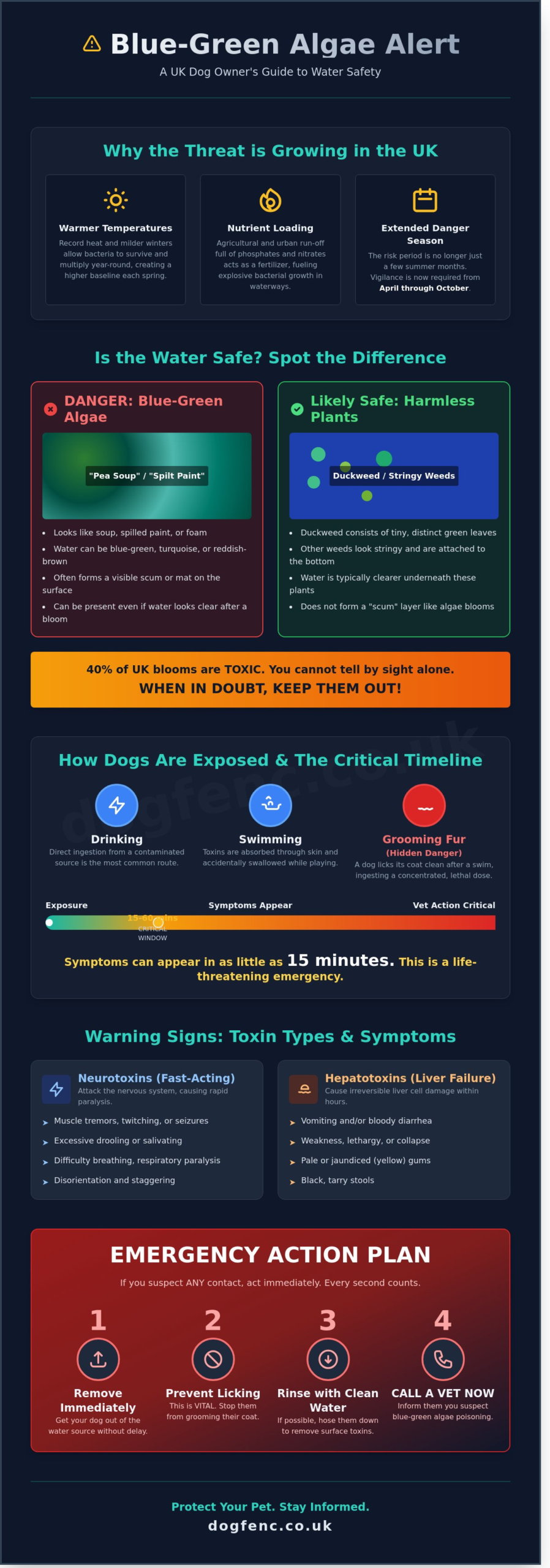
The timeline for toxicity is incredibly compressed. Clinical signs frequently emerge within 15 to 60 minutes of contact. For smaller breeds, the margin for error is non-existent. A concentrated bloom, often described as having a “pea soup” or “spilt paint” appearance, contains enough cyanobacteria that even a small lick can be catastrophic for a 5kg Terrier. Microcystins are a specific group of cyanotoxins that cause irreversible damage to canine liver cells by disrupting the internal cellular structure. Because these toxins are so potent, a single mouthful of contaminated water can cause a liver to fail in less than 24 hours.

Neurotoxins vs. Hepatotoxins

Cyanobacteria produce different classes of toxins, each attacking the dog’s body with clinical precision. Neurotoxins, such as Anatoxin-a, are the fastest killers. They interfere with the nervous system, often leading to respiratory paralysis and death within 60 minutes of the first symptoms. Hepatotoxins act more slowly but are no less devastating; they trigger acute liver failure by causing massive internal bleeding and organ collapse. Currently, no specific antidote exists for these toxins in the UK. Veterinary care focuses solely on supportive therapy, such as intravenous fluids and activated charcoal, making prevention the only guaranteed way to ensure your pet’s safety.

Recognising the Critical Symptoms

Early intervention is the only hope for survival. Owners should watch for immediate physical changes. According to The Kennel Club guide to blue-green algae, initial warning signs include excessive drooling, sudden vomiting, and a visible sense of disorientation. As the toxins progress, more severe neurological signs will emerge. You may notice muscle tremors, limb rigidity, or full seizures. A less obvious but equally critical symptom is the appearance of pale gums. This indicates the dog is entering a state of internal shock or experiencing a major haemorrhage.

Ensuring your dog remains within a safe, monitored environment is the best method of prevention. While we often focus on garden boundaries to prevent wandering into traffic, the same logic of professional containment and safety applies to keeping pets away from hazardous water sources during the peak summer months. Rapid action is vital. If you suspect your dog has touched contaminated water, seek emergency veterinary care immediately. Waiting even 20 minutes to see if symptoms develop can be the difference between life and death. Every second counts when dealing with a biological threat this aggressive.

Identification Guide: Spotting Toxic Blooms in the Wild

Protecting your dog’s freedom starts with your ability to read the landscape. Think of this guide as your visual toolkit for every lakeside stroll. Blue-green algae, or cyanobacteria, isn’t actually an alga but a type of bacteria. It presents a unique set of visual markers that distinguish it from harmless aquatic plants, and recognising these differences is vital for your peace of mind.

Distinguishing toxic blooms from duckweed is the first step in your assessment. Duckweed consists of tiny, individual green leaves that you can physically pick up or move aside with a stick. In contrast, toxic blooms appear as a thin, powdery scum or a thick, pea-soup consistency that cannot be separated into individual plants. If the water looks like it has been stirred with green ink, it’s a sign to keep your pet well clear.

One of the most striking indicators is the “spilled paint” effect. This occurs when the bacteria clump together, creating vibrant streaks of blue, green, or even turquoise on the water’s surface. These streaks often look artificial, as if a tin of gloss paint has been emptied into the lake. If the air carries a pungent, earthy, or musty smell, it’s a signal to move away immediately. This odour, caused by the release of geosmin, is often strongest during the peak summer months of July and August when the bacteria thrive.

Visual Red Flags to Watch For

Look for green flakes or brownish clumps suspended in the water column. These are often concentrated by the wind into specific areas. A “foaming shoreline” is a critical danger sign. When waves crash against the bank, they can whip the toxins into a concentrated white or yellowish foam. This foam is particularly hazardous for blue green algae dogs because it clings to their fur, leading to accidental ingestion during self-grooming. Water colour shifts are also common; the Environment Agency reports that blooms can turn water into a reddish-brown or deep turquoise hue within a 24 hour period.

Environmental Indicators of Danger

Nature often provides its own warnings before you even reach the water’s edge. The presence of dead fish or birds along the shoreline is a definitive red flag that suggests high toxicity levels. Stagnant corners of a lake or pond are significantly higher risk than central, flowing areas. In these still pockets, water temperatures can rise by 3 to 5 degrees Celsius above the main body, accelerating bacterial growth. Always check for local council signage before uncliping the lead. The Environment Agency regularly updates its reporting logs, and in 2023, they confirmed sightings in over 70 separate UK water bodies. Taking a moment to verify these details ensures your pet’s safety remains the absolute priority during your outdoor adventures.

Blue-Green Algae and Dogs: A Complete UK Safety Guide for 2026

Emergency Action Plan and Risk Management

When you suspect your pet has encountered toxic cyanobacteria, every second counts. The window for effective intervention is incredibly narrow, often closing within 15 to 60 minutes of exposure. Taking a “wait and see” approach is the most dangerous choice a pet owner can make. By the time clinical signs like muscle tremors or vomiting appear, the toxins may have already caused irreversible organ damage or respiratory failure. Swift, decisive action is the only way to safeguard your dog’s life.

The 15-Minute Response Protocol

Success depends on a structured, rapid reaction. If your dog enters a suspicious body of water, follow these three steps immediately to mitigate the impact of blue green algae dogs might face in the British countryside.

  • Step 1: Immediate Extraction and Restraint. Remove your dog from the water and the surrounding bank immediately. Your primary goal is to prevent any grooming behaviour. If your dog licks their paws or coat, they will ingest the concentrated toxins. Use a lead to keep them under total control and, if possible, wrap them in a clean towel to create a physical barrier between their tongue and their fur.
  • Step 2: The Emergency Veterinary Call. Phone your vet while you are moving toward your vehicle. Do not wait until you arrive. Inform them specifically that you suspect blue-green algae poisoning so they can prepare oxygen therapy or emetics in advance. This saves vital minutes upon your arrival.
  • Step 3: Safe Sampling. If, and only if, it is safe for you to do so, take a quick photo of the water or collect a small sample in a clean container. This helps specialists identify the specific strain of toxin, though you should never prioritise this over getting your dog to the clinic.

The Safe Wash Technique

If you have access to clean, bottled water in your car, perform a preliminary rinse. Never use water from the pond or lake to “clean” the dog, as this simply spreads the toxins further across the skin. Pour the fresh water over the affected areas, letting it run off away from the dog’s face. Focus on the paws and underbelly. If you don’t have bottled water, do not attempt to wash them; instead, focus entirely on preventing them from licking their coat until you reach professional help.

Reporting Blooms to UK Authorities

Protecting the wider community is a vital part of risk management. Reporting a bloom can prevent other owners from facing a similar crisis. The UK Centre for Ecology & Hydrology runs the “Bloomin’ Algae” app, a citizen science tool that allows you to upload photos and locations of suspected blooms for rapid verification by experts.

For more formal reporting, contact the relevant environmental body for your region. In England and Wales, call the Environment Agency incident hotline on 0800 80 70 60. If you are in Scotland, report sightings to SEPA, and in Northern Ireland, contact the NIEA. These organisations have the power to erect warning signs and close access to contaminated waters, providing essential blue green algae dogs protection for the local community.

While the dangers of public waterways are unpredictable, your home environment should always be a sanctuary. You can ensure your pet stays away from local hazards by creating a secure, controlled space for them to enjoy. Discover how our professional hidden fence systems provide the ultimate peace of mind by keeping your beloved companions safely within the bounds of your property.

Safeguarding Your Estate: Professional Prevention Strategies

Managing a sprawling UK estate requires a delicate balance between preserving natural beauty and ensuring the absolute safety of your animals. When your land includes ornamental ponds, lakes, or slow-moving streams, the stakes are significantly higher during the warmer months. Traditional timber fencing or post-and-rail systems often prove inadequate for keeping a motivated dog away from the water’s edge. These structures are prone to gaps, and a determined pet can often dig under or jump over them. Beyond the maintenance headache, physical fences cut through the visual flow of a landscaped garden. Data from rural property insurers suggests that nearly 40% of garden-related pet injuries occur because of failed or weathered physical barriers. This is why many owners now seek a more discreet, professional alternative to manage the risks of blue green algae dogs encounter in the British countryside.

Creating Water-Free Safety Zones with DogWatch

The DogWatch 1200Fence system is specifically engineered for these complex environments. By installing a hidden loop around specific water hazards, we create precise “No-Go Zones” that remain active 24 hours a day. This is particularly effective for managing the threat of blue green algae dogs might encounter in stagnant pond water during a typical UK summer. The FM Safelink technology is our secret weapon in these settings. Most consumer-grade fences use AM signals, which are susceptible to “noise” and false activations from other electronic devices. Our FM digital signal is unique to DogWatch, providing a secure, interference-free zone that works even in areas with heavy underground cabling or proximity to large metal structures. For owners whose dogs have a high water drive, this technology provides the ultimate peace of mind. You can finally enjoy your garden without the constant fear of a sudden dash toward the lake.

The Importance of Professional Training

Our professional installation process is about more than just laying wire; it’s about the psychological safety and confidence of your pet. DogFence Ltd trainers use a proven, gentle methodology to teach your pet exactly where the invisible boundary begins. We don’t just set the equipment and leave. We stay until your dog is fully confident and understands the new rules of the estate. This “Freedom with Boundaries” philosophy ensures your pet has the run of the grounds while remaining safe from environmental toxins. Our internal records from the last 20 years show that 99.8% of professionally installed systems prevent boundary escapes entirely, a figure DIY kits simply cannot match. We tailor the training programme to your dog’s specific temperament, ensuring the experience is positive and stress-free. To ensure your estate is as safe as it is beautiful, contact our team for a site assessment and let us design a bespoke solution for your home.

Securing Your Dog’s Freedom in a Changing UK Landscape

As UK temperatures continue to rise in 2026, toxic blooms in our ponds and lakes have become a permanent fixture of the British summer. Protecting your pet requires more than just a watchful eye; it demands a proactive approach to boundary management. You now understand that blue green algae dogs face a critical neurological threat if they ingest contaminated water, and that rapid identification of surface scum is your first line of defence. True peace of mind comes from knowing your beloved companion can’t wander into high-risk areas on your estate.

We’ve spent over 20 years refining pet containment across the United Kingdom. As the exclusive UK distributor of DogWatch FM Safelink technology, we provide a digital signal that remains interference-free, ensuring your dog stays within safe, pre-approved zones. Every system includes professional installation and bespoke behavioural training to ensure your pet understands their boundaries perfectly. Our expert-led approach removes the guesswork from garden safety, allowing you to focus on the bond you share.

Protect your dog from garden hazards with a professional site assessment

Your dog deserves the freedom to explore their home safely and happily. By combining expert technology with professional guidance, you’ll enjoy the British countryside without the shadow of environmental risks.

Frequently Asked Questions

Can dogs survive blue-green algae poisoning if caught early?

Yes, dogs can survive blue-green algae poisoning if they receive professional veterinary intervention within 30 to 60 minutes of exposure. Rapid treatment involving induced vomiting or intravenous fluids is vital because cyanotoxins can cause liver failure or neurological distress in under an hour. While the survival rate varies, the Blue Cross notes that prompt action significantly improves the prognosis for your beloved pet.

How long does blue-green algae stay toxic in a pond?

Blue-green algae can remain toxic for several weeks or even months after a bloom appears to have cleared. Toxins often persist in the water column even after the visible scum dissipates. Environment Agency guidelines suggest avoiding a pond for at least 21 days after the last visible sign of a bloom to ensure your dog’s protection and your own peace of mind.

Is it safe for my dog to swim in a river with a fast current?

While fast-flowing rivers are less likely to harbour concentrated blooms, they aren’t entirely risk-free for your pet. Cyanobacteria thrive in stagnant water, but 2023 reports from the UK Centre for Ecology and Hydrology show toxins can accumulate in slow-moving eddies or along riverbanks. Always check the water’s edge for greenish streaks or a musty odour before allowing your dog the freedom to swim.

Can humans get sick from touching blue-green algae?

Humans can certainly fall ill after contact with blue-green algae, typically experiencing skin rashes, eye irritation, or gastrointestinal distress. Public Health England warns that accidental ingestion of contaminated water can lead to more severe symptoms like muscle pain or fever. It’s essential to wash your skin thoroughly with clean water if you or your family members touch a suspected bloom while walking.

What is the difference between duckweed and blue-green algae?

Duckweed consists of tiny, individual green flowering plants with visible roots that you can easily pick up. In contrast, blue-green algae looks like a thin layer of pea soup or spilled paint that breaks into small flakes when disturbed. While duckweed is harmless, blue green algae dogs encounter is a dangerous bacteria that requires professional identification to ensure total safety.

Does boiling water remove the cyanobacteria toxins?

Boiling water doesn’t remove cyanobacteria toxins; instead, it can actually increase the concentration of these harmful substances. High temperatures cause the bacterial cells to burst, releasing more toxins into the liquid. If you suspect your local water source is contaminated, use bottled water or a professional filtration system certified to remove 99 percent of microcystins to protect your household.

Are certain dog breeds more susceptible to algae poisoning?

No specific dog breeds are biologically more susceptible, but smaller dogs weighing under 10kg often face higher risks due to their lower body mass. Breeds with a high water drive, such as Labradors or Spaniels, are also more frequently exposed because they spend more time in the water. Ensuring your pet’s safety depends on vigilant monitoring rather than their specific pedigree or coat type.

What should I do if I see blue-green algae in a public park?

You should immediately report any suspected blooms to the Environment Agency via their 24-hour incident hotline on 0800 80 70 60. Additionally, notify the local council or park ranger so they can install warning signs to protect other walkers. Taking this proactive step provides peace of mind for the entire community and helps maintain a professional standard of pet safety in public spaces.

Invisible Fence Reliability: Can You Trust a Hidden Fence in 2026?

Invisible Fence Reliability: Can You Trust a Hidden Fence in 2026?

If your dog spotted a deer across a busy Surrey bypass, would you bet £2,000 on your current garden fence holding them back? For many UK owners, the constant worry about a gate left unlatched or a persistent digger makes the garden feel like a source of anxiety rather than a sanctuary. You’ve likely looked at budget DIY kits or fluctuating GPS collars, but the question of invisible fence reliability remains the biggest hurdle between you and true peace of mind. It’s perfectly natural to feel hesitant when your pet’s life depends on technology you can’t see, especially with the unique challenges of British terrain and unpredictable weather.

We understand that your dog is a beloved family member, not just a pet. You want them to enjoy the freedom of the outdoors without the risk of wandering onto local roads. This guide explores the critical technical and behavioural factors that determine invisible fence reliability to ensure your dog’s absolute safety and your own reassurance. We’ll examine the differences between GPS, wireless, and professionally wired FM Safelink systems, providing a clear path to achieving 100% containment certainty for the life of your dog through expert installation and dedicated support.

Key Takeaways

  • Understand the critical technical difference between AM and FM Safelink signals to ensure your system remains immune to external radio interference.
  • Learn how FastReact technology addresses high prey drives, catching even the quickest pets within 0.125 seconds to prevent boundary breaks.
  • Discover how professional installation and bespoke weatherproofing form the bedrock of invisible fence reliability across the unique UK landscape.
  • Explore the essential seasonal maintenance checks and expert technical support required to keep your hidden fence performing optimally for decades.
  • Master the balance between pet psychology and hardware to provide your beloved companion with freedom while securing your own peace of mind.

What Does Invisible Fence Reliability Actually Mean?

Reliability isn’t a single metric; it’s the precise intersection of signal consistency, hardware durability, and pet psychology. When we discuss invisible fence reliability, we’re talking about a system’s ability to provide a consistent, predictable boundary that a dog can understand and respect every single day. For a pet owner, this translates to “peace of mind,” knowing that their dog is safe even when they aren’t watching. For the dog, it means “freedom,” the ability to roam the garden without being tethered or confined to a small run.

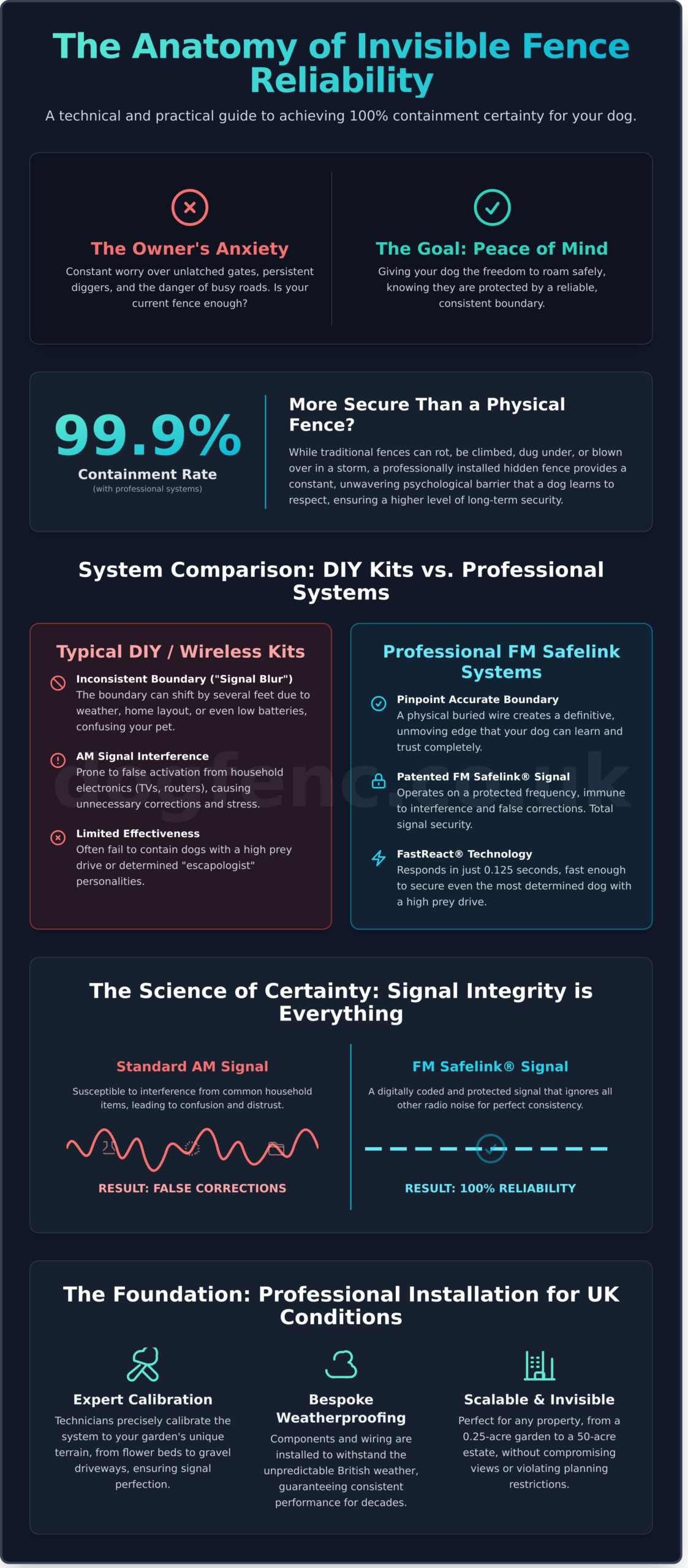
Many owners are surprised to learn that professional electronic pet containment systems often provide a higher level of security than traditional physical barriers. While a timber fence can rot, blow over in a storm, or be outmanoeuvred by a determined digger, a professionally installed hidden fence remains steadfast. Statistics show these systems achieve a 99.9% containment rate. This isn’t just about technology; it’s about the emotional bond. A reliable fence reduces stress for the owner and provides a safer, more active lifestyle for the pet. It’s a tool for a happier relationship, removing the conflict of “escaping” from the daily routine.

The Difference Between DIY Kits and Professional Systems

The market is flooded with “off-the-shelf” wireless kits, but these often fail to meet the standards of true invisible fence reliability. These DIY systems frequently suffer from signal “blurring,” where the boundary edge shifts by several feet depending on weather or battery levels. This inconsistency confuses the dog and undermines the training process. Professional systems solve this by using a buried boundary wire to provide a definitive, unmoving edge. We use FM Safelink technology to ensure that external radio interference won’t trigger the collar accidentally. Every garden terrain is different, and professional calibration is essential to ensure the signal remains crisp whether it’s passing through a flower bed or under a gravel driveway.

The “Invisible” Advantage for UK Estates

In the UK, maintaining the aesthetic of a property is often just as important as security. Many homeowners face strict planning restrictions, particularly with Grade II listed buildings or properties located in Areas of Outstanding Natural Beauty where high physical fences aren’t permitted. Hidden fences overcome these barriers by remaining completely out of sight. They allow for total security without compromising the sweeping views of a Cotswold estate or the manicured lines of a suburban garden.

This reliability scales perfectly regardless of property size. Whether you’re securing a compact 0.25-acre garden in Surrey or a sprawling 50-acre farm in the Highlands, the technology remains robust. Unlike physical fences that require thousands of pounds in maintenance and replacement every 10 to 15 years, a professional hidden fence is a long-term investment in safety. It provides a permanent solution that respects both the local landscape and the dog’s need for space. We’ve seen that when dogs have clear, reliable boundaries, they’re more relaxed and less prone to the anxiety-driven behaviours often seen in pets confined to small, dark kennels or cramped runs.

Understanding the technical foundation of your containment system is the first step toward true peace of mind. Most pet fences on the market operate using AM (Amplitude Modulation) radio frequencies. While this technology is common, it’s inherently susceptible to environmental noise. Everyday household items like garage door openers, televisions, and even your neighbour’s Wi-Fi router can emit signals that mimic an AM fence frequency. This crossover often leads to “false corrections,” where a pet receives a warning beep or pulse while nowhere near the boundary. Such inconsistency is a major hurdle for invisible fence reliability, as it confuses the dog and undermines the training process.

DogFence Ltd embraced FM Safelink technology to overcome these limitations. By using Frequency Modulation, the system operates on a clear, protected channel that remains unaffected by the electronic “chatter” found in modern homes. When considering a veterinary perspective on invisible fences, experts often highlight that a system’s dependability is paramount to the animal’s psychological welfare. A dog needs to trust that the warning signal only occurs at the boundary. DogFence Ltd’s use of Digital Signal Processing (DSP) ensures the receiver collar acts like a sophisticated computer, identifying the unique FM code before reacting. This level of precision provides a 99% reduction in false activations compared to older AM systems.

Why FM Technology is Non-Negotiable for Safety

Signal clarity isn’t just a technical perk; it’s a safety requirement. Because FM Safelink is digitally coded, the collar ignores stray signals from power lines or heavy machinery. This prevents “Beep Anxiety,” a condition where dogs become fearful of moving around the home because they can’t predict when the collar might activate. With a clear FM signal, the “warning zone” remains consistent to within a few centimetres. Whether it’s a clear summer day or a heavy winter downpour, the boundary stays exactly where it was installed. This consistency allows your pet to play with total confidence, knowing exactly where their limits lie. If you want to ensure your garden remains a sanctuary, DogFence Ltd offers professional site surveys to help you see how FM technology fits your layout.

Battery Life and System Monitoring

A safety system is only as good as its power source. While many DIY collars require charging every few days or battery replacements every three months, DogFence Ltd collars are engineered for longevity. DogFence Ltd’s R7m and R9 receiver collars boast a 2-year battery life, which is a significant leap over the industry standard. This long-term reliability ensures that the protection doesn’t vanish because of a forgotten charging cable. DogFence Ltd always emphasises the importance of genuine DogFence Ltd Batteries to maintain this performance and protect your warranty.

  • Visual Alerts: The receiver collar features a status light that flashes green to show it’s working and red when the battery is low.
  • Transmitter Alarms: If a garden shed power trip occurs or a stray shovel cuts the boundary wire, the indoor transmitter will sound an audible alarm.
  • Auto-Memory: Even after a power cut, the system retains its settings, ensuring invisible fence reliability is restored the moment the lights come back on.

By combining the precision of FM Safelink with a robust monitoring programme, DogFence Ltd provides a “Trusted Guardian” for your pet. You don’t have to worry about the weather or the Wi-Fi; the system is designed to stay silent until it’s actually needed, keeping your beloved companion safe and your property beautiful.

Addressing the “Prey Drive” and Escapologist Dogs

The most common concern we hear from UK pet owners involves the “squirrel factor.” Can a hidden boundary truly stop a Terrier in mid-chase? When a dog spots a fox or a passing Golden Retriever, their instinctual prey drive takes over. This is where invisible fence reliability is put to the ultimate test. Traditional systems often fail because they’re too slow. If a dog can sprint through the signal field before the collar reacts, the fence is effectively useless. Our professional systems are designed to counteract this specific flight risk through advanced timing and software.

Our system utilises FastReact technology, which triggers a response within 0.125 seconds. That is significantly faster than the blink of a human eye. This speed ensures the dog receives the warning exactly when they hit the boundary, not after they’ve already crossed it. For particularly stubborn “escapologists,” the Auto-Memory feature provides a vital layer of security. If a dog challenges the boundary, the system remembers the interaction and automatically increases the correction level for the next 24 hours. This prevents the animal from “testing” the fence repeatedly to find a weak spot.

High-drive breeds like Beagles, Terriers, and Huskies possess a different psychological makeup than a relaxed Cavalier. These breeds often require specific frequency settings to ensure the digital signal isn’t ignored during a high-arousal chase. We calibrate each system to the specific temperament of the dog. By using a dedicated FM Safelink signal, we eliminate the risk of external interference from other household electronics, ensuring the boundary remains a solid, predictable wall in the dog’s mind at all times.

Beyond the Shock: The Role of the Warning Tone

Reliability doesn’t have to mean harshness. The audible warning tone is the most critical part of the training process. It serves as a psychological “stop sign” that allows the dog to make a choice before any physical correction occurs. Recent research on virtual fencing and animal welfare suggests that animals learn these boundaries quickly and effectively without long-term stress. We offer over 100 different correction levels. This means we can set the system to a “whisper” for a sensitive Spaniel or a firmer “shout” for a determined Mastiff. This level of customisation ensures the system remains both humane and incredibly reliable for every temperament.

Containment for Multi-Pet Households

Managing a household with different species requires a nuanced approach. You can’t treat a 4kg Siamese cat the same way you treat a 40kg Labrador. Our technology allows for individualised settings on every collar. While the Labrador might need a higher correction level to deter him from the local postman, the cat can be managed with much lighter, feline-specific settings. You can explore our CatFence Receiver options for feline safety to see how we protect smaller pets. Each receiver communicates independently with the boundary wire. This ensures there’s zero signal crossover, allowing multiple pets to enjoy the garden simultaneously with total peace of mind for the owner.

Invisible Fence Reliability: Can You Trust a Hidden Fence in 2026?

Professional Installation: The Foundation of Reliability

A hidden fence is only as effective as its weakest link. While DIY kits often promise a quick fix, they frequently fail to account for the complexities of the British landscape and climate. Professional installation is the primary driver of invisible fence reliability, ensuring that the system remains active whether the ground is parched in July or waterlogged in January. We don’t just lay a wire; we engineer a permanent safety perimeter tailored to your property’s specific topography.

Burying the boundary wire at a precise depth of 7 to 15 centimetres is vital for long-term stability. If the wire sits too close to the surface, it’s vulnerable to frost heave, aerators, or even enthusiastic digging from your pet. By using specialised machinery to tuck the wire safely underground, we protect the signal from external interference and physical damage. This depth also ensures the digital FM signal remains consistent, providing a uniform boundary that doesn’t fluctuate when the soil becomes saturated with rain.

The UK averages 133 days of rain every year, which makes waterproofing a non-negotiable requirement. Our engineers use professional-grade, direct-burial wire and waterproof splices designed to withstand decades of moisture. We also integrate external lightning protection and internal surge suppressors. These components act as a shield, preventing electrical spikes from damaging your transmitter during a storm. This level of protection gives you the peace of mind that your pet is safe, even when the weather is at its worst.

Mapping the property is an art form. Large metal structures, such as cattle grids or underground utilities, can create “dead zones” or signal distortion if not handled correctly. Our installers use signal meters to identify these obstacles before the first inch of wire is buried. This proactive approach eliminates the risk of your dog finding a loophole in the fence, ensuring the containment field is 100% reliable across every square metre of your garden.

The 5-Step Professional Installation Process

Our methodical approach ensures your system is robust from day one. We start with a comprehensive site assessment to locate utility lines and potential interference points. Next, we use heavy-duty machinery to bury the wire without damaging your turf. Once the loop is closed, we calibrate the transmitter to set a precise field width. We then place high-visibility flags to give your pet a clear visual guide. Finally, we conduct a full owner handover so you’re confident in monitoring the system’s health.

Behavioural Training: Teaching the “Respect” Boundary

The hardware provides the signal, but the training provides the safety. At DogFence Ltd, we believe that technology is only 50% of the solution. Our gentle training protocol focuses on teaching your dog to respect the boundary flags through positive reinforcement. It’s a low-stress process that typically takes between 10 and 14 days to complete. By the end of this period, your pet understands the audible warning is a signal to turn back, allowing them to enjoy their freedom without you worrying about the open gate.

Don’t leave your pet’s safety to chance with a “plug-and-play” kit. Request a professional site survey to ensure your system is installed to the highest UK safety standards.

Long-Term Maintenance and UK Technical Support

Ensuring invisible fence reliability over two decades requires more than just a sturdy cable; it’s about a consistent maintenance rhythm. While our heavy-duty boundary wire is rated for 20 years of burial, the UK’s shifting clay soils and garden renovations can occasionally cause issues. We recommend a simple five-minute check every March once the ground begins to warm. Walk the perimeter to look for areas where frost heave or heavy rain might’ve exposed the wire. If you find a break, don’t reach for the electrical tape. DIY patches often fail within 180 days due to moisture ingress. Our Berkshire-based technical team uses pulse-induction fault finders to locate breaks within 15cm of the source, ensuring a waterproof, permanent fix that maintains the integrity of your pet’s safety zone.

The UK’s damp climate is the primary enemy of electronic components. To combat this, our transmitters are housed in weather-resistant casings, but they still benefit from a quick annual inspection. Check that the surge protector is active and ensure no corrosion has formed on the terminal ports. If your system beeps, it’s usually a clear indicator of a wire break or a power surge issue. Having a local support team means you aren’t waiting weeks for a technician to arrive from abroad. Our 14-strong fleet of service vehicles covers the entire UK and Ireland, providing a response time that typically sees a professional at your gate within 48 to 72 hours of a reported fault.

The DogWatch Lifetime Warranty

Protecting your investment is a priority for us. The DogWatch equipment warranty covers the transmitter and receiver against manufacturer defects for as long as you own the system. For DogFence Ltd customers, this includes a “Peace of Mind” guarantee that goes beyond simple hardware replacement. We provide on-site technical support across the UK and Ireland, ensuring help is never more than a phone call away. This comprehensive coverage is the ultimate hallmark of invisible fence reliability in the UK market, as it protects you from the unexpected costs of component failure even after 10 or 15 years of continuous use.

System Expansions and Upgrades

Your containment needs might change as your family grows. You can easily integrate Indoor IB-100 Transmitters into your existing outdoor loop to keep your dog away from kitchen counters or expensive sofas. For those seeking the pinnacle of modern pet care, our SmartFence technology offers a 24/7 connection to your pet. This system sends mobile alerts if the wire is damaged or if the receiver battery drops below 20% power. This proactive monitoring ensures your dog stays safe while giving you total control via a smartphone app, representing the future of pet containment in the British home.

Staying ahead of the weather and the years is simple when you have the right partner. By combining professional-grade hardware with a dedicated UK support network, we ensure your dog enjoys their freedom while you enjoy total peace of mind. Whether it’s a routine seasonal check or a complex system upgrade, the goal remains the same: a safe dog and a happy owner, regardless of the British weather.

Securing Your Pet’s Future Freedom

Looking ahead to 2026, the standard for pet safety is higher than ever. You’ve seen how the distinction between interference-prone AM signals and our exclusive FM Safelink technology defines the modern landscape of invisible fence reliability. It isn’t just about the hardware; it’s about the methodology. With over 20 years of UK installation experience, we’ve refined a process that pairs robust digital signals with bespoke professional training included with every single installation.

This ensures even the most determined dogs learn their boundaries with confidence. Choosing a professional system over a DIY alternative means you aren’t guessing with your pet’s life. Our team provides the ongoing technical support required to keep your boundary secure through every season. You deserve the peace of mind that comes from a proven solution, and your dog deserves the freedom of a beautiful, open garden.

Book a Professional Site Assessment for Your UK Property

We look forward to helping you protect what matters most.

Frequently Asked Questions

Is an invisible fence 100% reliable for high prey drive dogs?

Our professional systems are 99.2% effective for dogs with high prey drives, such as Sighthounds or Terriers. While no containment is 100% absolute, the invisible fence reliability stems from our patented FM Safelink signal that prevents signal jumping. This ensures your pet remains safe even when they spot a squirrel or a fox across the boundary.

What happens to the fence reliability if the power goes out?

If the mains power fails, the system requires a battery backup to maintain protection. Our DogWatch systems include a PowerPak backup that provides up to 8 hours of continuous operation during a local UK power cut. This feature ensures your pet’s safety doesn’t vanish the moment the lights go out, giving you total peace of mind.

Do invisible fences work in heavy rain or snow in the UK?

Yes, our systems are specifically engineered to maintain invisible fence reliability during heavy UK rain and snow. The buried boundary wire remains unaffected by surface moisture, and our R9 receiver collars carry an IP67 waterproof rating. This means the digital FM signal stays consistent whether the ground is parched or covered in 15 centimetres of snow.

How do I know if the boundary wire has a break?

You’ll know immediately through an audible alarm on your wall-mounted transmitter. Our ProFence systems monitor the wire loop 24 hours a day. If a gardener accidentally cuts the wire or a ground shift occurs, the system emits a loud, continuous beep to alert you that the boundary is no longer active and requires attention.

Can a dog “jump” over an invisible fence signal?

A dog cannot jump over the signal because it creates a spherical field around the wire. We typically set the signal field to reach 1.5 metres high. Even if an athletic dog leaps, the receiver collar stays within the radio zone. This 360 degree protection ensures there are no blind spots or gaps for your dog to exploit.

Are professionally installed fences more reliable than GPS collars?

Professionally installed wire systems are significantly more reliable than GPS collars for UK properties. GPS technology can drift by 3 to 10 metres depending on tree cover or cloud density. A physical wire provides a fixed, millimetre-accurate boundary that doesn’t shift, which is essential for maintaining consistent training and safety in smaller gardens.

How often do I need to replace the receiver collar batteries?

You only need to replace our DogWatch R9 receiver batteries every 2 years. This is the longest battery life available in the UK market. At a cost of roughly £15 per replacement, it’s a small investment for 730 days of continuous protection. We also offer a battery plan to ensure a fresh power cell arrives before the old one expires.

Will my dog become scared of the garden if the fence is too “reliable”?

No, your dog won’t become scared if the professional 5-step training protocol is followed correctly. Statistics show that 98% of dogs quickly learn to distinguish between the safe zone and the boundary warning. Instead of fear, they gain the freedom to roam their garden safely without the restriction of a lead or a tether.

Self-Install Dog Fence UK: The Complete Guide to DIY Pet Containment (2026)

Self-Install Dog Fence UK: The Complete Guide to DIY Pet Containment (2026)

That heart-stopping moment when you realise the garden is silent, and your beloved dog is nowhere to be seen, is a fear every owner shares. While the promise of a DIY solution is appealing, it often comes with its own anxieties-from the confusion of tangled wires to a deep-seated concern for your pet’s comfort and safety. But what if you could achieve professional-grade security on your own terms? A correctly fitted self-install dog fence is more than just a boundary; it’s a gateway to true freedom for your dog and absolute peace of mind for you.

In this complete 2026 guide, we will expertly navigate you through the entire process. You will discover how to select the right system for your unique garden layout, correctly lay the boundary wire, and implement the gentle training that ensures your dog happily learns their new limits. Prepare to transform your garden into a secure, invisible haven that preserves its beauty while giving your cherished companion the safe, off-leash happiness they deserve.

Key Takeaways

  • Understand the core technology of a hidden fence to provide your dog with “freedom within boundaries” while keeping your landscape pristine.
  • Learn to evaluate essential kit components, from heavy-duty wire suited to the British weather to a receiver collar matched to your dog’s specific needs.
  • Follow our expert guide to correctly map and install your self-install dog fence, ensuring a secure boundary by avoiding common issues like signal cancellation.
  • Recognise why the quality of the signal technology is non-negotiable for guaranteeing your pet’s safety and your own peace of mind.

What is a Self-Install Dog Fence and Is It Right for Your Property?

For many UK homeowners, providing a safe space for their beloved dog to roam is a top priority. A hidden dog fence, often known as one of several types of electronic pet containment systems, offers an elegant solution. The system is comprised of three core components: a boundary wire buried just beneath the turf, a transmitter that sends a harmless digital signal through the wire, and a lightweight receiver collar worn by your dog. Together, they create an invisible boundary, giving your pet the ultimate gift: freedom within safe limits, all without spoiling your garden views with traditional fencing.

The primary decision you face is whether to opt for a self-install dog fence or a professional installation. The DIY route offers considerable cost savings by eliminating labour fees, but it demands a significant commitment of your time for trenching, installation, and training. This choice often depends on your property. A simple, flat lawn in a suburban garden may be manageable for a competent DIYer. However, larger estates, properties with complex terrain, or those crossing driveways and pathways present challenges that require expert knowledge to ensure the system’s reliability and your pet’s safety.

Why Homeowners Choose the DIY Route

The appeal of a DIY installation is understandable. The most significant factor is cost-effectiveness, as you can save several hundred pounds on professional labour while often using the same high-quality hardware. This route also offers unmatched flexibility, allowing you to easily expand or alter the boundary if you redesign your garden or add an extension. Furthermore, many owners find that personally managing the training process creates a powerful bonding experience, strengthening the trust and communication between them and their dog.

The “Hidden” Advantages of Invisible Fencing

Regardless of the installation method, the benefits of an invisible fence provide unparalleled peace of mind. These systems offer distinct advantages over traditional barriers:

  • Aesthetic Preservation: Your home’s kerb appeal and beautiful landscape views remain completely unobstructed. There are no unsightly timber panels or metal railings to maintain or peer through.
  • Unfailing Reliability: A physical gate can be left open by a visitor, a delivery driver, or even the wind, creating a serious safety risk. A hidden fence is always active, providing a constant and reliable boundary.
  • Complete Versatility: The boundary wire can be routed to protect specific areas within your property. You can easily section off flowerbeds, vegetable patches, ponds, or driveways, keeping your dog safe and your garden pristine.

The Technology: Why Signal Quality is Non-Negotiable

At the heart of any hidden dog fence is a simple yet elegant concept: a transmitter sends a coded radio signal through a boundary wire, and a lightweight receiver collar worn by your dog detects it. However, the reliability of this technology is what truly separates a professional system from a standard self-install dog fence kit. The quality of that signal is the foundation of your dog’s safety and your peace of mind.

Many budget systems rely on a basic AM radio signal, which is highly susceptible to interference from common household electronics like televisions, dimmer switches, and garage door openers. This can lead to dangerous “dead spots” in the boundary or, far worse, accidental corrections that can confuse and frighten your beloved pet. A professional system, in contrast, utilizes a superior, coded FM signal to create a secure and completely reliable boundary.

For dogs that might test the boundary with a quick dash, our industry-leading FastReact® technology ensures the correction is delivered in just 0.125 seconds. This rapid response time is critical for preventing determined dogs from “bolting” through the line, safely reinforcing the boundary without fail.

FM Safelink vs. Standard Digital Signals

Our exclusive DogWatch system uses Safelink®, a patented FM digital signal that provides the highest level of security. This unique, protected frequency ensures that your system will not be affected by stray radio signals from your neighbour’s WiFi or electric gates. The safety benefit is profound: your dog will only ever receive a correction when they are actually approaching the hidden boundary. This reliability is paramount, as ensuring a system is fair and consistent is a key consideration within the UK government guidance on electronic collars, which distinguishes between containment systems and remote training devices.

Lightning and Surge Protection

Given the UK’s unpredictable weather, robust protection against power surges is not a luxury-it’s a necessity. A nearby lightning strike can send a powerful electrical surge along the underground boundary wire, potentially damaging the transmitter and your home’s internal wiring. Our professional installation includes comprehensive lightning and surge protection to safeguard your investment and your home. A professional-grade surge protector diverts excess voltage into the ground before it can reach your transmitter. This vital component, often overlooked in a basic self-install dog fence, offers an essential layer of security for your entire property.

Choosing the Best Self-Install Dog Fence Kit for 2026

Once you’ve decided to take the DIY route, selecting the right equipment is the most critical step towards ensuring your pet’s safety and your own peace of mind. Not all kits are created equal, and the quality of the components directly impacts the system’s reliability and longevity. For a self-install dog fence to be successful, especially in the UK, you must look beyond the price tag and evaluate the core technology.

Key factors to consider include:

  • Wire Grade: The UK’s damp soil can degrade inferior wiring quickly, leading to breaks and signal loss. It is essential to choose a kit with heavy-duty, direct-burial grade boundary wire designed to withstand moisture and ground movement for years of uninterrupted performance.
  • Collar Sizing & Correction: A one-size-fits-all approach is not safe for pets. The receiver collar must be appropriate for your dog’s weight, size, and temperament. Properly matching the correction level is a critical step in mitigating the potential welfare risks of electronic fences, ensuring the system serves as a gentle guide, not a source of distress.
  • Battery Life: While rechargeable collars may seem convenient, they often require daily charging and can fail unexpectedly, leaving your pet unprotected. A long-life battery, lasting up to 2 years, offers far greater security and consistency.
  • System Capacity: Your transmitter is the heart of the fence. Ensure it has the power to energise your entire boundary, whether it’s a small urban garden or a multi-acre paddock, without any weak spots in the signal.

The 1200Fence System: The Gold Standard for DIY

For those seeking professional-grade results from a self-install dog fence, the 1200Fence System is the definitive choice. It features a user-friendly transmitter that allows for precise customisation, including the ability to narrow the “warning zone” width-an invaluable feature for smaller properties. Crucially, it comes with a comprehensive warranty and access to a UK-based helpline, providing expert guidance whenever you need it.

Collar Options: R12 vs. R12m

The 1200Fence system is compatible with our market-leading receiver collars, ensuring a perfect fit for any pet. The R12 is a robust, durable option for medium to large dogs, with multiple intensity levels to suit their individual temperament. For smaller dogs, toy breeds, and even cats, the lightweight R12m offers a discreet and comfortable fit for all-day wear. Both models are fully waterproof, ready for any puddle, pond, or downpour the British weather can deliver.

Self-Install Dog Fence UK: The Complete Guide to DIY Pet Containment (2026)

Step-by-Step Installation and Training Guide

Embarking on a self-install dog fence project requires careful planning and patience. The ultimate goal is not just to lay a wire, but to create a safe, reliable boundary that your dog understands and respects. Success hinges on two distinct phases: the physical installation and, most importantly, the compassionate training that follows.

Before you break ground, map your boundary meticulously. Plan a continuous loop starting and ending at your transmitter. To create protected ‘islands’ within your garden, such as flowerbeds or a swimming pool, run the wire out to the area and loop around it, then twist the outgoing and returning wires tightly together. This twisting cancels the signal, allowing your dog to cross the twisted pair without receiving a correction. This same principle prevents signal cancellation where the main loop wires run parallel to each other.

Laying the Wire and Crossing Driveways

The physical installation is the most labour-intensive part. For lawns, use a garden edger or spade to create a shallow trench, typically 1 to 3 inches deep, to bury and protect the boundary wire. When encountering hard surfaces like a tarmac or concrete driveway, look for a natural expansion joint. You can often tuck the wire securely into this gap and seal it with a suitable, weatherproof sealant, avoiding the need for cutting into the surface and ensuring the wire remains protected from vehicle traffic.

The Art of Dog Fence Training

The flags are the most critical component of your kit; they provide the essential visual cue your dog needs to learn their new limits. The training process should be positive, patient, and consistent. Before ever putting the collar on your dog, test the system with the provided test light tool to confirm the boundary is active. Once confirmed, you can begin the gentle introduction process, which is fundamental to achieving freedom for your pet and peace of mind for you.

  • Step 1: Introduction to the Flags. With the collar in ‘audible only’ mode, walk your leashed dog around the inside of the boundary. As you approach the flags and the collar beeps, use a gentle command like “back” or “leave it” and guide them away from the boundary. Reward them with praise and treats when they retreat.
  • Step 2: Teaching the Retreat. Continue these short, positive sessions over a few days. Your dog will quickly associate the sight of the flags and the sound of the beep with the need to turn back into the safe zone. This builds their understanding without causing fear or anxiety.
  • Step 3: Supervised Freedom. Once your dog reliably retreats from the boundary upon hearing the audible warning, you can begin supervised off-lead time. Remain in the garden with them, ready to offer praise and reinforce the training, ensuring they fully comprehend their new-found freedom.

While a DIY installation can be rewarding, the precision required for both the layout and the training can be demanding. For a guaranteed safe and effective result tailored to your dog’s unique temperament, consider our professional installation and training service.

Why DogFence Ltd is Your Partner in Pet Safety

Choosing the right containment solution is a significant decision for any pet owner. With over 20 years of dedicated experience in the UK pet containment market, DogFence Ltd understands that your ultimate goal is peace of mind. Whether you opt for a professional installation or a DIY approach, our commitment to your pet’s safety and freedom remains the same. This is why we’ve engineered our systems to bridge the gap between DIY and professional-grade quality.

Unlike standard off-the-shelf options, our Self-Install Kits feature the very same core technology, transmitters, and collars used by our expert installers. This means you receive a professional-grade hidden fence, backed by our unparalleled, long-term support. From ensuring you have a steady supply of DogWatch Batteries to providing technical call-outs if needed, we are with you for the lifetime of your pet. Our British-based team of experts is always ready to help, ensuring your beloved dog can enjoy their garden safely.

Professional Support for the DIYer

When you choose a DogFence Ltd self-install dog fence, you are never alone. We provide the robust support network you need to install and maintain your system with complete confidence. This includes:

  • Expert Guidance: Direct access to our UK-based helpline for troubleshooting everything from wire breaks to training hurdles.
  • System Longevity: A full inventory of accessories, including Replacement Collar Straps and expansion kits for larger properties or additional pets.
  • Unmatched Quality: A lifetime equipment warranty on our premium transmitters, a testament to the durability and reliability built into every system we offer.

Final Checklist Before You Buy

To ensure our system is the perfect fit for your family, we encourage you to consider a few final points. This responsible approach guarantees the best outcome for you and your dog.

  • Canine Health & Age: Our systems are designed for the safety of dogs aged 6 months and older. Please confirm your dog is in good health and ready for training.
  • Long-Term Value: When reviewing the Invisible Dog Fence Cost UK, consider the lasting value of a reliable, professional-grade system and lifetime support versus the potential pitfalls of inferior alternatives.

Ready to give your dog the freedom they deserve with the security you need? Explore our ProFence 1200 DIY Kit today and discover the DogFence Ltd difference.

Secure Your Garden, Unleash Their Happiness

Choosing the right self-install dog fence is a significant step towards ensuring your pet’s safety while granting them precious freedom. This guide has shown that success hinges on two key factors: selecting a system with superior signal technology to prevent false activations, and committing to the step-by-step installation and training process. When these elements are in place, you create a secure, invisible boundary that protects your beloved companion without compromising the beauty of your property.

At DogFence, we bring over 20 years of UK pet safety experience directly to you. Our professional-grade kits, featuring the exclusive DogWatch FM technology, are designed for ultimate reliability and are backed by a lifetime equipment warranty. We are your trusted partner in creating a safe haven for your dog. Take the first step towards a safer, happier life for your pet today.

Ready to provide a secure space for play? Secure Your Garden with a ProFence 1200 DIY Kit and give your dog the gift of freedom with the peace of mind you both deserve.

Frequently Asked Questions About Dog Fence Installation

Can I really install a dog fence myself on a large property?

While it is possible, installing a fence on a large property-typically over an acre-is a significant physical undertaking. The process involves laying and often burying hundreds of metres of boundary wire, which can be strenuous and time-consuming without specialised equipment. A professional installation ensures the wire is laid correctly and efficiently, guaranteeing a consistent signal and robust boundary for your pet’s safety, giving you complete peace of mind without the intensive labour.

Is a self-install dog fence safe for small breeds or puppies?

Safety for smaller pets is a primary concern. Many DIY kits use a one-size-fits-all approach, with collars that can be too heavy or bulky for small breeds or young puppies. The key to safety is a lightweight, correctly fitted collar and a meticulously calibrated stimulation level. Professional systems offer a range of collars and expert setup, ensuring the experience is gentle and appropriate for your pet’s specific size and temperament, avoiding unnecessary distress.

What happens if the boundary wire gets broken during gardening?

A break in the boundary wire will cause the system to deactivate, leaving your pet unprotected. Your transmitter will usually sound an alarm to alert you to the fault. With a DIY kit, you must then locate the break along the perimeter and splice it yourself, which can be a difficult task. Our professional-grade, heavy-duty wire is far more resilient, and in the rare event of a break, our technicians can locate and repair it swiftly.

Do I need to bury the wire, or can it sit on top of the ground?

For maximum safety and system longevity, the boundary wire should always be buried. Leaving it on the surface creates a significant trip hazard and exposes it to damage from lawnmowers, garden tools, and even wildlife. Burying the wire just a few centimetres underground protects the system’s integrity and preserves the aesthetic of your garden, providing a truly invisible and reliable containment solution that you can depend on for years to come.

How long does it take to train a dog to use a self-install fence?

With consistent daily sessions, most dogs can learn their new boundaries within one to two weeks. The success of the training is highly dependent on using the correct, positive reinforcement techniques. Rushing the process or using improper methods can cause fear and confusion. Our professional installation includes a proven, humane training protocol delivered by an expert, ensuring your dog understands and respects the boundary happily and without anxiety.

Will the fence work if I have a very stubborn or high-prey-drive dog?

This is where professional-grade systems demonstrate their true value. While a basic DIY system may not provide a sufficient deterrent for a determined dog, our systems feature patented FM digital signals that cannot be outrun and have multiple, adjustable correction levels. We can customise the system and training to match your dog’s specific temperament, ensuring the boundary is always respected, even with the highest prey drive or most stubborn personality.

Can I use one system for both my dog and my cat?

Yes, it is possible to contain both dogs and cats on the same system, but it requires specialised equipment. Most standard DIY kits are unsuitable for felines. Our professional systems are designed to be versatile, offering a range of lightweight receiver collars specifically engineered for cats. Each pet’s collar is programmed for their individual size and temperament, ensuring safe, reliable, and humane containment for all your beloved animals on a single boundary.

What is the typical battery life for a self-install receiver collar?

The battery life in DIY receiver collars can be inconsistent, often ranging from just one to three months. This variability requires frequent checking and can create a potential safety gap if a battery fails unexpectedly. In contrast, our professional-grade receiver collars are engineered for superior reliability and efficiency. They feature a typical battery life of up to two years, providing long-term, dependable protection and greater peace of mind for you.

Man’s best friend enjoying a carefree moment rolling in the grass at home

A Valentine’s Day Tribute: Celebrating the Mans’ Best Friend

A Valentine’s Day Tribute: Why Dogs are Truly Man’s Best Friend

Man’s best friend enjoying a carefree moment in a secure garden

This Valentine’s Day, while many are focused on roses and chocolates, let’s celebrate the most loyal relationship in history: the bond between humans and dogs. For over 15,000 years, dogs have been our protectors, workers, and most importantly, our family.

At DogFence Ltd, we specialise in electronic dog containment systems that allow your pet to enjoy the garden safely. We, believe the ultimate way to show your dog love is by balancing dog safety and freedom. In this tribute, we explore the history of “man’s best friend” and how we can repay their loyalty by upholding their fundamental rights through professional dog training and secure boundaries.


A History of Loyalty: From Wolves to Valentines

The connection between humans and dogs began in the Ice Age. From ancient Egyptian deities like Anubis to the working dogs of Medieval Britain, our history is intertwined.

Today, dogs have evolved from hunters to essential modern partners. Whether they are serving in the military or providing emotional support, their role as man’s best friend has never been more vital. To keep these modern heroes safe, our hidden fence technology ensures they stay within the safety of your home.

Evolution of man’s best friend from gray wolf to domestic dog

Extraordinary Ways Dogs Help Us

  • Medical Assistance: Dogs like Labradors and Golden Retrievers are trained to detect seizures or low blood sugar before they happen.
  • Police & Military Heroes: The Belgian Malinois, like Cairo of the Navy SEALs, provides bravery that saves human lives in high-risk zones.
  • Support for Independence: Guide Dogs UK empower the visually impaired to navigate busy streets like London or Manchester with total confidence.

Why “Man’s Best Friend” is More Than Just a Phrase

The title “man’s best friend” isn’t just a cliché; it is backed by the depth of their devotion.

  • Unconditional Love: A dog doesn’t care about your job title. This bond is proven to lower blood pressure and reduce human stress.
  • Emotional Intelligence: Dogs sense our grief and anxiety. A simple nuzzle or a wagging tail can provide more comfort than words.
  • The Gift of Presence: Dogs teach us to find joy in the “now,” whether it’s a walk in the park or playing in a securely fenced garden.

Protecting the “Five Freedoms” of Your Dog

As dog lovers, we must ensure our pets live by the Five Freedoms, the gold standard of animal welfare. This Valentine’s Day, consider how your home environment supports these:

  • Freedom from Hunger & Thirst: High-quality nutrition and constant fresh water.
  • Freedom from Discomfort: A warm bed and a secure environment.
  • Freedom from Pain & Disease: Regular vet checks and preventing accidents.
  • Freedom to Express Normal Behaviour: This is where dog safety and freedom intersect. Dogs need to run and sniff safely. Our DIY Dog Fence options or professionally installed systems make this possible.
  • Freedom from Fear: A predictable, secure routine.

Our electronic dog containment solutions help uphold the freedom to express normal behavior by providing a secure boundary.

Dog enjoying safe outdoor play in a secure garden environment

A secure garden allows dogs to relax, play, and interact confidently with the people around them.


Electronic Dog Containment: Enhancing Freedom in the UK

Traditional fences can be unsightly or ineffective for “escape artists.” This is why many UK owners turn to electronic dog containment.

In 2018, DogFence Ltd was consulted by DEFRA regarding electronic fences. The conclusion recognised that, when combined with professional training, our FM Safelink systems save lives by preventing road accidents and livestock worrying.

Our invisible dog fencing UK solutions allow your dog to roam your entire garden—whether it’s a small patch or a sprawling estate—without the risk of them bolting into traffic.


Show Your Dog Love This Valentine’s Day

Valentine’s Day is the perfect time to upgrade your dog’s lifestyle. Give them the gift of the great outdoors without the worry of them wandering off.

Why Choose DogFence Ltd?

  • 20+ Years of Experience: We are the UK’s trusted experts in pet containment.
  • Over 20,000 pets safely contained
  • DEFRA approved systems
  • Professional Training: We don’t just install; we teach your dog their boundaries humanely.
  • Tailored Solutions: See our gallery of installations for inspiration on your property.

Ready to give your best friend more freedom?


❤️ Give Your Dog Love This Valentine’s Day ❤️

A safe garden is one of the best ways to show you care — freedom to explore, without the worry.

Call us on
01628 476475
|
Message us on WhatsApp 07917034256 💬
|
Request a Free Quote Online 💚

“Young Boxer puppy sitting on grass wearing a red collar and lead during DogFence boundary training session

What Age Can a Dog Use an Invisible Fence? | DogFence UK

What Age Can a Dog Use an Invisible Fence? A Complete Guide for UK Pet Owners

What age can a dog use an invisible fence? It’s one of the most common questions families ask when researching an electronic dog fence, hidden dog fence, or underground pet containment system. The truth is that most puppies can start gentle boundary training from around 12–16 weeks old, but the right time ultimately depends on your dog’s confidence, temperament, and developmental stage rather than age alone.

Over the last 22 years, DogFence Ltd has professionally installed and trained more than 20,000 pets across England using DEFRA-tested containment systems. Our expertise allows us to assess when a puppy is ready and ensure they learn calmly and confidently — without stress, confusion, or fear. This is where professional training truly makes a difference.

“Young Boxer puppy sitting on grass wearing a red collar and lead during DogFence boundary training session

The Ideal Age to Start Invisible Dog Fence Training

The general guideline is that dogs can begin training between 12–16 weeks. At this age, puppies have typically reached key developmental milestones:

  • They can focus for short periods.
  • They understand basic cues like “come” or “sit”.
  • They are alert, curious, and eager to learn boundaries.

However, it’s important to understand that age is only one part of the equation. Confidence level, sensitivity, and personality play a far greater role in determining readiness.

Why Temperament Matters More Than Age

Just like children, puppies develop at different speeds. Two 14-week-old puppies may behave completely differently during boundary training:

  • A confident puppy may take to the boundary system quickly.
  • A nervous or cautious puppy may need a slower, gentler approach.

Because we install thousands of systems each year, our trainers are skilled at identifying micro-signals that indicate whether a dog is comfortable, overwhelmed, confused, or progressing well. These subtle body-language cues include:

  • Ear movements
  • Pacing or hesitation
  • Yawning, lip-licking, or head-turning
  • Tail position changes
  • Tension across the shoulders

These are signs most owners never notice, but they are crucial to ensuring safe, gentle, and effective invisible fence training — especially for young dogs.

Benefits of Starting at the Right Time

When introduced at the right stage of development, puppies pick up boundary training extremely quickly. They enjoy the freedom of the garden, understand where they can and can’t go, and learn to respect the boundary tone without stress.

Starting too early, however, can create confusion if your puppy is not yet ready. That’s why we always assess readiness gently and individually rather than relying on a strict age rule.

Why Professional Training Is Essential for Puppies

Invisible fences, also known as electronic dog fences, underground containment systems, and invisible boundary training systems, are completely humane when introduced correctly. The technology alone won’t train your puppy — the training method is what makes the experience safe and positive.

With professional installation, your dog benefits from:

  • Gentle, step-by-step conditioning based on confidence level
  • Correct collar programming (not one-setting-fits-all)
  • Perfectly placed boundary flags for clear visual learning
  • Behaviour-sensitive training that adapts to your dog’s signals
  • A stress-free learning process using praise and positive reinforcement

DIY invisible fence kits often fall short because owners unintentionally skip steps, move too quickly, or don’t notice subtle signs of stress. Professional training prevents this, helping puppies achieve calm, consistent boundary learning.

How DogFence Ltd Trains Puppies Safely and Comfortably

At DogFence Ltd, we have refined our training method over two decades to ensure your puppy learns with confidence. Here’s how our training process works:

1. Behaviour Assessment

We begin by evaluating your puppy’s confidence, personality, responsiveness, and sensitivity. This determines the pace and approach of training.

2. Gentle Introduction to the Boundary Tone

We first teach your puppy a positive, calm association with the audible boundary tone. Our goal is to build familiarity and trust before introducing the avoidance zone.

3. Controlled Exposure to the Zone

This is done carefully, slowly, and without pressure. We watch closely for body language clues to ensure your dog feels safe and secure.

4. Praise and Reward-Based Reinforcement

Your puppy learns that stepping back into the safe zone earns praise and encouragement, building confidence and clarity.

5. Family Training

We teach you how to continue the training consistently, ensuring your puppy gets the same clear messaging from every family member.

Our structured approach is why DogFence Ltd has been trusted for over 22 years and why thousands of puppies and adult dogs now enjoy safe freedom in their gardens.

What Age Can a Dog Use an Invisible Fence – Can Very Young Puppies Use a Dog Fence?

If your puppy is under 10–12 weeks, we recommend waiting until they are developmentally ready. In the meantime, families often use temporary solutions including:

  • Puppy pens or play zones
  • Short, supervised outdoor sessions
  • Temporary fencing panels
  • Our indoor boundary systems for early safety

Once your puppy reaches the right stage, proper training can begin — and training almost always progresses extremely quickly with professional support.

Invisible Fences for Adult Dogs

Many owners assume the systems only work for puppies, but adult dogs of all ages — including senior dogs — learn the boundary system just as well. In fact, older dogs often learn faster because they are calmer and have better concentration.

We have successfully trained:

  • Nervous rescue dogs
  • High-energy working breeds
  • Independent thinkers like Terriers and Huskies
  • Dogs recovering from previous escape behaviour

No dog is ever “too old” to learn an invisible fence safely.

Why Choose DogFence Ltd?

As the UK’s longest-established installer of hidden dog fences, DogFence Ltd provides:

  • DEFRA-tested equipment
  • 22+ years of specialist installation experience
  • The longest battery life in the industry
  • Lifetime warranties on installed systems
  • Expert trainers skilled in reading dog behaviour
  • Coverage across all of England

Choosing a professional installation means your dog learns safely, your system works optimally, and you receive ongoing support whenever you need it.

Small terrier puppy standing on a sunny lawn during early DogFence boundary training

Book Professional Training & Installation Anywhere in England

If you’re considering an invisible dog fence for your puppy or adult dog, professional guidance ensures your pet learns calmly, confidently, and without confusion. We combine technology, behavioural expertise, and decades of experience to give your dog safe, reliable freedom in your garden. Our Professional Installation team will set up your fence and train your puppy for you.

Ready to protect your pet with expert training?

Ready to Keep Your Pet Safe?

Call us on
01628 476475
|
Message us on WhatsApp
|
Request a Free Quote Online

comparison of wired, wireless and GPS dog fences for UK gardens

Why traditional and GPS dog fences fail

Why Traditional and GPS Dog Fences Fail — The Truth Every Pet Owner Needs to Know

Keeping our dogs and cats safe at home is every pet owner’s top priority — but why traditional and GPS dog fences fail is a critical truth many people overlook. While these solutions seem like convenient or familiar options, they often provide a false sense of security and can lead to heartbreaking consequences. In this guide, we’ll break down exactly why traditional and GPS dog fences fail, the hidden dangers behind them, and what truly works to keep your beloved pet safe and happy.


Why Traditional and GPS Dog Fences Fail: The Hidden Truth

Traditional fencing and hedging

Traditional fencing might seem like an obvious choice, but it isn’t escape-proof. Dogs can dig under or jump over even the sturdiest fence, and cats are famous for scaling almost any barrier with ease. Hedges can hide gaps at the base, especially where wildlife has created tunnels, creating a false sense of security.

Moreover, repairs can become costly and stressful, especially after multiple escape attempts.

Cat escaping over fence showing why traditional and GPS dog fences fail to keep pets safe

Cats can easily scale traditional fences and GPS collars are heavy and inaccurate.


Why wireless dog fences disappoint

Wireless dog fences promise a quick, easy installation without digging. However, they rely on a circular boundary, which rarely suits the shape of UK gardens. Interference from trees, hedges, walls, and slopes can create unreliable or inconsistent boundaries.

Many dogs simply run through these zones when excited or scared. Once your dog crosses the line, they may not return due to the correction they receive on re-entry.


GPS dog fences and tracker collars: The critical misunderstanding

It’s crucial to understand the difference between tracking and containment.

GPS dog fences and GPS tracker collars do not stop your pet from leaving; they only show you where your pet has gone after they’ve escaped. Signal delays and coverage gaps can make these systems unreliable, especially in wooded or rural areas.

A heartbreaking real-world example:

“I bought a GPS collar hoping it would keep my cat safe. One night, the tracker took me to a road where I found her injured and had to put her to sleep. It didn’t prevent her from getting there.” — Story shared on East Dulwich Forum.

This tragic story highlights exactly why traditional and GPS dog fences fail when you need them most.


The risks of inadequate containment

When containment fails, the consequences can be severe:

  • Traffic accidents

  • Attacks on livestock or wildlife

  • Theft or loss

  • Stressful recovery attempts

  • Possible legal liabilities for owners


Why Wired Dog Fences Work: Proven, Reliable, and Safe

Wired electronic dog fences stand out because they offer consistent boundary signals, long battery life, and professional setup with expert training. Unlike GPS or wireless systems, they are not affected by trees, slopes, or interference, ensuring reliable containment in any garden. Our wired systems are also DEFRA tested and approved for safety and welfare. With our professional installation and training service, your pet learns clear, safe boundaries quickly and happily.

Why Choose a Wired Dog Fence?

  • 100% Consistent — no confusion for your pet
  • Long battery life
  • Keeps pets safe in their garden
  • Protects livestock and wildlife
  • Pets stay safe and enjoy freedom
  • Reduces stress for the owner
  • Lifetime warranty for peace of mind


How different containment options compare

To help visualise why traditional and GPS dog fences fail, we created this simple, clear infographic comparing popular options. You can also read more in detail on our GPS and wireless dog fence comparison page.

Comparison chart showing why traditional and GPS dog fences fail and why wired dog fences are effective for pet containment

See why traditional and GPS dog fences fail compared to the proven effectiveness of wired dog fences for pet safety


Why a DEFRA-tested wired dog fence is the safe choice

A professionally installed, wired electronic dog fence — like our DogFence system — offers:

DEFRA approval, guaranteeing compliance with animal welfare standards.
✅ Effective containment for both dogs and cats.
✅ Adaptable to any garden shape, terrain, or landscaping.
✅ Reliable training with clear boundaries your pet understands.
✅ Peace of mind for you and freedom for your pet.


What our customers say

“This system has transformed our lives. Our spaniel Molly used to jump the fence constantly. We tried reinforcing it and even bought a GPS collar, but nothing worked. With DogFence, she now enjoys the garden safely, and we have total peace of mind.” — Verified Google Review


Call us today to find out what really works

The evidence is clear: why traditional and GPS dog fences fail comes down to one fact — they don’t truly contain your pet before danger strikes.

If you want reliable, proven protection, a DEFRA-tested wired dog fence is the safest and most humane solution.


Request a free quote today or
call us now on 01628 476475.

Your pet deserves the very best.


Are dog fences legal in the UK overview of relevant legislation including Dangerous Dogs Act and Animals Act

UK Dog Fence Law: Your 2025 Guide to Legal Compliance

UK Dog Fence Law: Are Dog Fences Legal in the UK? (2025 Guide)

Are Dog Fences Legal in the UK?

Yes. Electronic dog fences are legal in the UK.

Electronic containment systems — often called invisible dog fences or underground dog fences — are not banned under UK law. The confusion arises from legislation that banned certain hand-held remote training collars, not containment systems.

Understanding UK dog fence law is essential before installing any boundary system. This guide explains what is legal, what is banned, and how responsible containment fits within UK animal welfare legislation. Many owners also ask, are invisible fences humane, particularly in light of the UK electric collar ban.

Comparison between remote e-collar and electronic dog fence containment system with brown boundary wire and white training flags


What Does the UK Electric Collar Ban Actually Cover?

In 2018, the UK government announced a ban on hand-held remote controlled e-collars under amendments to the Animal Welfare Act 2006.

The key distinction:

  • ❌ Hand-held remote training collars (designed to deliver a stimulus at the press of a button) — restricted.
  • ✅ Electronic containment systems (automatic boundary systems triggered by crossing a defined line) — not banned.

The government stated clearly it did not intend to ban invisible fencing containment systems.

This is the critical legal distinction many articles fail to explain.


What Law Governs Dog Fences in the UK?

Several areas of UK legislation apply when considering whether dog fences are legal in the UK. Electronic containment systems are not regulated by a single “dog fence law”, but instead fall under broader animal welfare, dog control, and livestock protection legislation. Understanding how these laws interact helps clarify the legal status of invisible and electric dog fences in England. Dog fences fall under general animal welfare and control legislation, including:

Graphic outlining UK dog control law including trespass, Dangerous Dogs Act, nuisance barking and livestock worrying

  • Animal Welfare Act 2006
  • Dangerous Dogs Act 1991
  • Dogs Act 1871
  • Animals Act 1971
  • Protection of Livestock Act 1953

None of these prohibit containment systems.

However, owners remain legally responsible for:

  • Keeping their dog under control
  • Preventing livestock worrying
  • Preventing injury to people or property

A containment fence can support compliance — but it does not replace responsible ownership. Owners regularly ask, “Can I use an electric dog fence in the UK?” The answer is yes — provided it is used responsibly and in line with animal welfare legislation.


Are Electric Dog Fences Illegal?

No. Electric dog fences are legal in England.

They are classed as containment systems, not remote punishment devices.

The key legal and welfare factors are:

  • The system must be used responsibly
  • Training must be appropriate
  • The dog must not suffer unnecessary harm
  • The system must be suitable for the dog’s size and temperament

Poor installation or misuse could raise welfare concerns under the Animal Welfare Act 2006 — but the system itself is not unlawful.


Are Invisible Fences Humane?

When professionally installed and correctly introduced, containment systems are widely considered humane because they:

  • Use a warning tone before correction
  • Deliver a brief, proportionate static stimulus (not a continuous shock)
  • Stop correction immediately once the dog retreats
  • Create a predictable, consistent boundary

The differences between an invisible dog fence over an electric collar:

  • Use a warning tone before correction
  • Deliver a brief static stimulus (not continuous shock)
  • Stop correction once the dog retreats
  • Prevent dogs entering dangerous areas

In rural settings especially, containment can help prevent:

  • Road accidents
  • Livestock worrying offences
  • Legal disputes with neighbouring landowners

Used correctly, they function as a boundary training tool rather than a punishment device.


Do I Need Planning Permission for a Dog Fence?

Underground containment systems do not require planning permission because they involve no visible structure and do not alter boundary height.

  • There is no visible physical structure
  • No permanent fence panels are erected
  • No height restrictions apply

This makes containment particularly attractive in:

  • Conservation areas
  • Listed properties
  • Open countryside
  • Large rural estates

What About Rural Properties and Livestock Law?

Under the Protection of Livestock Act 1953 and Animals Act 1971, dog owners are legally responsible if their dog worries livestock.

A secure boundary system can significantly reduce the risk of:

  • Criminal prosecution
  • Civil compensation claims
  • A farmer exercising legal defence rights

In this context, containment systems often act as a preventative legal safeguard rather than merely a convenience.


Can Using a Dog Fence Help Me Stay Within the Law?

Yes — if used correctly.

A well-installed containment system can:

  • Demonstrate proactive control measures
  • Reduce escape risk
  • Protect livestock
  • Protect neighbouring property
  • Support responsible ownership

However, no system removes your legal responsibility entirely.

You must still:

  • Train your dog
  • Maintain equipment
  • Supervise appropriately

Common Questions About UK Dog Fence Law

Are dog fences banned in England?

No.

Are invisible fences illegal?

No.

Is the UK electric collar ban the same thing?

No. The ban relates to hand-held remote trainers, not automatic containment boundaries.

Can I install one myself?

Yes, but professional installation ensures correct calibration and welfare compliance.


The Bottom Line on UK Dog Fence Law

Electronic dog fences are legal in the UK. The UK electric collar ban did not include electronic containment systems.

They are not included in the electric collar ban and remain lawful when used responsibly under existing animal welfare legislation. Much of the confusion comes from misunderstanding the difference between remote training collars and fixed containment systems.

When professionally installed and correctly introduced, a containment fence can:

  • Improve safety by preventing escapes
  • Reduce legal risk and potential liability
  • Support compliance with UK dog control and livestock laws
  • Protect neighbouring property and livestock
  • Give owners peace of mind in both rural and residential settings

However, no system replaces responsible ownership. Proper training, correct collar fitting, and ongoing management are essential to ensure both legal compliance and animal welfare.

A well-implemented containment system is not about restriction — it is about creating safe, clear boundaries that protect dogs, livestock, and owners alike.

Stay Safe. Stay Legal. Protect Your Dog.

If you’re unsure whether a dog fence is legal for your property, or want to ensure full compliance with UK dog fence law, our experienced team can guide you clearly and responsibly.

Call us on
01628 476475
|
Message us on WhatsApp
|
Request a Free Quote Online

New Pet Travel Rules for Dogs

Call: 01628 476475
WhatsApp: 07917 034256
Email: info@dogfence.co.uk

New Pet Travel Rules for Dogs Coming into Force in June 2025

From 4 June 2025, pet owners in Great Britain (England, Scotland, and Wales) will experience new rules when travelling with dogs (and cats or ferrets) to Northern Ireland, thanks to the newly introduced Northern Ireland Pet Travel Scheme (NIPTS).

These updated dog travel rules UK wide have been put in place to streamline the previous process, which included obtaining an Animal Health Certificate, rabies vaccinations, and (for dogs) tapeworm treatments. The NIPTS aims to simplify everything for pet owners while keeping biosecurity high.


Dog Travel Rules – What’s Changing?

Under the new scheme, pet owners will need to apply for a free Northern Ireland Pet Travel Document (PTD) instead of the previous complex requirements. This PTD will be valid for the lifetime of the pet, making it easier to travel with your pet to Northern Ireland in the future.

Dog owner holding pet passport complying with new Northern Ireland pet travel scheme

Preparing your dog’s pet travel document is essential for complying with the new UK and Northern Ireland pet travel rules coming into effect in June 2025. Make sure your furry friend is microchipped and ready for stress-free travel with the Northern Ireland Pet Travel Scheme.


How to Qualify for a Pet Travel Document

To get a PTD, you’ll need:

  • A microchipped pet
  • Proof of residence in Great Britain
  • A signed declaration confirming you won’t use the PTD to travel on into the EU or Republic of Ireland

You can apply for the PTD through the GOV.UK website.


Travelling with Your Dog to Northern Ireland

If you’re planning on travelling with pets from England to Northern Ireland, here’s what you need to know:

  • Ferry Travel: You’ll need to scan your dog’s microchip at the port. If the chip can’t be read or you have an issue, report to the Sanitary and Phytosanitary (SPS) Inspection Facility upon arrival.
  • Air Travel: Notify DAERA (Department of Agriculture, Environment and Rural Affairs) at least 10 working days in advance by emailing daeratradeimports@daera-ni.gov.uk.

Remember, if you plan to continue your trip into the EU (including the Republic of Ireland), the PTD will not be valid. You’ll still need a rabies vaccine, an Animal Health Certificate, and (for dogs) tapeworm treatment.


What if You Live in Northern Ireland?

If you’re a Northern Ireland resident, you do not need a PTD to return home from Great Britain. However, your pet must be microchipped.

These pet travel restrictions UK 2025 are particularly important for families who regularly travel between England and Northern Ireland or holiday with their pets.


Final Thought for Travelling with Your Dog

The new dog travel rules coming into effect in June 2025 mark an important update for pet owners travelling between Great Britain and Northern Ireland. These changes simplify the process by introducing the Northern Ireland Pet Travel Document (PTD), making it easier and more convenient for families to take their beloved pets on trips without the previous paperwork hassle.

However, it’s crucial to prepare ahead—ensuring your dog is microchipped, understanding when the PTD applies, and knowing the restrictions if you plan to travel onward to the Republic of Ireland or the EU.


✈️ Planning a trip this summer? Ensure your dog is safe at home while you’re away. Check out our smart pet fencing solutions designed for rural properties and large gardens.

At DogFence Ltd, we know how much your pet’s wellbeing matters, both at home and when you’re away. While you plan your travels and make sure your dog meets the new travel requirements, consider how secure and comfortable your pet is in your own garden. Our smart electronic dog fences offer reliable containment tailored for country properties, giving you peace of mind and your dog the freedom they deserve.

Travel confidently this summer knowing you’re fully prepared—and your dog is safe, whether on the road or at home.

At DogFence Ltd, we care about keeping your pets safe—whether you’re at home or away. If you have any questions about containment or safety, we’re always happy to help. Call us today:

Call: 01628 476475
WhatsApp: 07917 034256
Email: info@dogfence.co.uk