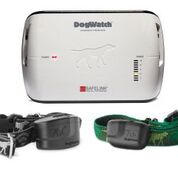
Dog Fence Solutions: Rural vs Urban Challenges
Finding the right dog fence solution is not always straightforward. A fence that works perfectly for one dog may be completely unsuitable for another. Some dogs jump, others dig, and determined escapees can find their way through surprisingly small gaps.
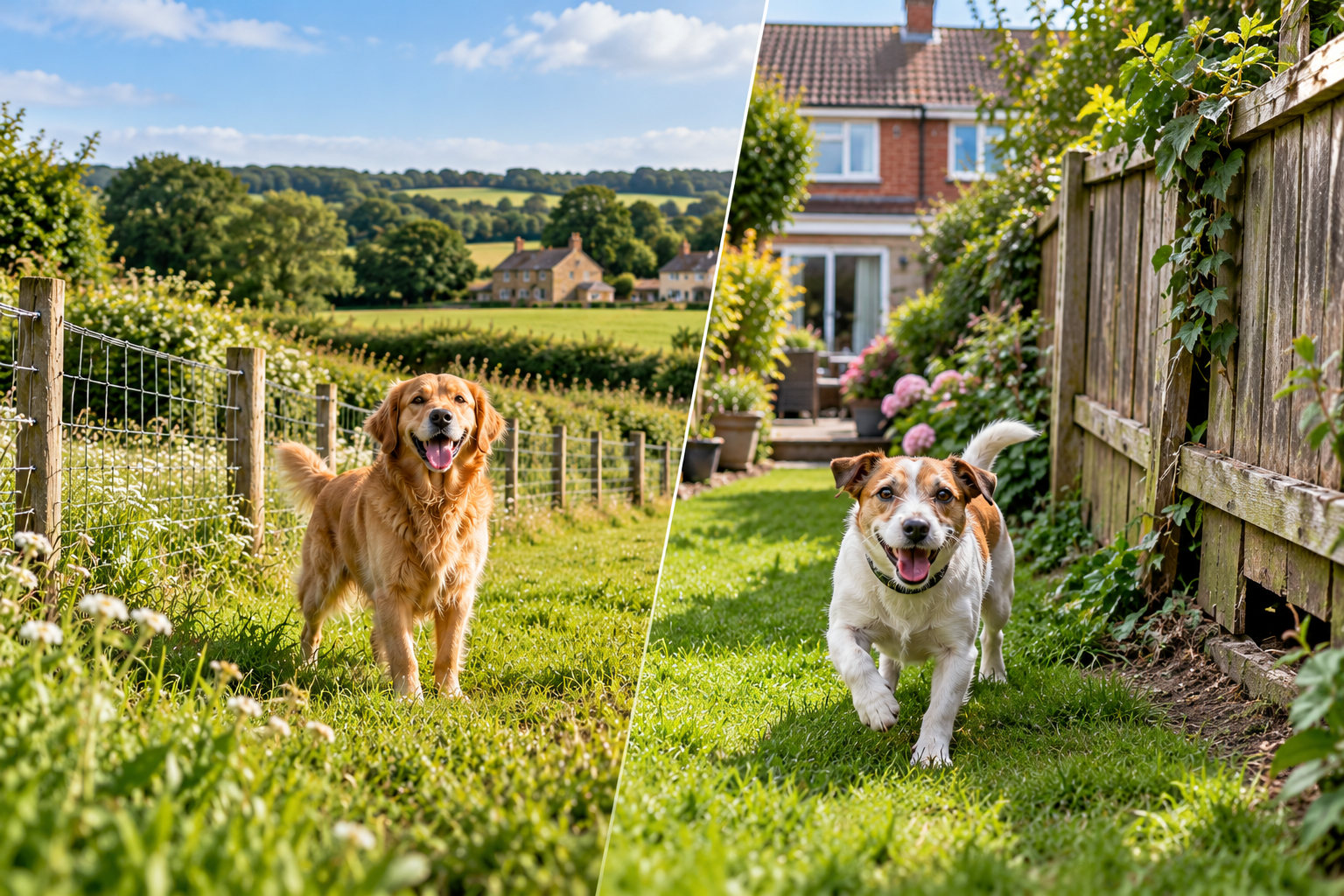
Where you live makes a difference too. A rural property with several acres, woodland and hedgerows presents very different challenges from a suburban garden with close board fencing and an open driveway.
At DogFence UK, we have been helping owners contain their dogs since 2003. Over more than 23 years, we have encountered almost every type of garden, boundary and escape attempt imaginable.
In this guide, we compare traditional and electronic dog fence solutions for rural and urban homes, including their advantages, limitations and the practical considerations that matter before you invest.
Why Dogs Escape (and Why Fencing Matters)
Dogs escape for many reasons. Some are motivated by wildlife, interesting smells or other dogs. Others are bored, anxious, highly energetic or simply determined to explore beyond the garden.
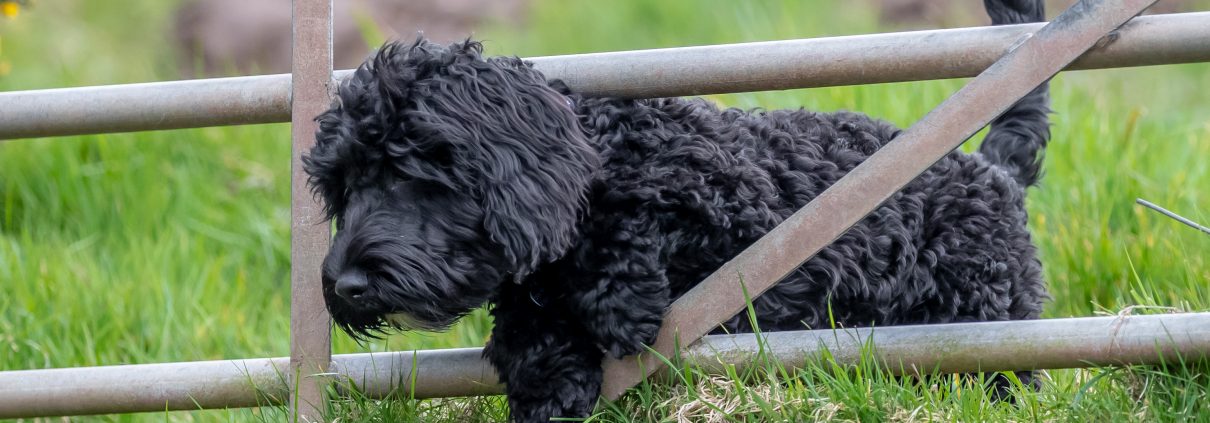
Even a substantial fence may not solve the problem if a dog has learned to jump over it, dig underneath it or squeeze through gaps.
For rural owners, hedgerows can be particularly deceptive. A thick hedge might look like a secure boundary, but rabbits, foxes and badgers can create openings that quickly become escape routes.
Urban gardens have their own problems, including low fencing, neighbouring gardens, open-plan frontages and driveways that cannot easily be gated.
If your dog regularly finds a way out, our guide to affordable dog fencing options explores alternative ways of securing your property.
Rural Dog Fence Options
Rural properties are often among the most challenging to fence. Uneven ground, steep slopes, streams, woodland and long boundaries can make conventional fencing expensive to install and maintain.
The right solution depends on the size and layout of the land, your dog’s behaviour, the presence of livestock or wildlife, and whether a physical barrier is essential.
1. Stock Fencing
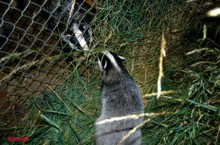
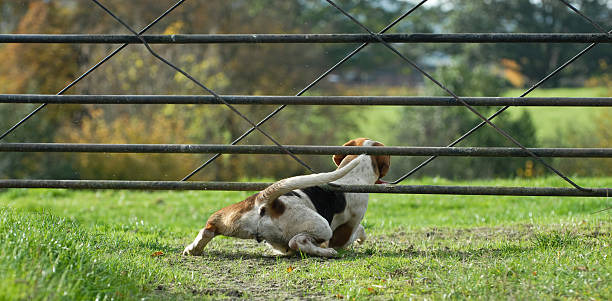
Wildlife can create gaps beneath stock fencing that dogs may use to escape.
Stock fencing is a familiar sight across the British countryside. Originally designed for livestock, it can also provide a practical boundary for dogs, particularly where there is already an established fence line.
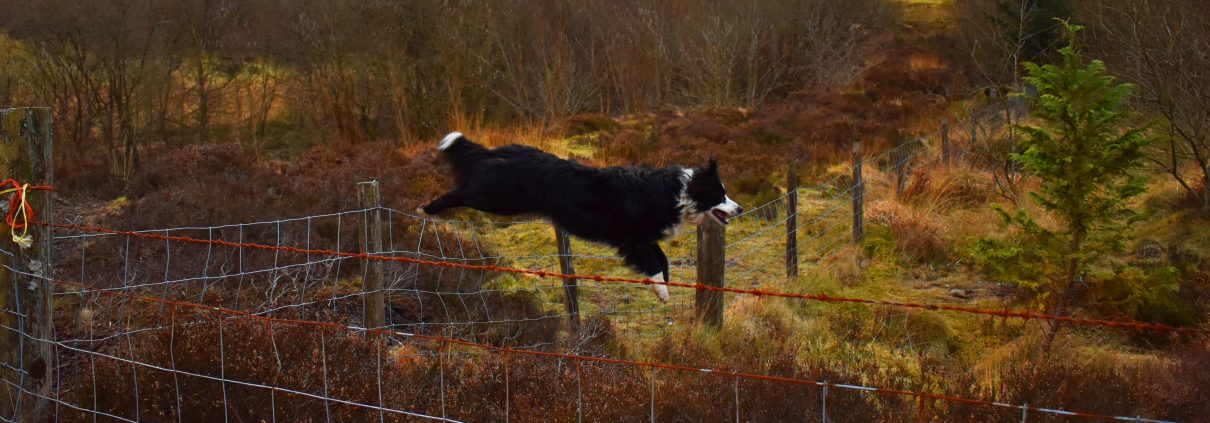
However, stock fencing is not automatically dog-proof. Smaller dogs may squeeze through the mesh, athletic dogs may jump it, and determined diggers can escape underneath.
Wildlife can also compromise the boundary. Badgers and foxes may create gaps beneath fencing, leaving openings that owners do not notice until their dog has disappeared.
Advantages: A physical barrier, suitable for long rural boundaries and useful where livestock also need containment.
Limitations: Installation and maintenance costs, potential wildlife damage, and the need for additional protection against digging or jumping.
2. Deer Fencing
Deer fencing is another option for larger rural gardens and estates. Its height can make it more effective than ordinary stock fencing for dogs that jump.
However, tall deer fencing can be visually intrusive, particularly around landscaped gardens or properties with attractive countryside views.
It can also be expensive across long boundaries. Although it provides a physical barrier, gaps at ground level or damage caused by wildlife can still create escape opportunities.
Advantages: Greater height, physical separation and suitability for certain rural boundaries.
Limitations: High installation costs, visual impact, ongoing maintenance and possible escape routes underneath.
3. Electronic Dog Fencing
For properties where traditional fencing is impractical, a professionally installed electronic dog fence can offer a discreet alternative.
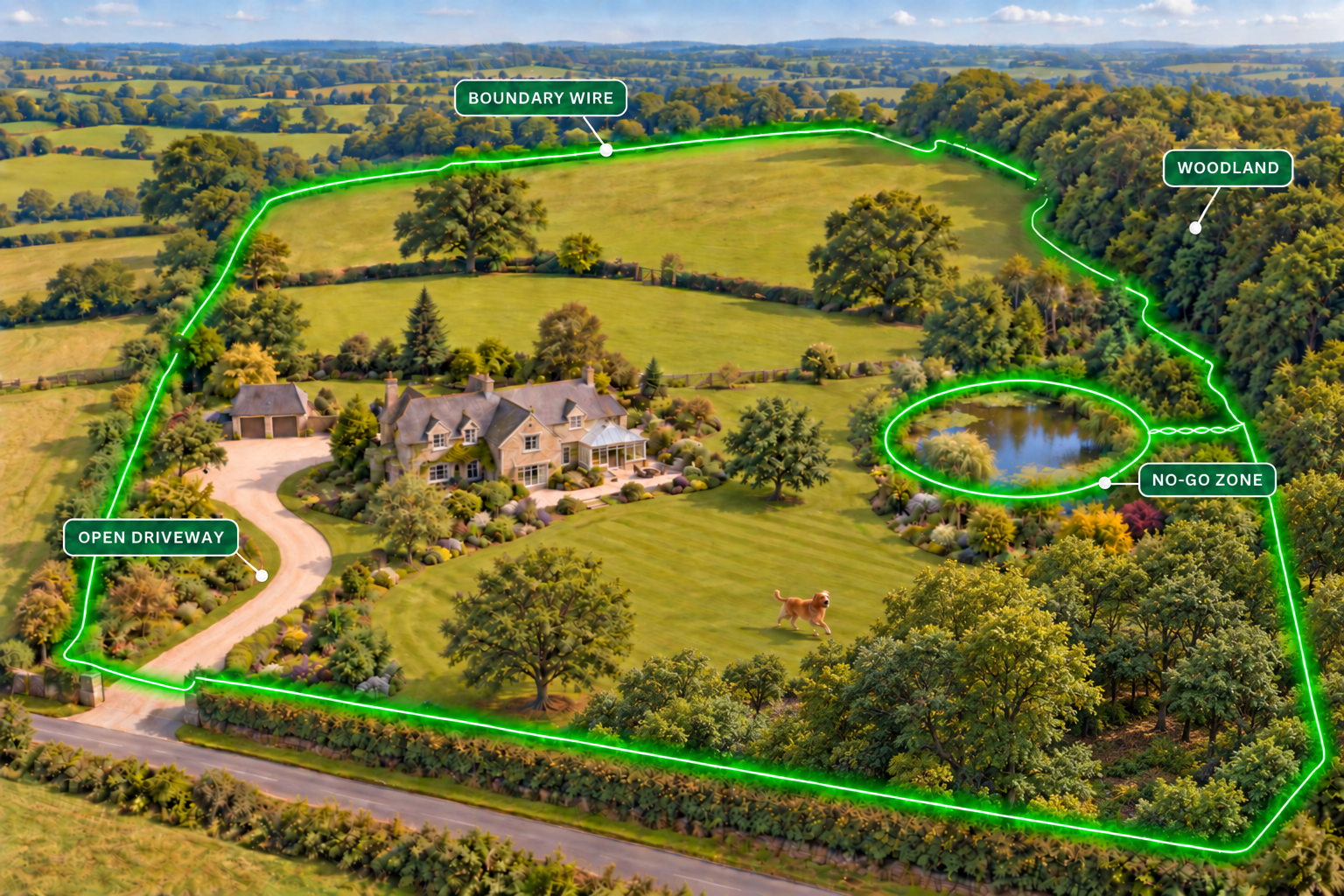
Unlike a physical fence, an electronic dog fence uses a boundary wire, transmitter and receiver collar to establish a designated containment area.
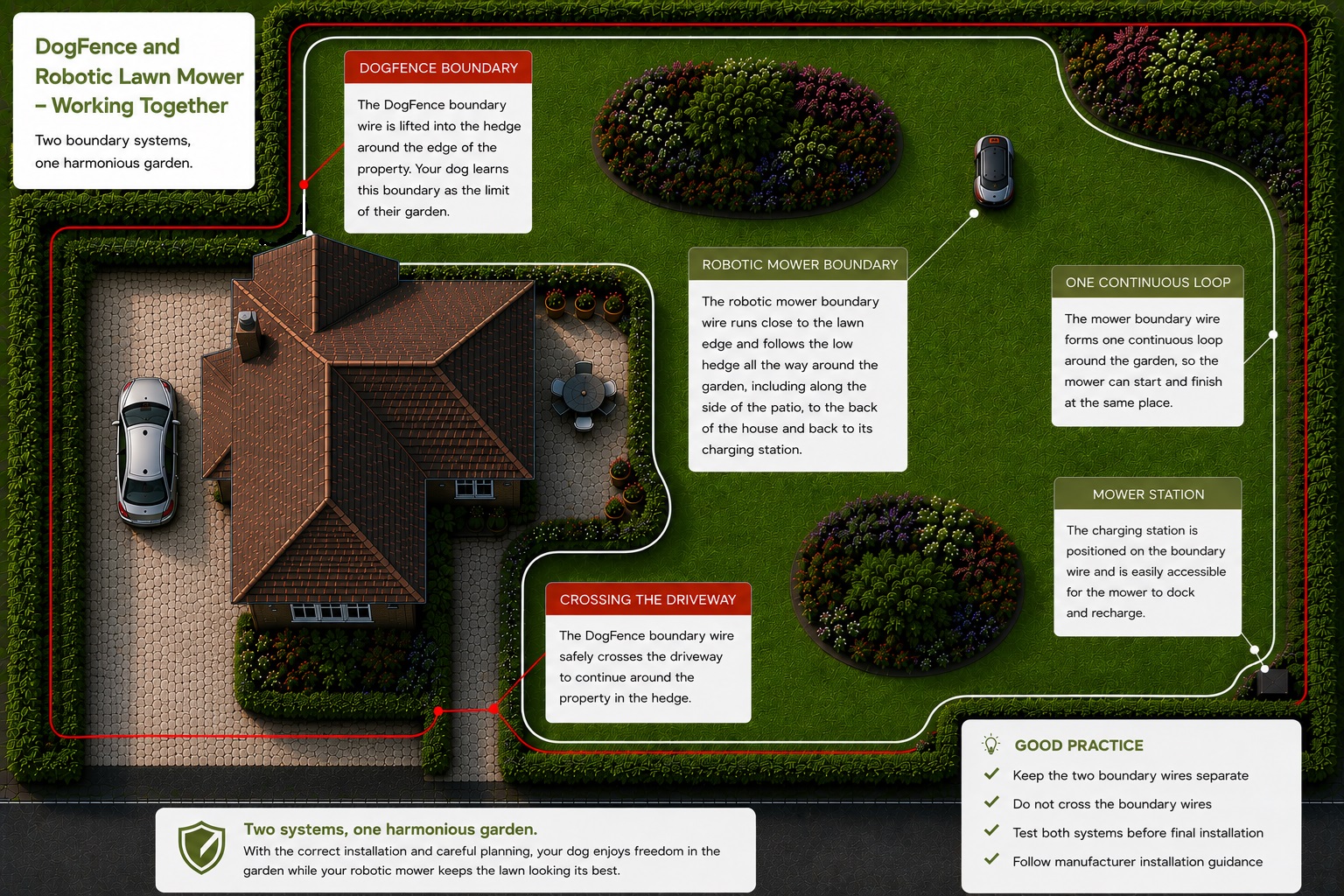
The cable can follow irregular boundaries, run through hedgerows and woodland, and cross suitable driveway surfaces without the need for a visible fence along every section.
During training, temporary flags mark the boundary. The dog learns to recognise the receiver collar’s audible warning and return towards the safe area. If the dog continues into the correction zone, the collar can deliver an adjustable static correction.
Professional assessment and structured training are essential. An electronic boundary is not a physical barrier, will not exclude wildlife or other dogs, and may not be suitable for every animal.
For larger properties, electronic containment can be particularly attractive because installation costs are not necessarily proportional to the acreage in the same way as conventional fencing.
Our guide to dog fencing for large properties explains how hidden boundaries can be designed around fields, woodland, slopes and complex rural layouts.
Advantages: Discreet installation, flexible boundary design, potential cost savings on large properties and the ability to incorporate open driveways.
4. Kennels and Dog Runs
A secure kennel or enclosed dog run can provide a useful containment option for rural properties, particularly when dogs need a supervised or temporary outdoor area.
A properly constructed run with secure sides, suitable roofing where necessary and protection against digging can provide physical containment without relying on an electronic collar.
However, the size and design matter. A small run is not a substitute for regular exercise, enrichment, companionship or opportunities to explore.
For dogs that spend significant time outdoors, sufficient space, shelter, shade, water and stimulation are essential.
Advantages: Physical containment, controlled access and suitability for specific situations.
Limitations: Restricted space, potential boredom, construction costs and ongoing cleaning and maintenance.
Urban Dog Fence Options
Urban gardens are often smaller than rural properties, but that does not necessarily make them easier to secure.
Many homes already have fences, walls or hedges, yet these may not prevent a determined dog from escaping. Low picket fencing, gaps beneath gates and open driveways are particularly common weaknesses.
Planning restrictions can also influence your choices. In England, fences and walls generally have permitted development height limits of 2 metres, or 1 metre where adjacent to a highway used by vehicles, although additional restrictions and exceptions apply. Always check the rules for your individual property before installing or raising a fence.
1. Close Board and Picket Fencing
Close board and picket fencing are some of the most popular choices for British gardens. Its solid construction provides privacy and, when correctly installed, can prevent many dogs from escaping.
It is available in different heights and can be adapted to suit a variety of garden layouts.
However, close board fencing is not always sufficient for persistent escapees. Some dogs dig beneath the panels, while others climb or jump over them.
Rotten posts, loose gravel boards and gaps around gates can also compromise an otherwise secure garden.
Advantages: Privacy, physical containment, familiar appearance and widespread availability.
Limitations: Can be expensive to replace, may restrict views, and does not automatically prevent digging or jumping.
For further comparisons, read our cheap dog fence ideas guide, which explains why the lowest initial price does not always provide the best long-term solution.
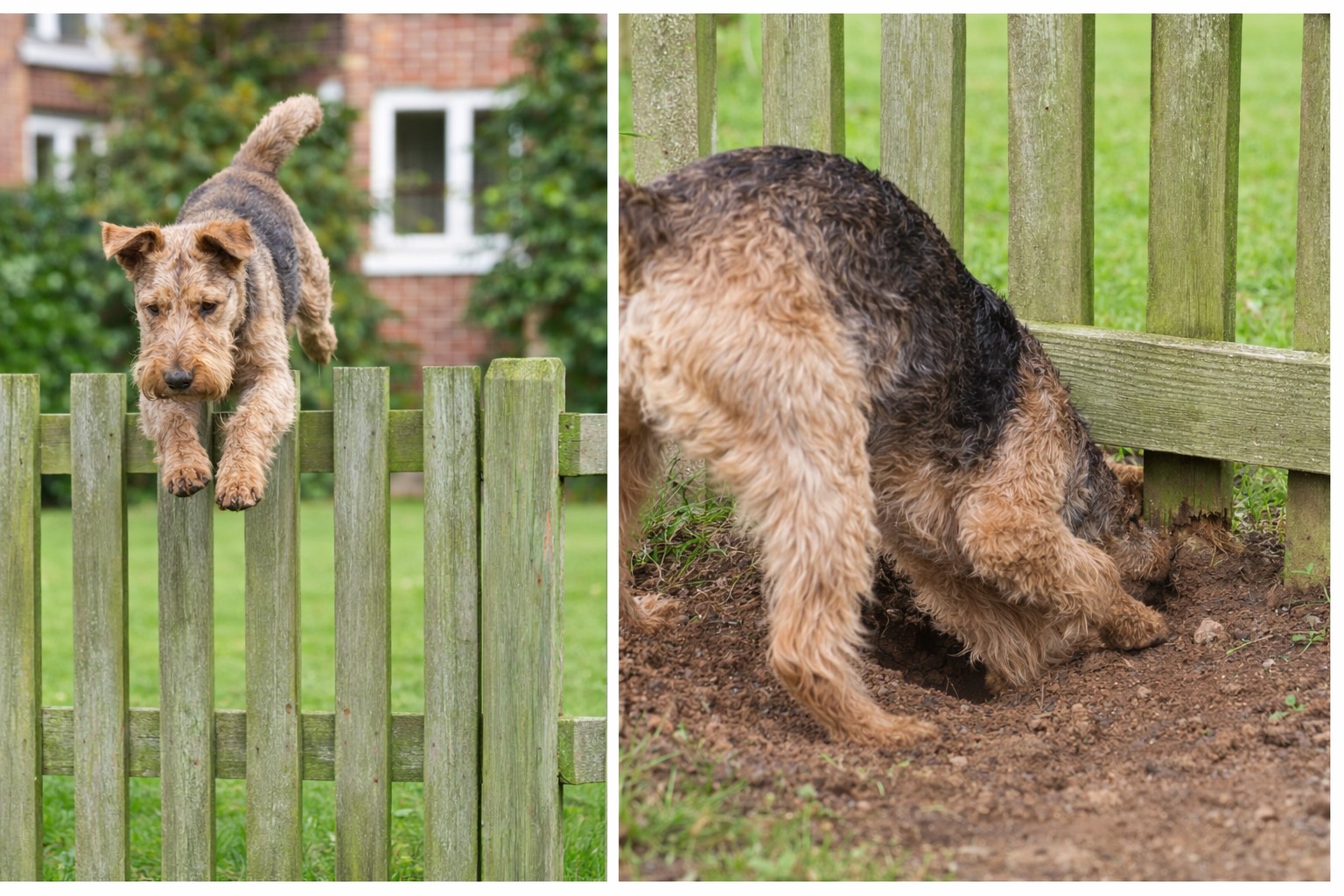
Instinct-driven behaviours like digging and jumping are not defiance — they’re rooted in how working dogs were bred to interact with their environment.
2. Electronic Dog Fencing – Without Installing Gates
Electronic dog fencing is not just for large country properties. It can also be useful for suburban homes, especially where a traditional fence already exists but is not keeping the dog contained.
For example, an electronic boundary can be installed inside an existing close board fence to help discourage a dog from jumping over or digging underneath it.
It can also be designed around an open driveway, allowing owners to establish a containment boundary without necessarily installing physical gates.
The cable can be routed discreetly around the garden and across suitable driveway surfaces, although the installation method will depend on the ground conditions and layout.
Our advanced electronic dog fence systems offer options for different garden sizes and dog requirements.
For owners of persistent escapees, a professionally designed boundary may provide an additional layer of containment where conventional fencing has repeatedly failed.
However, the dog must be trained to recognise the boundary. A collar alone will not teach a dog where it should stop.
Advantages: Can complement existing fencing, protect open driveways and preserve the appearance of the garden.
Limitations: Requires careful training and maintenance; does not stop other animals or people entering the property.
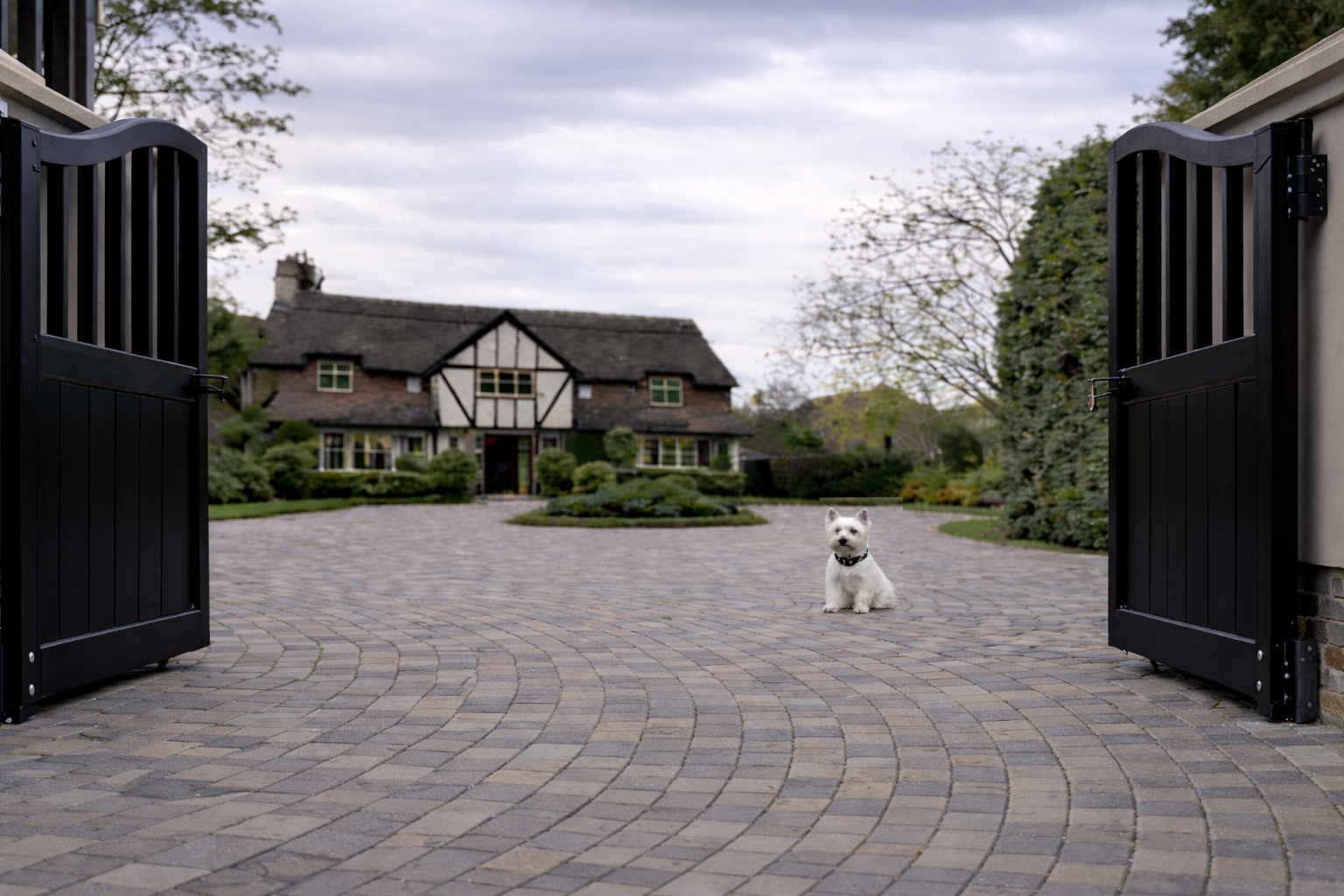
3. Cat Runs and Enclosed Garden Areas
Although primarily associated with cats, enclosed garden runs can sometimes be adapted for smaller dogs or for pets requiring a dedicated outdoor area.
These structures may be useful where the owner wants a physical enclosure without fencing the entire garden.
However, they can be costly, visually prominent and restrictive if the enclosed area is too small.
If you also own cats, our cat fence systems provide another containment option, subject to an individual assessment and suitable training.
Rural vs Urban Dog Fencing: Which Solution Is Best?
There is no single dog fence that suits every property. The most appropriate option depends on your dog’s behaviour, the size of your garden, your budget and whether you need a physical barrier.
| Dog Fence Solution | Best Suited To | Main Consideration |
|---|
| Stock fencing | Rural properties and fields | Gaps, digging and wildlife damage |
| Deer fencing | Large rural gardens and estates | Height, cost and visual impact |
| Close board fencing | Urban and suburban gardens | Jumping, digging and maintenance |
| Electronic dog fencing | Rural and urban properties | Training, suitability and maintenance |
| Kennels and enclosed runs | Dedicated secure outdoor areas | Space, exercise and enrichment |
Unusual DIY Dog Fencing Attempts We’ve Seen Over the Years
After more than two decades of installing dog fences, our team has encountered some remarkably inventive attempts to keep dogs at home.
Among the more unusual solutions we have seen are:
- Old fireplaces used to block gaps in hedgerows.
- Garage doors positioned along garden boundaries.
- Bright orange builders’ netting used as a temporary fence.
- Dogs tethered to stakes, only to become tangled around them.
- Electric horse fencing used in an attempt to contain dogs.
While some of these approaches may have seemed like quick fixes, they can create new safety problems or fail to address the reason the dog is escaping.
In particular, tethering can create entanglement and injury risks, while livestock electric fencing is not designed as a substitute for a properly assessed domestic dog containment system.
Rather than repeatedly patching escape routes, it is worth identifying how and why your dog is getting out and choosing a solution designed for that behaviour.
Why Professional Dog Fence Training Matters
Whether you live in a small urban garden or on a large rural estate, successful electronic containment depends on more than the equipment.
Dogs need to understand where the boundary is and what the warning signal means. This is why DogFence includes personalised training with its professional installations.
Temporary flags make the boundary visible during the learning process. The dog is gradually introduced to the warning tone and taught to return confidently towards the safe area.
The training should be appropriate for the individual dog’s age, temperament, health and behaviour. Not every dog will be suitable for electronic containment, and a professional assessment can help identify concerns before installation.
Frequently Asked Questions About Dog Fence Solutions
What is the best dog fence for a rural property?
For rural properties, the best solution depends on acreage, terrain, wildlife, livestock and the dog’s behaviour. Stock fencing and deer fencing provide physical barriers, while a professionally installed electronic dog fence can offer a discreet alternative for large or irregular boundaries.
What is the best dog fence for a small garden?
Close board fencing is a popular physical option for smaller gardens. Where a dog jumps, digs or escapes through an open driveway, a professionally designed electronic dog fence may be worth considering as an additional containment measure.
Can a dog fence stop a dog digging underneath fencing?
A secure physical fence with appropriate ground-level protection can help prevent digging escapes. An electronic dog fence can also be positioned inside an existing boundary, with training to help the dog recognise and avoid the designated area.
Can an electronic dog fence cross a driveway?
Yes. Professionally installed wired dog fences can incorporate many gravel, tarmac and block-paved driveways. The installation method depends on the surface, layout and required boundary design.
Is electronic dog fencing cheaper than traditional fencing?
It can be, particularly on larger properties with long or difficult boundaries. However, the final cost depends on perimeter length, ground conditions, number of dogs and installation requirements. Comparing like-for-like quotations is the best approach.
Does an electronic dog fence work for every dog?
No. Suitability depends on the dog’s individual temperament, health, behaviour and ability to learn the boundary. Appropriate training and professional guidance are important, and some dogs may be better suited to a secure physical enclosure.
Need Help Choosing the Right Dog Fence for Your Property?
Every dog and every garden is different. Whether you are trying to secure several acres of countryside, protect an open driveway or stop a determined digger escaping beneath an existing fence, DogFence can help you assess the options.
We have been professionally installing dog containment systems in the UK since 2003, combining individually designed boundaries with personalised dog training and ongoing support.
DOGFENCE UK • SINCE 2003
Every Garden Is Different. So Is Every Dog.
From rural estates to suburban gardens, discover a professionally designed dog fence solution that works for your property and your dog.
GET MY FREE DOG FENCE QUOTE →
Some images in this article may be AI-generated for illustrative purposes.