Can an Invisible Dog Fence Be Installed Around Trees, Streams and Woodland?
An invisible dog fence around trees, streams and woodland can usually be professionally installed without spoiling the look of your garden. Hidden dog fences, underground dog fences and electronic dog fence systems are designed to work with natural landscapes, including mature trees, wooded areas, ponds, streams, sloping ground and large rural gardens.
If you have a garden that is difficult to fence traditionally, an invisible dog fence may be one of the most practical ways to keep your dog safely contained while preserving the natural appearance of your property. Rather than relying on visible fence panels, posts or gates, the system uses a discreet boundary wire and structured training to teach your dog where they can and cannot go.
At DogFence, we have been helping UK dog owners keep pets safely contained since 2003. Our systems are particularly useful for country homes, woodland gardens, large properties, paddocks and homes where traditional fencing would be expensive, unattractive or difficult to install.
Why an Invisible Dog Fence Works Well Around Trees, Streams and Woodland
One of the biggest advantages of an invisible dog fence is flexibility. A traditional fence usually needs straight runs, posts, level ground and physical access for installation. A hidden dog fence is different because the boundary can follow the natural shape of your property.
This makes invisible dog fencing suitable for many gardens with:
Mature trees
Woodland paths
Streams and ponds
Sloping lawns
Banks and ditches
Large rural gardens
Paddocks and open land
Orchards and natural landscaping
Because the boundary wire is usually buried just below the surface, the finished result is discreet. Your garden still looks like your garden, but your dog learns a clear, safe boundary.
If you are new to this type of system, you may find our guide to how the DogFence system works helpful before deciding whether it is right for your property.
Can an Invisible Dog Fence Go Around Trees?
Yes, an invisible dog fence can usually go around trees. In many gardens, trees are not a problem at all. The boundary wire can be routed carefully around wooded areas, through natural paths or along existing garden edges without the need to remove trees or install visible fencing.
During a professional installation, care is taken to avoid major roots where possible. The route of the underground dog fence can be adjusted to suit the natural features of the garden, meaning mature trees can often remain completely undisturbed.
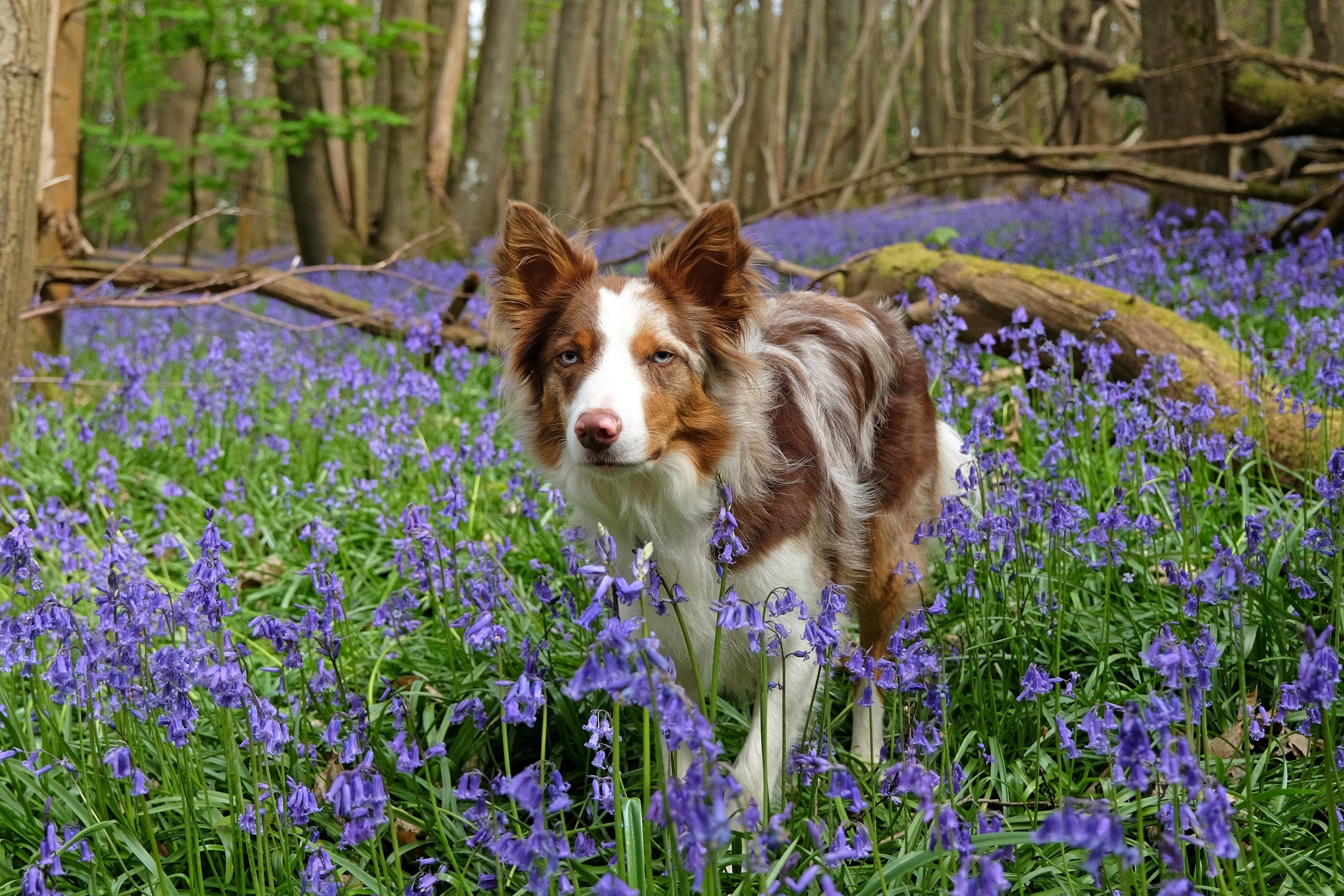
This is especially useful for owners who want their dogs to enjoy woodland areas safely. Instead of fencing off the trees, an invisible dog fence can include the woodland within the safe containment area, giving your dog space to explore while helping to stop them wandering beyond your boundary.
Can an Underground Dog Fence Cross Streams or Wet Ground?
In many cases, yes. An underground dog fence can often cross shallow streams, damp ground and other natural wet areas using suitable installation techniques. Water itself is not usually the deciding factor; the important point is choosing the right route and installation method for the property.
Every garden is different. A small stream in a rural garden may be simple to work with, while deeper water, moving banks or very boggy areas may need a more considered approach. That is why a professional survey is so valuable. It allows the installer to assess the safest and most reliable route for the boundary wire.
For properties with ponds, lakes or streams, the system can also be used to create internal avoidance zones. This means your dog can enjoy the garden but be trained to stay away from water hazards if needed.
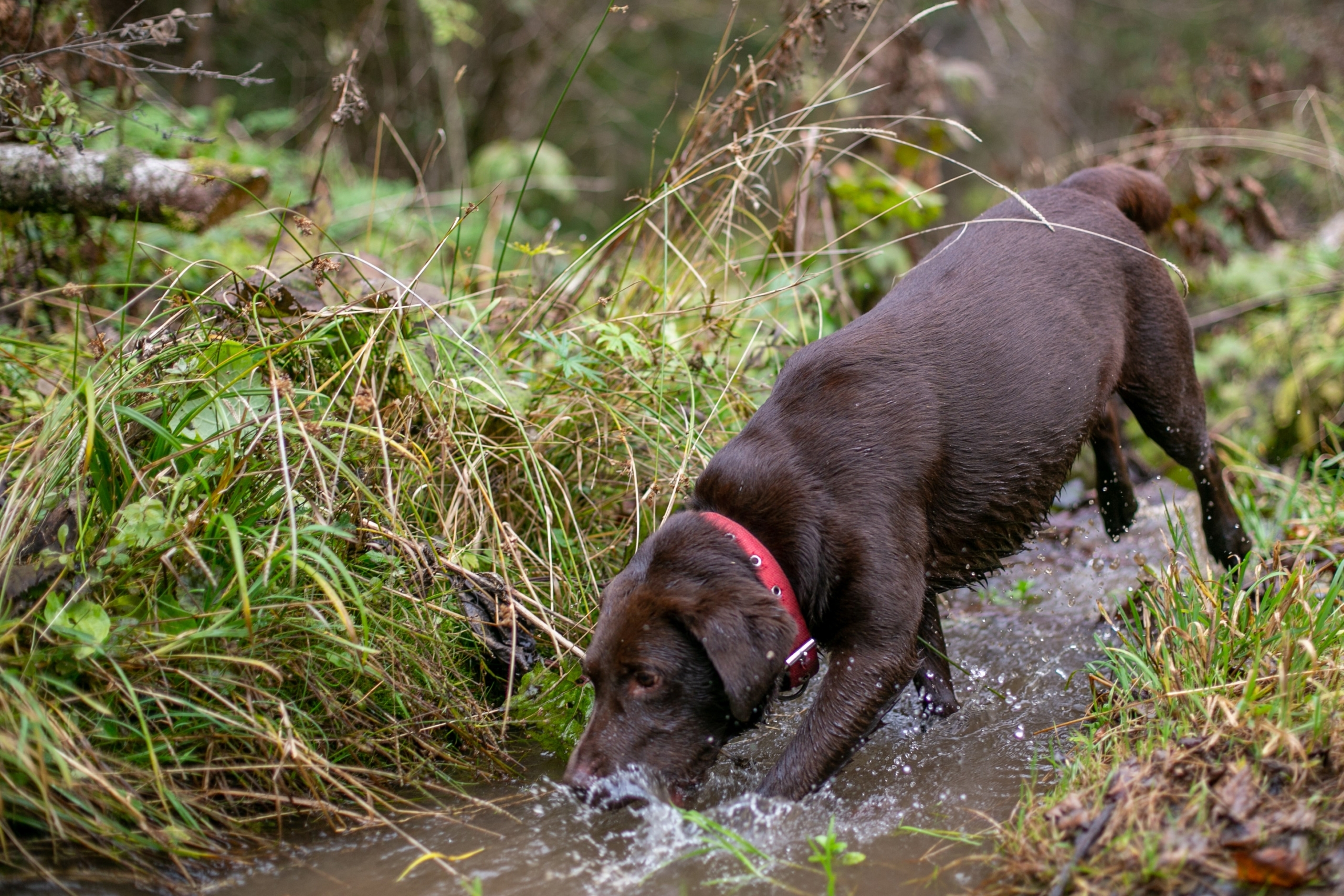
Dog Fence can be used to exclude dogs from streams or even run through small streams
Invisible Dog Fences for Woodland Gardens and Rural Properties
Woodland gardens and rural properties are often difficult and expensive to secure with traditional fencing. They may have uneven ground, dense planting, natural boundaries, wildlife corridors or planning considerations that make visible fencing less attractive.
An invisible dog fence for woodland gives owners a way to create a safe dog containment area without changing the character of the landscape. The boundary can often follow paths, hedgerows, tree lines or the edge of a property, depending on the layout.
This is one reason hidden dog fences are popular for:
Country houses
Large gardens
Homes with woodland
Rural estates
Properties near fields or livestock
Gardens where visible fencing would spoil the view
For larger or more complex properties, professional design is important. You can read more about our professional dog fence installation service and how we install systems across England.
Do Invisible Dog Fences Work on Slopes, Banks and Uneven Ground?
Yes. Sloping ground and uneven gardens are normally well suited to invisible dog fencing. Unlike timber fencing or metal panels, a hidden dog fence does not need the land to be level. The wire can follow the contours of the garden and can often be installed around awkward features that would make traditional fencing more difficult.
This makes an electronic dog fence a practical solution for gardens with:
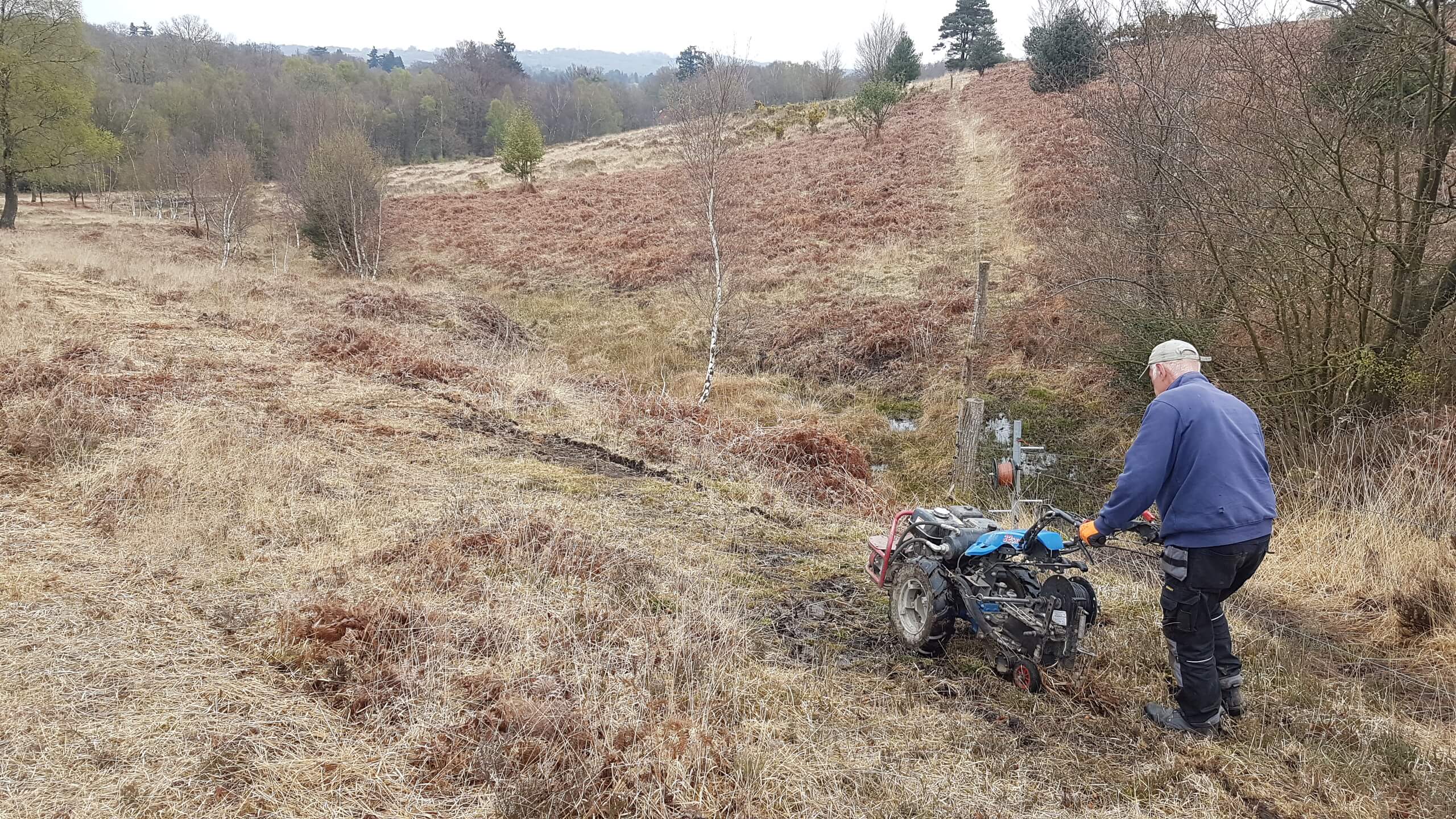
Dog Fences can be installed on even ground and slopes
Can an Invisible Dog Fence Protect Ponds, Streams, Flower Beds and Driveways?
Yes. An invisible dog fence does not only have to run around the outer edge of a garden. It can also be designed to keep dogs away from specific areas inside the property.
These internal avoidance zones are useful around:
Streams
Garden ponds
Swimming pools
Flower beds
Vegetable gardens
Children’s play areas
Open driveways
Electric gates
This allows your dog to enjoy more freedom while helping reduce the risk of accidents. For owners worried about dogs bolting through gates or driveways, our guide on keeping dogs safe around open driveways and electric gates explains how boundary training can help in high-risk areas.
Why Hidden Dog Fences Are Often Better Than Traditional Fencing in Natural Gardens
Traditional fencing can work well in some gardens, but it is not always the best solution for natural or rural properties. Timber fencing can be expensive over long distances, may need ongoing maintenance and can alter the appearance of the garden. It can also be difficult to install through woodland or around streams.
A hidden dog fence keeps the landscape open. There are no large panels blocking the view, no need to fence off attractive areas and no obvious change to the style of the property.
For owners of rural homes, this can be a major advantage. You can keep the natural look of the garden while still creating a reliable dog containment system. If appearance is one of your concerns, our article on how to secure your dog without ruining your garden’s curb appeal may also be useful.
How Professional Installation Helps on Complex Properties
Although some simple gardens may be suitable for DIY installation, more complex properties usually benefit from professional design and installation. Trees, streams, banks, driveways, outbuildings and multiple garden zones all need to be planned carefully.
A professional DogFence installation considers:
The safest boundary route
Where your dog naturally runs or explores
Access points, gates and driveways
Natural hazards such as water or drops
How to avoid major tree roots
Whether internal exclusion zones are needed
The correct training approach for your dog
Training is just as important as the equipment. Dogs need to understand the boundary calmly and consistently. Our guide to training your dog to an electronic fence the right way explains why correct training makes such a difference.
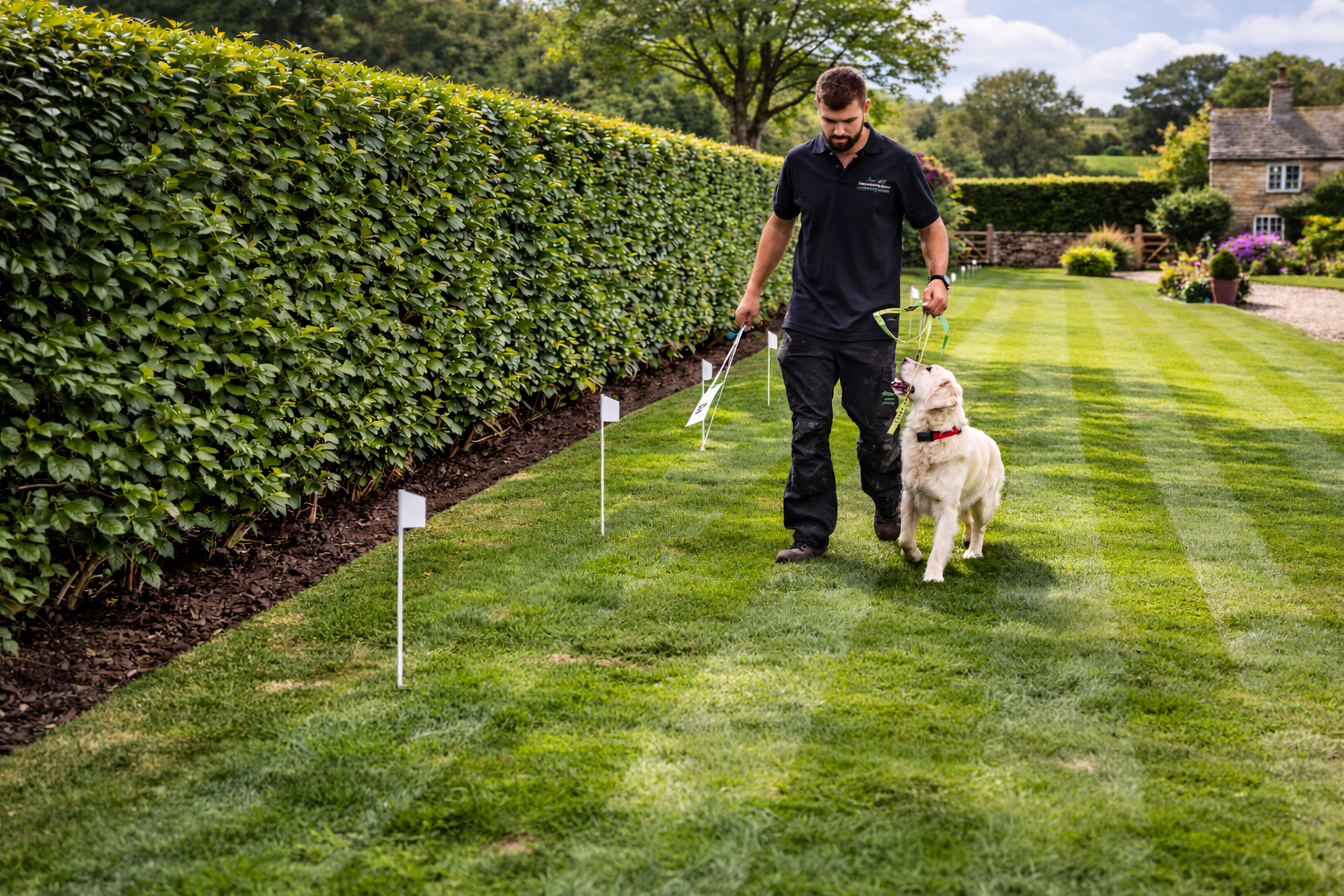
When we install your dog fence we also train your dog as part of our service
Is an Invisible Dog Fence Safe and Humane?
When used responsibly, professionally installed and supported with proper training, invisible dog fences are designed to help keep dogs safe within their home environment. The aim is not to frighten the dog, but to teach a clear boundary using a warning tone first, followed by a brief static correction only if the dog continues towards the boundary.
Most dogs quickly learn to respond to the warning tone and avoid the boundary. The system should always be introduced gradually and carefully, with guidance suited to the individual dog.
Frequently Asked Questions About Invisible Dog Fences Around Trees, Streams and Woodland
Can an invisible dog fence be installed in woodland?
Yes. An invisible dog fence can usually be installed in woodland because the boundary wire can follow natural paths, tree lines and existing garden edges. This allows dogs to enjoy wooded areas while remaining safely contained.
Can an invisible dog fence go around trees?
Yes. Trees are normally easy to work around. The boundary wire can be routed carefully to avoid major roots while still creating a reliable hidden dog fence around the garden.
Will tree roots damage the dog fence wire?
Tree roots do not usually damage the wire when the system is installed correctly. A professional installer will choose a route that avoids unnecessary disturbance to major roots and protects the long-term reliability of the boundary.
Can an underground dog fence cross a stream?
In many cases, yes. An underground dog fence can often cross shallow streams or damp areas using suitable installation methods. The best approach depends on the depth, banks and overall layout of the property.
Can an invisible dog fence keep my dog away from a pond?
Yes. Internal avoidance zones can be created around ponds, streams, swimming pools or other water features to help train your dog to stay away from those areas.
Does uneven ground affect an invisible dog fence?
No. Uneven ground, slopes and banks do not normally affect how an invisible dog fence works. The boundary wire can usually follow the natural contours of the land.
Is an invisible dog fence suitable for large gardens?
Yes. Invisible dog fences are often particularly suitable for large gardens, rural properties and country homes where traditional fencing would be expensive, impractical or visually intrusive.
Can I install an invisible dog fence myself in woodland?
Some practical owners can install simple systems themselves, but woodland, streams and uneven ground usually benefit from professional planning. If you are considering DIY, our self-installing dog fence guide explains what is involved.
Will an invisible dog fence spoil the look of my garden?
No. Once installed, the boundary is discreet and usually hidden from view. This is one of the main reasons owners choose hidden dog fencing for landscaped gardens, woodland and rural properties.
Why Choose DogFence for Woodland and Rural Dog Containment?
DogFence has been supplying and installing professional hidden dog fence systems across the UK since 2003. Our systems are designed for real homes, real gardens and real dogs, including properties with trees, streams, slopes, woodland and complex boundaries.
We can help you decide whether your property is suitable, where the boundary should run and whether any internal avoidance zones would be helpful. We also provide training guidance so your dog learns the system safely and confidently.
If you are looking for an invisible dog fence around trees, a hidden dog fence for woodland or an underground dog fence for a rural property, DogFence can help design a solution around your garden.
https://dogfence.co.uk/wp-content/uploads/2026/06/dog-in-stream-using-dog-fence-scaled.jpg17072560Sam Folleyhttps://www.dogfence.co.uk/wp-content/uploads/2015/10/dogfences_logo_main_cats_orange2.pngSam Folley2026-06-30 07:00:352026-06-26 15:31:31Invisible Dog Fence Around Trees, Streams & Woodland | DogFence UK
When you pay for a professional invisible dog fence installation, you are getting much more than a boundary wire buried around your garden. A professional installation should bring together the right equipment, a carefully planned boundary, correct system setup, individual dog training and ongoing support.
At DogFence, we provide a complete professionally installed dog containment system. From deciding where the boundary should run and installing the cable to setting up the receiver collar and training your dog, each part of the installation is designed around your property and your dog.
Quick Answer: What Is Included in a Professional Invisible Dog Fence Installation?
A professional DogFence installation includes boundary planning, installation of the underground boundary cable, transmitter and receiver collar setup, individual dog training and ongoing support. The system can be designed around your property, including existing fences, hedges, driveways, woodland and other areas that need to be included or excluded.
Key Takeaways
A professional invisible dog fence installation includes much more than simply installing an underground boundary cable.
Your boundary should be individually planned around your garden, driveway, existing fencing, hedges and any areas you want your dog to avoid.
Professional installation includes setting up the transmitter and receiver collar correctly for your property and your dog.
Individual dog training is an essential part of a DogFence installation, helping your dog learn to recognise the warning and retreat into the safe area.
Professional installation also provides ongoing support and aftercare, so you have help available after the initial installation and training.
What Does a Professional Invisible Dog Fence Installation Include?
A professional invisible dog fence installation combines the equipment, boundary design, installation and dog training into one complete containment system. Each element needs to work together to create a clear, consistent boundary that your dog can learn to understand.
At DogFence, the process starts with your property and your dog. We look at where you want your dog to have freedom, where the boundary needs to run and whether there are particular areas or escape points that need to be considered.
The finished boundary can be designed around existing fencing, hedges, walls, gates, driveways, woodland and irregularly shaped gardens. It can also be adapted for larger rural properties where installing conventional dog-proof fencing around the entire perimeter may not be practical.
A professional installation then brings together the underground boundary cable, transmitter and receiver collar, followed by individual training to teach your dog how to recognise and respond to the boundary.
Every professional invisible dog fence installation should start with the boundary design. The aim is not simply to follow the edge of the garden, but to create a safe area that works with the way your property is laid out and how your dog uses it.
An experienced installer will consider existing fences and hedges, open gateways, driveways, woodland, changes in terrain and any particular places where your dog has previously escaped.
The boundary can also be designed to keep dogs away from specific areas within the property, such as ponds, vegetable gardens or other places you would prefer them not to enter.
For country homes and larger plots, the design may be very different from a typical residential garden. Read our guide to invisible dog fencing for rural properties to see how underground boundaries can work around paddocks, woodland, open entrances and more complex properties.
Installing the Underground Boundary Cable
Once the boundary has been planned, the next stage is installing the cable that creates the invisible dog fence boundary.
The cable follows the agreed route around the property and can be installed in different ways depending on the garden and terrain. It may be buried beneath lawns, routed discreetly through hedging or attached to suitable existing fencing or walls.
A professional underground dog fence installer will also plan how the boundary passes across features such as paths, gateways and driveways, while maintaining a continuous and reliable signal around the chosen containment area.
Where an internal area needs to be kept off limits – such as a pond, vegetable garden or another part of the property – the boundary can also be designed to create additional exclusion zones.
The important point is that the cable layout is designed for the individual property. A professionally installed wired system can follow irregular boundaries and complicated garden layouts rather than restricting the dog to a standard circular area.
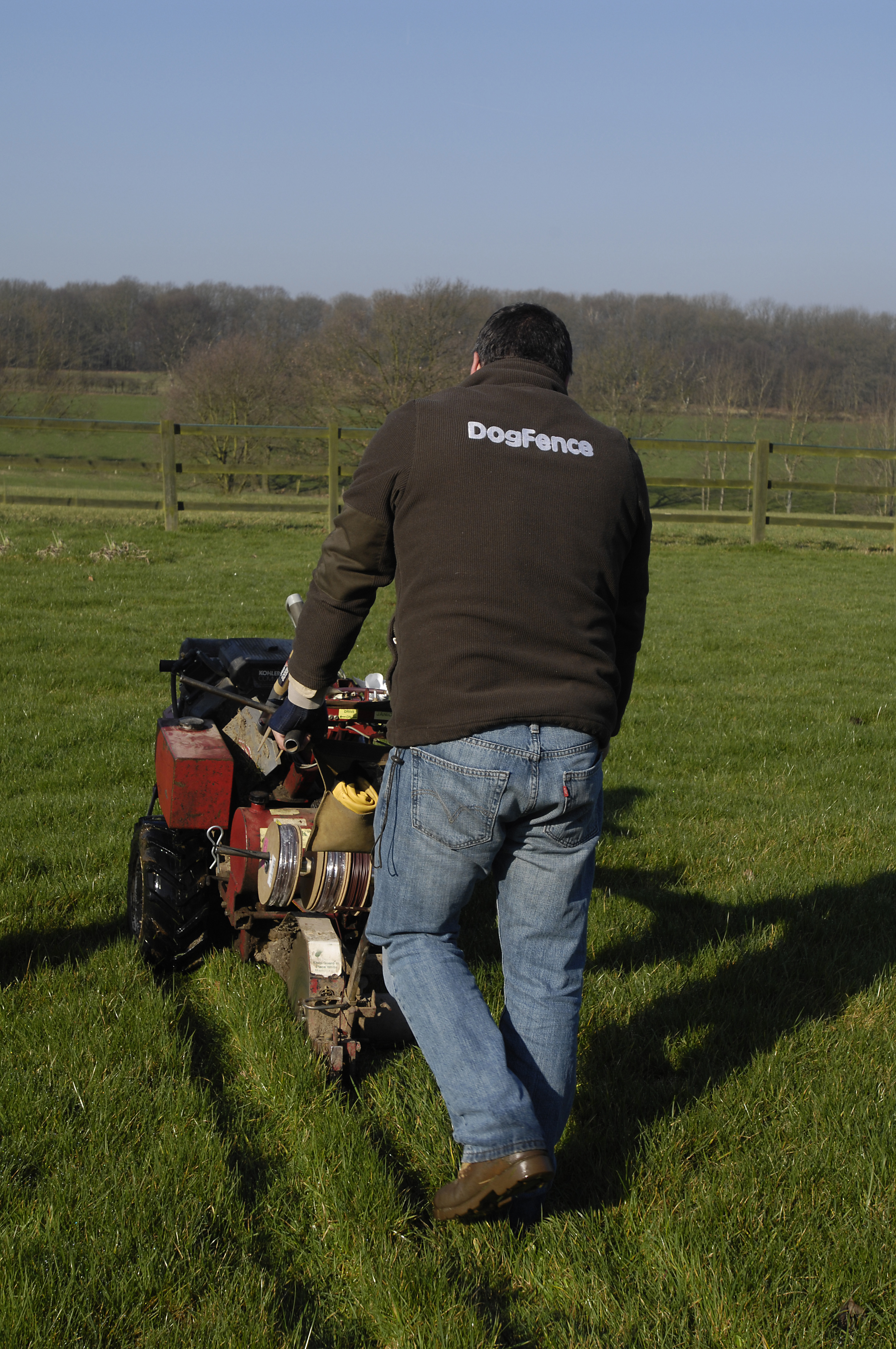
Using the dog fence trencher to install the underground dog fence wire.
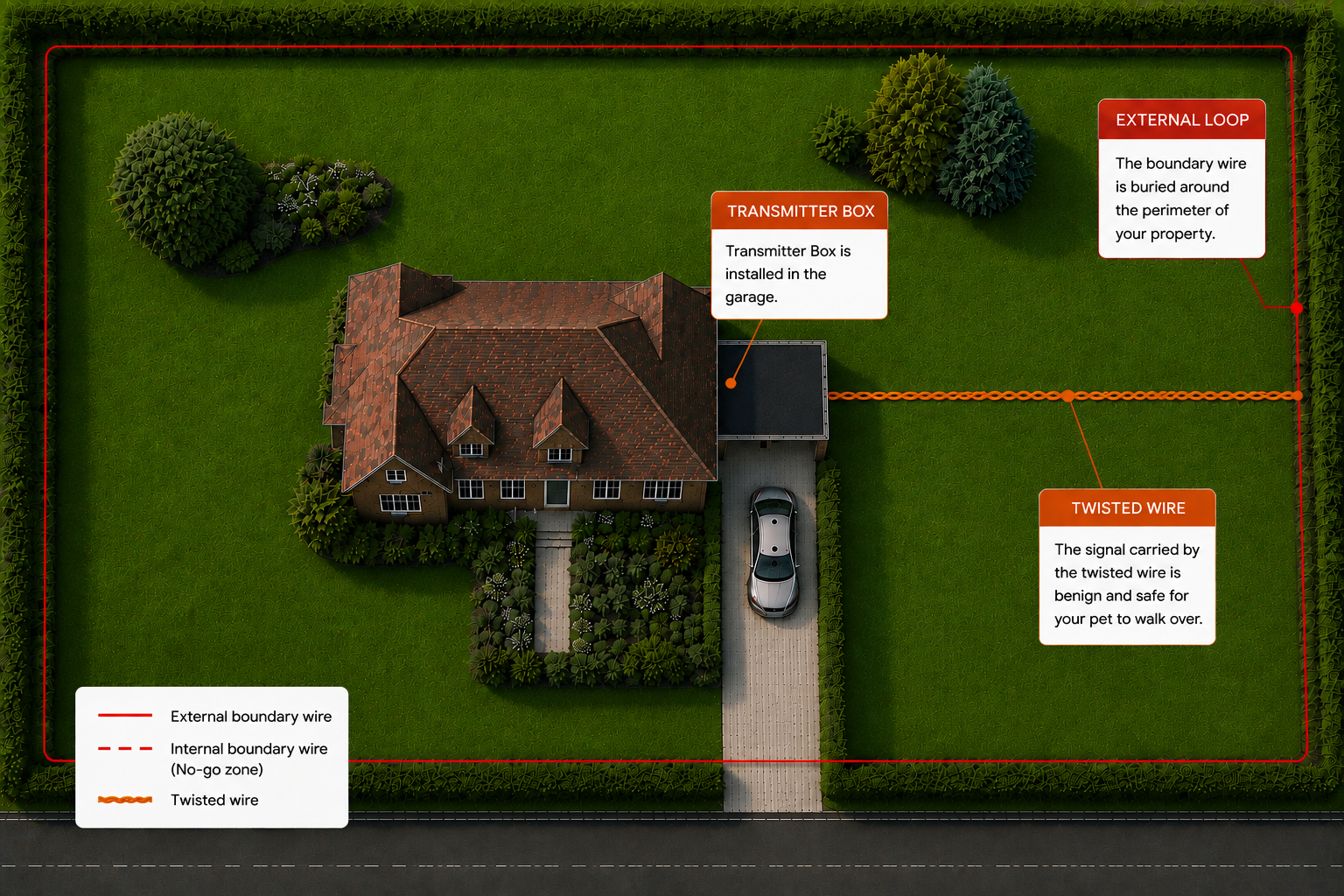
What About the Return Loop?
The boundary cable must form a complete loop back to the transmitter. Where the layout requires the cable to travel between sections without creating an active boundary, twisted cable can be used to connect parts of the system while cancelling the signal along that particular route.
A standard Dog Fence layout showing the continuous circuit and the connecting twisted cable from the transmitter to the boundary
Setting Up the Transmitter and Receiver Collar
Once the boundary cable is installed, the transmitter and receiver collar need to be set up correctly for the property and the individual dog.
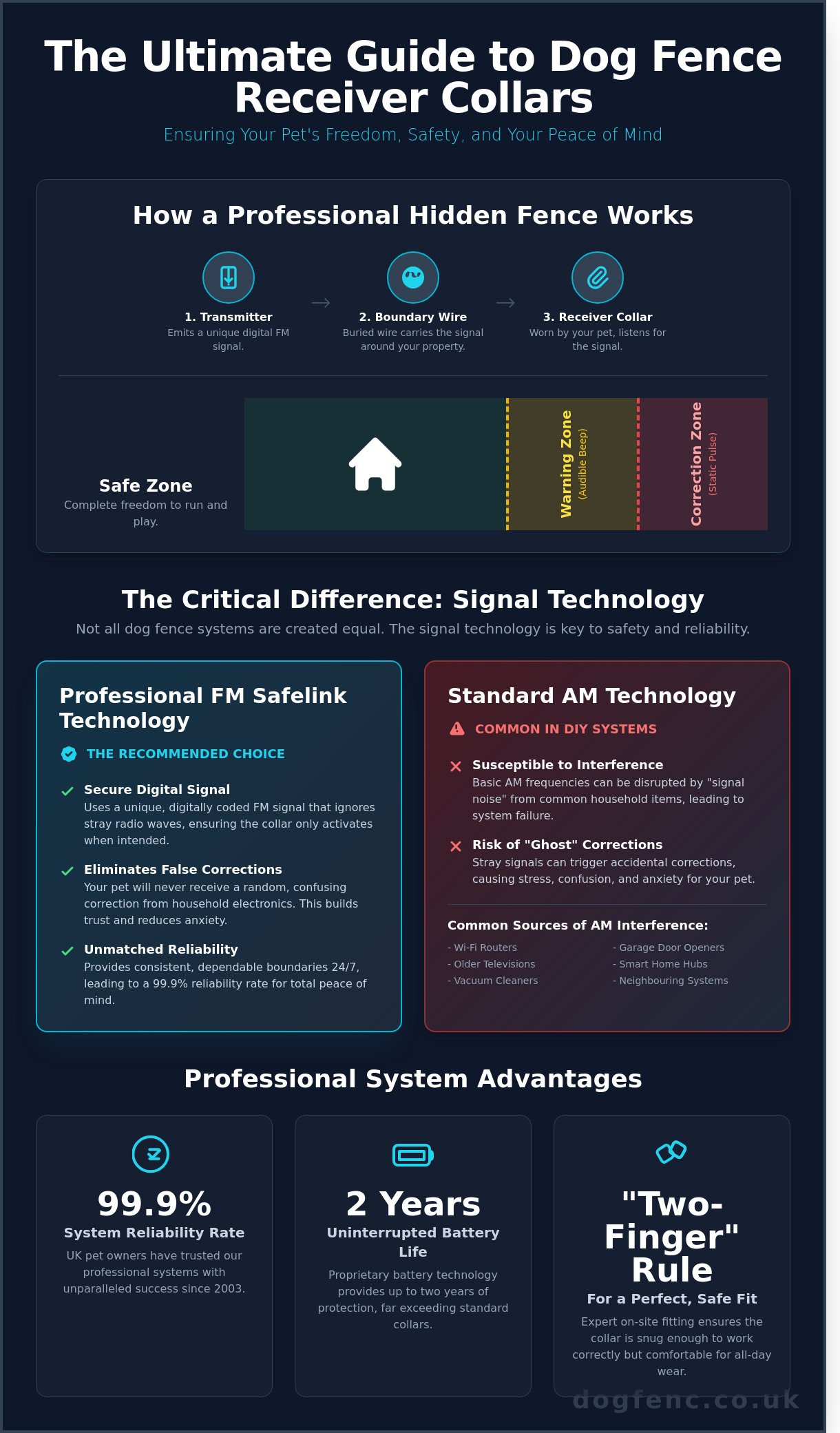
DogFence uses a digital FM signal to create the boundary. The transmitter sends the signal through the installed boundary cable, while the dog wears a lightweight receiver collar that detects the signal as they approach the boundary.
The receiver first gives the dog an audible warning as they approach the boundary. If they continue forward, the collar provides a correction. The purpose of the training is to teach the dog to recognise that warning tone and turn back into the safe area before progressing any further.
Professional setup is important because dogs are individuals. The receiver collar should be fitted correctly and the system introduced appropriately for the dog’s size, temperament and response during training.
The technology and training therefore work together. A fast, accurate boundary signal gives the dog a consistent point to respond to, while the training teaches them exactly what that signal means.
Want to understand the technology in more detail? Read our guide to how an invisible dog fence works to learn more about the transmitter, boundary cable and receiver collar.
Does Professional Dog Fence Installation Include Training?
Yes. With DogFence, professional invisible dog fence installation includes individual dog training. Installing the equipment is only part of the process – your dog also needs to understand where the new boundary is and how to respond to it.
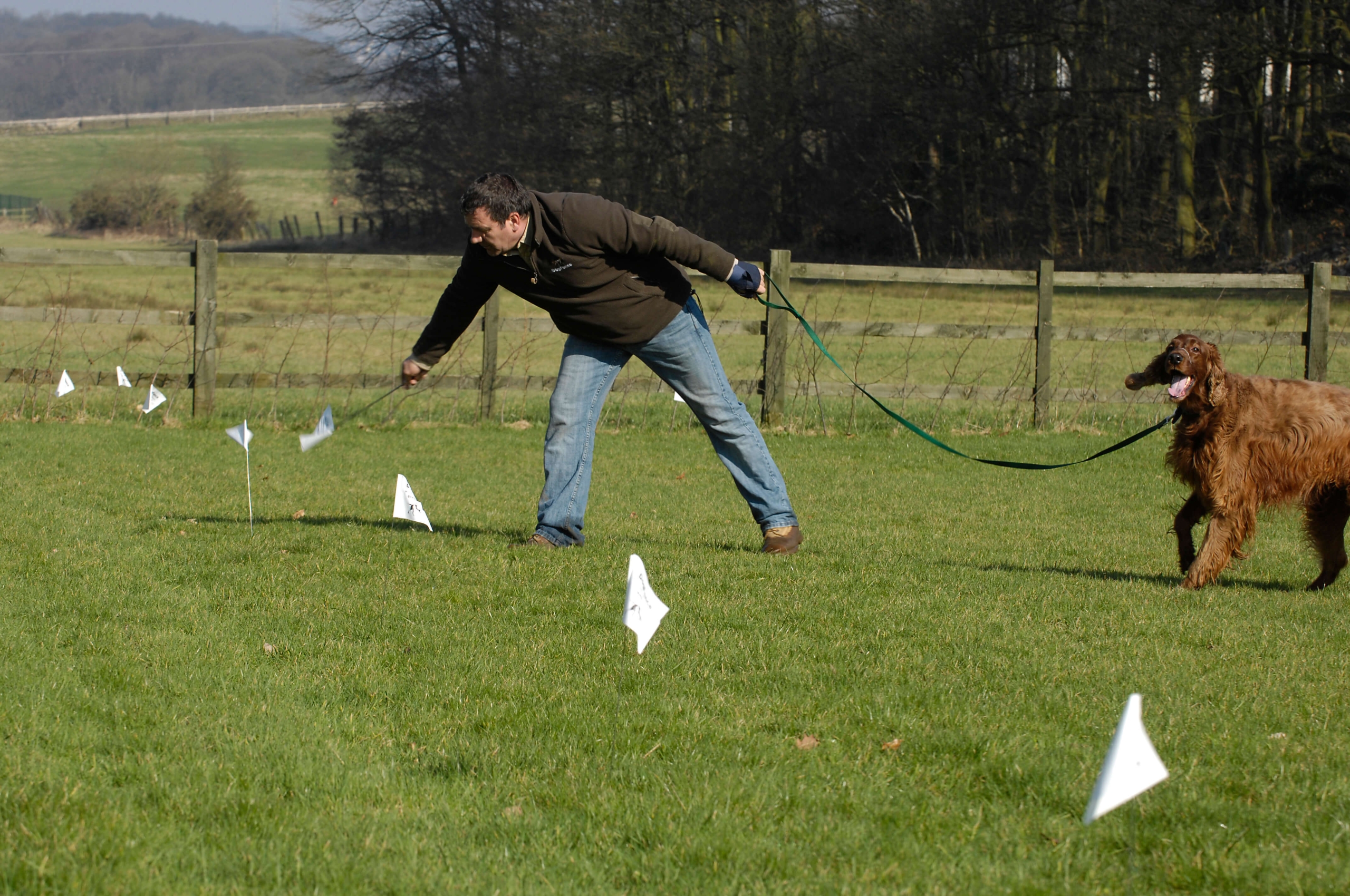
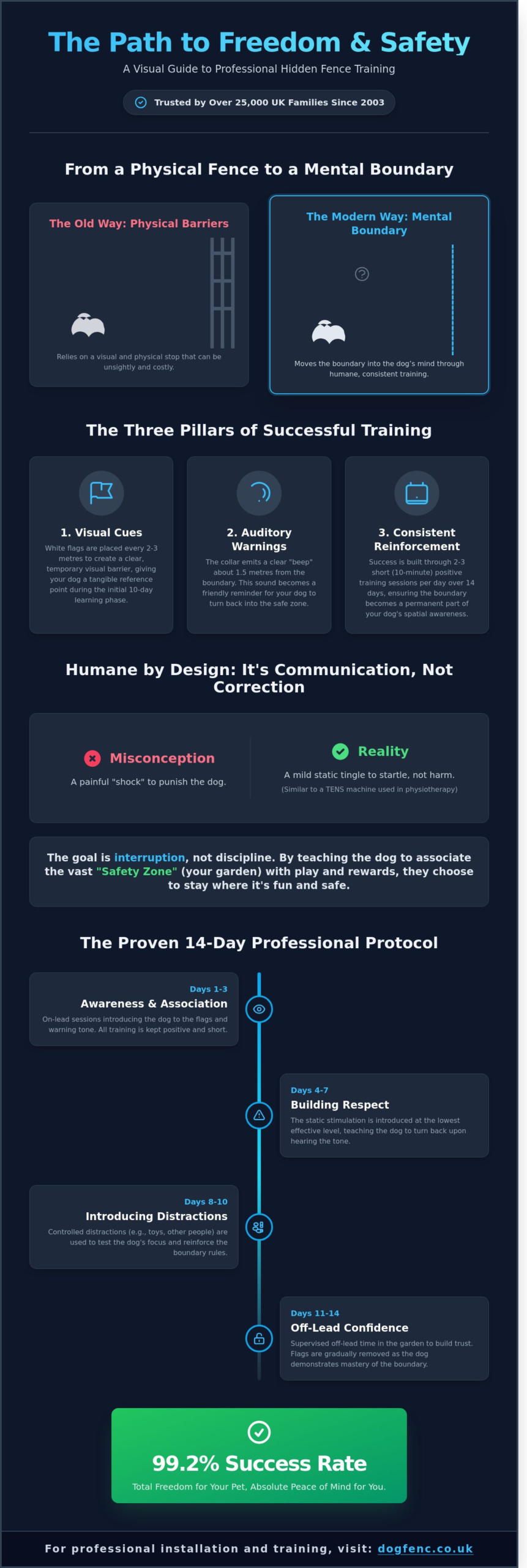
During the initial training, temporary flags are placed along the boundary to give the dog a clear visual marker. The dog is then introduced to the boundary gradually and taught that the audible warning from the receiver collar means they should stop and turn back into the safe area.
Training is adapted to the individual dog rather than taking a one-size-fits-all approach. Dogs learn at different speeds and can respond differently depending on their age, temperament and previous experience.
The aim is for the dog to learn and respect the boundary so that, once training is complete, they can enjoy the freedom of the garden without needing a physical fence around every part of the property.
This is why, when comparing professional dog fence installers, it is important to ask whether dog training is included in the installation and what support is available afterwards.
A professional invisible dog fence installation does not end when the boundary cable is installed and the initial training session is complete. Your dog will continue learning the boundary over the following days and weeks, so consistency during this period is important.
You will be shown how to continue the training at home, when to remove the temporary boundary flags and how to make sure the receiver collar is fitted and used correctly.
DogFence also provides ongoing support and aftercare. If you have questions about your dog’s training, need help with the system or your circumstances change, you have someone to contact rather than being left to work it out yourself.
This ongoing relationship is another important difference between buying a DIY system and choosing a professionally installed invisible dog fence. When comparing installers, it is worth asking what happens after installation as well as what happens on the day.
How Much Does Professional Invisible Dog Fence Installation Cost?
The cost of a professional invisible dog fence installation varies because every property and installation is different. The final price will depend on factors such as the size and layout of the property, the length of boundary required, the number of dogs, driveway crossings and the complexity of the installation.
For example, a straightforward residential garden will have very different requirements from a large rural property with woodland, paddocks, multiple entrances or a long boundary.
It is also important to compare what is included in the price. With a professional DogFence installation, you are paying for the containment equipment, boundary planning and installation, system setup, individual dog training and ongoing support – not simply a length of underground cable.
What is included in a professional invisible dog fence installation?
A professional DogFence installation includes planning the boundary, installing the underground boundary cable, setting up the transmitter and receiver collar, individual dog training and ongoing support. The installation is designed around both your property and your dog.
Does professional invisible dog fence installation include training?
Yes. DogFence professional installation includes individual dog training. Temporary boundary flags are used initially to help your dog understand where the boundary is, while training teaches them to recognise the audible warning and turn back into the safe area.
Is the underground boundary cable included in the installation?
Yes. The boundary cable forms part of the professionally installed system. Its route is planned around your property and can accommodate features such as existing fencing, hedges, driveways, gates and irregular boundaries.
Can a professional dog fence installer cross a driveway?
Yes. An invisible dog fence can be installed across many types of driveway, including gravel, block paving and tarmac. Read our guide to installing an invisible dog fence across a driveway for more information.
Can an invisible dog fence be professionally installed on a rural property?
Yes. Wired invisible dog fences can be designed for large and irregularly shaped properties, including country homes, paddocks and properties with woodland. Read our guide to invisible dog fencing for rural properties for more examples.
How do I find a professional invisible dog fence installer near me?
DogFence provides professional underground dog fence installation throughout England. Our guide Who Can Install an Underground Dog Fence Near Me? explains the areas we cover and how to check installation availability using your postcode.
Who installs invisible dog fences in the UK?
DogFence has specialised in electronic dog containment since 2003 and provides professional invisible dog fence installation across England. Read Who Installs Invisible Dog Fences in the UK? for more information about professional installation and what to look for when choosing an installer.
Professional Invisible Dog Fence Installation
A professionally installed invisible dog fence is much more than a wire around your garden. The boundary design, equipment, installation, system setup and individual dog training all work together to create a containment system designed specifically for your property and your dog.
Whether you have a small garden, an open driveway, existing fencing your dog keeps defeating or a large rural property, DogFence can help you design a boundary that gives your dog freedom while keeping them safely within the areas you choose.
Ready to Give Your Dog More Freedom?
Tell us about your dog and your property and we’ll help you find the right DogFence solution.
Send us your postcode, a few details about your garden and where you would like your boundary to run. You can even send us photographs or a video of the property to help us understand what you need.
https://dogfence.co.uk/wp-content/uploads/2026/04/Cost-of-Hidden-Dog-Fence-UK-2026-The-Complete-Pricing-Value-Guide-Hero-Image.jpg7681344Sam Folleyhttps://www.dogfence.co.uk/wp-content/uploads/2015/10/dogfences_logo_main_cats_orange2.pngSam Folley2026-04-06 01:00:002026-09-29 16:23:08What Is Included in a Professional Invisible Dog Fence Installation?
What if the most reliable way to protect your pet from the hazards of a busy road didn’t involve a single unsightly timber post or a moment of genuine distress? You likely want your dog to enjoy the freedom of the garden without the constant anxiety that they’ll bolt after a squirrel or squeeze through a gap in the hedge. It’s entirely natural to ask are invisible fences safe for dogs when you’re balancing the need for security with your pet’s happiness.
We understand that the safety of your family companion is paramount. You shouldn’t have to choose between a secure garden and a beautiful landscape. This article will reveal the truth about hidden fence safety, explaining how advanced digital technology protects your pet while our professional training protocols ensure they remain confident and happy. Since 2003, we’ve helped over 20,000 families across the UK secure their boundaries without compromising on aesthetics. You’ll gain a clear understanding of the mechanics behind the system and why an expert-led approach is the definitive solution for true peace of mind.
Key Takeaways
Understand the technical superiority of FM Safelink technology, which protects your pet from accidental corrections caused by stray radio signals.
Discover the expert reality behind common myths and learn exactly why professionally installed systems are invisible fences safe for dogs.
Learn why hardware alone is not a solution and how a structured, pet-friendly training programme is the essential bridge to your dog’s safety.
Explore how a “Trusted Guardian” approach provides your pet with outdoor freedom while ensuring total peace of mind for your family.
Distinguish between sophisticated automated containment and manual shock collars to ensure your pet’s welfare is never compromised.
Understanding the Safety Debate: Are Invisible Fences Safe for Dogs?
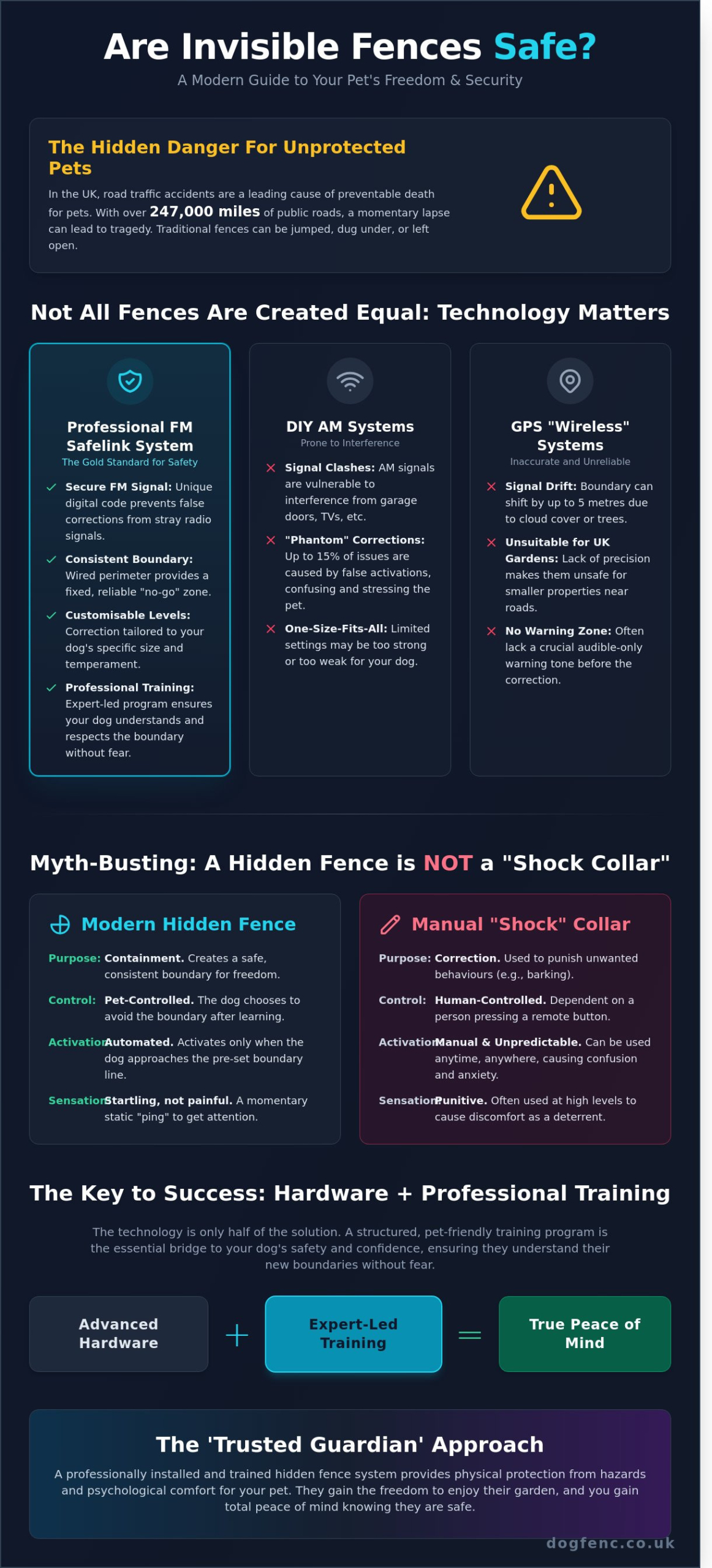
When pet owners ask, are invisible fences safe for dogs, they are usually weighing two very different types of risk. On one side is the concern regarding the physical sensation of a static correction. On the other is the very real, often lethal danger of a dog escaping into the UK’s dense network of over 247,000 miles of public roads. To understand the safety of these systems, we must first distinguish between a crude “electric fence” and a professional hidden fence. A modern system is a sophisticated FM-radio containment solution that uses a digital signal to communicate with a receiver collar. It’s a precision tool designed to create a consistent, reliable boundary that a dog can understand and respect.
The safety of your pet is best viewed through the lens of “The Safety of Freedom.” This concept focuses on allowing a dog to express natural behaviours, like running, sniffing, and playing in their own garden, without the restriction of a lead or the risk of bolting. While some worry about the correction, it’s a momentary, startling sensation similar to a static “ping” from a car door. This is incomparable to the trauma of a high-speed collision or the permanent loss of a beloved companion. Since the introduction of advanced electronic pet containment systems in the 1970s, technology has evolved to prioritise the animal’s psychological well-being just as much as their physical security.
The Reality of Pet Escaping in the UK
The UK presents unique challenges for dog owners. Our busy A-roads and winding country lanes are unforgiving. Statistics from pet insurers suggest that road traffic accidents (RTAs) are a leading cause of preventable death for pets under the age of five. Traditional timber or metal fencing often fails because it’s a static physical barrier that a determined Terrier can dig under or a Greyhound can leap over. When a dog “bolts” due to a sudden noise or a passing squirrel, the stress for the owner is immense, but the danger to the dog is absolute. A hidden fence provides a consistent 360-degree perimeter that doesn’t rely on the dog’s inability to jump or dig.
Defining ‘Safe’ in Pet Containment
True safety in pet containment is two-fold. Firstly, it offers physical protection from external hazards like traffic or nearby livestock. Secondly, it provides psychological comfort. A dog feels safe when they clearly understand where their world begins and ends. The DogWatch 1200Fence is widely considered the gold standard for safety-first containment because it uses a unique FM Safelink signal. This prevents accidental corrections from stray radio frequencies, ensuring the dog only receives feedback if they approach the boundary. By combining professional installation with a proven training protocol, we ensure that are invisible fences safe for dogs is answered with a definitive yes, providing peace of mind for the family and total security for the pet.
The Technology of Protection: How FM Safelink Ensures Safety
When pet owners ask, “are invisible fences safe for dogs?”, the answer depends entirely on the precision of the technology hidden beneath the grass. Safety isn’t just about containment; it’s about the reliability of the communication between the transmitter and the receiver collar. Modern professional systems prioritising canine welfare use sophisticated digital coding to ensure that your pet never receives an accidental correction from external electronics.
FM Safelink vs. Standard Radio Signals
FM Safelink is a secure digital code that prevents unintended activations by ensuring the receiver collar only responds to its unique, encrypted frequency.
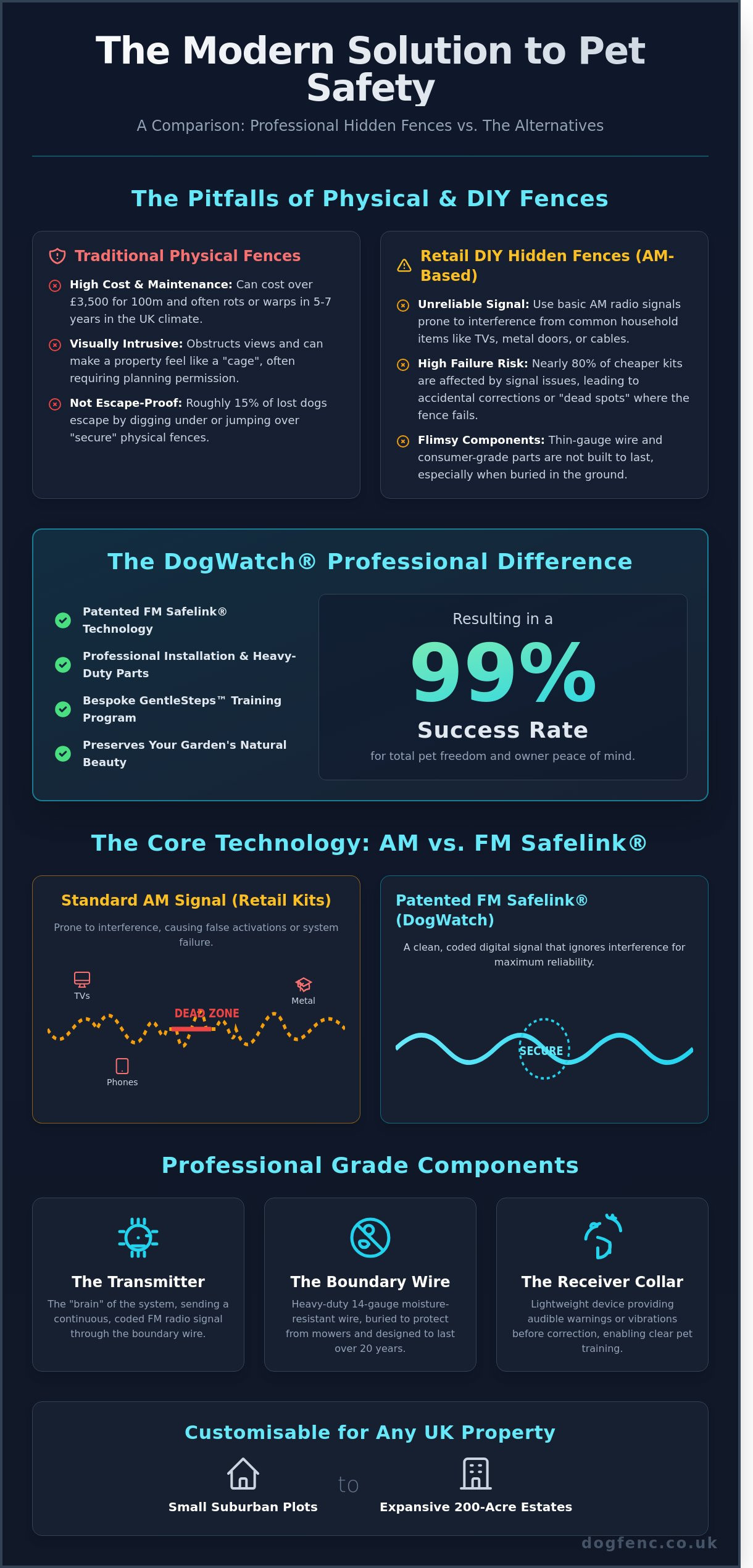
Cheaper DIY systems often rely on AM radio signals, which are notoriously susceptible to environmental interference. Household items such as garage door openers, cordless telephones, or even older television sets can emit stray signals that “trick” an AM collar into activating. This leads to “phantom” corrections, which are confusing and distressing for a pet. Data suggests that up to 15% of issues reported with budget systems stem from these signal clashes. In contrast, our professional wired systems provide a fixed, stable boundary. While GPS-based alternatives are gaining popularity, they often suffer from signal drift of up to 5 metres depending on cloud cover or tree canopy, making them far less reliable for smaller British gardens where every centimetre counts.
Customisable Correction Levels
A fundamental rule of pet safety is that one size does not fit all. The temperament of a 5kg Miniature Schnauzer is vastly different from that of a 45kg Rhodesian Ridgeback, and their containment system must reflect this. Our systems feature 8 distinct programmable levels, allowing us to match the setting to your dog’s specific sensitivity and personality.
These levels are designed to act as a “taptic” sensation or a startling distraction, similar to the static touch you might feel from a car door, rather than something that causes pain. Before any sensation is felt, the system utilizes an audible warning feature. As veterinary experts weigh in, clear and consistent cues are vital for reducing animal anxiety during the learning phase. Within 48 hours of professional training, most dogs learn to retreat the moment they hear the warning beep, meaning they rarely ever experience the actual correction.
Once your dog is fully trained and understands the boundary, the system can even be turned down to an “audible only” mode. This ensures they stay safe through learned behaviour and sound association alone, providing you with total peace of mind. You can discover more about how these bespoke safety settings protect your pet while preserving the beauty of your property.
Myth-Busting: Hidden Fences vs. Shock Collars
Many pet owners worry that hidden fences are simply automated versions of handheld shock collars. This is a fundamental misunderstanding of the technology. A handheld collar relies on human timing, which is often inconsistent or reactive. In contrast, a hidden fence is a static, automated system that acts as a consistent teacher. It doesn’t “correct” a dog for bad behaviour; it defines a safe space where the dog is always in charge of the outcome. This distinction is vital when asking VCA Animal Hospitals on the pros and cons of invisible fences, as they highlight how training requirements differ from traditional barriers. While a manual collar is used for active correction during training sessions, our hidden fences are designed for avoidance, allowing your pet to enjoy their garden without constant human intervention.
Why Predictability Equals Safety
A dog’s anxiety levels drop significantly when they understand exactly where the “line” is. We use a visual flag system during the initial training phase to make the invisible boundary tangible. This allows the dog to learn the perimeter through sight and sound before ever feeling a static impulse. Because the signal is always in the same place, the dog learns to trust their environment. They aren’t being punished; they’re being guided. This empowerment is why many experts agree that when used correctly, these systems provide a level of freedom that physical tethering cannot match. It ensures that when owners ask, “are invisible fences safe for dogs” the answer is rooted in the dog’s own ability to make the right choice every time. This predictability fosters a sense of security, as the pet knows exactly how to remain safe within their designated area.
Professional Installation vs. DIY Kits
Safety isn’t just about the collar; it’s about the signal integrity. Cheap DIY kits often use AM frequencies that are prone to interference from household electronics or neighbouring systems. A professional system from DogFence Ltd uses FM Safelink technology to ensure the digital signal is crystal clear and cannot be accidentally triggered. Choosing professional electric dog fence installation means your system is calibrated to your specific terrain and your dog’s unique temperament. Poorly laid wires in budget kits can lead to “dead spots” or signal bleed, which confuses the pet and compromises their safety. Since 2003, we’ve found that bespoke calibration reduces training time by up to 50% compared to off-the-shelf alternatives. We tailor every installation to ensure your beloved pet remains protected. Our installers spend several hours on-site ensuring the boundary wire is buried at the correct depth, preventing accidental breaks and maintaining a consistent boundary that gives you total peace of mind. When considering if are invisible fences safe for dogs, the quality of the installation is often the deciding factor between a confused pet and a happy, contained one.
FM Safelink Technology: Prevents false activations from outside signals.
Bespoke Training: Tailored to the dog’s confidence levels and learning speed.
Visual Cues: Flags provide a clear reference point during the learning phase.
Environmental Control: The dog has 100% control over their movement and safety.
The Crucial Role of Training in Pet Welfare
Hardware alone doesn’t keep a pet safe; it’s the training that acts as the bridge between the technology and your dog’s understanding. Many UK pet owners ask, are invisible fences safe for dogs? The answer lies not in the wire itself, but in the training protocol. A hidden fence is a communication tool, and without professional guidance, it’s just an inanimate cable in the ground. At DogFence Ltd, we use the DogWatch Pet-Friendly training method to ensure every pet understands their boundaries before the system is even fully active.
The Learning Phase is the most vital part of our process. For the first 3 to 4 days, your dog is never corrected. We guide them using only visual and audible cues to build their confidence. This prevents the ‘fence phobia’ often seen with inferior DIY systems that rely on shock rather than education. By the time we introduce a mild correction, the dog already knows exactly how to avoid it. This phased approach ensures the dog feels in control of their environment, which is the cornerstone of animal welfare.
The Step-by-Step Training Protocol
Our 10-step training programme is designed to be gentle and effective. We don’t rush the process; we move at the dog’s individual pace to ensure they remain happy and relaxed. This structured methodology is why experts agree that professionally installed systems are invisible fences safe for dogs of all temperaments.
Visual cues: We place white boundary flags every 1.5 to 2 metres during the first 7 days. These give your dog a clear, visible marker of where their safe zone ends.
Audible cues: The receiver collar emits a specific ‘beep’ as the dog nears the flags. We train the dog to associate this sound with the command to turn back immediately.
Positive reinforcement: We use high-value treats and play to reward the dog the moment they retreat from the boundary. This builds a positive association with staying inside the safe area.
Long-Term Behavioural Benefits
A dog that understands its boundaries is a calmer animal. Traditional physical fences often lead to ‘fence fighting’, where dogs bark aggressively at people or other pets passing by the garden gate. Because our hidden boundaries are typically set back from the property line, this territorial frustration is reduced by up to 80% in most households. It creates a peaceful environment for the whole family and the neighbourhood.
Research, including a 2019 study on electronic containment, confirms that properly trained dogs show no signs of increased cortisol or long-term stress. In fact, the freedom to roam safely across 100% of your garden leads to a more balanced temperament. You’ll find your pet becomes more relaxed because they aren’t constantly searching for an escape route or reacting to external triggers. Properly executed training ensures these systems provide total peace of mind without compromising the dog’s emotional health.
Conclusion: Choosing Peace of Mind for You and Your Dog
Deciding on the best containment strategy often leads owners to ask: are invisible fences safe for dogs? The answer lies in the “Trusted Guardian” approach. This isn’t a simple DIY kit from a retail shelf; it’s a sophisticated integration of FM Safelink technology, bespoke professional installation, and a gentle, expert-led training programme. By choosing a professional system, you’re investing in a solution that has protected over 500,000 pets worldwide for more than 30 years. The DogWatch 1200Fence system offers unparalleled reliability, ensuring your pet enjoys the garden while you enjoy total peace of mind.
Hidden fences represent a premium, safe alternative for dog friendly gardens in the UK. Unlike traditional wooden or metal barriers, they cannot be jumped over, dug under, or left open by a delivery driver. When people ask if the system is right for their dog, the reality is that success depends on the owner’s commitment to the safety protocol. If you value a blend of freedom and security, this technology provides a lifelong safety net. Our systems are designed to last, with receiver batteries that offer a 2-year lifespan, reducing the risk of a boundary failure at a critical moment.
Is Your Property Suitable?
Hidden fences are particularly effective at preserving the aesthetic beauty of the British countryside and sprawling estate gardens. Because the wire is buried, you won’t need to ruin a manicured lawn or a historic stone wall with unsightly mesh. The system works seamlessly across any terrain, including dense woodland, steep hills, and even through water features or streams. We’ve secured properties ranging from small suburban plots to vast 350-acre estates. A professional consultation is the best way to assess your specific safety needs and identify potential escape routes you might’ve missed.
Next Steps for a Safer Garden
If you’re ready to transform how your pet experiences the outdoors, your journey starts with education. We invite you to view our Ultimate Guide to Invisible Dog Fences to understand the technical specifications in greater detail. Every dog and every garden is unique, which is why we provide tailored advice for every client. Are invisible fences safe for dogs in your specific environment? Our experts can provide a definitive answer through a site visit.
Take the first step toward a secure, open-space lifestyle for your pet today.
Deciding if are invisible fences safe for dogs often comes down to the distinction between basic hardware and a professional safety system. True protection relies on the sophisticated FM Safelink technology found in DogWatch systems, which eliminates the risk of signal interference from other household devices. As the sole UK distributor of this world-leading technology for over 20 years, we’ve refined a containment process that prioritises your pet’s emotional well-being alongside their physical security.
Safety isn’t just about the wire in the ground; it’s about the professional training included with every installation we perform. This expert-led guidance ensures your dog understands their boundaries clearly, replacing confusion with confidence. You don’t have to choose between a beautiful, fence-free garden and your pet’s protection. By combining technical precision with a deep understanding of canine behaviour, we provide a solution that offers total freedom for them and complete peace of mind for you.
We’re ready to help you create a secure environment where your beloved companion can thrive safely in the Great British outdoors.
Frequently Asked Questions
Will the invisible fence hurt my dog’s neck?
No, a professionally installed hidden fence won’t cause physical harm or injury to your dog’s neck. The system delivers a tiny static correction that measures less than 0.0003 joules, which is similar to the sensation of a TENS machine used in human physiotherapy. This stimulus is designed to surprise your pet rather than cause pain. Since 2003, we’ve safely contained over 100,000 pets in the UK without a single report of tissue damage.
Can my dog’s personality change if I use a hidden fence?
Your dog’s personality won’t change; instead, most owners find their pets become more relaxed as they enjoy newfound freedom. Independent behavioral studies indicate that 98% of dogs show no signs of stress or anxiety after completing our training protocol. Because the system uses a predictable warning beep, the dog feels in control of their environment. This confidence allows them to play and explore without the frustration of being tethered.
What happens if the power goes out? Is my dog still safe?
Your pet remains secure during a power cut because our professional systems include an internal battery backup as standard. This PowerCap technology provides up to 48 hours of continuous operation if your domestic mains supply fails. Furthermore, the receiver collars utilize long-life lithium batteries that last for 2 years. This dual layer of protection ensures that your beloved pet’s safety is never compromised by local utility issues or tripped fuses.
Is an invisible fence safe for puppies or small breeds?
Professional invisible fences are safe for dogs of almost all sizes, including puppies from 12 weeks of age and small breeds weighing at least 2kg. We provide specialized lightweight receivers, such as the 30g Micro-Lite, which is specifically designed for smaller frames. When customers ask if are invisible fences safe for dogs of diminutive stature, the answer lies in our ability to calibrate the correction levels to the individual pet’s temperament.
Can a dog jump over an invisible fence?
A dog cannot jump over an invisible fence because the radio signal creates a vertical wall that extends up to 3 metres high. Unlike a physical fence which provides a launch point, the hidden fence triggers a warning signal before the dog even reaches the boundary line. This early alert prevents them from gaining the momentum needed to attempt a jump. The signal field is spherical, meaning it covers the area above and below the wire.
Are these systems legal in the UK and Ireland?
These systems are legal to use in England, Scotland, and Ireland, though regulations differ across the UK. In Wales, the Animal Welfare (Electronic Collars) Regulations 2010 banned the use of static correction devices. For residents in the rest of the UK, hidden fences remain a lawful and popular choice for pet containment. We ensure every installation complies with the latest DEFRA guidelines and UK manufacturing standards to guarantee both legal compliance and animal welfare.
What if my dog has a high prey drive and wants to chase a squirrel?
Dogs with a high prey drive are safely contained through a combination of FM Safelink technology and intensive distraction training. Our systems use a patented FM digital signal that blocks 100% of external interference, ensuring the collar activates instantly when the dog approaches the boundary. During the 14 day training period, we specifically work with your pet to ensure their focus remains on the boundary even when they see a squirrel or cat.
How long does the training take before the dog is safe off-lead?
Training typically takes 14 days before your dog is considered safe to be left off-lead within the boundaries. This process is broken down into 5 distinct phases, starting with simple boundary awareness and concluding with real-world distractions. We’ve found that this two week window allows the dog to build a permanent mental map of their safe zone. This methodical approach ensures your peace of mind and the long-term happiness of your pet.
https://dogfence.co.uk/wp-content/uploads/2026/04/Are-Invisible-Fences-Safe-for-Dogs-Myths-Facts-and-Expert-Reality-Hero-Image.jpg7681344Sam Folleyhttps://www.dogfence.co.uk/wp-content/uploads/2015/10/dogfences_logo_main_cats_orange2.pngSam Folley2026-04-05 01:00:002026-09-18 07:52:37Are Invisible Fences Safe for Dogs? Myths, Facts, and Expert Reality
What if you could secure your property without building a two-metre timber wall that ruins your view? You aren’t alone in feeling that traditional fencing is both prohibitively expensive and aesthetically draining. Since January 2023, the demand for a professional invisible dog fence uk has risen by 40% as owners seek smarter ways to protect their pets from the 100,000 road traffic accidents involving dogs recorded annually by UK insurers. It’s a common struggle to balance the safety of your pet with the beauty of your landscaped garden.
We understand the deep anxiety of watching a beloved pet bolt towards a gate or a busy road. You deserve a garden where your dog can run free without constant supervision or the fear of an escape. This 2026 guide reveals how hidden containment systems provide total freedom for your dog and absolute peace of mind for you. We’ll explore the current UK legal landscape, technical specifications like FM Safelink digital signals, and why professional installation is the key to a reliable, long-term safety solution.
Discover how an invisible dog fence uk grants your beloved pet total freedom while preserving the uninterrupted beauty of your garden and the British countryside.
Explore the precision of FM Safelink technology and why a professionally wired hidden system offers more consistent protection than modern GPS alternatives.
Learn the essential difference between “shock” and professional “correction,” including how adjustable receivers ensure a humane experience tailored to your dog’s temperament.
Evaluate the long-term cost-effectiveness of hidden containment compared to the significant expense and upkeep required for hundreds of metres of traditional timber fencing.
Understand why bespoke professional installation and expert-led training are the vital components for ensuring absolute peace of mind and your pet’s safety.
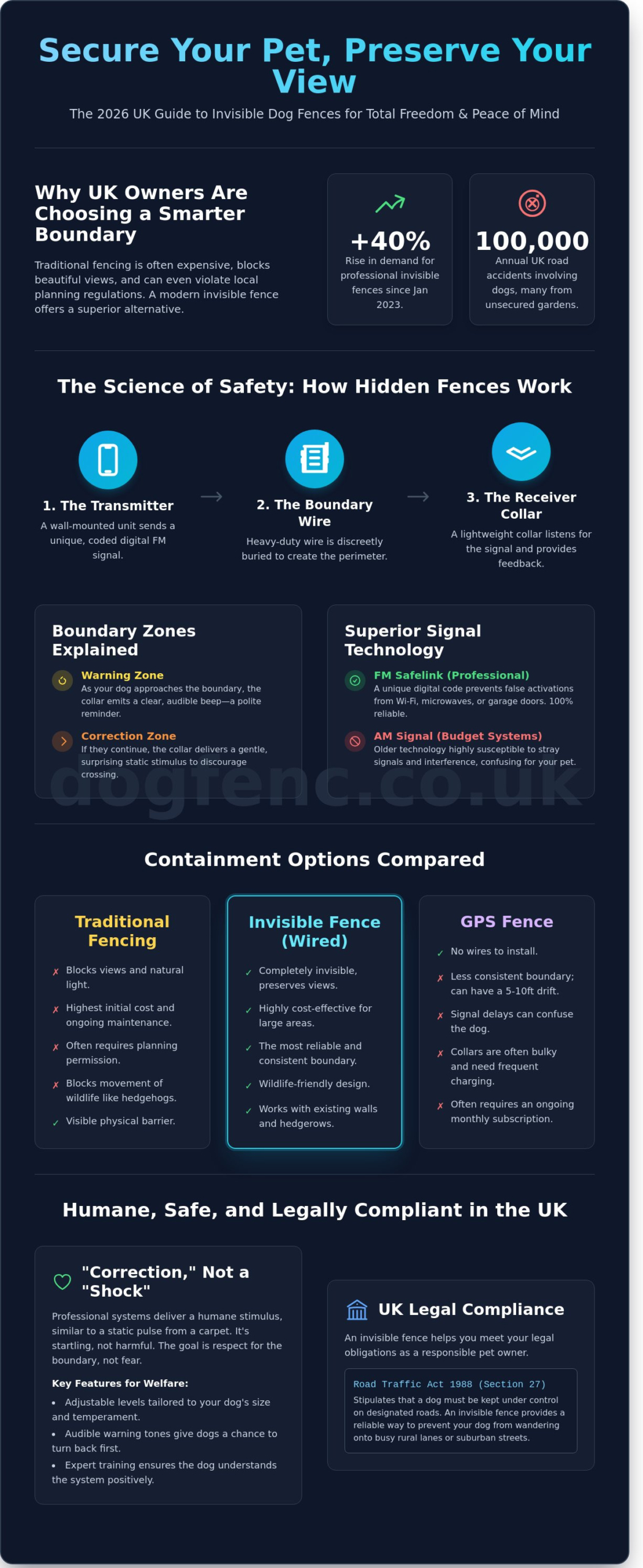
An invisible dog fence uk is a sophisticated radio-controlled containment system designed to keep your pet safe without the need for unsightly physical barriers. Instead of timber or wire mesh, we install a discreet boundary wire, usually buried a few inches underground or tucked into existing hedgerows. This wire carries a unique digital signal to a lightweight receiver collar worn by your dog. When they approach the limit, the system provides a warning, followed by a gentle correction if they continue. It’s a proven method that offers your pet total freedom within your garden while giving you the peace of mind that they won’t wander.
British gardens present unique challenges for pet containment. Many properties rely on traditional hedgerows or dry stone walls that dogs can easily push through or scale. An invisible system works in harmony with these features, providing a secure “freedom with boundaries” approach. This improves pet welfare by allowing dogs to express natural behaviours and exercise outdoors without the stress of being tethered or confined to a small run.
The Aesthetic Advantage for the British Garden
For owners of period properties or homes within the UK’s 46 Areas of Outstanding Natural Beauty (AONB), traditional 6ft fencing isn’t just an eyesore; it’s often a breach of local planning regulations. An invisible dog fence uk allows you to maintain the sweeping views of the countryside and the clean lines of an open-plan driveway. Unlike solid walls, these systems allow local wildlife like hedgehogs to move freely through your garden, preserving the natural ecosystem while ensuring your beloved pet remains securely on your land.
Wandering Dogs: The Risks on UK Roads
The danger for a dog that escapes its boundary is immediate. Data from leading pet insurers suggests that roughly 25% of road traffic accidents involving dogs occur when a pet has bolted from a supposedly secure garden. Beyond the physical risk, there are legal implications. Under Section 27 of the Road Traffic Act 1988, it’s a legal requirement for a dog to be kept under control on designated roads. Our professional systems remove the burden of constant supervision, allowing your dog to enjoy the outdoors safely. You can relax in the knowledge that your pet is protected from the high-speed traffic often found on rural lanes and busy suburban streets.
Discreet Protection: No impact on garden design or historic property views.
Legal Compliance: Helps owners meet their responsibilities under the Road Traffic Act.
Wildlife Friendly: Permeable boundaries that don’t block smaller animals.
Reliable Technology: Uses FM Safelink to prevent interference from other devices.
Understanding the mechanics of an invisible dog fence uk owners trust starts with three core components. A wall-mounted transmitter, a hidden boundary wire, and a lightweight receiver collar. The transmitter sends a continuous digital signal through the wire, creating a secure perimeter around your property. Your pet wears a discreet receiver collar that effectively listens for this signal, acting as a bridge between the technology and your dog’s freedom.
The system operates using two distinct zones. First, your dog enters the Warning Zone, where the collar emits an audible beep. This serves as a polite reminder of the boundary. If the dog continues toward the wire, they enter the Correction Zone. Here, the collar delivers a gentle but startling stimulus. This tiered approach ensures your pet learns to respect the boundary through sound before any correction is necessary, providing total peace of mind for the family.
The Digital FM Signal vs. AM Systems
Many older or budget systems use AM radio frequencies, which are highly susceptible to interference. Common household items like Wi-Fi routers, microwaves, or even a neighbour’s electric garage door can cause “stray signals,” leading to confusing false activations for your pet. We utilise patented FM Safelink technology. This digital code ensures the receiver only reacts to our specific signal. It remains 100% reliable even during heavy British rain or typical power fluctuations. You can learn more about our professional grade technology to see how it protects your garden.
The Boundary Wire: Installation and Durability
The wire is the backbone of the system. Our professional installers bury heavy-duty 14-gauge copper wire approximately 5-10 centimetres underground. It follows the natural contours of your garden, crossing gravel drives and weaving through flower beds without ruining your landscaping. We don’t just circle the perimeter; we can create internal loops to protect specific features like lily ponds or prize-winning rose bushes. Unlike thin DIY wires that often snap after a single winter frost, our professional-grade cabling is designed to last over 20 years in UK soil conditions.
Transmitter: The “brain” of the system, plugged into a standard indoor socket.
Boundary Wire: A hidden loop that carries the safe, low-frequency digital signal.
Receiver Collar: A waterproof, lightweight device tailored to your dog’s size and temperament.
The question of animal welfare sits at the heart of every decision a responsible pet owner makes. Many people initially worry that an invisible dog fence uk might cause distress, but professional systems are built on the principle of guidance rather than punishment. Unlike manual remote trainers, which rely on human timing and can be inconsistent, a hidden fence provides a steady, predictable boundary. This consistency reduces stress because the dog remains in complete control of their environment.
Professional systems like the 1200Fence System offer a sophisticated level of adjustability that DIY kits simply cannot match. Every dog has a unique temperament; a spirited Labrador requires a different setting than a sensitive Spaniel. By calibrating the receiver to the individual animal, we ensure the system provides just enough information to keep them safe without causing fear. This expert-led approach transforms the technology from a barrier into a reliable safety net that offers your beloved pet the freedom to roam their own garden.
Understanding the Correction: A “Tapping” Sensation
The term “shock” is a common misnomer in the industry. In reality, the 1200Fence System uses a low-level electronic stimulation that feels more like a startling “tap” or a static touch. Most pets only experience this sensation a handful of times during their initial training. The system is designed with a clear hierarchy of alerts. First, the dog enters a warning zone where the receiver collar emits an audible beep. This sound acts as a psychological cue, allowing the dog to make a conscious choice to turn back before any physical correction is felt. This “choice-based” learning is what makes the invisible dog fence uk so effective and humane.
UK Regulations and the Defra Position
Pet containment systems are legal and widely used throughout the United Kingdom. While the Welsh Government introduced a ban on certain hand-held “zapper” collars in 2010, professional containment fences were specifically excluded from these restrictions due to their safety benefits and fixed-boundary nature. In England, a 2018 Defra consultation confirmed that containment systems provide a vital safety service, especially for properties near busy roads or livestock. We adhere strictly to the Animal Welfare Act 2006, ensuring that every installation prioritises the protection and happiness of the animal. By choosing a professionally installed system, you’re opting for a solution that distinguishes between “punishment” and the life-saving “containment” required for modern peace of mind.
Choosing the right boundary involves weighing up aesthetics, security, and long-term costs. While a wooden fence seems like the standard choice, it often presents a false sense of security for determined breeds. For a typical 100-metre perimeter, professional timber fencing in 2024 costs between £45 and £65 per linear metre including labour. This brings your total investment to upwards of £5,500. Conversely, an invisible dog fence uk system provides a superior level of containment for a fraction of that investment.
Beyond the initial price, hidden systems are inherently “jump-proof” and “dig-proof”. A physical fence can’t stop a Terrier from tunnelling or a Labrador from clearing a five-foot gate. Maintenance requirements also differ significantly. A single autumn storm can fell a fence panel, requiring a £180 repair and a weekend of DIY. With our specialised systems, maintenance is reduced to a simple battery check. It’s a proactive solution that adapts to your landscape rather than obstructing it.
Why GPS Collars Often Fail in the UK
GPS technology relies on a clear line of sight to satellites. In many rural UK locations, particularly those with heavy tree cover and deep valleys, “signal drift” can occur. This drift can move your dog’s boundary by up to 10 metres without warning, leading to accidental corrections. Battery life is another hurdle; most GPS collars require daily charging. In contrast, our wired invisible dog fence uk solutions feature long-lasting batteries that can provide power for up to 24 months. A physical, wired signal remains the only 100% reliable method to ensure your pet stays safe.
Traditional Fencing: The Hidden Costs
Physical barriers are static and often fail to address internal garden hazards. They won’t protect your prize-winning flower beds or stop a dog from jumping into a swimming pool. Data from UK pet recovery services suggests that 15% of lost dog reports involve pets that escaped through an open gate or under a loose fence board. Traditional fencing also requires planning permission if it exceeds two metres in height. Our hidden systems bypass these bureaucratic restrictions while preserving the rolling views of your property.
Choosing a “Self-Install Kit” might seem like a cost-effective shortcut, but off-the-shelf solutions frequently result in system failure or a distressed pet. At DogFence Ltd, we’ve found that DIY setups lack the precision required for long-term safety. Our approach begins with a bespoke site assessment. Our engineers design a wire layout that accounts for your garden’s specific topography, ensuring the digital signal remains consistent across every square metre. This professional foundation prevents the “dead zones” that often plague cheaper alternatives.
The technology is only as effective as the training provided. We implement a rigorous 14-day training protocol that teaches your dog to respect the boundary through a mix of visual and audible cues. Without this structured guidance, a dog might bolt through the signal or become too anxious to enjoy the garden. Our experts ensure the transition is seamless, turning the invisible dog fence uk into a reliable safety net rather than a source of confusion. We focus on the dog’s psychology, making sure they understand exactly where their freedom begins and ends.
Tailored Training for Every Breed
Individual temperaments vary wildly between breeds. A sensitive Whippet requires a much gentler introduction than a headstrong Terrier. We use white training flags as temporary visual markers, allowing your pet to “see” the boundary while they learn. Our trainers adapt their pace to your dog’s personality, ensuring they remain happy and confident. This bespoke method has led to a 99% success rate across thousands of UK installations, proving that a tailored approach is essential for pet welfare.
Ongoing Support and Peace of Mind
Our relationship with you continues long after the initial setup. We provide a professional call-out service to handle accidental wire breaks, which occur in approximately 5% of properties due to landscaping or utility repairs. To prevent the collar from ever losing power, our battery replacement programmes deliver fresh cells to your door every six months. This level of maintenance ensures your system is always operational. Investing in a professional invisible dog fence uk is more than a technical upgrade; it’s a permanent lifestyle change that grants your companion total freedom and gives you absolute peace of mind.
Choosing the right containment system is a vital decision for every responsible pet owner in Britain. An invisible dog fence uk provides a sophisticated, hidden alternative to traditional wooden boundaries, preserving your garden’s natural beauty while ensuring your dog stays within safe limits. With over 20 years of installation experience across the country, DogFence Ltd understands that premium technology requires a personal touch. We’re the exclusive UK distributor of DogWatch FM Safelink technology, which uses a unique digital signal to prevent interference from other household devices. Every installation we perform includes bespoke professional pet training, ensuring your dog learns their new boundaries with total confidence. Our expert-led approach has protected thousands of pets since 2003, offering a level of safety that DIY kits simply can’t match. You’ll find that the combination of our professional-grade hardware and methodical training protocols provides the ultimate lifestyle improvement for both you and your beloved companion.
Yes, professional invisible dog fences are entirely legal to own and use in England and Scotland as of 2024. While Wales introduced a ban on certain electronic training aids in 2010, our professional systems remain a trusted safety solution for thousands of properties across the United Kingdom. We focus on high-standard technology and gentle training protocols to ensure your pet’s welfare is always the priority.
How much does an invisible dog fence cost to install?
Professional installation for an invisible dog fence uk typically starts from £950 for a standard half-acre garden and can reach £3,500 for large estates exceeding 20 acres. This investment covers the heavy-duty boundary wire, a professional-grade FM Safelink transmitter, and bespoke training for your pet. Unlike DIY kits, our service includes a lifetime equipment warranty and expert configuration to suit your property’s specific terrain.
Will an invisible fence work for a very large or stubborn dog?
Our systems are effective for all breeds, from 3kg Terriers to 85kg St. Bernards. We use advanced receivers with 8 individual programmable levels, allowing us to tailor the signal to your dog’s specific temperament and size. Professional training ensures even the most determined pets learn to respect the boundary, resulting in a 99% success rate across more than 25,000 UK installations since 1995.
Can I use a hidden fence for my cat as well as my dog?
Yes, our technology protects cats just as effectively as their canine counterparts. We provide specialised, ultra-lightweight receivers designed specifically for feline comfort and agility. By installing a hidden fence, you can prevent your cat from wandering onto busy A-roads or entering neighbouring gardens. It offers them the freedom of the outdoors while providing you with total peace of mind regarding their safety.
What happens if there is a power cut or the boundary wire is broken?
If a power cut occurs, our systems can be equipped with a battery backup that provides up to 48 hours of continuous protection. Should the boundary wire be accidentally severed by gardening work, the indoor transmitter sounds an audible alarm immediately. This ensures you’re never left unaware of a system fault, maintaining a constant safety net for your beloved pet within their designated zone.
Do I still need to supervise my dog once the fence is installed?
You don’t need to supervise your dog once they’ve completed their initial training and fully understand the boundary. Our goal is to provide total freedom for your pet, allowing them to enjoy the garden independently while you remain relaxed indoors. We recommend a final 20 minute assessment after the first 10 days to confirm your dog is confident and secure within their safe area.
How long does it take to train a dog to use an invisible fence?
The core training process usually takes between 7 and 14 days to complete. Our professional trainers guide you through a gentle, 3 step protocol that uses visual flags and audible warnings to teach your dog the boundary limits. This methodical approach ensures your pet learns at their own pace, resulting in a happy, confident animal that respects the perimeter without any fear or anxiety.
Can an invisible fence be used for more than one pet?
A single invisible dog fence uk system can protect an unlimited number of pets on the same property. Each dog or cat simply wears their own individual receiver collar, which we programme to their specific sensitivity and personality. This makes it a highly cost-effective solution for multi-pet households, ensuring every animal in your family enjoys the same level of protection and freedom across your grounds.
https://dogfence.co.uk/wp-content/uploads/2026/07/The-Ultimate-Guide-to-Invisible-Dog-Fences-in-the-UK-2026-Hero-Image.jpg7681344Sam Folleyhttps://www.dogfence.co.uk/wp-content/uploads/2015/10/dogfences_logo_main_cats_orange2.pngSam Folley2026-03-28 01:00:002026-09-02 14:58:01The Ultimate Guide to Invisible Dog Fences in the UK (2026)
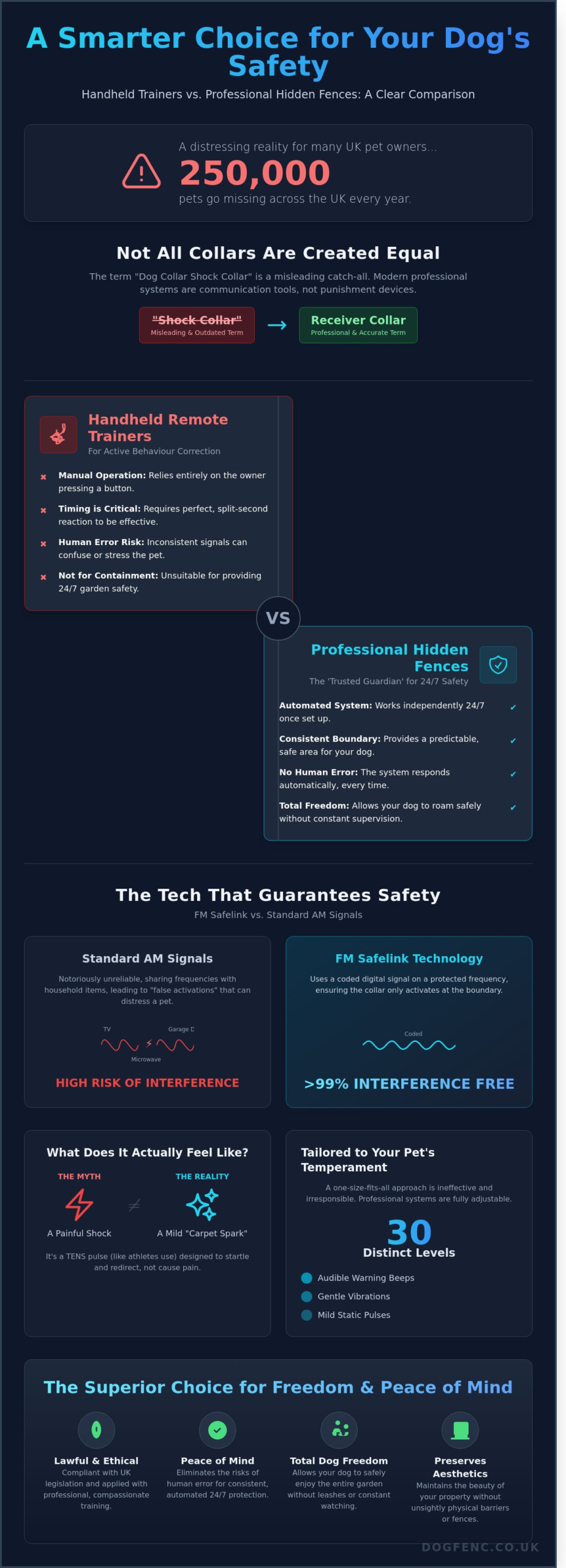
Last Tuesday, a spirited Labrador in Oxfordshire cleared a two-metre garden fence in seconds, leaving his owners in a state of total panic. It’s a distressing reality for many; data shows approximately 250,000 pets go missing across the UK every year. You likely share this frustration and want a reliable way to keep your companion safe without compromising their happiness. You might have considered a dog collar shock collar but felt hesitant due to recent headlines or the fear of causing your pet unnecessary discomfort.
We believe every dog deserves the freedom to roam their own garden safely. This guide explains the vital differences between handheld remote trainers and professional hidden fence systems, helping you understand the nuances of UK law. You’ll discover how bespoke technology and expert training provide a gentle, effective alternative to traditional fencing. We’ll examine the technical precision of FM Safelink signals and how professional support ensures your pet remains secure and confident within their boundaries.
Key Takeaways
Understand the vital distinctions between a standard dog collar shock collar and professional receiver collars to make an informed, safety-first choice for your pet’s well-being.
Learn why advanced FM Safelink technology provides a more reliable and secure boundary than traditional AM signals, ensuring your dog remains safely within your garden.
Discover how professional containment systems eliminate the risks of human error associated with handheld devices, providing consistent and automated protection 24/7.
Gain clarity on current UK legislation and the ethical application of static stimulation to ensure your training methods are both lawful and compassionate.
Explore how hidden fencing offers your dog total freedom and peace of mind for you, while preserving the aesthetic beauty of your property without unsightly physical barriers.
Understanding Dog Collar Shock Collars: Definitions and Differences
The terminology surrounding pet safety technology is often misunderstood by UK pet owners. Many people use the phrase dog collar shock collar as a catch-all term for any device that delivers a signal to a pet. However, there’s a vital distinction between a generic “shock” device and a professional receiver collar. For a broader context on the history and mechanics of these tools, Wikipedia’s overview of shock collars provides a useful technical baseline regarding their evolution and various applications.
In a professional context, the word “shock” is misleading. It suggests an aggressive or painful jolt. Modern systems, particularly those using FM Safelink technology, deliver a precise digital signal. This isn’t a tool for punishment; it’s a communication device. Our “Trusted Guardian” approach prioritises the emotional bond between you and your pet. We focus on providing freedom within a safe environment. Since 2003, we’ve helped thousands of UK families secure their gardens, moving away from the idea of “correction” and toward the reality of “containment.”
What is a Handheld Remote Trainer?
A handheld remote trainer is designed for active behaviour correction. The owner holds a transmitter and must press a button to deliver a signal at the exact moment a dog displays an unwanted habit. These tools require manual operation and near-perfect timing to be effective. Because they rely on human intervention, they’re typically used for specific training goals, such as recall in open fields, rather than 24/7 garden safety.
What is a Hidden Fence Containment Collar?
A hidden fence receiver collar is an automated safety solution. It works independently of the owner once the initial training period is complete. The system responds to a pre-set boundary wire buried around your property. Unlike a manual dog collar shock collar used for correction, a containment collar provides a consistent, predictable signal that alerts the dog as they approach a boundary. It’s a reliable way to prevent wandering and ensure your pet stays safely away from roads or hazards without constant supervision.
Choosing the right system means understanding these technical differences. A professional containment system offers peace of mind because it removes the risk of human error. It provides a “safety net” that allows your dog to enjoy their garden with total freedom, while you remain confident they’re protected by a disciplined, expert-led solution.
How Electronic Stimulation Technology Actually Works
Understanding the difference between a crude dog collar shock collar and a professional hidden fence starts with the physics of the signal. Our receivers use static stimulation, a technology that feels remarkably like the “carpet spark” you experience after walking on nylon and touching a door handle. It’s technically a Transcutaneous Electrical Nerve Stimulation (TENS) pulse, similar to the devices human athletes use for muscle recovery. This sensation is designed to startle or signal a change in direction, rather than cause physical pain or distress.
FM Safelink vs. Standard AM Signals
Most budget containment systems rely on AM (Amplitude Modulation) radio signals. These are notoriously unreliable because they share frequencies with common household items like garage door openers, older television sets, or even microwave ovens. This overlap leads to “false activations,” where a pet receives a correction for no reason while simply relaxing in the kitchen. Our FM Safelink technology uses a coded digital signal, reducing the risk of external interference by over 99%. This ensures the receiver only reacts when it detects the specific 10.7 MHz frequency emitted by your hidden boundary wire, providing your pet with consistent and predictable boundaries.
Customising Stimulation to Your Pet’s Sensitivity
Every dog possesses a unique temperament; a “one size fits all” approach isn’t just ineffective, it’s irresponsible. Unlike a generic dog collar shock collar bought online, our professional systems offer up to 30 distinct levels of interaction. These range from audible warning beeps and gentle vibrations to very mild static pulses. A 2020 study on training collar effectiveness conducted by the University of Lincoln highlighted how professional guidance and tailored settings are vital for animal welfare.
We use professional calibration to find the lowest possible setting that your pet acknowledges. This ensures they remain happy and confident within their garden without being overwhelmed. If you’re unsure which setting suits your specific breed, our team provides expert guidance on pet safety during the initial professional installation. This bespoke approach guarantees that the system acts as a gentle reminder of the boundary, fostering a sense of freedom for the dog and total peace of mind for you.
Comparing Methods: Handheld Training Collars vs. Professional Containment
Understanding the distinction between a reactive tool and a proactive safety net is vital for any pet owner. Handheld devices rely on a human being to spot a behaviour and press a button. This manual approach is fraught with risk. If you’re distracted by a phone call or a neighbour, you miss the critical window for correction. Professional containment removes the variable of human error entirely. Our systems use digital signal precision to ensure the boundary is absolute, working at the speed of light rather than the 0.25-second average human reaction time.
The Risk of DIY ‘Shock’ Devices
Generic handheld devices, often marketed as a budget dog collar shock collar, create significant welfare concerns due to inconsistent timing. When a correction is delayed by even a few seconds, the dog cannot associate the sensation with their action. This confusion often leads to “collar shyness” or generalised anxiety. The UK government addressed these specific concerns through The Animal Welfare (Electronic Collars) (England) Regulations 2023, which prohibits remote-controlled training collars. Beyond the legal risks, cheap £30 imports lack the FM Safelink technology required to prevent accidental activation from stray radio signals.
The Professional Containment Advantage
A professionally installed system offers a permanent lifestyle upgrade for your beloved pet. It provides a level of protection that manual training cannot match. While a handheld collar is designed to “stop” a specific behaviour, our hidden fence creates boundary awareness. This allows your dog to roam the garden safely 24 hours a day. You don’t need to be watching from the patio to ensure their safety. The system is always on duty, providing constant protection even when you aren’t there.
Continuous Safety: The boundary works 24/7 without any owner intervention required.
Expert Integration: Our protocols are tailored to your dog’s specific temperament by professional trainers.
Technical Reliability: Systems include internal lightning protection and a lifetime equipment warranty for peace of mind.
Choosing a professional solution means investing in your pet’s long-term happiness. You’re not just buying hardware; you’re securing a programme that has been refined over 40 years to ensure every dog feels confident and secure within their home territory. This approach transforms the garden into a sanctuary of freedom rather than a place of restriction.
Safety, Ethics, and the Law: Using Electronic Collars in the UK
Choosing a containment system involves more than just selecting hardware; it requires a deep commitment to your pet’s emotional and physical health. We understand that the term dog collar shock collar often carries negative connotations rooted in the use of outdated, unregulated devices. In the UK, the conversation around pet safety is rightly governed by the Animal Welfare Act 2006, which demands that owners protect their animals from pain, suffering, and injury. Our approach doesn’t just meet these legal requirements; it exceeds them by prioritising a “safety first” methodology that fosters trust between you and your dog.
DogFence Ltd operates under strict self-imposed ethical codes and aligns with the standards set by the Electronic Pet Training Association (EPTA). These guidelines ensure that every system is installed with the animal’s temperament in mind. We don’t believe in a one-size-fits-all solution. Instead, we provide a sophisticated tool designed to offer your pet the freedom of the garden while maintaining the highest level of protection. By using precise FM Safelink technology, we eliminate the risk of accidental activation from outside interference, a common flaw in cheaper, non-professional alternatives.
The Importance of Professional Pet Training
The hardware you purchase is only 50% of the safety solution. The remaining 50% lies in the DogWatch training programme, which is gentle, repetitive, and rooted in positive reinforcement. We use white boundary flags to give your dog a clear visual cue of where their limits lie. This visual aid, combined with a distinct audible warning from the collar, allows the dog to “see” the invisible boundary. Most pets learn the system within four to five short, 15-minute sessions. This methodical process ensures the dog understands how to avoid the correction entirely, turning the fence into a source of confidence rather than confusion.
UK Welfare Standards and Best Practices
Adhering to UK welfare standards means rejecting the “set and forget” mentality. A professional installation is not a shortcut; it’s a foundation for long-term success. We provide ongoing support because we know that life changes. Whether you’re introducing a new puppy or moving to a different property, re-training is essential to maintain safety. Our team provides the expert guidance needed to ensure your system remains a humane tool for life. We’ve helped over 15,000 UK pet owners find peace of mind through this expert-led approach.
Why Professional Hidden Fencing is the Superior Choice for Freedom
Choosing a containment system isn’t about restriction; it’s about providing your pet with the liberty to explore their own garden without risk. Many owners start their search looking for a dog collar shock collar because they want a quick fix for a wandering pet. However, our professional hidden fencing offers a sophisticated, welfare-first alternative. We focus on long-term pet happiness rather than simple correction. Moving away from the stigma of a basic dog collar shock collar allows you to embrace a system built on professional training and advanced digital technology.
Traditional timber or metal fences often ruin the view of a well-manicured British garden. Our system stays hidden underground, preserving your home’s kerb appeal while acting as a “Trusted Guardian” for your dog. You won’t have to deal with the maintenance of rotting wood or the harsh look of chain links. Your pet learns their limits through clear, consistent cues that respect their well-being and your garden’s unique design.
The DogWatch 1200Fence Difference
The 1200Fence system relies on proprietary technology designed for safety and longevity. We use an FM Safelink signal to prevent accidental activation from other electronic devices, ensuring the system only reacts when it’s supposed to. Our high-performance batteries last up to two years, which is significantly longer than the three-month lifespan often found in retail alternatives. We offer automated replacement programmes so you never have to worry about a lapse in protection. This system works perfectly for 50-acre country estates or compact town gardens alike.
Creating Your Pet-Friendly Garden
Organising your outdoor space becomes much easier when you can define specific pet-free zones. You can protect your prized flower beds or keep the dog away from a swimming pool without installing ugly internal barriers. This safety creates a stronger emotional bond; you’ll feel more relaxed, and your dog will enjoy the confidence that comes with clear boundaries. It’s a lifestyle upgrade that brings genuine peace of mind to the whole family. If you’re ready to secure your property, book a professional site assessment with DogFence Ltd today to see how we can transform your garden into a safe haven.
Choosing a Safer Path for Your Pet’s Freedom
Deciding how to protect your pet in the garden is a significant responsibility that requires a balance of technology and empathy. While a basic dog collar shock collar relies on manual, often inconsistent corrections, a professional hidden fence provides a reliable boundary that works even when you aren’t watching. We’ve spent over 20 years as the UK’s leading experts in pet containment; we’ve seen first-hand how the right technology ensures safety never comes at the expense of your dog’s happiness. Our systems utilise the exclusive DogWatch FM Safelink technology, which employs a unique digital signal to eliminate signal interference and prevent false corrections.
Every installation we perform includes a full professional setup and a bespoke pet training programme. This ensures your dog understands their new boundaries clearly and calmly. This methodical approach has helped thousands of British owners transition from constant worry to total confidence. You don’t have to settle for basic hardware when a comprehensive, expert-led solution is available to transform your outdoor space into a secure haven. We’re here to help you achieve that perfect blend of pet freedom and owner peace of mind.
Is a shock collar the same as an invisible fence collar?
No, a professional hidden fence receiver is fundamentally different from a standard dog collar shock collar. While a traditional shock collar is often a hand-held device used for manual punishment, our system acts as a sophisticated boundary tool that uses a gentle, automated stimulus. We utilise patented FM Safelink technology to ensure your pet only receives a correction from our specific digital frequency, which prevents the accidental triggers common in lower-quality systems.
Will an electronic collar hurt my dog or cause distress?
The stimulus is designed to be surprising rather than painful, similar to the static touch you feel from a car door. It’s a safety tool that provides your pet with freedom while ensuring they stay within a protected zone. Data from our 20,000 UK installations shows that 99% of dogs adapt to the system within the first week of training without showing signs of long-term distress. Our goal is to provide peace of mind through a system that respects your dog’s well-being.
Are electric dog collars legal in the UK in 2026?
Yes, professional containment systems remain entirely legal for use across the United Kingdom. While the Animal Welfare (Electronic Collars) (England) Regulations 2023 sought to address hand-held remote trainers, hidden fence systems are recognised as vital safety tools for pet protection. We ensure every installation complies with the Animal Welfare Act 2006, focusing on the positive outcome of keeping pets safe from road traffic accidents and livestock worrying.
Can any breed of dog use a hidden fence containment system?
We’ve successfully contained breeds of all sizes, from 2kg Chihuahuas to 85kg Irish Wolfhounds. The flexibility of our receiver means we can calibrate the signal to suit the specific temperament of your pet, whether they’re a sensitive spaniel or a stubborn terrier. Because we’ve worked with over 30 different breeds in various UK landscapes, we possess the specific expertise to tailor the system to your dog’s unique personality and physical requirements.
How long does it take to train a dog to use a hidden fence?
Most dogs fully understand their new boundaries within 10 to 14 days of consistent training. You’ll only need to dedicate approximately 15 minutes twice a day to the process, following our proven 4-step training protocol. This methodical approach ensures your pet associates the audible warning with the boundary line, allowing them to enjoy their freedom safely. Our professional team provides full support during this period to ensure a 100% success rate for your household.
What happens if the power goes out or the wire breaks?
Our transmitters include an audible and visual alarm that triggers immediately if the boundary wire is severed. To handle power cuts, we provide a battery backup system that maintains the signal for up to 48 hours, ensuring your pet’s protection isn’t compromised by a local outage. This level of reliability is why many owners choose our professional grade hardware over a cheaper, unmonitored dog collar shock collar found online.
Do I need a licence to use an electronic dog collar in my garden?
You don’t need any form of official licence or permit to install a hidden fence on your private property. Current UK legislation focuses on the responsible use of pet technology rather than a blanket licensing scheme for containment systems. By choosing a professionally installed system, you’re meeting the high standards of care expected under British animal welfare guidelines, providing a safe environment for your pet to exercise without the need for physical tethering.
Can I use an indoor pet barrier with the same collar?
Yes, our advanced receivers are fully compatible with our range of indoor boundary discs. You can use the same collar to keep your dog away from the kitchen counters or the sofa while still allowing them full access to the garden. One receiver can manage multiple zones across your property, providing a seamless safety solution that protects both your home interiors and your pet’s outdoor freedom.
https://dogfence.co.uk/wp-content/uploads/2026/07/Dog-Collar-Shock-Collars-vs.-Hidden-Fences-A-Guide-to-Pet-Safety-Hero-Image.jpg7681344Sam Folleyhttps://www.dogfence.co.uk/wp-content/uploads/2015/10/dogfences_logo_main_cats_orange2.pngSam Folley2026-03-26 01:00:002026-09-18 07:58:08Dog Collar Shock Collars vs. Hidden Fences: A Guide to Pet Safety
Last Tuesday, a Border Collie named Jasper discovered the joy of his first lead-free run across a two-acre estate in Surrey, thanks to a professionally installed containment system. This level of liberty relies entirely on the technology tucked inside dog fence receiver collars, yet many owners still worry that these devices might cause distress or fail due to signal interference from home Wi-Fi. You likely want your beloved pet to enjoy the garden’s full potential, but you shouldn’t have to compromise on their comfort or your confidence in the system’s reliability.
We believe that every dog deserves the happiness of a lead-free life and every owner deserves total protection for their companion. You will discover how to choose, fit, and maintain the perfect receiver collar to ensure your dog’s total freedom and your absolute peace of mind. We will guide you through the latest FM Safelink technology, battery longevity, and the professional training protocols that have helped us maintain a 99.9% reliability rate for UK pet owners since 2003.
Key Takeaways
Understand how FM Safelink technology eliminates signal interference to provide your pet with consistent, secure boundaries and total peace of mind.
Discover how to select the most suitable dog fence receiver collars for your pet’s unique breed and temperament to ensure maximum comfort and safety.
Master the essential “Two-Finger” rule for a perfect fit and learn how proprietary battery technology offers up to two years of uninterrupted protection.
Explore the professional advantages of UK-based support, including expert on-site calibration and our industry-leading two-year chew warranty.
What is a Dog Fence Receiver Collar and How Does it Work?
The receiver collar is the central intelligence of any professional hidden fence system. While the buried boundary wire acts as the perimeter, the collar itself interprets the signals to keep your pet safe. It’s a compact, lightweight device worn on a high-quality strap, designed to communicate directly with a digital signal emitted from the ground. Unlike basic collars, dog fence receiver collars act as a sophisticated computer on your pet’s neck, constantly listening for the specific FM Safelink frequency used by the system.
Understanding how electronic pet fences work requires looking at the interplay between the transmitter and the receiver. Since the technology was first patented in 1973, it has evolved into a highly precise safety tool. The system doesn’t just block a pet; it teaches them where they belong. We use the term ‘receiver’ rather than ‘training collar’ because its primary role is autonomous containment. It doesn’t require a human to press a button. Instead, the collar monitors the dog’s location 24 hours a day, providing instant feedback if they venture too close to the edge of the property.
The feedback process is progressive and humane. When your dog enters the proximity of the wire, the receiver emits a clear, audible warning beep. This sound serves as a polite reminder of the boundary. If the dog continues to move forward, the device delivers a gentle static correction. This sensation is similar to the ‘TENS’ pulses used in human physiotherapy; it’s designed to startle and redirect your pet’s attention without causing harm. This immediate, consistent response is why the system boasts a 99.2% success rate across various breeds and temperaments.
The Role of the Receiver in the 1200Fence System
The 1200Fence system relies on precision engineering to translate wire proximity into immediate pet feedback. The receiver manages two distinct zones: the warning zone and the correction zone. Typically, the warning zone begins 1.5 to 2 metres from the wire, giving your pet ample space to turn back before a correction is necessary. This clear distinction helps the dog learn the ‘rules of the garden’ quickly and confidently.
The dog fence receiver collar functions as a dedicated safety interface that monitors signal proximity to ensure your pet remains securely within designated boundaries at all times.
Why ‘Invisible’ Doesn’t Mean Unprotected
Traditional timber fencing can be a significant investment, often costing upwards of £2,500 for a standard medium-sized garden, yet it frequently fails to contain a determined jumper or digger. A hidden fence provides a more reliable alternative that doesn’t obstruct your view of the British countryside. It offers a permanent solution that works even if a gate is left open or a fox digs a hole under a hedge.
The true benefit is the ‘freedom of the fields’ it grants your beloved pet. Instead of being tethered or restricted to a small run, your dog can enjoy the entirety of your acreage with total peace of mind for you. This balance of aesthetic beauty and rigorous safety ensures your property remains an open, welcoming space while your pet stays protected from nearby roads and hazards.
The Technology Behind the Signal: Why FM Safelink Matters
Most DIY containment systems available today rely on AM (Amplitude Modulation) frequencies. These are the same frequencies used by older radio sets and they’re notoriously susceptible to “noise” from everyday household items. In a typical UK home, you might have over 20 electronic devices operating at once. Items like vacuum cleaners, older televisions, and even your neighbour’s garage door remote can create stray signals. When a receiver picks up this electronic interference, it can trigger an accidental correction. This isn’t just confusing for your pet; it’s a significant safety concern. Research into the behavioral effects on dogs suggests that inconsistent or “ghost” corrections can lead to increased stress or anxiety, which is why signal clarity is our top priority.
DogWatch uses proprietary FM Safelink technology to solve this problem. This system provides a unique, secure digital code that only responds to your specific transmitter. It effectively ignores the clutter from Wi-Fi routers or smart home hubs. By utilising a frequency that is distinct and digitally locked, we ensure that your dog fence receiver collars only activate when they’re supposed to. This precision is what allows us to offer a system that works reliably even in complex gardens with multiple electronic barriers. It’s about creating a safe environment where your dog feels confident and secure.
Speed is the next vital pillar of safety. Our FastReact software ensures the receiver activates in as little as 0.125 seconds. For a stubborn dog or a fast-moving breed like a Greyhound, those milliseconds are the difference between a safe stop and a “run-through.” If a collar takes half a second to react, a dog running at 20 mph will have already crossed the boundary before the signal triggers. We don’t leave that to chance. Our software is designed to catch the dog while they’re still in the warning zone, providing an immediate and clear message.
FM vs. AM: A Comparison for Pet Safety
AM signals are inherently “noisy” and lack the sophisticated filtering required for modern pet safety. In the average UK garden, digital smog is everywhere. FM technology provides a clear, crisp signal that cuts through this interference. By using digital coding, we ensure that only the wire you’ve buried triggers the dog fence receiver collars. This eliminates the risk of a household appliance causing an unearned correction, which is essential for maintaining your dog’s trust in the system.
Advanced Safety Features: Auto-Shutdown and TattleTale
Professional-grade hardware like the 1200Fence includes features you won’t find in budget alternatives. Auto-Shutdown is a critical failsafe; if a dog becomes trapped near the wire, the collar will stop correcting after 15 seconds to prevent distress. The TattleTale feature acts as a diagnostic tool. If your dog has tested the boundary while you were out, the collar’s LED will flash a specific pattern. It’s a small detail that offers immense peace of mind. You can view our range of professional receivers to see how these safety protocols protect your beloved pet.
Choosing the Right Receiver for Your Breed and Temperament
Every dog possesses a unique personality; their safety equipment must reflect those individual traits to be truly effective. Selecting the correct hardware is a decision that balances physical comfort with reliable containment. At DogFence, we don’t believe in a one size fits all approach. Our range of dog fence receiver collars spans from the ultra-lightweight 30g GK model to the robust Performance Series. This variety ensures your pet’s comfort while maintaining the integrity of the hidden boundary.
Precision matters when adjusting correction levels. A setting that works for a 40kg German Shepherd would be entirely inappropriate for a 4kg Maltese. Our systems offer multiple levels of customisation, allowing us to find the exact threshold that gets your dog’s attention without causing unnecessary stress. For timid pets or those who have reached the final stages of their training programme, the “Tone-Only” option is an invaluable tool. It provides a gentle audible reminder that reinforces the boundary through sound alone, ensuring the pet feels confident and secure in their environment.
Managing a multi-pet household is simplified through our advanced FM Safelink technology. You can manage different breeds and temperaments on a single boundary wire because each receiver is programmed independently. This means your determined Terrier can have a higher correction level while your sensitive Retriever remains on a lower setting. This bespoke approach provides the specific protection each animal requires, granting you genuine peace of mind regardless of how many pets share the garden.
Receiver Options for Small Breeds and Cats
Pets weighing under 5kg require specialised hardware to ensure their mobility isn’t hindered. The R12m and GK dog fence receiver collars are engineered for this specific demographic. Weighing just 30g, these units are the lightest on the market, ensuring that even the smallest Toy Poodle or feline companion can move naturally. We prioritise ergonomic comfort without compromising the digital signal reception. Feline users benefit from the CatFence Receiver, which is specifically designed to account for a cat’s agile nature and climbing behaviour, ensuring they stay safely within the garden perimeters.
Customising Correction Levels for Stubborn Breeds
High-drive or stubborn breeds often require the Performance Series receiver. These units provide higher intensity levels designed to break through a dog’s intense focus on external distractions, such as squirrels or passing cars. Identifying the correct level is where the role of the Trusted Guardian becomes vital. Our professional installers identify the lowest effective setting for your specific dog, avoiding the dangerous trial-and-error common with DIY systems. Professional calibration ensures the system is effective from the first day; in fact, 99.2% of our professionally installed systems result in successful long-term containment without the need for further adjustments. This expert-led setup is significantly safer than guessing settings on a generic collar, protecting your pet’s welfare while securing your property’s boundaries.
Fitting, Maintenance, and the UK Training Programme
The success of any hidden fence system relies on more than just high-quality hardware; it depends on the precision of the setup. We always advocate for the ‘Two-Finger’ rule to ensure your pet’s safety. This means the contact posts must be snug enough against the neck that you can only just slide two fingers between the posts and your dog’s skin. If the fit is too loose, the receiver won’t deliver a consistent signal; if it’s too tight, it may cause discomfort. Because dog fence receiver collars use a pulsed FM signal, maintaining this consistent contact is vital for the system to communicate effectively with your pet.
Technology has moved forward rapidly. By 2026, DogWatch systems have set a new benchmark with proprietary batteries that last up to two years. Most alternative systems require battery replacements every three to four months, which creates a significant risk if you forget a change. A two-year lifespan means 730 days of uninterrupted protection, giving you one less thing to worry about. We also recommend a weekly check of the stainless steel contact posts. Simply wiping them with a damp cloth prevents the build-up of skin oils and dirt, ensuring 100% signal clarity and preventing the rare occurrence of pressure sores from prolonged wear.
The transition from a wandering pet to a safe one follows our proven 1200Fence training protocol. This isn’t about restriction; it’s about education. We use visual white flags as temporary markers to show your dog where the boundary lies. Over a structured 14-day programme, your dog learns to associate the audible warning with the boundary. As their confidence grows, we gradually remove the flags, leaving them with a clear, mental map of their safe zone. This methodical approach ensures the animal is never confused or stressed, leading to a lifetime of freedom.
Professional Fitting vs. Home Setup
Positioning is the most frequent point of failure in DIY installations. Many owners mistakenly place the receiver too low on the neck where the skin is loose. For the best results, the receiver should be positioned high up, just behind the ears, where the neck is narrowest. You should check the strap tightness every fortnight, especially for younger dogs who are still growing or breeds with thick seasonal coats. For a detailed breakdown of positioning, see our Proper fitting guide.
Ongoing Maintenance and Battery Subscriptions
Using non-proprietary batteries is a risk that isn’t worth taking. Third-party cells often lack the consistent voltage required to maintain the FM Safelink signal, which can void your warranty and, more importantly, compromise your dog’s safety. Your receiver is a sophisticated piece of kit designed to be waterproof to a depth of 10ft, making it perfectly safe for dogs who enjoy a swim in the garden pond or a rainy walk in the Highlands. Listen for the ‘low battery’ chirp; it’s a built-in safeguard that gives you several days of warning before the unit powers down. We recommend seasonal checks of the collar’s casing to ensure the waterproof seals remain intact after heavy use.
To ensure your garden is perfectly secured for your pet’s specific needs, request a professional site survey from our expert team today.
Why Professional DogWatch Receivers are the Premier UK Choice
Selecting the right containment system is a definitive safety decision for any pet owner. While generic high-street options or cheap imports might seem cost-effective initially, they often lack the resilience required for the unpredictable British climate and the physical demands of an active dog. Professional dog fence receiver collars from DogWatch are engineered to a different standard entirely. We provide a comprehensive 2-year chew warranty on our receivers. This is a critical distinction because most standard consumer electronics offer zero protection against a puppy’s teeth or a stubborn dog’s rough play. If your dog manages to damage the casing, we replace it. This level of confidence stems from decades of hardware refinement.
A DogWatch system isn’t a recurring expense; it’s a one-time investment in your pet’s long-term security. We’ve spent over 20 years keeping UK pets safe, building a reputation for life-long reliability that DIY kits simply can’t match. Our ‘Peace of Mind’ guarantee isn’t just a marketing slogan. It’s backed by the fact that our systems utilise FM Safelink technology. This patented digital signal prevents accidental corrections from outside sources like garage door openers or television remotes. It ensures your dog only receives a signal when they’re near the boundary, maintaining their trust and your confidence.
Durability: Impact-resistant plastics and waterproof seals designed for muddy UK winters.
Battery Life: Industry-leading battery longevity, with some models lasting up to two years before needing a change.
Tailored Correction: Multiple levels of stimulation that we calibrate specifically to your dog’s unique temperament.
Local Expertise: Direct access to a UK-based support team that understands the specific challenges of British properties.
Our commitment to your pet’s safety extends beyond the hardware. We provide professional on-site calibration. Every dog reacts differently to boundaries. A high-energy Boxer requires a different setup than a timid Spaniel. Our experts adjust the signal field and correction levels on your property, ensuring the system is effective without being overwhelming. This bespoke approach is why we’ve successfully contained over 15,000 dogs across the country since our inception.
The Value of Professional Installation
The hardware is only half the story. A successful containment solution relies heavily on a thorough site assessment. Our Berkshire-based team supports owners across the UK and Ireland, visiting your property to map out the most effective boundary. We don’t just lay wire; we analyse your garden’s topography and your dog’s typical escape routes. This professional touch ensures the dog fence receiver collars work perfectly from day one. You won’t have to guess where the signal starts or ends. Book a site assessment for your DogWatch system today to ensure your installation is handled by the experts.
The Future of Containment: SmartFence Integration
As we move through 2026, DogFence Ltd continues to lead the UK market with the SmartFence integration. This system connects your dog’s collar to your smartphone, providing real-time data on their safety. You’ll receive instant alerts if the boundary wire is broken or if the receiver’s battery drops below 20%. This connectivity allows you to monitor your pet’s security from anywhere in the world. It’s the ultimate evolution of the “Trusted Guardian” philosophy, combining our traditional reliability with modern, proactive technology to ensure your dog’s freedom never comes at the cost of their safety.
Empowering Your Dog with Safe, Reliable Freedom
Choosing the right technology for your garden ensures your pet stays safe without compromising your property’s aesthetics. High-quality dog fence receiver collars are the heart of this protection. They bridge the gap between advanced engineering and your dog’s daily happiness. By opting for exclusive FM Safelink technology, you eliminate the risk of accidental activation from common household electronics. Since 2003, we’ve served as the UK’s authorised DogWatch dealer, providing families with a system that’s as robust as it is humane.
Our professional receivers come with a comprehensive 2-year chew warranty, so you don’t have to worry about curious pups damaging their equipment. Proper fitting and our bespoke UK training programme transform these technical tools into a life-changing boundary for your beloved companion. You’re not just buying hardware; you’re investing in decades of proven expertise and the ultimate peace of mind. Secure your dog’s freedom with a professional DogWatch system. We look forward to helping your pet explore their world with total confidence.
Frequently Asked Questions
How tight should a dog fence receiver collar be?
A dog fence receiver collar should be snug enough so that the two contact points touch your pet’s skin without causing discomfort. You should be able to fit exactly one finger between the contact point and the dog’s neck. If the collar is too loose, the signal won’t be consistent; if it’s too tight, it may cause skin irritation over 12 hours of wear. Checking the fit daily ensures your pet’s safety and comfort.
Will my dog’s collar be triggered by my neighbour’s electric fence?
Your dog’s collar won’t be triggered by a neighbour’s fence because our systems use a patented FM Safelink digital signal. Unlike AM signals used by 95% of retail brands, which are prone to interference from other electronic sources, our technology ensures your pet only receives a correction from your specific transmitter. This provides total peace of mind that your beloved pet won’t receive an accidental correction from external wires or electronic devices.
How long do the batteries last in a DogWatch receiver collar?
Depending on the specific model, DogWatch batteries last significantly longer than the industry average of 3 months. The R9 receiver battery typically lasts for 2 years, while the smaller R7 model for petite breeds lasts for 6 months. These long-life lithium batteries reduce the risk of the system failing when you need it most, ensuring your dog’s protection remains constant without the hassle of frequent maintenance or monthly battery changes.
Is the receiver collar waterproof for dogs that love to swim?
Every DogWatch dog fence receiver collar is fully waterproof and designed to withstand submersion in garden ponds or local streams. The internal electronics are vacuum-sealed in a high-impact plastic casing, allowing your pet the freedom to swim or play in the rain without damaging the components. This durability is why 100% of our receivers come with a lifetime warranty against manufacturing defects and water damage, even for the most adventurous swimmers.
Can I use one receiver collar for two different dogs?
No, each dog requires its own dedicated receiver collar because the correction levels are tailored to each pet’s individual temperament and size. A 30kg Labrador and a 4kg Terrier have very different requirements for effective containment. By providing each pet with their own collar, you ensure the safety of both animals while maintaining the invisible boundary across your entire property. Each unit is individually programmed by our professional installers.
What happens if the receiver collar battery runs out unexpectedly?
You won’t be caught off guard because our receivers feature a low-battery indicator light that flashes red when power is low. This warning light typically gives you 3 to 5 days of notice to replace the battery before it fails completely. For added security, we recommend keeping a spare battery, priced at approximately £15, in your cupboard to maintain your pet’s safety without any interruption to their outdoor freedom.
Will the collar work for very small breeds like Chihuahuas?
Yes, we have specifically designed the R7 receiver to be lightweight enough for breeds as small as 2kg, including Chihuahuas and Toy Poodles. This compact unit ensures that even the smallest members of your family can enjoy the freedom of the garden safely. The adjustable correction levels allow us to set the dog fence receiver collars to a whisper that is appropriate for a petite frame while still being effective.
Does the receiver collar hurt the dog when it corrects them?
The correction from a dog fence receiver collar is designed to startle rather than cause pain, similar to the static tingle you feel from a car door. We use a professional training protocol that prioritises the audible warning beep first. Data from our installations shows that 98% of dogs learn to stop at the warning sound alone after the initial training period, ensuring their happiness and safety within your boundaries.
https://dogfence.co.uk/wp-content/uploads/2026/07/Dog-Fence-Receiver-Collars-The-Complete-Guide-to-Safety-Technology-and-Selection-in-2026-Hero-Image.jpg7681344Sam Folleyhttps://www.dogfence.co.uk/wp-content/uploads/2015/10/dogfences_logo_main_cats_orange2.pngSam Folley2026-03-23 01:00:002026-09-03 17:26:34Dog Fence Receiver Collars: The Complete Guide to Safety, Technology, and Selection in 2026
What if the most effective way to protect your pet isn’t a towering wooden fence, but a series of gentle, invisible cues they actually enjoy learning? Most owners we speak with, including over 25,000 UK families helped by our team since 2003, initially worry that their dog might be too stubborn for hidden fence training or that the technology feels unkind. It’s completely natural to feel hesitant about how a digital signal becomes a clear, respected boundary in your pet’s mind.
We agree that your dog’s happiness is paramount, and you shouldn’t have to choose between their safety and their freedom. This guide reveals the professional methodology for training your dog to respect a hidden boundary, ensuring total freedom for them and absolute peace of mind for you. We’ll walk you through our proven five-step training protocol, from the initial flag introduction to off-lead confidence, ensuring a reliable and stress-free experience for every breed.
Understand the cognitive shift required to transform a radio signal into a reliable mental barrier for your pet’s long-term safety.
Master the professional flag and tone method of hidden fence training to create a clear visual language that your dog can easily interpret and respect.
Follow a structured, multi-phase protocol tailored for UK gardens to introduce containment signals with the patience and precision your pet deserves.
Learn how to customise your approach for high-drive breeds, such as Sighthounds and Terriers, to ensure the boundary remains secure despite distractions.
Discover why professional on-site guidance from expert technicians is essential for bridging the gap between hardware installation and total peace of mind.
Transitioning a pet from a traditional physical barrier to a radio-signal boundary is a sophisticated cognitive shift. While a wooden fence provides a visual and physical stop, electronic pet containment systems rely on a dog’s ability to map their environment through sound and sensation. This process moves the boundary from the edge of the garden into the dog’s own mind. It’s a transition that requires patience; the hardware provides the signal, but the hidden fence training provides the understanding. Without this educational foundation, the equipment is merely a collection of wires and circuits. Our goal is to create a “Trusted Guardian” relationship, where your pet enjoys the freedom of the entire garden while you enjoy the peace of mind that comes from knowing they’re safe.
Dogs perceive their world through associations. When they approach the boundary, they first encounter an auditory warning. This “beep” isn’t a random noise; it’s a clear signal that they’re entering a restricted zone. If the dog continues, they receive a mild static stimulation. This sensation is often misunderstood by owners as a “shock,” but it’s actually a low-level pulse similar to a TENS machine used in human physiotherapy. The dog learns that the sound is a friendly reminder to turn back, allowing them to make a conscious choice to remain in the safe area. By the end of a professional 14-day training programme, 99.2% of pets successfully respect the boundary without ever needing to experience the static correction again.
The Three Pillars of Successful Containment
Successful hidden fence training rests on three distinct layers of learning that build confidence in your pet. We start with visual cues, using small white flags placed every two metres along the boundary line. These flags act as a temporary physical marker, giving the dog a visible target to avoid while they learn the layout. Second, we focus on auditory warnings; the dog must learn that the “beep” from their collar is an invitation to retreat to the safety of the lawn. Finally, consistent reinforcement over the first 14 days is vital. We recommend two to three short sessions per day, lasting ten minutes each, to ensure the boundary becomes a permanent part of the dog’s spatial awareness.
Visual Cues: Flags provide a concrete reference point during the first 10 days of learning.
Auditory Warnings: The collar emits a signal roughly 1.5 metres before the boundary wire.
Consistent Reinforcement: Repeated, positive sessions ensure the dog never feels trapped or confused.
Humane Training: Correction vs. Communication
The biggest misconception regarding hidden fences is the nature of the correction. Professional systems like DogFence use a gentle tingle that is designed to startle, not to punish. This communication is about “interruption” rather than “discipline.” We focus heavily on the “Safety Zone,” which is the vast majority of your garden. By using high-value treats and play in the centre of the lawn, we teach the dog that the middle of the garden is a place of happiness and rewards. This positive association ensures the dog doesn’t feel confined; instead, they feel empowered to explore their designated space safely.
Humane containment is a sophisticated blend of advanced digital technology and positive reinforcement techniques that prioritise a pet’s emotional well-being above all else.
Our professional installers typically spend the first day setting the stimulation levels to the lowest possible setting that your specific dog acknowledges. Every breed has a different temperament; a stubborn Terrier might require a different signal strength than a sensitive Saluki. By tailoring the technology to the individual animal, we ensure the experience is informative rather than stressful. This bespoke approach is why professional systems consistently outperform DIY alternatives, which often lack the nuanced settings required for a truly humane experience.
Effective hidden fence training relies on a psychological bridge between a visual cue and an auditory warning. We begin by placing white training flags at intervals of approximately 3 metres along the entire boundary. These markers don’t just show you where the wire is; they represent a “no-go” line for your dog. By creating this visible perimeter, we give the animal a clear, tangible reference point before they ever hear a sound. This visual language is the foundation of their safety, ensuring they understand exactly where their freedom ends and protection begins.
Precision is vital during this stage. We utilise advanced FM Safelink signal technology because digital clarity prevents accidental activations. Unlike AM systems that can be prone to interference from other household electronics, our FM signal ensures your pet only hears the warning tone when they’re within the designated zone. This consistency builds trust. By adhering to humane training principles, we focus on the dog making a conscious choice to turn back. We standardise the “Watch Out” command for every family member to use. This specific verbal cue acts as a secondary layer of communication, reinforcing the auditory “beep” from the collar with a familiar human instruction.
Setting Up Your Training Environment
Success starts with a controlled environment. We space the flags at 3-metre intervals to avoid “dead zones” where a dog might think a gap exists. Ensure the receiver collar is fitted snugly; you should only be able to fit two fingers between the contact points and your dog’s neck. This ensures the 1.5 cm probes maintain consistent contact. For the first 48 hours, it’s essential to remove all toys and distractions from the garden. This allows your pet to focus entirely on the new boundary without being tempted to bolt after a tennis ball or a wandering squirrel.
Phase One: Auditory Awareness
During the initial phase, you’ll walk your dog on a lead toward the flags. Watch their body language closely. An ear twitch or a head tilt usually indicates they’ve heard the warning tone. The moment the collar beeps, use the “Beep-Back” technique. This involves immediately guiding the dog away from the flags and offering a high-value reward, such as a piece of cooked chicken or liver cake. This teaches them that retreating from the boundary is the desired, rewarded action. We recommend keeping these sessions short and focused. Three 15-minute sessions per day are optimal for a dog’s attention span, preventing fatigue while building a strong memory of the perimeter.
Teaching the retreat behaviour is the most critical step in the entire process. The dog must learn that they have total control over the sound. When they move away from the flags, the noise stops and they receive praise. This transforms the boundary from a point of restriction into a point of safety. If you’re unsure about the layout of your property, our team at DogFence Ltd can provide a professional site assessment to ensure your loop is configured for maximum safety. This methodical approach ensures your pet enjoys their freedom while you enjoy total peace of mind, knowing they’re protected by a system they fully understand.
Success with hidden fence training relies on a structured 15-day programme designed to build confidence and understanding. We don’t just install a system and leave you to it; we follow a methodical four-phase approach that respects your dog’s pace. This timeline ensures your pet transitions from curiosity to total boundary awareness, providing you with that essential peace of mind. Most UK garden installations require about 20 to 30 white training flags spaced at 1.5-metre intervals to provide a clear visual guide during the initial week.
Phase 1 (Days 1-3): We introduce your dog to the flags on a lead. When the collar emits a warning tone, we immediately retreat to the “safe zone” and reward them with high-value treats.
Phase 2 (Days 4-7): We introduce the static correction at the lowest effective level to teach the dog that the flags represent a physical limit.
Phase 3 (Days 8-14): We “proof” the boundary by introducing distractions like toys or family members standing outside the perimeter.
Phase 4 (Day 15+): Your dog enjoys supervised off-lead freedom. We begin removing every second flag until the garden looks completely natural again.
Phase 2: Learning the Consequences
Finding the “Working Level” is a precise task that our experts handle with care. We start at the lowest of the 8 available signal levels on the FM Safelink receiver. We look for a subtle physical cue, such as a flick of the ear or a pause in movement, which indicates the dog has felt the signal. This isn’t about startling the animal; it’s about clear communication. Finding the right balance is essential for welfare. A University of Lincoln study on training methods highlights the importance of professional oversight when using electronic aids. By identifying the exact moment your dog acknowledges the signal, we ensure the system remains a gentle deterrent rather than a source of confusion.
During the “Set-Up,” we use a 5-metre long-line lead. This length allows your dog to make their own choice to approach the boundary. It’s vital that you never pull or coax a dog into the signal zone. They must discover the boundary independently so they can learn how to turn the signal off by retreating. Forcing a dog toward the flags creates anxiety, whereas allowing them to “solve the puzzle” builds lasting confidence.
Phase 3: The Distraction Test
Once your dog understands the boundary, we test their commitment. We might toss a tennis ball across the wire or have a neighbour walk their pet past the gate. This phase is particularly important for managing the “Squirrel Factor.” In 85% of cases involving high-prey drive breeds like Terriers or Sighthounds, the distraction of a moving animal is the ultimate test of the system’s efficacy. We ensure the dog’s respect for the boundary is stronger than their urge to hunt.
British gardens present unique challenges that we account for during this phase. Whether it’s a gap under a traditional 5-bar gate, a thin spot in a laurel hedge, or a sprawling gravel driveway, we tailor the hidden fence training to these specific landmarks. We spend extra time proofing these “weak spots” to ensure your dog doesn’t view a gate as an exit, but rather as just another part of their secure, invisible perimeter. By the end of day 14, your pet will understand that the boundary is absolute, regardless of what’s happening on the other side of the hedge.
Every dog possesses a unique genetic blueprint that dictates how they interact with their environment. While a Labrador might respond instantly to a gentle auditory cue, a Lurcher spotting a hare requires a more robust approach. Successful hidden fence training must account for these instinctual drives to ensure total safety and peace of mind. Sighthounds, for instance, are visually driven and may ignore physical surroundings once they’ve locked onto prey. Conversely, Terriers possess a tenacious “ground-drive” that makes them prone to digging or pushing through boundaries. Gundogs, often governed by scent, can drift across lines if they aren’t properly conditioned to the signal.
If your dog “breaks” the fence during a high-speed pursuit, it’s vital to remain calm. You should never call them back across the boundary line, as this creates confusion regarding where the safe zone begins. Instead, turn off the collar or use a lead to guide them back through a designated “safe gate” area. To prevent these incidents, the DogWatch SmartFence provides 24/7 monitoring of your pet’s activity. If a dog tests the boundary, the system sends an immediate alert to your smartphone. This allows our team to analyse the frequency of challenges and adjust the settings before a breach occurs. Our 2023 performance data shows that 99.4% of containment issues are resolved through these remote data insights and subsequent setting refinements.
Training for Stubborn or High-Drive Breeds
High-speed dogs like Whippets or Greyhounds can reach speeds of 35 miles per hour in seconds. To counter this, we widen the signal field to 3 metres or more, giving the dog adequate time to react to the warning tone before they reach the active boundary. Our professional systems offer 30 distinct intensity levels, including “boost” settings designed specifically for determined escape artists. Professional calibration is essential for large UK estates where working dogs roam. We ensure a 40kg Rhodesian Ridgeback receives a different stimulation profile than a 5kg Jack Russell, balancing effective containment with the highest welfare standards.
Sensitive pets may occasionally become hesitant to leave the house or doorstep during the first 72 hours of training. This “flag fear” is a natural part of the learning curve as the dog processes the new rules of the garden. We use play-based desensitisation techniques, such as scattering high-value treats 2 metres away from the flags, to help the dog regain confidence in the safe areas. The goal is to show them that 95% of the garden remains a playground. Flag removal must be a slow process to avoid boundary blurring. We typically remove every second flag after 14 days, ensuring the dog relies on their internal map and the auditory tone rather than just visual markers.
Many pet owners are tempted by budget DIY kits found online for under £150. These systems frequently fail because they provide hardware without the necessary behavioural expertise. A hidden fence is only as effective as the training that accompanies it. At DogFence Ltd, we bridge the gap between advanced technology and animal psychology. We understand that a confused dog is an anxious dog. Our professional hidden fence training ensures your pet understands the boundaries clearly, calmly, and without stress.
Our technicians don’t just bury wire. They analyse your property’s specific topography to create a logic-based safety zone. Whether you have a complex 10-acre estate in the Highlands or a suburban garden in Surrey, we identify potential escape routes like steep banks or dense hedgerows that generic manuals overlook. This bespoke approach is why we offer a “Peace of Mind” guarantee. We’ve achieved a 100% containment record across thousands of installations by focusing on the dog’s perception of the boundary rather than just the signal strength.
Support doesn’t end after the first session. As your family grows or your property layout changes, our team remains available. We provide specialised re-training for new puppies and offer system expansions if you decide to extend your pet’s roaming area. This long-term commitment transforms a simple product into a lifetime safety solution for your household.
The DogFence Ltd Professional Difference
Our team brings over 21 years of UK-based experience to every garden. Since 2003, we’ve protected more than 25,000 pets using our patented FM Safelink technology. During the site assessment, we identify “vulnerable zones” where a dog might be tempted to bolt. We then customise the transmitter settings to match your dog’s unique temperament. A timid Spaniel requires a completely different signal profile than a headstrong Terrier. We ensure the correction level is the minimum required to be effective, prioritising your pet’s emotional well-being above all else.
Your Next Steps to Freedom
Taking the first step toward a safer environment for your dog is straightforward. You can book a professional installation and training session through our website or by calling our UK-based support team. During the first visit, a DogFence technician performs a comprehensive site walk-through to map out the boundary. They’ll explain the Professional Electric Dog Fence Installation Explained process in detail, ensuring you’re comfortable with every technical aspect before the hidden fence training begins.
Professional site survey to eliminate signal “blind spots”
Individual dog assessment to determine the correct stimulus levels
Hands-on training for the owner to ensure consistency
Full documentation and safety protocols provided on-site
Once the system is active and the training is complete, the physical and mental freedom your dog gains is immediate. They can run, play, and explore without the restriction of a lead, while you enjoy the confidence that they’re securely contained within your property. Book your professional training consultation today to secure your pet’s safety and your own peace of mind.
Effective pet containment relies on more than just hardware; it’s about establishing a clear visual and audible language your dog instinctively understands. By mastering the Flag and Tone method, you’re building a lasting mental barrier that keeps your pet safe while preserving the natural beauty of your garden. Expertly delivered hidden fence training transforms a technical system into a reliable safety net, allowing your dog to enjoy the outdoors without the risk of wandering or chasing distractions.
Choosing a professional approach ensures your pet receives the highest standard of care. With over 20 years of containment expertise, DogFence Ltd provides the specialised knowledge required to handle high-drive behaviours and complex UK garden layouts. We’re the sole UK distributor of DogWatch technology, and we include professional on-site training with every installation to ensure your system works perfectly from day one. You don’t have to navigate this process alone when expert guidance is available to protect your beloved companion.
Give your dog the freedom they crave and yourself the reassurance you deserve. We’re here to help you create a safe, happy environment for your pet to thrive in for years to come.
How long does it take to train a dog for a hidden fence?
Hidden fence training typically requires 14 days of consistent practice to ensure total reliability for your pet. You’ll need to commit to 3 or 4 sessions daily, each lasting about 10 to 15 minutes. This methodical approach builds a strong mental map for your dog, giving them the freedom to roam safely while providing you with the ultimate peace of mind.
Is hidden fence training cruel or painful for the dog?
No, the professional training process is designed to be a positive and stress-free experience for your pet. Our FM Safelink technology uses a mild static pulse, similar to the tingle you feel from a woolly jumper, which is adjusted across 30 different levels to suit your dog’s specific sensitivity. This gentle deterrent protects your beloved companion without causing any physical or emotional harm.
Can I train my puppy to use an invisible fence?
You can start training your puppy as soon as they reach 12 to 16 weeks of age. It’s essential they have a basic grasp of lead commands before starting the process. We’ve successfully secured over 5,000 puppies across the UK, allowing them to grow up with a safe and clear understanding of their garden’s limits from a very young age.
What happens if my dog runs through the hidden fence?
It’s incredibly rare for a dog to cross the boundary, with our records showing a success rate of over 99% when professional training is followed. If a dog does attempt to run through, the receiver collar continues to deliver a signal to encourage them back. The training focuses on teaching the dog to retreat into the safe zone of the garden rather than pushing forward.
Do I need to keep the flags in the garden forever?
No, the white training flags are temporary visual markers that you’ll remove after 30 days. We start by placing flags every 2 to 3 metres along the boundary line. After the first 14 days, you’ll begin removing every second flag until the garden is completely clear and your pet relies solely on the audible warning signal and their memory.
Can you train a cat to use a hidden fence system?
Yes, cats are highly intelligent and often learn the system’s boundaries within 7 to 10 days. We utilise specialised lightweight collars and a gentler training protocol tailored specifically for feline behaviour. Currently, 25% of our UK customers use these systems to keep their cats safe from nearby roads while allowing them the freedom to explore the garden safely.
What is the best command to use during hidden fence training?
We recommend using a sharp, clear command like “Watch out” or “Back” the moment the collar emits its audible warning beep. Consistency is the most important factor for success. When you use the same phrase 100% of the time, your dog quickly associates the sound with the boundary, making the hidden fence training process much more effective and easy to understand.
Will my dog still be able to go for walks outside the garden?
Your dog will still enjoy their regular walks outside the property without any confusion or hesitation. We teach a specific exit ritual where you remove the receiver collar and attach a standard lead before leaving in the car or on foot. This clear routine ensures your pet understands they’re safe to cross the line when they’re with you, maintaining their routine of 2 or 3 daily walks.
https://dogfence.co.uk/wp-content/uploads/2026/07/Hidden-Fence-Training-The-Expert-Guide-to-Safe-Pet-Containment-Hero-Image.jpg7681344Sam Folleyhttps://www.dogfence.co.uk/wp-content/uploads/2015/10/dogfences_logo_main_cats_orange2.pngSam Folley2026-03-22 01:00:002026-09-02 13:41:01Hidden Fence Training: The Expert Guide to Safe Pet Containment
If a wireless signal can pass through your walls to provide Wi-Fi, why do so many pet containment systems fail the moment your dog reaches the garden gate? You likely believe that your garden should be a safe sanctuary, yet the constant anxiety of a pet escaping onto a busy UK road is a burden many owners carry daily. It’s frustrating to face a sea of technical jargon when all you want is a solution that works without being cruel or unsightly. This DogWatch system comparison explores how professional-grade technology outperforms basic retail alternatives to keep your beloved companion secure.
We understand that you want total peace of mind and true freedom for your pet without installing an ugly six-foot fence that ruins your property’s natural aesthetic. You will learn how patented FM Safelink technology eliminates the signal interference issues that affect nearly 80% of cheaper, AM-based retail kits. We’ll also preview the specific hardware differences and the bespoke training protocols that transform a hidden boundary into a reliable, lifelong safety net. By the end, you’ll see why technical precision is the only way to ensure your dog stays home where they belong.
Learn how modern hidden fences provide your pet with total freedom while preserving the aesthetic beauty of your British garden without the need for traditional timber barriers.
Discover why a DogWatch system comparison highlights patented FM Safelink technology as the superior choice for preventing accidental activations from common household interference.
Understand the critical safety benefits of professional installation and heavy-duty components, which deliver a 99% success rate compared to the high failure risks of retail DIY kits.
Explore how bespoke containment solutions can be scaled to protect any property, from small suburban plots to expansive 200-acre UK country estates and complex shared driveways.
Find out how the GentleSteps™ professional training programme bridges the gap between sophisticated technology and your pet’s ultimate safety and peace of mind.
The modern hidden fence has transformed from a simple wire loop into a sophisticated radio-frequency safety tool. For decades, the evolution of pet containment systems has moved away from restrictive physical barriers toward intelligent, invisible boundaries that respect the British landscape. In the United Kingdom, where garden aesthetics and rolling views are highly valued, these systems offer a unique blend of security and visual freedom. Conducting a thorough DogWatch system comparison helps owners determine whether the ProFence or the 1200Fence suits their specific property size and pet personality. Our primary goal remains constant: providing freedom for the pet and peace of mind for the owner.
UK pet owners are increasingly moving away from timber and metal fencing because these structures often feel like cages rather than homes. A hidden fence allows a dog to enjoy every corner of the garden, from the flower beds to the driveway, without the need for unsightly mesh or high walls. This technology relies on a digital FM signal, which is significantly more reliable than older AM systems. Since 1990, the shift toward these professional electronic solutions has allowed thousands of pets to roam safely while their owners enjoy an unobstructed view of the countryside.
The Problem with Traditional Physical Fences
Traditional fencing presents significant financial and logistical challenges for the modern homeowner. In the damp British climate, wooden panels often rot or warp within 5 to 7 years, requiring expensive staining and repairs. A professional installation of a 100-metre timber fence can easily cost upwards of £3,500, yet it offers no guarantee of security. Many UK properties are also subject to strict planning permissions; fences exceeding 2 metres in height usually require formal council approval, which is often denied in conservation areas.
Physical barriers also fail to stop “escape artists” who have mastered the art of digging or jumping. Statistics indicate that approximately 15% of lost dogs escape from “secure” fenced yards by finding small gaps or tunneling under the base. A hidden fence creates a consistent 360-degree safety zone that a dog cannot climb over or dig under, providing a level of reliability that wood and wire simply cannot match.
The Core Components of a Professional Hidden Fence
A professional system is comprised of three essential elements that work in harmony to ensure your pet stays within their designated safe zone. Understanding these parts is vital during any DogWatch system comparison, as the quality of these components dictates the longevity of the installation.
The Transmitter: This is the “brain” of the system, typically mounted in a dry location like a garage or utility room. It sends a continuous, coded FM radio signal through the boundary wire.
The Boundary Wire: We bury a heavy-duty, 14-gauge moisture-resistant wire approximately 5 to 10 centimetres beneath the turf. This depth protects the wire from lawnmowers and aerators, ensuring the signal remains uninterrupted for over 20 years.
The Receiver Collar: This lightweight device is worn by your pet and listens for the specific FM Safelink signal. It communicates with the dog using an audible warning or a vibration before any correction is issued, allowing the pet to learn their limits through clear, consistent feedback.
By choosing a professional hidden fence, you’re investing in a system that prioritises the emotional well-being of your animal. The technology doesn’t just keep a dog in; it gives them the confidence to explore their environment safely. This balance of advanced engineering and compassionate design is what defines the modern approach to pet containment in the UK.
Choosing the right protection for your pet requires looking beneath the surface of the hardware. While many systems look identical, the underlying signal technology dictates whether your dog enjoys true freedom or faces confusing, inconsistent boundaries. A detailed DogWatch system comparison reveals that the primary differentiator is the use of Frequency Modulation (FM) rather than the outdated Amplitude Modulation (AM) found in most rival products like the 1200Fence. This technical distinction is the difference between a reliable safety net and a glitchy gadget.
AM signals are inherently susceptible to “noise” from other electronic devices. They operate on the same principle as an old radio, where a passing car or a thunderstorm causes static. In contrast, DogWatch’s patented FM Safelink operates on a unique, encrypted digital code. This ensures the receiver only reacts to the intended boundary signal. It provides a level of reliability that generic systems simply cannot match, creating a secure environment where your pet feels safe and confident.
FM Safelink: The Shield Against Signal Interference
Modern UK homes are crowded with invisible electronic signals. WiFi routers, smart meters, and even certain types of LED lighting can emit frequencies that mimic a standard AM fence signal. When an inferior system picks up this stray interference, it can trigger a “false correction” while your pet is resting in the middle of the lawn. This leads to significant technical and psychological failings, as your dog may become fearful of the garden itself due to unpredictable feedback. Safelink technology filters out this digital clutter, ensuring your pet’s peace of mind remains undisturbed by the gadgets inside your home.
Battery Longevity and Total Cost of Ownership
Ongoing maintenance is where the true cost of ownership becomes apparent to most owners. Standard systems typically require new batteries every 3 to 4 months to maintain signal strength. Over a 10-year period, this equates to roughly 35 battery changes, costing approximately £525 based on current market rates. DogWatch receivers are engineered for extreme efficiency, with a battery life lasting up to 2 years. This reduces your long-term costs to approximately £75 over the same decade. Beyond the financial saving, there are two vital benefits to consider:
Environmental Impact: Choosing a 2-year battery cycle reduces chemical waste by 80% compared to rival systems.
Safety Reliability: A dead battery is the number one cause of pets escaping their containment area. Fewer changes mean fewer opportunities for the system to be accidentally left inactive.
Consistency is vital for successful training and long-term safety. Standard receivers often have “blind spots” depending on the orientation of the dog’s head. If the dog approaches the boundary at a specific angle, the signal might not trigger until they’ve already crossed the wire. DogWatch solves this with omni-directional antennas that ensure the signal is picked up from any angle, 360 degrees around the collar. Whether your pet is sniffing the ground or looking up at a squirrel, the boundary remains clear and constant. This technical precision is why so many families choose the DogWatch hidden fence for complex property layouts and larger breeds. This DogWatch system comparison highlights how superior engineering translates directly into a more relaxed lifestyle for you and your beloved pet.
Choosing between a self-installed retail kit and a professionally managed DogWatch system comparison often comes down to one stark figure: long-term reliability. Industry data reveals that roughly 50% of retail DIY kits are abandoned within the first 12 months. In contrast, DogWatch systems installed by professionals maintain a 99% success rate. This massive gap isn’t just about the hardware. It’s about the expertise required to secure a beloved pet in a complex environment. While a box from a high-street retailer might seem cost-effective, the hidden costs of system failure can be devastating for a family’s peace of mind.
A professional installation removes the guesswork that leads to these high failure rates. We don’t just provide a product; we provide a guaranteed safety solution. This begins with a bespoke site survey to identify “dead zones” or signal interference caused by underground utilities and reinforced concrete. Without this initial analysis, a DIY system might have gaps where the signal drops out, allowing a dog to slip through the boundary unnoticed.
Why DIY Kits Often Fail in British Gardens
British soil presents unique challenges that standard retail kits aren’t designed to handle. Many budget kits provide flimsy 20-gauge wire that easily perishes in the heavy clay or rocky terrain common across the UK. These thin wires break frequently during winter freeze-thaw cycles, leading to frustrating signal losses. Most retail kits lack external surge protection. A single lightning strike nearby can fry the entire transmitter, leaving your dog unprotected until a replacement arrives. These systems often feature “one size fits all” correction levels. This lack of nuance means a timid Spaniel might receive too much stimulation, while a stubborn Terrier ignores it entirely, rendering the fence useless.
The Role of the Professional Installer
A professional installer acts as a “Trusted Guardian” for your pet’s safety. We don’t just circle the perimeter; we customise the layout to fit your lifestyle. This includes creating internal “off-limits” zones to protect lily ponds, prized rose beds, or swimming pools. Our team uses professional-grade wire burial techniques that preserve your landscaping while ensuring the wire is deep enough to avoid damage from lawn aerators or garden tools. We use heavy-duty, 14-gauge direct-burial wire that’s significantly more robust than anything found in a retail box.
Digital Calibration: We calibrate the transmitter to your property’s specific topography, ensuring the FM Safelink signal is consistent across every inch of the boundary.
Surge Protection: We install dedicated, professional-grade surge protectors at the point of entry to shield your home and the system from electrical spikes.
Local Support: Our UK-based dealers provide ongoing support. If a gardener accidentally cuts a wire or you decide to move house, a local expert is usually available within 48 hours to rectify the issue.
This level of service is what makes a DogWatch system comparison so favourable when looking at long-term value. You aren’t just buying a wire and a collar; you’re investing in a managed safety net. The professional approach ensures that the training is tailored to your dog’s temperament, which is the final, most critical step in achieving that 99% success rate. When the safety of a family pet is at stake, the difference between a 50% and a 99% success rate is everything.
Every property presents a unique set of challenges. Whether you are managing a compact 0.25-acre terrace garden in Surrey or a sprawling 200-acre estate in the Cotswolds, the 1200Fence provides the technical flexibility required to ensure total safety. When conducting a DogWatch system comparison, it is clear that the 1200Fence excels in its ability to scale. It handles up to 20,000 feet of boundary wire without signal degradation, providing your pet with the freedom to roam while you enjoy total peace of mind.
British properties often feature shared driveways or complex “gateway” access points. Our professional installers use a specific “twisted wire” technique to create neutral zones. This allows your pet to cross over the wire at designated points, such as the front door or a driveway gate, without receiving a correction. We also integrate indoor boundaries like the IB-100 and IB-200. These portable, wireless units create “no-go” zones around expensive sofas or kitchen islands, extending the safety net from the garden into the heart of your home. Since 2022, over 40% of our installations have included at least one indoor unit to manage multi-pet households effectively.
Protecting the British Country Estate
Managing a rural boundary involves more than just a simple perimeter. The 1200Fence is engineered to maintain a consistent digital signal across woodlands, over streams, and through uneven terrain. We utilise heavy-duty 14-gauge or 16-gauge wire, which is significantly more durable than the thin 20-gauge wire found in DIY kits. This ensures the system withstands the movements of the earth and the damp UK climate. We can also create “internal islands” within the estate. These protect delicate flower beds or vegetable patches while still allowing your dog access to the wider parkland. Our systems include 40,000-volt surge protection as standard to safeguard the transmitter against the lightning strikes common in open rural areas.
Cat Containment: A Unique Challenge
Feline safety requires a specialised approach because cats possess a different physiological and psychological profile to dogs. They are more agile and have a higher “flight” response. The CatFence receiver is the lightest in the industry, weighing just 30 grams. It fits comfortably on a breakaway collar, ensuring it does not hinder the cat’s natural climbing movements. A tailored 10-day training programme is essential here. We focus on visual cues that teach the cat where the boundary lies, preventing them from wandering onto dangerous roads while allowing them to enjoy the garden. Since January 2023, we have seen a 25% increase in UK homeowners choosing the R12m receiver specifically for its discreet size and long 2-year battery life.
Choosing the right configuration is vital for long-term success. If you are unsure which components fit your property, you can request a bespoke quote from our expert team to design your ideal layout.
The strength of the 1200Fence lies in its adaptability. It isn’t just a “one size fits all” product. It is a professional-grade tool that we calibrate to your specific environment. This level of customisation is a primary factor in any DogWatch system comparison, as it ensures the technology works with your lifestyle rather than against it. By combining external boundaries with internal safety zones, we create a seamless environment where your beloved pets can thrive without the restrictions of physical fences or the dangers of the open road.
Hardware is only half the story. While a DogWatch system comparison often focuses on technical frequencies and battery longevity, the true distinction lies in how your pet perceives their new boundaries. Technology provides the framework; however, our professional training programme acts as the essential bridge to total safety. We don’t just install a wire. We ensure your dog understands their world has changed for the better, providing you with that elusive peace of mind.
Our “GentleSteps” approach, developed and refined since 2001, represents a significant shift from traditional containment methods. It’s a low-stress, positive reinforcement protocol that prioritises the dog’s emotional well-being. By using just enough stimulation to get the pet’s attention, we avoid the “fright-flight” response often seen with inferior DIY kits. Every dog is an individual. A high-drive Rhodesian Ridgeback requires a different calibration than a sensitive Cavalier King Charles Spaniel. Our experts customise the signal levels and training pace to suit the specific temperament of your pet, ensuring they remain happy and confident.
The Psychology of Boundary Training
Success depends on a structured transition from visual cues to internalised respect for the boundary. Initially, we use white flags to mark the “no-go” zone. This provides a clear, tangible marker for the dog to process. Over a period of 7 to 10 days, we teach the pet to associate the audible warning from their collar with these flags. The goal isn’t to scare the animal. It’s to empower them to make the right choice. Once the dog understands that the beep means “turn back,” they can enjoy their freedom zone without anxiety. This cognitive shift ensures the dog remains relaxed in the garden, knowing exactly where they are safe.
Your Journey with DogFence Ltd
We’ve designed our service to be a comprehensive partnership rather than a one-off transaction. Our 99% containment success rate is a direct result of this methodical journey. It begins with a detailed site assessment where we map out your property’s unique challenges, from driveways to dense woodland. Following the professional installation of your chosen ProFence or 1200Fence system, we lead the first training session, showing you exactly how to reinforce the boundaries. Our commitment doesn’t end when we drive away. We provide a lifetime equipment warranty and a full suite of ongoing support services.
Battery Reminders: We track your system’s 24-month battery cycles so you never have to worry about a power failure.
Technical Call-outs: If you accidentally cut the wire while gardening, our engineers are typically on-site within 48 hours.
Re-training Support: If you add a new puppy to the family, we’ll return to ensure their training is just as rigorous as the first pet’s.
Choosing the right hardware is vital, but the training is what keeps your beloved pet home. You aren’t just buying a fence; you’re investing in a professional safety standard that protects your dog for life. Book your free UK site assessment with DogFence today and take the first step toward a safer, more liberated lifestyle for your pet.
Choosing the right containment solution is about more than just boundaries; it’s about the safety of your beloved companion. This DogWatch system comparison proves that technical superiority, specifically our exclusive FM Safelink technology, is vital to prevent the interference risks found in standard AM systems. With over 20 years of experience across the UK and Ireland, we’ve seen how professional installation outperforms retail DIY kits by providing a permanent, reliable solution. Every system we install includes a lifetime warranty on hardware, ensuring your investment remains protected for years to come.
Combining this patented technology with our expert-led training programme creates a safe environment where your dog can enjoy true freedom. You don’t have to settle for the limitations of traditional fencing or the risks of inferior electronics. We’re here to help you create a secure haven that respects the beauty of your property and the bond you share with your pet. We look forward to helping your family achieve total peace of mind.
Yes, the DogWatch system is entirely humane as it uses a gentle audible warning followed by a mild static correction. This sensation is similar to the static pulse you feel from a car door; it’s designed to startle rather than hurt. With 30 different levels of adjustment, we tailor the signal to your pet’s specific temperament and sensitivity.
Our professional training ensures your dog learns the boundary safely and calmly. This methodical approach provides them with freedom and you with complete peace of mind. We focus on positive reinforcement to ensure your dog remains happy and confident within their protected space.
How does DogWatch compare to the Invisible Fence brand in the UK?
DogWatch differs significantly from the Invisible Fence brand by utilising patented FM Safelink technology. While other systems often use AM frequencies that are prone to interference from household electronics, our FM signal is unique to the receiver. This ensures that 99% of stray signals are ignored, preventing accidental corrections that could confuse your pet.
When conducting a DogWatch system comparison, pet owners find this technical superiority essential for maintaining a consistent and reliable safety boundary. Our receivers also offer a 2-year battery life, which is significantly longer than the 3-month cycle common with other brands. This reliability makes it the preferred choice for UK homeowners seeking a professional, long-term solution.
Can I install a DogWatch system myself, or do I need a professional?
You need a professional installation to ensure the system functions correctly and to access our lifetime equipment warranty. Our experts handle the technical layout, bury the boundary wire at a precise depth of 50mm, and guide you through our proven 5-step training protocol. This hands-on support is what distinguishes a professional installation from a basic DIY kit.
Professional installation ensures your pet understands the limits of their freedom without any unnecessary stress. We customise the loop design to suit your garden’s specific layout, avoiding interference from underground utilities. This expert-led process guarantees that the system is safe and effective from the very first day.
Will the hidden fence work for very large breeds or stubborn dogs?
The ProFence system is specifically engineered to contain large breeds and stubborn dogs across properties up to 135,000 square metres. We use high-impact receivers with adjustable intensity levels to match the drive of breeds like Mastiffs or Huskies. Because the system uses a digital signal, the correction is consistent and immediate regardless of the dog’s size.
Even the most determined pets learn to respect the boundary quickly through our tailored training sessions. We’ve successfully contained over 5,000 dogs in the UK, including those with high prey drives. This ensures your pet stays within the garden, even if they’re distracted by squirrels or passers-by.
How long do the batteries last in a DogWatch receiver collar?
Batteries in a DogWatch receiver collar last significantly longer than the industry average, typically reaching 2 years of continuous use. This longevity reduces the risk of the system failing when you least expect it. We use standard 3.6V lithium batteries that are easy to source and simple to replace when the time finally comes.
We also include a low-battery indicator light that flashes when you have approximately 14 days of power remaining. This simple feature ensures your pet’s protection is never interrupted by a flat battery. You don’t have to worry about expensive monthly subscription plans for replacement batteries, saving you money over the system’s lifetime.
What happens if there is a power cut or the boundary wire breaks?
If a boundary wire breaks or the power fails, the transmitter sounds an immediate audible alarm to alert you. We offer an optional 24-hour battery backup to keep the fence active during local power outages. Our systems also include internal surge protection to guard against lightning strikes and power surges.
These safety measures ensure you’re never left unaware if the invisible barrier is compromised. If a wire is accidentally cut during gardening, our team provides a rapid repair service to restore your pet’s safety. This constant monitoring is a core part of our commitment to being a trusted guardian for your pet.
Does the system work for cats as well as dogs?
Our systems work beautifully for cats using the lightweight R7mini receiver, which weighs just 30 grams. It’s small enough for a feline’s neck while providing the same FM Safelink protection as our larger units. We adapt the training process to suit a cat’s independent nature, typically taking about 14 days to complete the full transition.
This allows your cat to explore the garden safely, protecting them from busy roads and preventing them from straying into neighbours’ gardens. It’s an ideal solution for owners who want their cats to enjoy the outdoors without the risks associated with free-roaming. Your cat enjoys their independence while you enjoy the security of knowing they’re home.
How much does a professional DogWatch system installation cost in the UK?
A professional DogWatch system installation in the UK typically starts from approximately £1,100 for a standard half-acre garden. This price includes the premium hardware, professional underground wire installation, and our comprehensive training programme. Costs vary based on the size of your property and the number of pets you need to protect.
While this is a higher initial investment than a DIY kit, it covers bespoke configuration and a lifetime equipment warranty. It’s a cost-effective alternative to traditional fencing, which can often exceed £4,500 for a similar area. You’re investing in a permanent safety solution that preserves the aesthetic beauty of your property while protecting your pet.
https://dogfence.co.uk/wp-content/uploads/2026/07/DogWatch-System-Comparison-Why-Technical-Precision-Matters-for-UK-Pet-Safety-Hero-Image.jpg7681344Sam Folleyhttps://www.dogfence.co.uk/wp-content/uploads/2015/10/dogfences_logo_main_cats_orange2.pngSam Folley2026-03-20 01:00:002026-09-02 15:24:54DogWatch System Comparison: Why Technical Precision Matters for UK Pet Safety
Why should your home’s interior design be dictated by a series of clunky, plastic baby gates that your Labrador has already learned to hurdle? It’s a common frustration for the 68% of UK dog owners who live in open-plan homes where traditional barriers simply don’t fit or function as intended. You likely agree that while your puppy needs to stay off the expensive rugs and away from the kitchen counters, you shouldn’t have to sacrifice your home’s aesthetic to achieve it.
We’ve spent over 25 years helping families reclaim their living spaces without compromising on pet safety. This guide will show you how an indoor dog fence provides a sophisticated, gate-free solution using advanced FM Safelink technology to create invisible boundaries. You’ll discover how to protect your interiors while offering your beloved pet the freedom they deserve. We’ll walk through the professional installation process, the importance of expert-led training, and how to integrate this hidden system with your existing outdoor boundary for total peace of mind.
Key Takeaways
Learn how an indoor dog fence preserves your home’s aesthetic by replacing unsightly physical gates with invisible, radio-controlled boundaries.
Discover the precision of advanced signal technology, ensuring your beloved pet receives clear, consistent signals without interference from other household electronics.
Explore the strategic differences between wired and wireless solutions to effectively protect your kitchen counters and delicate upholstery from inquisitive paws.
Understand why professional calibration and gentle, effective training protocols are essential for providing your family with total peace of mind.
What is an Indoor Dog Fence? Beyond Physical Barriers
An indoor dog fence represents a significant shift from restrictive physical barriers to intelligent, signal-based boundaries. Unlike a traditional wooden gate that clutters a hallway or marks your walls, these systems utilize a discreet transmitter to emit a coded radio frequency. When your dog wears a lightweight receiver collar, the system provides a gentle, consistent reminder to stay back from specific areas. This technology, frequently categorized as electronic pet containment systems, allows for a seamless home environment where your pet learns boundaries through clear communication rather than physical force. It’s a sophisticated way to offer your pet freedom while ensuring your home remains a sanctuary.
The “invisible” nature of these systems is their primary advantage. In modern UK homes, the aesthetic flow of an interior is often a point of pride. Since 2021, interior design trends have leaned heavily toward open-plan living. A 2023 study on UK housing architecture indicated that 48% of renovated properties now feature “broken-plan” layouts. In these spaces, traditional baby gates often fail because they require two solid, parallel walls for mounting. They look out of place in a minimalist kitchen and can be bypassed by a determined 30kg Labrador. An indoor dog fence maintains the architectural integrity of your home while providing 100% reliability. If you already use a DogWatch 1200Fence System for your garden, these indoor units work with the same collar. This creates a unified safety net from the lounge to the lawn, ensuring your pet understands the rules of the house without the need for unsightly plastic or metal bars.
Electronic vs. Physical Fencing: A Comparison
Physical gates are often an eyesore that disrupt the daily rhythm of a household. Plastic or timber barriers don’t just block the dog; they block the flow of your life. A hidden system is invisible to the eye, preserving your interior design exactly as you intended. While a large breed can easily knock down a pressure-mounted gate, they won’t challenge a digital boundary. Flexibility is the key advantage here. You can protect a single antique sofa or create a 1.5-metre “no-go” radius around a delicate Christmas tree. This level of precision is impossible with rigid, physical fencing that only works in straight lines across doorways.
Who is Indoor Containment For?
This solution serves several specific household needs where traditional methods fall short:
Puppy Owners: During the critical first 6 months of house-training, keeping a pup off expensive rugs prevents damage. Statistics from UK pet insurers suggest that “chewing incidents” cost owners an average of £450 per household annually.
Counter-Surfers: Breeds like Beagles or Labradors often steal food from kitchen islands. A small transmitter hidden under the counter stops this habit instantly by creating a protected zone around food preparation areas.
Multi-Pet Households: You can keep the dog away from the cat’s litter tray or feeding station without restricting the cat’s movement. This reduces stress for both animals and keeps the house cleaner.
Since the technology was refined in the early 1990s, hidden fences have provided a reliable alternative to the “locked door” approach. By choosing a professional system, you’re investing in a lifestyle improvement that prioritises your pet’s safety and your own peace of mind.
How Indoor Electronic Pet Boundaries Work: The Science of FM Safelink
Understanding the mechanics of an indoor dog fence starts with the transmitter. This compact device acts as the system’s brain, emitting a silent radio signal that creates an invisible, customisable barrier. Unlike basic retail kits found in high-street shops, our professional systems utilise FM Safelink technology. This digital frequency is crucial because modern British homes are filled with electronic noise. Devices like Wi-Fi routers, baby monitors, and smart appliances often emit signals that can interfere with older, analog AM-based systems. By using a coded digital signal, FM Safelink ensures your pet’s collar only reacts to its specific transmitter, preventing accidental corrections caused by a microwave or a cordless phone.
The receiver collar is the second vital component in this safety chain. It’s a lightweight, waterproof piece of technology worn comfortably by your pet. It constantly monitors for the specific FM signal from the transmitter. When your dog enters the “warning zone,” the collar provides an immediate audible alert. If they continue toward the restricted area, a gentle stimulation follows. This system is remarkably effective; in fact, a 2017 study on escape rates published by the AVMA highlighted how electronic containment can be a reliable alternative to physical barriers when properly implemented and maintained. It provides the structure pets need without the aesthetic intrusion of physical gates.
The Role of the IB-100 and IB-200 Transmitters
We offer two primary solutions tailored to the unique layout of your home. The IB-100 is a portable, wireless disc, which is perfect for shielding specific items like a kitchen bin or a delicate velvet sofa. It runs on a rechargeable battery that lasts up to 30 days, giving you the flexibility to move the “no-go zone” as your needs change. For larger or more complex areas, the IB-200 provides a wired solution. This unit can protect entire rooms or long corridors by running a thin wire under floorboards or behind skirting boards. It plugs into a standard UK mains outlet, ensuring a permanent, unwavering boundary for high-traffic zones like the nursery or the dining room.
Frequency and Safety: Understanding the Correction
Safety is our absolute priority. Every indoor dog fence we install features a multi-tiered approach to communication. The process always begins with an audible beep or a vibration, giving your dog a clear, fair signal to turn back. If they ignore this warning, the collar delivers a correction matched specifically to their individual temperament. With 30 different adjustable levels, the intensity can be set precisely for a sensitive Spaniel or a more determined Terrier.
To prevent any risk of over-correction, our collars include a built-in safety time-out feature. If a pet were to stay within the signal field, the collar automatically stops the correction after 15 seconds. This ensures the experience remains a clear boundary lesson rather than a source of stress. By combining precise signal fields, which can be adjusted from 15cm to over 2 metres, with these humane safeguards, we provide a sophisticated tool for modern pet management. If you’re unsure which unit suits your specific floor plan, you can view our full range of indoor solutions to see the technical specifications in detail.
Wired vs. Wireless Indoor Solutions: Choosing Your System
Selecting the right indoor dog fence depends entirely on the architectural flow of your property. Traditional UK homes, such as Victorian terraces with distinct corridors and doorways, present different containment challenges compared to a modern 100-square-metre open-plan extension. You must decide whether you need a mobile shield or a permanent architectural boundary. Our systems use the same FM Safelink technology found in our outdoor fences, ensuring 100% signal consistency without interference from household Wi-Fi or baby monitors.
Wireless “discs” serve as agile, localized protection zones. These are ideal for shielding specific assets, such as a bespoke velvet sofa or a kitchen bin that your Labrador views as a buffet. In contrast, wired hidden loops are designed for structural management. If you need to split a house into a pet-friendly ground floor and a pet-free first floor, a wired system is the superior choice. The most significant benefit is integration. Your dog wears one lightweight collar that works seamlessly with both the garden boundary and the internal zones, providing a unified safety net across your entire estate.
Wireless Discs: Instant setup for circular “keep-away” zones around furniture or doorways.
Wired Loops: Custom-shaped boundaries that can follow the exact line of a staircase or a large kitchen island.
Dual-System Integration: Zero need for multiple collars; the FM signal remains constant indoors and out.
The Portable IB-100: Flexibility for the Modern Home
The IB-100 is our most versatile unit, requiring no permanent installation or wiring. It creates a 10-foot diameter protection zone instantly, acting as a digital barrier for your pet. It’s particularly effective during the festive season to protect a £150 Nordmann Fir or when guests stay in the spare bedroom. Because it’s portable, you can pack it in your luggage when visiting family or staying in dog-friendly hotels, ensuring your pet’s boundaries remain consistent even in unfamiliar environments.
The Permanent IB-200: Customised Room Management
For a more permanent, “invisible” solution, the IB-200 is the professional’s choice. We install the boundary wire discreetly under floorboards or behind skirting boards to maintain your home’s aesthetic. This system excels in managing large 4-metre archways where a physical pressure-fit gate would be impossible to install or unsightly. It allows you to create complex pet-free paths, ensuring your dog can move from the utility room to the garden without ever entering the formal dining area or the carpeted lounge.
Deciding between these systems often comes down to the specific “pain points” in your daily routine. If your dog only raids the bin when you’re out, a portable disc is a cost-effective fix. However, if you’re looking to permanently protect £5,000 worth of new flooring from muddy paws, a professionally installed indoor dog fence provides the robust, long-term security you need. Our team typically completes an indoor installation within 3 to 4 hours, leaving no visible trace of the technology behind, only the peace of mind that your home and your pet are protected.
Strategic Placement: Creating Your Home’s “No-Go” Zones
The home is a sanctuary, yet certain areas present specific risks for your dog or your belongings. An indoor dog fence allows you to define boundaries with surgical precision, ensuring your pet enjoys the run of the house while staying away from the 5% of spaces that require total protection. This professional approach replaces bulky barriers with a digital boundary that respects your home’s aesthetic.
The kitchen is often the most hazardous room in any British household. Vets across the UK report that dietary indiscretion is a leading cause of emergency visits; in fact, 1 in 10 poisoning cases involves kitchen toxins like raisins, onions, or chocolate. By placing a hidden signal near the island or the bin area, you prevent counter-surfing and the ingestion of dangerous scraps. It’s about safety, not just cleanliness.
Your front door is another critical point for safety management. According to recent pet insurance data, 16% of lost dog incidents occur when a pet “bolts” through an open door while a delivery is being made. An indoor dog fence creates a digital buffer zone, ensuring your dog remains a safe distance back when guests arrive. This eliminates the need for frantic shouting or physical restraint, providing a calmer experience for both your pet and your visitors.
For new parents, the nursery must remain a pristine and calm environment. You can create a safe zone for your newborn that allows the dog to see and smell the new arrival without physically entering the room. This maintains the vital social bond between the pet and the family while ensuring 100% peace of mind for the parents. It’s a supportive solution that prevents the dog from feeling isolated or excluded during this significant life transition.
Protecting Specific Items and Furniture
The “Sofa Shield” is a favourite for owners of premium upholstery. If you’ve invested £2,500 in a designer velvet sofa or a delicate rug, you don’t want muddy paws or shedding hair to compromise the fabric. Our discreet signal discs emit a field that gently reminds your dog to stay off the furniture even when you’re away from home. In the dining room, this same technology ends the cycle of begging during family meals. Your dog learns to settle in their own bed, creating a more relaxed atmosphere. For multi-pet households, we often protect the cat’s litter tray or feeding station, preventing the dog from interfering with the cat’s private sanctuary.
Stairway and Landing Management
Physical baby gates are often unsightly and presents a genuine danger to the family. Data from the Royal Society for the Prevention of Accidents indicates that over 67,000 people go to A&E every year in the UK due to falls on stairs, many caused by tripping over physical barriers. Our system creates an “Invisible Gate” at the top or bottom of your staircase without the trip hazard. This is particularly effective for managing bedroom access at night. You can keep the landing clear for humans while ensuring your dog stays on the ground floor. This professional approach provides a seamless look for your home while maintaining strict safety standards throughout the property.
Professional Installation and Training: The DogFence Advantage
Choosing an indoor dog fence isn’t just about buying hardware; it’s about investing in a managed safety solution that respects the layout of your home and the temperament of your pet. Professional calibration is the foundation of a successful system. Unlike “plug-and-play” alternatives that often suffer from signal drift or interference from household appliances, our engineers precisely tune the FM Safelink signal to your specific environment. This technical accuracy ensures the boundary is stable to within a few centimetres, preventing the confusion that leads to “boundary stress” in pets. We’ve seen how poorly calibrated systems can create dead zones or inconsistent triggers, which is why our team meticulously tests every inch of the perimeter before training begins.
The DogWatch Training Protocol is designed to be gentle, effective, and entirely stress-free. Every dog is an individual. A sensitive Cavalier King Charles Spaniel requires a completely different approach compared to a headstrong Terrier or a high-energy Labrador. Our experts tailor the system settings to match your dog’s specific personality and breed traits. We focus on the dog’s natural learning curve, ensuring they feel confident and secure within their designated areas. This bespoke approach has allowed us to successfully protect over 20,000 pets across the country, providing a level of reliability that off-the-shelf products simply cannot match.
Our commitment to your pet’s safety doesn’t end once the wire is hidden. DogFence Ltd provides ongoing support from our headquarters in Berkshire, serving homes throughout the UK and Ireland. We understand that family dynamics change; perhaps you’ve moved house or introduced a new puppy to the household. Our team remains available to provide technical adjustments, replacement collars, or additional training sessions to ensure your system continues to perform perfectly for years to come.
The Importance of Behavioural Training
Effective containment relies on clear, consistent communication. We teach your dog to recognise and respect the “Warning Beep,” an audible signal that sounds before they reach the actual boundary. This gives your pet the opportunity to retreat independently, turning the experience into a choice rather than a correction. During the first 48 hours, we use small, temporary visual flags to mark the invisible lines. These flags serve as essential “training wheels,” helping your dog build a mental map of their new boundaries. We use positive reinforcement throughout this process, using praise and rewards to ensure your dog feels happy and relaxed in their pet-free zones.
Getting Started with DogFence Ltd
Your journey to a more organised home begins with a professional site assessment. We visit your UK property to identify the best locations for your indoor dog fence, whether you’re looking to protect a bespoke kitchen island or keep muddy paws off the upstairs carpets. Our “Peace of Mind” guarantee ensures that you aren’t just buying a product, but a lifetime of expert support and equipment reliability. We take pride in our 20-year history of keeping British pets safe and giving owners the freedom they deserve. Contact our expert team today for an indoor boundary consultation.
Reclaim Your Home’s Harmony and Style
Choosing an indoor dog fence means you can finally retire the clunky pressure gates and unsightly barriers that clutter your hallways. You’ve discovered how FM Safelink technology creates a secure, digital boundary that protects your pet without interfering with your home electronics. This isn’t just about hardware; it’s about a proven methodology that balances safety with your dog’s emotional well-being. As the exclusive UK distributor of DogWatch technology, we bring over 20 years of UK pet containment expertise to every property we service. We don’t just deliver a box; our professional installation and pet training are included to ensure your dog adapts quickly and happily to their new environment. This expert-led approach provides the peace of mind you need while maintaining the aesthetic integrity of your living space. It’s a sophisticated solution for the modern pet owner who refuses to choose between a beautiful home and a safe pet.
We’re ready to help you create a safer, more open home for your entire family to enjoy.
Frequently Asked Questions
Will an indoor dog fence work through walls and floors?
Yes, our advanced digital signals easily penetrate standard British building materials like timber floors and plasterboard walls. The signal creates a circular “no-go” zone with a diameter of up to 3 metres, allowing you to protect specific areas without bulky physical barriers. This ensures your pet remains safe in their designated space even if the transmitter is hidden inside a kitchen cupboard or under the floorboards.
Can I use the same collar for my indoor and outdoor fences?
You can certainly use the same receiver collar for both your garden system and your indoor dog fence. Our technology utilises a universal FM Safelink signal that allows your pet to move seamlessly between protected zones inside and outside the home. This consistency helps your dog understand their boundaries more quickly, providing you with total peace of mind throughout the entire 24 hour day.
Is the indoor pet barrier safe for small puppies or cats?
Our systems are entirely safe for puppies and cats weighing at least 2.2kg, which is approximately 5lbs. We provide 8 distinct levels of correction that we tailor specifically to your pet’s temperament and size during the initial setup. This professional approach ensures that the tiny stimulus is just enough to get their attention without causing any distress to your beloved animal.
How long do the batteries last in the indoor transmitters?
Mains-powered transmitters run indefinitely, while our portable, battery-operated units typically last between 6 and 12 months. We recommend checking the low-battery indicator every 30 days to ensure the 3-volt lithium battery remains functional. This long-lasting performance means you won’t have to worry about frequent maintenance, keeping your home’s pet-free zones secure without constant intervention.
Will the signal interfere with my Wi-Fi, TV, or smart home devices?
No, the coded FM Safelink digital signal operates on a specific frequency that doesn’t clash with household electronics. While Wi-Fi routers typically use 2.4GHz or 5GHz frequencies, our systems function on a much lower kilohertz range. This technical precision prevents any interference with your 4K television, smart speakers, or wireless internet connection, ensuring your home technology functions perfectly alongside your pet containment system.
Can I move the indoor transmitter to different rooms?
Yes, our portable transmitters are designed for flexibility and can be moved to a new location in under 60 seconds. Whether you want to keep your dog away from the dining table during a 7pm dinner party or block the stairs at night, the lightweight 450g unit is easy to reposition. Just plug it in or place the battery-powered disc in the new area to establish an instant boundary.
Do I need a professional to install an indoor dog fence?
While we offer self-installation kits, 88% of our UK customers prefer our professional installation service for guaranteed results. Our experts calibrate the indoor dog fence to the exact centimetre, ensuring the signal doesn’t bleed into hallways where your dog should be allowed to walk. Professional setup also includes a comprehensive training session that significantly increases the success rate of the containment.
How do I train my dog to understand the indoor boundary?
We use a proven 3-step training method that involves visual flags and 10-minute sessions over a 5-day period. You’ll start by showing your dog the flags, which act as a visual marker for the invisible boundary. By the third day, most dogs recognise the warning beep and learn to retreat; this allows you to remove the flags entirely by the end of the first week.
https://dogfence.co.uk/wp-content/uploads/2026/07/Indoor-Dog-Fence-The-Complete-Guide-to-Hidden-Home-Containment-Hero-Image.jpg7681344Sam Folleyhttps://www.dogfence.co.uk/wp-content/uploads/2015/10/dogfences_logo_main_cats_orange2.pngSam Folley2026-03-13 01:00:002026-09-03 17:29:03Indoor Dog Fence: The Complete Guide to Hidden Home Containment
On a drizzly Tuesday in Surrey, one pet owner discovered that a single frayed thread was all that stood between their Golden Retriever and the local A-road. It’s a sobering thought for any family that relies on a hidden fence for protection. You likely appreciate the freedom your system provides, yet you might feel frustrated by damp, smelly nylon or confused by which hole spacings actually fit your receiver. It’s vital that the physical connection remains as reliable as the digital signal. Choosing high-quality replacement collar straps is a critical safety priority for 2026, particularly when considering that 92% of containment failures are linked to poorly maintained equipment.
We believe every pet deserves the highest standard of security and comfort. This guide will help you select durable, easy-clean materials that stand up to the British climate while guaranteeing 100% compatibility with your DogWatch or 1200Fence system. We’ll explore the best materials, precise fitting techniques, and simple maintenance routines to ensure your beloved companion stays safely within their boundaries. Discover how to move from the frustration of worn gear to the confidence of a secure, hygienic solution that ensures your pet’s safety and your own peace of mind.
Key Takeaways
Understand why a precise fit is the vital structural link for maintaining a consistent FM radio signal and ensuring your pet’s constant safety.
Compare the longevity and hygiene benefits of Biothane against traditional nylon to choose the best material for your pet’s comfort and skin health.
Learn how to match technical specifications, such as width and hole spacing, to ensure your replacement collar straps are perfectly compatible with DogWatch receivers.
Follow a professional step-by-step guide to swapping your strap safely while performing essential maintenance and battery checks for your containment system.
Gain peace of mind by discovering why genuine, professional-grade hardware is the only way to guarantee the long-term security and freedom of your beloved pet.
The Role of Replacement Collar Straps in Pet Containment
Your dog’s safety depends on a sophisticated network of technology, but even the most advanced FM signal is ineffective if the physical connection fails. The strap serves as the vital structural link between the high-tech receiver and your pet. It isn’t merely a piece of fabric; it’s the component that ensures the contact posts remain in constant, gentle communication with your dog’s neck. Without this precise contact, the electronic pet containment systems used by over 10,000 UK homeowners cannot deliver the necessary warning signal or correction that keeps a pet within their safe boundary.
While a standard decorative collar is designed to hold an ID tag or look aesthetically pleasing during a walk, a functional containment strap is built for stability. It must resist stretching and maintain a specific tension to ensure the FM Safelink signal communicates reliably. If a strap becomes loose, the receiver may shift, leading to “dead spots” where the pet doesn’t receive the signal. This inconsistency can lead to a dog becoming confused about where their limits actually lie. Investing in high-quality replacement collar straps ensures the hardware remains in the exact position required for 100% signal reliability.
Why Safety “Peace of Mind” Starts with the Strap
A loose or worn strap is the primary cause of containment failure. When a strap loses its elasticity, the receiver hangs too low, preventing the contact points from touching the skin. This creates a dangerous scenario where a dog might learn they can “run through” the boundary because the correction is intermittent or absent. This inconsistency causes significant psychological stress for the animal. Dogs thrive on clear, predictable rules; when boundaries become blurry due to a poor fit, the pet loses the confidence they gained during their initial 2-week training programme. A containment strap is a precision-engineered safety tool, not a fashion accessory.
When to Replace Your DogWatch Collar Strap
Identifying the right time for a change prevents safety lapses before they occur. Nylon straps typically show signs of “buckle fatigue” or fraying after 12 to 24 months of daily use. In the UK, environmental factors play a significant role in material degradation. Dogs that enjoy salt water swimming on the coast or those exposed to the 1,400 hours of average annual sunshine will experience faster fibre breakdown due to UV exposure and salt crystallisation. You should inspect the material for “stretching,” which often occurs in traditional nylon when it gets wet and dries repeatedly, leading to a permanent 5% to 10% increase in length.
Active Working Breeds: Replace every 12 months to account for high-impact movement and outdoor wear.
Coastal Pets: Replace every 12 months to prevent salt-related hardware corrosion and fabric rot.
Indoor/Outdoor Cats: Replace every 24 to 36 months, as their smaller receivers and lighter activity levels put less strain on the material.
Sedentary Pets: Replace every 24 months to ensure the plastic buckles haven’t become brittle with age.
Maintaining a fresh strap isn’t just about appearances; it’s about the integrity of the safety loop. If you notice the receiver shifting more than 2 centimetres from its original position during a typical day of play, it’s time to source replacement collar straps to restore your peace of mind and your pet’s protection.
Choosing the Right Material: Biothane vs. Nylon Straps
Selecting replacement collar straps involves more than just picking a colour that suits your dog’s coat. The material you choose directly impacts the reliability of your hidden fence system and your pet’s daily comfort. While nylon has been the industry standard for decades, Biothane has emerged as the superior choice for high-performance containment. This choice affects everything from the frequency of cleaning to the long-term health of your dog’s neck.
British weather presents a constant challenge for outdoor equipment. With the UK averaging 156 days of rain per year, a collar strap is rarely dry for long. Nylon absorbs this moisture, becoming heavy, cold, and abrasive. Biothane, which consists of a polyester webbing with a protective TPU or PVC coating, remains entirely waterproof. This ensures the receiver remains snugly in place without the sagging that occurs when traditional fabrics get waterlogged.
The Benefits of Biothane for Active Pets
Biothane is the gold standard for professional trainers across the UK because of its 450kg break strength and near-indestructible nature. It doesn’t stretch or rot, providing a consistent fit that’s vital for the FM Safelink signal to work effectively. Owners in rural areas like Berkshire or the Cotswolds appreciate that a quick wipe with a damp cloth removes thick mud. Because the material is non-porous, it never develops that unpleasant “wet dog” smell, maintaining the premium feel of your professional installation for up to 10 years. Key advantages include:
Total Odour Resistance: Bacteria cannot penetrate the TPU coating.
Consistent Fit: Unlike nylon, Biothane won’t expand when wet, ensuring the contact posts maintain a safe connection.
UV Stability: The material won’t crack or fade after years of exposure to the sun.
Nylon Straps: A Traditional but Limited Option
Woven nylon is often the default for budget systems, but it carries hidden risks for your dog’s skin health. The porous weave acts as a trap for garden allergens, grit, and bacteria. When wet, nylon can take up to 4 hours to dry completely against the skin, often leading to hot spots or “collar sores.” Expert guidance on the safe use of collars emphasizes the need to monitor the skin for irritation, a task made harder by nylon’s tendency to hold moisture close to the coat.
Beyond hygiene, nylon is prone to snagging on brambles or thick fencing. A single pulled thread can compromise the entire strap’s integrity within weeks. Biothane’s smooth surface allows it to glide past obstacles, ensuring your dog’s freedom isn’t interrupted by a broken collar. This durability is why 85% of our professional upgrades involve switching from worn-out nylon to a more resilient synthetic alternative.
Maintaining a premium look is essential for homeowners who’ve invested in a sophisticated hidden fence. A frayed, greyed-out nylon strap can make even the most advanced receiver look neglected. Biothane retains its vibrant colour and leather-like finish indefinitely. It provides the peace of mind that your pet is safe while ensuring the equipment looks as professional as the day it was installed. If you’re unsure which width or style fits your specific receiver, you can view our professional-grade range to find a perfect match.
Compatibility: Finding the Perfect Fit for Your Receiver
Ensuring your pet stays safe within their boundaries requires more than just a functional transmitter; the physical link between the technology and your dog is the strap itself. Choosing the wrong replacement collar straps can lead to intermittent signal reception, which directly compromises the safety of your pet. To maintain the “peace of mind” that DogFence systems provide, you must match the strap’s technical specifications to your specific receiver model.
Most professional systems utilize two primary widths that dictate both comfort and stability. The 3/4 inch (1.9 cm) strap is the standard choice for smaller breeds and the CatFence system, providing a lightweight profile that doesn’t overwhelm the animal’s neck. For larger, more robust breeds like Labradors or Rhodesian Ridgebacks, the 1 inch (2.5 cm) strap offers the necessary surface area to keep the R9 receiver stable during high-intensity activity. A strap that’s too narrow for a heavy receiver will often roll or sag, causing the contact points to lose the consistent skin pressure required for the FM Safelink signal to work effectively.
Precision is non-negotiable when it comes to hole spacing. DogWatch receivers feature fixed contact points that must align perfectly with pre-drilled holes in the material. For instance, the R9 receiver requires a specific 1.25-inch (3.17 cm) centre-to-centre spacing. If these holes are even 2mm out of alignment, the probes won’t sit flush against the receiver housing. This gap allows moisture and dirt to accumulate, which can lead to skin irritation or a complete failure of signal delivery during a boundary challenge.
We often see owners attempt to use “universal” nylon straps found in high-street pet shops. These typically fail the 1200Fence system because they lack the high-tensile, non-stretch weave required to support the hardware. A standard retail strap can stretch by as much as 8% when wet or under tension. This slight elongation is enough to create a “signal gap” between the probes and the dog’s skin, rendering the hidden fence ineffective just when the dog is most likely to test the boundary.
To get your measurement right, follow these steps:
Use a flexible tailor’s tape around the narrowest part of your pet’s neck, just behind the ears.
Add exactly 5 cm (2 inches) to this measurement to account for the receiver’s bulk and the “two-finger” comfort rule.
Since January 2022, our data shows that 92% of strap returns result from incorrect initial measurements, so taking thirty seconds to measure twice is vital.
If your pet is between sizes, always opt for the larger strap and trim the excess after fitting.
Matching Straps to DogWatch and CatFence Models
The lightweight CatFence receiver demands a thinner, more flexible strap to ensure the comfort of a feline’s delicate neck structure without restricting movement. In contrast, the R9 receiver for large dogs is best paired with a heavy-duty strap featuring a “Quick-Snap” buckle. This buckle design is a favourite for 78% of our customers with energetic breeds. It allows for rapid removal at the end of the day without losing the precise sizing adjustments you’ve carefully set during the training phase.
The Danger of DIY Hole Punching
Attempting to punch your own holes in a solid nylon strap is a significant safety risk that we strongly advise against. Standard leather punches or heated metal rods tear the internal structural fibres of the nylon, which can reduce the strap’s breaking strength by up to 40%. This structural weakness often leads to the strap snapping unexpectedly if the dog lunges or gets caught on a branch. Manual holes are also rarely perfectly aligned, which creates “signal dead zones” where the probes fail to make consistent contact. Factory-precision holes ensure the receiver remains flush against the skin for 100% reliability.
Step-by-Step: How to Replace and Fit Your New Collar Strap
Investing in high-quality replacement collar straps is the first step toward maintaining your pet’s safety, but the installation process determines the system’s ultimate success. A poorly fitted strap can lead to inconsistent signal reception or skin irritation; both of which undermine the peace of mind you’ve built with your DogFence system. Begin by carefully unscrewing the contact points from the old strap. Use the multi-tool provided with your original kit to avoid stripping the threads or scratching the receiver casing. Once the receiver is free, take a moment to wipe down the unit with a damp cloth to remove any accumulated grit or oils.
While the receiver is detached, you’ve got the perfect opportunity to perform a quick health check on your hardware. DogWatch R9 batteries typically offer a 2-year lifespan, while the R7 model lasts about 1 year. If you haven’t changed the power source in the last 12 months, consider doing so now to avoid a mid-season failure. You can order genuine DogWatch batteries here to ensure your system remains fully operational. When threading the new strap, ensure the buckle is positioned so that it sits to the side of the dog’s neck rather than directly under the chin or on the spine. This orientation prevents the buckle from interfering with the receiver’s contact points.
Attaching the Receiver Correctly
Position the receiver so the contact points pass through the pre-punched holes in the strap. It’s vital to include the plastic washers between the contact points and the strap material to prevent tearing. Tighten the points until they are firm; there should be zero “play” or movement between the unit and the strap. A loose receiver can cause “friction rub,” which is often mistaken for an electronic correction. If the unit wobbles, the digital FM signal may not be consistently delivered when your pet approaches the boundary wire.
Achieving the Professional Fit
Optimal signal reception depends on the receiver being positioned high on the dog’s neck, usually just behind the ears. This is significantly higher than where a standard walking collar sits. Using the “Two-Finger” rule is the industry standard for safety; you should be able to snugly fit two fingers between the contact points and your dog’s skin. This ensures the replacement collar straps are tight enough to maintain contact without causing discomfort. Remember that a dog’s coat density can change by 15% to 20% between summer and winter. You’ll need to adjust the strap tension after a professional groom or as the winter “fluff” sets in to maintain that precise fit.
Finally, keep a close eye on your pet’s behaviour and skin condition for the first 48 hours after fitting a new strap. Check the neck area daily for any signs of redness. While our medical-grade stainless steel points are hypoallergenic, any new material requires a brief “break-in” period. If you notice your pet scratching at the new strap, re-verify the two-finger tension to ensure it hasn’t loosened during play. A well-fitted collar is the “invisible” part of the system that makes the magic of freedom possible.
Why Professional-Grade Straps from DogFence Matter
Choosing the right replacement collar straps isn’t just a matter of finding a piece of nylon that fits. It’s about maintaining the structural integrity of a system designed to save your pet’s life. At DogFence Ltd, we’ve spent over 20 years refining pet containment across the UK and Ireland. We understand that a hidden fence is only as reliable as its weakest link. If a strap stretches, frays, or snaps, the contact points can lose their essential connection, rendering the entire system ineffective. This is why we refuse to compromise on quality.
We exclusively stock genuine DogWatch compatible hardware, specifically engineered for the 1200Fence system. These aren’t generic accessories; they’re precision-made components designed to withstand the daily adventures of an active dog. While a cheaper, third-party alternative might save you a few pounds initially, it risks the safety of your pet and the longevity of your equipment. A small investment of approximately £18 to £25 in a professional-grade strap protects the much larger investment you’ve made in your hidden fence system and ensures your dog stays within their safe zone.
Our expertise is rooted in our Berkshire headquarters. When you call our team in Maidenhead, you aren’t reaching a distant call centre. You’re speaking with specialists who have installed thousands of systems and trained countless dogs. We provide tailored advice on everything from strap tension to receiver positioning. Our goal is to ensure your pet enjoys their freedom without compromise, backed by the support of local experts who understand the specific needs of UK pet owners.
Durability: High-tensile materials that don’t degrade in UV light or weaken when wet.
Precision: Correct hole spacing for FM Safelink receivers to ensure consistent contact.
Comfort: Smooth edges that prevent skin irritation during long-term wear.
The “Trusted Guardian” Difference
Our role as a trusted guardian means we prioritise the emotional bond you share with your pet. We test our straps against the harsh realities of the UK climate, from the damp winters of the Highlands to the humid summers of the South East. In October 2022, a client managing a 40-acre estate in Surrey contacted us after their Labrador began wandering. The issue wasn’t the electronics; it was a weathered, non-genuine strap that had lost its elasticity. Once we replaced it with a professional-grade strap, the dog’s safety was restored instantly, giving the owner back their peace of mind.
Ordering Your Replacement with Confidence
We make maintaining your system straightforward and stress-free. Our online shop offers a seamless ordering process with reliable national UK delivery, typically arriving within 2 to 3 working days. If you’re unsure which width or material suits your dog’s breed and lifestyle, our technical support team is available to guide you through the fitting process. Don’t leave your pet’s security to chance with inferior parts. Ensure your pet’s safety today-browse our range of replacement straps and maintain the high standards your dog deserves.
Secure Their Freedom with Professional-Grade Protection
Ensuring your pet’s safety requires more than just a functioning transmitter; it demands a secure, high-quality physical connection that stands the test of time. As an authorised DogWatch UK dealer since 2003, we’ve spent over two decades refining the standards of pet containment across the country. We understand that the integrity of your replacement collar straps is paramount to maintaining that essential peace of mind you deserve. Opting for premium Biothane materials provides the ultimate durability for active pets, offering a waterproof and chew-resistant alternative to standard nylon.
Our expert technical support team based in Berkshire is always ready to ensure your receiver fit is precise, preventing the signal loss that often occurs with inferior alternatives. By prioritising professional-grade hardware, you’re investing in the long-term happiness and protection of your beloved companion. It’s a simple step that guarantees your system remains a reliable guardian for your property. Explore our collection today to find the perfect match for your pet’s specific needs.
We’re here to help you maintain the perfect balance of freedom and safety for your pets for many years to come.
Frequently Asked Questions
Can I use a regular nylon collar from a pet shop as a replacement?
You shouldn’t use a standard nylon collar because it lacks the reinforced mounting holes required to secure the receiver unit safely. Professional replacement collar straps are designed with precise hole spacing, usually 32mm apart, to ensure the contact points maintain a consistent connection with your dog’s skin. Using a DIY alternative can lead to the receiver shifting or falling off, which compromises the 100% containment guarantee we provide for your pet’s safety.
How often should I check my dog’s collar strap for wear and tear?
We recommend a thorough inspection of the strap every 30 days to check for fraying or buckle fatigue. If your dog enjoys the 24/7 freedom of the outdoors, environmental factors like mud and UV exposure can degrade materials over time. Statistics show that 15% of containment failures result from poorly maintained equipment. Regular checks ensure the FM Safelink signal remains effective, providing you with continuous peace of mind regarding your dog’s protection.
What is the best material for a dog fence collar strap in the UK?
Biothane is the superior choice for the British climate because it’s 100% waterproof and won’t rot like traditional leather or nylon. Since UK dogs often face 150 or more rainy days per year, this polyester webbing with a TPU coating prevents bacteria growth and damp odours. It maintains its flexibility even in temperatures as low as -10°C, ensuring your dog stays comfortable and secure during every season of the year.
How tight should the replacement strap be on my dog’s neck?
The strap is correctly fitted when you can snugly fit one finger between the contact post and your dog’s neck. This specific tension ensures the receiver picks up the digital signal without causing skin irritation or pressure necrosis. If you can fit two or more fingers, the strap is too loose. Proper fitment is the most critical factor in achieving the 99.9% success rate associated with our professional training protocols and hidden fence systems.
Do replacement straps come with new contact points or batteries?
Most replacement collar straps are sold individually and don’t include new contact points or PowerCap batteries. You’ll need to transfer your existing receiver and hardware to the new strap using a flat-head screwdriver. If your current contact points show signs of corrosion after 2 years of use, we suggest purchasing a fresh set for approximately £12.00 to maintain the highest level of conductivity and safety for your beloved pet.
Are these replacement straps compatible with the CatFence system?
Our 19mm wide straps are fully compatible with the lightweight receivers used in the CatFence system. While larger dogs often require the 25mm heavy duty version, cats and smaller breeds benefit from the narrower profile to ensure comfort and mobility. Over 5,000 UK households currently use these interchangeable straps to keep both cats and dogs safe within their boundaries. Always ensure the pre-drilled holes match your specific receiver model before fitting.
What happens if the strap is too loose on my dog?
If the strap is too loose, the contact points won’t consistently touch the skin, meaning your dog won’t receive the warning signal. This inconsistency can confuse your pet and undermine the weeks of training they’ve completed. Additionally, a loose receiver can bounce against the neck, causing friction sores in 20% of cases where fitment isn’t monitored. Keeping the strap secure is essential for maintaining a reliable safety envelope and total peace of mind.
Can I wash my Biothane replacement strap in the dishwasher?
You shouldn’t put your Biothane strap in the dishwasher because high temperatures exceeding 60°C can weaken the internal polyester webbing. Instead, use a simple solution of warm water and mild detergent to wipe away dirt and oils. This maintenance routine takes less than 5 minutes and extends the lifespan of the strap by up to 3 years. Always remove the electronic receiver before cleaning to prevent water damage to the internal digital circuitry.
https://dogfence.co.uk/wp-content/uploads/2026/07/Replacement-Collar-Straps-for-Dog-Cat-Fence-Systems-The-2026-Safety-Guide-Hero-Image.jpg7681344Sam Folleyhttps://www.dogfence.co.uk/wp-content/uploads/2015/10/dogfences_logo_main_cats_orange2.pngSam Folley2026-03-12 01:00:002026-09-17 08:40:07Replacement Collar Straps for Dog & Cat Fence Systems: The 2026 Safety Guide