
Tag Archive for: dog escaping garden

Labrador and cockapoo standing on a stone bridge outside a Cotswold cottage with low garden boundaries

Dog Fence Planning Permission UK: Do You Need Permission for Garden Fencing?

Dog Fence Planning Permission in AONB Areas: What Dog Owners in the Cotswolds Need to Know

If you’re wondering about dog fence planning permission UK, you’re not alone. Many countryside homeowners want to keep their dogs safe while preserving the natural beauty of their gardens. Because rural areas often include protected landscapes and conservation zones, planning rules around fencing can sometimes be more complex than many people expect.

Do Dog Fences Need Planning Permission in the UK?

In most cases, dog fences do not require planning permission in the UK if they fall within standard garden fence height limits. Generally, fences can be up to 2 metres high, or 1 metre if next to a highway, without planning approval. However, stricter rules may apply in conservation areas, protected countryside landscapes, or where fencing could affect public views or neighbouring properties.
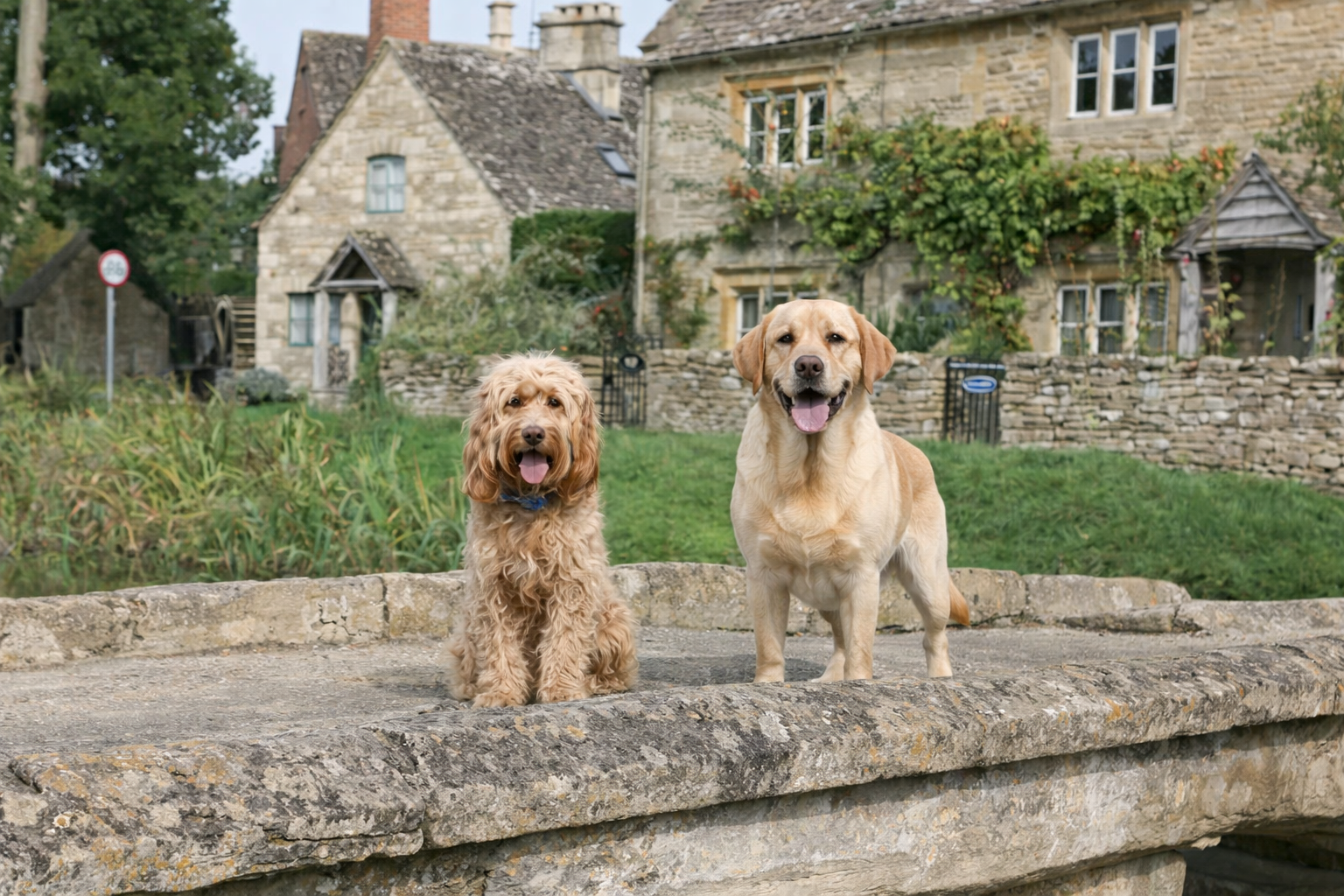
Labrador and cockapoo standing on a stone bridge outside a Cotswold cottage with low garden boundaries


Dog Fence Planning Rules UK Homeowners Should Know

Areas of Outstanding Natural Beauty and other protected landscapes have planning controls designed to preserve the countryside. These dog fence planning rules UK often focus on visible structures that could alter the natural landscape. Local planning authorities may assess fencing applications to ensure they do not damage the natural appearance of the area. These AONB dog fencing rules often focus on visible structures that could alter the landscape. Planning guidance for protected landscapes is overseen by Natural England, which works to conserve the natural beauty of Areas of Outstanding Natural Beauty.

Planning officers may consider whether fencing:

• interrupts countryside views
• affects historic landscape features
• alters traditional field boundaries
• becomes visible from public footpaths or roads

For rural homes with open gardens or countryside views, installing high fencing or boundary structures can sometimes require planning permission.


Dog Fencing in Protected Landscapes: The Real Challenge

For properties with open views or traditional boundaries, installing large or visible fencing may raise planning concerns. This often leads dog owners to look for solutions that keep their pets secure without changing the character of the property. The difficulty with dog fencing in protected landscapes is that many countryside homes were never designed with secure garden boundaries.

Typical issues include:

• low dry-stone walls
• open gardens that blend into fields
• farmland boundaries that dogs can cross easily
• large properties with multiple escape routes

This means many dog owners face a dilemma: they want to keep their dog safe, but traditional fencing may not suit the property or the surrounding landscape.

If your dog already has a habit of escaping the garden, our guide on How to Stop a Dog Running Away explains the behavioural reasons dogs leave home and how owners can prevent it.


Dog Fence Planning Rules UK Homeowners Should Know

In many cases, planning permission for garden fences UK homeowners install is not required, but height limits and location rules can apply. Restrictions are more likely if the fence borders a highway, exceeds two metres in height, or is located within protected landscapes such as conservation areas. Across England, dog fence planning rules UK can vary depending on the location and height of the fence.

General planning guidance usually states:

• fences next to highways over 1 metre high may need permission
• fences elsewhere over 2 metres high may require permission
• stricter controls apply in conservation areas and AONB landscapes

Because of these restrictions, many countryside homeowners start looking for ways to create a secure boundary without installing tall physical fencing.


Invisible Dog Fence Countryside Properties Often Choose

For many invisible dog fence countryside properties, underground containment systems provide a discreet alternative.

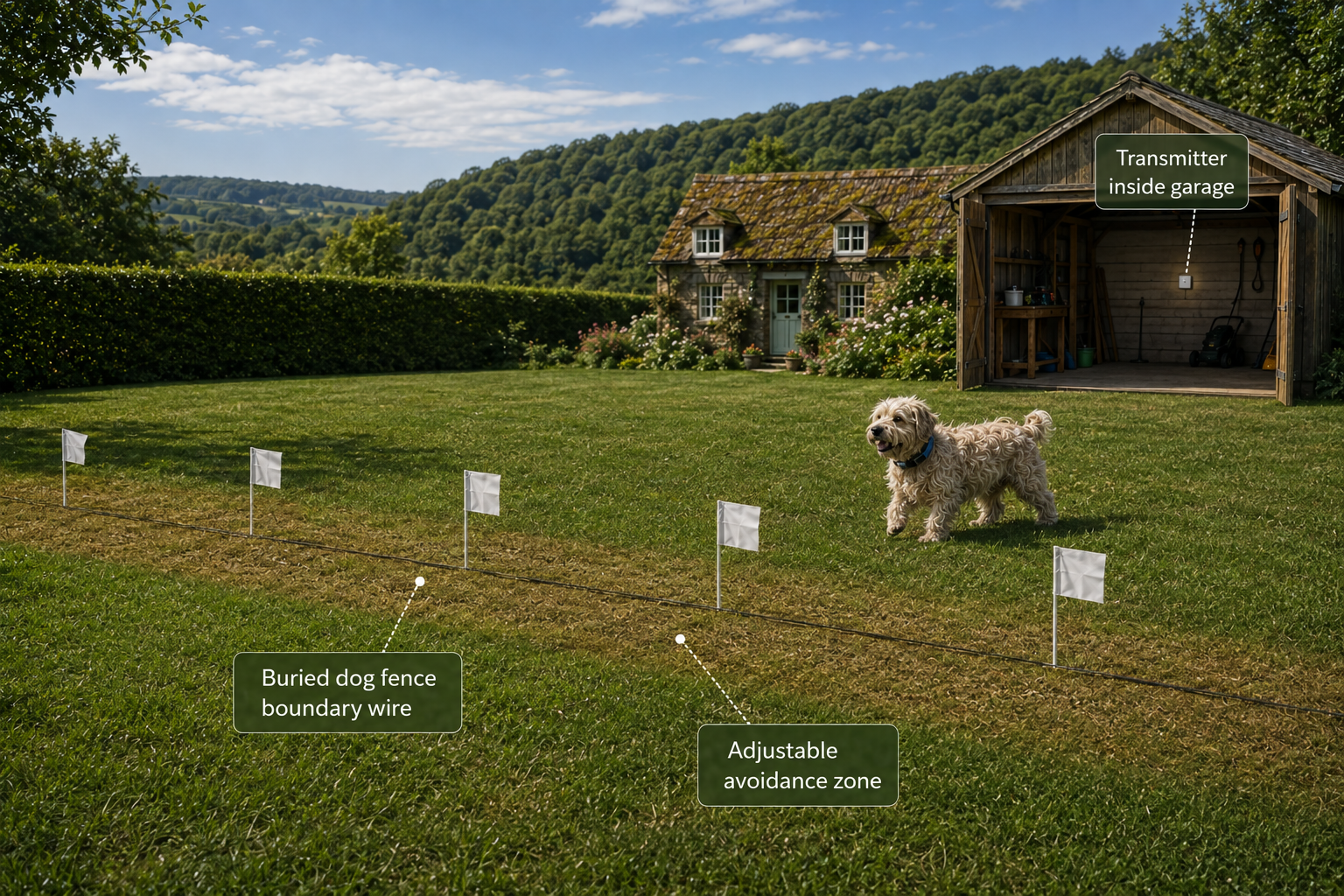
Instead of building visible fencing, a boundary wire is buried underground around the garden. The dog is trained to recognise this boundary and remain safely within it.

The benefits include:

• no visible fencing panels
• no posts or structures altering the garden
• uninterrupted countryside views
• discreet containment that blends into the landscape

Because the system is underground, it usually avoids many of the visual planning issues associated with traditional fencing.

If maintaining the appearance of your property matters to you, our guide to Secure Garden Without Ugly Fencing explains how homeowners create safe gardens without compromising their landscape.
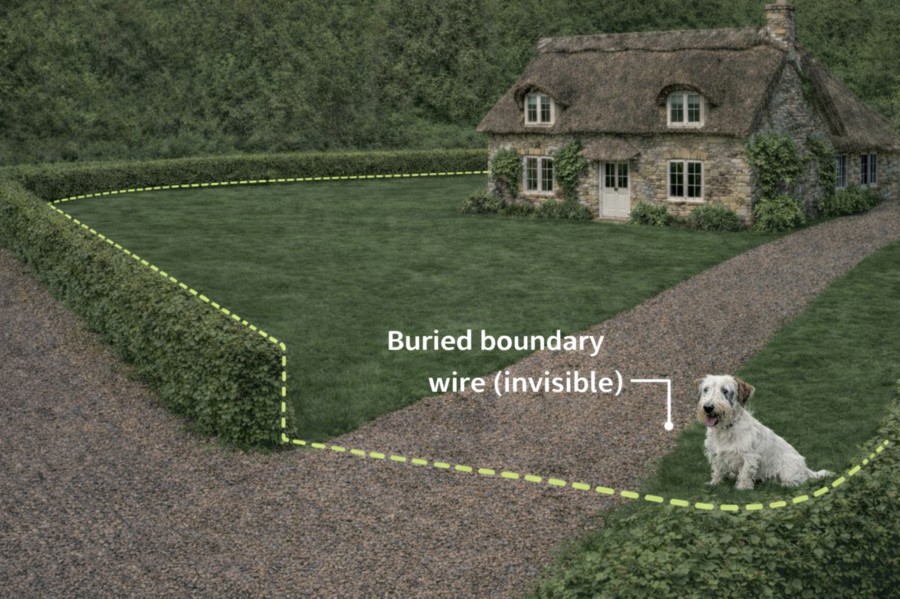
Diagram showing invisible dog fence boundary wire around a countryside cottage garden

Invisible dog fences use a buried boundary wire to create a secure garden for dogs without installing visible fencing.


Why Discreet Containment Works Well for Countryside Homes

Many rural gardens prioritise natural boundaries and uninterrupted views.

A discreet containment system allows homeowners to:

• protect their dog
• maintain the natural landscape
• avoid intrusive fencing structures
• preserve countryside views

For properties located in protected areas such as the Cotswolds, this balance can be particularly important.

If you are curious about how the system works in practice, you may also find our guide to Dog Fence Installation Guide helpful.


FAQs: Dog Fence Planning Permission in the UK

Do dog fences need planning permission in the UK?

In most cases, dog fences do not require planning permission in the UK if they stay within standard garden fence height limits. Typically, fences can be up to 2 metres high, or 1 metre next to a highway, without approval. However, additional restrictions may apply in conservation areas or protected countryside landscapes.

Are invisible dog fences legal in the UK?

Yes, invisible dog fences are legal in the UK. Because the boundary wire is buried underground and does not create a visible structure, these systems usually do not require planning permission. They are often chosen by homeowners who want to keep their dogs safe without installing traditional fencing.

What height fence can I build without planning permission in the UK?

In most cases, you can build a fence up to 2 metres high without planning permission. If the fence borders a road used by vehicles, the height limit without approval is usually 1 metre. Always check local council guidance if your property is in a conservation area or protected landscape.

Can I install a dog fence in the countryside?

Yes, many countryside homeowners install dog fences to keep pets safely contained. However, visible fencing may be restricted in some rural landscapes. Discreet solutions such as underground dog fences are often chosen because they provide containment without altering the appearance of the property.


Keeping Your Dog Safe Without Changing the Landscape

For many countryside homeowners, the goal is simple: keep their dog safe while protecting the beauty of the property and surrounding landscape.

A discreet containment system can help achieve this by creating a clear boundary for the dog without altering the natural appearance of the garden.

For homes in the Cotswolds and other Areas of Outstanding Natural Beauty, this approach often provides the safest and most practical solution.
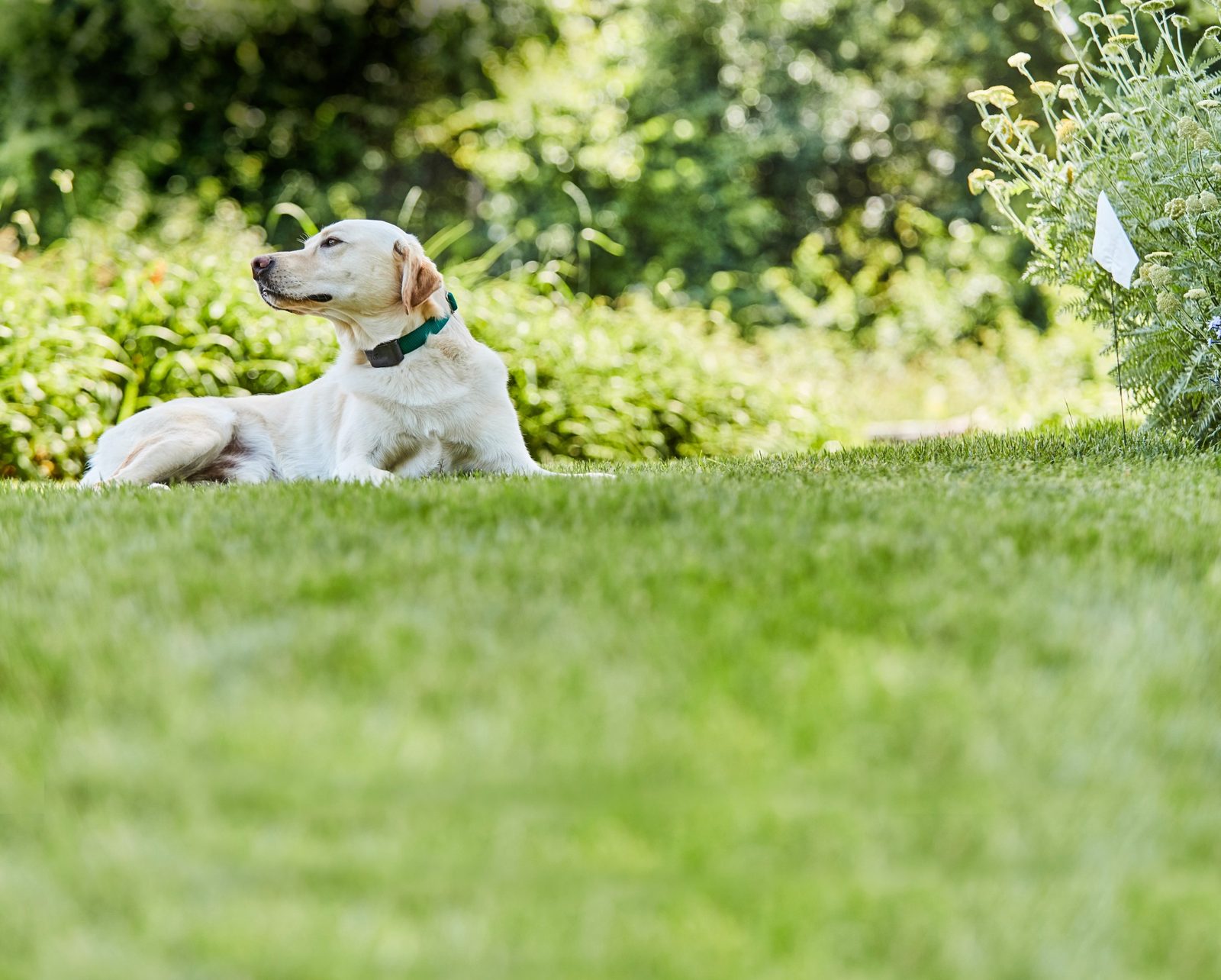
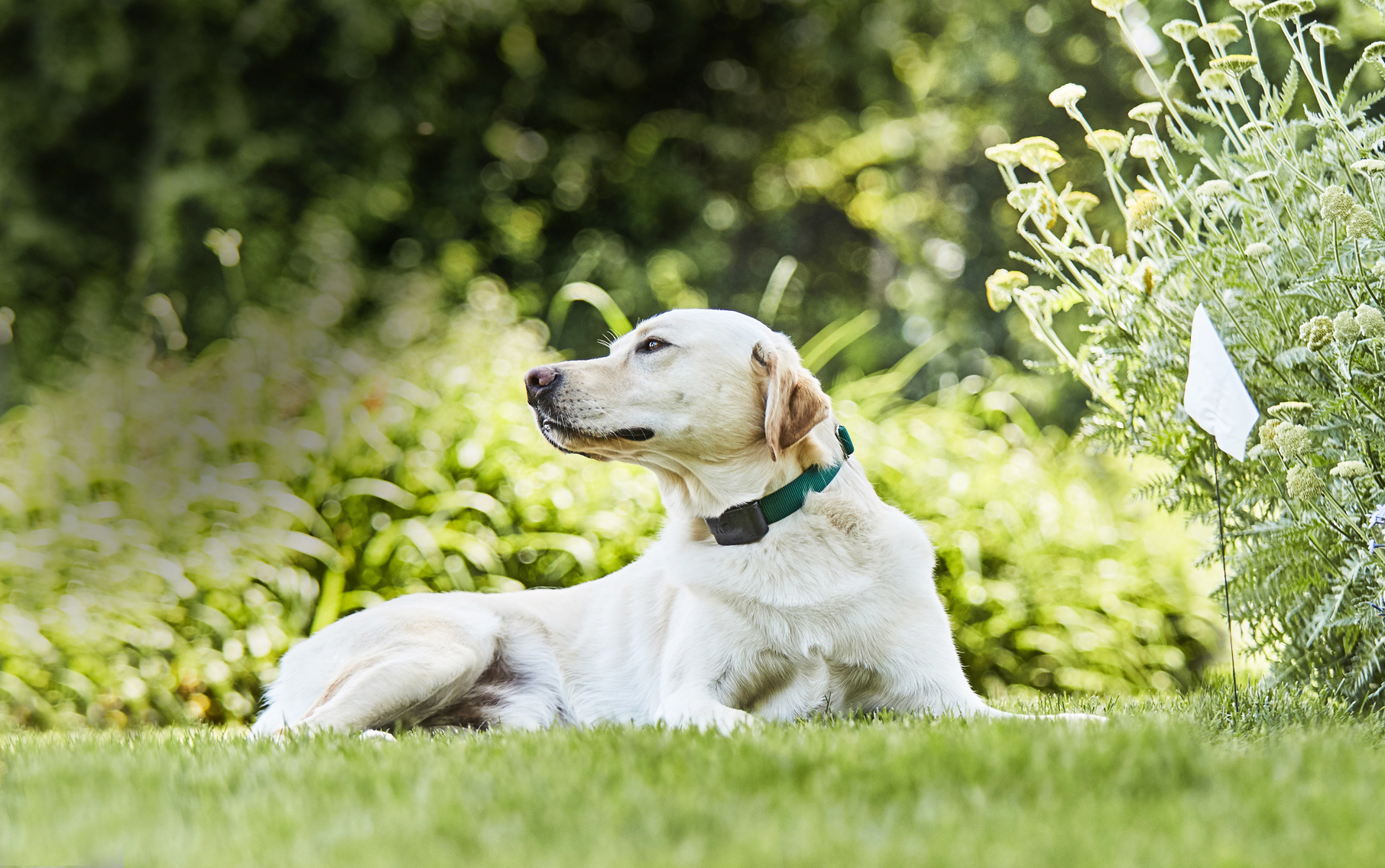
Dog relaxing in countryside garden protected by invisible dog fence boundary

Invisible dog fences allow dogs to enjoy large countryside gardens without installing visible fencing.


Need a Discreet Dog Fence for Your Garden?

If you’re researching dog fence planning permission in the UK or looking for a way to keep your dog safe without installing visible fencing, we can help. Our professionally installed systems create a secure boundary while preserving the natural look of your garden.

Call us on
01628 476475
|
Message us on WhatsApp
|
Request a Free Quote Online
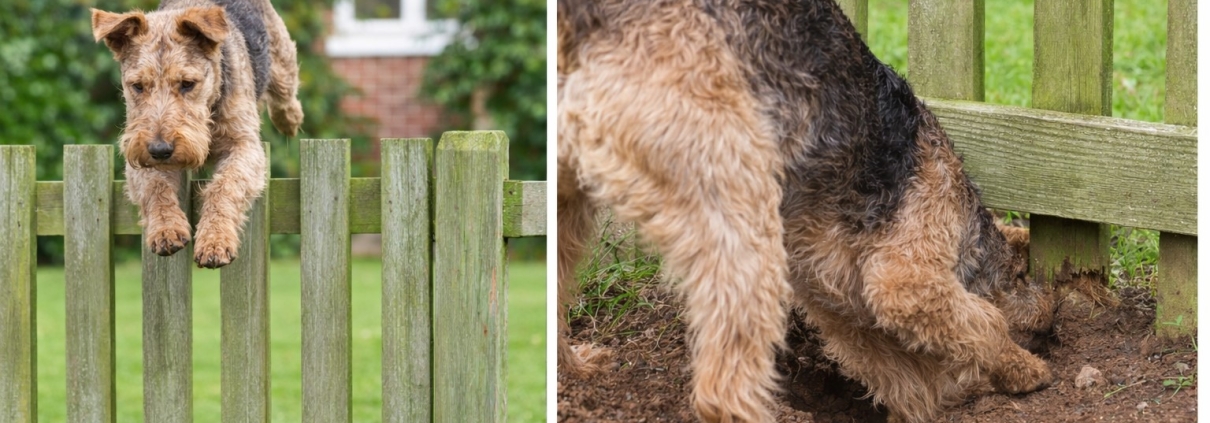
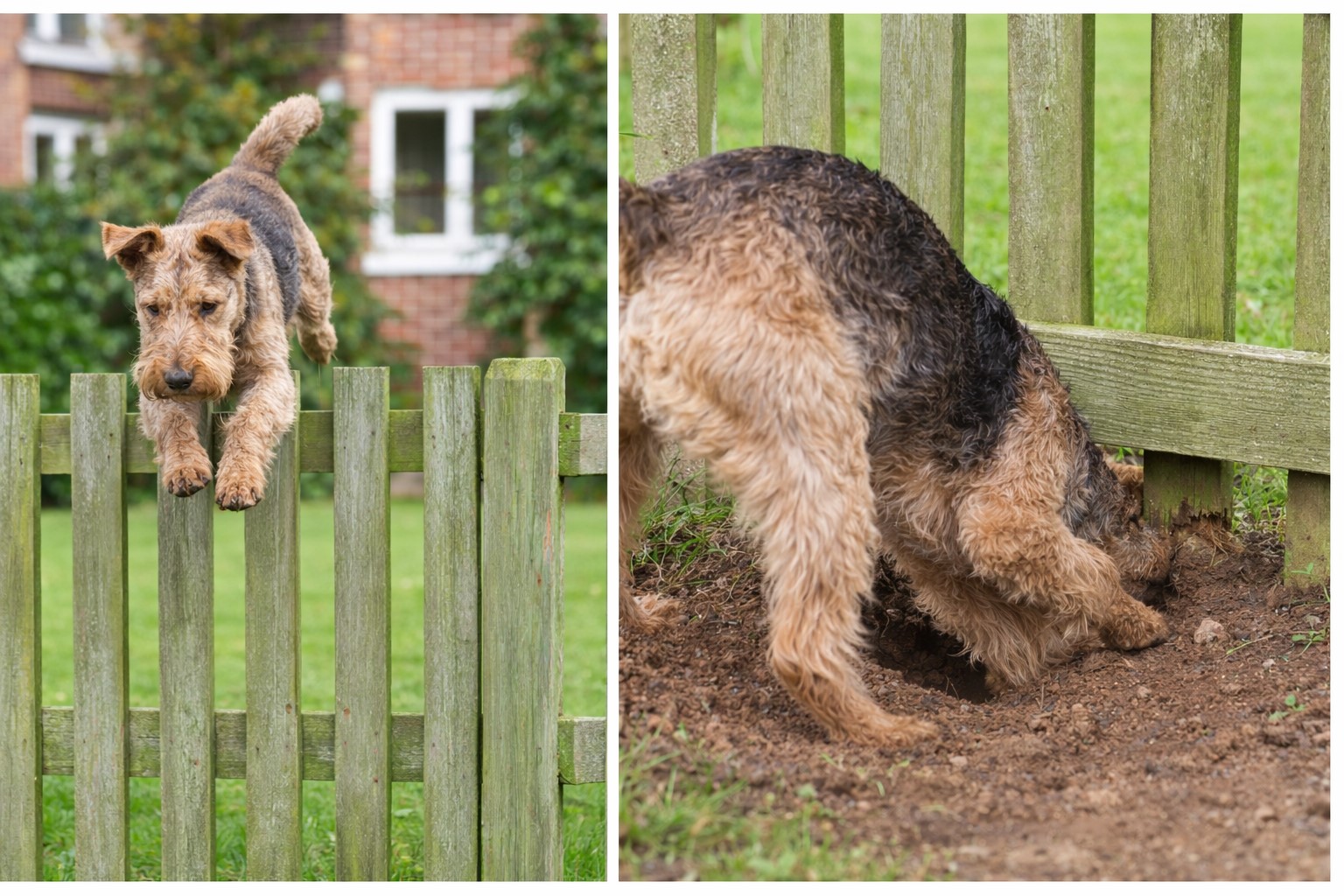
Escape artist dog jumping over a fence and digging under garden boundary

Escape Artist Dog: How to Stop Jumping & Digging Under Fences

Escape Artist Dog: Jumpers vs Diggers & The Science of Containment

If you’re living with an escape artist dog, you’ll know how quickly an ordinary garden can start to feel insecure. Whether you’re trying to stop dog jumping fence panels or stop dog digging under fence boundaries, the issue is rarely just faulty timber. Creating a truly secure garden for dogs means understanding what’s driving the behaviour in the first place. Determined dogs are motivated by instinct and learned success — which is why long-term results often require structured dog containment solutions, not just higher panels or reinforced bases.

Some dogs squeeze through gaps.
Some climb.
Some dig.

And some become what owners quickly describe as an escape artist dog — turning an ordinary garden fence into a daily challenge.

If your dog keeps escaping — whether by jumping panels or tunnelling under the boundary — you’re not dealing with a “bad” dog. You’re dealing with instinct, motivation, and learned behaviour.

Understanding whether you have a jumper, a digger, or both is the first step in solving the problem safely and permanently.


The Escape Artist Dog Who Jumps: Why Fence Height Isn’t Always Enough

Athletic breeds — Labradors, Spaniels, Collies, Shepherds — are capable of clearing surprising heights when sufficiently motivated.

Prey drive, territorial behaviour, boredom, or separation anxiety can all trigger fence jumping.

Many owners assume:

“I’ll just make the fence higher.”

But height alone doesn’t guarantee containment.

In fact, we regularly speak to owners whose dogs have cleared 6ft panels with ease.

If you’re unsure what height is considered standard in UK gardens — and whether it’s truly enough —  read our detailed guide on recommended fence heights.

What that guide explains clearly is this:

Height reduces risk.
It does not remove intent.

And when intent remains, behaviour finds a way.

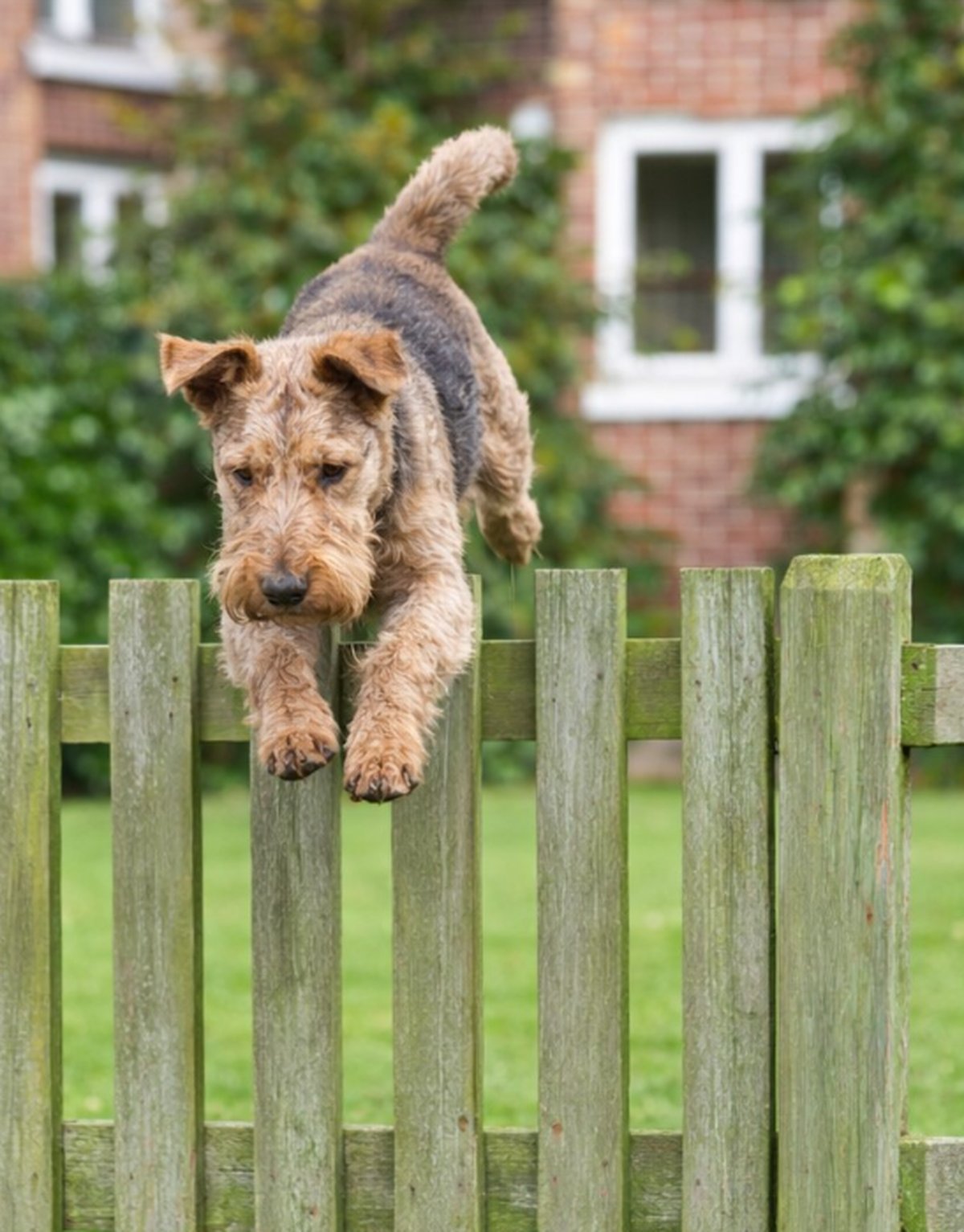
Escape artist dog jumping over a wooden garden fence


Can a 6ft Fence Really Stop a Dog?

In most UK homes, 6ft is considered the “safe” benchmark.

But can a determined dog jump a 6ft fence?

Yes — many can.

Large breeds can power-jump.
Some dogs climb horizontal slats like ladders.
Others use nearby objects for launch leverage.

If your dog has already cleared that height, increasing panels further may only delay the problem.

At that point, the issue is no longer about fencing — it’s about behavioural containment.

How to Stop Dog Jumping Fence Behaviour Safely

If you’re searching for ways to stop dog jumping fence behaviour, it’s important to look beyond height alone. Jumping is usually driven by motivation — whether that’s excitement, prey drive, or anxiety.

Raising panels may help temporarily, but long-term solutions focus on reducing the reward of escape and creating a clear boundary your dog understands and respects. Many owners searching for ways to stop dog jumping fence behaviour focus on height alone, but without addressing motivation, the problem often repeats.


The Escape Artist Dog Who Digs: Why Reinforcement Alone Fails

Digging is instinctive.

Terriers were bred to tunnel.
Spaniels follow scent.
Huskies dig for temperature regulation.

But when digging focuses along the boundary line, it usually means one thing:

Your dog is trying to get out.

Owners often respond by:

  • Filling the hole
  • Laying slabs
  • Burying wire mesh
  • Adding gravel boards

Sometimes that works temporarily.

Often, the digging simply moves sideways. Digging behaviour is often linked to scent tracking and prey drive, as explained by the RSPCA’s guidance on understanding dog behaviour.

How to Stop Dog Digging Under Fence Repeatedly

When owners try to stop dog digging under fence attempts, they often reinforce the same area repeatedly. But determined dogs simply shift location.

Effective prevention combines structural reinforcement with behavioural clarity — so the dog no longer sees the boundary as an opportunity to escape. If your dog is repeatedly tunnelling under panels, our step-by-step guide on See our boundary protection advice explains practical prevention methods as well as when reinforcement alone is unlikely to succeed

Escape artist dog digging under a wooden garden fence trying to escape


Why Traditional Fencing Fails an Escape Artist Dog

Most garden fencing systems are built for privacy — not determined containment.

Wood warps.
Ground shifts.
Gates loosen.
Dogs adapt.

Once a dog learns there is a weak point, that location becomes the focus.

And once they experience the reward of escape, repetition becomes highly likely.

This is why many “fixes” become an ongoing cycle of repair rather than a long-term solution.


The Science of Containment: Interrupting Intent

The most reliable containment strategies don’t rely on height or depth alone.

They rely on clarity.

When a dog clearly understands a boundary — and that boundary is consistent — the behaviour changes.

Modern containment systems work because they:

  • Establish a visible and invisible boundary
  • Provide clear warning cues
  • Remove ambiguity
  • Prevent both jumping and digging at source

Instead of reacting to the method of escape, they interrupt the intention to escape.

That behavioural clarity is what stops repeat attempts.


Jumper vs Digger: Which Type Is Yours?

Some dogs specialise.

Some combine tactics.

If your dog:

  • Jumps when stimulated by movement
  • Digs when left alone
  • Patrols the fence line obsessively
  • Has escaped more than once

You’re likely dealing with motivation, not just structure. And motivation cannot be solved with timber alone.


When to Consider a Different Approach

You may need a broader containment solution if:

  • Fence height increases haven’t worked
  • Reinforced bases haven’t stopped digging
  • Escapes are becoming more frequent
  • Your dog appears determined or anxious

At this stage, repeating physical upgrades often costs more than resolving the root behaviour.


Frequently Asked Questions

Can a dog jump a 6ft fence?

Yes. Many medium and large breeds can clear a 6ft fence if sufficiently motivated. Height alone does not guarantee containment.

If you’re unsure whether 6ft is enough for your breed, see our detailed guide on whether a dog can jump a 6ft fence.

Why does my dog keep digging under the fence?

Digging along the boundary usually indicates an attempt to escape, often driven by scent, boredom, anxiety, or prey drive.

What is the most reliable way to stop a dog escaping the garden?

Long-term solutions combine clear boundary communication with consistent containment, rather than relying solely on physical barriers.


Conclusion

Many owners repairing panels eventually realise they’re not dealing with faulty fencing — they’re living with an escape artist dog. And solving that requires behavioural clarity, not just stronger timber.

About the Author

Sam Chapman has worked in professional pet containment since 2003 and is part of one of the UK’s longest-established electronic boundary specialists. With over two decades of experience and thousands of installations across England, DogFence systems focus on safety, training clarity, and long-term containment rather than temporary fixes.

Escape Artist Dog? Let’s Stop the Jumping & Digging — For Good.

Get expert help creating a secure garden boundary with a proven pet containment system and calm, structured training.

Call us on
01628 476475
|
Message us on WhatsApp
|
Request a Free Quote Online
Dog following scent trail in winter garden

Why Dogs Escape More in Winter: Scent, Wildlife & Boundary Testing

Why Dogs Escape More in Winter: Scent, Wildlife & Boundary Testing Explained

Winter is one of the most common times we hear the phrase:

“He’s never escaped before — and suddenly he’s gone.”

For many dog owners, winter escapes come as a complete shock. The garden hasn’t changed. The fence is still standing. The dog is older, trained, and normally reliable.

Dog following scent trail in winter garden

Cold, damp winter conditions can intensify scent trails, encouraging dogs to test garden boundaries

So what’s going on?

The answer lies in scent, seasonal wildlife movement, and instinct-driven boundary testing — not bad behaviour or failed training. For many owners, learning how electronic dog fences work helps explain why behaviour-led boundaries are often more effective for instinct-driven dogs than traditional fencing alone.


Cold Weather Makes Scents Stronger (Not Weaker)

One of the biggest myths about winter is that dogs are less stimulated outdoors. In reality, the opposite is true.

Cold, damp air holds scent closer to the ground, rather than allowing it to disperse. Wet soil, fallen leaves, frost, and reduced sunlight all help scent trails linger longer and travel further.

For scent-led breeds — and many non-hounds too — this can turn an ordinary garden into a sensory overload.

A fox passing through at dawn.
A deer crossing a nearby field overnight.
A badger trail along a hedge line.

To a dog, these scents can feel urgent, fresh, and impossible to ignore.


Winter Wildlife Movement Increases Temptation

Winter forces wildlife to move differently.

  • Deer travel wider in search of food

  • Foxes become bolder and closer to homes

  • Small mammals shelter near fences, sheds, and compost areas

This means more wildlife activity closer to your boundary lines, exactly where dogs spend time patrolling.

Even dogs that have never shown interest before may suddenly begin:

  • Fixating on fence lines

  • Pacing specific areas

  • Digging or pushing at weak spots

  • Ignoring recall when something catches their nose

This isn’t disobedience — it’s instinct taking over.

Muntjac deer moving through the countryside in winter

Deer such as muntjac leave powerful scent trails that linger in cold, damp winter conditions and can draw dogs towards boundary lines.


Why Physical Garden Fences Often Fail in Winter

Traditional fencing relies on visual and physical barriers, but winter exposes their weaknesses.

Common winter fence failures include:

  • Soft or waterlogged ground under panels

  • Gates swelling or warping

  • Reduced visibility from darkness and fog

  • Gaps forming where soil shifts

More importantly, fences don’t communicate boundaries — they only block them.

When a dog is following scent, height often doesn’t matter. If the motivation is strong enough, dogs will climb, dig, squeeze, or simply run through weak points they previously ignored.

According to the RSPCA, dogs that roam or escape unsupervised face increased risks from roads, wildlife encounters and becoming lost — risks that are heightened during darker winter months.


Boundary Testing Is Normal (Even in “Good” Dogs)

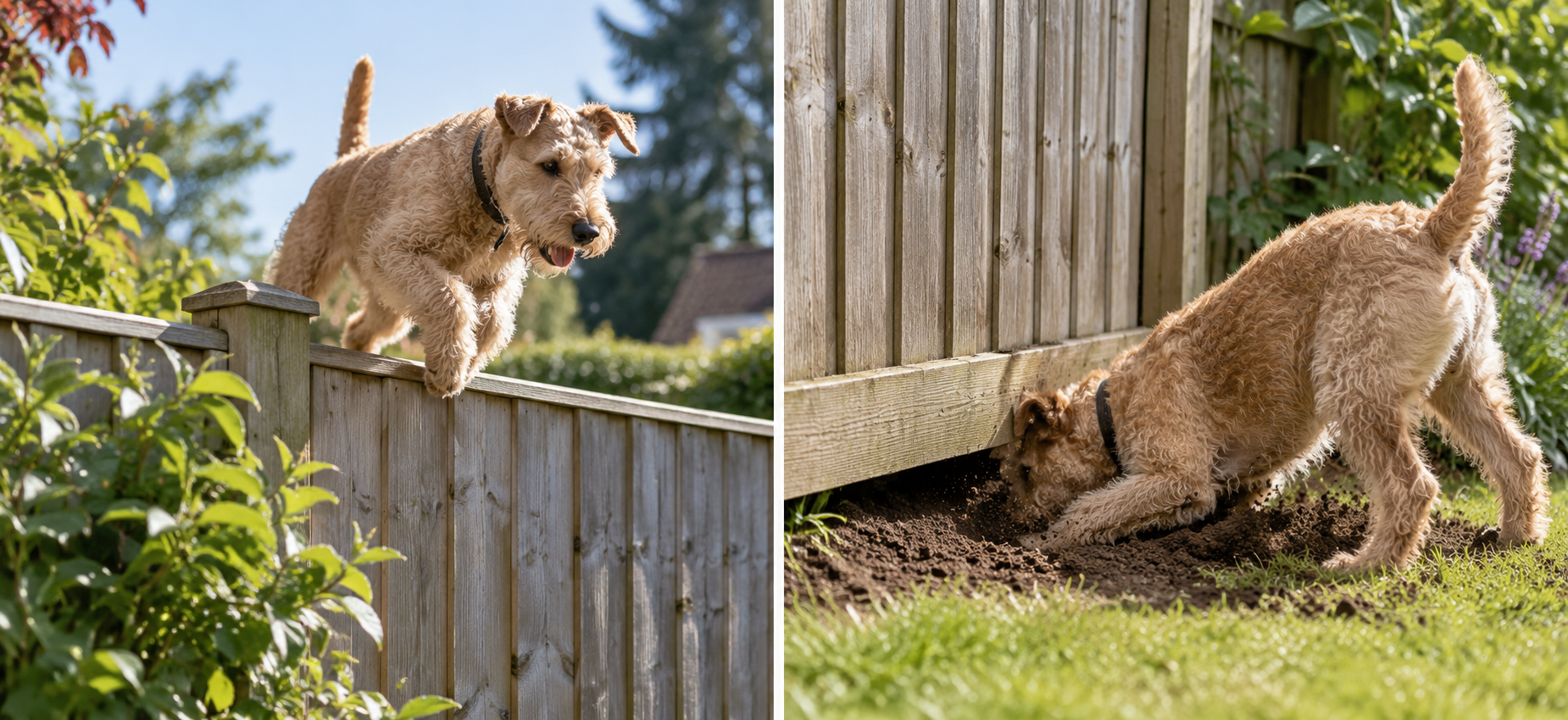
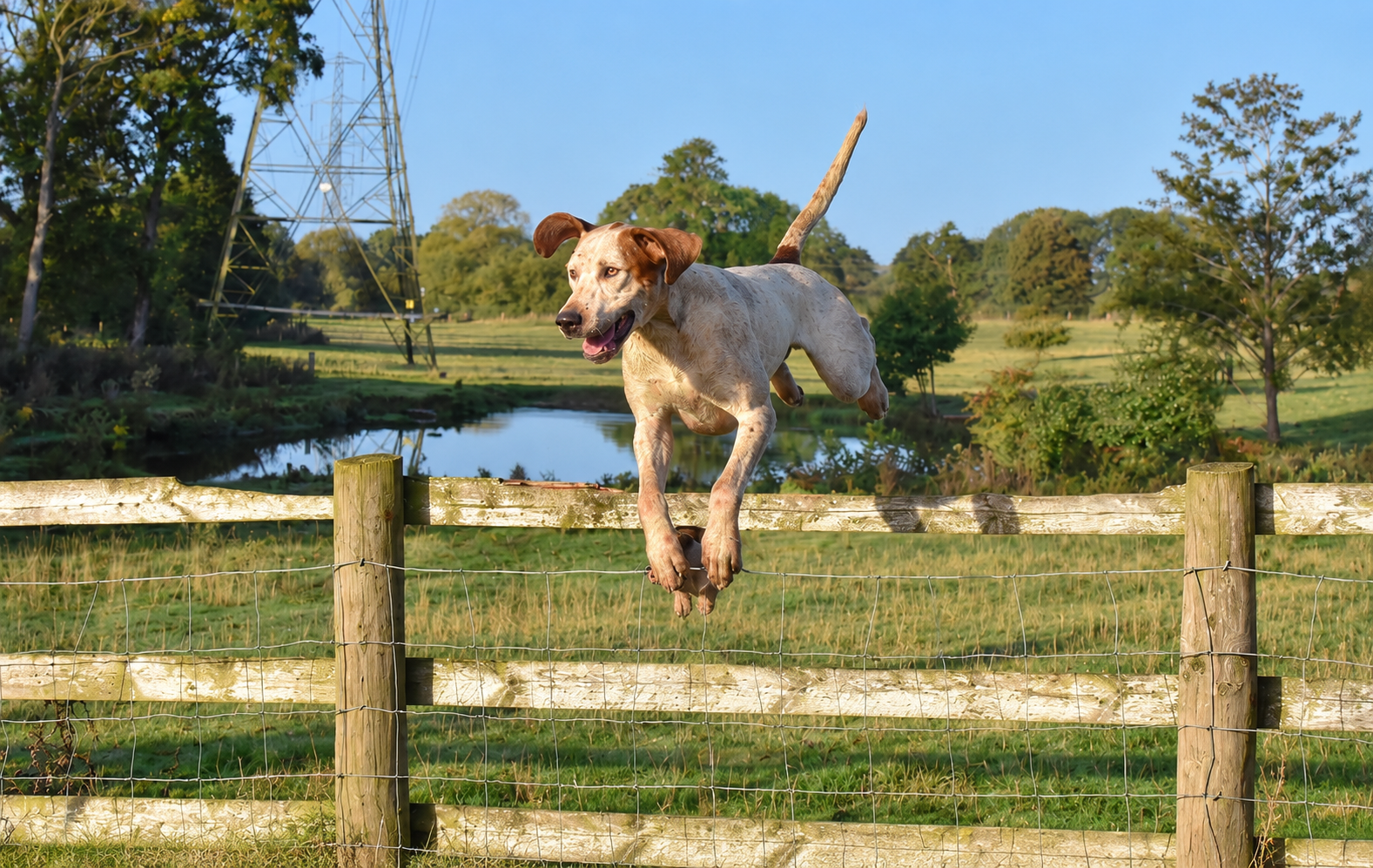
Dog testing a garden fence by jumping

When environmental conditions change, some dogs test boundaries by jumping or investigating fence lines.

Dogs constantly assess their environment. Winter is a major environmental change.

When conditions shift, dogs naturally:

  • Re-check limits

  • Test responses

  • Push boundaries that previously felt unimportant

This is especially common in:

  • Scent-driven breeds

  • Adolescents and young adults

  • Confident or intelligent dogs

  • Dogs given more unsupervised garden access in darker months

Owners often blame themselves — but this behaviour is predictable, explainable, and preventable.

ust as puppies learn where their boundaries begin, even adult dogs will re-test limits when conditions change — whether it’s winter scent or seasonal wildlife movement. Learn more about how young dogs learn boundaries in our detailed guide for puppies


Why Training Matters More Than Fence Height

The most reliable containment systems don’t rely on physical barriers alone. They teach dogs where their boundary is, not just where a fence happens to be.

When dogs understand a boundary:

  • They stop testing it

  • They disengage from scent earlier

  • They remain calmer and more confident

  • They stay safe even when highly stimulated

This is why many owners find that electronic containment used alongside training works where traditional fencing fails — especially during high-instinct seasons like winter.

The boundary becomes clear, consistent, and independent of weather, light, or ground conditions.


Winter Escapes Are a Warning Sign — Not a Phase

If your dog has started escaping, or seems suddenly “different” in the garden, it’s rarely something they’ll simply grow out of.

In fact, once a dog has:

  • Successfully escaped once

  • Followed a scent beyond the boundary

  • Experienced the reward of exploration

They are more likely to try again, not less.

Addressing the cause early protects your dog from:

  • Road accidents

  • Getting lost while tracking scent

  • Injury or wildlife confrontation

  • Stress and anxiety from repeated escapes


Helping Your Dog Stay Safe This Winter

If winter has changed your dog’s behaviour outdoors, you’re not alone — and you’re not doing anything wrong.

Understanding how seasonal scent, instinct, and boundaries interact is the first step toward keeping your dog safe, calm, and contained all year round.

If you’d like advice tailored to your dog, your garden, and your location, speak to a team that understands both behaviour and containment, not just products.


📞 Talk to DogFence About Winter Escapes

Talk to DogFence About Winter Escapes

Call us on
01628 476475
|
Message us on WhatsApp
|
Request a Free Quote Online
dog fence dogs

Fencing For Dogs Who Escape

What Is the Best Fence for Dogs That Escape?

The best fence for dogs that escape depends on how your dog is getting out. A dog that jumps needs a different solution from one that digs, squeezes through gaps or bolts through an open gate. For persistent escape artists, simply making a physical fence higher or stronger may not solve the problem.

In this guide, we look at the main fencing options for escaping dogs, their advantages and limitations, and what to consider when choosing a secure boundary for your garden.

Fencing for dogs who escape – dog jumping over a garden fence

Quick Answer: What Is the Best Fence for Dogs That Escape?

For many dogs, a secure physical fence with no gaps and sufficient height will work perfectly well. However, dogs that repeatedly jump, climb, dig or escape through gates may need a different approach.

The main options are:

  • Solid wooden fencing – useful for dogs distracted by what they can see outside the garden.
  • Mesh or wire fencing – practical for larger gardens and rural properties.
  • Dig-proof fencing – designed for dogs that tunnel underneath boundaries.
  • Higher fencing – potentially useful for athletic dogs that jump.
  • A hidden dog fence – creates a consistent boundary that can work across fences, hedges, gates and driveways.

The right choice depends on your dog, how they escape and the layout of your property.

Why Do Some Dogs Escape Conventional Fencing?

Some dogs are remarkably good at finding weaknesses in garden boundaries. Fix one escape route and they simply start looking for another.

Common escape methods include:

  • jumping over fences;
  • climbing mesh or timber fencing;
  • digging underneath;
  • squeezing through small gaps;
  • pushing through hedges;
  • escaping when gates are opened;
  • bolting down open driveways.

Before spending money on new fencing, identify exactly how your dog is escaping. This will help you choose a solution that addresses the actual problem rather than just one particular escape point.

If you are not sure why your dog keeps getting out, read our guide to why dogs escape gardens.

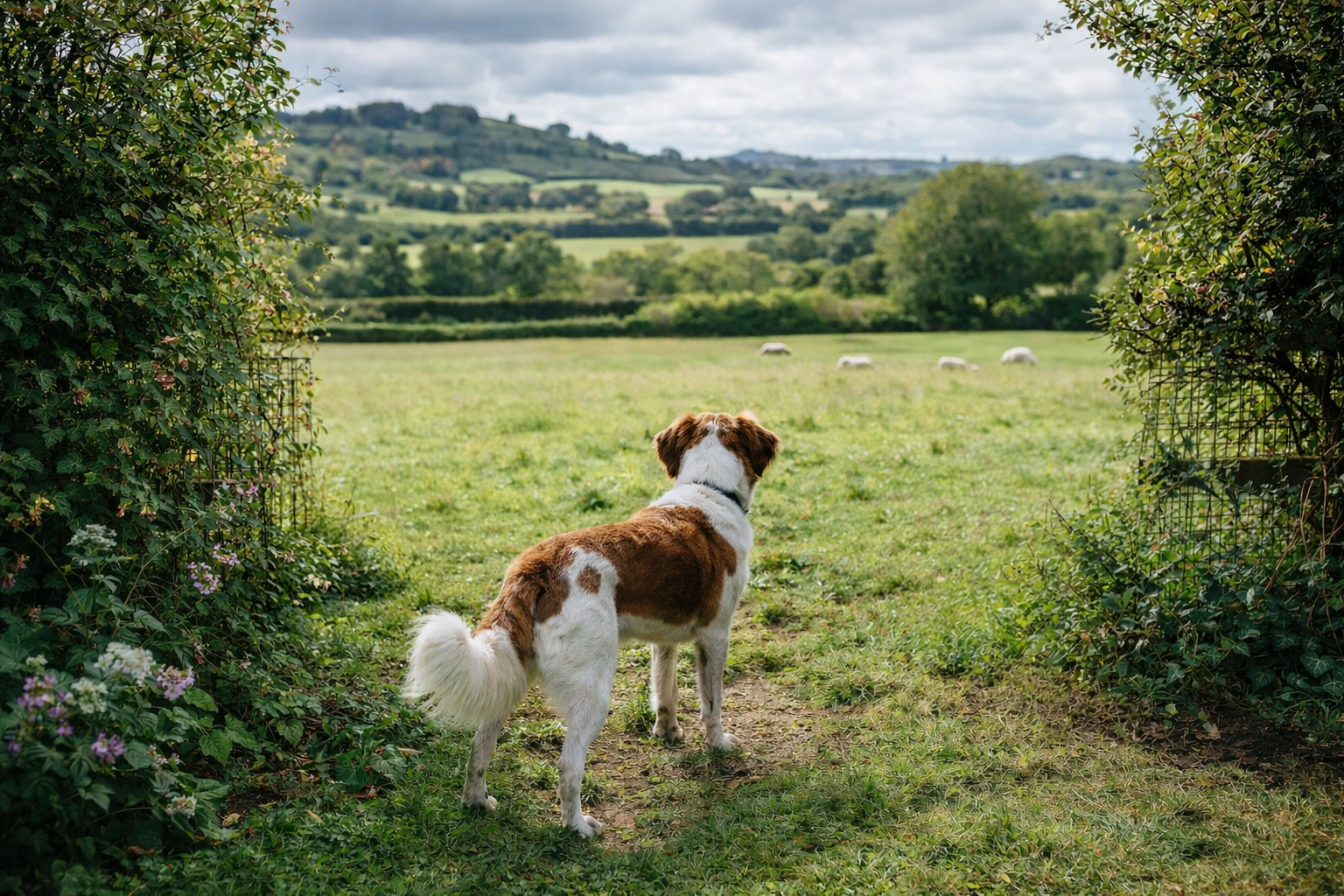
Fencing for dogs who escape – dog looking through an open garden boundary

Escape Proof Fence for Dogs: Does One Exist?

There is no single physical fence that can honestly be described as completely escape proof for every dog.

A six-foot fence may stop one dog but another may climb it. Reinforcing the bottom may prevent digging, while still leaving a gate or driveway as an escape route.

That is why the best escape proof fence for dogs is the one designed around both the dog’s behaviour and the individual property.

1. Wooden Fencing for Dogs That Escape

Solid wooden fencing is one of the most common choices for gardens. It provides a visible physical barrier and can also prevent a dog seeing distractions such as passing dogs, people or wildlife.

Advantages:

  • Creates a solid visual barrier.
  • Available in different heights.
  • Can reduce visual triggers outside the garden.
  • Works well for many ordinary residential gardens.

Potential problems:

  • Dogs can dig underneath it.
  • Athletic dogs may jump over it.
  • Some dogs learn to climb panels or nearby structures.
  • Damaged panels can create escape gaps.
  • It cannot normally solve an open driveway or frequently opened gate.

2. How High Should Fencing Be for an Escape Artist Dog?

If your dog jumps, increasing fence height may seem like the obvious answer. For some dogs, it is.

However, jumping ability varies enormously according to size, breed, athleticism and motivation. There isn’t one fence height that guarantees every dog will remain inside.

Also check for bins, sheds, walls, garden furniture and raised flower beds close to the fence. A dog may be using these as a launch point.

For more detail, see how high a dog fence should be and our guide answering can a dog jump a 6ft fence?

3. Dog Proof Fencing for Dogs That Dig

For a determined digger, fence height is largely irrelevant. The weak point is underneath the boundary.

Physical fencing may need to be extended or reinforced at ground level to make digging underneath more difficult. Regularly inspect the perimeter because some dogs simply move along the fence and start digging somewhere else.

If this sounds familiar, our guide to how to stop a dog digging under a fence looks specifically at this problem.

4. Mesh and Wire Fencing for Dogs

Mesh fencing can be a practical choice for large gardens, paddocks and rural properties where installing solid timber fencing around the entire boundary would be expensive or visually intrusive.

However, the mesh size and construction matter. Small dogs may squeeze through larger openings and some dogs are surprisingly capable climbers.

Large properties also introduce another challenge: the longer the boundary, the more potential weak points there are to maintain.

Owners of larger properties may find our guide to dog proof fencing for rural properties useful.

5. What About Gates and Open Driveways?

This is where conventional fencing often becomes difficult.

You may have excellent fencing around the entire garden but still need vehicles, deliveries and visitors to enter through a gate or open driveway.

A dog can quickly learn that an opening gate creates an opportunity to escape. For some owners, permanently closing or physically fencing an entrance simply isn’t practical.

A hidden dog fence can create a boundary across a driveway or gate without physically preventing vehicles or people from passing through.

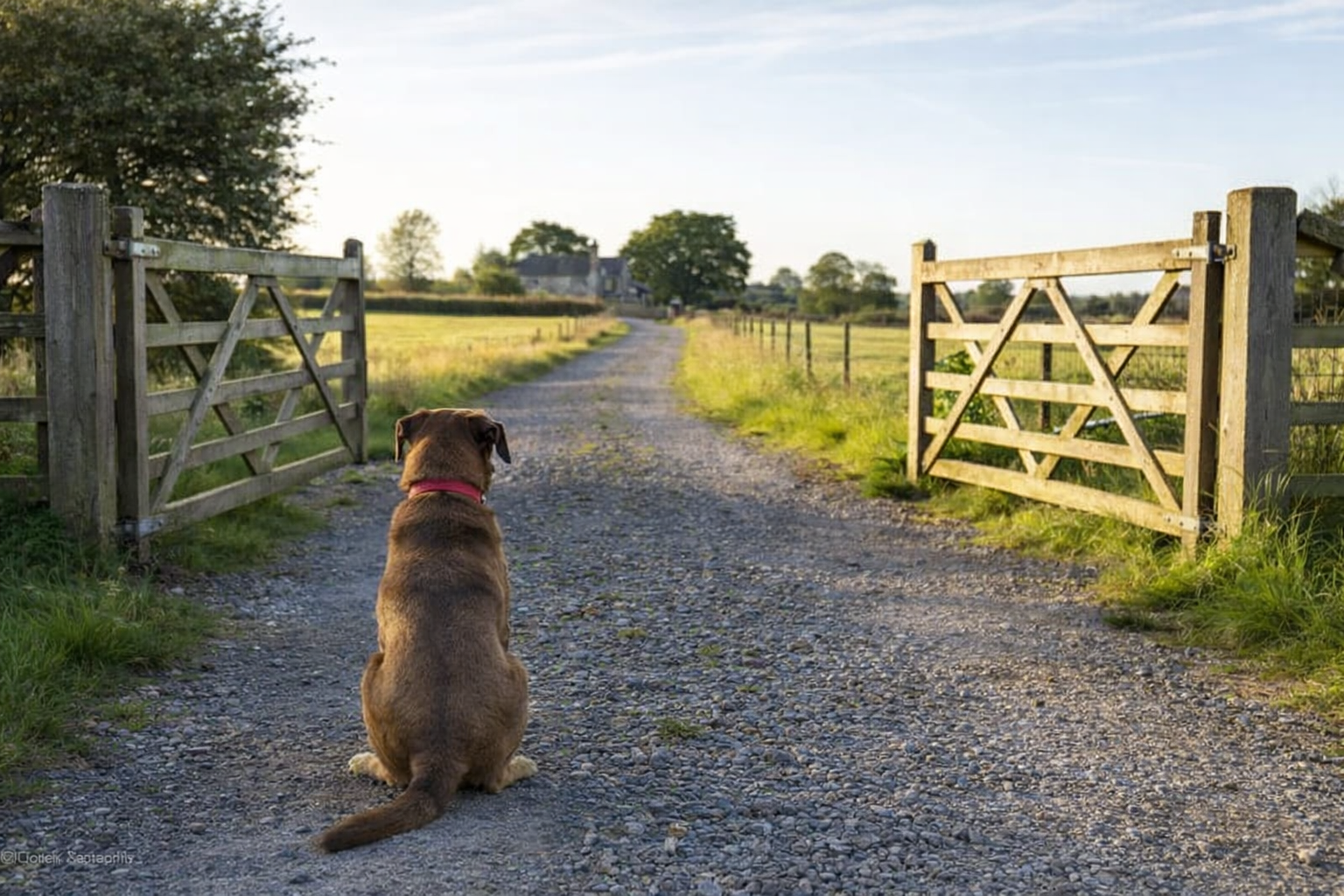
Escape proof fence for dogs – dog sitting beside an open driveway gate

6. Hidden Dog Fence for Dogs That Escape

For dogs that repeatedly defeat conventional fencing, a professionally installed hidden dog fence provides another option.

Rather than relying solely on the height or strength of a physical barrier, DogFence creates a consistent boundary that your dog is trained to recognise.

A discreet boundary wire is installed around the selected area of the property. Your dog wears a lightweight receiver collar and is introduced to the boundary through a structured training programme.

The boundary can be designed around:

  • existing fencing;
  • hedges;
  • gardens and lawns;
  • woodland;
  • open driveways;
  • electric gates;
  • large and rural properties;
  • specific areas within a garden.

If you have a persistent escape artist, see our dedicated dog fence for dogs that escape page for more information about how the system works for dogs that jump, dig, squeeze through gaps or bolt through entrances.

Wired or Wireless Dog Fence: Which Is Better?

Hidden dog fences can use either a wired boundary or a wireless system, but they do not provide the same flexibility.

A wired system allows the boundary to be designed around the individual property. It can follow irregular gardens, encompass larger areas and be positioned around existing landscaping, gates and driveways.

Wireless systems generally create a predetermined signal area around a transmitter. This can make them convenient in some circumstances, but the boundary shape is less flexible.

DogFence uses a professionally designed wired boundary because it allows us to tailor the layout to the dog and the property rather than asking the property to fit a predetermined boundary.

How Does a Hidden Dog Fence Work?

The principle is straightforward:

  1. A discreet boundary wire is installed around the area in which your dog can safely roam.
  2. The wire carries a radio signal.
  3. Your dog wears a lightweight receiver collar.
  4. Temporary training flags provide a visual reference during training.
  5. The collar gives an audible warning as your dog approaches the boundary.
  6. Your dog is taught to recognise the warning and move back into the safe area.
  7. The training flags are gradually removed once your dog understands the boundary.

The system is designed to work alongside appropriate training rather than simply relying on the equipment itself.

What Is the Best Dog Fence for a Large Garden?

For a large garden, acreage or rural property, the cost and practicality of installing traditional fencing around the entire perimeter can become significant.

A hidden dog fence can cover substantial and irregular areas without blocking views or requiring a high physical fence around the property.

It can also follow boundaries through hedges, woodland and other areas where conventional fencing may be difficult or undesirable.

What Is the Best Fence for a Dog That Jumps AND Digs?

This is where simply modifying a physical fence can become frustrating.

If you make the fence higher, your dog may start digging underneath it. Reinforce the bottom and they may discover a gap beside the gate. Block the gap and they may simply wait for somebody to open the driveway.

For dogs with several different escape techniques, a DogFence hidden dog fence can provide a different solution. Rather than trying to physically block every possible escape route, the DogFence creates a consistent boundary around the area where you want your dog to remain.

A discreet boundary wire is installed around the property and your dog wears a lightweight receiver collar. As your dog approaches the boundary, the collar gives an audible warning. During professional training, your dog learns to recognise that warning and retreat back into the safe area.

This means the same hidden dog fence can protect areas where a dog might otherwise jump over fencing, dig underneath it, squeeze through gaps or escape through an open driveway.

Importantly, a DogFence can also work alongside your existing garden fence, hedge, wall or gates. You do not necessarily need to remove the fencing you already have – the hidden boundary provides an additional layer of security for a determined escape artist.

For a dog that both jumps and digs, this can be particularly useful because you are creating one consistent dog boundary rather than continually trying to anticipate the next way your dog might escape.

See how it works on our dog fence for dogs that escape page.

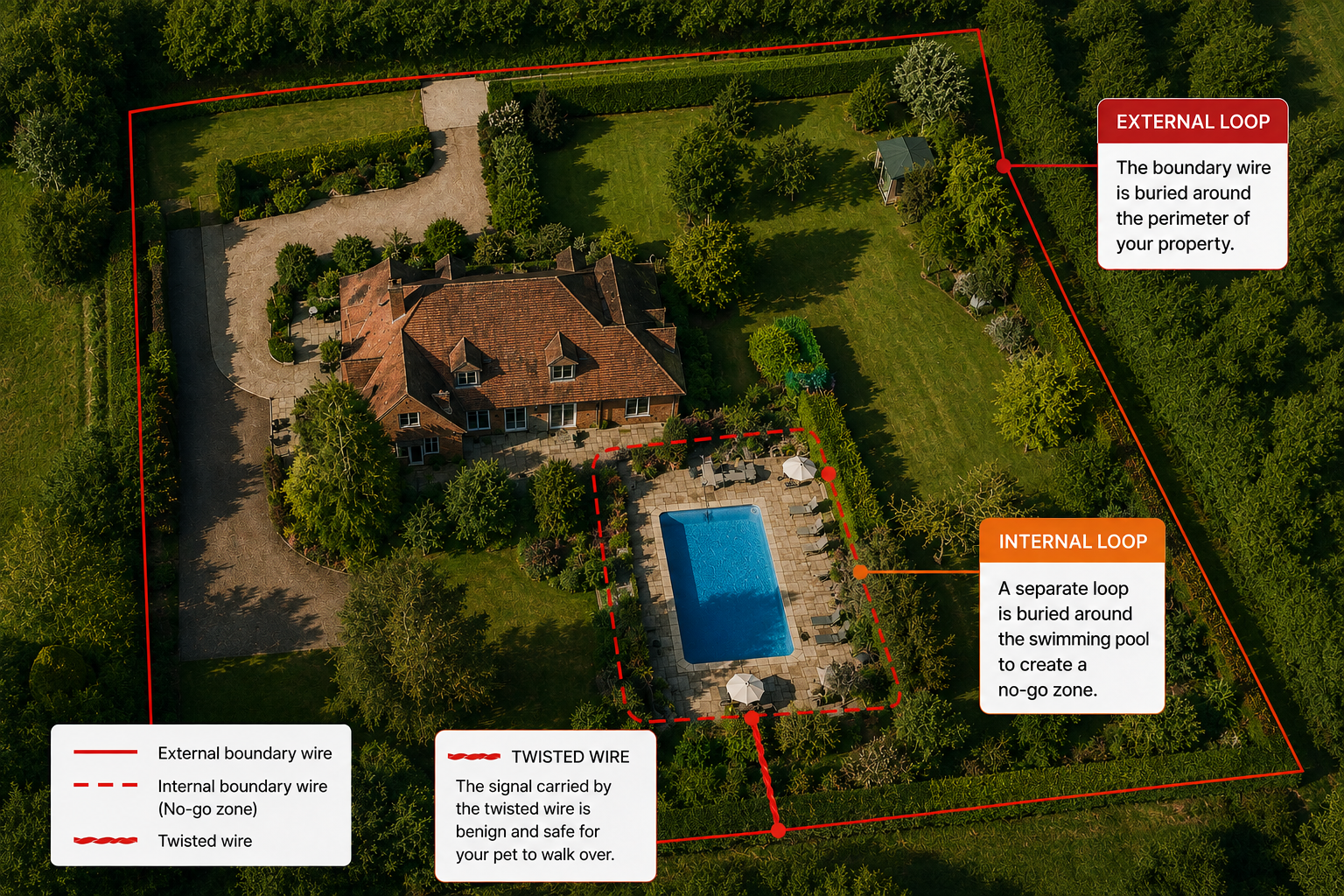
Aerial view of Escape-proof fencing for dogs showing a hidden boundary around the garden and a separate no-go zone around the swimming pool

A hidden dog fence can create both an external garden boundary and an internal no-go zone around your swimming pool. The twisted wire safely connects the two boundaries, allowing your dog to cross it without receiving a warning.

How Do I Choose the Best Fencing for My Dog?

Ask yourself five questions:

  1. How is my dog escaping? Jumping, digging, climbing, squeezing or bolting?
  2. Where are they escaping? Fence, hedge, gate or driveway?
  3. How large is the area? A small enclosed garden and a rural property require very different solutions.
  4. Do I want a visible physical fence? Appearance and planning considerations may influence your choice.
  5. Has my dog already defeated conventional fencing? If so, simply replacing it with something similar may not address the underlying problem.

The best fencing solution should suit your dog, your garden and the way you use your property.

Frequently Asked Questions About Fencing for Dogs That Escape

What is the best fence for dogs that escape?

The best fence depends on how the dog escapes. Solid fencing can suit many gardens, while diggers may need ground-level reinforcement and jumpers may need greater height. Dogs that repeatedly defeat physical fencing or escape through gates and driveways may benefit from a hidden dog fence combined with appropriate training.

What is the best escape proof fence for dogs?

No physical fence can be guaranteed escape proof for every dog. Determined dogs may jump, climb, dig or find gaps. The most appropriate solution is one designed around the dog’s particular escape behaviour and the property’s layout.

What fencing is best for a dog that digs?

A physical fence needs to be secure at ground level and regularly checked for new digging points. A hidden boundary can also be considered for persistent diggers that continually find new places to tunnel underneath conventional fencing.

What fencing is best for dogs that jump?

Increasing physical fence height can help, but the required height depends on the dog’s size and athletic ability. Remove objects that can act as launch points and consider whether the dog is likely to find another escape method if jumping is prevented.

Can a hidden dog fence cross a driveway?

Yes. A professionally designed wired boundary can cross driveways and entrances, allowing vehicles and people to continue using them while the dog is trained to recognise the boundary.

Can I use a DogFence with an existing fence?

Yes. A DogFence can work alongside existing timber, mesh or other garden fencing. It can provide an additional consistent boundary where a dog has learned to jump, dig underneath or exploit gaps in the existing fence.

Can one DogFence be used for several dogs?

Yes. Multiple pets can use the same boundary with individual receiver collars appropriate to each animal.

Which Fence Should I Choose for My Escape Artist?

If your existing fence already keeps your dog safely in the garden, there may be no reason to replace it.

But if you are continually blocking holes, increasing fence height, repairing gaps or worrying every time somebody opens the gate, it may be worth considering a different approach.

DogFence has been helping UK owners keep their dogs safely at home since 2003. We design boundaries around the individual dog and the individual property, including difficult gardens, driveways and large rural areas.

Looking for the Best Fence for a Dog That Escapes?

If your dog jumps, digs, squeezes through gaps or bolts through gates, talk to our experienced team. We’ll help you find the best way to secure your garden — tailored to your dog and your property.

Give your dog freedom in the garden — without constantly worrying about them escaping.

Call us on
01628 476475

|
Message us on WhatsApp

|
Request a Free Quote Online

Related posts