
Tag Archive for: invisible dog fence UK

why dogs escape gardens – dog standing by rural fence boundary

Why Dogs Escape Gardens (And How to Stop a Dog Running Away)

Why Dogs Escape Gardens (And How to Stop a Dog Running Away)

If you’re wondering why dogs escape gardens, you’re not alone. Every week we speak to owners whose dog escaping garden behaviour has become stressful and dangerous. Understanding why dogs escape gardens is the first step in learning how to stop a dog running away safely and permanently. Creating a secure garden for dogs starts with understanding why dogs escape gardens in the first place.

Dogs escape gardens because of boredom, prey drive, anxiety, mating instincts, fear triggers, or weaknesses in fencing. When something outside the boundary feels more rewarding than staying inside, even a well-loved dog may attempt to leave.

Understanding why dogs escape gardens is the first step in learning how to stop a dog escaping safely and permanently.

If your dog keeps digging under panels, squeezing through gaps or testing the fence line, this guide explains:

  • Why dogs escape gardens
  • The most common escape routes
  • How to stop a dog running away
  • And how to create a truly secure garden for dogs

At DogFence, we’ve been helping owners across England by anwering the question of “How do I stop  my dog running away?” since 2003. In almost every case, the solution starts with understanding motivation — not just building a higher fence.
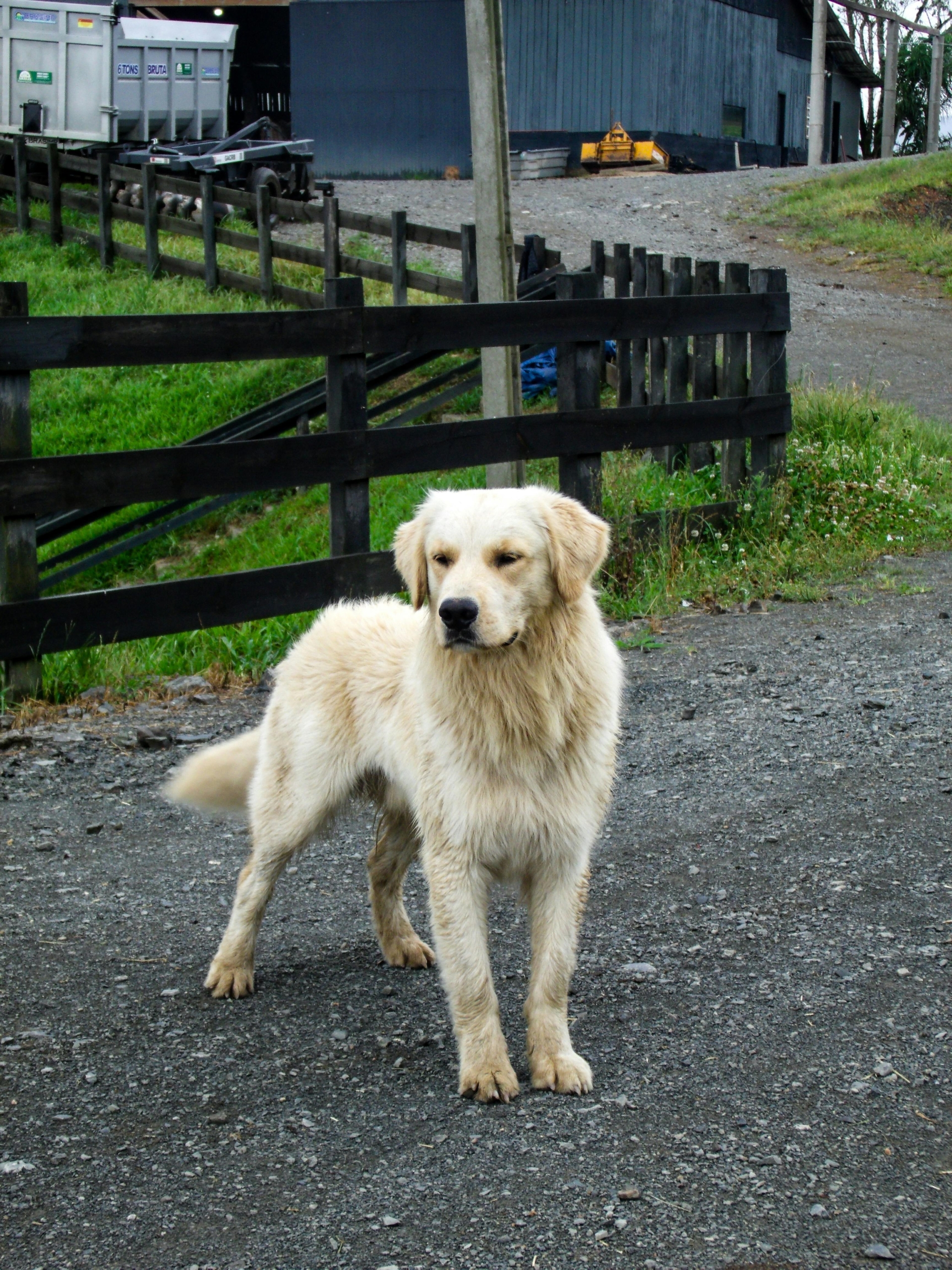
why dogs escape gardens – dog standing by rural fence boundary


Quick Summary: Why Dogs Escape Gardens

Dogs escape gardens mainly because of:

  • Boredom or lack of mental stimulation
  • Strong prey drive (wildlife, livestock, scents)
  • Separation anxiety
  • Fear triggers such as fireworks or loud noises
  • Mating instincts (especially unneutered dogs)
  • Weak fencing or poorly secured gates
  • Learned escape behaviour after a successful attempt

If your dog escaping garden behaviour has become a regular problem, identifying the trigger is essential. Stopping a dog running away requires both behaviour management and a secure boundary.

According to RSPCA advice on dog behaviour, dogs are naturally exploratory animals and will investigate sounds, scents and movement beyond their garden boundary.

You can also read our earlier guide on: 
👉 Understanding Why Dogs Escape Gardens and the Benefits of Pet Containment Systems
for more behavioural insight.


Why Do Dogs Escape Even When They’re Happy?

Many owners assume that if their dog tries to escape, they must be unhappy. In most cases, that isn’t true.

Dogs are instinct-driven and curious. Even a well-loved family pet may attempt to roam if:

  • A rabbit runs past the boundary
  • A neighbouring dog barks
  • A scent trail appears
  • They discover a weak escape route

Certain breeds — particularly Huskies, Collies and terriers — are also genetically wired to roam.

Escape behaviour is often about instinct, not dissatisfaction.


What Are the Most Common Ways Dogs Escape Gardens?

Over the last 22+ years, we’ve seen everything from Labradors squeezing through four-inch gaps to Jack Russells climbing chain-link fencing.

Most escape routes fall into one of these categories:

Jumping Over Fences

Many dogs can jump higher than owners expect.

  • 5ft fencing is often insufficient
  • 6ft is a minimum for many active breeds
  • Raised ground, bins or garden furniture create launch points.

Simply increasing height does not always solve the problem. Creating a secure garden for dogs requires more than just taller fencing.
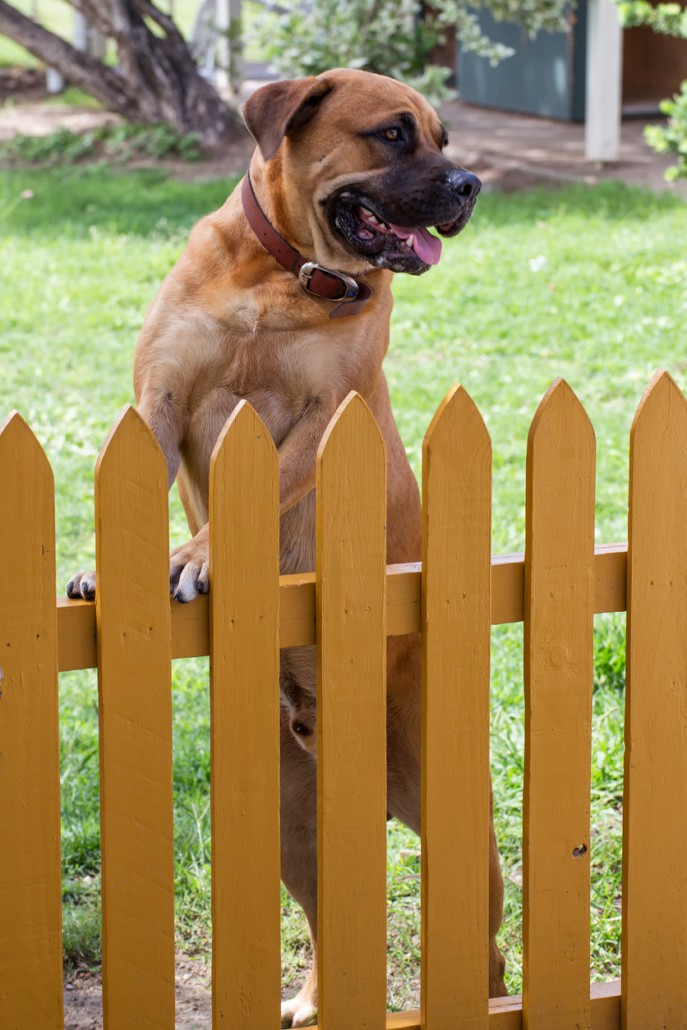
dog trying to jump over garden fence boundary


How to Stop Your Dog Digging Under a Fence

Digging is one of the most common escape methods, especially in rural properties.

Dogs dig because:

  • Soil is loose near boundaries
  • They smell wildlife or livestock
  • Digging becomes habitual
  • Anxiety drives escape behaviour

Blocking the top of the fence won’t help if the route underneath remains open.

If your dog is digging at the fence line, read our guide on how to stop dog digging under fence for practical reinforcement options.


Squeezing Through Gaps

Timber panels shrink. Gates warp. Hedges thin.

Small gaps quickly become reliable escape routes. Regular inspection is essential if you want a truly secure garden.

If you’re looking for immediate actions, read our guide:
👉 8 Practical Tips for Stopping Dogs from Escaping
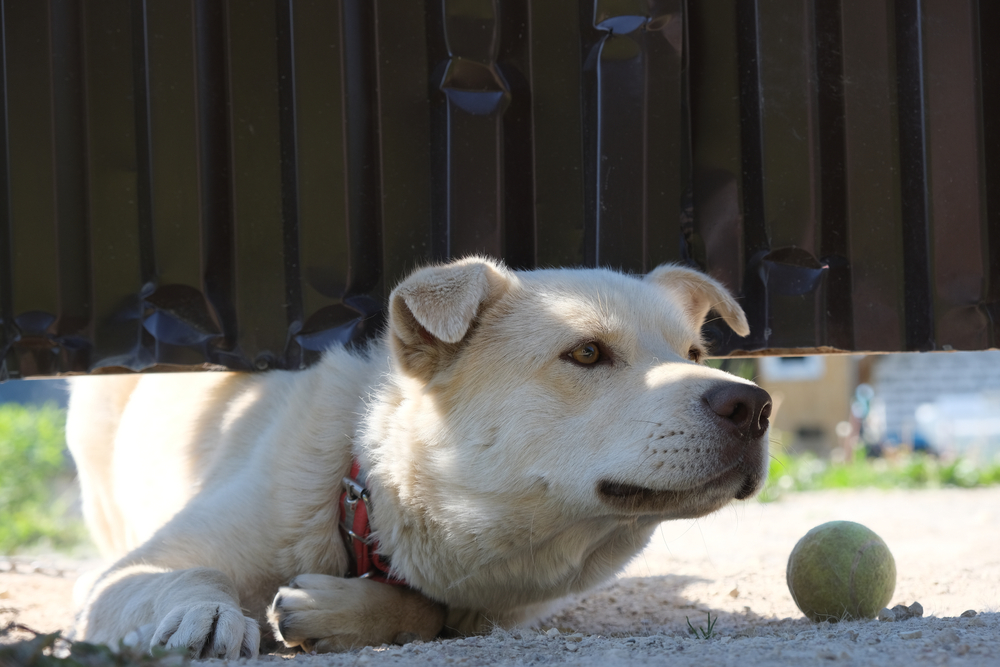
dog squeezing through small gap in garden fence


Pushing Gates Open

Loose latches are responsible for many preventable escapes.

Install:

  • Self-closing hinges
  • Lockable latches
  • Double gate security in larger gardens

How to Stop a Dog Escaping and Running Away?

Stopping escape behaviour requires a layered approach:

  1. Identify why your dog is escaping.
  2. Remove weak points in fencing and gates.
  3. Increase physical and mental stimulation.
  4. Reinforce recall and boundary awareness training.
  5. Establish a clear, consistent containment boundary.

When motivation to leave decreases and boundaries are reliable, most dogs stop testing escape routes.


Why Traditional Fencing Alone Often Fails

We regularly visit properties where thousands have been spent on timber fencing — yet the dog still escapes.

This happens because:

  • Dogs adapt their strategy (jumping becomes digging).
  • Anxiety overrides physical barriers.
  • Rural gardens are difficult to enclose completely.
  • Motivation outside the boundary is stronger than the barrier itself.

A fence creates a physical barrier.
A trained boundary creates understanding.

That difference is critical.


The Three Essentials to Prevent Dog Escape Behaviour

1. Behaviour Training

  • Reinforce recall positively
  • Avoid chasing your dog
  • Reward calm behaviour outdoors
  • Practice boundary awareness

Training supports containment — but does not replace it.


2. Environmental Enrichment

Many escape attempts are boredom-driven.

Provide:

  • Structured play
  • Mental stimulation
  • Supervised garden time
  • Problem-solving activities

A mentally satisfied dog is less motivated to roam.


3. Secure Garden Boundaries

Effective garden security should include:

  • Adequate fence height
  • Anti-dig protection
  • Secure gates
  • Removal of climb aids
  • Clear perimeter definition

Creating a truly safe garden setup for your dog means combining strong physical boundaries with consistent behavioural training. A secure garden for dogs is not just about height — it’s about removing weak points and giving your dog a clear, understood perimeter.

However, even reinforced fencing can fail with determined escape artists.

If your dog repeatedly escapes despite stronger fencing, understanding how an electronic dog fence works can help you see how a defined boundary supports consistent training. Often referred to as “invisible dog fences,” these systems create a fixed perimeter without altering the appearance of your garden — ideal for both rural properties and urban spaces.

How to Stop a Dog Escaping Repeatedly

To stop a dog escaping repeatedly, combine secure fencing, structured recall training and consistent boundary reinforcement.


When a Professional Dog Fence Becomes the Safer Solution

If your dog repeatedly escapes despite improved fencing, a defined containment boundary may be the safest long-term solution.

A professionally installed electronic dog fence creates a consistent perimeter around your garden. Unlike GPS collars (which rely on signal strength and can drift), wired containment systems establish a fixed boundary line and support structured training.

DogFence systems:

  • Have operated in the UK since 2003
  • Have safely contained over 20,000 pets
  • Are DEFRA-tested
  • Include safety shut-off features
  • Are fully waterproof and durable
  • Include professional installation and owner training

If you’re concerned about your dog running away, for larger rural properties, installing a professionally fitted electronic dog fence in the UK can provide a clearly defined boundary without changing the look of your garden.

If you’re worried about how to stop dog running away behaviour before it leads to an accident, you can:
👉 Request a Free Quote Here

Dog standing calmly inside a secure fenced garden boundary

Clear, secure garden boundaries help dogs relax and reduce escape behaviour.


Do Dogs Escape Gardens More in Winter?

Yes — dog escape behaviour can increase during certain seasons.

Winter boredom, shorter daylight hours and anxiety triggers can increase escape attempts.

You can read more in our detailed guide:
👉 Why Dogs Escape in Winter

Spring and summer can also increase roaming behaviour due to scent and breeding activity.


Garden Security Checklist

If you want to prevent your dog running away, check:

  • Fence height suitable for your breed
  • No gaps under panels
  • Secure, self-closing gates
  • No climb aids near boundaries
  • Adequate daily stimulation
  • Consistent boundary reinforcement

Prevention requires regular inspection and proactive management.


Frequently Asked Questions

Why does my dog keep escaping the garden?

Dogs escape due to instinct, boredom, anxiety, or weak boundaries. Repeated success reinforces the behaviour, making it more likely to happen again.

How high should a fence be to stop a dog escaping?

6ft is a common minimum, though athletic breeds may require additional measures such as anti-climb extensions or boundary reinforcement.

Is an electronic dog fence safe?

Modern professionally installed containment systems include safety shut-off features and structured training protocols designed to prioritise pet welfare.


Why Dog Escaping Garden Behaviour Gets Worse Over Time

When a dog escaping garden attempt is successful, the behaviour becomes reinforced.

Each time your dog escapes:

  • Confidence increases
  • Boundaries feel weaker
  • The outside world becomes more rewarding

This is why learning how to stop a dog escaping early is critical. The longer escape behaviour continues, the harder it becomes to correct.

Preventing dog escaping garden behaviour requires consistency, supervision, and a clearly defined secure garden for dogs that removes opportunity altogether.


Final Thoughts:

Dogs escape gardens when something outside the boundary becomes more compelling than staying inside.

The solution isn’t simply a taller fence.

It’s:

  • Understanding motivation
  • Removing weak escape routes
  • Providing mental and physical fulfilment
  • Creating a reliable, clearly defined boundary

If your dog keeps escaping and you’re worried about roads, livestock, or neighbouring land, the DogFence team can help you create a secure outdoor space without compromising your garden’s appearance.

Because freedom should never come at the expense of safety.

Worried Your Dog Will Escape Again?

Don’t wait for a near miss with a road or livestock. Speak to the experts at DogFence about creating a secure, reliable boundary for your garden.

📞 Call 01628 476475
|
💬 Message us on WhatsApp
|
📝 Request a Free Quote
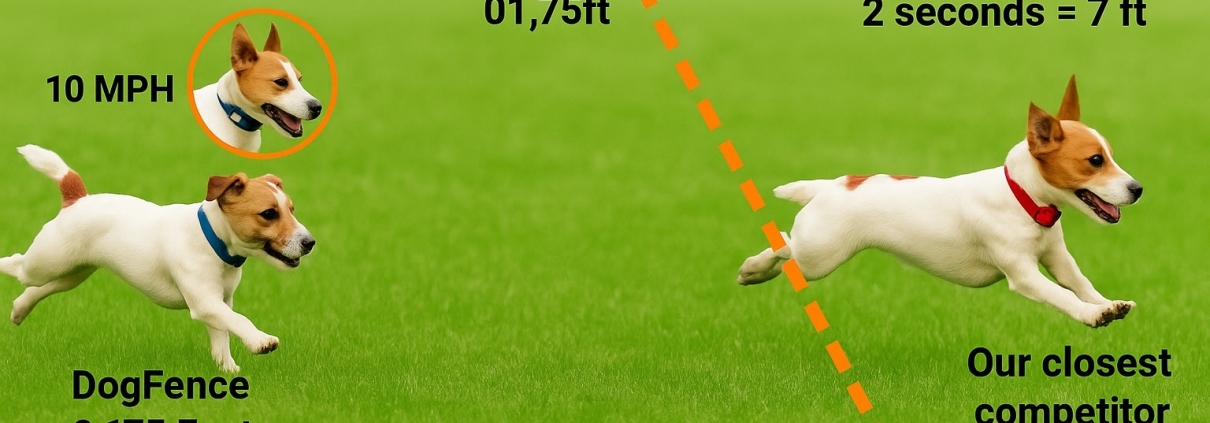
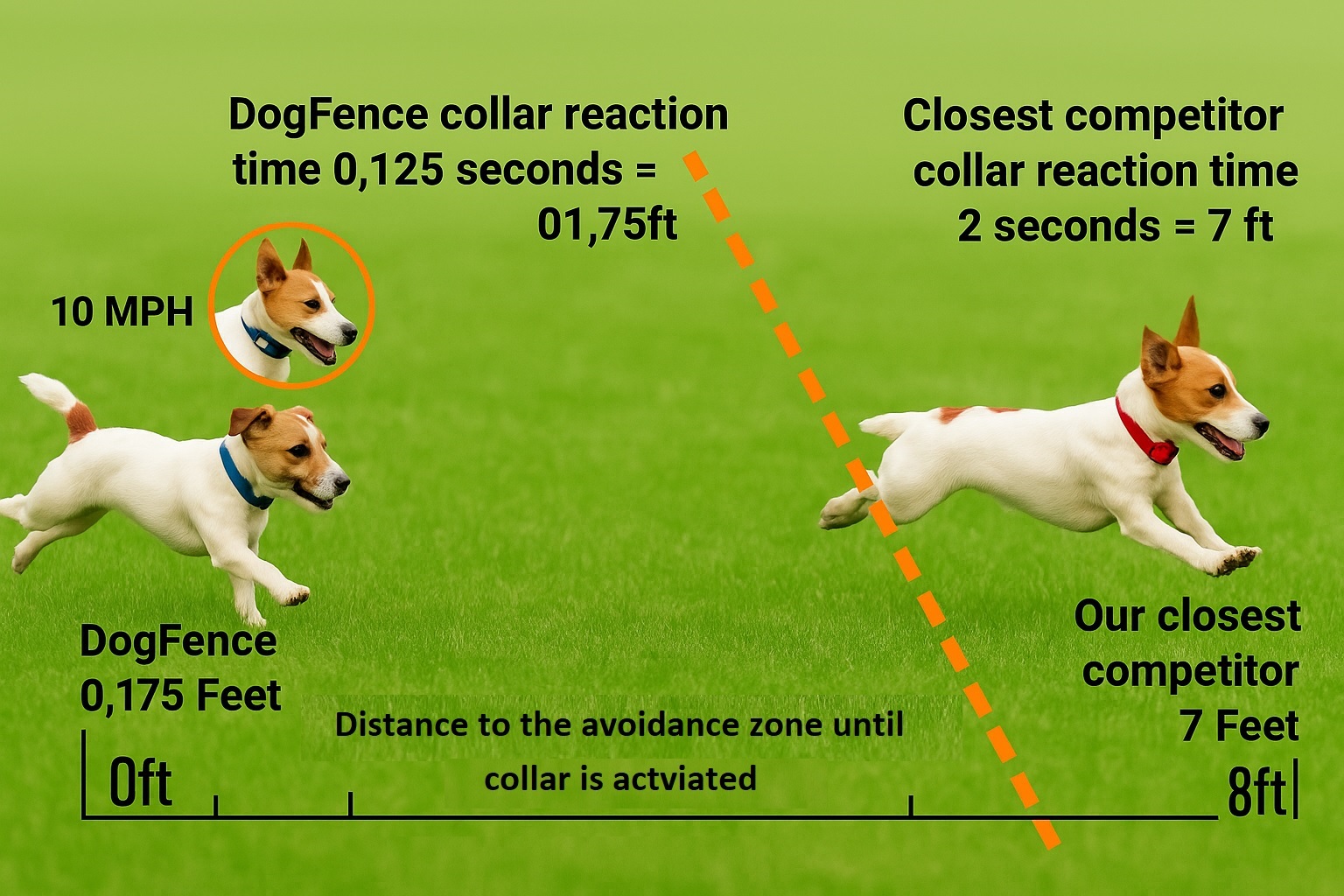
At 10mph, DogFence’s FM collar reacts in just 0.125 seconds—stopping your dog after only 1.75ft. The nearest competitor reacts in 2 seconds, allowing a 7ft run into the avoidance zone

What is a Radio Dog Fence: FM vs AM Explained | DogFence Ltd

What Is a Radio Dog Fence?

A radio dog fence works by sending  either a coded AM or  FM signal through a small boundary wire that’s laid around your garden or designated safe zone. The system does not carry any electric current in the wire — it’s completely safe to touch, even if the wire is cut or damaged.

Instead, the boundary wire acts as an antenna, carrying the AM or FM radio signal from the transmitter. This creates an invisible 360-degree signal field around the wire. The width of that field — known as the avoidance zone — can be adjusted to suit the size of your garden, your pet’s temperament, and the layout of your property. An average setting is around 4 ft on either side of the wire.

Your pet wears a receiver collar that’s programmed to recognise only the unique AM or FM signal produced by your DogFence transmitter. As your pet moves towards the boundary:

  • The collar emits a warning beep as they enter the avoidance zone.
  • If they continue forward, the collar delivers a gentle impulse alongside the beep.

At DogFence all our systems use a digital FM signal.

With professional training, your pet quickly learns that the warning tone means “stop and return to the safe area.” Once your pet moves back into the safe zone, our FM receiver collar instantly shuts down — there’s no lingering correction or delay.

In contrast, AM-based systems typically have a slower response and hang-on time (often 2–5 seconds), meaning the correction can continue even after the pet has turned back. The FM system avoids this issue entirely, offering a faster, safer, and more reliable response.

The result? A containment fence that offers both freedom and safety for your pets — and peace of mind for you.

Learn more about how our DogFence system works.


Radio Dog Fence: FM vs AM Compared

The difference between AM and FM is easy to understand if you think about car radios:

  • AM radio often sounds crackly and suffers interference.

  • FM radio is clearer and more reliable.

The same principle applies to radio dog fences:

Feature AM Radio Dog Fence FM Radio Dog Fence (DogFence)
Signal type Step signal with “down” gaps Continuous FM waveform
False activations More likely — collar can pick up stray signals Rare — FM reacts only to the true signal
Response speed Slower — must double-check Faster — checks one clear signal
Interference risk High — Wi-Fi, gates, electrics Very low — FM filters out background noise
Pet safety Timing can be inconsistent Clear, accurate boundary feedback

Technical explainer: How Stuff Works – AM vs FM

Why Choose an FM Radio Dog Fence?

DogFence uses FM technology because it’s safer, faster (up to 15 times faster in some cases), and more consistent than AM:

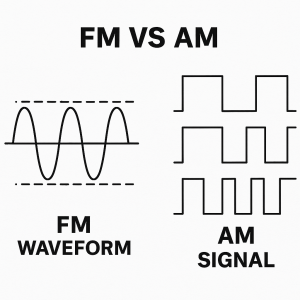
  • No weak spots — FM signals are continuous (wave form, not step form).
  • Fewer false activations — corrections happen only at the boundary (FM signals do not pick up interference).
  • Faster reaction — collars check once, not twice (faster start up and shut down).
  • Gentler training — pets learn quickly when the boundary is clear.

With an FM system, your pet gains freedom without confusion.

  • AM (Amplitude Modulation) systems have to check for two separate signals — a carrier and a modulation pulse — before reacting. This makes them slower and creates brief “gaps” in the signal where interference from Wi-Fi, garage doors, or electric gates can slip through.

  • FM systems like DogFence need to recognise only one smooth, continuous waveform, so the collar responds almost instantly and isn’t confused by external signals.

Because FM operates in a wave form rather than a step pattern, it’s both faster and more stable. That means your dog’s collar activates at the correct point — every time — giving precise correction only at the true boundary, nowhere else.

FM vs AM radio dog fence signals showing smooth FM waveform compared to step-like AM signal

FM vs AM radio dog fence signals – FM uses a smooth, continuous waveform while AM uses a step signal that can cause interference and false activations.


Why is Training Important with a Radio Dog Fence

Training ensures your pet learns the system quickly and confidently. DogFence provides full installation and onsite training for both you and your dog/s or cat/s or even cats and dogs!

What are the important elements of radio dog fence training?

  • Training flags for clear visual markers. A visual for you pet to see.
  • Audible tones as early warnings. An audible tone for your pet to hear
  • Short daily sessions of 5–10 minutes. Little and often – we all learn better in bite size chunks!
  • Custom settings suited to your pet’s breed and temperament. Impulse something to feel.

Most pets understand their new radio dog fence within a week. Many people think a radio dog fence is only for dogs, but with the right technology and smaller receiver collars, these systems are also ideal for safely containing cat

Explore how this also works for Cat Containment.


Aren’t All Digital Systems the Same?

Not quite. Some suppliers advertise “digital” systems, but:

  • Digital AM is still AM — step signals, weak points, interference risk.

  • Digital FM combines programmable digital collars with a strong, interference-free FM signal.

DogFence only uses FM digital radio dog fences — the safest option for UK gardens. Our FM dog fences react almost instantly — up to ten times faster than AM fences. That means if your dog is running at 10mph, they’ll stop about 7 feet sooner, keeping them safely inside your garden.”

At 10mph, DogFence’s FM collar reacts in just 0.125 seconds—stopping your dog after only 1.75ft. The nearest competitor reacts in 2 seconds, allowing a 7ft run into the avoidance zone

At 10mph, DogFence’s FM collar reacts in just 0.125 seconds—stopping your dog after only 1.75ft. The nearest competitor reacts in 2 seconds, allowing a 7ft run into the avoidance zone


DogFence: Trusted UK Experts

DogFence Ltd has been installing radio dog fences across England since 2003. We were proud to be the only UK company consulted by DEFRA during the government’s review of electronic collars, where our input helped secure the official exemption of pet containment systems.

This exemption recognised not only the importance of correct training and professional installation, but also the built-in safety features unique to our DogFence system.

When announcing the exclusion of containment fences from the wider e-collar ban, the government also indicated plans to introduce legislation requiring all electronic pet fences to be professionally installed.
At the time of writing, these proposed changes — along with the formal e-collar ban — have not yet been enacted into law.

Why are dog fence are the best option to install your electronic pet fence?

  • Over 22 years’ experience

  • Trusted by 20,000+ pets

  • Lifetime warranty & containment promise on installed systems

Want to learn more about how to install a radio dog fence or keep your pet safely contained?

Join thousands of UK pet owners who trust DogFence to keep their dogs and cats safe at home.
Our systems are proven, reliable, and backed by a lifetime warranty.

Contact us today:
01628 476475
info@dogfence.co.uk
Chat with us on WhatsApp


Request a Free Quote

Dog wearing a hidden fence collar enjoying freedom in a secure UK garden, with training flags marking the boundary – illustrating dog fence cost UK value and effectiveness

Dog Fence Cost UK: DIY & Professional Hidden Fence Prices Compared

Dog Fence Cost UK: A Practical Guide to Hidden Fence Pricing & Value

Updated February 2026

If you’re researching the best way to secure your garden, this Dog Fence Buying Guide UK will help you compare systems, understand costs, and choose the right containment solution for your property. Across England, more and more dog owners are searching for reliable ways to prevent their dog running away — without building ever-higher fences or turning their garden into a fortress.

Many pet owners want to keep their dogs safely contained without compromising their garden’s appearance — or spending thousands on traditional fencing. Traditional timber or close-board fencing in the UK typically costs £110–£120 per metre installed, meaning an average garden can easily exceed £2,500–£3,000 — and far more for large rural properties.

In this guide, we break down:

  • DIY dog fence costs
  • Professional installation prices
  • What you’re really paying for
  • How hidden fence prices compare to traditional fencing and GPS systems

Dog Fence Cost UK: What You Might Pay

When people talk about the cost of wired electronic containment system, they’re usually referring to a wired radio fence using a boundary cable, a transmitter, and a receiver collar worn by the pet. In the UK, the total cost can vary depending on whether you install it yourself or professional installation.

DIY Dog Fence Kits (From £299–£800+)

DIY systems offer a more budget-friendly entry point. DIY dog fence cost UK options are typically more affordable upfront, making them popular for straightforward gardens and confident installers.

Most mid-range UK kits start from £299, and typically include:

  • Lightweight programmable receiver collar
  • Boundary wire (often up to 100m, expandable)
  • Training flags
  • Transmitter and power adapter
  • Installation instructions or video guidance

Our DIY kits use:

  • Robust, heavy-grade cable
  • Weatherproof components
  • Built-in safety features including auto shut-off
  • 2–4 year warranties depending on model

⚠ A Word of Caution About Ultra-Cheap Kits

Very cheap systems (often under £50 online) may include:

  • Extremely thin cable that breaks during installation
  • Weak or inconsistent collars
  • Poor battery life
  • No lightning protection
  • No correction shut-off safety feature
  • Minimal training guidance

These systems can quickly become a false economy — especially if a pet escapes or becomes confused due to inconsistent correction. When comparing electronic dog fence cost options, it’s important to look beyond the headline price and consider cable quality, collar technology and long-term reliability.


Professionally Installed Hidden Dog Fences (£1200–£2500+)

Professional dog fence installation UK services are ideal for larger rural properties or for owners who want structured training and long-term support. Professional installation typically ranges between £1,200 and £2500, depending on:

  • Garden size
  • Layout complexity
  • Number of pets

This usually includes:

  • Full boundary survey
  • Cable installation (buried or discreetly secured)
  • Custom collar programming
  • Structured pet training session
  • Support for multi-pet households
  • Extended or lifetime warranties on selected systems

For reactive dogs, rural properties, or complex gardens, professional installation often delivers greater peace of mind.

“You came and fitted our setup in February and it is amazing and worth every single penny. From two naughty ‘we will escape’ pets, we now have total peace of mind.”


Dog Fence Cost UK vs Traditional Fencing

Hidden dog fence prices vary depending on garden size, installation complexity and whether you choose a DIY kit or professional setup.

Fence Type Approx. Cost (UK)
Timber or Close board Fence £6,000–£12,000
Metal or Picket Fence £10,000+
Wireless GPS Dog Fence £700–£1,800
DIY Hidden Dog Fence Kit £299–£800
Pro Hidden Dog Fence £1200–£12000
  • Your dog jumps
  • Your dog digs
  • You need multiple gates
  • Landscaping adjustments are required

A hidden dog fence avoids visual barriers and can be installed across large areas at a fraction of the cost. Here’s an example of a Professional hidden dog fence installation after cable burial.

Boundary training flags marking the layout of a Professional hidden dog fence during installation.


Are There Ongoing Costs?

Wired electronic fences have minimal ongoing costs:

  • Replacement batteries (every few months depending on usage)
  • Occasional collar strap replacement
  • Rare cable repair if physically damaged

Unlike many GPS systems, wired containment has no monthly subscription fees.


Is a Hidden Dog Fence Worth the Investment?

When considering dog fence cost UK, think long-term value.

Benefits often include:

  • No repeated garden repair from digging
  • Reduced escape risk
  • No visual impact on your property
  • Lower long-term cost compared to high fencing
  • Less daily supervision stress

Even mid-range DIY systems can last many years when correctly installed and maintained.

“Finally a company that does what they say — the installer arrived on time and the service from start to finish has been impressive.”


Choosing Between DIY Dog Fence Cost or Professional Installation

Ask yourself:

  • Are you confident installing boundary wire?
  • Is your garden large or complex?
  • Is your dog reactive or highly driven?
  • Do you want structured training support?

DIY suits straightforward gardens and confident owners.

Professional installation suits larger properties, complex layouts and escape-prone dogs. Many owners choose a DIY dog fence when they feel confident laying the boundary wire and following the structured training process.

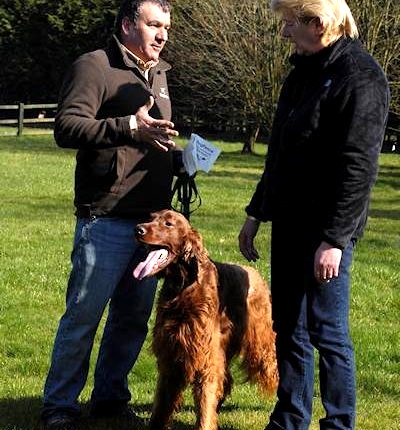
Professional dog fence installer discussing hidden fence installation options with a UK customer

Professional hidden dog fence installation consultation in a UK garden


Want to Understand How It Works?

Hidden dog fences operate using a radio signal transmitted through a boundary cable.

If you’re new to the concept, read our guide on how electronic dog fences work.


Ready to Explore Your Dog Fence Options?

If you’re comparing electronic dog fence cost options or want clarity on hidden dog fence prices for your specific garden, we’re here to help.

Every property — and every dog — is different. A quick conversation can help you understand whether a DIY system or professional installation will give you the best long-term value and peace of mind.

No hard sell — just honest advice based on over 20 years of real-world experience helping UK dog owners keep their pets safe.

If you’re comparing electronic dog fence cost options or want clarity on hidden dog fence prices for your garden, we’re here to help. Every property (and every dog) is different — a quick chat can help you choose the right system for long-term value and peace of mind.

Want to Get a Free Quote or Consultation ?

Call us on
01628 476475
|
Message us on WhatsApp
|
Request a Free Quote Online

Girl comforting dog wearing electric dog fence collar in UK garden

Electric dog fences cruel or kind?

Are Electric Dog Fences Cruel or Kind? The Evidence Explained (UK Guide)

Are electric dog fences cruel or kind? It’s one of the most common and emotionally charged questions dog owners ask when considering ways to keep their pet safe at home.

The word “electric” can sound alarming. Many owners understandably worry about welfare, pain, or long-term stress. But modern electronic containment systems are very different from what people often imagine.

In this guide, we explain how electric dog fences work, what independent research says, and whether they are truly cruel — or in fact a responsible solution for protecting dogs in the UK.


What Is an Electric Dog Fence?

Despite the name, an electric dog fence is not the same as a livestock electric fence. It is an electronic containment system designed specifically for domestic pets.

If you would like to see the full specification of a professionally installed system, you can read more about our electric fence for dogs solutions on our dedicated product page.

Modern systems consist of:

  • A central transmitter
  • A boundary wire (for wired systems)
  • A lightweight receiver collar worn by the dog

The boundary wire carries a coded radio signal around the perimeter of your property. If you’d like a full technical explanation, you can read more about how our electronic dog fence systems work.

When a dog approaches the boundary:

  • The collar emits a warning beep.
  • If the dog continues forward, a brief, programmable static impulse is delivered.

The impulse is not a continuous electric shock. It is a controlled, momentary static correction, adjusted to suit your dog’s size, temperament and sensitivity.


Types of Electric Dog Fence Systems

Understanding system types is important when asking, are electric dog fences cruel or kind?

Wired Dog Fences

A wired system involves installing a boundary wire around your property. The wire is typically buried a few inches underground for protection.

Wired systems are:

  • Flexible in shape and layout
  • Suitable for slopes and uneven ground
  • Able to create “no-go zones” around ponds or driveways
  • Reliable in complex UK gardens

At DogFence Ltd, we specialise in wired systems because they offer superior reliability and safety. You can learn more about our professional dog fence installation and training process.

Wireless Dog Fences

Wireless systems create a circular signal from a central base unit.

They are generally only suitable for:

  • Flat, open spaces
  • Clear line-of-sight environments
  • Simple garden layouts

They cannot adapt easily to buildings, trees or irregular boundaries, which makes them less suitable for many UK properties.


How Does an Electric Dog Fence Work?

The boundary wire acts as an antenna, transmitting a coded radio signal around your garden.

The receiver collar:

  • Detects proximity to the boundary
  • Emits a warning tone
  • Delivers a brief static impulse only if necessary

The correction level is individually programmed. It is never “one size fits all.”

With structured training, most dogs quickly learn to respond to the warning beep alone. After the initial learning phase, many rarely experience the static correction.


Are Electric Dog Fences Cruel or Kind? Looking at Welfare

So, are electric dog fences cruel or kind?

When professionally installed and properly introduced through training, modern electronic containment systems are designed to prioritise safety and welfare.

The static impulse is comparable to the mild static sensation you might experience when touching a metal car door after walking across carpet — momentary and surprising, but not harmful.

Importantly, the goal of the system is not punishment. It is boundary awareness.

What Does Research Say About Whether Electric Dog Fences Are Cruel or Kind?

Researchers at the University of Lincoln found no evidence of long-term welfare problems in cats living with electronic containment systems compared to animals able to roam freely.

You can read the published findings on the official University of Lincoln website.

When asking whether electric dog fences are cruel or kind, it’s important to compare them with the real-world risks dogs face without reliable containment.


What Happens When Dogs Escape?

Dogs are naturally curious. Some will dig, jump or squeeze through traditional fencing.

Common consequences of escape include:

  • Road traffic accidents
  • Livestock chasing (which can lead to prosecution or fatal outcomes)
  • Injury from other animals
  • Getting lost
  • Legal liability for property damage
  • Neighbour disputes

In rural and semi-rural England, livestock incidents can have devastating consequences for both farmer and dog.

Responsible containment is often about prevention — protecting the dog, livestock and the wider community.


How Dogs Learn to Respect the Boundary

Professional training is essential to humane use.

During installation:

  • Visual training flags are positioned along the boundary
  • Dogs are introduced on lead
  • The warning tone becomes the primary cue
  • The static impulse is introduced only if necessary

Most customers report that after training, their dog rarely triggers more than the warning beep.

If you still have questions about suitability or safety, our Dog Fence FAQs page  answers many of the most common concerns.

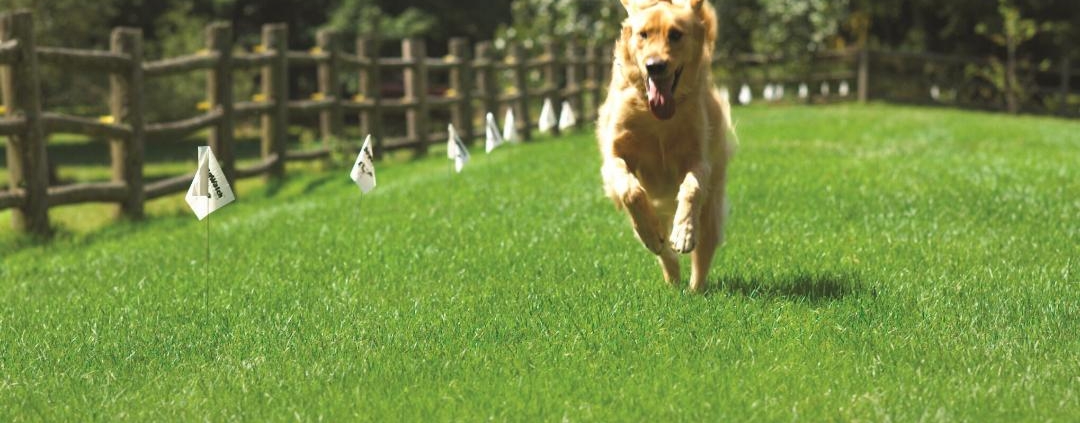
Golden retriever trained to electric dog fence boundary with flags

With professional training, most dogs quickly learn to recognise boundary flags and respond to the warning tone alone.


When Electric Dog Fences May Not Be Suitable

To answer honestly whether electric dog fences are cruel or kind, it’s important to acknowledge that they are not suitable in every case.

They may not be appropriate for:

  • Extremely anxious or highly nervous dogs
  • Situations without professional training
  • Owners unwilling to follow structured guidance

Used incorrectly, any training tool can cause confusion. Used responsibly, electronic containment systems are predictable, consistent and safe.

This is one reason professional installation is so important. Poorly installed systems, incorrect collar settings, or inconsistent training can undermine both safety and welfare. If you are weighing up your options, our guide on dog fence installation: DIY vs hiring a professional explains the key differences and risks to consider.


So, Are Electric Dog Fences Cruel or Kind?

When professionally installed, carefully programmed and supported with structured training, electric dog fences are a responsible containment solution.

They allow dogs to:

  • Enjoy freedom within their own garden
  • Display natural behaviour
  • Avoid roads and livestock
  • Remain safely at home

For over 22 years, DogFence Ltd has installed systems across England — from compact gardens to 350-acre estates — always prioritising safety, welfare and responsible ownership.

Experience matters. Training matters. Quality matters.

While some critics remain concerned, the debate around electronic containment has been ongoing for years. If you would like to explore both sides of the discussion in more depth, you can read our article on the controversy surrounding dog fences and whether they are cruel or harmful


FAQs: Are Electric Dog Fences Cruel or Kind?

Do electric dog fences give dogs an electric shock?

No. Despite the name, these systems do not deliver a continuous electric shock. They use a warning beep first, followed (only if the dog ignores the warning) by a brief, programmable static impulse.

Do electric dog fences hurt dogs?

When set correctly for the individual dog and introduced through professional training, the sensation is mild and momentary. Most dogs learn to respond to the warning beep and rarely need more than the audible cue.

Are electric dog fences legal in the UK?

Yes. Electronic dog containment systems are legal in the UK. As with any training tool, they must be used responsibly, with appropriate set-up and training.

Will an electric dog fence stop my dog running out of the garden?

A professionally installed wired system is designed to contain dogs within the boundary you set. Success depends on correct installation, correct collar programming, and training that teaches the dog what the warning beep means.

Are wireless dog fences as reliable as wired systems?

Wireless systems can work in very open, flat areas, but they are usually less flexible and less reliable in typical UK gardens with buildings, trees, slopes or complex boundaries. Wired systems are generally the safer, more consistent option.

How long does it take to train a dog to an electric dog fence?

Most dogs learn the boundary quickly with structured sessions over several days. The key is consistency: flags, lead work, the warning tone and positive reinforcement.

Final Thoughts

If you are still wondering are electric dog fences cruel or kind, the answer lies in how the system is installed, programmed and introduced. When professionally fitted and supported by structured training, modern electronic containment systems are designed to protect both welfare and safety.

With over 22 years of experience installing wired dog fences across England, DogFence Ltd focuses on responsible containment that allows dogs freedom within safe boundaries.


Ready to Keep Your Pet Safe?

Call us on
01628 476475
|
Message us on WhatsApp
|
Request a Free Quote Online