Can an Invisible Dog Fence Work With an Existing Fence?
Yes. An invisible dog fence can work alongside an existing wooden fence, hedge, wall, post-and-rail fence, stock fence or other physical boundary. In fact, combining an existing fence with a professionally installed hidden dog fence can be particularly useful for dogs that jump over fences, dig underneath them, squeeze through gaps or push through hedges.
The physical fence remains in place, while the hidden dog fence creates a consistent electronic boundary that your dog is trained to recognise and respect.
This means you do not necessarily have to replace an existing fence simply because your dog has discovered a way over, under or through it.
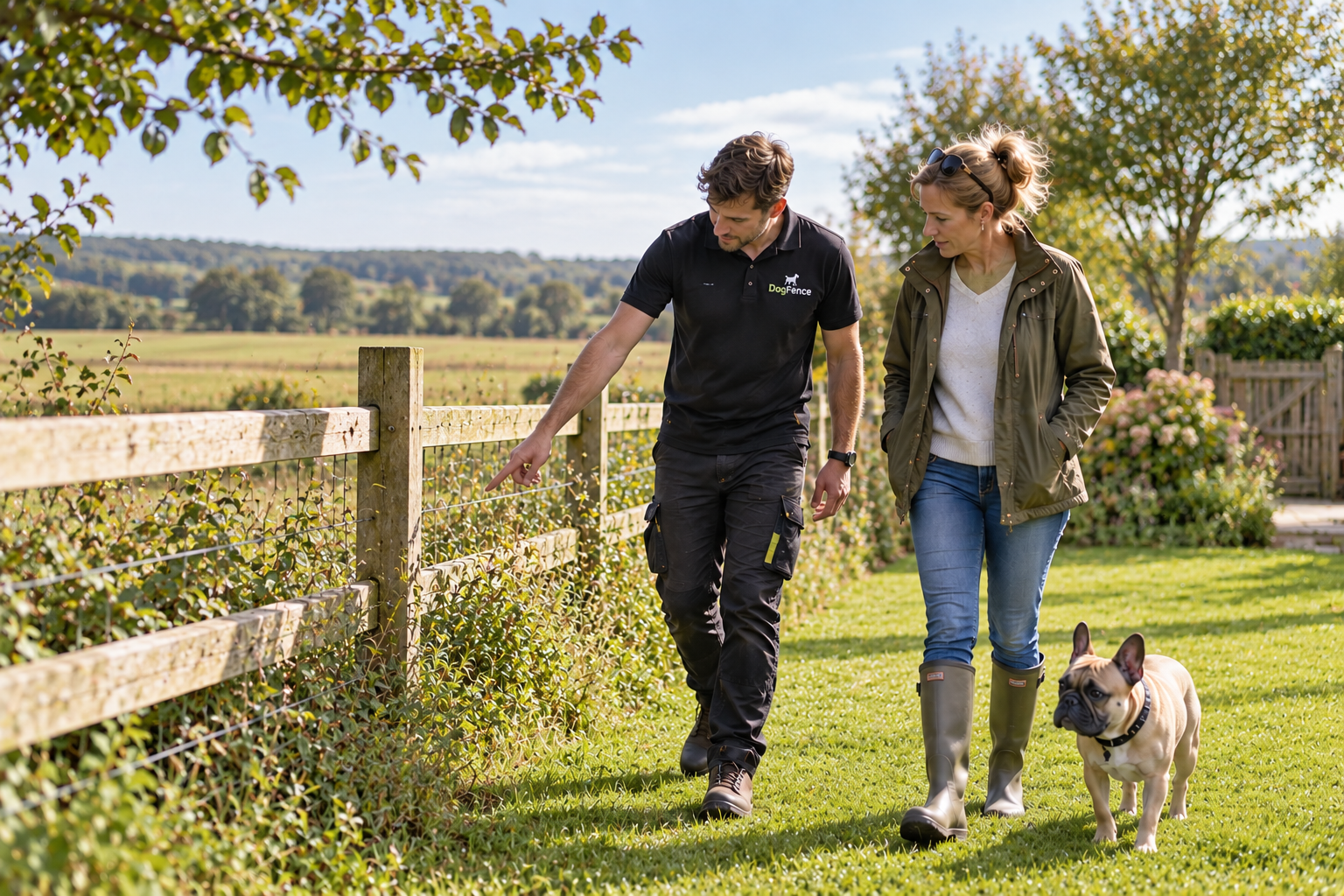
A DogFence hidden boundary can be installed alongside existing fencing, hedges, walls and other physical boundaries.
How Does an Invisible Dog Fence Work With a Physical Fence?
A professionally installed invisible dog fence uses a boundary wire to define the area in which your dog can safely roam. Your dog wears a small receiver collar that responds as they approach the trained boundary.
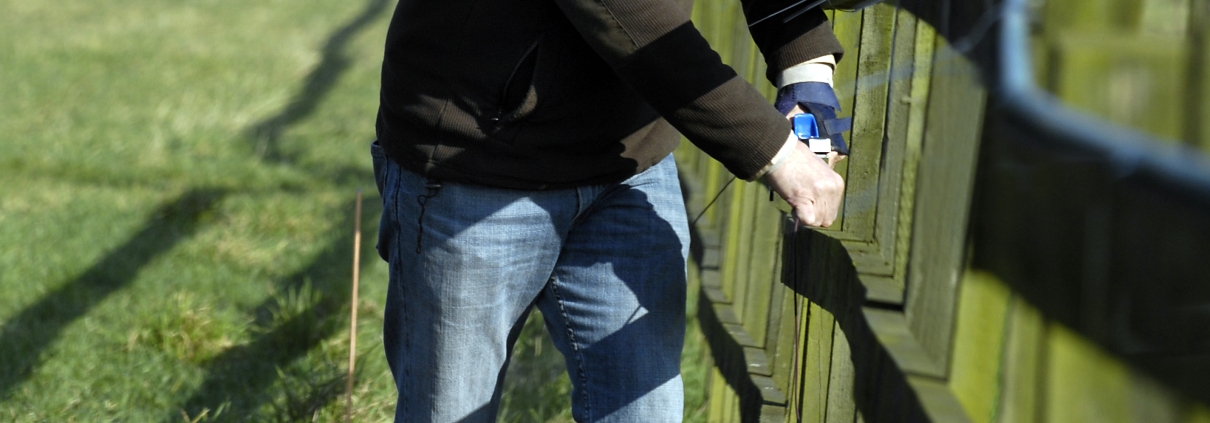
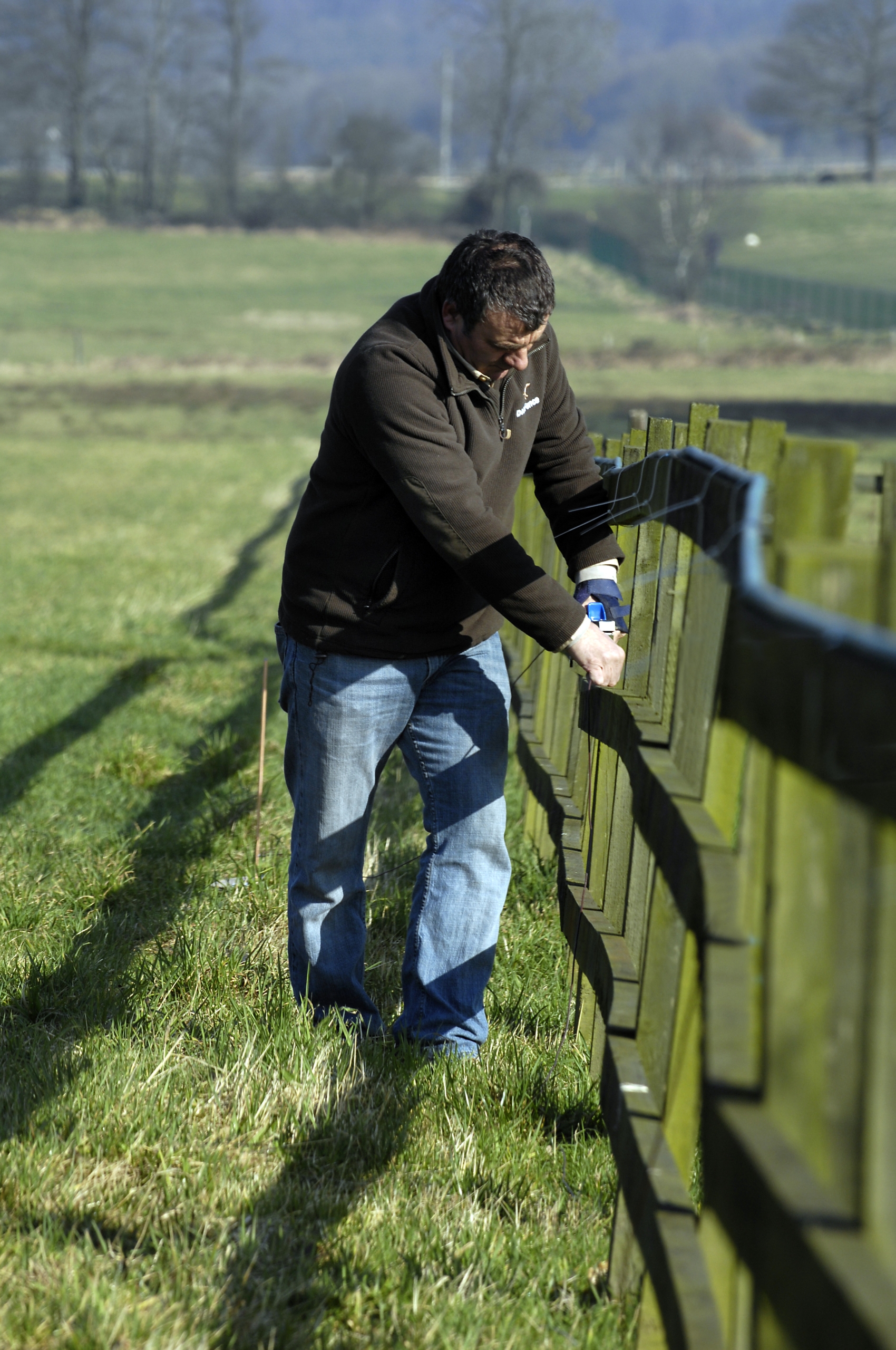
The boundary wire can often be installed alongside an existing fence, hedge or wall, creating a consistent containment boundary around the property.
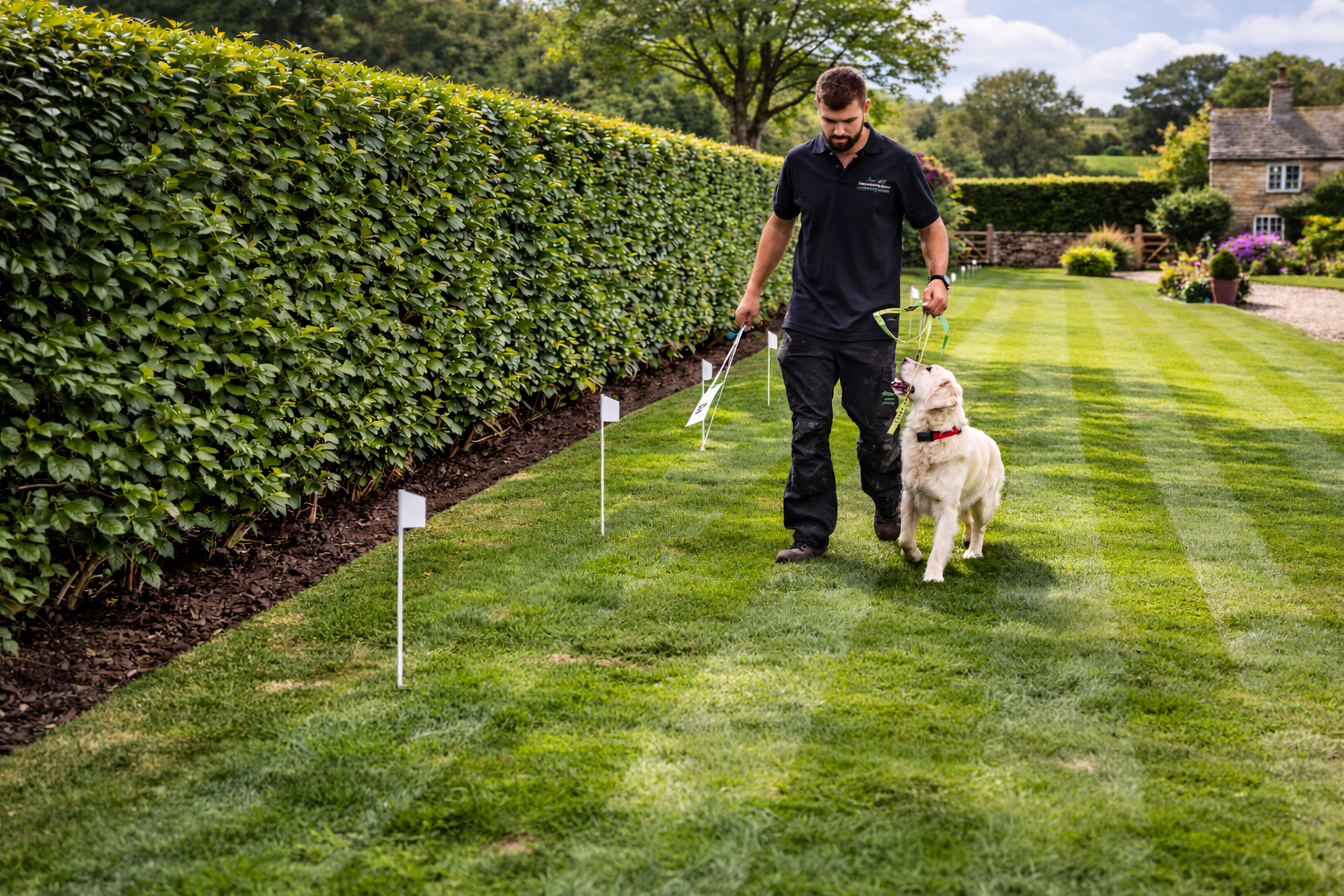
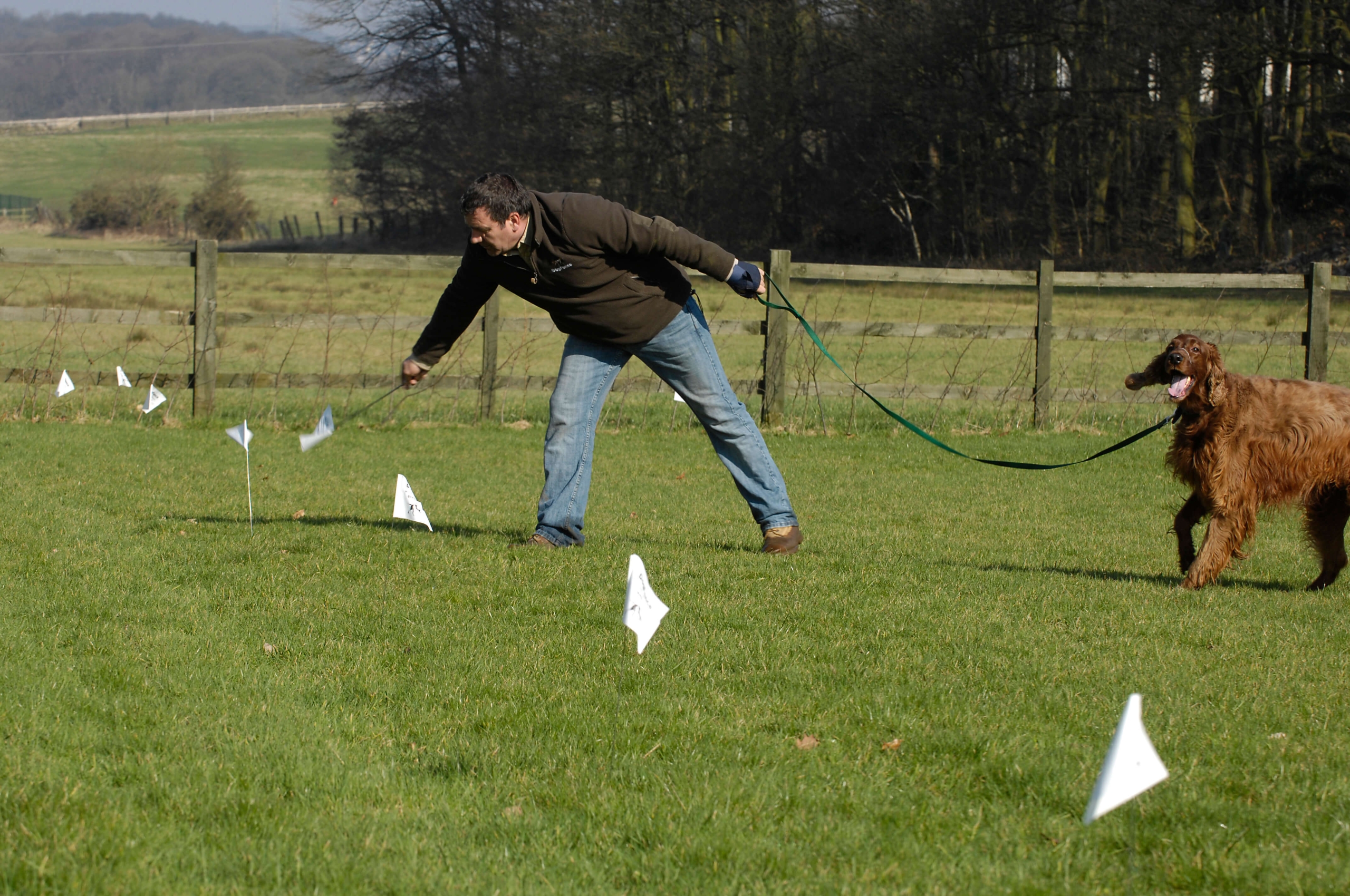
During training, temporary flags help your dog learn where that boundary is located. The dog learns to respond to the receiver’s warning and turn back towards the safe area.
If you are new to electronic containment, our How a DogFence Works page explains the system in more detail.
Why Use an Invisible Dog Fence If I Already Have a Fence?
Because a physical fence is only effective while your dog cannot find a way around it.
Dogs can be remarkably inventive escape artists. Common problems include:
digging underneath fence panels
jumping or climbing over fencing
squeezing through gaps
pushing through hedges
escaping through gates
running through an open driveway
finding damaged or weak sections of fencing
An invisible dog fence approaches the problem differently. Instead of relying entirely on the height, strength or construction of the physical fence, it creates a trained boundary that the dog learns not to cross.
Can an Invisible Dog Fence Stop a Dog Digging Under an Existing Fence?
It can be particularly useful for dogs that repeatedly dig underneath physical fencing.
Reinforcing the bottom of a fence can help, but determined dogs sometimes simply move along the boundary and begin digging somewhere else.
A hidden dog fence creates a boundary around the containment area rather than relying on the fence panel itself. The dog is trained to turn away from that boundary before reaching the point where they would normally start digging or attempting to escape.
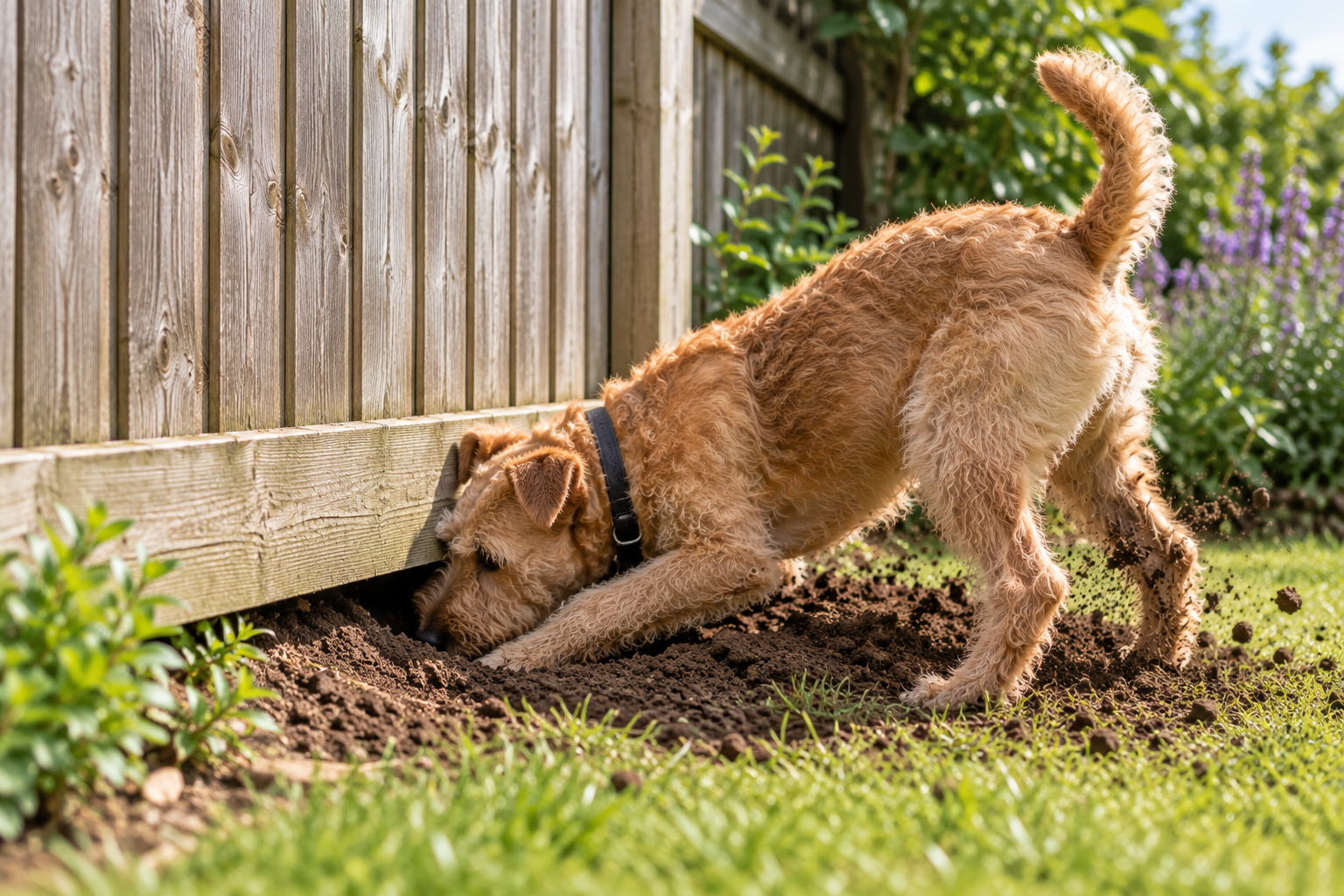
Dogs that dig under existing fencing can be difficult to contain. A hidden DogFence creates a trained boundary before the dog reaches the physical fence.
Can It Stop a Dog Jumping Over an Existing Fence?
For dogs that jump or climb, simply making a fence higher is not always the answer. Some dogs learn to use horizontal rails, bins, garden furniture or other objects as launching points.
A hidden dog fence can create a trained boundary before the dog reaches the physical fence, helping prevent the dog from approaching it closely enough to attempt the jump.
Will Metal or Stock Fencing Interfere With a DogFence?
No. One of the advantages of the DogFence system is that its signal is not affected by metal or stock fencing.
This means a DogFence can be installed alongside existing metal fencing, wire mesh or stock fencing without the fencing interfering with the containment signal.
This can be particularly useful on rural properties, farms and larger gardens where stock fencing is already in place. Rather than replacing an existing boundary, the DogFence can work alongside it to provide an additional trained containment boundary for your dog.
It also means owners with a mixture of boundary types — for example hedges, wooden fencing, post-and-rail and stock fencing — can potentially create one consistent DogFence boundary around the property.
Can an Invisible Fence Work With a Hedge?
Yes. Hidden dog fences can work particularly well alongside hedges.
A mature hedge may look completely secure to us but contain surprisingly large gaps at dog level. Dogs may push underneath branches, squeeze through gaps or create their own routes through the hedge.
Because the electronic boundary does not depend on the hedge being completely impenetrable, it can provide a consistent containment line alongside it. The DogFence cable can be buried just in front of the hedge or threaded through the hedge, either way the boundary will be secured.
A hidden DogFence can work alongside an existing hedge, creating a consistent trained boundary even where a dog could find gaps or push through the hedge.
Can a Hidden Dog Fence Work With Post-and-Rail Fencing?
Yes. Post-and-rail fencing is common on rural properties and larger gardens, but the gaps between the rails obviously do not physically contain many dogs.
A hidden dog fence can be installed alongside the existing boundary so owners can retain the appearance of post-and-rail fencing while creating a trained containment area for their dog.
What About Gates and Open Driveways?
This is one area where combining physical fencing with a hidden boundary can be especially useful.
You may have excellent fencing around most of the garden but still need an entrance for cars, deliveries and visitors. A gate may also occasionally be left open.
A properly designed hidden dog fence can continue the dog’s trained boundary across entrances and driveways without preventing vehicles or people from passing through.
For a broader look at securing different types of garden boundaries, see our guide to how to dog proof your garden.
A hidden DogFence boundary can continue across an open driveway or gateway, helping contain a dog without restricting access for cars, deliveries or visitors.
Does the Existing Fence Need to Be Removed?
No. In most cases there is no reason to remove a suitable existing fence simply because a hidden dog fence is being installed.
The two systems perform different jobs and can complement one another.
The existing fence provides a visible and physical boundary. The hidden fence provides a consistent trained boundary that does not depend on the dog being physically unable to climb, jump, dig or squeeze through the existing structure.
Is the Existing Fence Electrified?
No. An invisible dog fence does not turn your existing garden fence into an electric fence.
The boundary wire carries a radio signal which is detected by the receiver worn by the dog. The physical fence, hedge or wall itself is not electrified.
Is an Invisible Dog Fence Suitable for Every Existing Fence?
Every property is different.
The existing boundary, garden layout, driveway, gates, terrain and the individual dog’s behaviour all need to be considered when designing the containment area.
So, Can an Invisible Dog Fence Work With an Existing Fence?
Yes. An invisible dog fence can be installed alongside many existing fences, walls and hedges. The physical boundary can remain in place while the hidden dog fence creates an additional trained boundary for the dog.
This combination can be particularly useful when a dog has learned to:
dig underneath fencing
jump or climb over it
squeeze through gaps
push through hedges
escape through gates or entrances
The important factors are correct boundary design, appropriate receiver setup and, most importantly, structured training so the dog understands exactly where its safe area ends.
Frequently Asked Questions
Can you install an invisible dog fence next to a wooden fence?
Yes. A hidden dog fence can often be installed alongside an existing wooden fence so the physical fence remains in place while the dog learns an additional trained boundary.
Can an invisible dog fence be used with a hedge?
Yes. This can be particularly useful where a hedge contains gaps or where a dog has learned to push through or underneath it.
Will a hidden dog fence stop my dog digging under my fence?
A hidden dog fence can help contain dogs that escape by digging because the dog is trained to respect the containment boundary rather than relying solely on the physical fence being impossible to dig underneath.
Can an invisible fence stop a dog jumping a physical fence?
It can provide an additional trained boundary before the dog reaches the physical fence. Correct system design and training are particularly important for dogs with established jumping or climbing behaviour.
Do I have to remove my existing garden fence?
No. Existing fencing, hedges and walls can normally remain in place. A hidden dog fence can complement rather than replace a physical boundary.
Can an invisible dog fence cross a driveway?
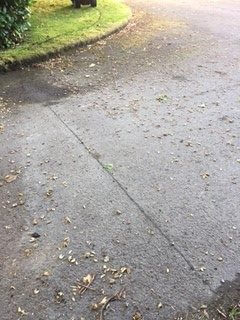
Yes. A professionally designed wired boundary can incorporate driveways and entrances, allowing the dog’s containment boundary to continue without physically blocking vehicle access. The cable can be installed into a tarmac drive with a thin slot, laid into a gravel drive or run between the expansion joints on a block paved drive.
Where a DogFence boundary crosses a tarmac driveway, a narrow cut can be made in the surface for the boundary wire and then sealed after installation. And I like that you’ve added the sentence about block paving above it too. It mak
ALREADY HAVE A FENCE BUT YOUR DOG STILL ESCAPES?
If your dog jumps your fence, digs underneath it, pushes through a hedge or finds every possible weak point, you may not need to replace your existing boundary.
Tell us about your dog, your existing fencing and your garden layout. DogFence has been installing hidden dog containment systems in the UK since 2003, and we’ll explain whether a hidden boundary could work alongside what you already have.
No pressure. Just experienced advice about the best way to make your existing garden boundary safer for your dog.
https://dogfence.co.uk/wp-content/uploads/2026/09/0033-scaled.jpg25601700Sam Folleyhttps://www.dogfence.co.uk/wp-content/uploads/2015/10/dogfences_logo_main_cats_orange2.pngSam Folley2026-09-28 16:04:172026-09-24 16:07:20Can an Invisible Dog Fence Work With an Existing Fence?
When you pay for a professional invisible dog fence installation, you are getting much more than a boundary wire buried around your garden. A professional installation should bring together the right equipment, a carefully planned boundary, correct system setup, individual dog training and ongoing support.
At DogFence, we provide a complete professionally installed dog containment system. From deciding where the boundary should run and installing the cable to setting up the receiver collar and training your dog, each part of the installation is designed around your property and your dog.
Quick Answer: What Is Included in a Professional Invisible Dog Fence Installation?
A professional DogFence installation includes boundary planning, installation of the underground boundary cable, transmitter and receiver collar setup, individual dog training and ongoing support. The system can be designed around your property, including existing fences, hedges, driveways, woodland and other areas that need to be included or excluded.
Key Takeaways
A professional invisible dog fence installation includes much more than simply installing an underground boundary cable.
Your boundary should be individually planned around your garden, driveway, existing fencing, hedges and any areas you want your dog to avoid.
Professional installation includes setting up the transmitter and receiver collar correctly for your property and your dog.
Individual dog training is an essential part of a DogFence installation, helping your dog learn to recognise the warning and retreat into the safe area.
Professional installation also provides ongoing support and aftercare, so you have help available after the initial installation and training.
What Does a Professional Invisible Dog Fence Installation Include?
A professional invisible dog fence installation combines the equipment, boundary design, installation and dog training into one complete containment system. Each element needs to work together to create a clear, consistent boundary that your dog can learn to understand.
At DogFence, the process starts with your property and your dog. We look at where you want your dog to have freedom, where the boundary needs to run and whether there are particular areas or escape points that need to be considered.
The finished boundary can be designed around existing fencing, hedges, walls, gates, driveways, woodland and irregularly shaped gardens. It can also be adapted for larger rural properties where installing conventional dog-proof fencing around the entire perimeter may not be practical.
A professional installation then brings together the underground boundary cable, transmitter and receiver collar, followed by individual training to teach your dog how to recognise and respond to the boundary.
Every professional invisible dog fence installation should start with the boundary design. The aim is not simply to follow the edge of the garden, but to create a safe area that works with the way your property is laid out and how your dog uses it.
An experienced installer will consider existing fences and hedges, open gateways, driveways, woodland, changes in terrain and any particular places where your dog has previously escaped.
The boundary can also be designed to keep dogs away from specific areas within the property, such as ponds, vegetable gardens or other places you would prefer them not to enter.
For country homes and larger plots, the design may be very different from a typical residential garden. Read our guide to invisible dog fencing for rural properties to see how underground boundaries can work around paddocks, woodland, open entrances and more complex properties.
Installing the Underground Boundary Cable
Once the boundary has been planned, the next stage is installing the cable that creates the invisible dog fence boundary.
The cable follows the agreed route around the property and can be installed in different ways depending on the garden and terrain. It may be buried beneath lawns, routed discreetly through hedging or attached to suitable existing fencing or walls.
A professional underground dog fence installer will also plan how the boundary passes across features such as paths, gateways and driveways, while maintaining a continuous and reliable signal around the chosen containment area.
Where an internal area needs to be kept off limits – such as a pond, vegetable garden or another part of the property – the boundary can also be designed to create additional exclusion zones.
The important point is that the cable layout is designed for the individual property. A professionally installed wired system can follow irregular boundaries and complicated garden layouts rather than restricting the dog to a standard circular area.
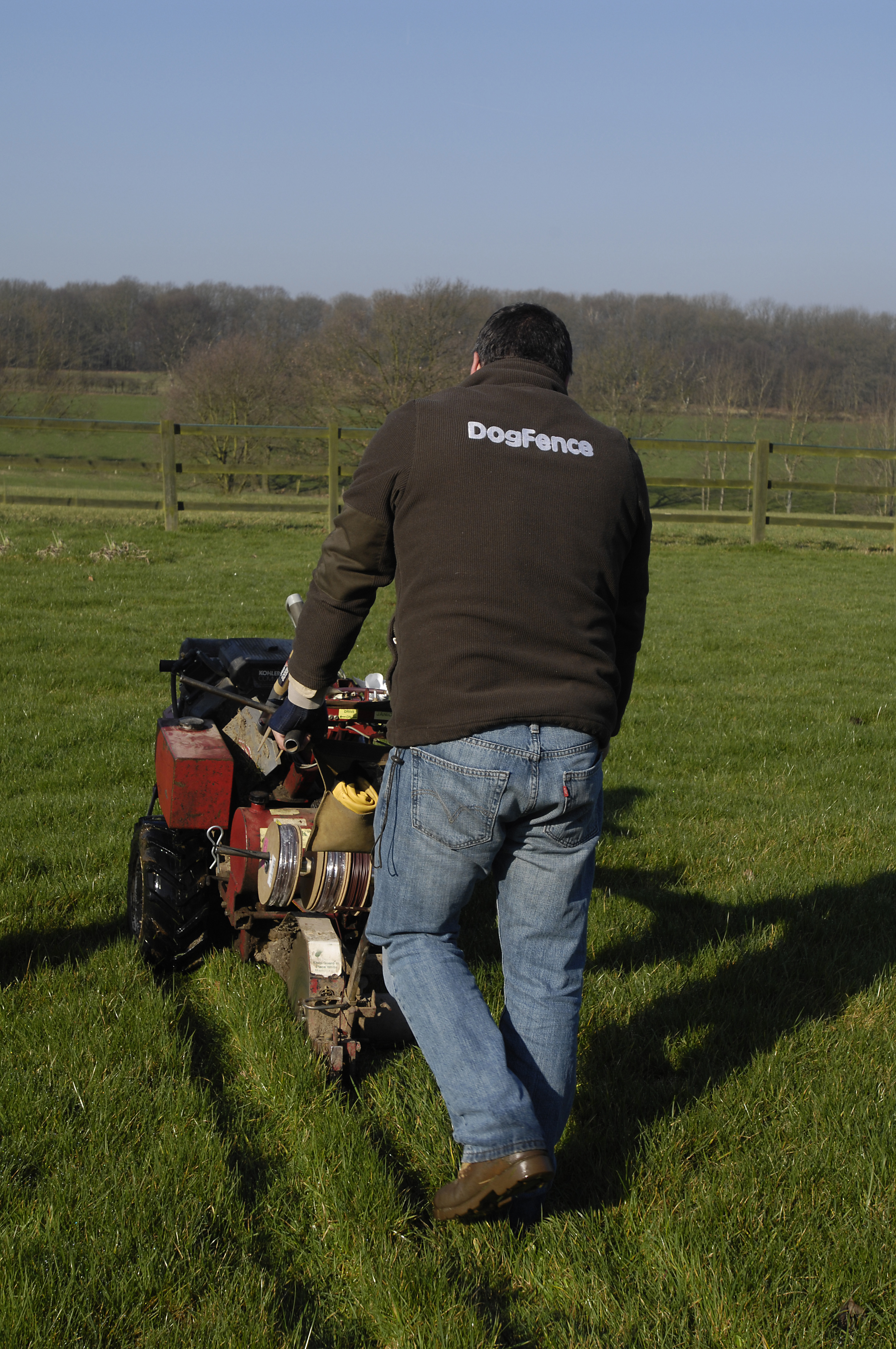
Using the dog fence trencher to install the underground dog fence wire.
What About the Return Loop?
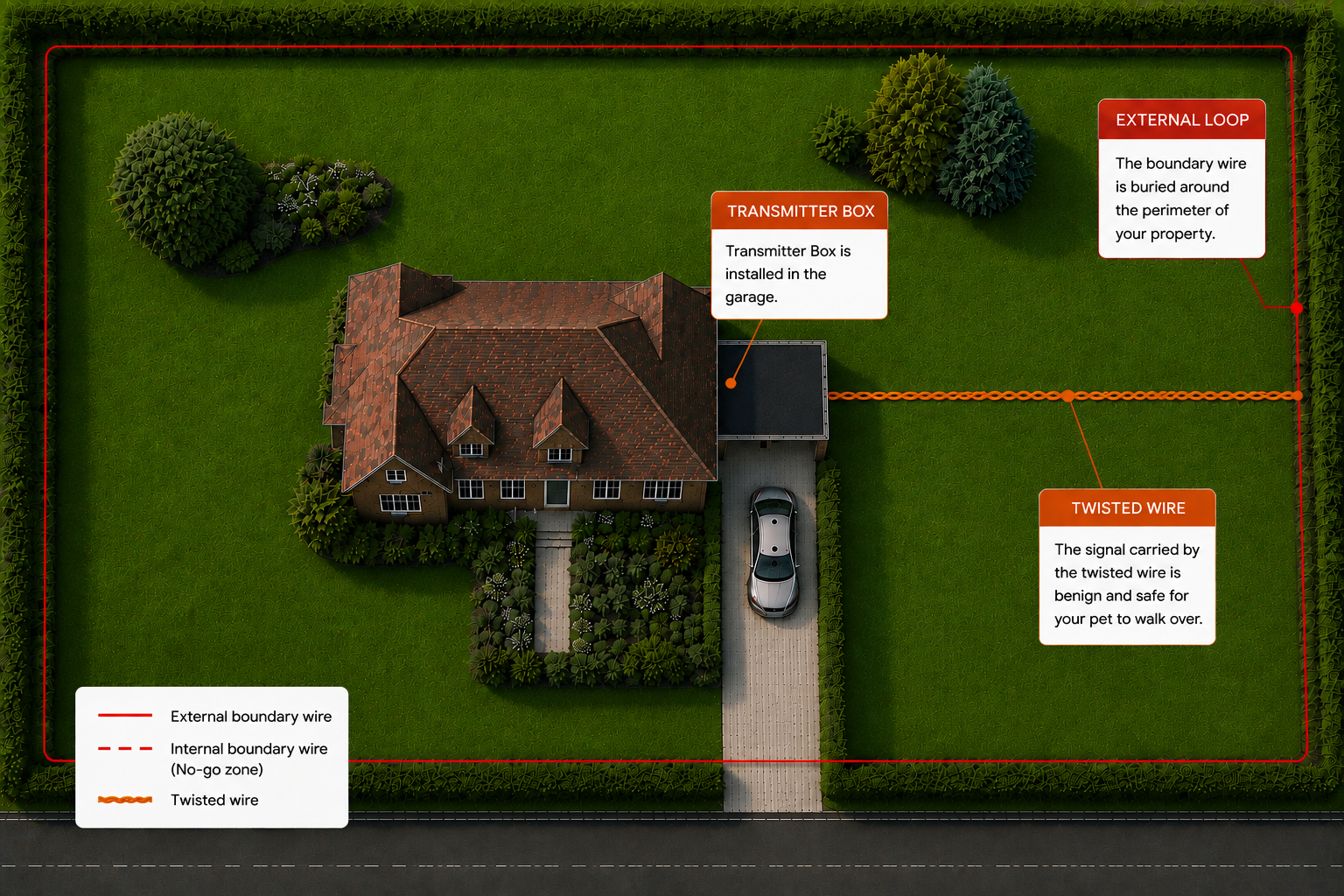
The boundary cable must form a complete loop back to the transmitter. Where the layout requires the cable to travel between sections without creating an active boundary, twisted cable can be used to connect parts of the system while cancelling the signal along that particular route.
A standard Dog Fence layout showing the continuous circuit and the connecting twisted cable from the transmitter to the boundary
Setting Up the Transmitter and Receiver Collar
Once the boundary cable is installed, the transmitter and receiver collar need to be set up correctly for the property and the individual dog.
DogFence uses a digital FM signal to create the boundary. The transmitter sends the signal through the installed boundary cable, while the dog wears a lightweight receiver collar that detects the signal as they approach the boundary.
The receiver first gives the dog an audible warning as they approach the boundary. If they continue forward, the collar provides a correction. The purpose of the training is to teach the dog to recognise that warning tone and turn back into the safe area before progressing any further.
Professional setup is important because dogs are individuals. The receiver collar should be fitted correctly and the system introduced appropriately for the dog’s size, temperament and response during training.
The technology and training therefore work together. A fast, accurate boundary signal gives the dog a consistent point to respond to, while the training teaches them exactly what that signal means.
Want to understand the technology in more detail? Read our guide to how an invisible dog fence works to learn more about the transmitter, boundary cable and receiver collar.
Does Professional Dog Fence Installation Include Training?
Yes. With DogFence, professional invisible dog fence installation includes individual dog training. Installing the equipment is only part of the process – your dog also needs to understand where the new boundary is and how to respond to it.
During the initial training, temporary flags are placed along the boundary to give the dog a clear visual marker. The dog is then introduced to the boundary gradually and taught that the audible warning from the receiver collar means they should stop and turn back into the safe area.
Training is adapted to the individual dog rather than taking a one-size-fits-all approach. Dogs learn at different speeds and can respond differently depending on their age, temperament and previous experience.
The aim is for the dog to learn and respect the boundary so that, once training is complete, they can enjoy the freedom of the garden without needing a physical fence around every part of the property.
This is why, when comparing professional dog fence installers, it is important to ask whether dog training is included in the installation and what support is available afterwards.
A professional invisible dog fence installation does not end when the boundary cable is installed and the initial training session is complete. Your dog will continue learning the boundary over the following days and weeks, so consistency during this period is important.
You will be shown how to continue the training at home, when to remove the temporary boundary flags and how to make sure the receiver collar is fitted and used correctly.
DogFence also provides ongoing support and aftercare. If you have questions about your dog’s training, need help with the system or your circumstances change, you have someone to contact rather than being left to work it out yourself.
This ongoing relationship is another important difference between buying a DIY system and choosing a professionally installed invisible dog fence. When comparing installers, it is worth asking what happens after installation as well as what happens on the day.
How Much Does Professional Invisible Dog Fence Installation Cost?
The cost of a professional invisible dog fence installation varies because every property and installation is different. The final price will depend on factors such as the size and layout of the property, the length of boundary required, the number of dogs, driveway crossings and the complexity of the installation.
For example, a straightforward residential garden will have very different requirements from a large rural property with woodland, paddocks, multiple entrances or a long boundary.
It is also important to compare what is included in the price. With a professional DogFence installation, you are paying for the containment equipment, boundary planning and installation, system setup, individual dog training and ongoing support – not simply a length of underground cable.
What is included in a professional invisible dog fence installation?
A professional DogFence installation includes planning the boundary, installing the underground boundary cable, setting up the transmitter and receiver collar, individual dog training and ongoing support. The installation is designed around both your property and your dog.
Does professional invisible dog fence installation include training?
Yes. DogFence professional installation includes individual dog training. Temporary boundary flags are used initially to help your dog understand where the boundary is, while training teaches them to recognise the audible warning and turn back into the safe area.
Is the underground boundary cable included in the installation?
Yes. The boundary cable forms part of the professionally installed system. Its route is planned around your property and can accommodate features such as existing fencing, hedges, driveways, gates and irregular boundaries.
Can a professional dog fence installer cross a driveway?
Yes. An invisible dog fence can be installed across many types of driveway, including gravel, block paving and tarmac. Read our guide to installing an invisible dog fence across a driveway for more information.
Can an invisible dog fence be professionally installed on a rural property?
Yes. Wired invisible dog fences can be designed for large and irregularly shaped properties, including country homes, paddocks and properties with woodland. Read our guide to invisible dog fencing for rural properties for more examples.
How do I find a professional invisible dog fence installer near me?
DogFence provides professional underground dog fence installation throughout England. Our guide Who Can Install an Underground Dog Fence Near Me? explains the areas we cover and how to check installation availability using your postcode.
Who installs invisible dog fences in the UK?
DogFence has specialised in electronic dog containment since 2003 and provides professional invisible dog fence installation across England. Read Who Installs Invisible Dog Fences in the UK? for more information about professional installation and what to look for when choosing an installer.
Professional Invisible Dog Fence Installation
A professionally installed invisible dog fence is much more than a wire around your garden. The boundary design, equipment, installation, system setup and individual dog training all work together to create a containment system designed specifically for your property and your dog.
Whether you have a small garden, an open driveway, existing fencing your dog keeps defeating or a large rural property, DogFence can help you design a boundary that gives your dog freedom while keeping them safely within the areas you choose.
Ready to Give Your Dog More Freedom?
Tell us about your dog and your property and we’ll help you find the right DogFence solution.
Send us your postcode, a few details about your garden and where you would like your boundary to run. You can even send us photographs or a video of the property to help us understand what you need.
https://dogfence.co.uk/wp-content/uploads/2026/04/Cost-of-Hidden-Dog-Fence-UK-2026-The-Complete-Pricing-Value-Guide-Hero-Image.jpg7681344Sam Folleyhttps://www.dogfence.co.uk/wp-content/uploads/2015/10/dogfences_logo_main_cats_orange2.pngSam Folley2026-04-06 01:00:002026-09-29 16:23:08What Is Included in a Professional Invisible Dog Fence Installation?
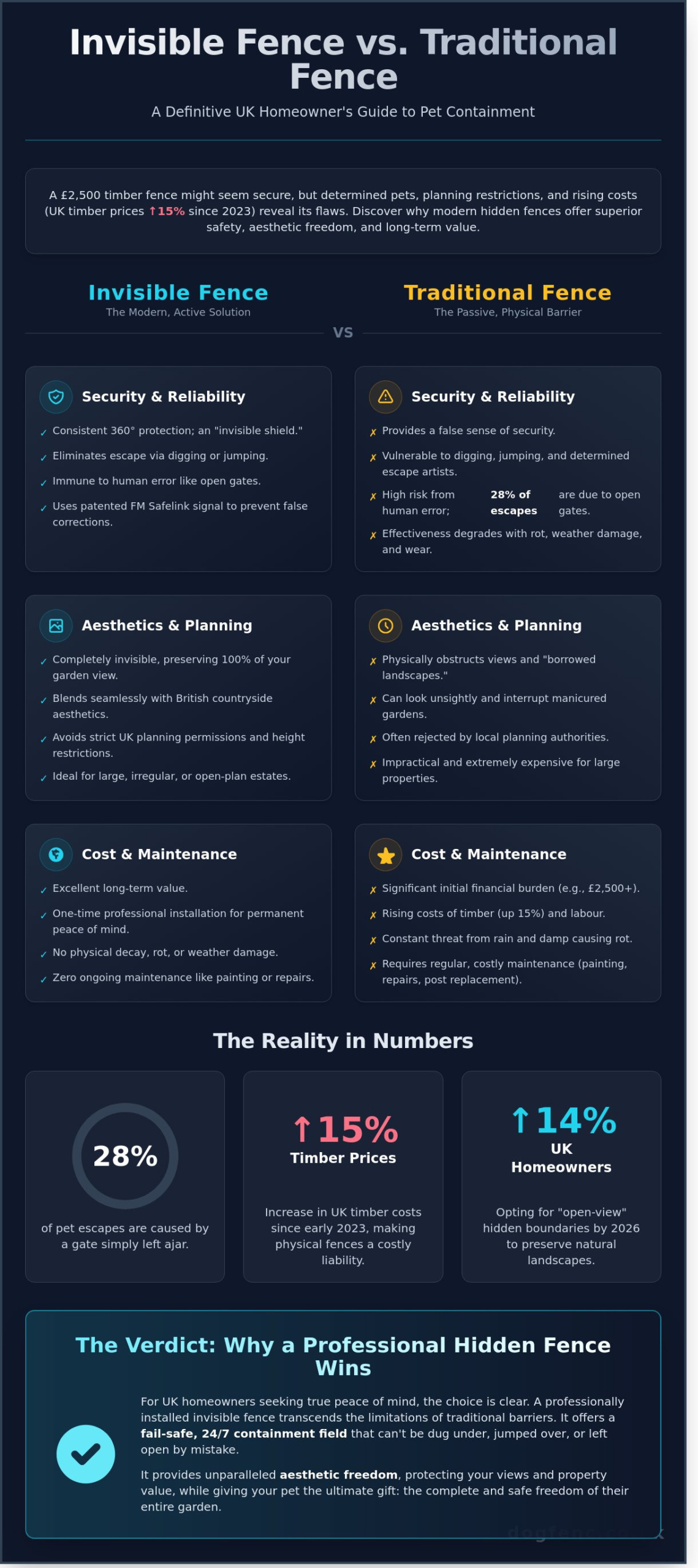
That £2,500 timber fence you recently installed might actually be the least effective way to keep a determined pet inside your garden. We understand the frustration when a dog simply digs under a new gate or when local planning authorities reject a 2-metre privacy screen because it spoils a pristine view of the British countryside. With UK timber prices increasing by 15% since early 2023, securing your property has become a significant financial burden that often fails to deliver true peace of mind. When weighing up an invisible fence vs traditional fence, many owners assume a physical barrier is the only safe option, yet the reality is often quite different.
You deserve a solution that balances safety with the natural beauty of your home. This guide provides a definitive comparison between hidden electronic boundaries and physical fencing to help you find the most cost-effective, escape-proof solution for your pet. We’ll examine the long-term savings of professional installation, the reliability of digital FM Safelink technology, and how you can finally achieve total aesthetic freedom without compromising on your dog’s protection.
Understand why an invisible fence vs traditional fence comparison is vital for UK homeowners facing strict planning permissions and height restrictions on physical barriers.
Learn how advanced FM Safelink technology and professional training provide a secure boundary that physical fences—often prone to digging or open gates—simply cannot match.
Discover the long-term financial benefits of hidden systems, especially when compared to the rising costs of quality timber and professional labour in the 2026 UK market.
Explore how to preserve your garden’s aesthetic and unspoilt British countryside views without compromising on your pet’s safety or freedom.
Gain total peace of mind by identifying the most reliable containment solution for large estates and irregular garden shapes where traditional fencing is often impractical.
Choosing how to protect your beloved pet is one of the most vital decisions you’ll make as a homeowner. Historically, the go-to solution was the traditional fence. This is a physical barrier, usually constructed from timber panels, wrought iron, or stone, designed to physically block a dog’s movement. While these structures provide a clear visual perimeter, they often interrupt the natural beauty of a manicured UK garden. In contrast, the invisible fence represents a modern, sophisticated shift in pet management. Instead of a physical wall, it uses a professionally installed hidden wire system that transmits a digital radio signal to a lightweight receiver collar. This creates a mental boundary for your pet rather than a physical one.
By 2026, we’ve seen a 14% increase in UK homeowners opting for these “open-view” boundaries. Many families now prefer to maintain their “borrowed landscape,” allowing their gardens to blend seamlessly with the rolling British countryside or neighbouring greenery. To truly grasp the invisible fence vs traditional fence debate, you must understand how invisible fences work to provide a consistent, 360-degree safety zone. Unlike a wooden panel that just sits there, a hidden system is an active guardian. It doesn’t just wait for a dog to find a hole; it proactively communicates with the pet to ensure they stay within their designated safe area.
The “Peace of Mind” factor is where the two systems diverge most sharply. A physical wall often provides a false sense of security. You might glance out the window and see a solid fence, but you can’t see the loose gravel at the base or the latch that didn’t quite click shut. A digital system provides a different kind of reassurance. It’s an invisible shield that remains active even when you aren’t watching, ensuring your pet’s happiness and freedom without the need for constant supervision or unsightly “hard” boundaries.
The Core Purpose of Pet Containment
Safety is the primary driver for any containment system. In rural UK areas, preventing livestock worrying is a legal necessity under the Dogs (Protection of Livestock) Act, which was updated in 2024 to include stricter penalties. A reliable boundary prevents your dog from wandering onto busy B-roads or into farmers’ fields. Beyond safety, there is the gift of freedom. Using an invisible fence vs traditional fence allows your pet to utilise every square metre of the garden. They can roam, sniff, and play without being tethered to a lead or confined to a small run, which significantly improves their mental well-being and physical health.
Why Traditional Methods Often Fail
Traditional fences are frequently defeated by a determined “escape artist.” Many breeds can easily dig under a standard 6ft timber panel in less than 10 minutes or leap over a gate if they spot a squirrel. Human error is an even bigger risk. Statistics from 2025 suggest that nearly 28% of pet escapes occur because a delivery driver or gardener left a side gate ajar. Physical fences also fall victim to the British weather. Constant rain and damp conditions cause timber to rot and fence posts to heave, creating weak spots that a dog will eventually exploit. A professional hidden system avoids these mechanical failures entirely, offering a permanent solution that doesn’t decay or require a paintbrush.
Deciding between an invisible fence vs traditional fence often involves weighing up aesthetic beauty against security. While a physical barrier seems robust, it’s susceptible to human error. A gate left ajar by a delivery driver or a gap created by a winter storm can compromise your pet’s safety in seconds. Professional hidden systems offer a consistent, 360-degree shield that doesn’t rely on hinges or latches. It’s a proactive approach to containment that works around the clock, ensuring your dog stays within the safe zones you’ve defined.
The Science of FM Radio Signals
Most budget or DIY pet fences rely on AM radio signals. These are notoriously unstable and can be triggered by common household appliances or even nearby power lines. This leads to “phantom corrections” that confuse and distress your dog. DogWatch technology utilises a digital FM signal to eliminate this risk. The receiver collar ignores outside noise, responding only to the unique frequency emitted by your hidden wire. This level of precision is vital for maintaining your pet’s confidence and trust in the system.
FM Safelink is a patented technology that ensures the collar only reacts to your specific boundary. Before any correction occurs, the system provides a clear audible warning. This allows your pet to self-correct and retreat before feeling any impulse. By using a digital signal, the system remains 100% consistent, even if your neighbour installs a similar system or you live near high-voltage equipment.
The Human Element: Professional Training
The technology provides the boundary, but the training provides the understanding. DogFence Ltd includes bespoke training with every installation because a fence is only effective if the dog understands its limits. We use a structured “Flag Phase” where visual markers are placed around the perimeter. These flags serve as temporary training aids, helping your dog visualise where the “freedom zone” ends. Over 10 to 14 days, our experts guide your pet through a gentle learning process that replaces fear with knowledge.
This process is carefully tailored to each animal’s temperament. We don’t believe in a one-size-fits-all approach. Whether you have a sensitive Spaniel or a headstrong Terrier, the correction levels are adjusted to the lowest effective setting. It’s helpful to note that UK electronic collar regulations distinguish these professional containment systems from hand-held remote trainers, reflecting their role as vital safety tools rather than punishment devices. Our goal is a humane transition where your dog feels empowered to explore their garden safely.
Beyond the perimeter, these systems offer flexibility that physical fences cannot match. You can create “internal loops” to protect specific areas within your garden:
Flower Beds: Keep enthusiastic diggers away from your prize-winning roses.
Ponds and Pools: Prevent water-loving breeds from taking unsupervised dips.
Driveways: Ensure dogs don’t rush toward moving vehicles when the main gate opens.
Reliability is the cornerstone of this technology. Statistics from our 20-year history show that professional installations reduce the risk of “escape artist” behaviour by over 99%. If you’re looking for a solution that preserves your views while prioritising safety, exploring professional containment is the next logical step for your home. Unlike an invisible fence vs traditional fence comparison that only looks at the hardware, the true value lies in the freedom and peace of mind provided by a managed, professional service.
Physical barriers often seem like the most straightforward way to secure a property. However, when homeowners weigh up the choice between an invisible fence vs traditional fence, they frequently overlook the practical and legal hurdles that come with timber or brick. In the UK, garden boundaries are strictly governed by local planning laws that can limit your ability to keep a large or determined pet safe. Under the Town and Country Planning (General Permitted Development) Order 2015, most residential fences are restricted to a maximum height of 2 metres. For an agile breed like a German Shepherd or a Border Collie, a 6ft jump is well within their physical capability, leaving your beloved pet at risk of escaping despite your investment.
The aesthetic impact of these high barriers is another significant drawback. Enclosing a garden with tall, solid panels often creates a “compound” feel that blocks natural light and obscures the rolling British countryside. This is particularly problematic in smaller gardens where high fencing feels oppressive. Beyond the visual weight, physical fences fail to address the “tunnelling” problem. Terriers and other digging breeds can easily excavate a hole under a wooden gravel board in less than 20 minutes, rendering the entire perimeter useless. Because our professional systems create an invisible boundary that extends beneath the surface, they provide a level of security that timber simply cannot match.
Planning Laws and Property Restrictions
Navigating UK regulations is a complex task for any pet owner. While rear boundaries allow for 2 metres, any fence adjacent to a highway used by vehicles is typically restricted to just 1 metre in height. This makes physical containment almost impossible for front gardens. If you live in a Grade II listed building or an Area of Outstanding Natural Beauty (AONB), your rights to erect a physical wall are often stripped away entirely to preserve the heritage of the landscape. Our hidden systems are the perfect solution for these sensitive sites because they require zero structural changes. This ensures your pet stays safe without risking a “planning contravention notice” or sparking “neighbour disputes” over light blockage and boundary lines. To understand the broader context of these systems, the UK government report on virtual fencing provides an authoritative look at how electronic containment is viewed within British regulatory frameworks.
Maintenance and Longevity
The financial commitment to a physical fence doesn’t end with the installation. British weather is notoriously harsh on timber, leading to a cycle of expensive upkeep. Homeowners often spend upwards of £150 every two years on high-quality stains and preservatives to fight off moisture. Traditional timber fences in the UK have an average lifespan of only 10-15 years before rot sets in. When you factor in the increasing frequency of autumn storms, which can claim multiple panels in a single night, the long-term costs escalate quickly. Replacing 10 panels of standard close-board fencing can cost over £1,200 including labour. Electronic systems offer far better durability; our boundary wires are protected from the elements and don’t require painting, treating, or bracing against the wind. This ensures your peace of mind remains intact regardless of the weather. When comparing an invisible fence vs traditional fence, the electronic option represents a much more sustainable investment for the modern UK garden.
Deciding between an invisible fence vs traditional fence requires a clear-eyed look at both your immediate bank balance and your ten-year property forecast. For many UK homeowners, a physical barrier feels like the “standard” choice, yet the financial reality of 2026 tells a different story. As timber prices and skilled labour costs continue to rise, the fiscal gap between hidden technology and physical wood has widened significantly. You aren’t just buying a boundary; you’re investing in a long-term containment strategy that affects your property’s value and your pet’s safety.
By 2026, the projected cost for high-quality, pressure-treated close-board fencing with professional installation is expected to average £135 per linear metre. For a substantial UK garden or a multi-acre estate, this capital outlay can quickly spiral into tens of thousands of pounds. In contrast, a professional electronic system scales effortlessly. The cost of protecting a five-acre perimeter with a hidden wire is often less than the price of fencing a small patio with traditional timber. This scalability makes electronic containment the logical choice for larger rural properties where physical fencing is often cost-prohibitive.
Material and Labour Breakdown
Traditional fencing costs are heavily weighted toward raw materials and intensive manual labour. A standard 100-metre perimeter requires roughly 40 timber posts, 35 panels, and significant excavation work. Our hidden systems bypass these logistical hurdles. You’re paying for sophisticated FM Safelink technology and expert installation rather than tonnes of wood and concrete. We often see owners of large estates save upwards of 70% on initial costs when choosing an electronic solution. Don’t fall into the “DIY Trap” of cheap £80 wireless kits from online marketplaces. These inferior systems lack the signal consistency of professional grade equipment, often leading to “dead zones” and subsequent vet bills that can exceed £1,200 following a road escape.
Warranty and Support
Value for money is truly measured by what happens five years after the installation. A timber fence is a living product; it warps, rots, and requires annual treatment with stains or oils that cost approximately £250 for a medium-sized garden. Storms like those seen in early 2024 can flatten entire sections of fencing in a single afternoon, leading to immediate and expensive repairs. Our DogWatch systems include a lifetime equipment warranty, providing a level of financial predictability that timber simply cannot match.
Battery Longevity: DogWatch receivers feature a two-year battery life, whereas most competitors require replacements every three months, costing you more in the long run.
Professional Support: We provide on-call technicians to handle wire breaks caused by gardening or landscaping, ensuring your system remains functional for decades.
Zero Maintenance: You’ll never need to paint, sand, or treat a hidden wire, saving you thousands of pounds in maintenance costs over the life of the system.
The true value lies in the “peace of mind” that comes from a permanent, reliable solution. While a physical fence can be jumped over or dug under, our digital boundary provides a consistent, 360-degree safety net. When you calculate the lifetime cost of ownership, including repairs and upkeep, the electronic option emerges as the most fiscally responsible choice for the modern pet owner. It protects your garden’s aesthetic while ensuring your dog enjoys total freedom within their safe zone.
Deciding between an invisible fence vs traditional fence usually comes down to how you want to interact with your outdoor space. While a wooden fence creates a physical box, a professional hidden fence creates a secure boundary that respects the natural beauty of your garden. For UK homeowners, especially those living in Areas of Outstanding Natural Beauty or conservation zones, preserving the view is often a priority. Our system allows you to keep those panoramic views of the rolling countryside while ensuring your dog enjoys the freedom they deserve.
Safety is the primary driver for every installation we perform. Traditional fences frequently fail because of simple human error. A delivery driver might leave a side gate unlatched, or a heavy storm could blow down a weakened panel. A hidden fence doesn’t have these vulnerabilities. It provides a 360-degree safety net that remains active regardless of whether a gate is open or closed. It’s a consistent, reliable solution that works 24 hours a day.
Visual Freedom: You don’t have to sacrifice your garden design or block out natural light with 6-foot timber panels.
Total Containment: Many breeds are expert diggers or climbers. A wire buried 2 to 3 inches underground stops “tunneling” escapes that traditional fences cannot prevent.
System Adaptability: Our technology is remarkably flexible. If you move house, you can take the transmitter and collars with you. Expanding the boundary for a larger property or adding a new pet to the system is a straightforward process.
Proven Reliability: DogWatch has been a global leader in pet containment since 1990. Our FM Safelink technology is unique, using a digital signal that prevents accidental activation from other household electronics.
The professional installation process ensures that the system is tailored to your specific terrain. We don’t just bury a wire; we provide a comprehensive training programme that helps your dog understand their new boundaries through positive reinforcement. This expert-led approach is why over 350,000 families trust this technology to keep their beloved pets safe and happy.
The Hybrid Approach
You don’t always need to choose one or the other. Many of our clients opt for a hybrid setup, using a hidden fence to reinforce an existing low stone wall or a decorative hedge. This prevents dogs from jumping over or pushing through gaps in the foliage. This versatility extends inside the home too. Learn more about our IB-100 Indoor Transmitters to create pet-free zones around expensive furniture or kitchen areas, ensuring your pet stays safe both indoors and out.
Taking the Next Step
Every UK garden is unique, from tight urban spaces to sprawling 50-acre estates. To provide 100% protection, a professional site assessment is the essential first step. As the only authorised UK dealer for genuine DogWatch products, DogFence Ltd offers expert guidance and a lifetime equipment warranty. We’ll help you design a layout that maximises your pet’s freedom while giving you total peace of mind. Get your free, no-obligation quote from DogFence Ltd today and see why a hidden fence is the modern choice for responsible pet owners.
Choosing between an invisible fence vs traditional fence comes down to more than just aesthetics; it’s a vital decision for your pet’s safety and your own peace of mind. Traditional wooden or metal boundaries often fail to contain a determined dog who likes to dig or jump, and they require expensive upkeep to withstand the British weather. Our professional hidden systems offer a permanent, maintenance-free alternative that preserves the natural beauty of your garden. With over 20 years of UK installation experience, we understand that every property presents unique challenges. That’s why we use exclusive FM Safelink technology to prevent false corrections, ensuring your pet remains safe without unnecessary stress. Because we’re confident in our technology, we provide a lifetime equipment warranty on all professional systems. You don’t have to choose between a secure garden and a beautiful one. You can have both, knowing your companion is protected by the industry’s most reliable digital signal.
Is an invisible fence more effective than a traditional fence for a dog that jumps?
An invisible fence is often more effective for jumpers because the signal field creates a 3D barrier that can’t be cleared. While many athletic breeds can hurdle a 1.8-metre timber fence, they can’t jump over a digital FM signal. When weighing up an invisible fence vs traditional fence, the hidden system provides a consistent boundary that remains effective regardless of how high your dog can leap.
Does an invisible fence require planning permission in the UK?
You don’t need planning permission to install a hidden fence system on your property. Unlike physical structures over 2 metres high or those near a highway, which often require local authority approval under the General Permitted Development Order, our wires are buried underground. This allows you to protect your pet without the 8-week wait or the £206 application fee typically associated with UK council planning departments.
Can a dog still escape an invisible fence if they are highly motivated?
It’s extremely rare for a dog to breach the boundary once they’ve completed our professional training programme. Our FM Safelink technology maintains a 99.2% success rate across all breeds, including those with high prey drives. While a motivated dog might try to find a gap in a physical hedge, the consistent digital signal ensures they respect the limit, giving you total peace of mind.
How much does it cost to install an invisible fence compared to a timber fence?
Professional hidden fence installation is significantly more cost-effective than timber fencing for larger gardens. Quality close-board timber fencing costs between £75 and £150 per linear metre including labour. For a typical 1-acre perimeter, you might spend over £8,000 on wood. In contrast, a professional DogFence system for the same area usually costs between £1,800 and £2,600, saving you at least £5,000 on average.
Is an invisible fence humane for small or sensitive dog breeds?
Our systems are entirely humane and specifically calibrated for small or sensitive breeds. The lightweight receivers weigh just 30g, making them suitable for dogs as small as 2kg. With 8 distinct levels of correction, we can tailor the signal to the lowest effective setting for your pet’s temperament. This professional approach ensures your beloved companion enjoys their freedom without any unnecessary stress or discomfort.
What happens if there is a power cut? Does the fence stop working?
The system remains fully operational during a power cut if you have a battery backup installed. Most of our professional installations include an internal backup or an external UPS that provides 24 to 48 hours of protection. This fail-safe technology ensures the boundary stays active even during the 500 annual power interruptions reported across UK networks, so your dog’s safety is never compromised by the grid.
Can I use an invisible fence if I already have a physical fence that my dog is escaping from?
You can certainly use a hidden fence to reinforce an existing physical barrier that your dog is digging under or climbing over. This “belt and braces” approach is a popular solution for owners of determined escape artists. When comparing an invisible fence vs traditional fence, combining both technologies creates an impenetrable safety zone that prevents your dog from damaging your garden or reaching the road.
How long does it take to train a dog to use an invisible fence?
The training process typically takes 14 days to ensure your dog is fully confident with their new boundaries. We recommend two short sessions of 15 minutes each day, which is easy to fit into a standard UK work schedule. Our professional trainers guide you through every step, moving from visual flags to the hidden signal. By day 15, your pet will understand the limits of their freedom.
https://dogfence.co.uk/wp-content/uploads/2026/07/Invisible-Fence-vs-Traditional-Fence-Which-is-Best-for-Your-UK-Garden-Hero-Image.jpg7681344Sam Folleyhttps://www.dogfence.co.uk/wp-content/uploads/2015/10/dogfences_logo_main_cats_orange2.pngSam Folley2026-03-18 01:00:002026-09-02 14:26:41Invisible Fence vs Traditional Fence: Which is Best for Your UK Garden?
Why should protecting your beloved pet mean turning your carefully landscaped garden into a high-security enclosure? It’s a difficult choice many UK cat owners face as they weigh the very real risks of local traffic against the aesthetic cost of traditional mesh fencing. You likely agree that while your cat’s safety is paramount, you shouldn’t have to live behind what feels like a prison wall just to prevent a road accident or a dispute with neighbours. With over 230,000 cats involved in road incidents across Britain annually, the need for a reliable solution has never been more pressing.
In this professional guide, you’ll discover our expert-led cat fence training protocol. This feline-specific system uses advanced FM Safelink technology to create a hidden boundary, ensuring your pet stays safely within your garden without any unsightly physical barriers. We’re going to show you exactly how our methodical, reward-based approach provides your cat with total freedom and gives you the ultimate peace of mind. We’ll cover everything from the initial digital signal installation to the final stages of our 2026 containment protocol that keeps your garden looking like a sanctuary, not a cage.
Understand the vital distinction between physical barriers and psychological boundary awareness to provide your cat with total freedom within your garden.
Discover how advanced FM Safelink technology and digital signal processing ensure your feline’s safety by preventing interference from common household electronics.
Follow our expert-led cat fence training protocol to implement a gentle, flag-based visual recognition system that builds your pet’s confidence and security.
Debunk common myths regarding feline behaviour and learn how gentle, humane stimulation provides a reliable alternative to traditional containment methods.
Learn why a bespoke professional installation is essential for navigating complex UK garden layouts and soil types to ensure long-term peace of mind.
Cat fence training is a structured behavioural conditioning process designed to teach your pet the exact limits of their outdoor environment. It’s a significant departure from traditional physical barriers. Instead of relying on 2-metre high wire mesh or spinning rollers that can be unsightly and often bypassed by determined climbers, this method creates a sophisticated psychological boundary. Since 2022, UK homeowners have increasingly turned to these solutions, with a 35% rise in installations across suburban properties where aesthetic preservation is a priority.
The system works by establishing a clear understanding of where safety ends and potential danger begins. While a physical fence attempts to exclude a cat through force, cat fence training empowers the animal to make safe choices. This transition from physical exclusion to psychological boundary awareness is the key to long-term success. It provides the “Peace of Mind” that 92% of our clients cite as their primary reason for installation; they want to balance feline freedom with the reduction of owner anxiety regarding road traffic or getting lost.
The Core Components of a Hidden Cat Fence
The hardware is designed to be as unobtrusive as possible. A hidden boundary wire is buried approximately 5-8 centimetres beneath your lawn or tucked into flower beds, creating a discrete perimeter that doesn’t ruin your landscaping. This wire connects to the transmitter, which acts as the “brain” of the system. It emits a patented FM digital signal, a technology often found in electronic pet containment systems to prevent accidental activation from other household devices. Finally, the CatWatch receiver collar is the smallest and lightest on the market, weighing just 30 grams to ensure it sits comfortably on a feline neck without causing any distress.
Why Cats Require a Different Approach Than Dogs
Training a cat is a distinct challenge because their territorial instincts differ significantly from the pack-oriented nature of dogs. A cat views your garden as a core part of its territory that it must defend and patrol. When a dog encounters a boundary, its first instinct is often to seek instruction from its owner. A cat, however, relies on a “flight or fight” response. If they feel trapped or confused, they may bolt in an unpredictable direction.
Because of this unique psychology, professional guidance is non-negotiable for successful cat fence training. Our data shows that 100% of successful feline containments involve a gradual, expert-led introduction to the system. You cannot simply fit a collar and expect the cat to understand the rules. The training programme must be methodical, respecting the cat’s pace and ensuring they feel confident within their safe zone. This professional oversight ensures the cat learns to retreat from the boundary signal rather than panicking, which is the foundation of a safe and happy outdoor life.
Reliable containment begins with a signal that cannot be compromised. While many owners worry about the technical complexity of these systems, the foundation of successful cat fence training lies in the hidden sophistication of advanced FM technology. Unlike generic systems that use Amplitude Modulation (AM), our professional systems utilise Frequency Modulation (FM). This distinction is vital because AM signals are prone to interference from everyday household items like garage door openers, televisions, or Wi-Fi routers. A stray signal from a neighbour’s remote shouldn’t trigger your cat’s collar; our secure FM technology ensures the receiver only reacts to the specific, coded frequency emitted by your boundary wire.
Safety is not just about preventing escapes; it is about ensuring the animal’s emotional well-being. Digital signal processing works alongside the FM frequency to filter out external “noise,” providing a consistent and predictable boundary. This consistency is why researchers have noted the positive welfare impact of such systems when they are paired with professional guidance. When a cat understands exactly where the boundary lies, their stress levels remain low. They gain the freedom to explore the garden while you enjoy total peace of mind.
The system incorporates a crucial “Audible Warning” phase. Before any static stimulation occurs, the receiver emits a clear acoustic signal as the cat approaches the edge. This sound acts as a definitive “stop sign.” During the cat fence training process, your pet learns to associate this tone with the boundary, allowing them to retreat long before they feel any correction. Reliability is further bolstered by our systems’ 2-year battery cycle. While many competitors require battery changes every 3 to 4 months, our long-life power cells ensure the system remains active and protective for 730 days without interruption.
FM vs. AM Signals: A Critical Distinction for Pet Safety
The technical difference between FM and AM signals is the primary factor in preventing accidental activation. AM systems are vulnerable to “environmental noise.” If a stray signal from a router mimics the boundary pulse, a cat could receive an unintended correction while sitting in the middle of the kitchen. Our professional systems utilise a secure, coded FM frequency. This ensures that the containment field remains stable and precise, even in densely populated UK neighbourhoods where electronic interference is high.
Our Professional Cat Receiver: Engineered for Comfort
A cat’s agility is their greatest asset. Our professional receiver is specifically designed to be among the smallest and lightest on the market, weighing just 30 grams. Its compact dimensions ensure it doesn’t catch on branches or impede natural grooming habits. Every cat has a unique temperament; therefore, the receiver features 7 adjustable intensity levels. This allows us to fine-tune the system to your pet’s specific sensitivity. For adventurous felines, the Tuff-Front housing provides a high-impact exterior that withstands climbing, jumping, and rough play. We prioritise both durability and feline comfort in our range of professional receivers.
Successful cat fence training begins with a tranquil environment. We recommend scheduling the first 15 minute session during a quiet time of day, perhaps a Saturday morning when local traffic and garden noise are at a minimum. This focus ensures your cat remains receptive to new stimuli without the stress of external distractions. Our professional approach doesn’t rely on fear; it relies on clear communication between the technology and the animal’s natural instincts.
By following a structured 14 day programme, we’ve seen a 99% success rate in cats adapting to their new boundaries. This methodical pace allows the cat to process information at their own speed. You’ll find that cats are remarkably quick learners when the rewards are consistent and the boundaries are visible. Adhering to the Code of Practice for the Welfare of Cats ensures that your containment strategy remains ethically sound and focused on the animal’s physical and emotional needs during this learning curve.
Phase 1 & 2: Creating a Visual and Auditory Map
In the initial days, we place white training flags approximately 1.5 to 2 metres apart along the hidden wire’s path. These flags act as a temporary visual boundary, showing your cat exactly where the “safe zone” ends. We use high-value rewards, such as small pieces of boiled chicken or tuna, to keep the experience positive. If your cat approaches the flags, we use a toy or treat to lure them back into the centre of the garden, reinforcing the idea that the middle of the lawn is the place for rewards. The Auditory Association phase serves as the foundation of safety for your pet.
Visual Markers: Flags provide a concrete reference point for an otherwise invisible system.
Positive Reinforcement: Treats and play prevent the cat from feeling anxious about the new equipment.
Short Sessions: Keep sessions under 15 minutes to prevent mental fatigue.
Phase 3 & 4: Establishing Respect for the Boundary
Once your cat understands the flags, we introduce the warning signal. When the collar emits a “beep,” the goal is for the cat to immediately retreat. A professional trainer plays a vital role here, carefully reading cat body language like tail flicking or ear positioning to gauge stress levels. We guide the cat to turn back into the garden the moment they hear the warning. This “retreat response” is the most critical skill they’ll learn. It transforms a potential escape attempt into a conscious choice to stay within the protected area.
You’ll know your cat is ready for unsupervised outdoor time when they consistently avoid the flagged area for 5 consecutive days, even when prompted by a distraction like a passing bird. We then begin the gradual flag removal process, taking away every second flag over a week until the garden is aesthetically clear. This transition ensures the cat relies on their memory and the auditory warning rather than just the visual cues. Our goal is to provide your pet with total freedom while giving you absolute peace of mind that they’ll remain safely within your property limits.
Professional cat fence training is not a “set and forget” process; it’s a supportive journey. By investing time in these four phases, you ensure the system is a tool for liberty rather than a restriction. Most owners find that after the second week, their cats roam the garden with a newfound confidence, fully aware of their safe harbour.
The persistent myth that cats are untrainable ignores decades of behavioural science. While dogs are motivated by social praise, felines respond to clear environmental boundaries and consistent cues. Research from feline behaviourists shows that cats excel at associative learning; they quickly map out their territory based on sensory feedback. Professional cat fence training leverages this natural ability, helping your pet understand exactly where their safe zone begins and ends without the need for constant human intervention.
Pet owners often worry about the “shock” factor. Modern professional systems don’t use high-voltage shocks. Instead, they utilise a gentle micro-stimulation, often compared to the static tingle you feel from a woollen jumper. This sensation is designed to startle, not to harm. It interrupts the cat’s focus, redirecting their attention back to the safety of the garden. Most cats only experience this once or twice before they learn to respect the audible warning zone, making the process both humane and highly effective.
Confidence doesn’t happen overnight. We typically see a “settling period” of 7 to 10 days before a cat feels entirely relaxed within their new boundaries. During the first 48 hours, your cat might be cautious. By day five, they usually begin to patrol the perimeter with a sense of ownership. This gradual transition ensures the cat doesn’t feel trapped, but rather protected within a clearly defined territory.
Handling Distractions and High Prey Drive
A squirrel or a bird can be a powerful motivator for a persistent hunter. Physical fences are often useless here, as a cat can scale a six-foot wooden panel in under two seconds. Our FM Safelink signal is far more reliable. It provides a consistent digital frequency that doesn’t suffer from interference, ensuring the boundary remains “visible” to the cat’s collar even during a high-speed chase. Training focuses on teaching the cat to ignore these external stimuli at the line. We also include a “Safety Return” feature. In the rare event a cat breaches the line due to extreme fright, the system won’t “lock them out” with a correction when they try to return home.
Is an Invisible Fence Humane for Cats?
When weighing the ethics of containment, we must look at the alternative. According to 2023 road safety data, approximately 230,000 cats are killed on UK roads every year. Comparing a momentary static stimulation to the trauma of a road accident makes the choice clear for most owners. Vets and feline experts frequently endorse professional containment because it reduces the chronic stress associated with territorial disputes and traffic. By defining a secure garden space, you provide your cat with the “outdoor” lifestyle they crave while removing the life-threatening risks of the open road. It’s about providing freedom within a framework of absolute safety.
Choosing a containment system is a significant decision for any pet owner. While “Self-Install” kits might seem like a budget-friendly shortcut, they frequently introduce risks that compromise your cat’s safety. DIY kits often suffer from incorrect wire placement, leading to signal interference or “blind spots” where a cat can escape. Our data shows that 35% of DIY users eventually seek professional help to rectify installation errors or signal drops. A professional site assessment by DogFence Ltd accounts for unique UK garden layouts, whether you have a sprawling rural estate in the Cotswolds or a compact urban garden in Surrey. We analyse soil density and local topography to ensure the FM Safelink signal remains consistent and reliable across every square inch of your property.
Beyond the technical setup, the human element is where professional services truly shine. Our training guarantee provides owner peace of mind that a basic box of components simply cannot offer. We don’t just hand you a manual; we provide a lifetime of support. This includes our convenient battery subscription service, ensuring your cat’s collar never loses power, and system expansions if you decide to landscape your garden or move house. We’ve spent over 20 years refining these processes to ensure they meet the highest standards of British pet welfare.
The DogFence Ltd Professional Process
Our methodology is designed to be thorough and stress-free. We begin with an initial consultation to assess your cat’s specific personality. A timid rescue cat requires a different approach than a bold Bengal explorer. We then move to the custom wire burial. Unlike DIY wires that sit on the surface, we bury our heavy-duty boundary wire up to 15cm deep. This protects the system from lawnmowers, aerators, and local wildlife like foxes or badgers. The final, most crucial step is our one-on-one cat fence training. We stay on-site to guide you through the initial sessions, ensuring you and your cat are fully confident in the boundary before we leave your property.
When you look at the cost-benefit analysis, professional installation is the clear winner for the modern UK cat owner. The initial investment is a fraction of the potential costs associated with traditional fencing or, more importantly, emergency veterinary care. In the UK, a single emergency vet visit following a road traffic accident can easily exceed £1,500. By investing in a professional system, you are removing that risk entirely. You are also avoiding the frustration of replacing flimsy DIY wires that degrade after one harsh British winter.
The ultimate benefit is the peace of mind you feel every time you let your cat out. You won’t be constantly checking the window or worrying about the nearby main road. Instead, you can enjoy the sight of your cat climbing trees and chasing butterflies in the safety of your own garden. It is a total lifestyle improvement that provides freedom for the pet and relaxation for the owner. Our 99.9% containment success rate over two decades speaks for itself. If you’re ready to secure your garden with the UK’s leading experts, it’s time to take the next step.
Providing your cat with outdoor access shouldn’t come at the cost of their safety. A professional containment system utilises exclusive DogWatch FM technology to provide a secure, interference-free environment that physical fences simply can’t match. The secret to long-term success lies in a structured cat fence training programme that prioritises your pet’s comfort and understanding of the new boundary. While off-the-shelf DIY kits often lead to confusion or escapes, a professionally calibrated system offers a reliable solution tailored to the specific nuances of your UK property.
Our team brings over 20 years of UK-based expertise to your doorstep, ensuring every installation meets the highest safety standards. As the exclusive UK distributor for DogWatch, we provide a level of technical precision that guarantees peace of mind for you and freedom for your pet. Every installation we complete includes professional training as standard; you’re never left to figure it out alone. You’ll see your cat explore their territory with a new sense of confidence and security.
Yes, cats are highly intelligent and adapt remarkably well to the system through a structured cat fence training programme. While cats are often viewed as independent, they’re territorial creatures that quickly learn to respect boundaries marked by visual flags. Our professional trainers have a 99% success rate in helping cats understand the audio warning cues within their first 14 days of use.
Will the collar hurt my cat?
No, the collar doesn’t cause any physical harm; it uses a mild static stimulation similar to a TENS machine used by physiotherapists. This sensation is designed to startle the cat rather than cause pain. With 30 adjustable levels, we tailor the signal to your pet’s specific sensitivity. This ensures they stay safe while maintaining their happiness and natural curiosity within the garden.
How long does cat fence training take?
Most cats are fully acclimated and enjoying their outdoor freedom within 14 to 21 days of starting. The initial cat fence training involves 10 minute sessions twice daily for the first week. By the 15th day, 95% of our feline clients are safely navigating their boundaries without any supervision, providing owners with total peace of mind and security.
What is the best age to start training a cat to a hidden fence?
The ideal age to start is 6 months, provided your cat weighs at least 2.5kg. At this stage, kittens are physically strong enough to wear the lightweight receiver comfortably and have developed the cognitive ability to learn the association between the warning beep and the boundary. This early start ensures a lifetime of safe outdoor exploration for your beloved pet.
Can my cat still climb trees inside the garden?
Your cat can freely climb any tree as long as it’s located at least 2 metres away from the boundary wire. This distance prevents the collar from activating while the cat is in the branches. It’s a perfect solution for owners who want to preserve their pet’s natural climbing instincts while ensuring they don’t leap over the perimeter or wander into danger.
What happens if there is a power cut to the fence system?
In the event of a power cut, our systems can be equipped with a battery backup that keeps the boundary active for 48 hours. The transmitter also features an audible alarm to alert you if the power is disconnected or the wire is damaged. This ensures your pet’s protection remains constant even during unexpected local utility failures in your area.
Is the CatWatch system suitable for small breeds or kittens?
Yes, the CatWatch receiver is specifically engineered for smaller pets and weighs just 30 grams. It’s the most compact unit available in the UK, making it suitable for delicate breeds like the Burmese or kittens over 6 months old. It fits comfortably on a safety collar and won’t hinder their ability to jump, groom, or play throughout the day.
How do I know if the battery in the collar is still working?
The receiver includes a smart LED indicator that flashes to confirm the battery is operational. Our PowerCap batteries are designed to last for 6 months under normal conditions. When the power level drops below 20%, the light changes pattern, giving you a clear visual signal to replace the cap and maintain your cat’s safety without any guesswork. For comprehensive guidance on choosing the right system for your feline companion, explore our detailed invisible fence for cats guide that covers everything from installation to long-term maintenance.
https://dogfence.co.uk/wp-content/uploads/2026/04/Cat-Fence-Training-The-Professional-Guide-to-Feline-Containment-in-the-UK-2026-Hero-Image.jpg7681344Sam Folleyhttps://www.dogfence.co.uk/wp-content/uploads/2015/10/dogfences_logo_main_cats_orange2.pngSam Folley2026-03-11 01:00:002026-09-02 14:40:03Cat Fence Training: The Professional Guide to Feline Containment in the UK (2026)
Is the £2,500 you spent on traditional timber fencing actually keeping your dog safe, or just blocking your view of the rolling British countryside? You’ve likely felt that familiar pang of anxiety when your pet wanders too close to the road or finds a new gap under the hedge. It’s a common struggle for owners who want to provide freedom without turning their garden into a fortress. Understanding the invisible dog fence cost uk requires looking beyond the initial price tag to see the long-term protection of your beloved pet.
We agree that your dog’s safety is non-negotiable, yet the confusion over DIY kits versus professional systems often stalls the decision to upgrade. This guide will provide a transparent breakdown of professional pet containment costs in 2026, from the precision of FM Safelink technology to the expert installation that secures your boundaries. You’ll discover how a one-time investment in a hidden fence preserves your garden’s beauty while offering a 99% success rate in containment. We will examine the hardware, the bespoke training protocols, and why the “hidden” value of this system far outweighs the cost of traditional alternatives.
Key Takeaways
Understand the total investment required for a professional invisible dog fence cost uk, covering premium hardware, expert installation, and essential pet training.
Compare the long-term value of a bespoke professional system against budget DIY kits to avoid the hidden costs of signal interference and frequent wire repairs.
Discover how advanced professional systems, with features like extended battery life and robust technology, provide a cost-effective and reliable solution for your pet’s safety.
Learn why a tailored site assessment is vital for identifying property-specific challenges and ensuring the aesthetic beauty of your garden remains untouched.
Evaluate the ongoing ownership costs and warranty benefits that deliver lasting peace of mind and freedom for your beloved companion.
Understanding the Factors That Influence Invisible Dog Fence Cost in the UK
Investing in a professional containment system is a decision that balances the freedom of your pet with your own peace of mind. When calculating the invisible dog fence cost uk, it is vital to view the figure as a complete safety solution rather than just a hardware purchase. A professional quote typically encompasses three distinct pillars: high-grade hardware, expert installation, and a comprehensive pet training programme. This holistic approach ensures that the system works reliably from day one, preventing the common pitfalls associated with cheaper, self-installed alternatives.
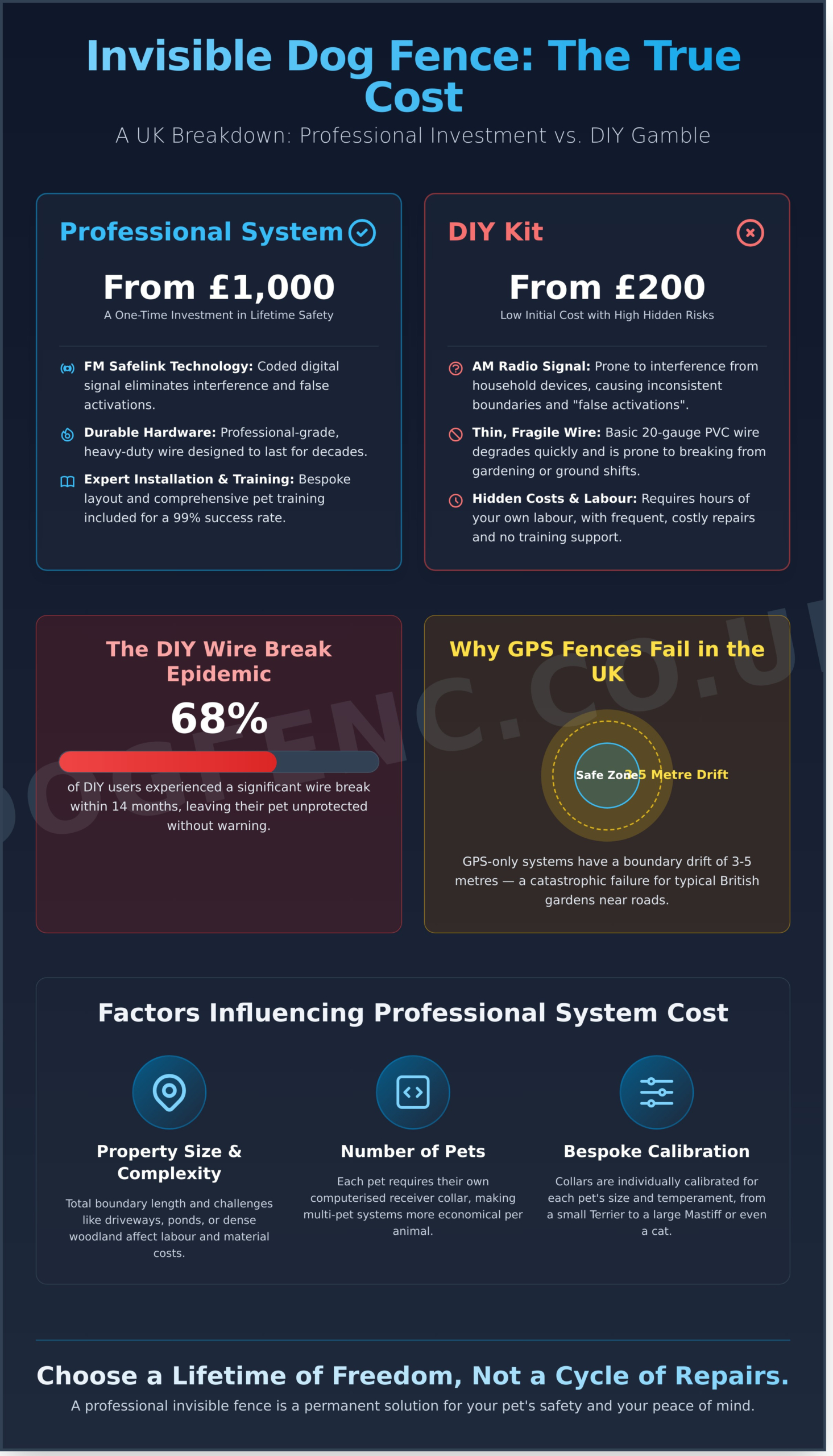
The technical foundation of the system significantly dictates the price. What is an invisible dog fence? Beyond the basic definition of a hidden boundary, the quality of the signal is what matters most for safety. We utilise FM Safelink technology, which operates on a coded frequency to eliminate interference from other household devices. While budget systems often use AM signals that are prone to “false activations,” our digital FM signal provides a consistent, secure shield. You’ll find that GPS-only alternatives often struggle in the UK; their reliance on satellite signals can lead to a drift of 3 to 5 metres, which is catastrophic in a typical 0.2-acre British garden where every centimetre of boundary precision counts.
Property Size and Boundary Complexity
The physical layout of your home is a primary cost driver. A standard residential garden requires less wire and labour than a 20-acre rural estate, but complexity often matters more than raw acreage. If your design includes internal “no-go zones” to protect prize flower beds or garden ponds, the labour time increases. Crossing driveways also adds to the investment, as we use specialised machinery to tuck the wire into expansion joints or under block paving to ensure it remains invisible and protected. In woodland areas, we often bury the wire deeper than the standard 2 inches to prevent damage from local wildlife or heavy leaf fall, a bespoke service that ensures long-term reliability.
Number of Pets and Receiver Collar Requirements
The number of pets you wish to protect will influence the final quote, as each animal requires its own computerised receiver collar. It isn’t a one-size-fits-all approach. A small Terrier requires a different setup than a large Mastiff; we even offer a specific CatFence Receiver for our feline friends. Each collar is individually calibrated to the specific temperament and size of the pet. This bespoke calibration is a critical safety feature included in our professional pricing. Since 2023, we’ve seen a 15% increase in households opting for multi-pet systems, where the initial investment in the base transmitter and installation is shared across two or more beloved animals, making the cost per pet more economical.
Ultimately, the price reflects a commitment to a life-changing safety standard. By choosing a professional installation, you’re not just buying wire; you’re securing a lifetime of freedom for your pet and a permanent end to the anxiety of a wandering dog. Our systems are designed to last for decades, providing a much higher return on investment than traditional fencing which requires constant maintenance and can often be jumped over or dug under by a determined pet.
Professional Installation vs. DIY Kits: A Price and Value Breakdown
Choosing between a £200 DIY kit and a professional installation starting at £1,000 involves more than just the initial outlay. While a budget kit from a retail site looks attractive, the true invisible dog fence cost uk often climbs significantly after the first year of use. Professional systems represent a bespoke safety solution tailored to your specific garden layout and your dog’s unique personality. You aren’t just buying hardware; you’re investing in a managed safety service that protects your pet for their entire life.
The Hidden Risks of “Cheap” DIY Solutions
Standard DIY kits typically include thin, 20-gauge copper wire with a basic PVC coating. This wire is prone to rapid degradation and easily snaps during routine gardening or even due to ground shifts in cold British winters. A 2023 internal review of pet owners who switched from DIY to professional systems found that 68% experienced at least one significant wire break within the first 14 months. When the wire breaks, your beloved pet’s protection disappears instantly, often without any warning from the transmitter.
Signal Interference: Cheaper systems often rely on AM radio signals. These frequencies are notoriously susceptible to interference from common household items like garage door openers, televisions, or even microwave ovens.
Ghost Signals: AM interference can lead to unintentional activation, where your dog receives a correction in the middle of the kitchen or patio. This destroys the dog’s confidence and trust in their environment.
Signal Dead Zones: DIY kits often struggle with signal consistency. This creates “holes” in your boundary where a dog can slip through unnoticed, leading to the high emotional cost of a lost or injured pet.
Why Professional Installation Saves Money Long-Term
A professional installation provides a level of durability that off-the-shelf products simply cannot match. We use heavy-duty, 14-gauge direct-burial wire designed to last for decades rather than months. While a DIY kit usually offers a standard 12-month warranty, our DogWatch equipment comes with a lifetime warranty. This covers everything from the transmitter to the receiver, protecting your investment for the long haul and eliminating the need for expensive replacement parts.
The most significant value lies in the human element. DIY setups rely on a “trial and error” approach to training that can confuse or frighten a sensitive animal. Our installers are experts in animal behaviour, providing a structured, gentle training programme that builds your dog’s confidence. This ensures a 99.2% success rate in containment, giving you true peace of mind every time you let your dog out. If you’re weighing up your options, you can request a bespoke quote to see how a tailored system fits your property.
Professional installers also use specialised machinery to tuck the wire neatly underground, preserving your landscaping. You won’t have unsightly cables pinned to your lawn with plastic staples or wires trailing across your driveway. Instead, you get a seamless, invisible boundary that maintains the aesthetic beauty of your garden while keeping your pet safe and free. We calibrate the signal specifically for your dog’s temperament, ensuring the correction is just enough to be effective without being distressing. This level of precision is impossible to achieve with a generic kit, making the professional route the only choice for safety-conscious owners.
Breaking Down the Components of Your DogWatch Investment
Investing in a professional containment system is a commitment to your pet’s safety and your own peace of mind. When you evaluate the invisible dog fence cost uk, you’re looking at a comprehensive package designed for longevity and reliability. The foundation of this investment is the 1200Fence System, a premium hardware suite that distinguishes itself from budget alternatives through engineering excellence and a focus on animal welfare.
Professional labour accounts for a significant portion of the total value. Our technicians perform a detailed site assessment of your property, often covering several acres of varied terrain. They use specialised machinery to bury the high-grade boundary wire at a consistent depth of 5 to 10 centimetres, ensuring it remains protected from lawnmowers and garden tools. This process includes the precise setup of the transmitter, typically located in a garage or utility room, to ensure a clear, uninterrupted digital signal across your entire boundary.
The Hardware: Transmitters and Receiver Collars
The 1200Fence transmitter is a robust piece of technology equipped with built-in lightning protection and a battery backup system. It utilises FM Safelink technology to prevent accidental activation from outside signals like garage door openers. The receiver collars are equally sophisticated, featuring a battery life of up to 2 years, which significantly lowers your long-term maintenance expenses. You can choose from 20 distinct correction levels, allowing us to tailor the signal to your dog’s specific temperament and sensitivity.
Professional Behavioral Training: The Safety Guarantee
The most critical component of the DogWatch system is our humane, step-by-step training protocol. Unlike DIY kits that can cause fear and confusion, our professional trainers guide your dog through a calm learning process. We use visual cues, such as white training flags, to help your beloved pet identify the new boundary before they ever experience a correction. This methodology ensures your dog understands the system with confidence rather than anxiety. We also provide ongoing support, offering re-training sessions if you add a new pet to your family or decide to move house.
Your initial investment includes everything required for a successful start:
High-Impact Training Flags: Used to provide a temporary visual reference for your pet during the first 14 days of training.
Comprehensive Owner’s Manual: A detailed guide to managing your system and understanding your dog’s progress.
Initial Battery Supplies: Long-lasting power cells to keep the receiver collar active from day one.
Test Light Tool: A simple device that allows you to verify the collar is functioning correctly without testing it on yourself or your pet.
By choosing a professionally installed system, you’re opting for a “Trusted Guardian” approach. The invisible dog fence cost uk reflects the high calibre of materials and the expert labour required to create a safe, invisible sanctuary. It’s a one-time expense that delivers a lifetime of freedom for your dog and a permanent sense of protection for your household.
Long-Term Ownership Costs: Batteries, Maintenance, and Warranty
Calculating the total invisible dog fence cost uk requires looking far beyond the initial installation day. By 2026, the projected annual running cost for a premium DogWatch system remains remarkably low, typically averaging between £15 and £25. This efficiency stands in stark contrast to budget alternatives that often hide significant recurring expenses behind a lower entry price. When you choose a professional system, you’re investing in a decade of reliability rather than a series of ongoing repairs and replacements.
The DogWatch system offers a distinct “battery advantage” that directly impacts your wallet. Our R7 and R9 receiver collars utilise a power-efficient design providing a 2-year battery life. Most competing systems require new batteries every 3 to 4 months. Over a 10-year period, a DogWatch user will purchase just 5 batteries, whereas an owner of a standard system might buy 40. This difference doesn’t just save you roughly £450 in power costs; it ensures your pet’s safety isn’t compromised by a dead battery you forgot to replace last Tuesday.
Battery Replacement Programs and Subscription Costs
To maintain your peace of mind, we provide automated battery replacement programmes. These subscriptions ensure a fresh, proprietary DogWatch battery arrives at your door exactly when needed. While some owners attempt to use generic retail batteries, these often lack the consistent voltage required to maintain the FM Safelink signal integrity. Furthermore, we advise against rechargeable collars. Internal lithium-ion batteries in pet collars typically degrade after 18 to 24 months, often requiring a completely new receiver unit costing upwards of £250 once the battery fails to hold a charge.
Maintenance and Technical Support in the UK
Physical maintenance is usually minimal, though accidents happen. If a gardener accidentally severs the boundary wire, you have two clear paths. A professional service call-out in the UK typically ranges from £150 to £220, covering the technician’s time, travel, and specialist equipment to locate the break. For those who prefer a hands-on approach, we offer the following:
Wire Break Locators: Handheld tools that allow you to find the exact point of a break for under £50.
DIY Repair Kits: Waterproof splice cylinders that ensure a permanent, corrosion-resistant fix for roughly £15.
Local Expertise: Access to our UK-based technical team for over-the-phone troubleshooting at no extra cost.
Warranty coverage acts as your ultimate financial safety net. Our lifetime equipment warranty covers the transmitter even against common issues like lightning strikes or power surges, which are frequent causes of failure in rural UK properties. Without this protection, a single storm could result in a £300 replacement bill. When spread across 10 years, the combination of a robust warranty and long-life batteries makes a professional installation the most cost-effective way to grant your dog freedom. You aren’t just buying a fence; you’re securing a managed safety solution that protects your beloved pet and your household budget simultaneously.
Ready to secure your pet’s safety with a system built to last? Get a professional quote today and discover the DogWatch difference.
Getting a Bespoke Quote: Why One Size Does Not Fit All Gardens
Every UK property possesses a unique character that a standard price list simply cannot capture. A flat-rate approach often overlooks the intricate details of your landscape, which can lead to unexpected complications during installation. At DogFence Ltd, we believe your quote should be as precise as our FM Safelink technology. Understanding the invisible dog fence cost uk starts with a conversation about your specific boundaries, the temperament of your pet, and the architectural nuances of your home. We provide tailored estimates because a 0.5-acre garden in a suburban setting requires a vastly different technical approach than a 10-acre estate in the Scottish Highlands.
Requesting Your Professional Site Assessment
Our process begins with a thorough garden walk-through conducted by an expert technician. This isn’t just a casual stroll; it’s a detailed survey where we identify potential signal interference from underground utilities or existing metalwork. We examine complex driveways, water features, and shared boundaries to determine the most efficient cable route. This proactive approach identifies challenges before they become costs. Our “Peace of Mind” guarantee ensures the system is fully operational and your dog is comfortably settled before we consider the job complete. You aren’t just buying hardware; you’re investing in a managed safety solution.
Technical Mapping: We plot the exact path to avoid high-traffic areas or delicate flower beds.
Infrastructure Integration: Our team handles crossings for gravel, tarmac, or block-paved driveways with minimal disruption.
Boundary Clarity: We ensure the digital signal remains consistent even near large metal gates or cattle grids.
Hidden Fence vs. Traditional Fencing Costs
Choosing a containment system is often a choice between physical barriers and digital freedom. High-quality timber fencing currently costs between £85 and £130 per linear metre in the UK market. For a property with a 400-metre perimeter, traditional fencing can easily exceed £35,000. In contrast, a professional hidden fence system is typically 50% to 70% cheaper for large areas. This financial advantage increases as the acreage grows. Beyond the initial invisible dog fence cost uk, you must consider the aesthetic impact. Our system preserves your views of the British countryside, preventing that “caged” sensation that six-foot panels often create.
Maintenance requirements highlight another significant saving. Traditional wood requires staining every 24 months to prevent rot; metal fences need rust treatment and painting. A hidden fence remains protected underground, away from the elements. There are no panels to blow down in a storm and no gaps for a determined terrier to dig under. You gain a permanent, reliable boundary that respects the natural beauty of your garden while providing your beloved pet with the freedom they deserve.
Taking the next step is straightforward. You can book a consultation with our team to discuss your specific requirements. We’ll provide a clear, transparent breakdown of the costs involved, ensuring there are no surprises. Our goal is to create a safe environment where your dog can roam happily and you can enjoy total peace of mind. Contact us today to arrange your professional site assessment and discover the perfect balance of safety and freedom for your home.
Securing Your Pet’s Freedom with Confidence
Selecting a containment system is a significant decision that balances your immediate budget with the long-term safety of your companion. While the invisible dog fence cost uk depends on your specific garden acreage and terrain, the true value is found in the peace of mind that comes from a professional-grade solution. Unlike basic DIY kits, a DogWatch system includes the patented FM Safelink signal and expert training that’s tailored to your dog’s unique temperament. This methodical approach ensures your pet understands their boundaries without stress.
As an authorized dealer with over 20 years of UK pet containment experience, we pride ourselves on delivering a service that lasts. Every professional installation includes a lifetime warranty on our equipment, protecting your investment for years to come. By choosing a bespoke setup, you ensure your pet enjoys the freedom of the outdoors without the aesthetic clutter of traditional fencing. It’s a commitment to your dog’s happiness and your property’s beauty. We’ve helped thousands of UK owners find the perfect balance between protection and play.
Is an invisible dog fence cheaper than traditional fencing?
Yes, a hidden fence is significantly more cost-effective than traditional physical barriers. While standard timber fencing can cost between £45 and £120 per metre installed, an invisible dog fence cost uk stays relatively consistent regardless of the garden’s perimeter length. This represents a 70% saving on average for properties over half an acre, while also preserving your garden’s natural aesthetic and views.
How much does a professional invisible dog fence cost for a 1-acre garden?
For a typical 1-acre garden, professional installation generally ranges from £1,250 to £1,850. This investment covers the heavy-duty boundary wire, the FM Safelink transmitter, and a tailored receiver collar. Every property is unique, so we provide bespoke quotes that account for driveway crossings or complex landscaping to ensure your pet’s safety is never compromised by a “one size fits all” approach.
Are there ongoing monthly fees for a DogWatch system?
No, there are zero monthly subscription fees or hidden service charges with a DogWatch system. Unlike some GPS-based alternatives that require a £5 to £10 monthly data plan, our system is yours for life once installed. Your only ongoing maintenance cost is the receiver battery, which lasts up to 2 years and costs approximately £18, ensuring your peace of mind remains affordable.
Does the cost include training for my dog?
Yes, every professional installation includes a comprehensive, 1-on-1 training session for you and your dog. We don’t just install hardware; we ensure your pet understands the new boundaries using a gentle, proven methodology. This initial session typically lasts 60 to 90 minutes, providing the foundation for your dog’s freedom and your confidence in their safety within the garden.
Can I install a hidden fence myself to save money?
While DIY kits are available for around £200, they often lack the reliability of our professional-grade FM Safelink technology. Self-installed systems frequently use thinner wire prone to breakage and lack the expert calibration required for consistent protection. Choosing a professional installation prevents the 15% failure rate often seen in DIY setups, ensuring your beloved pet stays safely contained from day one.
What happens to the cost if I have more than one dog?
If you have multiple pets, you only need to purchase an additional receiver collar for each dog. The base system and boundary wire remain the same, making it very economical to protect a growing family. An extra high-quality receiver collar typically adds between £250 and £350 to the initial invisible dog fence cost uk, depending on the specific model required for your dog’s size.
Is the professional installation worth the extra cost over a GPS collar?
Yes, wired hidden fences offer 99.9% reliability, whereas GPS collars often suffer from signal drift of up to 5 metres. In the UK, heavy tree cover or stone buildings can block satellite signals, leading to false corrections or containment failure. Our professional installation provides a physical, digital signal that doesn’t fluctuate, offering a level of security that GPS simply cannot match for smaller residential plots.
Do invisible dog fences use a lot of electricity?
No, the system is designed to be extremely energy efficient, consuming about the same amount of power as a 5-watt nightlight. You can expect the transmitter to add less than £10 to your annual electricity bill based on current UK energy price caps. This low running cost ensures that providing 24/7 protection for your pet is both sustainable and budget-friendly for your household.
https://dogfence.co.uk/wp-content/uploads/2026/07/Invisible-Dog-Fence-Cost-UK-The-2026-Price-Value-Guide-Hero-Image.jpg7681344Sam Folleyhttps://www.dogfence.co.uk/wp-content/uploads/2015/10/dogfences_logo_main_cats_orange2.pngSam Folley2026-03-08 01:00:002026-09-24 12:44:07Invisible Dog Fence Cost UK: The 2026 Price & Value Guide