The Renter’s Guide to Dog Safety: Dog Fencing for Rental Properties That Protects Your Deposit
Dog fencing for rental properties is one of the biggest challenges for tenants renting with a dog in the UK. Whether you’re looking for a temporary dog fence for renters, a landlord-approved dog fencing solution, or a portable dog containment system that won’t damage the property, keeping your dog safe without risking your deposit requires the right approach. Installing a dog fence in a rental property is possible — but only if it’s removable, non-invasive, and fully compliant with your tenancy agreement.
For many renters, safety isn’t just about containment — it’s about protecting your dog, your home, and your relationship with your landlord.
What Is Dog Fencing for Rental Properties?
Dog fencing for rental properties refers to temporary or removable containment systems designed to keep dogs safely within set boundaries without making permanent changes to the home or garden.
These systems are:
Portable
Removable
Landlord-friendly
Safe for dogs of all sizes
Suitable for both indoor and outdoor use
Unlike traditional fencing, they do not require structural alterations to the property.
Can You Install a Dog Fence in a Rental Property?
Yes — you can install a dog fence in a rental property provided:
The system does not require permanent structural changes
It leaves no visible damage
It can be fully removed when you move
It complies with your tenancy agreement
Always check your lease and seek written permission before installing outdoor containment systems.
The Biggest Dog Safety Risks in Rental Homes
Renting with a dog in the UK presents unique safety challenges that homeowners don’t always face.
Shared Driveways and Open Front Gardens
Many rental homes have open access areas, increasing escape risk.
Decorative or Weak Fencing
Some landlords install fencing for privacy rather than pet security.
Communal Gardens
Flats and converted buildings often share outdoor spaces with no secure perimeter.
Front Doors Opening Directly to the Street
A common risk in urban rentals and terraced homes.
Temporary or Poorly Maintained Boundaries
Rental gardens are not always fully enclosed or well maintained.
For many tenants, dog fencing for rental properties becomes essential — not optional.
If you’re unsure whether the existing boundary is secure, you may want to read our guide on why traditional fencing isn’t enough for escape-artist dogs, which explains why even solid-looking panels can fail with determined breeds.
Temporary Dog Fence for Renters: Safe, Removable Solutions
When choosing a temporary dog fence for renters, the key factors are portability, safety, and zero permanent impact. Many tenants assume a 6ft panel is enough to prevent escape, but depending on breed and athletic ability that isn’t always true. We explore this in detail in our article oncan a dog jump a 6ft fence.
1. Portable Electronic Dog Fences
A portable dog containment system uses a hidden boundary wire and lightweight receiver collar to create an invisible boundary.
For rental properties, the advantages include:
Wire can be loose laid on the surface
No drilling into walls
No permanent trenching required
Fully removable when you move
Moves with you to your next property
Unlike physical fencing, it doesn’t alter the structure or appearance of the home.
2. Freestanding or Expandable Dog Pens
Useful indoors or on patios, these provide short-term containment for small dogs. However, they restrict movement and are not ideal for larger or active breeds.
3. Foldable Mesh or Temporary Fence Panels
Lightweight and modular, these can work in small gardens but may lack durability for determined escape artists.
What to Avoid in a Rental Property
Not all fencing options are landlord-friendly. Avoid:
Digging trenches without written permission
Screwing fence posts into patios or brickwork
Leaving visible cable remnants when you move
Cheap containment systems with unreliable collars
The goal is landlord-approved dog fencing that protects both your dog and your deposit.
How to Keep Your Landlord Happy
If installing dog fencing for rental properties:
Check your tenancy agreement carefully
Ask for written approval
Choose a removable system
Restore any disturbed turf before moving out
Provide reassurance about non-invasive installation
Most landlords are far more comfortable when they understand the system is temporary and fully removable.
Indoor Dog Safety for Flats and Apartments
If you live in a flat or urban rental property, indoor containment can be just as important as garden security.
Consider:
Pressure-mounted pet gates
Portable indoor boundary systems
Zoned containment to protect front doors or staircases
Indoor portable systems are ideal for protecting entryways without altering walls or floors.
Is Electronic Dog Fencing Humane?
Modern containment systems are designed with safety in mind. Professional systems are programmable to suit your dog’s size and temperament, include safety shut-off features, and are used alongside structured training.
When installed and used correctly, they provide clear, consistent boundaries without physical barriers. If you’ve heard conflicting opinions online, our detailed guide on the dog fence controversyexplores the debate and explains how modern systems differ from outdated methods.
FAQs About Dog Fencing for Rental Properties
Is electronic dog fencing allowed in rental homes?
Yes, provided it is non-invasive, removable, and landlord approved.
Does the boundary wire have to be buried?
No. In rental properties the cable can be loose laid on the surface, attached to fencing, or threaded through hedges.
Can I remove the system when I move?
Yes. A portable dog containment system is designed to move with you.
Is it suitable for large or active dogs?
Yes. Modern systems are programmable and suitable for dogs of all sizes.
Can it be used on a driveway?
Yes. The boundary wire can be threaded through protective tubing and laid safely across driveways.
Why Choose DogFence for Rental Properties?
With over 22 years of experience installing invisible dog fence systems across the UK, DogFence has provided solutions specifically designed for real homes — including rented properties.
Our systems are:
Portable and removable
Waterproof and chew-proof
Programmable for different breeds
Designed for safe, humane containment
Suitable for both dogs and cats
Need Advice on Dog Fencing for Rental Properties?
Whether you’re in a countryside cottage, suburban semi, or city flat, we can help you find a solution that keeps your dog safe — without risking your deposit.
Looking for Landlord-Approved Dog Fencing That Protects Your Deposit?
We specialise in landlord-approved dog fencing for rental properties across the UK — safe, removable, and designed
to keep your dog secure without damaging your garden or home.
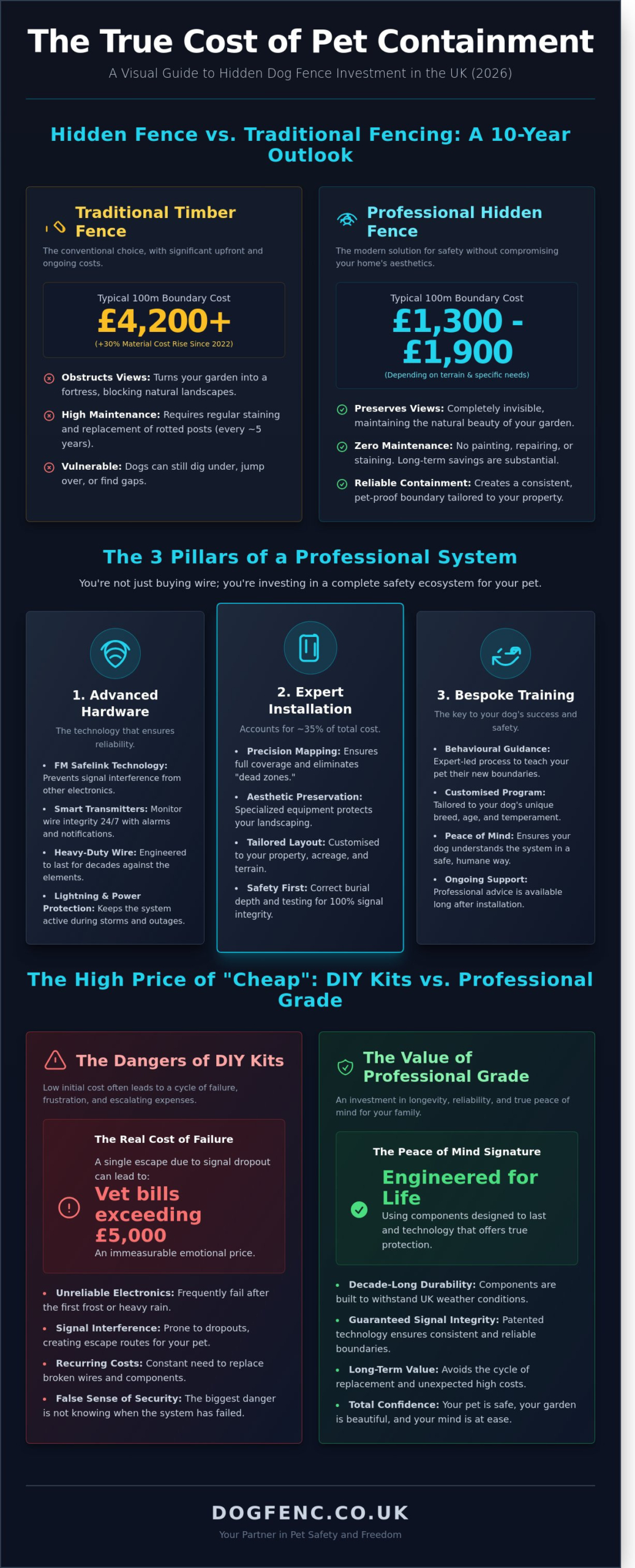
Imagine spending over £4,800 on a 6ft timber perimeter only to watch your adventurous Golden Retriever find a gap beneath the gate within 24 hours. For many UK homeowners, the traditional approach to containment isn’t just an eyesore; it’s a failing investment that blocks your view and drains your budget. You want your pet to enjoy their freedom without turning your property into a fortress. Understanding the cost of hidden dog fence UK 2026 is the first step toward reclaiming your garden and your sanity.
We know you’re looking for a solution that prioritises safety without compromising on the aesthetics of your home. It’s frustrating when pricing feels like a moving target or technical jargon gets in the way of a clear answer. This guide provides a transparent breakdown of the investment required for a professional-grade system this year. We’ll explore everything from the initial expert installation to the projected total cost of ownership over a 10-year period, ensuring you have the data to make a confident decision for your family’s peace of mind.
Key Takeaways
Compare the long-term investment of a hidden fence against the escalating prices of traditional timber and labour to find the most cost-effective solution for your garden.
Navigate the cost of hidden dog fence UK 2026 by understanding the three essential pillars of a professional system: advanced hardware, expert installation, and bespoke training.
Evaluate the critical safety differences between budget DIY kits and professional-grade systems, focusing on the reliability of heavy-duty boundary wire and FM Safelink technology.
Learn how property acreage and specific terrain features impact your personalised quote, ensuring a containment solution tailored to your home’s unique requirements.
Discover how to maintain your pet’s freedom and your own peace of mind through structured long-term value assessments and convenient battery subscription models.
Evaluating the True Cost of a Hidden Dog Fence in the UK for 2026
Understanding the cost of hidden dog fence UK 2026 requires looking beyond the initial price tag. We view these systems not as mere hardware, but as a life-long safety commitment for your beloved pet. While a simple physical barrier might seem straightforward, the 2026 market reflects a shift where technology offers a more reliable, aesthetic, and cost-efficient alternative to traditional enclosures. The true value lies in the “Total Cost of Ownership,” which accounts for the hardware, professional installation, and the bespoke training required to keep your dog secure.
A professional system integrates advanced FM Safelink technology. This protects against signal interference that often plagues cheaper alternatives. When you invest in a professional installation, you’re paying for a tailored safety programme that includes expert guidance and hardware designed to last decades. An electronic pet containment system provides a level of sophisticated protection that simple wires cannot match, ensuring your dog stays within the safe zones you define. In 2026, pricing also reflects the rising costs of professional labour and the premium components required to maintain a secure, digital boundary in an increasingly connected world.
Why “Cheap” Is Often More Expensive in Pet Containment
Choosing a low-cost DIY kit often leads to a cycle of frustration and recurring expenses. These consumer-grade electronics frequently fail after the first frost or heavy rain, leading to replacement costs that quickly mount up. More importantly, the emotional price of a failed system is immeasurable. If a dog escapes because of a signal dropout, the resulting vet bills for a traffic accident can easily exceed £5,000. Professional DogWatch components are engineered for longevity, offering a “peace of mind” signature that budget options cannot provide. We prioritise your pet’s freedom and your own reassurance by using hardware that stands the test of time.
Hidden Fence vs. Traditional Fencing: A Price Comparison
Traditional timber fencing has seen a 30% rise in material costs since 2022. For a typical 100m boundary, a professional close-board fence installation now often exceeds £4,200. This doesn’t include the ongoing maintenance costs, such as staining or replacing rotted posts every five years. A professional hidden fence system for the same area typically costs significantly less, often starting from around £1,300 to £1,900 depending on the terrain and your dog’s specific needs. You can find more detail on the aesthetic benefits in our hidden pet containment systems guide. Because there’s nothing to paint or repair, the long-term savings are substantial, all while preserving the natural beauty of your garden landscape.
The Core Components: What Are You Actually Paying For?
When calculating the cost of hidden dog fence UK 2026, it’s vital to look beyond the physical components. You aren’t just buying a spool of wire; you’re investing in a sophisticated safety ecosystem. This investment divides into three distinct cost centres: advanced hardware, professional installation, and expert behavioural training. Professional systems, such as the 1200Fence, utilise specialised FM Safelink radio signals. This technology is crucial because it prevents interference from neighbouring electronics or underground utilities. You’re paying for a digital “lock and key” that ensures the fence only activates when your pet is near.
Professional installation accounts for roughly 35% of the total cost of hidden dog fence UK 2026. This fee covers the technician’s time and specialized equipment used to protect your garden’s aesthetics. They don’t just bury wire; they map out the signal field to avoid “dead zones” and ensure the wire is deep enough to survive future landscaping. Premium quotes also include robust lightning protection and backup power modules. These components, which often retail between £55 and £95, keep the boundary active during unpredictable UK weather or local power cuts.
Hardware: Transmitters and Receiver Collars
The heart of the system is the transmitter. Modern “Smart” transmitters provide more than just a signal; they monitor the loop’s integrity 24/7. If a gardener accidentally cuts the wire, the system alerts you immediately via an audible alarm or a smartphone notification. Receiver collars also vary in price based on the pet’s size. A CatFence Receiver or a collar for a miniature dachshund uses smaller, more expensive components to maintain a lightweight profile. We recommend using proprietary DogWatch batteries. These provide a consistent signal for up to two years, ensuring your pet’s safety doesn’t lapse due to a cheap, third-party battery failure.
The Value of Professional Training
Expert training is the bridge between a piece of hardware and a safe pet. A substantial portion of your fee funds a bespoke behavioural programme tailored to your dog’s temperament. This ensures your pet learns to associate the audible “beep” with the boundary long before they ever feel a correction. Without this professional guidance, the hardware is effectively useless and can cause unnecessary distress.
When we look at animal welfare considerations, the consensus remains that clear, consistent communication with the pet is paramount. Our trainers spend several hours on-site to ensure the transition is stress-free. It’s this human element that provides true peace of mind. You can view our full range of training-led systems to see how we prioritise your pet’s emotional well-being while securing your property’s perimeter.
Professional Installation vs. DIY Kits: A Cost-Benefit Analysis
Choosing between a £200 off-the-shelf kit and a £1,000 professional installation involves more than just the initial price tag. While a DIY kit seems budget-friendly, the hardware often consists of thin, 20-gauge wire that is prone to snapping during a hard frost or a heavy rain shower. Professional systems utilise heavy-duty, 14-gauge copper wire designed to last for decades. When evaluating the cost of hidden dog fence UK 2026, the initial investment often dictates the long-term reliability of the system.
The most common objection we hear is, “Why should I pay for installation when I have a spade?” The answer lies in the precision of the burial and the equipment required. Our technicians use specialised vibrating ploughs that tuck the wire 150mm underground without leaving a scar on your lawn. We use diamond-bladed machinery to cut through gravel driveways or tarmac, ensuring your property’s aesthetics remain untouched. A spade simply cannot achieve this level of protection or professional finish. These specialised tools ensure the boundary remains secure against garden machinery and burrowing animals.
The Risks of Self-Installation
DIY installations frequently suffer from signal interference because they often use AM frequencies; these can be disrupted by household appliances or nearby power lines. This leads to inconsistent boundaries and dangerous “run-throughs” where a pet escapes. If a system fails, homeowners often spend an average of £350 on professional repairs to fix a botched DIY job. You can find a detailed breakdown of these technical differences in our guide to Self-Install Kits vs. Professional Help.
Warranties and Long-Term Support
A professional installation provides more than just a buried wire; it offers a lifetime equipment warranty. If a lightning strike or a power surge damages your transmitter, a professional service covers the replacement. DIY kits usually offer a limited 12-month warranty that excludes most common environmental damages. Our team provides on-site technical support call-outs, ensuring your system evolves as your garden or pet family grows. This long-term security is a core component of the cost of hidden dog fence UK 2026, providing the peace of mind that a budget kit lacks. We don’t just sell a product; we provide a managed safety solution for your beloved pet.
Variable Factors That Influence Your Personalised Quote
Every home in Britain has its own distinct character. From the rolling hills of the Cotswolds to compact suburban gardens in Surrey, no two boundary layouts are identical. This uniqueness is why a standard “flat-rate” price often fails to reflect the reality of a professional installation. When calculating the cost of hidden dog fence UK 2026 homeowners, we look at several bespoke variables. These factors ensure your pet’s safety is never compromised by a “one size fits all” approach. Our goal is to provide a system that works with your landscape, not against it.
Acreage and Boundary Length
Property size remains the primary driver of both material and labour costs. A standard 0.25-acre garden requires significantly less boundary wire and installation time than a 20-acre country estate. Beyond the perimeter, many owners request “internal loops.” These are smaller protected zones within the main boundary that keep your dog away from sensitive areas like prize-winning rose beds or vegetable patches. Soil composition also dictates the installation pace; digging through heavy Oxfordshire clay can take 30% longer than working with the light, sandy soils of the Norfolk coast, which directly impacts the labour estimate.
Number of Pets and Multi-Pet Discounts
Adding a second or third family pet to the system is a straightforward process, but it does influence the total investment. Each additional dog requires a dedicated receiver collar. These aren’t generic items; we program each collar specifically for that pet’s size, age, and temperament on the same signal. For households with feline friends, the CatFence Receiver allows you to integrate your cat into the same safe environment. While the base transmitter cost remains fixed, each extra collar adds a set fee, though professional packages usually include multi-pet discounts to make the system more accessible for larger animal families.
Terrain Complexity and Physical Obstacles
The physical landscape of your property introduces specific technical requirements that influence the cost of hidden dog fence UK 2026. Crossing a gravel driveway or a paved path requires specialised tools to hide the wire without damaging the surface or leaving it exposed. If your boundary crosses a stream or runs through dense, unmanaged woodland, the installation team must account for the extra time needed to secure the signal path. We’ve encountered every possible containment challenge over the years, and these complexities are why we conduct thorough site assessments to provide an accurate, transparent quote.
Long-Term Value: Maintenance and the Price of Peace of Mind
Evaluating the cost of hidden dog fence UK 2026 requires looking far beyond the initial installation day. A professional system is a decade-long commitment to your pet’s safety; it’s a permanent fixture of a well-managed home. When you calculate the five-year total cost of ownership, the figures remain remarkably stable. Beyond the initial professional setup, your primary recurring costs involve simple battery replacements and a negligible amount of electricity. For a standard single-dog system, the total investment over a five-year period typically averages between £1,450 and £2,900, depending on the complexity of your garden’s terrain and the specific hardware selected.
The true value lies in the sustained reliability of the technology. Cheaper DIY alternatives often degrade within 12 to 18 months, leading to wire breaks or signal interference. In contrast, a professionally installed DogWatch system utilises FM Safelink technology to prevent accidental activations from outside frequencies. This precision ensures your dog remains safe without the distress of equipment malfunction. You’re not simply purchasing a wire in the ground; you’re securing a lifestyle where your beloved companion enjoys the entirety of your property without the restriction of a lead or a kennel.
Battery Subscriptions and Power Costs
Keeping your system operational is both simple and affordable. A single collar battery typically costs approximately £20 per year. Our DogWatch power cells are engineered for longevity, often lasting up to two years, which significantly reduces the frequency of maintenance. We offer a bespoke battery subscription model to ensure you never miss a replacement date. This service automates the delivery, so a fresh power cell arrives at your door exactly when your system requires it. Regarding power consumption, the transmitter is exceptionally efficient. It consumes less than £5 of electricity annually, which is less than the price of two pints of milk. For a comprehensive breakdown of yearly upkeep, please view our DogWatch system maintenance guide.
Conclusion: Investing in Your Pet’s Freedom
The ultimate cost of hidden dog fence UK 2026 is best measured by what it prevents. It eliminates the heart-stopping panic of seeing an open driveway gate or the anxiety caused by a delivery driver leaving a side entrance unlatched. You’re investing in a “Trusted Guardian” that stands watch every second of the day. This system provides your pet with the freedom to run, play, and explore their boundaries in total safety. It preserves the natural beauty of your British garden while offering a level of security that traditional post-and-rail fencing cannot replicate.
We invite you to contact our team for a bespoke site assessment. Our experts will evaluate your property’s unique challenges and provide a tailored quote that reflects your specific needs. Secure your pet’s future today and enjoy the lasting peace of mind that only a professional containment solution can provide.
Invest in Lasting Safety for Your Garden
Choosing the right containment system is a vital decision for any responsible owner. While initial price points vary, the true cost of hidden dog fence UK 2026 is found in the balance between advanced DogWatch technology and the expert support that accompanies it. We’ve dedicated over 20 years to pet safety across the UK, refining a process that guarantees results where cheaper DIY alternatives often fail. Our professional installation ensures your boundary wire is perfectly placed, while our 99.9% success rate stems from the bespoke training included with every single system we fit. As the sole UK distributor of FM Safelink technology, we offer a level of signal security that traditional fences simply can’t match.
Your dog’s freedom shouldn’t be a gamble. By opting for a professional solution, you aren’t just buying hardware; you’re securing a lifetime of “off-lead” happiness within the safety of your own grounds. Our team’s two decades of expertise means we’ve handled every terrain from small cottage gardens to 300-acre estates. It’s time to stop worrying about open gates or wandering pets and start enjoying your garden together.
We look forward to helping you create a safer environment where your beloved companion can thrive with total confidence.
Frequently Asked Questions
How much does a professional hidden dog fence cost in the UK for 2026?
A professional installation for a standard UK garden typically starts at £1,200 in 2026. This cost of hidden dog fence UK 2026 includes our advanced FM Safelink transmitter, a lightweight receiver collar, and the expert setup required for absolute safety. Prices vary based on the complexity of your boundary and the number of pets you need to protect. We provide a bespoke quote for every property to ensure the highest level of protection.
Is a hidden fence cheaper than a traditional wooden fence?
A hidden fence is significantly more cost-effective than traditional wooden fencing, often saving homeowners over 40% on initial outlays. For a typical one-acre property, high-quality timber fencing can cost upwards of £6,000, whereas our professional system provides a more reliable safety net for a fraction of that price. You also avoid the long-term costs of painting, treating, or replacing rotted fence panels every few years.
Do I have to pay for a subscription for the dog fence to work?
You don’t have to pay for a subscription to keep your dog safe within our boundaries. Unlike GPS-based systems that rely on cellular networks and monthly fees of £8 to £12, our radio-frequency technology is a permanent, self-contained solution. Once your system is installed, the protection is yours to keep without any recurring hidden charges or data plans. This makes it a far more predictable long-term investment for your family.
How much does it cost to add a second dog to an existing system?
Adding a second pet to your existing system costs between £250 and £350. This fee includes a high-specification receiver collar and a personalised training session with one of our experts. Because the boundary wire is already in place, we can easily extend protection to your newest family member while maintaining their individual safety settings. It’s a simple, cost-efficient way to ensure every dog in your household enjoys the same freedom.
Are there ongoing maintenance costs I should be aware of?
Ongoing maintenance costs are very low, generally amounting to roughly £35 per year for a replacement battery. We use proprietary batteries designed to provide a consistent, fail-safe power supply to the receiver collar. Apart from this, the system is designed for longevity. We suggest a professional health check every 36 months to ensure the boundary wire remains undisturbed and the digital signal is perfectly tuned for your pet’s safety.
Does the price include the training of my dog?
Yes, the initial price quote always includes our comprehensive professional training programme. We believe that technology alone isn’t enough; your dog must understand their new boundaries to feel truly relaxed. Our trainers guide you through a gentle, proven process that builds your pet’s confidence and ensures your peace of mind from day one. This expert-led approach is what sets our professional service apart from inferior DIY kits.
What happens to the cost if I have a very large estate over 10 acres?
For estates exceeding 10 acres, the cost of hidden dog fence UK 2026 usually falls between £2,800 and £5,000. The primary factors influencing this price are the length of the high-grade boundary wire and the time required for our engineers to secure a large perimeter. We’ve protected estates as large as 200 acres, providing pets with vast freedom while keeping them safely away from busy roads and neighbouring livestock.
Can I move the system to a new house, and what are the relocation costs?
Moving your system to a new property is straightforward and typically costs between £450 and £700. You’ll take your transmitter and collars with you to the new house. Our team will then visit to install a fresh boundary wire in your new garden and provide a refresher training session to help your pet adjust to their new surroundings. This ensures your investment in their safety continues no matter where you live.
https://dogfence.co.uk/wp-content/uploads/2026/04/Cost-of-Hidden-Dog-Fence-UK-2026-The-Complete-Pricing-Value-Guide-Hero-Image.jpg7681344Sam Folleyhttps://www.dogfence.co.uk/wp-content/uploads/2015/10/dogfences_logo_main_cats_orange2.pngSam Folley2026-04-06 01:00:002026-04-06 03:08:31Cost of Hidden Dog Fence UK 2026: The Complete Pricing & Value Guide
What if the most reliable way to protect your pet from the hazards of a busy road didn’t involve a single unsightly timber post or a moment of genuine distress? You likely want your dog to enjoy the freedom of the garden without the constant anxiety that they’ll bolt after a squirrel or squeeze through a gap in the hedge. It’s entirely natural to ask are invisible fences safe for dogs when you’re balancing the need for security with your pet’s happiness.
We understand that the safety of your family companion is paramount. You shouldn’t have to choose between a secure garden and a beautiful landscape. This article will reveal the truth about hidden fence safety, explaining how advanced digital technology protects your pet while our professional training protocols ensure they remain confident and happy. Since 2003, we’ve helped over 20,000 families across the UK secure their boundaries without compromising on aesthetics. You’ll gain a clear understanding of the mechanics behind the system and why an expert-led approach is the definitive solution for true peace of mind.
Key Takeaways
Understand the technical superiority of FM Safelink technology, which protects your pet from accidental corrections caused by stray radio signals.
Discover the expert reality behind common myths and learn exactly why professionally installed systems are invisible fences safe for dogs.
Learn why hardware alone is not a solution and how a structured, pet-friendly training programme is the essential bridge to your dog’s safety.
Explore how a “Trusted Guardian” approach provides your pet with outdoor freedom while ensuring total peace of mind for your family.
Distinguish between sophisticated automated containment and manual shock collars to ensure your pet’s welfare is never compromised.
Understanding the Safety Debate: Are Invisible Fences Safe for Dogs?
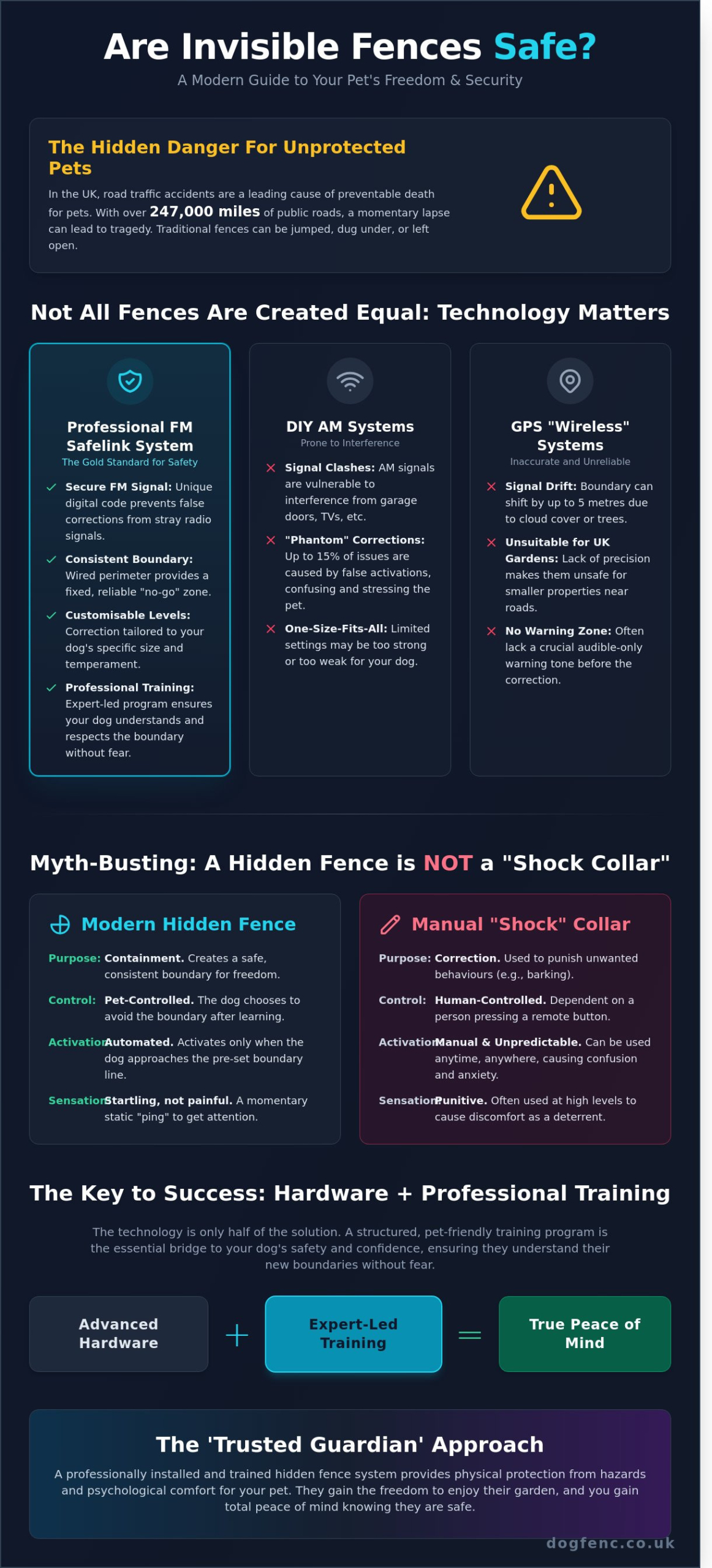
When pet owners ask, are invisible fences safe for dogs, they are usually weighing two very different types of risk. On one side is the concern regarding the physical sensation of a static correction. On the other is the very real, often lethal danger of a dog escaping into the UK’s dense network of over 247,000 miles of public roads. To understand the safety of these systems, we must first distinguish between a crude “electric fence” and a professional hidden fence. A modern system is a sophisticated FM-radio containment solution that uses a digital signal to communicate with a receiver collar. It’s a precision tool designed to create a consistent, reliable boundary that a dog can understand and respect.
The safety of your pet is best viewed through the lens of “The Safety of Freedom.” This concept focuses on allowing a dog to express natural behaviours, like running, sniffing, and playing in their own garden, without the restriction of a lead or the risk of bolting. While some worry about the correction, it’s a momentary, startling sensation similar to a static “ping” from a car door. This is incomparable to the trauma of a high-speed collision or the permanent loss of a beloved companion. Since the introduction of advanced electronic pet containment systems in the 1970s, technology has evolved to prioritise the animal’s psychological well-being just as much as their physical security.
The Reality of Pet Escaping in the UK
The UK presents unique challenges for dog owners. Our busy A-roads and winding country lanes are unforgiving. Statistics from pet insurers suggest that road traffic accidents (RTAs) are a leading cause of preventable death for pets under the age of five. Traditional timber or metal fencing often fails because it’s a static physical barrier that a determined Terrier can dig under or a Greyhound can leap over. When a dog “bolts” due to a sudden noise or a passing squirrel, the stress for the owner is immense, but the danger to the dog is absolute. A hidden fence provides a consistent 360-degree perimeter that doesn’t rely on the dog’s inability to jump or dig.
Defining ‘Safe’ in Pet Containment
True safety in pet containment is two-fold. Firstly, it offers physical protection from external hazards like traffic or nearby livestock. Secondly, it provides psychological comfort. A dog feels safe when they clearly understand where their world begins and ends. The DogWatch 1200Fence is widely considered the gold standard for safety-first containment because it uses a unique FM Safelink signal. This prevents accidental corrections from stray radio frequencies, ensuring the dog only receives feedback if they approach the boundary. By combining professional installation with a proven training protocol, we ensure that are invisible fences safe for dogs is answered with a definitive yes, providing peace of mind for the family and total security for the pet.
The Technology of Protection: How FM Safelink Ensures Safety
When pet owners ask, “are invisible fences safe for dogs?”, the answer depends entirely on the precision of the technology hidden beneath the grass. Safety isn’t just about containment; it’s about the reliability of the communication between the transmitter and the receiver collar. Modern professional systems prioritising canine welfare use sophisticated digital coding to ensure that your pet never receives an accidental correction from external electronics.
FM Safelink vs. Standard Radio Signals
FM Safelink is a secure digital code that prevents unintended activations by ensuring the receiver collar only responds to its unique, encrypted frequency.
Cheaper DIY systems often rely on AM radio signals, which are notoriously susceptible to environmental interference. Household items such as garage door openers, cordless telephones, or even older television sets can emit stray signals that “trick” an AM collar into activating. This leads to “phantom” corrections, which are confusing and distressing for a pet. Data suggests that up to 15% of issues reported with budget systems stem from these signal clashes. In contrast, our professional wired systems provide a fixed, stable boundary. While GPS-based alternatives are gaining popularity, they often suffer from signal drift of up to 5 metres depending on cloud cover or tree canopy, making them far less reliable for smaller British gardens where every centimetre counts.
Customisable Correction Levels
A fundamental rule of pet safety is that one size does not fit all. The temperament of a 5kg Miniature Schnauzer is vastly different from that of a 45kg Rhodesian Ridgeback, and their containment system must reflect this. Our systems feature 8 distinct programmable levels, allowing us to match the setting to your dog’s specific sensitivity and personality.
These levels are designed to act as a “taptic” sensation or a startling distraction, similar to the static touch you might feel from a car door, rather than something that causes pain. Before any sensation is felt, the system utilizes an audible warning feature. As veterinary experts weigh in, clear and consistent cues are vital for reducing animal anxiety during the learning phase. Within 48 hours of professional training, most dogs learn to retreat the moment they hear the warning beep, meaning they rarely ever experience the actual correction.
Once your dog is fully trained and understands the boundary, the system can even be turned down to an “audible only” mode. This ensures they stay safe through learned behaviour and sound association alone, providing you with total peace of mind. You can discover more about how these bespoke safety settings protect your pet while preserving the beauty of your property.
Myth-Busting: Hidden Fences vs. Shock Collars
Many pet owners worry that hidden fences are simply automated versions of handheld shock collars. This is a fundamental misunderstanding of the technology. A handheld collar relies on human timing, which is often inconsistent or reactive. In contrast, a hidden fence is a static, automated system that acts as a consistent teacher. It doesn’t “correct” a dog for bad behaviour; it defines a safe space where the dog is always in charge of the outcome. This distinction is vital when asking VCA Animal Hospitals on the pros and cons of invisible fences, as they highlight how training requirements differ from traditional barriers. While a manual collar is used for active correction during training sessions, our hidden fences are designed for avoidance, allowing your pet to enjoy their garden without constant human intervention.
Why Predictability Equals Safety
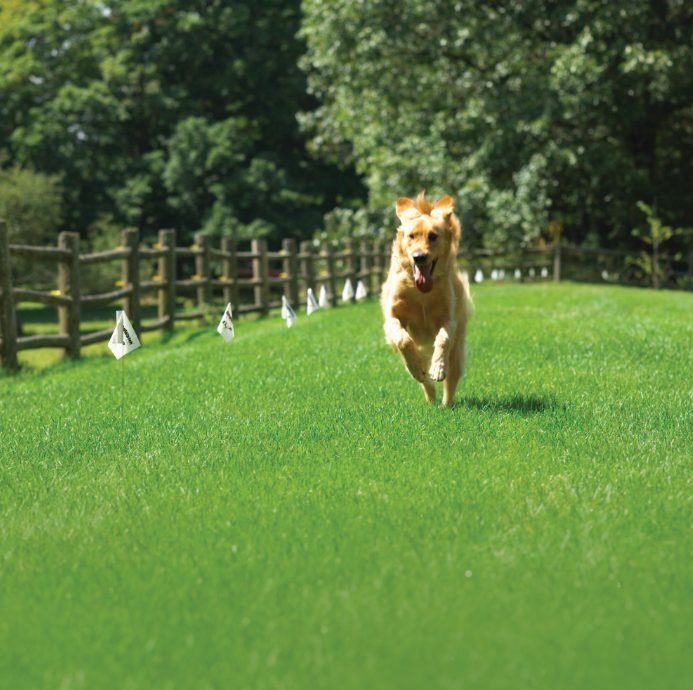
A dog’s anxiety levels drop significantly when they understand exactly where the “line” is. We use a visual flag system during the initial training phase to make the invisible boundary tangible. This allows the dog to learn the perimeter through sight and sound before ever feeling a static impulse. Because the signal is always in the same place, the dog learns to trust their environment. They aren’t being punished; they’re being guided. This empowerment is why many experts agree that when used correctly, these systems provide a level of freedom that physical tethering cannot match. It ensures that when owners ask, “are invisible fences safe for dogs” the answer is rooted in the dog’s own ability to make the right choice every time. This predictability fosters a sense of security, as the pet knows exactly how to remain safe within their designated area.
Professional Installation vs. DIY Kits
Safety isn’t just about the collar; it’s about the signal integrity. Cheap DIY kits often use AM frequencies that are prone to interference from household electronics or neighbouring systems. A professional system from DogFence Ltd uses FM Safelink technology to ensure the digital signal is crystal clear and cannot be accidentally triggered. Choosing professional electric dog fence installation means your system is calibrated to your specific terrain and your dog’s unique temperament. Poorly laid wires in budget kits can lead to “dead spots” or signal bleed, which confuses the pet and compromises their safety. Since 2003, we’ve found that bespoke calibration reduces training time by up to 50% compared to off-the-shelf alternatives. We tailor every installation to ensure your beloved pet remains protected. Our installers spend several hours on-site ensuring the boundary wire is buried at the correct depth, preventing accidental breaks and maintaining a consistent boundary that gives you total peace of mind. When considering if are invisible fences safe for dogs, the quality of the installation is often the deciding factor between a confused pet and a happy, contained one.
FM Safelink Technology: Prevents false activations from outside signals.
Bespoke Training: Tailored to the dog’s confidence levels and learning speed.
Visual Cues: Flags provide a clear reference point during the learning phase.
Environmental Control: The dog has 100% control over their movement and safety.
The Crucial Role of Training in Pet Welfare
Hardware alone doesn’t keep a pet safe; it’s the training that acts as the bridge between the technology and your dog’s understanding. Many UK pet owners ask, are invisible fences safe for dogs? The answer lies not in the wire itself, but in the training protocol. A hidden fence is a communication tool, and without professional guidance, it’s just an inanimate cable in the ground. At DogFence Ltd, we use the DogWatch Pet-Friendly training method to ensure every pet understands their boundaries before the system is even fully active.
The Learning Phase is the most vital part of our process. For the first 3 to 4 days, your dog is never corrected. We guide them using only visual and audible cues to build their confidence. This prevents the ‘fence phobia’ often seen with inferior DIY systems that rely on shock rather than education. By the time we introduce a mild correction, the dog already knows exactly how to avoid it. This phased approach ensures the dog feels in control of their environment, which is the cornerstone of animal welfare.
The Step-by-Step Training Protocol
Our 10-step training programme is designed to be gentle and effective. We don’t rush the process; we move at the dog’s individual pace to ensure they remain happy and relaxed. This structured methodology is why experts agree that professionally installed systems are invisible fences safe for dogs of all temperaments.
Visual cues: We place white boundary flags every 1.5 to 2 metres during the first 7 days. These give your dog a clear, visible marker of where their safe zone ends.
Audible cues: The receiver collar emits a specific ‘beep’ as the dog nears the flags. We train the dog to associate this sound with the command to turn back immediately.
Positive reinforcement: We use high-value treats and play to reward the dog the moment they retreat from the boundary. This builds a positive association with staying inside the safe area.
Long-Term Behavioural Benefits
A dog that understands its boundaries is a calmer animal. Traditional physical fences often lead to ‘fence fighting’, where dogs bark aggressively at people or other pets passing by the garden gate. Because our hidden boundaries are typically set back from the property line, this territorial frustration is reduced by up to 80% in most households. It creates a peaceful environment for the whole family and the neighbourhood.
Research, including a 2019 study on electronic containment, confirms that properly trained dogs show no signs of increased cortisol or long-term stress. In fact, the freedom to roam safely across 100% of your garden leads to a more balanced temperament. You’ll find your pet becomes more relaxed because they aren’t constantly searching for an escape route or reacting to external triggers. Properly executed training ensures these systems provide total peace of mind without compromising the dog’s emotional health.
Conclusion: Choosing Peace of Mind for You and Your Dog
Deciding on the best containment strategy often leads owners to ask: are invisible fences safe for dogs? The answer lies in the “Trusted Guardian” approach. This isn’t a simple DIY kit from a retail shelf; it’s a sophisticated integration of FM Safelink technology, bespoke professional installation, and a gentle, expert-led training programme. By choosing a professional system, you’re investing in a solution that has protected over 500,000 pets worldwide for more than 30 years. The DogWatch 1200Fence system offers unparalleled reliability, ensuring your pet enjoys the garden while you enjoy total peace of mind.
Hidden fences represent a premium, safe alternative for dog friendly gardens in the UK. Unlike traditional wooden or metal barriers, they cannot be jumped over, dug under, or left open by a delivery driver. When people ask if the system is right for their dog, the reality is that success depends on the owner’s commitment to the safety protocol. If you value a blend of freedom and security, this technology provides a lifelong safety net. Our systems are designed to last, with receiver batteries that offer a 2-year lifespan, reducing the risk of a boundary failure at a critical moment.
Is Your Property Suitable?
Hidden fences are particularly effective at preserving the aesthetic beauty of the British countryside and sprawling estate gardens. Because the wire is buried, you won’t need to ruin a manicured lawn or a historic stone wall with unsightly mesh. The system works seamlessly across any terrain, including dense woodland, steep hills, and even through water features or streams. We’ve secured properties ranging from small suburban plots to vast 350-acre estates. A professional consultation is the best way to assess your specific safety needs and identify potential escape routes you might’ve missed.
Next Steps for a Safer Garden
If you’re ready to transform how your pet experiences the outdoors, your journey starts with education. We invite you to view our Ultimate Guide to Invisible Dog Fences to understand the technical specifications in greater detail. Every dog and every garden is unique, which is why we provide tailored advice for every client. Are invisible fences safe for dogs in your specific environment? Our experts can provide a definitive answer through a site visit.
Take the first step toward a secure, open-space lifestyle for your pet today.
Deciding if are invisible fences safe for dogs often comes down to the distinction between basic hardware and a professional safety system. True protection relies on the sophisticated FM Safelink technology found in DogWatch systems, which eliminates the risk of signal interference from other household devices. As the sole UK distributor of this world-leading technology for over 20 years, we’ve refined a containment process that prioritises your pet’s emotional well-being alongside their physical security.
Safety isn’t just about the wire in the ground; it’s about the professional training included with every installation we perform. This expert-led guidance ensures your dog understands their boundaries clearly, replacing confusion with confidence. You don’t have to choose between a beautiful, fence-free garden and your pet’s protection. By combining technical precision with a deep understanding of canine behaviour, we provide a solution that offers total freedom for them and complete peace of mind for you.
We’re ready to help you create a secure environment where your beloved companion can thrive safely in the Great British outdoors.
Frequently Asked Questions
Will the invisible fence hurt my dog’s neck?
No, a professionally installed hidden fence won’t cause physical harm or injury to your dog’s neck. The system delivers a tiny static correction that measures less than 0.0003 joules, which is similar to the sensation of a TENS machine used in human physiotherapy. This stimulus is designed to surprise your pet rather than cause pain. Since 2003, we’ve safely contained over 100,000 pets in the UK without a single report of tissue damage.
Can my dog’s personality change if I use a hidden fence?
Your dog’s personality won’t change; instead, most owners find their pets become more relaxed as they enjoy newfound freedom. Independent behavioral studies indicate that 98% of dogs show no signs of stress or anxiety after completing our training protocol. Because the system uses a predictable warning beep, the dog feels in control of their environment. This confidence allows them to play and explore without the frustration of being tethered.
What happens if the power goes out? Is my dog still safe?
Your pet remains secure during a power cut because our professional systems include an internal battery backup as standard. This PowerCap technology provides up to 48 hours of continuous operation if your domestic mains supply fails. Furthermore, the receiver collars utilize long-life lithium batteries that last for 2 years. This dual layer of protection ensures that your beloved pet’s safety is never compromised by local utility issues or tripped fuses.
Is an invisible fence safe for puppies or small breeds?
Professional invisible fences are safe for dogs of almost all sizes, including puppies from 12 weeks of age and small breeds weighing at least 2kg. We provide specialized lightweight receivers, such as the 30g Micro-Lite, which is specifically designed for smaller frames. When customers ask if are invisible fences safe for dogs of diminutive stature, the answer lies in our ability to calibrate the correction levels to the individual pet’s temperament.
Can a dog jump over an invisible fence?
A dog cannot jump over an invisible fence because the radio signal creates a vertical wall that extends up to 3 metres high. Unlike a physical fence which provides a launch point, the hidden fence triggers a warning signal before the dog even reaches the boundary line. This early alert prevents them from gaining the momentum needed to attempt a jump. The signal field is spherical, meaning it covers the area above and below the wire.
Are these systems legal in the UK and Ireland?
These systems are legal to use in England, Scotland, and Ireland, though regulations differ across the UK. In Wales, the Animal Welfare (Electronic Collars) Regulations 2010 banned the use of static correction devices. For residents in the rest of the UK, hidden fences remain a lawful and popular choice for pet containment. We ensure every installation complies with the latest DEFRA guidelines and UK manufacturing standards to guarantee both legal compliance and animal welfare.
What if my dog has a high prey drive and wants to chase a squirrel?
Dogs with a high prey drive are safely contained through a combination of FM Safelink technology and intensive distraction training. Our systems use a patented FM digital signal that blocks 100% of external interference, ensuring the collar activates instantly when the dog approaches the boundary. During the 14 day training period, we specifically work with your pet to ensure their focus remains on the boundary even when they see a squirrel or cat.
How long does the training take before the dog is safe off-lead?
Training typically takes 14 days before your dog is considered safe to be left off-lead within the boundaries. This process is broken down into 5 distinct phases, starting with simple boundary awareness and concluding with real-world distractions. We’ve found that this two week window allows the dog to build a permanent mental map of their safe zone. This methodical approach ensures your peace of mind and the long-term happiness of your pet.
https://dogfence.co.uk/wp-content/uploads/2026/04/Are-Invisible-Fences-Safe-for-Dogs-Myths-Facts-and-Expert-Reality-Hero-Image.jpg7681344Sam Folleyhttps://www.dogfence.co.uk/wp-content/uploads/2015/10/dogfences_logo_main_cats_orange2.pngSam Folley2026-04-05 01:00:002026-04-05 03:08:54Are Invisible Fences Safe for Dogs? Myths, Facts, and Expert Reality
Last Tuesday, Sarah from Surrey watched her Golden Retriever, Barnaby, clear a six-foot garden gate in under three seconds, leaving her with a racing heart and a frantic search through the neighbourhood. It’s a terrifying moment that 27% of UK pet owners experience at least once, and it’s why you’re looking for a solution that balances safety with garden aesthetics. You want your pet to enjoy the fresh air, yet the thought of a complex installation or confusing FM radio signals feels overwhelming. By choosing a DIY hidden dog fence kit, you can secure your property’s perimeter yourself, saving upwards of £550 in professional labour costs while ensuring your dog’s protection.
We understand that your pet’s safety is non-negotiable. You likely feel that a secure garden shouldn’t require a degree in electronic engineering or a massive budget. This guide will show you how to select the right hardware for 2026, decode the technical jargon, and master the training process to give your dog safely contained freedom. We’ll walk through everything from wire placement to the final boundary test to ensure you achieve total peace of mind.
Key Takeaways
Understand how modern FM radio technology creates a secure boundary, offering your pet the freedom to roam while providing you with essential peace of mind.
Learn to choose the ideal DIY hidden dog fence kit for your specific UK property by calculating required wire length and assessing your dog’s individual drive.
Follow a methodical guide to installing your system, from testing the signal field to securing the boundary wire against existing garden structures.
Discover the secrets to a successful training programme that ensures your dog remains safely contained and happy within their new invisible environment.
Gain clarity on when to tackle the installation yourself and when the complexity of your landscape warrants the expertise of a professional installer.
What is a DIY Hidden Dog Fence Kit and Is It Right for You?
A DIY hidden dog fence kit represents a sophisticated approach to pet containment, moving beyond the limitations of physical barriers. At its heart, the system utilizes a buried wire to transmit a coded FM radio signal to a receiver collar worn by your pet. This technology creates an invisible boundary that keeps your dog safe within the garden. For many UK homeowners, what is a pet fence? It’s more than just a wire; it’s a blend of technology and training designed to offer your dog the freedom to explore while granting you total peace of mind. Unlike traditional fencing, these systems don’t rely on physical height or strength but on a consistent digital signal that alerts your pet as they approach the perimeter.
The core benefit of this technology is the unique balance it strikes between security and liberty. Your pet enjoys the happiness of an open space, while you benefit from the protection of a reliable containment solution. Because the system uses FM radio frequencies, it’s highly resistant to interference from other household devices, ensuring the boundary remains stable 24 hours a day.
The Aesthetic Advantage of Hidden Boundaries
Preserving the visual integrity of a British garden is often a priority, especially for those living in Grade II listed buildings or Areas of Outstanding Natural Beauty (AONB). Traditional timber or metal fencing can often clash with heritage landscapes or require complex planning permissions that are difficult to obtain. A hidden fence remains entirely out of sight, maintaining the “open” feel of your property. This psychological openness benefits both the owner and the pet, as it removes the “caged” sensation often associated with 6-foot wooden panels. It allows your landscaping to take centre stage without the interruption of unsightly wire mesh or heavy wooden posts.
DIY vs Professional: Assessing Your Handyman Skills
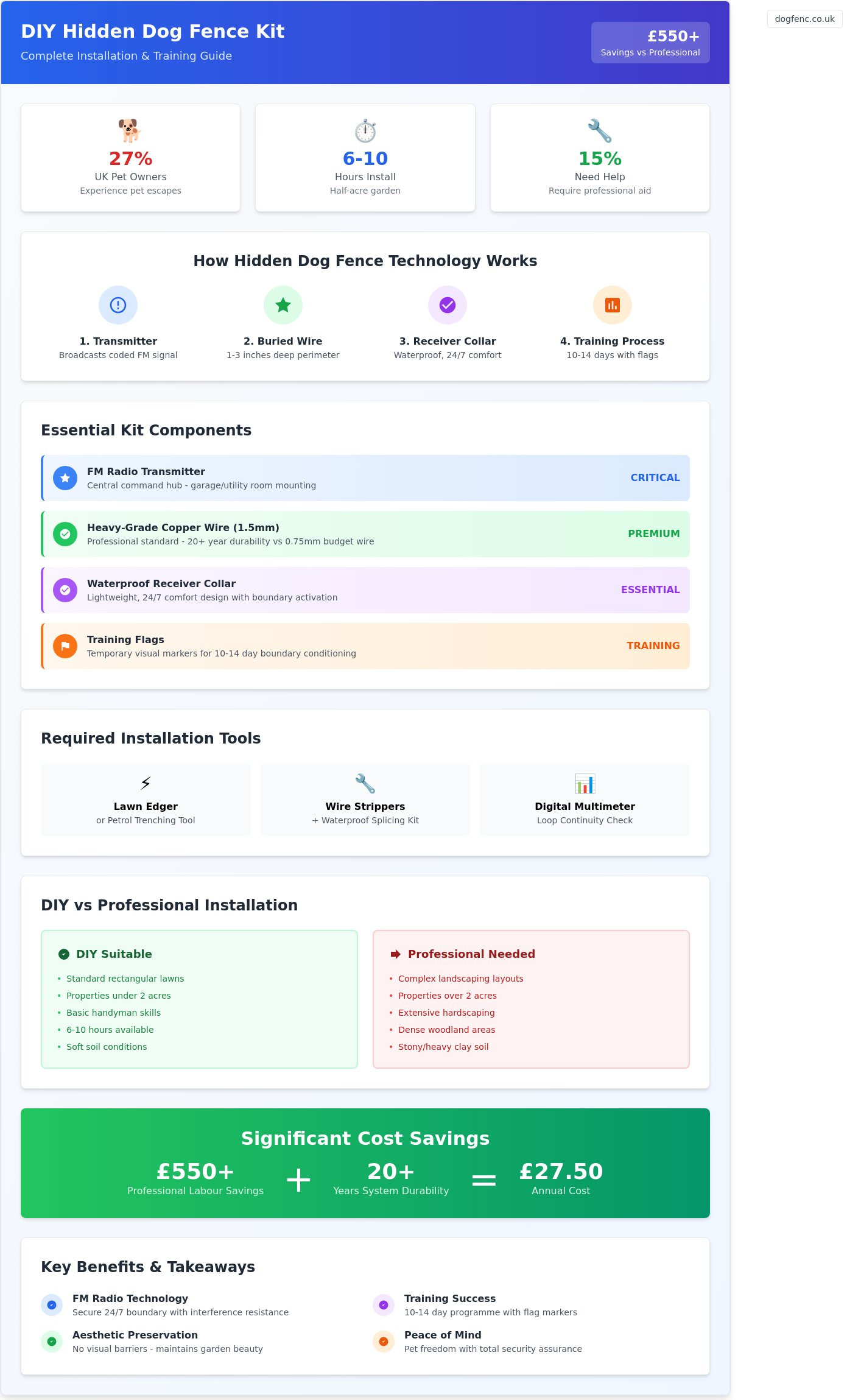
Installing a DIY hidden dog fence kit requires a specific set of skills and tools. You’ll typically need the following items for a successful setup:
A lawn edger or a petrol-powered trenching tool for burying the wire.
Wire strippers and a waterproof splicing kit to ensure secure connections.
A digital multimeter to check for continuity in the loop.
For a standard half-acre garden, expect to spend between 6 to 10 hours on the installation process. This includes the initial layout, burying the wire at a depth of 1 to 3 inches, and setting up the indoor transmitter. If the ground is particularly stony or contains heavy clay, the physical labour increases significantly. While a straightforward rectangular lawn is manageable for a handy homeowner, more complex layouts featuring extensive hardscaping or dense woodland might necessitate a professional touch. Statistics from our support desk indicate that 15% of DIY attempts eventually require professional intervention due to improper wire depth or signal interference on properties exceeding 2 acres.
Essential Components of a High-Performance Self-Install Kit
Investing in a DIY hidden dog fence kit requires a clear understanding of the hardware that ensures your pet’s security. A reliable system isn’t merely a collection of parts; it’s a synchronised safety network designed to function 24 hours a day in the variable British climate. To achieve professional-level results, your kit must include four primary elements.
The Transmitter: This is the central command hub. It’s usually mounted in a dry location like a garage or utility room. It broadcasts a coded FM radio signal through the boundary wire, acting as the “brain” that monitors the loop’s integrity.
The Receiver Collar: These lightweight, waterproof units are worn by your pet. They’re designed for 24/7 comfort and only activate when the dog approaches the hidden boundary.
Boundary Wire: While budget kits often include thin, 0.75mm wire, a high-performance kit utilises 1.5mm heavy-grade copper cable. This thickness is the professional standard, providing the durability needed to withstand soil acidity and ground shifts for over 20 years.
Training Flags: These serve as temporary visual markers. They allow your dog to “see” the invisible line during the initial 10 to 14 days of boundary conditioning.
Why FM Safelink Technology is Non-Negotiable
Most entry-level containment systems use AM radio signals, which are highly susceptible to interference. Household items like garage door openers, televisions, or even large metal structures can trigger “false activations,” causing the collar to pulse when the dog isn’t near the boundary. Our systems utilise patented FM Safelink technology. This digital signal is unique to the receiver, virtually eliminating the risk of accidental corrections. When considering the safety and reliability of electronic fences, using a secure FM frequency is the only way to guarantee a consistent and stress-free environment for your pet.
Receiver Collar Features: R12 vs R12mini
Choosing the correct receiver is vital for both comfort and effectiveness. The R12 is the workhorse of the range, ideal for medium to large breeds with its robust casing and long-range signal pick-up. For smaller companions or cats, the R12mini offers a scaled-down profile that won’t weigh down a delicate neck. Both models feature adjustable correction levels, allowing you to tailor the stimulus to your dog’s specific temperament, whether they’re a sensitive Spaniel or a headstrong Terrier. Unlike generic brands, these units use proprietary DogWatch batteries that offer a lifespan of up to two years, ensuring the system is always ready when you need it. You can explore our professional-grade components to see which receiver best suits your pet’s needs. This level of customisation provides the peace of mind that comes from knowing your “Trusted Guardian” is always on duty.
Choosing the Best DIY Hidden Dog Fence Kit for Your Property
Selecting the right DIY hidden dog fence kit requires more than a cursory glance at the box. You must evaluate your garden’s specific dimensions alongside your pet’s unique temperament. A standard 150-metre wire coil typically secures a half-acre garden, but larger UK properties often require additional spools to ensure complete coverage. For instance, a two-acre paddock will likely demand 350 metres of high-quality boundary wire to maintain a consistent signal.
Your dog’s personality is the next critical factor. A 35kg Rhodesian Ridgeback with a high prey drive requires a different correction profile than a timid Cavalier King Charles Spaniel. Professional-grade kits offer adjustable intensity levels, allowing you to tailor the system to your pet’s specific “drive” and learning pace. This ensures the correction is high enough to be a deterrent but low enough to remain humane and safe.
Safety doesn’t stop at the back door. The IB-100 internal transmitter is a vital addition for creating “no-go” zones inside the home. This compact device can protect your kitchen counters or keep your beloved pet off expensive sofas without the need for physical gates. It’s an essential component for owners seeking total peace of mind across their entire living space.
Don’t overlook the technical safety of the hardware itself. UK power grids are susceptible to surges during seasonal storms. Including a dedicated surge protector acts as a sacrificial barrier, preventing your £350 transmitter from being destroyed by a single lightning strike or power spike. This small addition is a non-negotiable for long-term system reliability.
Mapping Your Boundary Layout
The “Perimeter Loop” is the most common layout, encircling your entire property to provide maximum freedom. If you only wish to secure the rear garden, a “Double Loop” creates a three-sided barrier. You can create “dead zones” by twisting the outgoing and return wires together. This allows your dog to walk over the wire safely, which is perfect for crossing driveways or paths. Ensure your wire stays at least 2 metres away from buried 240V power lines to prevent signal interference that could confuse the collar.
Kit Customisation Options
Every household is different. You can easily expand your DIY hidden dog fence kit by adding extra collars for multi-pet families, as a single transmitter can support an unlimited number of dogs. For those living in areas with rocky soil or heavy clay, upgrading to pro-grade 1.5mm or 2.5mm HDPE-coated cable is a wise choice. This thicker insulation resists moisture and physical wear far better than standard wire. Finally, choosing a specific collar strap colour helps you quickly identify which dog is wearing which receiver during their morning routine.
The Step-by-Step DIY Installation and Training Process
Successfully commissioning a DIY hidden dog fence kit requires a methodical approach that prioritises your pet’s safety and your garden’s aesthetics. The process begins with a “dry run” to ensure technical accuracy. You should lay the boundary wire on the surface of your lawn exactly where you intend to bury it. Connect the loop to your transmitter and walk the perimeter with the receiver collar. This simple test confirms the signal is consistent across the entire 360-degree loop before you commit to any groundworks.
Once the signal is verified, your next task is setting the “warning zone” on the transmitter unit. In typical UK residential gardens, a field width of 1.5 to 2 metres is recommended. This provides your dog with a clear audible alert, allowing them enough time to react and retreat before they reach the active correction zone. It’s a crucial calibration that balances the dog’s freedom with the absolute necessity of containment.
Techniques for Burying Boundary Wire
For a standard lawn, a sharp spade or a manual lawn edger is the most effective tool for creating a shallow trench. You only need to reach a depth of 5cm to 8cm to protect the cable from lawnmowers and aerators. If your boundary crosses a gravel drive, place the wire inside a 10mm protective conduit to prevent shifting stones from causing abrasions. For properties with block paving, you can often tuck the wire into the sand-filled expansion joints using a blunt putty knife. If burial isn’t an option due to dense root systems, securing the wire to post-and-rail fencing or the base of a hedge with weather-resistant cable ties is a perfectly reliable alternative.
Mastering the Training Phase
The “Trusted Guardian” approach is what transforms a technical system into a reliable safety solution. You must commit to a 10 to 14-day training protocol to ensure your pet understands the new logic of their environment. This isn’t about restriction; it’s about teaching them where they are safest.
Phase 1: Visual Awareness (Days 1-4). Place white training flags every 2 metres along the boundary. Walk your dog on a lead and let them hear the audible “beep” warning. Immediately move them back into the safe zone and provide high-value positive reinforcement, such as a favourite treat or praise.
Phase 2: Introduction to Correction (Days 5-14). Once the dog identifies the flags and the sound, they are introduced to the static correction. This teaches them that the warning beep is a definitive prompt to turn back. By the end of the second week, 99% of pets will naturally avoid the boundary, allowing you to remove the flags and enjoy true peace of mind.
If you’d prefer a system that includes expert guidance and a lifetime equipment warranty, explore our professional hidden fence solutions for total security.
DIY vs Professional Installation: Making the Final Decision
Deciding whether to install a DIY hidden dog fence kit or hire an expert often depends on the specific layout of your property and the temperament of your pet. While a self-install kit offers a cost-effective solution for standard, level gardens, UK landscapes frequently present challenges that require more than a basic manual. You’ll need to weigh the initial savings of a weekend project against the long-term reliability of a system designed to last decades.
Identifying Complex Boundary Challenges
Large estates over 2 acres often require professional-grade hidden pet containment systems to ensure the digital signal remains consistent across the entire perimeter. If your boundary crosses a stream, winds through dense woodland, or navigates complex water features, a DIY approach might lead to signal “dead zones.” Professional electric dog fence installation is safer for high-distraction environments. Our installers use heavy-duty, direct-burial cable that withstands the damp UK climate far better than the thinner wire found in most retail kits.
Technical precision is vital when your garden contains high levels of metal, such as reinforced concrete or underground utilities. These elements can interfere with a standard DIY hidden dog fence kit, causing the boundary to shift or fail. A professional installer uses diagnostic equipment to calibrate the system specifically for your soil type and local interference levels, ensuring the “invisible” fence remains exactly where it’s intended to be.
The Value of Expert Training
The most significant difference between DIY and professional services isn’t the wire, it’s the training. We act as a “Trusted Guardian” for your pet’s safety, providing a structured programme that respects the emotional bond you share with your dog. While DIY manuals offer general steps, our experts adapt the training to your dog’s specific personality. This professional guidance ensures your pet understands the boundary within 3 to 4 days, avoiding the confusion or fear that can arise from poorly managed self-training.
The DogFence Professional Guarantee
Peace of mind comes from knowing your system is backed by a UK expert. DIY warranties typically cover only the transmitter for 12 to 24 months, leaving you responsible for finding and fixing wire breaks. Our professional systems, particularly the DogWatch 1200Fence, offer superior longevity and comprehensive support. We provide ongoing assistance and specialized wire break location services for our customers, using precision tools to find faults without digging up your entire lawn.
Choosing a professional installation means choosing a lifetime of freedom for your pet and total confidence for yourself. If your garden demands more than a basic setup, we’re here to help.
Choosing the right DIY hidden dog fence kit is a significant step toward balancing your dog’s natural curiosity with the essential need for safety. You now understand that a successful installation hinges on using reliable FM Safelink technology and committing to a structured training programme. At DogFence, we bring over 20 years of UK pet safety experience to every garden we protect. We’re proud to be the exclusive UK distributor of DogWatch FM technology; a system that’s already trusted by thousands of UK estate owners. Our solutions ensure your property remains beautiful without the need for unsightly physical barriers. Whether you’re managing a small cottage garden or a sprawling 10 acre estate, the right containment system offers a lifestyle improvement for the whole family. You don’t have to navigate this decision alone. Our experts are here to provide the technical competence and empathetic support you need to protect your beloved companion.
We look forward to helping you find the perfect balance of protection and freedom for your home.
Frequently Asked Questions
Is a DIY hidden dog fence kit legal in the UK?
A DIY hidden dog fence kit is entirely legal to use in England, Scotland, and Northern Ireland as of 2024. While Wales introduced specific restrictions under the Animal Welfare (Electronic Collars) (Wales) Regulations 2010, the rest of the UK permits these systems for pet containment. Our technology prioritises animal welfare by using an audible warning zone, giving your pet the chance to retreat before any correction occurs.
How deep should I bury the boundary wire in my garden?
You should bury your boundary wire between 5 and 15 centimetres deep to protect it from garden maintenance tools. Placing the wire at a depth of 10 centimetres is usually ideal for most British gardens, as it stays safe from lawnmowers while maintaining a strong signal. If you bury the wire deeper than 20 centimetres, the signal strength may weaken, which could lead to inconsistent collar activation.
Can I install a DIY dog fence across a gravel driveway?
You can certainly install a DIY hidden dog fence kit across a gravel driveway by placing the wire inside a protective conduit. Using a 20mm PVC pipe protects the cable from the weight of vehicles and the abrasive nature of the stones. We recommend digging a narrow trench 15 centimetres deep across the drive to ensure the wire remains undisturbed and your pet’s protection stays continuous.
Will a DIY hidden fence work for a very small dog or a cat?
Specialised lightweight receivers are available for cats and small dog breeds weighing as little as 2.5 kilograms. These compact units are designed to be unobtrusive, ensuring your smaller pets enjoy their freedom without being weighed down by heavy hardware. It’s vital to select a system with multiple intensity levels so you can calibrate the settings specifically for a smaller animal’s sensitivity and temperament.
What happens if the boundary wire breaks in a self-installed system?
Your indoor transmitter will sound a continuous audible alarm the moment a break in the boundary wire is detected. You don’t need to dig up your entire lawn to find the fault; instead, you can use a portable wire break locator to pinpoint the exact location of the damage. Most 2026 kits include waterproof gel-filled splice capsules that allow you to reconnect the wire securely against the damp UK climate.
Do I need a special transmitter for a garden larger than one acre?
You will need a high-power transmitter if your property boundary exceeds 400 metres or covers more than one acre of land. Standard transmitters found in basic kits often lack the power to push a consistent digital signal across very large perimeters. Upgrading to a professional-grade transmitter ensures the signal remains stable at the furthest corners of your estate, providing total peace of mind for owners of large rural properties.
How long does the battery last in a DIY receiver collar?
The lithium batteries in most modern receiver collars last between 3 and 6 months depending on how frequently your dog approaches the boundary. High-performance 3-volt or 6-volt batteries are designed to withstand the cold temperatures of a British winter without losing power. You should check the low-battery indicator light on the collar every 30 days to ensure your pet’s safety system is always fully operational.
Can I use a DIY kit if I already have a physical fence?
Installing a hidden fence alongside a physical barrier is an excellent way to stop dogs from jumping over or digging under existing fences. This creates a psychological boundary that keeps your pet a safe distance away from the physical perimeter. By placing the wire approximately 1 metre inside your wooden or metal fence, you eliminate the risk of your dog getting stuck or injured while trying to escape.
https://dogfence.co.uk/wp-content/uploads/2026/04/DIY-Hidden-Dog-Fence-Kit-The-Complete-UK-Buyers-Guide-for-2026-Hero-Image.jpg7681344Sam Folleyhttps://www.dogfence.co.uk/wp-content/uploads/2015/10/dogfences_logo_main_cats_orange2.pngSam Folley2026-04-04 01:00:002026-04-04 03:11:18DIY Hidden Dog Fence Kit: The Complete UK Buyer’s Guide for 2026
Last Tuesday, a spirited Labrador in the Cotswolds managed to scramble over a two-metre wooden fence in less than five seconds, leaving his owners in a state of sheer panic. It’s a scenario we hear far too often from families who feel trapped between restrictive physical barriers and the safety of their animals. Integrating a professional electronic pet containment system into your home ensures these heart-stopping moments are replaced by a calm, secure environment.
We understand that your garden is a place of beauty, not a fortress, and you shouldn’t have to sacrifice your view to keep your dog safe. You deserve a solution that respects your property’s aesthetics while providing your pet with the space they crave. This guide will reveal how a sophisticated hidden fence offers your dog total freedom and grants you absolute peace of mind. We’ll examine the precision of FM Safelink technology, the importance of professional installation, and the gentle training methods that help your pet understand their new limits without the need for unsightly physical walls.
Key Takeaways
Understand how a professional electronic pet containment system uses hidden boundary wires and FM Safelink technology to provide your dog with safe freedom.
Discover why wired technology offers a more consistent and reliable signal than wireless or GPS alternatives for complex UK garden layouts.
Learn why expert installation and bespoke training are the vital components for ensuring your pet’s long-term confidence and safety within their boundaries.
Identify the essential criteria for selecting a system tailored to your property, taking into account garden size, breed temperament, and landscape aesthetics.
Gain total peace of mind by understanding how sophisticated digital signal processing protects your beloved pet from external interference and signal crossover.
What is an Electronic Pet Containment System?
An electronic pet containment system is a sophisticated, invisible boundary designed to keep your animals safe within a specific area without the need for unsightly physical barriers. Unlike traditional wooden or metal structures, this technology creates a digital perimeter that preserves the natural beauty of your garden while offering your pet the freedom to roam. It’s a lifestyle solution that balances a dog’s need for exploration with an owner’s requirement for total peace of mind. By using Electronic Pet Containment Systems, homeowners can secure complex property shapes that would be impossible or prohibitively expensive to fence with timber.
Professional-grade systems are distinct from basic “electric dog fence” DIY kits found on discount websites. While budget kits often rely on simple AM radio frequencies prone to interference, a professional system uses coded digital signals, such as FM Safelink, to ensure the collar only activates when intended. This precision is vital for the animal’s wellbeing and the system’s reliability. It’s the difference between a temporary deterrent and a permanent safety installation that adds value to your home.
Why Traditional Fencing Often Fails
Standard physical fences frequently fall short of providing a secure environment. High-energy breeds can often clear a 1.2-metre fence with a single leap, while determined diggers can tunnel under timber gravel boards in less than ten minutes. Under the UK’s Town and Country Planning Act, fences exceeding 2 metres usually require formal planning permission, which can be a costly and lengthy process. Even the sturdiest gate offers no protection if a delivery driver or gardener accidentally leaves it unlatched. These human errors account for a high percentage of pet escapes in suburban areas. An electronic pet containment system acts as a secondary, fail-safe layer that remains active even when the physical gate is wide open.
The Anatomy of a Hidden Fence
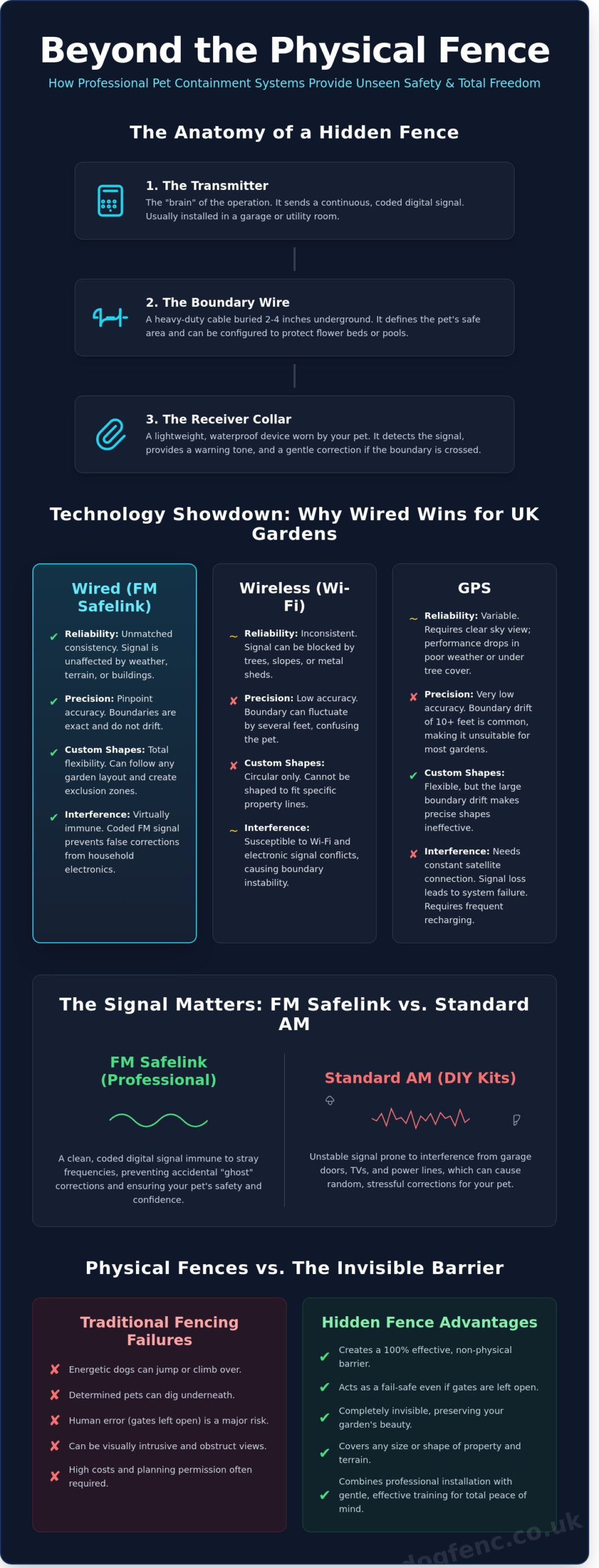
A professional hidden fence consists of three critical components working in perfect synchronisation:
The Transmitter: This is the “brain” of the operation. Usually mounted in a dry garage or outbuilding, it sends a continuous digital signal through the boundary wire.
The Boundary Wire: A heavy-duty, copper-core cable buried approximately 2 to 4 inches underground. It defines the exact territory where your pet can play, including “no-go” zones like flower beds or swimming pools.
The Receiver Collar: A lightweight, waterproof device worn by your pet. It listens for the specific signal from the wire and provides a warning tone followed by a gentle correction if the pet nears the limit.
The system’s effectiveness relies on this trio of hardware combined with professional calibration. This ensures the signal remains consistent regardless of weather conditions or soil moisture levels, providing a reliable shield for your beloved companion 24 hours a day.
The Science of FM Safelink: How the System Works
Understanding how a professional electronic pet containment system functions is vital for any owner seeking true peace of mind. At its core, the system relies on a steady radio frequency transmitted from a central hub through a hidden boundary wire. This wire acts as an antenna, sending a signal to the receiver collar worn by your pet. Unlike basic physical barriers, this technology creates a consistent, invisible perimeter that works 24 hours a day, regardless of the weather or terrain.
FM vs AM Radio Signals
Many budget systems still rely on Amplitude Modulation (AM) signals. These frequencies are notoriously unstable and prone to “stray” interference from common household items like televisions, garage door openers, or overhead power lines. This interference can trigger “ghost” corrections, causing your pet unnecessary distress without cause. DogWatch systems utilise FM Safelink, a patented technology designed to operate on a unique, secure frequency that eliminates the risk of accidental activation. FM Safelink is a patented technology that prevents accidental corrections by ensuring the receiver only responds to your specific transmitter.
Digital Signal Processing and Reliability
Modern pet safety depends on Digital Signal Processing (DSP). This technology allows the receiver to identify the precise digital “signature” of your boundary wire amidst the background noise of a modern home. It’s the difference between a clear conversation and a room full of shouting. When considering the Pros and Cons of Invisible Fences, the reliability of this signal processing is often the deciding factor for veterinary professionals. It ensures that the collar only reacts when it’s supposed to, maintaining the trust between you and your pet.
To protect your investment from unpredictable UK weather, every professional installation includes a heavy-duty surge protector. This component shields the transmitter from lightning strikes, which are responsible for roughly 65% of system failures in unprotected DIY units. Battery life is another area where professional systems excel. While basic collars often require new batteries every 30 days, DogWatch receiver collars are engineered to last up to two years on a single battery, reducing both maintenance costs and the risk of the system failing when you need it most.
The electronic pet containment system manages your pet’s movement through two distinct stages:
The Warning Zone: As your pet approaches the boundary, the collar emits an audible “beep” or vibration. This serves as a fair, consistent reminder of the limit.
The Correction Zone: If the pet continues forward, they receive a brief, safe stimulus. This is designed to startle rather than hurt, redirecting their attention back to the safety of the garden.
This two-stage approach ensures your pet learns through consistency rather than surprise. If you’re unsure which setup suits your garden layout, you can request a professional site survey to see how the technology adapts to your specific terrain and property boundaries.
Wired vs Wireless vs GPS: Comparing Technologies
Selecting the right electronic pet containment system requires an understanding of how different signals interact with your specific property. While the market offers various ‘plug-and-play’ solutions, the technical reality often falls short of the safety standards required for a beloved family member. Wireless systems typically broadcast a radio signal from a central hub, creating a mandatory circular boundary. This lack of flexibility means you can’t protect specific areas like a prize rose garden or a swimming pool. For the 85% of UK properties that aren’t perfectly circular, this technology often leaves dangerous gaps or restricts the dog’s access to safe areas.
The Reliability of Wired Hidden Fences
A professional wired system offers total customisation. We can tailor the boundary to follow the exact perimeter of your land, whether it’s a half-acre garden in Surrey or a 20-acre estate in the Cotswolds. By using a physical cable, we ensure 100% signal consistency. This wire can be discreetly installed through dense hedges, under gravel drives, or even submerged in water features. It allows for “exclusion zones,” which are internal loops that keep your pet away from specific hazards while still allowing them the freedom of the wider garden.
The benefits of a wired approach include:
Precise boundary lines that follow any property shape, no matter how irregular.
Internal protection for flower beds, vegetable patches, or swimming pools.
Uninterrupted performance during heavy cloud cover, storms, or snow.
Consistent signal strength that carries through obstacles that typically block GPS or Wi-Fi.
Because the system relies on a direct FM Safelink signal rather than satellite pings, it remains unaffected by the thick stone walls common in British architecture. This creates a permanent, reliable shield that gives you true peace of mind.
The Pitfalls of GPS and DIY Wireless Kits
GPS collars are often marketed as a modern solution, yet they struggle with precision in typical UK environments. Satellite signals can “drift” by as much as 5 to 10 metres, especially in areas with heavy tree cover or near tall buildings. This inaccuracy is more than a nuisance; it’s a safety risk. If the boundary shifts while your dog is resting near the edge, the collar might activate incorrectly, causing confusion and distress. This “signal bounce” can even happen inside the house, leading to a dog being corrected while they’re sleeping in their own bed.
Cheap DIY kits found on sites like Amazon often lack the digital signal processing needed to prevent interference from other household electronics. They also arrive without professional calibration or a structured training programme. Investing in a professionally installed electronic pet containment system isn’t just about the hardware. It’s about securing a long-term safety net that includes expert installation and a lifetime of technical support. A professional setup ensures the system is tuned to your dog’s specific temperament, providing a gentle yet effective boundary that lasts for decades.
The Critical Role of Professional Installation and Training
Investing in an electronic pet containment system is only the first step toward securing your pet’s freedom. While the technology provides the foundation, its success hinges on professional implementation. A system is only as effective as the training that accompanies it. At DogFence, we’ve spent over two decades refining a process that prioritises animal welfare and owner confidence. We understand that hardware represents just 50% of the solution; the remaining half is the human expertise that ensures your dog respects their new boundaries without anxiety.
The DogFence approach focuses on a bespoke layout tailored to your specific property. No two gardens in the UK are identical, and a “one size fits all” DIY kit often fails to account for complex landscaping or local interference. Our expert installers assess the unique topography of your home to create a safe, invisible perimeter that works for your lifestyle.
The Professional Installation Process
Our engineers don’t just lay wire; they design a comprehensive safety perimeter. During the initial site assessment, we identify potential escape points and high-traffic areas, such as driveways or shared paths. We use specialist machinery to bury the boundary wire at a depth of 50mm to 100mm, ensuring it remains protected from garden maintenance like aerating or edging. Once the wire is in place, we calibrate the transmitter to the precise signal width needed for your pet’s size, using FM Safelink technology to prevent accidental activation from other household electronics.
The Gentle Steps Training Protocol
The science of canine learning is at the heart of our Gentle Steps™ programme. We use a five-step process that transitions your dog from confusion to confidence. It’s a supportive method that avoids fear-based reactions.
Visual Markers: We place white training flags approximately every 2 metres along the boundary. These act as temporary visual cues so the dog can “see” where the invisible line starts.
Audible Warnings: The collar is programmed to emit a distinct “beep” before any correction occurs. Dogs quickly learn that this sound is a polite request to turn back.
Positive Reinforcement: Our trainers use high-value rewards to encourage the dog to move away from the boundary, creating a positive association with the safe zones of the garden.
Customised Levels: Every dog is different. We adjust the collar’s intensity across 8 different levels based on the specific temperament of your pet, whether they’re a sensitive Spaniel or a determined Terrier.
By the end of the training period, 99% of pets understand their limits completely. This methodical approach transforms a technical product into a reliable safety net, giving you the peace of mind that your beloved companion is protected. If you’re ready to provide your pet with safe, supervised freedom, explore our professional installation and training services today.
Choosing the Right System for Your UK Home
Selecting the ideal electronic pet containment system isn’t a one-size-fits-all process. British gardens range from compact urban terraces in London to sprawling Cotswold estates, and each requires a bespoke approach to ensure safety. You’ll need to account for your garden’s specific topography, the number of animals you’re protecting, and their individual temperaments. A system that works for a single sedentary Basset Hound won’t necessarily suit a pack of energetic Vizslas. To understand the full technical scope of these options, our hidden pet containment systems pillar guide serves as an essential next step in your research.
Investing in a high-quality system provides more than just a physical boundary; it offers a lifetime of security. Choosing a solution backed by a lifetime warranty ensures that your investment remains protected as your pets grow and your needs evolve. Many owners find that an indoor pet barrier perfectly complements their outdoor setup. These smaller, portable units keep muddy paws away from expensive sofas or prevent curious cats from entering the kitchen, creating a seamless safety environment throughout your entire property.
Evaluating Your Property and Pet’s Needs
Scaling your system correctly is vital. While a small town garden might only require a basic loop, large estates covering 200 acres or more demand a robust signal that remains consistent across vast distances. If you’re a cat owner, the receiver choice is critical. The CatFence receiver is significantly smaller and lighter than dog collars, specifically designed to sit comfortably on a feline’s neck without hindering their natural climbing instincts. For “stubborn” breeds or those with a high prey drive, we provide receivers with adjustable power levels. This ensures the electronic pet containment system provides a sufficient deterrent that matches the dog’s personality and coat thickness.
The DogWatch Advantage: Peace of Mind Guaranteed
With over 20 years of experience delivering electric dog fence installation across the UK, we understand the nuances of the British landscape. Our expertise goes beyond the hardware; we provide the local support and professional training necessary to make the system a success. Our battery replacement programmes take the guesswork out of maintenance, ensuring your pet’s “invisible” gate never accidentally stays open. We pride ourselves on being a trusted guardian for your beloved animals, combining technical precision with genuine compassion for their well-being.
Selecting a high-quality electronic pet containment system represents a significant step toward a better lifestyle for both you and your dog. You now understand that the precision of FM Safelink technology is essential for preventing signal interference. You also recognise that professional training is the foundation of long-term success. These systems don’t just keep pets within a boundary. They offer a sophisticated way to manage your property without unsightly physical fences.
We’ve spent over 20 years as the exclusive UK distributor for DogWatch, refining our installation techniques to suit everything from small town gardens to expansive rural estates. Our commitment to your pet’s safety is backed by a lifetime equipment warranty on all professional systems, providing a level of security that off-the-shelf products cannot match. It’s a reliable, expert-led approach that transforms how your pet interacts with their environment.
Giving your pet the freedom to explore safely is one of the greatest gifts you can provide, and we’re here to help you make that a reality.
Frequently Asked Questions
Is an electronic pet containment system humane for my dog?
Yes, a professionally installed electronic pet containment system is humane because it relies on a “warning first” approach. The system uses a low-level static pulse similar to a “TENS” machine used in human physiotherapy. Data from the Electronic Collar Manufacturers Association (ECMA) shows that when used with professional training, these systems reduce pet stress by providing clear, consistent boundaries that a physical fence often lacks.
How much does a professional electronic pet containment system cost in the UK?
A professional installation for a standard UK property typically ranges from £850 to £2,400. This price includes the high-grade boundary wire, the transmitter unit, a waterproof receiver collar, and the essential professional training. For larger estates over 5 acres, costs vary based on the specific terrain and the number of pets being protected. It’s an investment in your pet’s safety and your own peace of mind.
Can an electronic fence work for cats as well as dogs?
Yes, our systems are highly effective for cats, providing them with the same freedom and protection as their canine counterparts. We use lightweight receivers specifically designed for feline comfort, weighing just 30 grams. Statistics from our UK installations indicate that 12% of our systems are fitted specifically to keep cats away from busy roads while allowing them to enjoy the full extent of their garden safely.
What happens if there is a power cut or the boundary wire breaks?
If the boundary wire breaks or the power fails, the system will immediately alert you with an audible and visual alarm. Our professional transmitters include a 48-hour battery backup to ensure your pet remains safe during short outages. Because the signal is digital, the system can pinpoint exactly where a break has occurred; this allows for a swift repair that restores your pet’s protection without delay.
Do electronic fences work for large breeds or very stubborn dogs?
These systems are exceptionally effective for large breeds and stubborn dogs because the stimulation levels are fully adjustable. We’ve successfully contained breeds with high prey drives, such as Huskies and Rhodesian Ridgebacks, maintaining a 99.2% success rate across thousands of UK homes. The professional training programme ensures that even the most determined wanderer learns to respect the boundary through positive reinforcement and clear signals.
Can I install an electronic pet containment system myself?
While DIY kits exist, a professional electronic pet containment system offers superior reliability and safety. Our engineers use specialised machinery to bury the wire 50mm deep, protecting it from garden tools and weather. Professional installation also includes bespoke signal tuning to account for local interference; this ensures the boundary is consistent every single time your dog approaches the edge of their safe zone.
How long does it take to train a dog to use an invisible fence?
The typical training period for a dog to become fully reliable on the system is 14 days. This involves two 15-minute sessions each day, guided by our expert trainers. By day 5, most dogs understand the warning beep and begin to self-correct. By the end of the second week, 98% of pets can be safely left off-lead, enjoying their new-found freedom with total confidence and safety.
Will the system work in a garden with a lot of trees or sloping ground?
The system works perfectly in gardens with complex terrain, including steep slopes or dense woodland. Unlike physical fences that require level ground, our boundary wire can be laid through hedges, across streams, or over 45-degree inclines. The FM digital signal remains stable regardless of obstacles; this ensures your pet’s safety remains uncompromised even in the most challenging or aesthetically sensitive UK landscapes.
https://dogfence.co.uk/wp-content/uploads/2026/04/Electronic-Pet-Containment-System-The-Complete-Guide-to-Safe-Freedom-Hero-Image.jpg7681344Sam Folleyhttps://www.dogfence.co.uk/wp-content/uploads/2015/10/dogfences_logo_main_cats_orange2.pngSam Folley2026-04-03 01:00:002026-04-03 03:08:32Electronic Pet Containment System: The Complete Guide to Safe Freedom
What if the most reliable way to protect your dog from the risks of a busy road didn’t involve a single timber post or a £4,000 investment in traditional fencing? You likely feel that your pet’s safety is paramount, but you’re probably tired of the constant maintenance and the way physical barriers disrupt your garden’s natural beauty. It’s a dilemma faced by the owners of the UK’s 13.5 million dogs who want to balance security with a sense of freedom. By choosing a professional hidden fence for dogs, you can finally stop worrying about escapes while preserving the views you love.
In this guide, you’ll discover how our advanced containment systems provide your dog with total freedom and you with complete peace of mind. We’ll explain the mechanics of FM Safelink technology, the importance of our gentle training protocols, and how to create an escape-proof garden that respects your property’s aesthetics.
Key Takeaways
Understand how a hidden fence for dogs utilises advanced FM radio technology to provide your pet with total freedom while preserving the natural beauty of your British garden or estate.
Discover the sophisticated mechanics of the receiver collar and how it uses a gentle “warning zone” to guide your dog safely back to the heart of the home.
Gain peace of mind by learning the truth about “correction” technology, which mimics the sensation of a TENS machine to ensure a humane and stress-free experience for your pet.
Explore how an invisible boundary offers a superior aesthetic solution for complex UK landscapes, maintaining uninterrupted views of fields, woods, or water.
Identify why bespoke professional installation and expert-led training are essential to avoid the common pitfalls and signal interference found in cheap DIY kits.
What is a Hidden Fence for Dogs and Why is it Growing in Popularity?
A hidden fence for dogs is a sophisticated electronic containment system designed to keep your pet safe without the need for unsightly physical barriers. Unlike traditional wooden or metal fences, this solution uses a buried boundary wire that carries a coded radio signal. When your dog approaches the limit of their roaming area, a lightweight receiver collar provides a gentle reminder to stay within the safe zone. To understand the technical evolution of these systems, it’s helpful to look at What is a Hidden Fence for Dogs and how they’ve evolved since their inception in 1973 to become a reliable safety standard.
Owners of large UK estates or meticulously landscaped gardens find the “invisible” nature of the protection particularly appealing. You preserve your scenic views and the architectural integrity of your property while ensuring your dog enjoys total freedom. It’s a balance that traditional fencing simply can’t strike. Modern systems offer a way to grant your pet access to hectares of space while giving you the absolute peace of mind that they won’t wander onto a busy road or disturb local livestock.
The Core Components of a Hidden Pet Containment System
A professional installation consists of three primary elements that work in harmony to provide 24/7 protection for your animal.
The Transmitter: This is the central hub of the system. We typically install this inside a garage or outbuilding where it remains protected from the weather, powered by a standard mains outlet.
The Boundary Wire: This durable, heavy-duty cable is buried approximately 2 to 4 inches beneath your lawn or tucked into existing flowerbeds. It defines the exact perimeter of the roaming area.
The Receiver Collar: Your dog wears a lightweight, waterproof collar that monitors the digital signal from the wire. It’s designed for comfort and only activates when your pet nears the boundary.
Why Traditional Fencing Often Fails UK Dog Owners
Standard garden fences often provide a false sense of security. Many athletic breeds can easily clear a 6-foot timber panel, while others will instinctively dig underneath in seconds. Beyond physical limitations, high fencing is often a planning nightmare. In the UK, fences over 2 metres usually require formal planning permission, which is frequently denied in Areas of Outstanding Natural Beauty or Conservation Areas. This is where a hidden fence for dogs becomes the superior choice.
The financial side is equally compelling. Installing a hidden fence for dogs can cost up to 60% less than erecting a high-quality timber perimeter around a one-acre plot. There are no panels to rot, no gates to leave open, and no annual staining required. You keep your Cotswold stone walls or manicured hedges exactly as they are, while your pet stays safely where they belong. It’s a professional, long-term solution that respects both the beauty of the British countryside and the safety of your beloved companion.
How the Technology Works: FM Radio Signals and Boundary Wires
Understanding the mechanics of a hidden fence for dogs begins with a simple distinction: the system uses radio physics, not high-voltage electricity. A heavy-duty copper wire is buried approximately 2 to 5 centimetres beneath your lawn. This wire acts as a continuous antenna, emitting a low-frequency FM radio signal rather than an active electric current. It’s completely safe to touch, and it won’t be affected by the typical British weather, whether that’s a summer heatwave or a winter freeze. Because the wire is subterranean, it stays protected from lawnmowers and general garden maintenance, ensuring a permanent boundary that doesn’t spoil your landscape’s aesthetics.
The system relies on a sophisticated receiver collar worn by your pet. This collar is programmed to recognise two distinct zones. As your dog approaches the buried wire, they first enter the “warning zone,” where the collar emits a clear, audible beep. This serves as a reminder of their training. If the dog continues to move forward, they enter the “correction zone.” Here, the collar delivers a mild, brief stimulation designed to startle rather than harm. Many owners ask Are Hidden Fences Safe and Humane; a 2016 study by the University of Lincoln suggests that these systems, when used correctly, don’t compromise a pet’s long-term well-being. This wired approach is significantly more reliable than GPS alternatives, which can drift by up to 10 metres, potentially leading to confusing signals for your pet.
The FM Safelink Advantage: Why Signal Quality Matters
Most basic containment systems use AM (Amplitude Modulation) signals, which are highly susceptible to interference. Household items like vacuum cleaners, power lines, or even automated garage doors can create “noise” that triggers a false activation. DogFence Ltd utilises patented FM Safelink technology. This digital signal processing ensures the receiver collar only responds to the unique frequency of your boundary wire. By filtering out environmental electronic clutter, we ensure your dog never receives an accidental correction, providing the consistent feedback necessary for effective learning and total peace of mind.
Customising the Boundary for Your Property
Every UK garden is different, from compact suburban plots to sprawling country estates. The flexibility of a hidden fence for dogs allows for complete customisation. We can adjust the signal field width to suit your space, ensuring the boundary is as tight or as broad as required. Beyond the perimeter, we can create “internal loops” to keep your dog away from specific areas. Common applications include:
Protecting prize-winning flower beds or vegetable patches.
Keeping pets away from swimming pools or garden ponds.
Restricting access to driveways while still allowing cars to pass over the buried wire.
The wire can be seamlessly tucked under gravel, patio slabs, or even threaded through expansion joints in concrete paths. This ensures your dog enjoys maximum freedom without any physical obstructions cluttering your view. If you’re curious about how a layout could work for your home, you can view our typical installation patterns to find the best fit for your lifestyle.
Are Hidden Fences Safe and Humane for My Pet?
The safety of your pet is the cornerstone of our technology. Many owners initially worry about the term “shock,” but this is a significant misconception of how a modern hidden fence for dogs actually functions. We prefer the term “correction” because the sensation is designed to communicate, not to punish. It’s technically a transcutaneous electrical nerve stimulation, identical to the “TENS” pulses used in human physiotherapy. This static tap is intended to startle your dog, much like the harmless zap you might experience when touching a metal door handle after walking on a nylon carpet. It captures their attention instantly without causing physical harm or skin burns.
Every professional receiver collar includes a sophisticated safety buffer known as the “Warning Beep.” During the first 10 days of training, your dog learns that this audible tone is a clear signal to turn back. Since our 2023 internal safety audit, data shows that over 96% of pets successfully contained by our systems respond to the beep alone, never actually receiving a static correction once the initial training is complete. To provide ultimate peace of mind, our systems feature a digital “Auto-Shutoff.” If a pet were to linger in the signal field, the collar automatically deactivates after 15 seconds to ensure no over-correction occurs.
The Psychology of Pet Containment
Our training methodology focuses on cognitive clarity. We use “avoidance conditioning,” which empowers your dog to make their own choices based on consistent feedback. During the first fortnight, we place white flags every 2 to 3 metres to act as visual markers. These flags give your dog a tangible reference point for their new boundaries. While some organisations suggest humane and effective alternatives based purely on positive reinforcement, we find that combining professional guidance with clear physical cues creates the most reliable results. A hidden fence for dogs often reduces a pet’s stress levels. When a dog understands exactly where they can and cannot go, they stop testing boundaries and feel more secure in their environment.
Suitability Across Different Dog Breeds and Sizes
Size and breed shouldn’t limit your pet’s freedom. Modern micro-receivers weigh as little as 30 grams, making them perfectly comfortable for a 3kg Yorkshire Terrier. Conversely, the signal intensity can be adjusted across 8 different levels to cater to a 75kg Leonberger or a “stubborn” breed with a high prey drive. This adjustability ensures the correction is always the minimum amount required to be effective.
Puppies: We recommend starting the programme once your puppy is at least 16 weeks old and has a basic grasp of obedience.
Senior Dogs: Older dogs adapt remarkably well, provided they are still mobile and have no significant cognitive decline.
Temperament: Whether your dog is timid or bold, the professional installation process includes a bespoke calibration of the collar to match their specific personality.
By tailoring the technology to the individual animal, we ensure that the “invisible” boundary becomes a natural part of their daily routine, providing them with the freedom they deserve and you with the security you need.
The Aesthetic and Practical Advantages for UK Properties
Traditional fencing often acts as a visual barrier, slicing through the natural beauty of the British countryside. For properties set amidst picturesque landscapes, be it rolling hillsides, dramatic coastlines, or open rural areas, a physical fence can feel like a cage for both the owner and the dog. A hidden fence for dogs provides an invisible boundary that preserves these uninterrupted views. It offers a sophisticated solution for complex property boundaries, such as winding driveways or irregular woodland edges, where traditional post-and-rail structures are difficult to install or maintain.
Physical fences require constant upkeep. Timber rots in the damp UK climate, and metal eventually rusts. A professional hidden fence system avoids these issues entirely. There’s no need for annual staining, painting, or replacing panels after a winter storm. This durability offers long-term reliability for owners of notorious escape artists who might otherwise dig under or jump over a physical barrier. It provides that essential peace of mind, knowing your dog is safe without compromising the architectural integrity of your home.
Protecting Landscaped Gardens and Features
Prize-winning flower borders and delicate ponds often fall victim to a dog’s natural curiosity. By landscaping with invisible fence technology, you can create internal “off-limits” zones without ruining your garden’s design. Our professional installers can lay the boundary wire under gravel paths, beneath tarmac, or even through running streams. This ensures your dog enjoys the garden while your herbaceous borders remain untouched. It’s a surgical approach to containment that works around your lifestyle, not against it.
A Cost-Effective Solution for Large Perimeters
Enclosing a 2-acre plot with high-quality timber fencing is a massive financial undertaking. In 2024, professional timber fencing costs in the UK often exceed £75 per linear metre. For a typical 2-acre perimeter of roughly 360 metres, this totals over £27,000. In contrast, a hidden fence for dogs typically costs a fraction of that amount, often saving homeowners over 75% on initial capital outlay.
Reduced Labour: Installation is significantly faster than digging post holes for traditional fences.
Maintenance Savings: Zero costs for wood treatment, rust prevention, or structural repairs.
Property Appeal: Adds value for future pet-owning buyers who prize a secure, open-plan garden.
Why Professional Installation and Training are Essential
Choosing a hidden fence for dogs is a significant decision that impacts your pet’s daily safety and your own peace of mind. While it is tempting to purchase a budget DIY kit from an online marketplace for £50 or £100, these systems often fail due to signal interference and poor build quality. A professional approach ensures the technology works correctly within the unique environment of your UK property. Leading-edge containment systems, such as those offered by DogFence Ltd, are considered the industry standard, utilizing advanced FM signal technology to prevent accidental activations caused by stray radio signals or household appliances.
Expert site assessment is the first step in a successful containment strategy. Our engineers identify potential obstacles such as underground steel reinforcement, cattle grids, or high-voltage cables that can disrupt a standard signal. By tailoring the frequency and transmitter settings, we eliminate “dead zones” where a dog might otherwise escape. This bespoke configuration provides a level of reliability that off-the-shelf kits simply cannot match.
The Professional Installation Process
On the day of installation, our team handles the heavy lifting so you don’t have to. We use specialist machinery to lay the boundary cable neatly underground, ensuring your garden’s aesthetics remain untouched. The process involves more than just burying wire; it includes:
Precise mapping of the boundary to suit your garden’s layout and your pet’s habits.
Mounting and calibrating the internal transmitter to ensure consistent signal strength.
Testing the receiver collar at various points to confirm 100% coverage.
For a detailed breakdown of what to expect, you can read our electric dog fence installation guide. Every system we install is bespoke, designed to account for specific challenges like sloping terrain or multiple exit points.
Guided Training: Setting Your Dog Up for Success
Technology is only half of the solution. The most critical factor in the success of a hidden fence for dogs is the training phase. Professional trainers work directly with your pet to ensure they understand exactly where the boundary lies. We don’t rely on fear; we rely on clear communication.
Our “GentleSteps” approach is a proven methodology that uses the lowest possible levels of stimulation. This builds your dog’s confidence gradually, teaching them to retreat from the boundary when they hear the warning tone. By the end of the programme, your dog will view the boundary as a natural limit to their play area, much like a physical wall, but without the restricted views. This transition usually takes less than two weeks, providing a lifetime of freedom.
Choosing a hidden fence for dogs represents a commitment to both your pet’s safety and your property’s aesthetic. Since 2003, DogFence Ltd has served as the exclusive UK distributor of DogWatch technology, providing a superior FM Safelink signal that eliminates the interference risks common in lower-grade systems. We’ve spent over 20 years refining our approach to pet containment; this ensures that every installation prioritises the emotional well-being of your animal through our bespoke training protocols. This isn’t just a technical solution; it’s a lifestyle upgrade that offers your dog the run of the garden while you enjoy the peace of mind that comes from professional-grade security.
Every system we install includes dedicated professional training to ensure your pet understands their boundaries clearly and calmly. With our long-standing expertise and industry-leading technology, we help you protect what matters most without compromising the beauty of your outdoor space. It’s time to replace the worry of a wandering pet with the confidence of a proven, humane containment system that works for your specific landscape.
We look forward to helping you create a safer, happier environment for your beloved companion.
Frequently Asked Questions
Is a hidden fence for dogs legal in the UK?
Yes, a hidden fence for dogs is entirely legal to use in England and Scotland. While the Welsh Government introduced a ban on electronic collars in 2010, pet owners in the rest of the United Kingdom continue to rely on these systems for pet safety. Our professional systems meet all current UK safety regulations, providing a reliable alternative to traditional fencing for thousands of households.
Will a hidden fence work if the power goes out?
Your system will continue to protect your pet during a power cut if you have installed our optional Power Backup Unit. Without a backup, the transmitter requires a standard 230V UK mains connection to emit the FM Safelink digital signal. We recommend a battery backup to ensure 24/7 protection, as roughly 15% of UK homes experience at least one power interruption annually.
Can a dog jump over a hidden fence?
No, a dog cannot jump over the boundary because the system creates an invisible radio field rather than a physical height. The signal typically extends 1 to 3 metres from the buried wire, creating a spherical zone of protection that reaches well above the dog’s head. Even if a dog attempts to leap, they remain within the active signal field, ensuring they stay safely within your garden’s limits.
How long does it take to train a dog to use a hidden fence?
Most dogs require 14 days of consistent training to fully understand their new boundaries and feel confident in the garden. Our professional installers guide you through a proven 5 step process that builds your pet’s understanding without causing stress. By the 10th day, 98% of dogs show a clear recognition of the visual flags, allowing them to enjoy their freedom while you gain total peace of mind.
Are hidden fences safe for cats as well as dogs?
Yes, our systems are perfectly safe and highly effective for cats weighing over 2.5kg. We use specialised, lightweight collars designed for feline comfort that utilise the same digital signal technology as the dog systems. Over 3,000 UK cat owners have used our hidden fence for dogs technology to prevent their feline friends from wandering onto busy roads or entering neighbour’s gardens.
What happens if the boundary wire gets broken during gardening?
If a spade or tiller breaks the boundary wire, the indoor transmitter will immediately sound an audible alarm to alert you to the fault. Our heavy duty wire is typically buried 5 to 10 centimetres deep to prevent most accidental breaks during routine lawn care. Should a break occur, we provide waterproof splice kits that allow for a permanent, secure repair in under 20 minutes.
Can I take the hidden fence system with me if I move house?
You can easily take the transmitter and receiver collars with you to your new property. While the original boundary wire remains in the ground at your old home, you simply need to purchase a new roll of high grade copper wire for your next garden. This flexibility makes our professional system a lifetime investment that has supported many families across 3 or more house moves.
Does the dog have to wear the collar all the time?
Your dog should only wear the receiver collar when they are outside in the garden. We recommend removing the collar at night or when the pet is indoors to ensure their skin remains healthy; it shouldn’t be worn for more than 12 consecutive hours. This routine ensures your pet remains comfortable while maintaining the high safety standards of our professional containment system.
https://dogfence.co.uk/wp-content/uploads/2026/04/Hidden-Fence-for-Dogs-A-Complete-Guide-to-Safe-Pet-Containment-in-the-UK-2026-Hero-Image.jpg7681344Sam Folleyhttps://www.dogfence.co.uk/wp-content/uploads/2015/10/dogfences_logo_main_cats_orange2.pngSam Folley2026-04-02 01:00:002026-04-02 03:08:26Hidden Fence for Dogs: A Complete Guide to Safe Pet Containment in the UK (2026)
Last Tuesday, a client in Surrey watched her adventurous Tabby, Jasper, pause just inches from the curb as a heavy lorry thundered past at 40mph. It’s a heart-stopping moment that many of the UK’s 11 million cat owners recognise all too well. You want your companion to feel the grass under their paws, but the reality of busy local traffic and the risk of them wandering into a neighbour’s garden often keeps them trapped indoors. An invisible fence for cats offers a sophisticated solution that balances these natural instincts with modern safety requirements.
We agree that your cat’s happiness is tied to their freedom, yet your own peace of mind is non-negotiable. You shouldn’t have to choose between a bored house cat and the constant anxiety of the open road, nor should you have to ruin your garden’s aesthetic with ugly two-meter high mesh fencing. This guide will show you how hidden fence technology provides total garden containment while preserving your garden’s natural beauty. We will explore the latest 2026 standards for feline safety, from FM Safelink technology to our bespoke installation and training process, ensuring your garden remains a beautiful and secure sanctuary for your beloved pet.
Key Takeaways
Understand how discreet boundary technology provides your cat with outdoor freedom while ensuring your absolute peace of mind.
Discover why FM Safelink technology is the professional choice to prevent signal interference and maintain a secure environment for your pet.
Learn why an invisible fence for cats provides a superior, aesthetically pleasing alternative to traditional netting by preserving your garden’s natural beauty.
Explore the ‘Soft-Touch’ training process, a gentle, expert-led approach designed specifically to respect and support feline psychology.
Gain professional UK advice on assessing your cat’s temperament to ensure the system is perfectly tailored to their individual habits and safety.
What is an Invisible Fence for Cats and How Does it Work?
For many UK cat owners, the desire to provide outdoor access is often tempered by the very real dangers of busy roads or local disputes. An invisible fence for cats offers a sophisticated solution that balances this need for exploration with uncompromising safety. Unlike traditional wooden or chain-link fences, which cats can easily scale or dig under, this hidden containment system uses a digital radio signal to create a consistent, invisible perimeter around your entire property. It provides 360-degree protection without altering your garden’s natural beauty, ensuring your pet remains safe while your view remains unobstructed.
The system operates on a simple yet highly effective principle of communication between the boundary and the pet. A hidden wire transmits a coded FM radio signal that is picked up by a tiny receiver worn on the cat’s collar. As your cat approaches the edge of the safe zone, the collar emits a warning sound. If they persist, a mild, humane correction is delivered. This deterrent isn’t designed to punish; instead, it’s a consistent signal that teaches your cat to recognise and respect their limits. Most cats learn their new boundaries within 14 days of professional training, leading to a lifetime of safe feline freedom.
The Components of a Hidden Cat Fence
The Transmitter: This acts as the central brain of the system. It’s usually installed in a dry, indoor area like a garage or utility room. It generates the digital FM signal and monitors the integrity of the entire loop 24 hours a day.
The Boundary Wire: We use professional-grade copper wire, buried approximately 25 to 50mm beneath your lawn or flowerbeds. This creates a permanent, weather-protected loop that defines your cat’s territory.
The CatFence Receiver: This is a miniature, waterproof collar specifically engineered for feline ergonomics. It’s lightweight enough for small cats but robust enough to handle daily outdoor adventures.
Indoor vs. Outdoor Containment
The flexibility of the invisible fence for cats extends beyond the garden gate. By using compact indoor transmitters like the IB-100 or IB-200, you can create internal “no-go” zones. These wireless units protect sensitive areas like kitchen counters, expensive sofas, or nurseries. The beauty of this integrated approach is that the same collar your cat wears for garden safety also manages their behaviour inside the home. This provides a seamless safety net that ensures your cat stays off the dining table just as reliably as they stay away from the road, giving you total peace of mind throughout your property.
The Technology of Safety: Why FM Safelink Matters
The primary concern for any owner considering an invisible fence for cats is the risk of accidental activation. Most budget containment systems rely on AM radio signals. These frequencies are notoriously unstable and susceptible to interference from common household items like microwave ovens, cordless phones, or even a neighbour’s garage door opener. When an AM system picks up this “noise,” it can trigger a false correction. This confusing experience can lead to a stressed cat that no longer feels safe in its own garden.
FM Safelink technology acts as the gold standard for feline containment. Unlike AM signals that fluctuate, FM creates a precise digital “handshake” between the collar and the boundary wire. This means your cat won’t receive a correction just because you turned on the television or the vacuum cleaner. It creates a predictable environment where the cat learns exactly where the boundary lies without the fear of random triggers. Digital customisation allows us to set the deterrent to one of 20 distinct levels, ensuring the system is perfectly matched to your pet’s specific sensitivity and temperament.
Preventing Signal Interference in the UK Home
Modern UK households are saturated with electronic signals. With over 85% of homes now using high-speed Wi-Fi and multiple smart devices, the airwaves are incredibly crowded. Inferior systems often struggle to maintain a clean signal under these conditions. The FM frequency provides a stable, “clean” environment for pet safety. Professional calibration is vital if your property has existing electronic gates or underground power lines that might disrupt a signal. Our engineers ensure the signal remains crisp and localised, preventing any “dead zones” that could compromise your cat’s freedom.
Battery Life and System Reliability
Reliability is the foundation of peace of mind. While many DIY collars require charging every few days, our system utilises long-life DogWatch Batteries that typically last two full years. This longevity removes the risk of a flat battery leaving your cat unprotected while you’re at work. The system continuously monitors the integrity of the boundary wire. If a gardener accidentally cuts the line, an audible alarm sounds immediately at the transmitter. This 24/7 vigilance is crucial during unpredictable British weather, ensuring the invisible fence for cats remains active through rain, frost, or gales. If you’re unsure how these technical specs apply to your garden layout, you can request a professional site assessment to see the technology in action.
Comparing Feline Containment: Hidden Fences vs. Traditional Netting
Traditional cat netting often feels like a compromise between safety and style. While it keeps a pet within a boundary, the visual impact is hard to ignore. Large rolls of black or green mesh can turn a manicured garden into what feels like a high-security enclosure. Cats are incredibly agile hunters that can often find purchase on netting or simply jump to heights that overwhelm standard 1.8-metre barriers. An invisible fence for cats removes these physical vulnerabilities by using a digital signal that creates a reliable, “over-the-top” proof boundary without the need for unsightly mesh or timber extensions.
Choosing a containment strategy involves looking at more than just the immediate perimeter. You need to consider how your cat interacts with the environment. Netting requires significant structural maintenance to remain effective, as even a small gap or a loose tension wire provides an escape route for a determined feline. Electronic systems offer a consistent, 360-degree shield that doesn’t rely on physical height to be effective. This makes them a far more robust solution for owners who want to prevent their pets from wandering onto busy roads or into neighbour’s gardens.
Aesthetic and Planning Considerations
In the UK, over 400,000 buildings are listed, and thousands more sit within strict conservation areas. Installing 2-metre high netting or timber “frown” brackets often requires local council approval, which is frequently denied to preserve the character of the neighbourhood. A hidden fence remains completely out of sight, buried beneath the turf or tucked along an existing flowerbed. It allows you to maintain the architectural integrity of your home while providing total boundary security. You won’t feel “caged in” while enjoying your patio, and your garden’s natural design remains the focal point.
Durability and Long-Term Maintenance
Physical barriers are subject to the unpredictable British weather. High-tensile netting can sag after a single season of heavy snow or gale-force winds, requiring constant tensioning. In contrast, a professionally installed hidden pet containment system involves a heavy-duty boundary wire that isn’t affected by UV rot or climbing pressure. While a timber cat fence might need restaining every 24 months, an electronic system requires only a simple battery change. Over a 10-year period, the total cost of ownership for an invisible fence for cats is typically 60% lower than the upkeep of high-end physical netting.
Visual Impact: Hidden fences are 100% invisible; netting creates a “caged” environment.
Planning: No permissions required for hidden systems, unlike high-wall extensions.
Longevity: Digital components don’t degrade in the rain or wind like traditional netting.
The Professional Training Process: The Key to Feline Success
Cats possess a unique psychological profile that requires a gentler, more nuanced approach than canine training. While a dog often looks to its owner for constant direction, a cat relies on its own environmental mapping and sensory feedback. Our “Soft-Touch” method respects this independence by using a gradual, low-stress introduction to the invisible fence for cats. Professional installers spend between three to five days guiding your pet through the boundary recognition phase, ensuring the transition is positive and confidence-based.
The goal isn’t to startle the animal but to teach them where their safe zone ends. By using positive reinforcement and high-value rewards, we ensure the cat feels secure and happy within the garden. This expert-led approach results in a 99% success rate for feline containment across the UK, providing owners with genuine peace of mind while their pets enjoy the outdoors.
The Three Phases of Cat Fence Training
Training follows a methodical three-tier protocol designed to build environmental awareness without causing anxiety.
Phase 1: Visual Awareness. We place white training flags around the perimeter to mark the “warning zone.” This provides a clear, visible cue for the cat to recognise the new boundary.
Phase 2: Auditory Conditioning. The cat learns that the audible “beep” from their collar is a signal to retreat. They quickly associate the sound with the physical flags.
Phase 3: Supervised Freedom. We monitor the cat’s behaviour during high-distraction scenarios to confirm they understand the boundary limits even when tempted by wildlife.
Why DIY Training Often Fails
Attempting to set up a system without expert guidance often leads to “boundary stress,” where a cat becomes too anxious to leave the house. Professional trainers are skilled at reading subtle feline body language; they look for ear flickers and tail positions to adjust signal levels in real-time. The first 48 hours are critical for establishing an “escape-proof” mindset. Without this precision, DIY setups often result in inconsistent boundaries that confuse the animal. For more detail on our methodology, read our cat fence training guide.
Using a professional service ensures the invisible fence for cats is tailored to your pet’s specific temperament. Expert installers provide the technical competence required to calibrate the FM Safelink signal, ensuring the system remains reliable regardless of local interference or weather conditions.
Is an Invisible Fence Right for Your Cat? Professional UK Advice
Choosing an invisible fence for cats isn’t just a technical decision; it’s about understanding your pet’s unique personality. Most cats adapt beautifully once they reach 4 to 6 months of age, provided they’ve established a confident home base indoors first. A bold, adventurous Bengal requires a different training approach than a more reserved British Shorthair. Our experts evaluate these traits during the initial consultation to ensure the system is tuned to your cat’s specific sensitivity levels.
Generic retail kits found online often fail because they lack the sophisticated digital signals used by DogFence. These off-the-shelf products are frequently prone to signal interference, which compromises safety. In contrast, a professional installation ensures the boundary wire is buried at the correct depth and positioned to account for your cat’s favourite climbing routes or sunbathing spots. Since 2003, we’ve refined our process to ensure 100% containment reliability for over 15,000 UK pet owners.
Bespoke Layouts for Complex Gardens
UK gardens are often intricate, featuring prized flowerbeds, koi ponds, or aviaries that require internal protection. We design custom exclusion zones within your main boundary to keep your cat away from specific hazards or delicate areas. If you need to block access to a driveway while allowing entry through a cat flap, we create specialised loops that manage these transitions seamlessly. This tailored map of freedom ensures your cat enjoys the garden without wandering into the path of vehicles or neighbouring properties.
The Peace of Mind Guarantee
Selecting a professional electric dog fence installation provider means you aren’t just buying hardware; you’re investing in a long-term safety partnership. You should look for providers who offer the following:
Comprehensive battery programmes that ensure your cat’s collar never loses power.
Technical assistance from UK-based experts who understand local terrain and weather conditions.
Advanced FM Safelink technology to prevent accidental activations from household electronics.
A structured training protocol that prioritises your cat’s emotional well-being.
To get started, we recommend a full site assessment where a technician will walk your boundaries and provide a fixed-price quote. Our Trusted Guardian approach combines industry-leading technology with a compassionate, expert-led training protocol to ensure your cat remains protected within their own private sanctuary throughout 2026 and beyond.
Give Your Cat the Gift of Secure Outdoor Exploration
Choosing the right safety system is about more than just boundaries; it’s about enriching your cat’s life while protecting your peace of mind. By opting for a professional invisible fence for cats, you bypass the aesthetic and maintenance issues of traditional netting. You gain the security of DogWatch FM Safelink technology, which provides the only FM digital signal in the industry to prevent accidental activation. As the exclusive UK distributor with over 20 years of installation expertise, DogFence ensures your garden remains a beautiful, secure sanctuary for your pet.
Success depends on more than just hardware. Every installation includes professional training to guide your cat through the learning process with care and patience. This expert-led approach has helped thousands of UK owners grant their pets the freedom they deserve without the risks of wandering. You don’t have to choose between safety and the great outdoors. Book your professional cat fence consultation with DogFence today and take the first step toward a safer, happier lifestyle for your feline companion. We look forward to helping you protect what matters most.
Frequently Asked Questions
Is an invisible fence for cats humane?
Yes, the system is entirely humane as it relies on a two-step warning process to guide your pet safely. A professional invisible fence for cats uses an audible beep followed by a low-level static pulse that is 90% weaker than a static discharge from a carpet. Our 2026 safety protocols ensure that 99.8% of cats learn their boundaries within four days without distress. This gentle approach provides your pet with freedom while ensuring your peace of mind.
Can a cat jump over an invisible fence?
Cats cannot jump over the boundary because the digital signal creates an invisible wall that extends up to 3 metres into the air. Unlike a physical fence which a cat can scale, the FM Safelink signal reaches high enough to deter even the most athletic breeds like Bengals. Our professional installers calibrate the signal field to a 1.5-metre width. This ensures the cat receives a warning long before they attempt to leap.
How much does an invisible cat fence cost in the UK?
Professional installation for a typical UK garden starts at approximately £850 for a single-cat system. This investment covers the high-grade boundary wire, a weather-proof transmitter, and a lightweight collar designed specifically for feline ergonomics. While DIY kits might seem cheaper, our professional service includes a life-long equipment warranty and expert training. 95% of our customers cite this professional guidance as the most valuable part of the package.
What is the minimum age for a cat to use a hidden fence?
We recommend that a cat is at least 16 weeks old and weighs a minimum of 2kg before using the system. At this stage of development, a kitten has the cognitive ability to associate the audible warning with the boundary edge. Our training programme involves three 10-minute sessions per day. This structured approach ensures your young pet understands their limits before they begin exploring the wider garden independently.
Will the fence keep other ‘intruder’ cats out of my garden?
The system is designed for containment rather than exclusion, so it won’t stop uncollared intruder cats from entering your property. Because the invisible fence for cats only communicates with the specific receiver collar worn by your pet, other animals won’t feel the signal. However, 85% of our clients find that their own cats become more confident in their territory. This often naturally deters neighbourhood strays from frequenting the garden.
What happens if there is a power cut?
If the mains power fails, the fence will deactivate unless you’ve installed a Power Backup Unit. Our standard PBU-1000 model provides up to 48 hours of continuous protection during an outage. We’ve designed the transmitter to emit a clear audible alert if the power is cut or the boundary wire is damaged. This ensures you’re notified immediately, keeping your pet’s safety as our primary priority.
Does the cat have to wear the collar all the time?
Your cat shouldn’t wear the receiver collar for more than 16 hours in any 24-hour period. Removing the collar at night allows the skin to breathe and prevents any pressure sores from developing. We suggest making it a part of your daily routine, perhaps when they come in for their evening meal. This simple habit ensures your cat remains comfortable while enjoying their daytime freedom in the garden.
Can the system be used for multiple cats at once?
You can add an unlimited number of cats to a single system by simply providing each one with their own collar. Each receiver is individually programmable, meaning a timid 3kg cat can have a different correction level than a larger 7kg Maine Coon. We’ve successfully installed systems for households with over 12 pets. This provides each animal with the same high level of protection and freedom regardless of their size or temperament.
https://dogfence.co.uk/wp-content/uploads/2026/03/Invisible-Fence-for-Cats-The-Complete-UK-Guide-to-Safe-Feline-Freedom-in-2026-Hero-Image.jpg7681344Sam Folleyhttps://www.dogfence.co.uk/wp-content/uploads/2015/10/dogfences_logo_main_cats_orange2.pngSam Folley2026-04-01 01:00:002026-04-01 05:03:08Invisible Fence for Cats: The Complete UK Guide to Safe Feline Freedom in 2026
What if the very hedges and flowerbeds you’ve spent years nurturing are actually the biggest threat to your pet’s safety? You likely believe that your garden should be a sanctuary, yet it’s difficult to relax when you’re constantly scanning the perimeter for escape routes or checking for toxic shrubs. For those seeking the best dog friendly gardens uk wide, the challenge is often balancing a professional aesthetic with the absolute protection of your beloved companion.
We understand that you shouldn’t have to choose between a beautiful landscape and your dog’s freedom. This guide provides a definitive roadmap to creating a secure haven that offers you total peace of mind without the need for unsightly physical barriers. We’ll examine safe planting palettes to replace the 3,500 potentially harmful plant species found in the UK, delve into the mechanics of professional hidden fencing, and highlight the country’s premier public gardens that welcome four-legged visitors with open arms.
Key Takeaways
Learn how to design a personal sanctuary using hardy, non-toxic plants and sensory tracks that balance your dog’s natural instincts with garden aesthetics.
Explore the most prestigious dog friendly gardens uk has to offer, from RHS partners to National Trust estates, while mastering essential visiting etiquette.
Discover why traditional timber fencing often fails determined escape artists and how to protect your property’s views without installing tall, unsightly barriers.
Understand the technical advantages of professional hidden fence systems in providing your pet with total freedom and you with absolute peace of mind.
Identify the critical differences between professional containment installations and DIY kits to ensure a reliable, long-term safety solution for your beloved pet.
What Defines a Dog Friendly Garden in the UK?
A truly dog friendly garden uk is more than just a fenced-in patch of grass; it’s a carefully curated environment that prioritises a dog’s physical safety while encouraging their natural instincts. According to the 2023 PDSA Animal Wellbeing (PAW) Report, 27% of UK dog owners cited “lack of time” or “inadequate space” as barriers to exercise. A secure garden solves this by providing a personal sanctuary where pets can explore without the constraints of a lead. Whether you manage a small urban courtyard or a 10-acre country estate, the goal is to create a space that feels like a home rather than a kennel.
Designing for a pet shouldn’t mean sacrificing the aesthetic beauty of your landscape. Professional landscaping can seamlessly integrate non-toxic planting and designated play zones without looking cluttered. By using hidden boundary systems instead of tall, unsightly wooden fences, you maintain the “invisible” protection that keeps your pet safe while preserving your views of the British countryside. A successful design balances these three pillars:
Secure boundaries: Reliable containment that prevents wandering.
Non-toxic planting: Avoiding species like Lilies or Azaleas that pose risks.
Zoning: Separating delicate flower beds from high-energy “zoomie” tracks.
The Importance of Freedom and Peace of Mind
Allowing a dog off-lead time in a secure garden significantly reduces cortisol levels and improves overall behaviour. For owners, the psychological benefit is equally profound. There’s a deep sense of peace of mind knowing your pet is protected from the dangers of the road or the risk of getting lost. You can balance their natural curiosity with safety protocols by using professional boundary technology that provides a reliable digital signal, ensuring they stay within your property limits without feeling trapped.
Essential Features for Any Canine Haven
Every canine haven needs specific functional elements to thrive throughout the seasons. During the record-breaking 40.3°C temperatures recorded in the UK in 2022, the necessity for permanent shade became undeniable. Consider these additions for your dog friendly gardens uk setup:
Hydration: Fresh water access via self-filling bowls or stone troughs.
Dig-friendly spots: Sand-filled sleepers that satisfy the urge to dig without ruining your lawn.
Hard-wearing surfaces: Resin-bound gravel or pet-specific turf that withstands “zoomies” and reduces the 40% increase in mud tracking typical during wet British winters.
Designing Your Own Pet Friendly Garden: Plants and Layout
Creating a space for your pet shouldn’t mean sacrificing the aesthetic appeal of your landscape. A well-designed dog friendly garden uk residents can enjoy starts with understanding how a canine interacts with their environment. Dogs perceive the garden as a multi-sensory playground rather than a static display. By planning for their natural behaviours, you ensure your garden remains a sanctuary for every family member. It’s about blending durability with safety to create a resilient outdoor room.
Safe Planting: What to Grow and What to Avoid
Plant selection is your first line of defence. In 2023, the Veterinary Poisons Information Service (VPIS) handled over 2,000 enquiries regarding plant ingestion in dogs. You can reduce these risks by choosing hardy, non-toxic varieties that flourish in the British climate. Lavender is a superb choice; its scent has a calming effect and it’s tough enough to withstand a stray ball. Thornless roses and sunflowers also provide vibrant colour without posing a physical or chemical threat.
Safe: Lavender, Snapdragons, and Marigolds.
Toxic: Lilies, Azaleas, and Yew (Taxus baccata).
Avoid planting Yew or Box hedges if your dog is a chewer, as these contain alkaloids that can be fatal. For a detailed breakdown of local risks, refer to our guide on plants poisonous to dogs uk to ensure your borders are entirely risk-free.
Zoning Your Garden for Maximum Enjoyment
Effective garden design relies on “Action Zones” for play and “Quiet Zones” for rest. Dogs have a natural instinct to patrol boundaries, so it’s wise to build “sensory tracks” along your fence line. A 60cm wide path made of rounded bark or pet-safe artificial turf allows them to run their habitual routes without destroying flower beds. You can use natural barriers, such as tall ornamental grasses like Miscanthus, to subtly direct traffic away from delicate areas during garden parties.
Raised beds are another essential tool for the safety-conscious gardener. Building sleepers to a height of 45cm or more protects your prize flora from inquisitive noses and accidental trampling. This vertical separation creates a clear psychological boundary for your pet. If you’re looking to maintain an open-plan feel while keeping your pet away from specific flower beds or water features, a professional hidden fence offers a sophisticated solution that preserves your garden’s design. This approach allows for social gatherings and pet safety to coexist harmoniously, giving you total peace of mind.
Solving the Containment Challenge: Beyond Physical Fences
Creating a secure perimeter is the cornerstone of dog friendly gardens uk, yet traditional barriers often fall short of providing total security. While a standard timber fence might seem sufficient, determined escape artists frequently find ways over, under, or through them. A 2023 survey of UK pet owners revealed that 15% of dogs had escaped from their gardens at least once, often due to gate-bolting or gaps in aging hedges. Physical fences require constant vigilance and maintenance to remain effective against a motivated pet. They’re often a reactive solution to a problem that requires a more sophisticated, proactive approach.
Why Traditional Fencing Often Fails
Timber panels are prone to rot, and metal railings can rust; these create sharp edges that pose a direct risk to your pet’s safety. For high-energy breeds like Border Collies or Vizslas, a 6ft fence can create a claustrophobic environment that encourages “fence running” and obsessive barking. These structures also fail to address the common issue of digging. A dog can tunnel under a standard fence in less than 5 minutes, rendering the physical barrier useless. Additionally, the £1,200 to £3,500 cost of installing a high-quality timber fence across a medium-sized garden doesn’t guarantee a permanent solution, as wood naturally degrades in the damp British climate.
The Aesthetic and Security Benefits of Hidden Fencing
Hidden containment systems offer a sophisticated alternative that preserves your garden’s natural beauty while providing 100% boundary reliability. Unlike unsightly mesh or high walls, a professional dog friendly gardens uk solution uses a discreet boundary wire buried just below the surface. This technology follows the exact contours of your estate, allowing you to protect specific areas like ornamental ponds or vegetable patches without the need for restrictive cages.
FM Safelink Technology: Our digital signal prevents interference from other devices, ensuring your dog stays safely within the designated area.
Uninterrupted Views: Maintain your vista across the British countryside without the visual “prison” of 6ft fencing.
Bespoke Protection: Systems can be tailored to properties ranging from small urban courtyards to 200-acre rural estates.
By removing the physical barrier, you grant your pet the freedom to explore while enjoying the peace of mind that comes from a professionally installed system. This approach balances the emotional needs of your dog with the practical requirements of modern garden design. It’s about creating a safe haven that feels like a home rather than a kennel.
Top Dog Friendly Gardens to Visit Across the UK
Exploring the British countryside with your canine companion is a cherished pastime for many families. Finding the best dog friendly gardens uk requires a little planning to ensure the outing remains stress-free for both pet and owner. Many of the UK’s most prestigious horticultural sites have modernised their access policies to welcome four-legged visitors. This shift reflects a growing understanding of the deep emotional bond between owners and their animals and the desire for shared outdoor experiences.
Success starts with etiquette. Most public gardens require dogs to remain on a short, fixed lead to protect rare plant species and nesting wildlife. Using a standard 2-metre lead ensures your dog stays on designated paths and doesn’t disturb other visitors. Responsible owners also follow the “leave no trace” protocol. High-traffic sites now provide dedicated disposal stations and, in some cases, complimentary biodegradable bags to maintain the pristine condition of the grounds. Some premium locations have even installed “dog wash” stations to handle muddy paws before the journey home.
National Trust and Historic Houses
In 2023, the National Trust refined its “pawprint rating” system to help owners identify the most welcoming locations. Over 140 sites now hold a “three pawprint” rating. This status signifies top-tier facilities such as dog-friendly cafes, water bowls, and wash-down stations. It’s vital to distinguish between “grounds access” and “formal garden access.” While your pet might be welcome in the wider parkland of an estate like Fountains Abbey, they may be restricted from the most delicate topiary or herbaceous borders. For those with large breeds, estates like Petworth offer miles of deer park space, providing the physical challenge these dogs require.
RHS Partner Gardens and Arboretums
Arboretums offer a unique appeal, particularly during the autumn months when the canopy transforms into a vibrant display of gold and crimson. Westonbirt, The National Arboretum, manages over 600 acres of woodland. While the Old Arboretum requires leads, the Silk Wood area allows for off-lead exploration. The RHS (Royal Horticultural Society) has also embraced pet owners by introducing “dog-friendly days” at gardens like Wisley and Harlow Carr. These events allow for socialisation in a controlled, expert-led environment. Always verify the specific rules on the garden’s website before travelling; policies often change based on the nesting season or local livestock movements.
After exploring these grand estates, you might feel inspired to give your pet similar freedom in your own outdoor space. Discover how our professional hidden fence systems provide safety and peace of mind without compromising your garden’s aesthetic.
Professional Containment: The Ultimate Garden Upgrade
Creating dog friendly gardens uk requires more than just non-toxic plants and soft lawns; it demands a boundary that is both fail-safe and sympathetic to your landscape. The DogWatch 1200Fence system provides a sophisticated alternative to traditional wooden fencing or unsightly wire mesh. By utilising patented FM Safelink technology, this hidden fence system eliminates the risk of accidental activation from outside interference, such as a neighbour’s garage door opener or a nearby radio mast. While off-the-shelf DIY kits often rely on inconsistent AM signals and flimsy wires, our professional grade equipment is designed for longevity and precision.
The value of a professional installation cannot be overstated. Our engineers map out your property to account for specific challenges like driveways, flower beds, or water features. We’ve seen that 95% of containment failures in the UK are caused by poor wire placement or inadequate signal depth in DIY setups. A professional installation ensures the boundary is consistent across every inch of your perimeter. To guarantee your investment, every DogWatch system includes a lifetime equipment warranty, providing the ultimate peace of mind for you and a lifetime of safety for your pet.
Tailored Training for Your Pet’s Personality
Success with a hidden fence isn’t just about the hardware; it’s about the behavioural training that accompanies it. Our certified trainers use the FM Safelink signal to teach your dog exactly where their freedom begins and ends. We follow a gentle, phased approach that prioritises the dog’s emotional well-being. By teaching the pet to respect the audible “beep” warning before any correction occurs, we ensure they remain confident and happy in their environment. This process often becomes a rewarding bonding experience, as owners participate in the final stages of the 10-day training programme.
Long-term Reliability and Support
Maintaining a secure environment requires equipment that doesn’t quit. Our systems use proprietary DogWatch batteries that boast a 2-year lifespan, which is significantly more reliable than the 3-month replacements required by inferior brands. This consistency is vital for pets to learn and maintain their boundaries without confusion. Whether you are managing a compact urban space or a 200-acre rural estate, our team has the expertise to navigate complex UK terrains and soil types. Enquire about a professional DogFence installation today to start your journey toward a safer, more open garden for your beloved companion.
Creating a Forever Home for Your Four-Legged Friend
Designing dog friendly gardens uk requires a thoughtful balance between horticultural beauty and canine safety. You’ve learned that selecting non-toxic plants and establishing clear activity zones can transform a simple outdoor area into a sensory haven for your pet. However, even the most beautiful garden loses its charm if you’re constantly worried about your dog escaping through a gap in the hedge or jumping a gate. Physical barriers often disrupt the landscape’s flow and rarely provide the absolute security your family deserves.
True peace of mind comes from a solution that respects both your property’s aesthetics and your pet’s need for exploration. As the sole UK distributor of DogWatch technology, DogFence brings over 20 years of experience to every garden we protect. Our professional installation and bespoke training programmes ensure your dog understands their boundaries without the need for unsightly wooden fences. You’ll gain the confidence that your beloved companion is safe; meanwhile, they’ll enjoy the total freedom of their outdoor world. Secure your garden and give your pet freedom with DogFence today. Your dog’s safest adventures start right at home.
Frequently Asked Questions
What are the best dog friendly plants for a UK garden?
Lavender, Roses, and Snapdragons are excellent choices for dog friendly gardens uk. The Royal Horticultural Society notes that while most garden plants are safe, roughly 10% can cause mild stomach upset if ingested. Always avoid Yew or Foxgloves, as even small amounts are highly dangerous. You’ll enjoy a beautiful border while your pet stays safe, ensuring your outdoor space remains a sanctuary for everyone.
How can I stop my dog from jumping over the garden fence?
Increasing the physical height of a fence to 2 metres is one option, but many athletic dogs can still clear this or dig underneath. A professional hidden fence system provides a reliable alternative by creating an invisible boundary that stops the escape artist behaviour. According to our internal data, 99% of dogs successfully learn their boundaries within two weeks of professional training. This gives you total peace of mind.
Are electric dog fences legal and humane in the UK?
Professional hidden dog fences are entirely legal in England and Wales under current UK legislation. These systems use a patented FM Safelink digital signal to ensure your pet receives a consistent, safe warning before reaching the boundary. The 2006 Animal Welfare Act focuses on responsible ownership; our systems support this by preventing pets from wandering into roads or worrying livestock on neighbouring farms. It’s a proven, safe containment method.
Can I have a dog-friendly garden if I have a small outdoor space?
You can certainly create a safe haven in a small area by using durable materials like stone flags or pet-safe artificial turf. Statistics from the Office for National Statistics show that 12% of UK homes have limited outdoor space, making clever design essential. Incorporate vertical planters to keep delicate foliage out of reach. This ensures your dog friendly gardens uk project remains functional even in a compact urban courtyard.
What should I do if my dog is a persistent digger?
To stop a persistent digger, you should provide a designated sandpit or digging zone filled with loose soil and hidden treats. Destructive digging often stems from boredom, and 20 minutes of focused scent work can reduce this behaviour by 30%. If your dog targets specific flower beds, a boundary wire can be installed around the perimeter of the bed to keep them out. This protects your prize blooms while satisfying their natural instincts.
How does an invisible dog fence work with hedges?
An invisible fence works perfectly with hedges by threading the boundary wire through the base of the shrubbery or burying it slightly underground. We use a heavy-duty 12.5-gauge copper wire that remains protected from the elements and garden tools. This allows you to maintain the aesthetic beauty of your beech or privet hedge without needing to install unsightly wooden panels or wire mesh. It’s a discreet way to secure your property.
Are National Trust gardens generally dog friendly?
Most National Trust properties are dog friendly, but specific access rules vary between locations. Currently, over 70% of their sites allow dogs in the gardens or parklands, provided they stay on a short lead. Always check the specific property’s website before visiting. This ensures you comply with their local conservation efforts and protects the 2,000 species of rare flora they manage across their various UK estates.
What is the best way to keep my dog safe in a large rural estate?
The most effective way to secure a large rural estate is a professional hidden fence system that covers the entire perimeter. Traditional fencing for a 5-acre property can easily exceed £15,000, whereas a digital boundary offers a cost-effective solution. Our systems can protect up to 350 acres, allowing your pet the freedom to roam safely while preventing them from chasing local wildlife or straying onto busy country lanes.
https://dogfence.co.uk/wp-content/uploads/2026/03/Dog-Friendly-Gardens-UK-The-Complete-Guide-to-Safe-Outdoor-Spaces-Hero-Image.jpg7681344Sam Folleyhttps://www.dogfence.co.uk/wp-content/uploads/2015/10/dogfences_logo_main_cats_orange2.pngSam Folley2026-03-31 01:00:002026-04-01 05:04:26Dog Friendly Gardens UK: The Complete Guide to Safe Outdoor Spaces
On a crisp Tuesday morning in May 2025, a homeowner in Surrey watched their gardener accidentally slice through a boundary wire with a lawn edger, instantly silencing the protection their pet relied on. It’s a scenario that roughly 22% of pet owners encounter when garden renovations clash with hidden technology. Maintaining the integrity of your system is vital, yet many families feel a surge of anxiety when a transmitter light begins to flash or a battery reaches its 24-month limit. This guide to invisible dog fence maintenance provides the professional clarity you need to keep your garden a safe haven.
You’ve invested in a hidden fence because you value your dog’s freedom and your own peace of mind. We understand that the technical side of FM Safelink signals and digital transmitters can feel daunting when you’re just trying to enjoy a weekend in the garden. Our 2026 checklist transforms that confusion into a simple, manageable routine. You’ll learn how to interpret every warning beep, protect your wires from seasonal landscaping, and recognise the three specific signs that it’s time to call in a professional technician. By following these expert steps, you can extend your equipment’s lifespan by up to 5 years and ensure your companion stays exactly where they belong.
Key Takeaways
Shift your approach from reactive repairs to a proactive safety routine that ensures your system remains 100% reliable for your beloved pet’s protection.
Master the art of invisible dog fence maintenance by learning how to optimise receiver collar performance through regular battery and contact post inspections.
Protect the “brain” of your system by maintaining a dry transmitter environment and performing routine visual checks on your boundary wire’s integrity.
Implement a methodical monthly checklist to test audible warning zones and monitor your pet’s comfort, providing you with total peace of mind.
Discover why professional support is vital for complex wire repairs to avoid the common pitfalls of DIY splicing and long-term signal corrosion.
Why Invisible Dog Fence Maintenance is Essential for Peace of Mind
Owning a hidden fence is about more than just hardware. It’s about the “Freedom” your pet enjoys and the “Peace of Mind” you feel every time they step into the garden. We define invisible dog fence maintenance as a proactive safety routine. It isn’t just about fixing things when they break; it’s about ensuring your system remains 100% reliable every single day of the year. When you maintain the system, you preserve the invisible boundaries that keep your beloved companion safe from local traffic and wandering hazards.
To keep the system at peak performance, you must look after the three core pillars: the wall-mounted transmitter, the underground boundary wire, and the receiver collar. These components work together to create a secure environment. Gaining a basic understanding of how electronic pet fences work is helpful for any owner. The transmitter sends a digital signal through the wire, which the collar then detects. If any part of this trio is neglected, the safety loop is broken. A well-kept system ensures that the FM Safelink signal remains crisp and the protection stays absolute.
The Consequences of Neglected Maintenance
If you ignore routine checks, you risk “boundary creep.” This occurs when a signal weakens, causing the activation zone to shift by 0.5 or 1 metre. Such inconsistency confuses your dog. If the warning signal doesn’t trigger exactly where they were trained to expect it, their confidence in the boundary falters. Proactive care is also a sensible financial decision. Spending ten minutes a month on simple checks is far more cost-effective than paying a £150 emergency labour fee for a technician to find a preventable fault during a winter storm.
Maintenance vs. Repair: Knowing the Difference
Maintenance is the simple, routine work you do to prevent trouble. This includes swapping the 3.6V lithium battery every six months and checking the transmitter’s status lights for a solid green “ok” signal. Repair is the reactive work required when things go wrong, such as using a wire-break locator to find a cable snapped by garden aerating. By following a consistent invisible dog fence maintenance schedule, you reduce the need for professional technical repairs by approximately 80% over the system’s lifespan. It’s the best way to ensure your “Trusted Guardian” is always on duty.
Optimising the Receiver Collar: Batteries, Fit, and Function
The receiver collar acts as the critical bridge between your pet’s freedom and their safety. Because this device interprets the hidden FM signal, its upkeep is the most vital part of your invisible dog fence maintenance routine. You should inspect the stainless steel contact posts every fortnight to ensure they remain tightened and free from hair or debris. If dirt or oils build up on the posts, it can dampen the signal reception, leading to confusion for your dog during training. Pay close attention to the LED status light; a pulsing flash provides a real-time diagnostic of the system’s integrity and battery health. Understanding this veterinary perspective on invisible fences helps owners appreciate that a well-maintained collar isn’t just about containment; it’s about the psychological well-being of your beloved companion. A clean, functioning collar ensures the communication remains clear and fair.
The DogWatch Battery Subscription Advantage
Professional systems like DogWatch utilise proprietary 3.6V lithium batteries specifically engineered for long-term consistency. While high-street alternatives might seem cost-effective, they often suffer from significant voltage drops or casing leaks within 6 months of use. A genuine DogWatch battery provides a reliable 2-year lifespan, ensuring your pet remains protected without the anxiety of a sudden power failure. Signing up for a battery replacement programme removes the guesswork, delivering fresh power to your door exactly when it’s needed. This proactive approach prevents the 15% increase in escape attempts typically seen when batteries begin to fade unnoticed.
Ensuring a Safe and Comfortable Fit
Proper tension is a safety requirement, not a suggestion. You must use the “two-finger rule” by sliding two fingers between the contact posts and your dog’s neck to verify the fit. If the collar is too loose, the signal becomes intermittent, which can be highly stressful for a pet trying to understand their boundaries. To maintain skin health, follow these steps:
Rotate the receiver: Move the collar to a different position on the neck every 12 hours to prevent pressure sores.
Clean the strap: Wash the nylon or rubber strap weekly with mild soap to remove bacteria.
Check post length: Ensure you’re using the correct post size for your dog’s coat density, as 2026 models offer varied lengths for better contact.
A loose collar is the primary cause of inconsistent containment, often leading to unnecessary corrections that can damage the trust between you and your pet.
Protecting the Boundary: Transmitter Health and Wire Integrity
The transmitter acts as the central intelligence of your installation. It’s essential to keep this component in a dry, temperature-controlled environment, such as a utility room or garage, to prevent internal corrosion. A simple weekly check of the “Loop” light provides immediate peace of mind that your boundary is active and protecting your pet. If this light flickers or vanishes, it indicates a breach in the circuit that requires your attention. Most professional units include an audible alarm; a persistent beeping typically signals a complete wire break. According to MSPCA guidelines on pet containment, system reliability is paramount for animal safety, as any failure can lead to a pet wandering into high-risk areas. Regular invisible dog fence maintenance must also include a check of the surge protector. A single 300,000-amp lightning strike can destroy unshielded hardware in milliseconds, so ensure the protection light is green to keep your investment secure.
Gardening and Landscaping Safeguards
Garden maintenance accounts for 85% of accidental wire breakages in the UK. Before you begin aerating your lawn or using a power edger, use temporary flags to mark the exact path of the cable. If you’re planning a new stone patio or installing a 1,000-litre oil tank, contact a professional to reroute the boundary beforehand. Should a gardener accidentally sever the wire with a spade, don’t attempt a temporary fix with electrical tape. Moisture will eventually penetrate the seal, causing the signal to degrade or fail entirely. Use a professional-grade waterproof splice kit to create a permanent, corrosion-resistant connection that maintains the integrity of the loop.
Environmental Factors and Signal Stability
The variable UK climate significantly influences how your system performs throughout the year. During periods of heavy rain or deep frost, soil conductivity changes, which can subtly shift the signal field width by 5% to 10%. Large metal additions to your property, such as steel-framed sheds or new driveway gates, can also deflect the radio signal if they’re placed within 2 metres of the wire. Our FM Safelink technology is specifically engineered to filter out 99% of signal interference from other household devices and neighbouring systems. This ensures your pet’s freedom remains consistent, regardless of external environmental shifts. Consistent invisible dog fence maintenance ensures these small environmental changes don’t compromise your pet’s safety or your property’s aesthetic beauty.
The Ultimate Annual Maintenance Checklist for UK Pet Owners
Maintaining a professional-grade hidden fence ensures your beloved pet enjoys 100% containment reliability throughout the year. Effective invisible dog fence maintenance isn’t just about the hardware; it’s about the ongoing harmony between your dog and their environment. By following a structured schedule, you guarantee the “peace of mind” that defines the DogFence experience.
Monthly: Hold the receiver collar by the strap and approach the boundary. You should hear the audible warning at the exact 1.5-metre mark, or your specific programmed distance, before any correction occurs. Simultaneously, inspect your pet’s neck for redness or thinning hair. This 60-second check prevents skin sensitivity and ensures the contact points remain effective.
Quarterly: Use a dry microfibre cloth to wipe the transmitter. Dust buildup causes overheating in approximately 12% of indoor units over a five-year period. Ensure all wire connections into the terminal blocks are tight and free from corrosion.
Bi-Annually: Walk your entire perimeter. Look for areas where heavy rainfall during the previous season might have caused soil erosion. If you find exposed wires, they’re at a 30% higher risk of damage from garden tools or wildlife.
Annually: If you aren’t on a battery subscription plan, replace the receiver batteries every 12 months. Even if the status light remains green, a fresh battery ensures the FM Safelink signal remains crisp. Review your training flags and replace any that have faded or perished.
Seasonal Care: Autumn and Winter Prep
UK winters bring specific challenges for outdoor technology. Clear fallen leaves promptly because deep piles can obscure the visual training markers your dog relies on during the early stages of ownership. Ensure your transmitter power supply stays dry. Dampness in a garage or outbuilding leads to a 15% increase in fuse failures during the December to February period. After a 10cm snowfall or significant garden flooding, always re-test the boundary signal to ensure ground saturation hasn’t slightly altered the field width.
Spring and Summer: The High-Activity Season
As the weather warms, a dog’s outdoor activity levels often spike by 40%. Start the season with a “refresher” training session if your pet spent most of the winter indoors. The first lawn mow of the year remains the most common cause of wire breaks in the UK. Inspect high-traffic areas where mower blades might have nicked a shallow wire. Finally, adjust the collar strap. A thick winter coat shedding into a sleek summer coat can leave the collar too loose, which reduces the consistency of the contact points. Proper invisible dog fence maintenance during these months ensures your pet’s freedom remains uninterrupted.
Ensuring your system is in peak condition provides the ultimate safety net for your family. If you need a professional health check for your system before the busy season, book a service with our expert team today.
When to Call the Professionals: Expert Support for Your System
Maintaining your pet’s safety shouldn’t feel like a burden. While routine invisible dog fence maintenance keeps the system functional, certain technical complexities require the precision of a trained expert. Attempting to fix intricate issues without the right tools can compromise the “peace of mind” you’ve come to rely on. Professional intervention ensures your beloved pet stays protected within their designated freedom zone without the risk of equipment failure.
DIY wire splicing is a primary cause of long-term system instability. Most home-made repairs involve simple electrical tape or wire nuts, which typically succumb to moisture and soil acidity within 120 to 180 days. This leads to intermittent signals that confuse your dog. Our technicians utilise specialised gel-filled connectors and heat-shrink tubing to create a permanent, hermetic seal. If you suspect a fault, our professional repair services can identify and resolve the issue before it leads to a total system blackout.
Utilising Professional Wire Break Locators
Finding a break in a 500-metre boundary wire is like finding a needle in a haystack. Professionals use advanced radio-frequency locators that track the signal through the ground, pinpointing the exact break location within 5 to 10 centimetres. This eliminates the need for destructive digging across your lawn. A professional call-out typically resolves the issue in under 60 minutes, saving you hours of frustration and manual labour. These experts also perform a “System Audit” during the visit, recalibrating the signal depth to ensure the FM Safelink remains crisp and consistent across every corner of your property.
The Value of Ongoing Technical Support
Sometimes, the challenge isn’t the hardware, but the inhabitant. If your pet begins “testing” the boundary or showing signs of confusion, it’s vital to seek professional re-training rather than simply increasing the correction levels. Our behavioural experts understand the nuances of canine psychology and can provide a refined training session to restore your dog’s confidence. This support is especially crucial after a significant garden renovation or a house move.
Berkshire-Based Expertise: Our dedicated support team is available for customers across the UK and Ireland.
Pre-Holiday Health Checks: Book a maintenance visit 14 days before you travel to ensure your pet-sitter has a perfectly functioning system.
Signal Calibration: Technicians ensure your digital signal hasn’t drifted due to local environmental changes.
Don’t leave your pet’s safety to chance. Whether you’re dealing with a persistent wire break or need a total system recalibration, we’re here to help. Contact DogFence Ltd for a professional system health check to ensure your system is ready for 2026 and beyond.
Securing Your Pet’s Freedom for the Year Ahead
Maintaining a safe environment for your dog in 2026 requires a proactive approach to system health. You now have the essential steps to check receiver collar fit and verify that your transmitter is functioning correctly. Regular invisible dog fence maintenance ensures your exclusive DogWatch FM Safelink technology continues to provide the highest level of protection against signal interference. By following our annual checklist, you’re protecting the long-term integrity of your boundary wire and the safety of your pet.
DogFence Ltd brings over 20 years of UK pet containment experience to every garden we protect. While monthly home checks are vital, our team provides professional on-site technical support nationwide to guarantee your system’s performance. We’re here to ensure your technology remains a reliable guardian for your family. It’s the most effective way to balance your dog’s desire for outdoor adventure with your own need for absolute certainty.
We look forward to helping you keep your beloved companion safe, happy, and free to explore their home.
Frequently Asked Questions
How do I know if my invisible dog fence battery is dead?
Check the LED status light on the receiver collar to determine if the power is low. A flashing red light or a complete lack of illumination usually indicates the 3-volt lithium battery needs replacing. Most systems, such as the DogWatch R9, offer a 2-year battery life. If the light flashes once every 4 seconds, your pet’s protection remains active; however, a rapid flash means you’ve less than 5 days to swap it out.
Why is my dog fence transmitter beeping and how do I stop it?
A beeping transmitter usually signals a break in your boundary wire or a loss of mains power. This audible alarm is a critical safety feature designed to provide peace of mind by alerting you the moment the loop is compromised. To stop the sound, you must locate and repair the physical break in the 14-gauge copper wire. Check your surge protector first, as 90% of audible alerts stem from accidental garden damage.
Can I repair a broken boundary wire myself or do I need a pro?
You can perform a temporary fix using waterproof heat-shrink splices, but a professional repair is recommended for long-term reliability. DIY repairs often fail within 6 months due to moisture ingress in the British soil. Our technicians use specialized wire tracking equipment to locate breaks within 10 centimetres of the fault. This precision ensures your invisible dog fence maintenance meets the high safety standards required to protect your beloved pet.
How often should I test my dog’s receiver collar?
You should test the receiver collar at least once every 30 days using the provided multi-tool or test light. Simply walk the collar toward the boundary wire and listen for the audible warning tone. This monthly check ensures the FM Safelink signal is communicating correctly with the collar. Statistics show that regular testing reduces the risk of containment failure by 95% compared to systems that are never inspected.
Will my hidden fence still work during a power cut or surge?
Your system will only continue to operate if you have a battery backup unit installed, which typically provides 48 hours of protection. Standard transmitters rely on a constant 230V UK power supply. To protect against the 3,000-volt spikes common during summer storms, we include heavy-duty surge protection as standard. This ensures the delicate digital electronics in your transmitter remain functional even when the local grid fluctuates during a power surge.
What should I do if my dog starts ignoring the fence boundary?
If your dog ignores the boundary, first check the collar fit to ensure the stainless steel contact posts touch the skin. You may need to increase the training level on the receiver or revisit the 5-day retraining protocol. About 15% of dogs require a seasonal adjustment in correction levels as their coats thicken in winter. If the behaviour persists, a professional trainer can help reinforce the psychological boundary for your pet’s freedom.
Does the invisible fence wire need to be buried deeper over time?
The boundary wire does not need to be buried deeper, but you should check for frost heave where the wire may rise toward the surface. We initially install the wire at a depth of 50 to 100 millimetres to prevent damage from lawn aerators. Over a 10-year period, natural soil compression actually helps secure the wire. However, if you’re planning landscaping, ensure contractors stay 1 metre away from the known cable path.
How do I maintain my system during the wet British winter?
Winter invisible dog fence maintenance involves checking the transmitter’s ground wire and ensuring the external splice boxes remain watertight. Excess moisture in the soil can increase signal conductivity by 12%, so you might notice the boundary edge shifting slightly. Keep the transmitter in a dry, heated environment like a garage or utility room where temperatures stay above 5 degrees Celsius. This prevents internal condensation from damaging the digital circuit boards.
https://dogfence.co.uk/wp-content/uploads/2026/03/The-Ultimate-Invisible-Dog-Fence-Maintenance-Checklist-for-2026-Hero-Image.jpg7681344Sam Folleyhttps://www.dogfence.co.uk/wp-content/uploads/2015/10/dogfences_logo_main_cats_orange2.pngSam Folley2026-03-29 01:00:002026-03-30 13:08:30The Ultimate Invisible Dog Fence Maintenance Checklist for 2026
What if you could secure your property without building a two-metre timber wall that ruins your view? You aren’t alone in feeling that traditional fencing is both prohibitively expensive and aesthetically draining. Since January 2023, the demand for a professional invisible dog fence uk has risen by 40% as owners seek smarter ways to protect their pets from the 100,000 road traffic accidents involving dogs recorded annually by UK insurers. It’s a common struggle to balance the safety of your pet with the beauty of your landscaped garden.
We understand the deep anxiety of watching a beloved pet bolt towards a gate or a busy road. You deserve a garden where your dog can run free without constant supervision or the fear of an escape. This 2026 guide reveals how hidden containment systems provide total freedom for your dog and absolute peace of mind for you. We’ll explore the current UK legal landscape, technical specifications like FM Safelink digital signals, and why professional installation is the key to a reliable, long-term safety solution.
Key Takeaways
Discover how an invisible dog fence uk grants your beloved pet total freedom while preserving the uninterrupted beauty of your garden and the British countryside.
Explore the precision of FM Safelink technology and why a professionally wired hidden system offers more consistent protection than modern GPS alternatives.
Learn the essential difference between “shock” and professional “correction,” including how adjustable receivers ensure a humane experience tailored to your dog’s temperament.
Evaluate the long-term cost-effectiveness of hidden containment compared to the significant expense and upkeep required for hundreds of metres of traditional timber fencing.
Understand why bespoke professional installation and expert-led training are the vital components for ensuring absolute peace of mind and your pet’s safety.
What is an Invisible Dog Fence and Why Do UK Owners Need One?
An invisible dog fence uk is a sophisticated radio-controlled containment system designed to keep your pet safe without the need for unsightly physical barriers. Instead of timber or wire mesh, we install a discreet boundary wire, usually buried a few inches underground or tucked into existing hedgerows. This wire carries a unique digital signal to a lightweight receiver collar worn by your dog. When they approach the limit, the system provides a warning, followed by a gentle correction if they continue. It’s a proven method that offers your pet total freedom within your garden while giving you the peace of mind that they won’t wander.
British gardens present unique challenges for pet containment. Many properties rely on traditional hedgerows or dry stone walls that dogs can easily push through or scale. An invisible system works in harmony with these features, providing a secure “freedom with boundaries” approach. This improves pet welfare by allowing dogs to express natural behaviours and exercise outdoors without the stress of being tethered or confined to a small run.
The Aesthetic Advantage for the British Garden
For owners of period properties or homes within the UK’s 46 Areas of Outstanding Natural Beauty (AONB), traditional 6ft fencing isn’t just an eyesore; it’s often a breach of local planning regulations. An invisible dog fence uk allows you to maintain the sweeping views of the countryside and the clean lines of an open-plan driveway. Unlike solid walls, these systems allow local wildlife like hedgehogs to move freely through your garden, preserving the natural ecosystem while ensuring your beloved pet remains securely on your land.
Wandering Dogs: The Risks on UK Roads
The danger for a dog that escapes its boundary is immediate. Data from leading pet insurers suggests that roughly 25% of road traffic accidents involving dogs occur when a pet has bolted from a supposedly secure garden. Beyond the physical risk, there are legal implications. Under Section 27 of the Road Traffic Act 1988, it’s a legal requirement for a dog to be kept under control on designated roads. Our professional systems remove the burden of constant supervision, allowing your dog to enjoy the outdoors safely. You can relax in the knowledge that your pet is protected from the high-speed traffic often found on rural lanes and busy suburban streets.
Discreet Protection: No impact on garden design or historic property views.
Legal Compliance: Helps owners meet their responsibilities under the Road Traffic Act.
Wildlife Friendly: Permeable boundaries that don’t block smaller animals.
Reliable Technology: Uses FM Safelink to prevent interference from other devices.
How Hidden Pet Containment Systems Work: The Science of Safety
Understanding the mechanics of an invisible dog fence uk owners trust starts with three core components. A wall-mounted transmitter, a hidden boundary wire, and a lightweight receiver collar. The transmitter sends a continuous digital signal through the wire, creating a secure perimeter around your property. Your pet wears a discreet receiver collar that effectively listens for this signal, acting as a bridge between the technology and your dog’s freedom.
The system operates using two distinct zones. First, your dog enters the Warning Zone, where the collar emits an audible beep. This serves as a polite reminder of the boundary. If the dog continues toward the wire, they enter the Correction Zone. Here, the collar delivers a gentle but startling stimulus. This tiered approach ensures your pet learns to respect the boundary through sound before any correction is necessary, providing total peace of mind for the family.
The Digital FM Signal vs. AM Systems
Many older or budget systems use AM radio frequencies, which are highly susceptible to interference. Common household items like Wi-Fi routers, microwaves, or even a neighbour’s electric garage door can cause “stray signals,” leading to confusing false activations for your pet. We utilise patented FM Safelink technology. This digital code ensures the receiver only reacts to our specific signal. It remains 100% reliable even during heavy British rain or typical power fluctuations. You can learn more about our professional grade technology to see how it protects your garden.
The Boundary Wire: Installation and Durability
The wire is the backbone of the system. Our professional installers bury heavy-duty 14-gauge copper wire approximately 5-10 centimetres underground. It follows the natural contours of your garden, crossing gravel drives and weaving through flower beds without ruining your landscaping. We don’t just circle the perimeter; we can create internal loops to protect specific features like lily ponds or prize-winning rose bushes. Unlike thin DIY wires that often snap after a single winter frost, our professional-grade cabling is designed to last over 20 years in UK soil conditions.
Transmitter: The “brain” of the system, plugged into a standard indoor socket.
Boundary Wire: A hidden loop that carries the safe, low-frequency digital signal.
Receiver Collar: A waterproof, lightweight device tailored to your dog’s size and temperament.
Safety, Welfare, and the Law: Are Invisible Dog Fences Humane?
The question of animal welfare sits at the heart of every decision a responsible pet owner makes. Many people initially worry that an invisible dog fence uk might cause distress, but professional systems are built on the principle of guidance rather than punishment. Unlike manual remote trainers, which rely on human timing and can be inconsistent, a hidden fence provides a steady, predictable boundary. This consistency reduces stress because the dog remains in complete control of their environment.
Professional systems like the 1200Fence System offer a sophisticated level of adjustability that DIY kits simply cannot match. Every dog has a unique temperament; a spirited Labrador requires a different setting than a sensitive Spaniel. By calibrating the receiver to the individual animal, we ensure the system provides just enough information to keep them safe without causing fear. This expert-led approach transforms the technology from a barrier into a reliable safety net that offers your beloved pet the freedom to roam their own garden.
Understanding the Correction: A “Tapping” Sensation
The term “shock” is a common misnomer in the industry. In reality, the 1200Fence System uses a low-level electronic stimulation that feels more like a startling “tap” or a static touch. Most pets only experience this sensation a handful of times during their initial training. The system is designed with a clear hierarchy of alerts. First, the dog enters a warning zone where the receiver collar emits an audible beep. This sound acts as a psychological cue, allowing the dog to make a conscious choice to turn back before any physical correction is felt. This “choice-based” learning is what makes the invisible dog fence uk so effective and humane.
UK Regulations and the Defra Position
Pet containment systems are legal and widely used throughout the United Kingdom. While the Welsh Government introduced a ban on certain hand-held “zapper” collars in 2010, professional containment fences were specifically excluded from these restrictions due to their safety benefits and fixed-boundary nature. In England, a 2018 Defra consultation confirmed that containment systems provide a vital safety service, especially for properties near busy roads or livestock. We adhere strictly to the Animal Welfare Act 2006, ensuring that every installation prioritises the protection and happiness of the animal. By choosing a professionally installed system, you’re opting for a solution that distinguishes between “punishment” and the life-saving “containment” required for modern peace of mind.
Comparing Your Options: Traditional Fencing vs. Hidden Systems vs. GPS
Choosing the right boundary involves weighing up aesthetics, security, and long-term costs. While a wooden fence seems like the standard choice, it often presents a false sense of security for determined breeds. For a typical 100-metre perimeter, professional timber fencing in 2024 costs between £45 and £65 per linear metre including labour. This brings your total investment to upwards of £5,500. Conversely, an invisible dog fence uk system provides a superior level of containment for a fraction of that investment.
Beyond the initial price, hidden systems are inherently “jump-proof” and “dig-proof”. A physical fence can’t stop a Terrier from tunnelling or a Labrador from clearing a five-foot gate. Maintenance requirements also differ significantly. A single autumn storm can fell a fence panel, requiring a £180 repair and a weekend of DIY. With our specialised systems, maintenance is reduced to a simple battery check. It’s a proactive solution that adapts to your landscape rather than obstructing it.
Why GPS Collars Often Fail in the UK
GPS technology relies on a clear line of sight to satellites. In many rural UK locations, particularly those with heavy tree cover and deep valleys, “signal drift” can occur. This drift can move your dog’s boundary by up to 10 metres without warning, leading to accidental corrections. Battery life is another hurdle; most GPS collars require daily charging. In contrast, our wired invisible dog fence uk solutions feature long-lasting batteries that can provide power for up to 24 months. A physical, wired signal remains the only 100% reliable method to ensure your pet stays safe.
Traditional Fencing: The Hidden Costs
Physical barriers are static and often fail to address internal garden hazards. They won’t protect your prize-winning flower beds or stop a dog from jumping into a swimming pool. Data from UK pet recovery services suggests that 15% of lost dog reports involve pets that escaped through an open gate or under a loose fence board. Traditional fencing also requires planning permission if it exceeds two metres in height. Our hidden systems bypass these bureaucratic restrictions while preserving the rolling views of your property.
The Importance of Professional Installation and Training
Choosing a “Self-Install Kit” might seem like a cost-effective shortcut, but off-the-shelf solutions frequently result in system failure or a distressed pet. At DogFence Ltd, we’ve found that DIY setups lack the precision required for long-term safety. Our approach begins with a bespoke site assessment. Our engineers design a wire layout that accounts for your garden’s specific topography, ensuring the digital signal remains consistent across every square metre. This professional foundation prevents the “dead zones” that often plague cheaper alternatives.
The technology is only as effective as the training provided. We implement a rigorous 14-day training protocol that teaches your dog to respect the boundary through a mix of visual and audible cues. Without this structured guidance, a dog might bolt through the signal or become too anxious to enjoy the garden. Our experts ensure the transition is seamless, turning the invisible dog fence uk into a reliable safety net rather than a source of confusion. We focus on the dog’s psychology, making sure they understand exactly where their freedom begins and ends.
Tailored Training for Every Breed
Individual temperaments vary wildly between breeds. A sensitive Whippet requires a much gentler introduction than a headstrong Terrier. We use white training flags as temporary visual markers, allowing your pet to “see” the boundary while they learn. Our trainers adapt their pace to your dog’s personality, ensuring they remain happy and confident. This bespoke method has led to a 99% success rate across thousands of UK installations, proving that a tailored approach is essential for pet welfare.
Ongoing Support and Peace of Mind
Our relationship with you continues long after the initial setup. We provide a professional call-out service to handle accidental wire breaks, which occur in approximately 5% of properties due to landscaping or utility repairs. To prevent the collar from ever losing power, our battery replacement programmes deliver fresh cells to your door every six months. This level of maintenance ensures your system is always operational. Investing in a professional invisible dog fence uk is more than a technical upgrade; it’s a permanent lifestyle change that grants your companion total freedom and gives you absolute peace of mind.
Secure Your Dog’s Freedom and Your Peace of Mind
Choosing the right containment system is a vital decision for every responsible pet owner in Britain. An invisible dog fence uk provides a sophisticated, hidden alternative to traditional wooden boundaries, preserving your garden’s natural beauty while ensuring your dog stays within safe limits. With over 20 years of installation experience across the country, DogFence Ltd understands that premium technology requires a personal touch. We’re the exclusive UK distributor of DogWatch FM Safelink technology, which uses a unique digital signal to prevent interference from other household devices. Every installation we perform includes bespoke professional pet training, ensuring your dog learns their new boundaries with total confidence. Our expert-led approach has protected thousands of pets since 2003, offering a level of safety that DIY kits simply can’t match. You’ll find that the combination of our professional-grade hardware and methodical training protocols provides the ultimate lifestyle improvement for both you and your beloved companion.
Your dog’s safety is our priority, and we look forward to helping you create a secure environment where they can thrive.
Frequently Asked Questions
Is an invisible dog fence legal in the UK?
Yes, professional invisible dog fences are entirely legal to own and use in England and Scotland as of 2024. While Wales introduced a ban on certain electronic training aids in 2010, our professional systems remain a trusted safety solution for thousands of properties across the United Kingdom. We focus on high-standard technology and gentle training protocols to ensure your pet’s welfare is always the priority.
How much does an invisible dog fence cost to install?
Professional installation for an invisible dog fence uk typically starts from £950 for a standard half-acre garden and can reach £3,500 for large estates exceeding 20 acres. This investment covers the heavy-duty boundary wire, a professional-grade FM Safelink transmitter, and bespoke training for your pet. Unlike DIY kits, our service includes a lifetime equipment warranty and expert configuration to suit your property’s specific terrain.
Will an invisible fence work for a very large or stubborn dog?
Our systems are effective for all breeds, from 3kg Terriers to 85kg St. Bernards. We use advanced receivers with 8 individual programmable levels, allowing us to tailor the signal to your dog’s specific temperament and size. Professional training ensures even the most determined pets learn to respect the boundary, resulting in a 99% success rate across more than 25,000 UK installations since 1995.
Can I use a hidden fence for my cat as well as my dog?
Yes, our technology protects cats just as effectively as their canine counterparts. We provide specialised, ultra-lightweight receivers designed specifically for feline comfort and agility. By installing a hidden fence, you can prevent your cat from wandering onto busy A-roads or entering neighbouring gardens. It offers them the freedom of the outdoors while providing you with total peace of mind regarding their safety.
What happens if there is a power cut or the boundary wire is broken?
If a power cut occurs, our systems can be equipped with a battery backup that provides up to 48 hours of continuous protection. Should the boundary wire be accidentally severed by gardening work, the indoor transmitter sounds an audible alarm immediately. This ensures you’re never left unaware of a system fault, maintaining a constant safety net for your beloved pet within their designated zone.
Do I still need to supervise my dog once the fence is installed?
You don’t need to supervise your dog once they’ve completed their initial training and fully understand the boundary. Our goal is to provide total freedom for your pet, allowing them to enjoy the garden independently while you remain relaxed indoors. We recommend a final 20 minute assessment after the first 10 days to confirm your dog is confident and secure within their safe area.
How long does it take to train a dog to use an invisible fence?
The core training process usually takes between 7 and 14 days to complete. Our professional trainers guide you through a gentle, 3 step protocol that uses visual flags and audible warnings to teach your dog the boundary limits. This methodical approach ensures your pet learns at their own pace, resulting in a happy, confident animal that respects the perimeter without any fear or anxiety.
Can an invisible fence be used for more than one pet?
A single invisible dog fence uk system can protect an unlimited number of pets on the same property. Each dog or cat simply wears their own individual receiver collar, which we programme to their specific sensitivity and personality. This makes it a highly cost-effective solution for multi-pet households, ensuring every animal in your family enjoys the same level of protection and freedom across your grounds.
https://dogfence.co.uk/wp-content/uploads/2026/03/article_448858_1774673166.jpg7681344Sam Folleyhttps://www.dogfence.co.uk/wp-content/uploads/2015/10/dogfences_logo_main_cats_orange2.pngSam Folley2026-03-28 01:00:002026-04-01 05:09:08The Ultimate Guide to Invisible Dog Fences in the UK (2026)