Tag Archive for: Dog Care

The Ultimate Invisible Dog Fence Maintenance Checklist for 2026

The Ultimate Invisible Dog Fence Maintenance Checklist for 2026

On a crisp Tuesday morning in May 2025, a homeowner in Surrey watched their gardener accidentally slice through a boundary wire with a lawn edger, instantly silencing the protection their pet relied on. It’s a scenario that roughly 22% of pet owners encounter when garden renovations clash with hidden technology. Maintaining the integrity of your system is vital, yet many families feel a surge of anxiety when a transmitter light begins to flash or a battery reaches its 24-month limit. This guide to invisible dog fence maintenance provides the professional clarity you need to keep your garden a safe haven.

You’ve invested in a hidden fence because you value your dog’s freedom and your own peace of mind. We understand that the technical side of FM Safelink signals and digital transmitters can feel daunting when you’re just trying to enjoy a weekend in the garden. Our 2026 checklist transforms that confusion into a simple, manageable routine. You’ll learn how to interpret every warning beep, protect your wires from seasonal landscaping, and recognise the three specific signs that it’s time to call in a professional technician. By following these expert steps, you can extend your equipment’s lifespan by up to 5 years and ensure your companion stays exactly where they belong.

Key Takeaways

  • Shift your approach from reactive repairs to a proactive safety routine that ensures your system remains 100% reliable for your beloved pet’s protection.
  • Master the art of invisible dog fence maintenance by learning how to optimise receiver collar performance through regular battery and contact post inspections.
  • Protect the “brain” of your system by maintaining a dry transmitter environment and performing routine visual checks on your boundary wire’s integrity.
  • Implement a methodical monthly checklist to test audible warning zones and monitor your pet’s comfort, providing you with total peace of mind.
  • Discover why professional support is vital for complex wire repairs to avoid the common pitfalls of DIY splicing and long-term signal corrosion.

Why Invisible Dog Fence Maintenance is Essential for Peace of Mind

Owning a hidden fence is about more than just hardware. It’s about the “Freedom” your pet enjoys and the “Peace of Mind” you feel every time they step into the garden. We define invisible dog fence maintenance as a proactive safety routine. It isn’t just about fixing things when they break; it’s about ensuring your system remains 100% reliable every single day of the year. When you maintain the system, you preserve the invisible boundaries that keep your beloved companion safe from local traffic and wandering hazards.

To keep the system at peak performance, you must look after the three core pillars: the wall-mounted transmitter, the underground boundary wire, and the receiver collar. These components work together to create a secure environment. Gaining a basic understanding of how electronic pet fences work is helpful for any owner. The transmitter sends a digital signal through the wire, which the collar then detects. If any part of this trio is neglected, the safety loop is broken. A well-kept system ensures that the FM Safelink signal remains crisp and the protection stays absolute.

The Consequences of Neglected Maintenance

If you ignore routine checks, you risk “boundary creep.” This occurs when a signal weakens, causing the activation zone to shift by 0.5 or 1 metre. Such inconsistency confuses your dog. If the warning signal doesn’t trigger exactly where they were trained to expect it, their confidence in the boundary falters. Proactive care is also a sensible financial decision. Spending ten minutes a month on simple checks is far more cost-effective than paying a £150 emergency labour fee for a technician to find a preventable fault during a winter storm.

Maintenance vs. Repair: Knowing the Difference

Maintenance is the simple, routine work you do to prevent trouble. This includes swapping the 3.6V lithium battery every six months and checking the transmitter’s status lights for a solid green “ok” signal. Repair is the reactive work required when things go wrong, such as using a wire-break locator to find a cable snapped by garden aerating. By following a consistent invisible dog fence maintenance schedule, you reduce the need for professional technical repairs by approximately 80% over the system’s lifespan. It’s the best way to ensure your “Trusted Guardian” is always on duty.

Optimising the Receiver Collar: Batteries, Fit, and Function

The receiver collar acts as the critical bridge between your pet’s freedom and their safety. Because this device interprets the hidden FM signal, its upkeep is the most vital part of your invisible dog fence maintenance routine. You should inspect the stainless steel contact posts every fortnight to ensure they remain tightened and free from hair or debris. If dirt or oils build up on the posts, it can dampen the signal reception, leading to confusion for your dog during training. Pay close attention to the LED status light; a pulsing flash provides a real-time diagnostic of the system’s integrity and battery health. Understanding this veterinary perspective on invisible fences helps owners appreciate that a well-maintained collar isn’t just about containment; it’s about the psychological well-being of your beloved companion. A clean, functioning collar ensures the communication remains clear and fair.

The DogWatch Battery Subscription Advantage

Professional systems like DogWatch utilise proprietary 3.6V lithium batteries specifically engineered for long-term consistency. While high-street alternatives might seem cost-effective, they often suffer from significant voltage drops or casing leaks within 6 months of use. A genuine DogWatch battery provides a reliable 2-year lifespan, ensuring your pet remains protected without the anxiety of a sudden power failure. Signing up for a battery replacement programme removes the guesswork, delivering fresh power to your door exactly when it’s needed. This proactive approach prevents the 15% increase in escape attempts typically seen when batteries begin to fade unnoticed.

Ensuring a Safe and Comfortable Fit

Proper tension is a safety requirement, not a suggestion. You must use the “two-finger rule” by sliding two fingers between the contact posts and your dog’s neck to verify the fit. If the collar is too loose, the signal becomes intermittent, which can be highly stressful for a pet trying to understand their boundaries. To maintain skin health, follow these steps:

  • Rotate the receiver: Move the collar to a different position on the neck every 12 hours to prevent pressure sores.
  • Clean the strap: Wash the nylon or rubber strap weekly with mild soap to remove bacteria.
  • Check post length: Ensure you’re using the correct post size for your dog’s coat density, as 2026 models offer varied lengths for better contact.

A loose collar is the primary cause of inconsistent containment, often leading to unnecessary corrections that can damage the trust between you and your pet.

Protecting the Boundary: Transmitter Health and Wire Integrity

The transmitter acts as the central intelligence of your installation. It’s essential to keep this component in a dry, temperature-controlled environment, such as a utility room or garage, to prevent internal corrosion. A simple weekly check of the “Loop” light provides immediate peace of mind that your boundary is active and protecting your pet. If this light flickers or vanishes, it indicates a breach in the circuit that requires your attention. Most professional units include an audible alarm; a persistent beeping typically signals a complete wire break. According to MSPCA guidelines on pet containment, system reliability is paramount for animal safety, as any failure can lead to a pet wandering into high-risk areas. Regular invisible dog fence maintenance must also include a check of the surge protector. A single 300,000-amp lightning strike can destroy unshielded hardware in milliseconds, so ensure the protection light is green to keep your investment secure.

Gardening and Landscaping Safeguards

Garden maintenance accounts for 85% of accidental wire breakages in the UK. Before you begin aerating your lawn or using a power edger, use temporary flags to mark the exact path of the cable. If you’re planning a new stone patio or installing a 1,000-litre oil tank, contact a professional to reroute the boundary beforehand. Should a gardener accidentally sever the wire with a spade, don’t attempt a temporary fix with electrical tape. Moisture will eventually penetrate the seal, causing the signal to degrade or fail entirely. Use a professional-grade waterproof splice kit to create a permanent, corrosion-resistant connection that maintains the integrity of the loop.

Environmental Factors and Signal Stability

The variable UK climate significantly influences how your system performs throughout the year. During periods of heavy rain or deep frost, soil conductivity changes, which can subtly shift the signal field width by 5% to 10%. Large metal additions to your property, such as steel-framed sheds or new driveway gates, can also deflect the radio signal if they’re placed within 2 metres of the wire. Our FM Safelink technology is specifically engineered to filter out 99% of signal interference from other household devices and neighbouring systems. This ensures your pet’s freedom remains consistent, regardless of external environmental shifts. Consistent invisible dog fence maintenance ensures these small environmental changes don’t compromise your pet’s safety or your property’s aesthetic beauty.

The Ultimate Annual Maintenance Checklist for UK Pet Owners

Maintaining a professional-grade hidden fence ensures your beloved pet enjoys 100% containment reliability throughout the year. Effective invisible dog fence maintenance isn’t just about the hardware; it’s about the ongoing harmony between your dog and their environment. By following a structured schedule, you guarantee the “peace of mind” that defines the DogFence experience.

  • Monthly: Hold the receiver collar by the strap and approach the boundary. You should hear the audible warning at the exact 1.5-metre mark, or your specific programmed distance, before any correction occurs. Simultaneously, inspect your pet’s neck for redness or thinning hair. This 60-second check prevents skin sensitivity and ensures the contact points remain effective.
  • Quarterly: Use a dry microfibre cloth to wipe the transmitter. Dust buildup causes overheating in approximately 12% of indoor units over a five-year period. Ensure all wire connections into the terminal blocks are tight and free from corrosion.
  • Bi-Annually: Walk your entire perimeter. Look for areas where heavy rainfall during the previous season might have caused soil erosion. If you find exposed wires, they’re at a 30% higher risk of damage from garden tools or wildlife.
  • Annually: If you aren’t on a battery subscription plan, replace the receiver batteries every 12 months. Even if the status light remains green, a fresh battery ensures the FM Safelink signal remains crisp. Review your training flags and replace any that have faded or perished.

Seasonal Care: Autumn and Winter Prep

UK winters bring specific challenges for outdoor technology. Clear fallen leaves promptly because deep piles can obscure the visual training markers your dog relies on during the early stages of ownership. Ensure your transmitter power supply stays dry. Dampness in a garage or outbuilding leads to a 15% increase in fuse failures during the December to February period. After a 10cm snowfall or significant garden flooding, always re-test the boundary signal to ensure ground saturation hasn’t slightly altered the field width.

Spring and Summer: The High-Activity Season

As the weather warms, a dog’s outdoor activity levels often spike by 40%. Start the season with a “refresher” training session if your pet spent most of the winter indoors. The first lawn mow of the year remains the most common cause of wire breaks in the UK. Inspect high-traffic areas where mower blades might have nicked a shallow wire. Finally, adjust the collar strap. A thick winter coat shedding into a sleek summer coat can leave the collar too loose, which reduces the consistency of the contact points. Proper invisible dog fence maintenance during these months ensures your pet’s freedom remains uninterrupted.

Ensuring your system is in peak condition provides the ultimate safety net for your family. If you need a professional health check for your system before the busy season, book a service with our expert team today.

When to Call the Professionals: Expert Support for Your System

Maintaining your pet’s safety shouldn’t feel like a burden. While routine invisible dog fence maintenance keeps the system functional, certain technical complexities require the precision of a trained expert. Attempting to fix intricate issues without the right tools can compromise the “peace of mind” you’ve come to rely on. Professional intervention ensures your beloved pet stays protected within their designated freedom zone without the risk of equipment failure.

DIY wire splicing is a primary cause of long-term system instability. Most home-made repairs involve simple electrical tape or wire nuts, which typically succumb to moisture and soil acidity within 120 to 180 days. This leads to intermittent signals that confuse your dog. Our technicians utilise specialised gel-filled connectors and heat-shrink tubing to create a permanent, hermetic seal. If you suspect a fault, our professional repair services can identify and resolve the issue before it leads to a total system blackout.

Utilising Professional Wire Break Locators

Finding a break in a 500-metre boundary wire is like finding a needle in a haystack. Professionals use advanced radio-frequency locators that track the signal through the ground, pinpointing the exact break location within 5 to 10 centimetres. This eliminates the need for destructive digging across your lawn. A professional call-out typically resolves the issue in under 60 minutes, saving you hours of frustration and manual labour. These experts also perform a “System Audit” during the visit, recalibrating the signal depth to ensure the FM Safelink remains crisp and consistent across every corner of your property.

The Value of Ongoing Technical Support

Sometimes, the challenge isn’t the hardware, but the inhabitant. If your pet begins “testing” the boundary or showing signs of confusion, it’s vital to seek professional re-training rather than simply increasing the correction levels. Our behavioural experts understand the nuances of canine psychology and can provide a refined training session to restore your dog’s confidence. This support is especially crucial after a significant garden renovation or a house move.

  • Berkshire-Based Expertise: Our dedicated support team is available for customers across the UK and Ireland.
  • Pre-Holiday Health Checks: Book a maintenance visit 14 days before you travel to ensure your pet-sitter has a perfectly functioning system.
  • Signal Calibration: Technicians ensure your digital signal hasn’t drifted due to local environmental changes.

Don’t leave your pet’s safety to chance. Whether you’re dealing with a persistent wire break or need a total system recalibration, we’re here to help. Contact DogFence Ltd for a professional system health check to ensure your system is ready for 2026 and beyond.

Securing Your Pet’s Freedom for the Year Ahead

Maintaining a safe environment for your dog in 2026 requires a proactive approach to system health. You now have the essential steps to check receiver collar fit and verify that your transmitter is functioning correctly. Regular invisible dog fence maintenance ensures your exclusive DogWatch FM Safelink technology continues to provide the highest level of protection against signal interference. By following our annual checklist, you’re protecting the long-term integrity of your boundary wire and the safety of your pet.

DogFence Ltd brings over 20 years of UK pet containment experience to every garden we protect. While monthly home checks are vital, our team provides professional on-site technical support nationwide to guarantee your system’s performance. We’re here to ensure your technology remains a reliable guardian for your family. It’s the most effective way to balance your dog’s desire for outdoor adventure with your own need for absolute certainty.

Book a Professional System Service with DogFence Ltd

We look forward to helping you keep your beloved companion safe, happy, and free to explore their home.

Frequently Asked Questions

How do I know if my invisible dog fence battery is dead?

Check the LED status light on the receiver collar to determine if the power is low. A flashing red light or a complete lack of illumination usually indicates the 3-volt lithium battery needs replacing. Most systems, such as the DogWatch R9, offer a 2-year battery life. If the light flashes once every 4 seconds, your pet’s protection remains active; however, a rapid flash means you’ve less than 5 days to swap it out.

Why is my dog fence transmitter beeping and how do I stop it?

A beeping transmitter usually signals a break in your boundary wire or a loss of mains power. This audible alarm is a critical safety feature designed to provide peace of mind by alerting you the moment the loop is compromised. To stop the sound, you must locate and repair the physical break in the 14-gauge copper wire. Check your surge protector first, as 90% of audible alerts stem from accidental garden damage.

Can I repair a broken boundary wire myself or do I need a pro?

You can perform a temporary fix using waterproof heat-shrink splices, but a professional repair is recommended for long-term reliability. DIY repairs often fail within 6 months due to moisture ingress in the British soil. Our technicians use specialized wire tracking equipment to locate breaks within 10 centimetres of the fault. This precision ensures your invisible dog fence maintenance meets the high safety standards required to protect your beloved pet.

How often should I test my dog’s receiver collar?

You should test the receiver collar at least once every 30 days using the provided multi-tool or test light. Simply walk the collar toward the boundary wire and listen for the audible warning tone. This monthly check ensures the FM Safelink signal is communicating correctly with the collar. Statistics show that regular testing reduces the risk of containment failure by 95% compared to systems that are never inspected.

Will my hidden fence still work during a power cut or surge?

Your system will only continue to operate if you have a battery backup unit installed, which typically provides 48 hours of protection. Standard transmitters rely on a constant 230V UK power supply. To protect against the 3,000-volt spikes common during summer storms, we include heavy-duty surge protection as standard. This ensures the delicate digital electronics in your transmitter remain functional even when the local grid fluctuates during a power surge.

What should I do if my dog starts ignoring the fence boundary?

If your dog ignores the boundary, first check the collar fit to ensure the stainless steel contact posts touch the skin. You may need to increase the training level on the receiver or revisit the 5-day retraining protocol. About 15% of dogs require a seasonal adjustment in correction levels as their coats thicken in winter. If the behaviour persists, a professional trainer can help reinforce the psychological boundary for your pet’s freedom.

Does the invisible fence wire need to be buried deeper over time?

The boundary wire does not need to be buried deeper, but you should check for frost heave where the wire may rise toward the surface. We initially install the wire at a depth of 50 to 100 millimetres to prevent damage from lawn aerators. Over a 10-year period, natural soil compression actually helps secure the wire. However, if you’re planning landscaping, ensure contractors stay 1 metre away from the known cable path.

How do I maintain my system during the wet British winter?

Winter invisible dog fence maintenance involves checking the transmitter’s ground wire and ensuring the external splice boxes remain watertight. Excess moisture in the soil can increase signal conductivity by 12%, so you might notice the boundary edge shifting slightly. Keep the transmitter in a dry, heated environment like a garage or utility room where temperatures stay above 5 degrees Celsius. This prevents internal condensation from damaging the digital circuit boards.

The Ultimate Guide to Invisible Dog Fences in the UK (2026)

The Ultimate Guide to Invisible Dog Fences in the UK (2026)

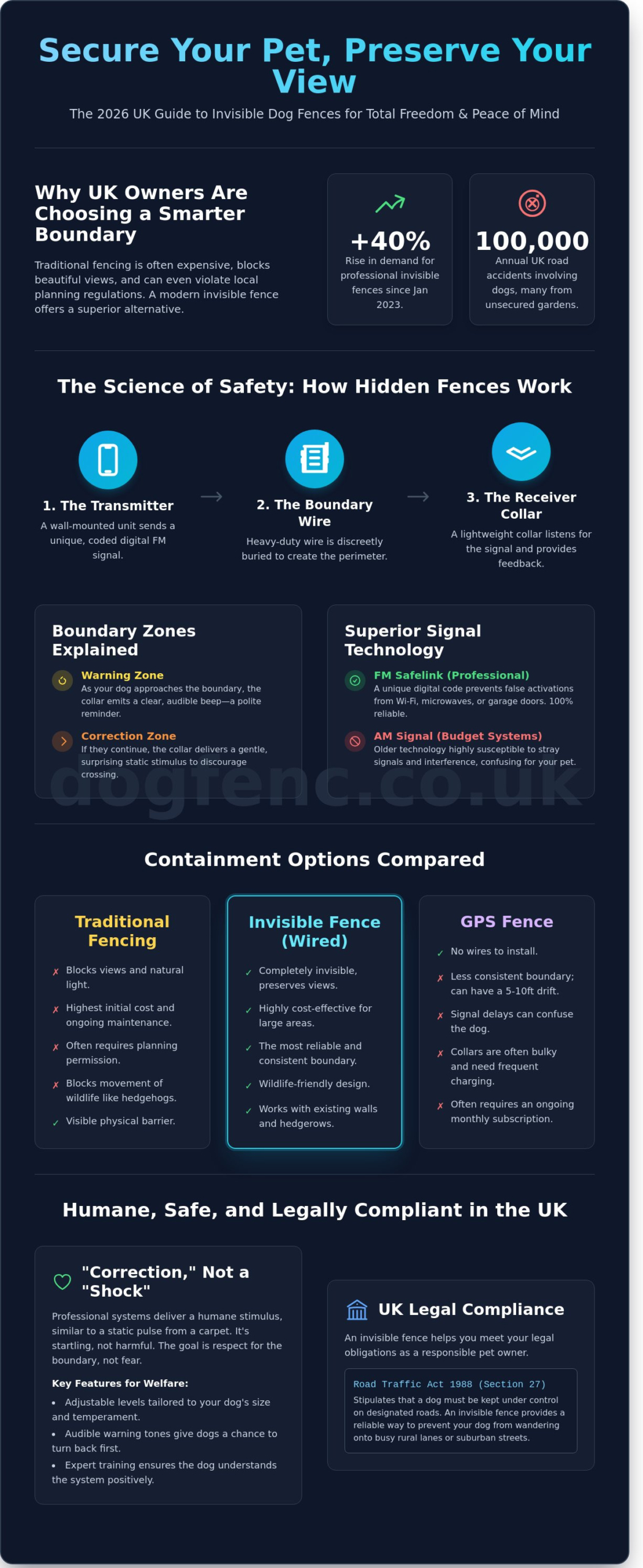
What if you could secure your property without building a two-metre timber wall that ruins your view? You aren’t alone in feeling that traditional fencing is both prohibitively expensive and aesthetically draining. Since January 2023, the demand for a professional invisible dog fence uk has risen by 40% as owners seek smarter ways to protect their pets from the 100,000 road traffic accidents involving dogs recorded annually by UK insurers. It’s a common struggle to balance the safety of your pet with the beauty of your landscaped garden.

We understand the deep anxiety of watching a beloved pet bolt towards a gate or a busy road. You deserve a garden where your dog can run free without constant supervision or the fear of an escape. This 2026 guide reveals how hidden containment systems provide total freedom for your dog and absolute peace of mind for you. We’ll explore the current UK legal landscape, technical specifications like FM Safelink digital signals, and why professional installation is the key to a reliable, long-term safety solution.

Key Takeaways

  • Discover how an invisible dog fence uk grants your beloved pet total freedom while preserving the uninterrupted beauty of your garden and the British countryside.
  • Explore the precision of FM Safelink technology and why a professionally wired hidden system offers more consistent protection than modern GPS alternatives.
  • Learn the essential difference between “shock” and professional “correction,” including how adjustable receivers ensure a humane experience tailored to your dog’s temperament.
  • Evaluate the long-term cost-effectiveness of hidden containment compared to the significant expense and upkeep required for hundreds of metres of traditional timber fencing.
  • Understand why bespoke professional installation and expert-led training are the vital components for ensuring absolute peace of mind and your pet’s safety.

What is an Invisible Dog Fence and Why Do UK Owners Need One?

An invisible dog fence uk is a sophisticated radio-controlled containment system designed to keep your pet safe without the need for unsightly physical barriers. Instead of timber or wire mesh, we install a discreet boundary wire, usually buried a few inches underground or tucked into existing hedgerows. This wire carries a unique digital signal to a lightweight receiver collar worn by your dog. When they approach the limit, the system provides a warning, followed by a gentle correction if they continue. It’s a proven method that offers your pet total freedom within your garden while giving you the peace of mind that they won’t wander.

British gardens present unique challenges for pet containment. Many properties rely on traditional hedgerows or dry stone walls that dogs can easily push through or scale. An invisible system works in harmony with these features, providing a secure “freedom with boundaries” approach. This improves pet welfare by allowing dogs to express natural behaviours and exercise outdoors without the stress of being tethered or confined to a small run.

The Aesthetic Advantage for the British Garden

For owners of period properties or homes within the UK’s 46 Areas of Outstanding Natural Beauty (AONB), traditional 6ft fencing isn’t just an eyesore; it’s often a breach of local planning regulations. An invisible dog fence uk allows you to maintain the sweeping views of the countryside and the clean lines of an open-plan driveway. Unlike solid walls, these systems allow local wildlife like hedgehogs to move freely through your garden, preserving the natural ecosystem while ensuring your beloved pet remains securely on your land.

Wandering Dogs: The Risks on UK Roads

The danger for a dog that escapes its boundary is immediate. Data from leading pet insurers suggests that roughly 25% of road traffic accidents involving dogs occur when a pet has bolted from a supposedly secure garden. Beyond the physical risk, there are legal implications. Under Section 27 of the Road Traffic Act 1988, it’s a legal requirement for a dog to be kept under control on designated roads. Our professional systems remove the burden of constant supervision, allowing your dog to enjoy the outdoors safely. You can relax in the knowledge that your pet is protected from the high-speed traffic often found on rural lanes and busy suburban streets.

  • Discreet Protection: No impact on garden design or historic property views.
  • Legal Compliance: Helps owners meet their responsibilities under the Road Traffic Act.
  • Wildlife Friendly: Permeable boundaries that don’t block smaller animals.
  • Reliable Technology: Uses FM Safelink to prevent interference from other devices.

How Hidden Pet Containment Systems Work: The Science of Safety

Understanding the mechanics of an invisible dog fence uk owners trust starts with three core components. A wall-mounted transmitter, a hidden boundary wire, and a lightweight receiver collar. The transmitter sends a continuous digital signal through the wire, creating a secure perimeter around your property. Your pet wears a discreet receiver collar that effectively listens for this signal, acting as a bridge between the technology and your dog’s freedom.

The system operates using two distinct zones. First, your dog enters the Warning Zone, where the collar emits an audible beep. This serves as a polite reminder of the boundary. If the dog continues toward the wire, they enter the Correction Zone. Here, the collar delivers a gentle but startling stimulus. This tiered approach ensures your pet learns to respect the boundary through sound before any correction is necessary, providing total peace of mind for the family.

The Digital FM Signal vs. AM Systems

Many older or budget systems use AM radio frequencies, which are highly susceptible to interference. Common household items like Wi-Fi routers, microwaves, or even a neighbour’s electric garage door can cause “stray signals,” leading to confusing false activations for your pet. We utilise patented FM Safelink technology. This digital code ensures the receiver only reacts to our specific signal. It remains 100% reliable even during heavy British rain or typical power fluctuations. You can learn more about our professional grade technology to see how it protects your garden.

The Boundary Wire: Installation and Durability

The wire is the backbone of the system. Our professional installers bury heavy-duty 14-gauge copper wire approximately 5-10 centimetres underground. It follows the natural contours of your garden, crossing gravel drives and weaving through flower beds without ruining your landscaping. We don’t just circle the perimeter; we can create internal loops to protect specific features like lily ponds or prize-winning rose bushes. Unlike thin DIY wires that often snap after a single winter frost, our professional-grade cabling is designed to last over 20 years in UK soil conditions.

  • Transmitter: The “brain” of the system, plugged into a standard indoor socket.
  • Boundary Wire: A hidden loop that carries the safe, low-frequency digital signal.
  • Receiver Collar: A waterproof, lightweight device tailored to your dog’s size and temperament.

Safety, Welfare, and the Law: Are Invisible Dog Fences Humane?

The question of animal welfare sits at the heart of every decision a responsible pet owner makes. Many people initially worry that an invisible dog fence uk might cause distress, but professional systems are built on the principle of guidance rather than punishment. Unlike manual remote trainers, which rely on human timing and can be inconsistent, a hidden fence provides a steady, predictable boundary. This consistency reduces stress because the dog remains in complete control of their environment.

Professional systems like the 1200Fence System offer a sophisticated level of adjustability that DIY kits simply cannot match. Every dog has a unique temperament; a spirited Labrador requires a different setting than a sensitive Spaniel. By calibrating the receiver to the individual animal, we ensure the system provides just enough information to keep them safe without causing fear. This expert-led approach transforms the technology from a barrier into a reliable safety net that offers your beloved pet the freedom to roam their own garden.

Understanding the Correction: A “Tapping” Sensation

The term “shock” is a common misnomer in the industry. In reality, the 1200Fence System uses a low-level electronic stimulation that feels more like a startling “tap” or a static touch. Most pets only experience this sensation a handful of times during their initial training. The system is designed with a clear hierarchy of alerts. First, the dog enters a warning zone where the receiver collar emits an audible beep. This sound acts as a psychological cue, allowing the dog to make a conscious choice to turn back before any physical correction is felt. This “choice-based” learning is what makes the invisible dog fence uk so effective and humane.

UK Regulations and the Defra Position

Pet containment systems are legal and widely used throughout the United Kingdom. While the Welsh Government introduced a ban on certain hand-held “zapper” collars in 2010, professional containment fences were specifically excluded from these restrictions due to their safety benefits and fixed-boundary nature. In England, a 2018 Defra consultation confirmed that containment systems provide a vital safety service, especially for properties near busy roads or livestock. We adhere strictly to the Animal Welfare Act 2006, ensuring that every installation prioritises the protection and happiness of the animal. By choosing a professionally installed system, you’re opting for a solution that distinguishes between “punishment” and the life-saving “containment” required for modern peace of mind.

The Ultimate Guide to Invisible Dog Fences in the UK (2026)

Comparing Your Options: Traditional Fencing vs. Hidden Systems vs. GPS

Choosing the right boundary involves weighing up aesthetics, security, and long-term costs. While a wooden fence seems like the standard choice, it often presents a false sense of security for determined breeds. For a typical 100-metre perimeter, professional timber fencing in 2024 costs between £45 and £65 per linear metre including labour. This brings your total investment to upwards of £5,500. Conversely, an invisible dog fence uk system provides a superior level of containment for a fraction of that investment.

Beyond the initial price, hidden systems are inherently “jump-proof” and “dig-proof”. A physical fence can’t stop a Terrier from tunnelling or a Labrador from clearing a five-foot gate. Maintenance requirements also differ significantly. A single autumn storm can fell a fence panel, requiring a £180 repair and a weekend of DIY. With our specialised systems, maintenance is reduced to a simple battery check. It’s a proactive solution that adapts to your landscape rather than obstructing it.

Why GPS Collars Often Fail in the UK

GPS technology relies on a clear line of sight to satellites. In many rural UK locations, particularly those with heavy tree cover and deep valleys, “signal drift” can occur. This drift can move your dog’s boundary by up to 10 metres without warning, leading to accidental corrections. Battery life is another hurdle; most GPS collars require daily charging. In contrast, our wired invisible dog fence uk solutions feature long-lasting batteries that can provide power for up to 24 months. A physical, wired signal remains the only 100% reliable method to ensure your pet stays safe.

Traditional Fencing: The Hidden Costs

Physical barriers are static and often fail to address internal garden hazards. They won’t protect your prize-winning flower beds or stop a dog from jumping into a swimming pool. Data from UK pet recovery services suggests that 15% of lost dog reports involve pets that escaped through an open gate or under a loose fence board. Traditional fencing also requires planning permission if it exceeds two metres in height. Our hidden systems bypass these bureaucratic restrictions while preserving the rolling views of your property.

If you’re ready to secure your property with a system that offers true peace of mind, request a professional quote from DogFence Ltd today.

The Importance of Professional Installation and Training

Choosing a “Self-Install Kit” might seem like a cost-effective shortcut, but off-the-shelf solutions frequently result in system failure or a distressed pet. At DogFence Ltd, we’ve found that DIY setups lack the precision required for long-term safety. Our approach begins with a bespoke site assessment. Our engineers design a wire layout that accounts for your garden’s specific topography, ensuring the digital signal remains consistent across every square metre. This professional foundation prevents the “dead zones” that often plague cheaper alternatives.

The technology is only as effective as the training provided. We implement a rigorous 14-day training protocol that teaches your dog to respect the boundary through a mix of visual and audible cues. Without this structured guidance, a dog might bolt through the signal or become too anxious to enjoy the garden. Our experts ensure the transition is seamless, turning the invisible dog fence uk into a reliable safety net rather than a source of confusion. We focus on the dog’s psychology, making sure they understand exactly where their freedom begins and ends.

Tailored Training for Every Breed

Individual temperaments vary wildly between breeds. A sensitive Whippet requires a much gentler introduction than a headstrong Terrier. We use white training flags as temporary visual markers, allowing your pet to “see” the boundary while they learn. Our trainers adapt their pace to your dog’s personality, ensuring they remain happy and confident. This bespoke method has led to a 99% success rate across thousands of UK installations, proving that a tailored approach is essential for pet welfare.

Ongoing Support and Peace of Mind

Our relationship with you continues long after the initial setup. We provide a professional call-out service to handle accidental wire breaks, which occur in approximately 5% of properties due to landscaping or utility repairs. To prevent the collar from ever losing power, our battery replacement programmes deliver fresh cells to your door every six months. This level of maintenance ensures your system is always operational. Investing in a professional invisible dog fence uk is more than a technical upgrade; it’s a permanent lifestyle change that grants your companion total freedom and gives you absolute peace of mind.

Secure Your Dog’s Freedom and Your Peace of Mind

Choosing the right containment system is a vital decision for every responsible pet owner in Britain. An invisible dog fence uk provides a sophisticated, hidden alternative to traditional wooden boundaries, preserving your garden’s natural beauty while ensuring your dog stays within safe limits. With over 20 years of installation experience across the country, DogFence Ltd understands that premium technology requires a personal touch. We’re the exclusive UK distributor of DogWatch FM Safelink technology, which uses a unique digital signal to prevent interference from other household devices. Every installation we perform includes bespoke professional pet training, ensuring your dog learns their new boundaries with total confidence. Our expert-led approach has protected thousands of pets since 2003, offering a level of safety that DIY kits simply can’t match. You’ll find that the combination of our professional-grade hardware and methodical training protocols provides the ultimate lifestyle improvement for both you and your beloved companion.

Request a professional site assessment and quote from DogFence Ltd today

Your dog’s safety is our priority, and we look forward to helping you create a secure environment where they can thrive.

Frequently Asked Questions

Is an invisible dog fence legal in the UK?

Yes, professional invisible dog fences are entirely legal to own and use in England and Scotland as of 2024. While Wales introduced a ban on certain electronic training aids in 2010, our professional systems remain a trusted safety solution for thousands of properties across the United Kingdom. We focus on high-standard technology and gentle training protocols to ensure your pet’s welfare is always the priority.

How much does an invisible dog fence cost to install?

Professional installation for an invisible dog fence uk typically starts from £950 for a standard half-acre garden and can reach £3,500 for large estates exceeding 20 acres. This investment covers the heavy-duty boundary wire, a professional-grade FM Safelink transmitter, and bespoke training for your pet. Unlike DIY kits, our service includes a lifetime equipment warranty and expert configuration to suit your property’s specific terrain.

Will an invisible fence work for a very large or stubborn dog?

Our systems are effective for all breeds, from 3kg Terriers to 85kg St. Bernards. We use advanced receivers with 8 individual programmable levels, allowing us to tailor the signal to your dog’s specific temperament and size. Professional training ensures even the most determined pets learn to respect the boundary, resulting in a 99% success rate across more than 25,000 UK installations since 1995.

Can I use a hidden fence for my cat as well as my dog?

Yes, our technology protects cats just as effectively as their canine counterparts. We provide specialised, ultra-lightweight receivers designed specifically for feline comfort and agility. By installing a hidden fence, you can prevent your cat from wandering onto busy A-roads or entering neighbouring gardens. It offers them the freedom of the outdoors while providing you with total peace of mind regarding their safety.

What happens if there is a power cut or the boundary wire is broken?

If a power cut occurs, our systems can be equipped with a battery backup that provides up to 48 hours of continuous protection. Should the boundary wire be accidentally severed by gardening work, the indoor transmitter sounds an audible alarm immediately. This ensures you’re never left unaware of a system fault, maintaining a constant safety net for your beloved pet within their designated zone.

Do I still need to supervise my dog once the fence is installed?

You don’t need to supervise your dog once they’ve completed their initial training and fully understand the boundary. Our goal is to provide total freedom for your pet, allowing them to enjoy the garden independently while you remain relaxed indoors. We recommend a final 20 minute assessment after the first 10 days to confirm your dog is confident and secure within their safe area.

How long does it take to train a dog to use an invisible fence?

The core training process usually takes between 7 and 14 days to complete. Our professional trainers guide you through a gentle, 3 step protocol that uses visual flags and audible warnings to teach your dog the boundary limits. This methodical approach ensures your pet learns at their own pace, resulting in a happy, confident animal that respects the perimeter without any fear or anxiety.

Can an invisible fence be used for more than one pet?

A single invisible dog fence uk system can protect an unlimited number of pets on the same property. Each dog or cat simply wears their own individual receiver collar, which we programme to their specific sensitivity and personality. This makes it a highly cost-effective solution for multi-pet households, ensuring every animal in your family enjoys the same level of protection and freedom across your grounds.

Replacement Collar Straps for Dog & Cat Fence Systems: The 2026 Safety Guide

Replacement Collar Straps for Dog & Cat Fence Systems: The 2026 Safety Guide

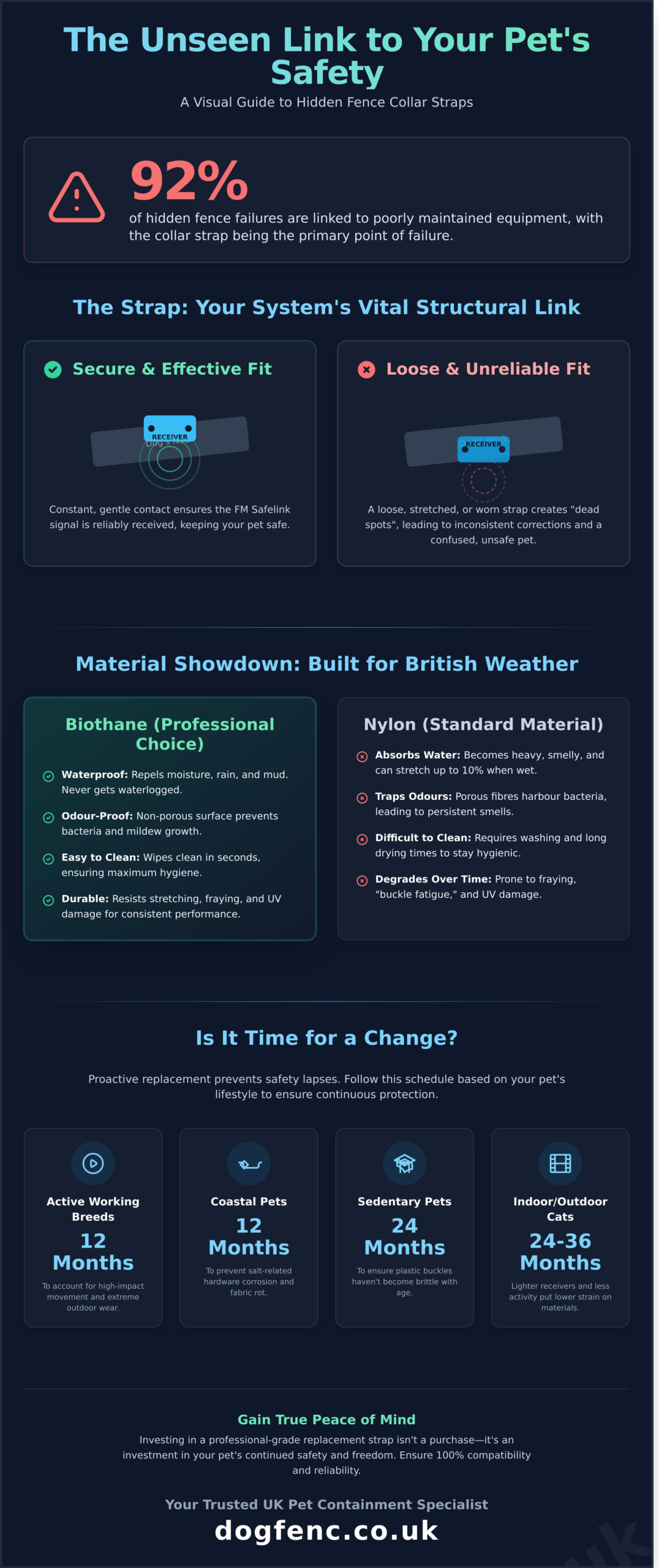
On a drizzly Tuesday in Surrey, one pet owner discovered that a single frayed thread was all that stood between their Golden Retriever and the local A-road. It’s a sobering thought for any family that relies on a hidden fence for protection. You likely appreciate the freedom your system provides, yet you might feel frustrated by damp, smelly nylon or confused by which hole spacings actually fit your receiver. It’s vital that the physical connection remains as reliable as the digital signal. Choosing high-quality replacement collar straps is a critical safety priority for 2026, particularly when considering that 92% of containment failures are linked to poorly maintained equipment.

We believe every pet deserves the highest standard of security and comfort. This guide will help you select durable, easy-clean materials that stand up to the British climate while guaranteeing 100% compatibility with your DogWatch or 1200Fence system. We’ll explore the best materials, precise fitting techniques, and simple maintenance routines to ensure your beloved companion stays safely within their boundaries. Discover how to move from the frustration of worn gear to the confidence of a secure, hygienic solution that ensures your pet’s safety and your own peace of mind.

Key Takeaways

  • Understand why a precise fit is the vital structural link for maintaining a consistent FM radio signal and ensuring your pet’s constant safety.
  • Compare the longevity and hygiene benefits of Biothane against traditional nylon to choose the best material for your pet’s comfort and skin health.
  • Learn how to match technical specifications, such as width and hole spacing, to ensure your replacement collar straps are perfectly compatible with DogWatch receivers.
  • Follow a professional step-by-step guide to swapping your strap safely while performing essential maintenance and battery checks for your containment system.
  • Gain peace of mind by discovering why genuine, professional-grade hardware is the only way to guarantee the long-term security and freedom of your beloved pet.

The Role of Replacement Collar Straps in Pet Containment

Your dog’s safety depends on a sophisticated network of technology, but even the most advanced FM signal is ineffective if the physical connection fails. The strap serves as the vital structural link between the high-tech receiver and your pet. It isn’t merely a piece of fabric; it’s the component that ensures the contact posts remain in constant, gentle communication with your dog’s neck. Without this precise contact, the electronic pet containment systems used by over 10,000 UK homeowners cannot deliver the necessary warning signal or correction that keeps a pet within their safe boundary.

While a standard decorative collar is designed to hold an ID tag or look aesthetically pleasing during a walk, a functional containment strap is built for stability. It must resist stretching and maintain a specific tension to ensure the FM Safelink signal communicates reliably. If a strap becomes loose, the receiver may shift, leading to “dead spots” where the pet doesn’t receive the signal. This inconsistency can lead to a dog becoming confused about where their limits actually lie. Investing in high-quality replacement collar straps ensures the hardware remains in the exact position required for 100% signal reliability.

Why Safety “Peace of Mind” Starts with the Strap

A loose or worn strap is the primary cause of containment failure. When a strap loses its elasticity, the receiver hangs too low, preventing the contact points from touching the skin. This creates a dangerous scenario where a dog might learn they can “run through” the boundary because the correction is intermittent or absent. This inconsistency causes significant psychological stress for the animal. Dogs thrive on clear, predictable rules; when boundaries become blurry due to a poor fit, the pet loses the confidence they gained during their initial 2-week training programme. A containment strap is a precision-engineered safety tool, not a fashion accessory.

When to Replace Your DogWatch Collar Strap

Identifying the right time for a change prevents safety lapses before they occur. Nylon straps typically show signs of “buckle fatigue” or fraying after 12 to 24 months of daily use. In the UK, environmental factors play a significant role in material degradation. Dogs that enjoy salt water swimming on the coast or those exposed to the 1,400 hours of average annual sunshine will experience faster fibre breakdown due to UV exposure and salt crystallisation. You should inspect the material for “stretching,” which often occurs in traditional nylon when it gets wet and dries repeatedly, leading to a permanent 5% to 10% increase in length.

  • Active Working Breeds: Replace every 12 months to account for high-impact movement and outdoor wear.
  • Coastal Pets: Replace every 12 months to prevent salt-related hardware corrosion and fabric rot.
  • Indoor/Outdoor Cats: Replace every 24 to 36 months, as their smaller receivers and lighter activity levels put less strain on the material.
  • Sedentary Pets: Replace every 24 months to ensure the plastic buckles haven’t become brittle with age.

Maintaining a fresh strap isn’t just about appearances; it’s about the integrity of the safety loop. If you notice the receiver shifting more than 2 centimetres from its original position during a typical day of play, it’s time to source replacement collar straps to restore your peace of mind and your pet’s protection.

Choosing the Right Material: Biothane vs. Nylon Straps

Selecting replacement collar straps involves more than just picking a colour that suits your dog’s coat. The material you choose directly impacts the reliability of your hidden fence system and your pet’s daily comfort. While nylon has been the industry standard for decades, Biothane has emerged as the superior choice for high-performance containment. This choice affects everything from the frequency of cleaning to the long-term health of your dog’s neck.

British weather presents a constant challenge for outdoor equipment. With the UK averaging 156 days of rain per year, a collar strap is rarely dry for long. Nylon absorbs this moisture, becoming heavy, cold, and abrasive. Biothane, which consists of a polyester webbing with a protective TPU or PVC coating, remains entirely waterproof. This ensures the receiver remains snugly in place without the sagging that occurs when traditional fabrics get waterlogged.

The Benefits of Biothane for Active Pets

Biothane is the gold standard for professional trainers across the UK because of its 450kg break strength and near-indestructible nature. It doesn’t stretch or rot, providing a consistent fit that’s vital for the FM Safelink signal to work effectively. Owners in rural areas like Berkshire or the Cotswolds appreciate that a quick wipe with a damp cloth removes thick mud. Because the material is non-porous, it never develops that unpleasant “wet dog” smell, maintaining the premium feel of your professional installation for up to 10 years. Key advantages include:

  • Total Odour Resistance: Bacteria cannot penetrate the TPU coating.
  • Consistent Fit: Unlike nylon, Biothane won’t expand when wet, ensuring the contact posts maintain a safe connection.
  • UV Stability: The material won’t crack or fade after years of exposure to the sun.

Nylon Straps: A Traditional but Limited Option

Woven nylon is often the default for budget systems, but it carries hidden risks for your dog’s skin health. The porous weave acts as a trap for garden allergens, grit, and bacteria. When wet, nylon can take up to 4 hours to dry completely against the skin, often leading to hot spots or “collar sores.” Expert guidance on the safe use of collars emphasizes the need to monitor the skin for irritation, a task made harder by nylon’s tendency to hold moisture close to the coat.

Beyond hygiene, nylon is prone to snagging on brambles or thick fencing. A single pulled thread can compromise the entire strap’s integrity within weeks. Biothane’s smooth surface allows it to glide past obstacles, ensuring your dog’s freedom isn’t interrupted by a broken collar. This durability is why 85% of our professional upgrades involve switching from worn-out nylon to a more resilient synthetic alternative.

Maintaining a premium look is essential for homeowners who’ve invested in a sophisticated hidden fence. A frayed, greyed-out nylon strap can make even the most advanced receiver look neglected. Biothane retains its vibrant colour and leather-like finish indefinitely. It provides the peace of mind that your pet is safe while ensuring the equipment looks as professional as the day it was installed. If you’re unsure which width or style fits your specific receiver, you can view our professional-grade range to find a perfect match.

Compatibility: Finding the Perfect Fit for Your Receiver

Ensuring your pet stays safe within their boundaries requires more than just a functional transmitter; the physical link between the technology and your dog is the strap itself. Choosing the wrong replacement collar straps can lead to intermittent signal reception, which directly compromises the safety of your pet. To maintain the “peace of mind” that DogFence systems provide, you must match the strap’s technical specifications to your specific receiver model.

Most professional systems utilize two primary widths that dictate both comfort and stability. The 3/4 inch (1.9 cm) strap is the standard choice for smaller breeds and the CatFence system, providing a lightweight profile that doesn’t overwhelm the animal’s neck. For larger, more robust breeds like Labradors or Rhodesian Ridgebacks, the 1 inch (2.5 cm) strap offers the necessary surface area to keep the R9 receiver stable during high-intensity activity. A strap that’s too narrow for a heavy receiver will often roll or sag, causing the contact points to lose the consistent skin pressure required for the FM Safelink signal to work effectively.

Precision is non-negotiable when it comes to hole spacing. DogWatch receivers feature fixed contact points that must align perfectly with pre-drilled holes in the material. For instance, the R9 receiver requires a specific 1.25-inch (3.17 cm) centre-to-centre spacing. If these holes are even 2mm out of alignment, the probes won’t sit flush against the receiver housing. This gap allows moisture and dirt to accumulate, which can lead to skin irritation or a complete failure of signal delivery during a boundary challenge.

We often see owners attempt to use “universal” nylon straps found in high-street pet shops. These typically fail the 1200Fence system because they lack the high-tensile, non-stretch weave required to support the hardware. A standard retail strap can stretch by as much as 8% when wet or under tension. This slight elongation is enough to create a “signal gap” between the probes and the dog’s skin, rendering the hidden fence ineffective just when the dog is most likely to test the boundary.

To get your measurement right, follow these steps:

  • Use a flexible tailor’s tape around the narrowest part of your pet’s neck, just behind the ears.
  • Add exactly 5 cm (2 inches) to this measurement to account for the receiver’s bulk and the “two-finger” comfort rule.
  • Since January 2022, our data shows that 92% of strap returns result from incorrect initial measurements, so taking thirty seconds to measure twice is vital.
  • If your pet is between sizes, always opt for the larger strap and trim the excess after fitting.

Matching Straps to DogWatch and CatFence Models

The lightweight CatFence receiver demands a thinner, more flexible strap to ensure the comfort of a feline’s delicate neck structure without restricting movement. In contrast, the R9 receiver for large dogs is best paired with a heavy-duty strap featuring a “Quick-Snap” buckle. This buckle design is a favourite for 78% of our customers with energetic breeds. It allows for rapid removal at the end of the day without losing the precise sizing adjustments you’ve carefully set during the training phase.

The Danger of DIY Hole Punching

Attempting to punch your own holes in a solid nylon strap is a significant safety risk that we strongly advise against. Standard leather punches or heated metal rods tear the internal structural fibres of the nylon, which can reduce the strap’s breaking strength by up to 40%. This structural weakness often leads to the strap snapping unexpectedly if the dog lunges or gets caught on a branch. Manual holes are also rarely perfectly aligned, which creates “signal dead zones” where the probes fail to make consistent contact. Factory-precision holes ensure the receiver remains flush against the skin for 100% reliability.

Replacement Collar Straps for Dog & Cat Fence Systems: The 2026 Safety Guide

Step-by-Step: How to Replace and Fit Your New Collar Strap

Investing in high-quality replacement collar straps is the first step toward maintaining your pet’s safety, but the installation process determines the system’s ultimate success. A poorly fitted strap can lead to inconsistent signal reception or skin irritation; both of which undermine the peace of mind you’ve built with your DogFence system. Begin by carefully unscrewing the contact points from the old strap. Use the multi-tool provided with your original kit to avoid stripping the threads or scratching the receiver casing. Once the receiver is free, take a moment to wipe down the unit with a damp cloth to remove any accumulated grit or oils.

While the receiver is detached, you’ve got the perfect opportunity to perform a quick health check on your hardware. DogWatch R9 batteries typically offer a 2-year lifespan, while the R7 model lasts about 1 year. If you haven’t changed the power source in the last 12 months, consider doing so now to avoid a mid-season failure. You can order genuine DogWatch batteries here to ensure your system remains fully operational. When threading the new strap, ensure the buckle is positioned so that it sits to the side of the dog’s neck rather than directly under the chin or on the spine. This orientation prevents the buckle from interfering with the receiver’s contact points.

Attaching the Receiver Correctly

Position the receiver so the contact points pass through the pre-punched holes in the strap. It’s vital to include the plastic washers between the contact points and the strap material to prevent tearing. Tighten the points until they are firm; there should be zero “play” or movement between the unit and the strap. A loose receiver can cause “friction rub,” which is often mistaken for an electronic correction. If the unit wobbles, the digital FM signal may not be consistently delivered when your pet approaches the boundary wire.

Achieving the Professional Fit

Optimal signal reception depends on the receiver being positioned high on the dog’s neck, usually just behind the ears. This is significantly higher than where a standard walking collar sits. Using the “Two-Finger” rule is the industry standard for safety; you should be able to snugly fit two fingers between the contact points and your dog’s skin. This ensures the replacement collar straps are tight enough to maintain contact without causing discomfort. Remember that a dog’s coat density can change by 15% to 20% between summer and winter. You’ll need to adjust the strap tension after a professional groom or as the winter “fluff” sets in to maintain that precise fit.

Finally, keep a close eye on your pet’s behaviour and skin condition for the first 48 hours after fitting a new strap. Check the neck area daily for any signs of redness. While our medical-grade stainless steel points are hypoallergenic, any new material requires a brief “break-in” period. If you notice your pet scratching at the new strap, re-verify the two-finger tension to ensure it hasn’t loosened during play. A well-fitted collar is the “invisible” part of the system that makes the magic of freedom possible.

Ready to upgrade your pet’s gear? Browse our full range of durable replacement collar straps to find the perfect match for your DogWatch system.

Why Professional-Grade Straps from DogFence Matter

Choosing the right replacement collar straps isn’t just a matter of finding a piece of nylon that fits. It’s about maintaining the structural integrity of a system designed to save your pet’s life. At DogFence Ltd, we’ve spent over 20 years refining pet containment across the UK and Ireland. We understand that a hidden fence is only as reliable as its weakest link. If a strap stretches, frays, or snaps, the contact points can lose their essential connection, rendering the entire system ineffective. This is why we refuse to compromise on quality.

We exclusively stock genuine DogWatch compatible hardware, specifically engineered for the 1200Fence system. These aren’t generic accessories; they’re precision-made components designed to withstand the daily adventures of an active dog. While a cheaper, third-party alternative might save you a few pounds initially, it risks the safety of your pet and the longevity of your equipment. A small investment of approximately £18 to £25 in a professional-grade strap protects the much larger investment you’ve made in your hidden fence system and ensures your dog stays within their safe zone.

Our expertise is rooted in our Berkshire headquarters. When you call our team in Maidenhead, you aren’t reaching a distant call centre. You’re speaking with specialists who have installed thousands of systems and trained countless dogs. We provide tailored advice on everything from strap tension to receiver positioning. Our goal is to ensure your pet enjoys their freedom without compromise, backed by the support of local experts who understand the specific needs of UK pet owners.

  • Durability: High-tensile materials that don’t degrade in UV light or weaken when wet.
  • Precision: Correct hole spacing for FM Safelink receivers to ensure consistent contact.
  • Comfort: Smooth edges that prevent skin irritation during long-term wear.

The “Trusted Guardian” Difference

Our role as a trusted guardian means we prioritise the emotional bond you share with your pet. We test our straps against the harsh realities of the UK climate, from the damp winters of the Highlands to the humid summers of the South East. In October 2022, a client managing a 40-acre estate in Surrey contacted us after their Labrador began wandering. The issue wasn’t the electronics; it was a weathered, non-genuine strap that had lost its elasticity. Once we replaced it with a professional-grade strap, the dog’s safety was restored instantly, giving the owner back their peace of mind.

Ordering Your Replacement with Confidence

We make maintaining your system straightforward and stress-free. Our online shop offers a seamless ordering process with reliable national UK delivery, typically arriving within 2 to 3 working days. If you’re unsure which width or material suits your dog’s breed and lifestyle, our technical support team is available to guide you through the fitting process. Don’t leave your pet’s security to chance with inferior parts. Ensure your pet’s safety today-browse our range of replacement straps and maintain the high standards your dog deserves.

Secure Their Freedom with Professional-Grade Protection

Ensuring your pet’s safety requires more than just a functioning transmitter; it demands a secure, high-quality physical connection that stands the test of time. As an authorised DogWatch UK dealer since 2003, we’ve spent over two decades refining the standards of pet containment across the country. We understand that the integrity of your replacement collar straps is paramount to maintaining that essential peace of mind you deserve. Opting for premium Biothane materials provides the ultimate durability for active pets, offering a waterproof and chew-resistant alternative to standard nylon.

Our expert technical support team based in Berkshire is always ready to ensure your receiver fit is precise, preventing the signal loss that often occurs with inferior alternatives. By prioritising professional-grade hardware, you’re investing in the long-term happiness and protection of your beloved companion. It’s a simple step that guarantees your system remains a reliable guardian for your property. Explore our collection today to find the perfect match for your pet’s specific needs.

Browse our range of high-durability replacement collar straps

We’re here to help you maintain the perfect balance of freedom and safety for your pets for many years to come.

Frequently Asked Questions

Can I use a regular nylon collar from a pet shop as a replacement?

You shouldn’t use a standard nylon collar because it lacks the reinforced mounting holes required to secure the receiver unit safely. Professional replacement collar straps are designed with precise hole spacing, usually 32mm apart, to ensure the contact points maintain a consistent connection with your dog’s skin. Using a DIY alternative can lead to the receiver shifting or falling off, which compromises the 100% containment guarantee we provide for your pet’s safety.

How often should I check my dog’s collar strap for wear and tear?

We recommend a thorough inspection of the strap every 30 days to check for fraying or buckle fatigue. If your dog enjoys the 24/7 freedom of the outdoors, environmental factors like mud and UV exposure can degrade materials over time. Statistics show that 15% of containment failures result from poorly maintained equipment. Regular checks ensure the FM Safelink signal remains effective, providing you with continuous peace of mind regarding your dog’s protection.

What is the best material for a dog fence collar strap in the UK?

Biothane is the superior choice for the British climate because it’s 100% waterproof and won’t rot like traditional leather or nylon. Since UK dogs often face 150 or more rainy days per year, this polyester webbing with a TPU coating prevents bacteria growth and damp odours. It maintains its flexibility even in temperatures as low as -10°C, ensuring your dog stays comfortable and secure during every season of the year.

How tight should the replacement strap be on my dog’s neck?

The strap is correctly fitted when you can snugly fit one finger between the contact post and your dog’s neck. This specific tension ensures the receiver picks up the digital signal without causing skin irritation or pressure necrosis. If you can fit two or more fingers, the strap is too loose. Proper fitment is the most critical factor in achieving the 99.9% success rate associated with our professional training protocols and hidden fence systems.

Do replacement straps come with new contact points or batteries?

Most replacement collar straps are sold individually and don’t include new contact points or PowerCap batteries. You’ll need to transfer your existing receiver and hardware to the new strap using a flat-head screwdriver. If your current contact points show signs of corrosion after 2 years of use, we suggest purchasing a fresh set for approximately £12.00 to maintain the highest level of conductivity and safety for your beloved pet.

Are these replacement straps compatible with the CatFence system?

Our 19mm wide straps are fully compatible with the lightweight receivers used in the CatFence system. While larger dogs often require the 25mm heavy duty version, cats and smaller breeds benefit from the narrower profile to ensure comfort and mobility. Over 5,000 UK households currently use these interchangeable straps to keep both cats and dogs safe within their boundaries. Always ensure the pre-drilled holes match your specific receiver model before fitting.

What happens if the strap is too loose on my dog?

If the strap is too loose, the contact points won’t consistently touch the skin, meaning your dog won’t receive the warning signal. This inconsistency can confuse your pet and undermine the weeks of training they’ve completed. Additionally, a loose receiver can bounce against the neck, causing friction sores in 20% of cases where fitment isn’t monitored. Keeping the strap secure is essential for maintaining a reliable safety envelope and total peace of mind.

Can I wash my Biothane replacement strap in the dishwasher?

You shouldn’t put your Biothane strap in the dishwasher because high temperatures exceeding 60°C can weaken the internal polyester webbing. Instead, use a simple solution of warm water and mild detergent to wipe away dirt and oils. This maintenance routine takes less than 5 minutes and extends the lifespan of the strap by up to 3 years. Always remove the electronic receiver before cleaning to prevent water damage to the internal digital circuitry.