
large dog jumping over wooden garden fence

How High Should a Fence Be to Stop a Dog Jumping? (UK Guide)

How High Should a Fence Be to Stop a Dog Jumping? (UK Guide)

How high should a fence be to stop a dog jumping? In most UK homes, a fence needs to be at least 6ft high to stop an average adult dog jumping over it — but breed, motivation, and garden layout all influence the correct fence height for dogs.

If your dog is jumping over the fence, simply increasing the height may not be enough. Choosing the right fence height for dogs must go hand in hand with understanding why your dog is attempting to escape in the first place.

For broader guidance on training, boundary reinforcement and long-term prevention, see our complete guide on how to stop a dog running away.

large working dog jumping over rural garden fence


How high should a fence be to stop a dog jumping?

In most UK homes, a fence needs to be at least 6ft (1.8 metres) high to prevent an average adult dog from jumping over it. However, athletic breeds, strong prey drive, sloping ground or nearby launch points may require fencing higher than 6ft or an alternative containment solution

For most medium to large breeds:

  • 4ft fencing – suitable only for small, low-energy dogs
  • 5ft fencing – may stop many dogs, but not athletic breeds
  • 6ft fencing – generally recommended minimum for larger or active dogs
  • Over 6ft fencing – required for highly motivated or athletic escape artists

For many owners asking how high should a fence be to stop a dog jumping, 6ft is the realistic starting point — particularly for working or high-drive breeds. If you’re unsure whether 6ft is actually enough for your dog, read our guide on can a dog jump a 6ft fence? to understand the real risks.


What Is the Best Fence Height for Labrador and Other Large Breeds?

The best fence height for Labrador types and similar large breeds is typically 6ft or higher.

Labradors, Border Collies, Spaniels and other athletic breeds can clear surprising heights when sufficiently motivated. If your dog is repeatedly jumping over fence panels, the issue may be both physical ability and environmental trigger.

Creating a secure garden for large dogs often requires more than just increasing panel height.


Why Is My Dog Jumping Over the Fence?

If you are researching how high should a fence be to stop a dog jumping, your dog may already be testing boundaries.

Common reasons include:

  • Prey drive (wildlife or livestock)
  • Boredom or lack of stimulation
  • Separation anxiety
  • Seasonal behaviour
  • Learned escape patterns

If broader escape behaviour is developing, read our guide on how to stop your dog running away


What Makes Fence Height for Dogs Less Effective?

Fence height for dogs is influenced by more than vertical measurement.

Dogs can use:

  • Garden furniture
  • Raised ground
  • Sloping terrain
  • Horizontal rails
  • Stacked bins or logs

as launching platforms.

This means the effective fence height for dogs may be lower than you think.

If your dog is also digging along boundaries, see our article on how to stop dog digging under fence.

large dog jumping over wooden garden fence


Is 6ft Always Enough to Stop Dog Jumping?

Not always.

Some athletic or highly driven dogs can clear 6ft when chasing wildlife or reacting to external triggers. If the motivation remains strong, simply increasing fence height may not permanently prevent dog jumping over fence panels.


Is There an Alternative to Increasing Fence Height?

If traditional fencing isn’t practical — especially in rural or post-and-rail properties — a professionally installed electronic dog fence system creates a clearly defined boundary around your entire property.

Unlike physical panels, a containment system works by teaching your dog where the limit lies, rather than relying solely on fence height for dogs.

You can learn more about the technology in our guide on how electronic dog fences work

When introduced with structured training, most dogs quickly understand their boundary and stop attempting to jump altogether.


Final Answer: How High Should a Fence Be to Stop a Dog Jumping?

So, how high should a fence be to stop a dog jumping?

For most medium to large breeds, 6ft is the recommended minimum. However, true containment depends on motivation, environment, and consistent boundary clarity — not just height.

  • Small dogs: 4–5ft may be sufficient
  • Medium dogs: minimum 5–6ft
  • Large or athletic breeds: 6ft+ recommended
  • Highly motivated escape artists: height alone may not be enough

At DogFence, we regularly see cases where increasing fence height alone doesn’t resolve escape behaviour. When a clear perimeter is introduced and properly trained, jumping behaviour often settles — even in athletic or highly motivated dogs.

If you’d like tailored advice on creating a secure garden for large dogs, speak to our team for a free, no-obligation assessment.

Is Your Dog Jumping the Fence?

If increasing fence height isn’t stopping your dog jumping, we can help you create a properly secure boundary tailored to your property and your dog’s temperament.

Call us on
01628 476475
|
Message us on WhatsApp
|
Request a Free Quote Online

Jack Russell Terrier climbing a 6ft chain link fence with barbed wire extension demonstrating how a dog can jump or scale high fencing

Can a Dog Jump a 6ft Fence? (UK Guide)

Can a Dog Jump a 6ft Fence?

Can a dog jump a 6ft fence? Yes — many dogs can jump or climb a 6ft fence if they are sufficiently motivated.

While 6ft fencing is often recommended as a minimum height for medium and large breeds, it does not guarantee containment. Athletic ability, adrenaline, instinct and environmental triggers all play a role.

If escape behaviour is already developing, you may find our guide on how to stop your dog running away helpful.

Black athletic dog jumping over 6ft wire fence in rural UK countryside showing that 6ft fencing may not stop determined escape artists


Which Dogs Can Jump a 6ft Fence?

People often assume only large breeds can clear 6ft. In reality, smaller dogs can be just as capable — especially if they climb rather than leap.

Breeds commonly capable of jumping or scaling fencing include:

  • Border Collies
  • Labradors
  • German Shepherds
  • Huskies
  • Lurchers
  • Jack Russells
  • Spaniels

Motivation matters more than size.

Dogs may jump higher when:

  • Chasing wildlife
  • Reacting to other dogs
  • Escaping boredom
  • Experiencing separation anxiety
  • Responding to hormonal drives

If you’re considering fence height more generally, see our guide on how high should a fence be to stop a dog jumping.


A Real Example: When 6ft Wasn’t Enough

We were once asked to visit a neighbour of an existing customer who needed help with two small Jack Russell Terriers.

Their half-acre garden was completely surrounded by a 6ft chain link fence — and to make matters worse, an extension had been added to increase the height even further.

On paper, it looked escape-proof.

In reality, it wasn’t.

The owner described how, the moment the back door opened, one of the Jack Russell’s would sprint out at lightning speed, scale the chain link and be over the top within seconds. It wasn’t jumping — it was climbing.

Fortunately, his wife would often be waiting on the other side to catch the dog. But the couple were unable to let their dogs out into their own garden unless they were attached to tie-outs.

The solution wasn’t to keep raising the fence.

After installing a professionally designed electronic dog fence system and completing structured boundary training, both dogs were safely enjoying freedom within a week.

Several months later, the owner joked that “the Berlin Wall came down” — the extended fencing was removed entirely.

Height hadn’t been the real issue.

Clarity of boundary had been.

Jack Russell Terrier climbing a 6ft chain link fence with barbed wire extension demonstrating how a dog can jump or scale high fencing

AI-generated illustration showing how a dog can jump a 6ft fence — even small breeds like Jack Russells can scale chain-link fencing when highly motivated.


Why 6ft Fence for Dogs Isn’t Always Enough

Even if a dog cannot leap 6ft vertically, they may:

  • Climb chain link fencing
  • Use horizontal rails as ladders
  • Launch from raised ground
  • Push off furniture or bins

This means the effective fence height may be lower than expected.

Physical height alone does not address the motivation to leave.


How to Prevent Dog Jumping Over a 6ft Fence

To prevent dog jumping over fence panels:

  • Remove climb points
  • Increase supervision
  • Address behavioural triggers
  • Reinforce recall
  • Consider inward extensions

However, when escape behaviour is driven by strong motivation, simply increasing fence height may not permanently solve the problem. If you’re trying to determine the safest boundary height for your property, read our guide on how high a fence should be to stop a dog jumping for practical UK recommendations.


Is There an Alternative to Raising the Fence?

A professionally installed electronic dog fence system</a> creates a clear boundary regardless of panel height.

Rather than relying purely on vertical barriers, the system teaches the dog exactly where the perimeter lies. Once understood, most dogs stop testing physical fencing altogether.

You can learn more about how this works in our guide on how electronic dog fences work.


Final Answer: Can a Dog Jump a 6ft Fence?

Yes — many dogs can jump or climb a 6ft fence, especially if they are motivated.

While 6ft fencing is a strong starting point, true containment depends on behaviour, environment and boundary clarity — not height alone.

If you’d like advice tailored to your property and breed, speak to our team for a free assessment.

Is Your 6ft Fence Still Not Enough?

If your dog is jumping, climbing or clearing a 6ft fence, simply making it higher may not solve the problem. True containment comes from clear boundary training — not just panel height.

Our professionally installed electronic dog fence systems provide reliable, discreet containment for escape artists of all sizes — from determined Jack Russell’s to athletic working breeds.

Call us on
01628 476475
|
Message us on WhatsApp
|
Request a Free Quote Online

Dog sitting safely inside hedge boundary in English garden demonstrating dog proof garden setup

How to Dog Proof Your Garden Properly (UK Guide)

How to Dog Proof Your Garden

Top Tips for a Safe & Secure Outdoor Space

How to dog proof your garden properly starts with identifying risks — from escape points to toxic plants and boredom-related damage.

As dog owners, we all want our pets to enjoy outdoor freedom safely. But without the right precautions, gardens can quickly become areas of risk — whether that’s escaping, digging, chewing plants, or damaging borders.

In this guide, we’ll explore practical ways to dog proof your garden while keeping it attractive and functional.

If your dog is actively trying to escape, you may also want to read our complete guide on why dogs escape and how to stop them for good.
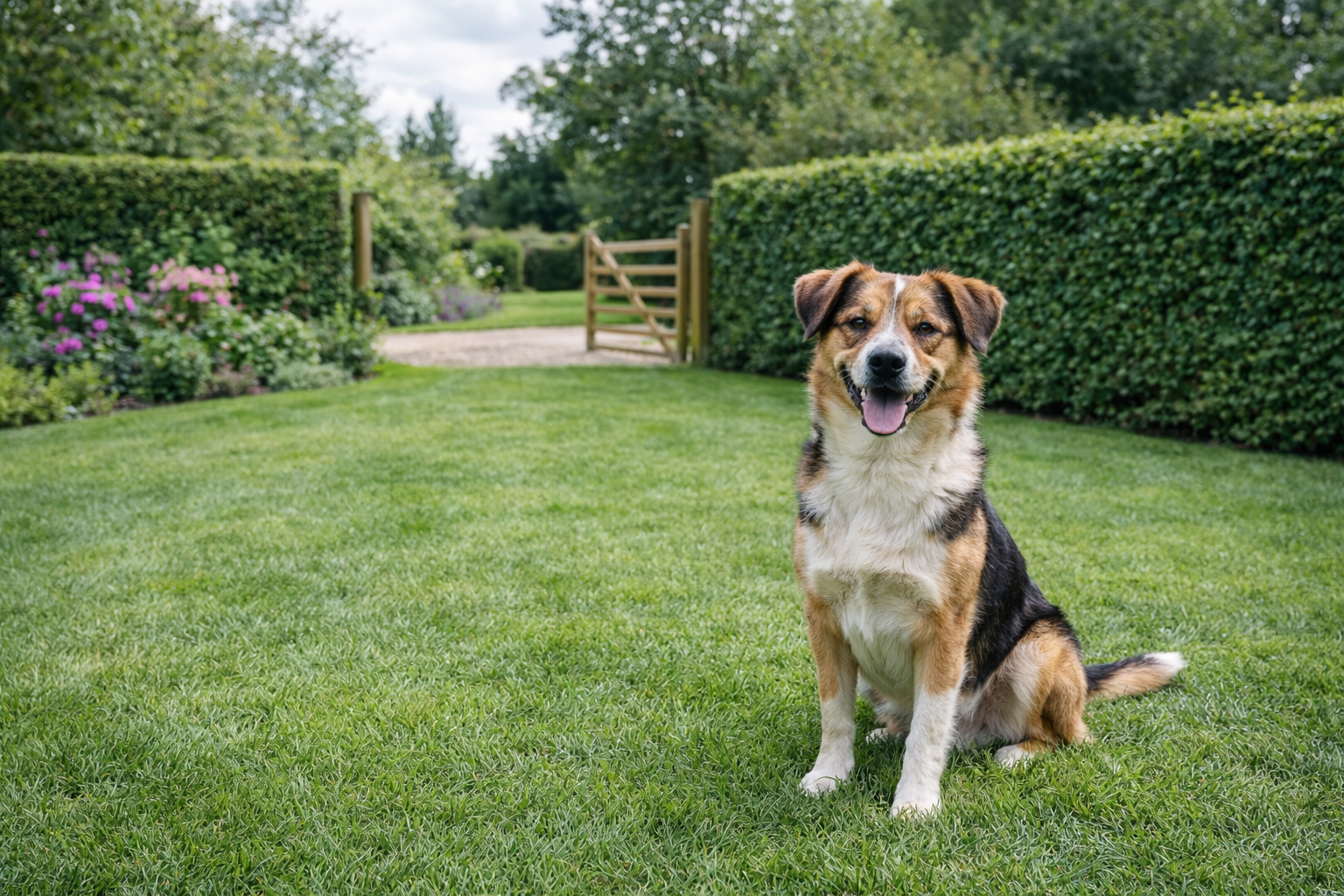
Dog sitting safely inside hedge boundary in English garden demonstrating dog proof garden setup


1. Secure Your Garden Boundaries

The first step to dog proof your garden is ensuring your boundaries are secure.

Check for:

  • Loose fence panels
  • Gaps between posts
  • Weak gate hinges
  • Gaps under fencing
  • Open driveways

For most medium to large breeds, fencing should be at least 6ft high.

If your dog is digging under fencing, see our guide on how to stop dog digging under fence

If you live in the countryside with livestock nearby, you may find our rural-specific guide on how to dog proof a rural garden in the UK more relevant.
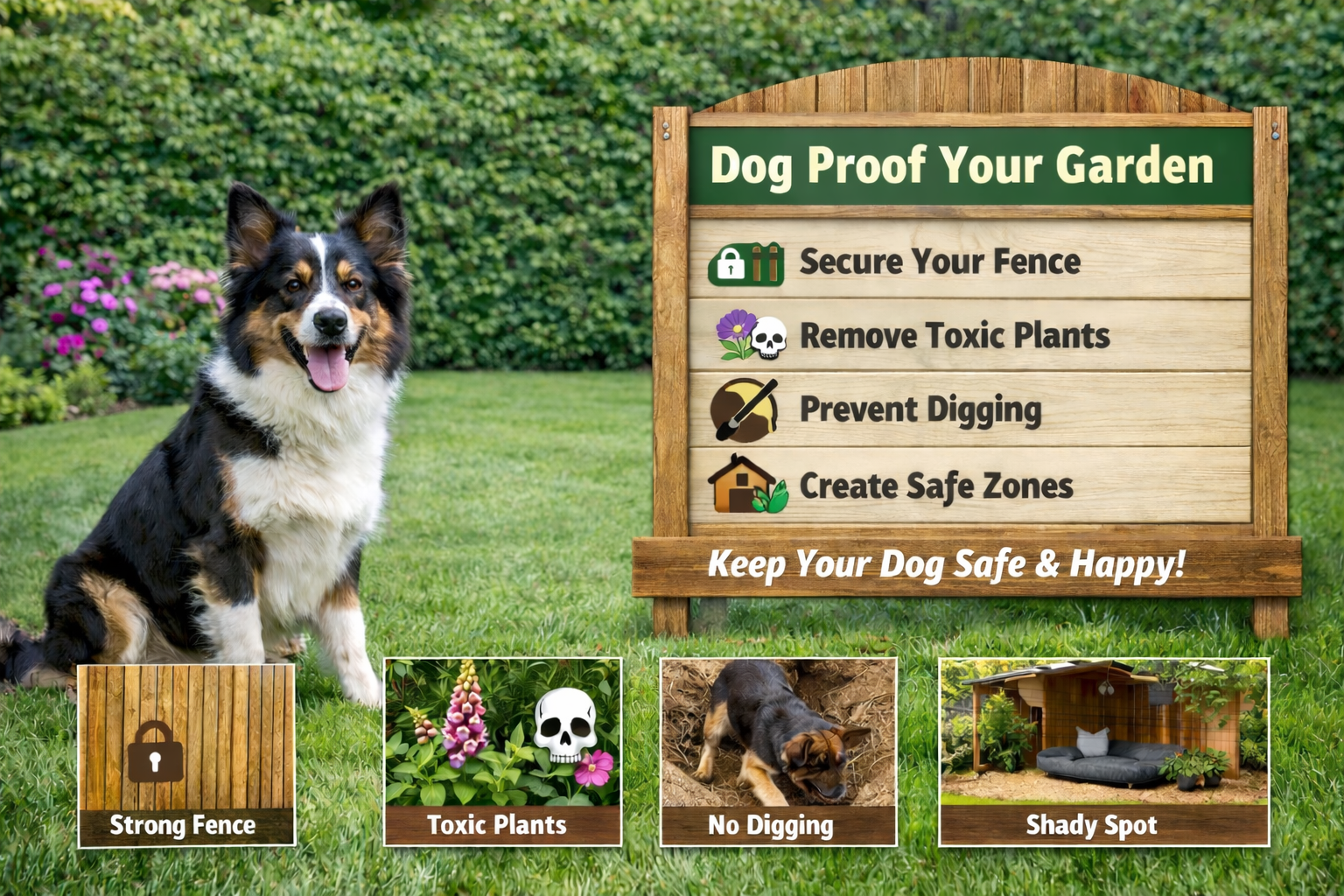
checklist sign showing ways to dog proof your garden including fencing plant safety and digging prevention


2. Prevent Digging & Garden Damage

Dogs dig for many reasons:

  • Boredom
  • Cooling down
  • Hunting
  • Attempting to escape

To reduce digging:

  • Increase daily exercise
  • Provide enrichment toys
  • Create shaded rest areas
  • Reinforce fence bases if necessary

Understanding why your dog digs is key to solving it long term.


3. Remove Hazardous Plants & Chemicals

To properly dog proof your garden, consider plant safety.

Common toxic garden plants include:

  • Foxglove
  • Yew
  • Azaleas
  • Rhododendrons
  • Daffodil bulbs

Fertilisers, slug pellets and weed killers also pose risks.

For official guidance on toxic plants for pets, the PDSA provides helpful information here:
https://www.pdsa.org.uk/pet-help-and-advice/looking-after-your-pet/poisoning/toxic-plants


4. Create Safe Zones for Play & Rest

A well-designed garden reduces destructive behaviour.

Consider:

  • Shaded areas
  • Water access
  • Defined pathways
  • Designated digging areas
  • Clear boundaries

A mentally stimulated dog is far less likely to test fencing or destroy borders.


5. Consider Containment for Extra Peace of Mind

For properties with open driveways or boundary concerns, additional containment may be worth considering.

A professionally installed electronic dog fence system can create a defined perimeter without altering your garden’s appearance.

Learn more in our guide on how electronic dog fences work.


Final Thoughts: Creating a Dog Safe Garden

To dog proof your garden effectively, combine:

  • Secure boundaries
  • Behaviour understanding
  • Plant safety
  • Enrichment

At DogFence, we’ve helped thousands of UK pet owners create safer outdoor spaces for their dogs and cats.

If you’d like tailored advice for your property, contact our team for a free, no-obligation consultation.

Ready to Dog Proof Your Garden Properly?

If you’re looking to dog proof your garden and prevent escape, digging or boundary problems, we can help you create a safe, secure outdoor space tailored to your property.

Call us on
01628 476475
|
Message us on WhatsApp
|
Request a Free Quote Online