

Tag Archive for: UK gardens

Dog Friendly Gardens UK: The Complete Guide to Safe Outdoor Spaces

Dog Friendly Gardens UK: The Complete Guide to Safe Outdoor Spaces

What if the very hedges and flowerbeds you’ve spent years nurturing are actually the biggest threat to your pet’s safety? You likely believe that your garden should be a sanctuary, yet it’s difficult to relax when you’re constantly scanning the perimeter for escape routes or checking for toxic shrubs. For those seeking the best dog friendly gardens uk wide, the challenge is often balancing a professional aesthetic with the absolute protection of your beloved companion.

We understand that you shouldn’t have to choose between a beautiful landscape and your dog’s freedom. This guide provides a definitive roadmap to creating a secure haven that offers you total peace of mind without the need for unsightly physical barriers. We’ll examine safe planting palettes to replace the 3,500 potentially harmful plant species found in the UK, delve into the mechanics of professional hidden fencing, and highlight the country’s premier public gardens that welcome four-legged visitors with open arms.

Key Takeaways

  • Learn how to design a personal sanctuary using hardy, non-toxic plants and sensory tracks that balance your dog’s natural instincts with garden aesthetics.
  • Explore the most prestigious dog friendly gardens uk has to offer, from RHS partners to National Trust estates, while mastering essential visiting etiquette.
  • Discover why traditional timber fencing often fails determined escape artists and how to protect your property’s views without installing tall, unsightly barriers.
  • Understand the technical advantages of professional hidden fence systems in providing your pet with total freedom and you with absolute peace of mind.
  • Identify the critical differences between professional containment installations and DIY kits to ensure a reliable, long-term safety solution for your beloved pet.

What Defines a Dog Friendly Garden in the UK?

A truly dog friendly garden uk is more than just a fenced-in patch of grass; it’s a carefully curated environment that prioritises a dog’s physical safety while encouraging their natural instincts. According to the 2023 PDSA Animal Wellbeing (PAW) Report, 27% of UK dog owners cited “lack of time” or “inadequate space” as barriers to exercise. A secure garden solves this by providing a personal sanctuary where pets can explore without the constraints of a lead. Whether you manage a small urban courtyard or a 10-acre country estate, the goal is to create a space that feels like a home rather than a kennel.

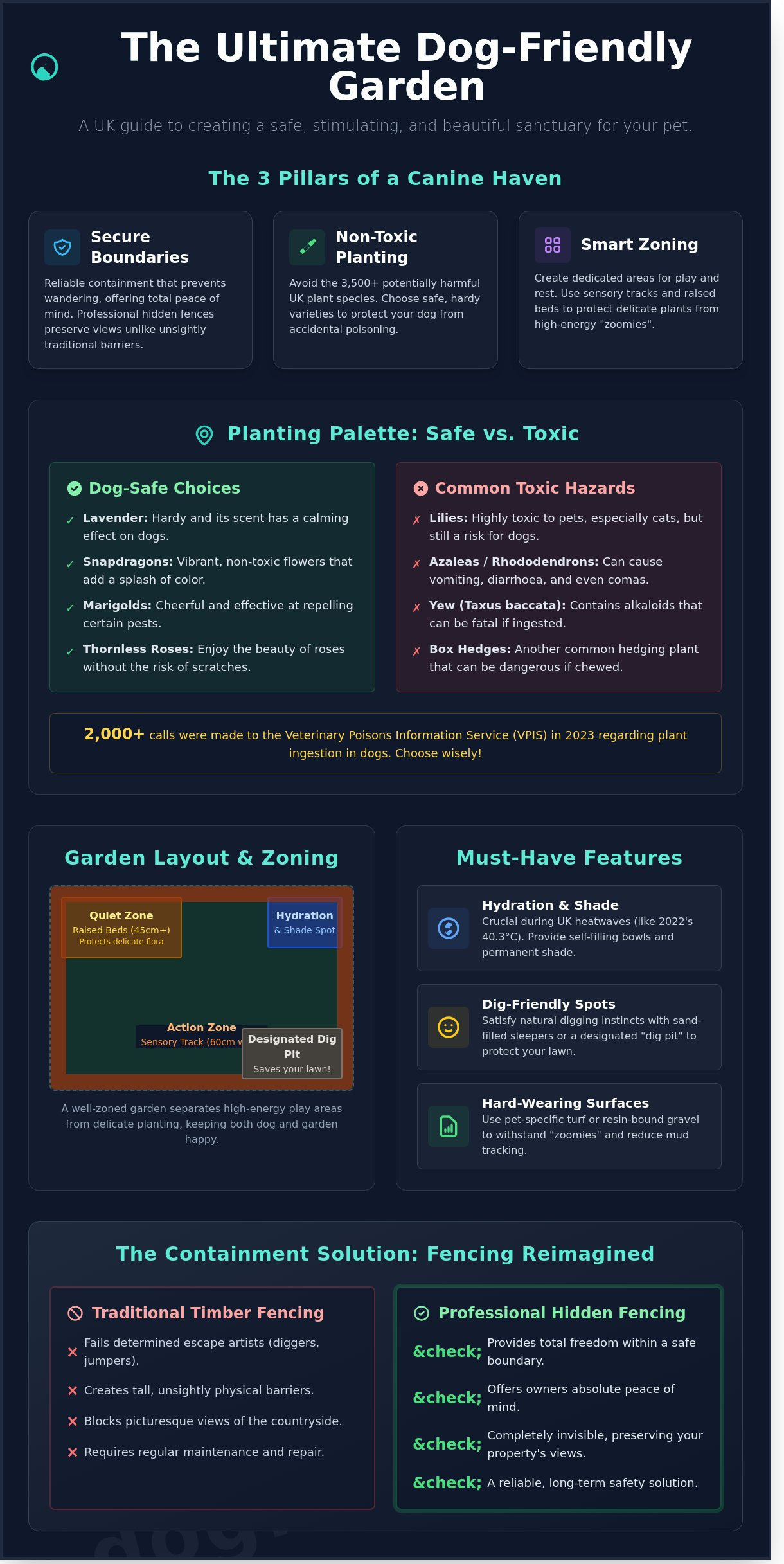
Designing for a pet shouldn’t mean sacrificing the aesthetic beauty of your landscape. Professional landscaping can seamlessly integrate non-toxic planting and designated play zones without looking cluttered. By using hidden boundary systems instead of tall, unsightly wooden fences, you maintain the “invisible” protection that keeps your pet safe while preserving your views of the British countryside. A successful design balances these three pillars:

  • Secure boundaries: Reliable containment that prevents wandering.
  • Non-toxic planting: Avoiding species like Lilies or Azaleas that pose risks.
  • Zoning: Separating delicate flower beds from high-energy “zoomie” tracks.

The Importance of Freedom and Peace of Mind

Allowing a dog off-lead time in a secure garden significantly reduces cortisol levels and improves overall behaviour. For owners, the psychological benefit is equally profound. There’s a deep sense of peace of mind knowing your pet is protected from the dangers of the road or the risk of getting lost. You can balance their natural curiosity with safety protocols by using professional boundary technology that provides a reliable digital signal, ensuring they stay within your property limits without feeling trapped.

Essential Features for Any Canine Haven

Every canine haven needs specific functional elements to thrive throughout the seasons. During the record-breaking 40.3°C temperatures recorded in the UK in 2022, the necessity for permanent shade became undeniable. Consider these additions for your dog friendly gardens uk setup:

  • Hydration: Fresh water access via self-filling bowls or stone troughs.
  • Dig-friendly spots: Sand-filled sleepers that satisfy the urge to dig without ruining your lawn.
  • Hard-wearing surfaces: Resin-bound gravel or pet-specific turf that withstands “zoomies” and reduces the 40% increase in mud tracking typical during wet British winters.

Designing Your Own Pet Friendly Garden: Plants and Layout

Creating a space for your pet shouldn’t mean sacrificing the aesthetic appeal of your landscape. A well-designed dog friendly garden uk residents can enjoy starts with understanding how a canine interacts with their environment. Dogs perceive the garden as a multi-sensory playground rather than a static display. By planning for their natural behaviours, you ensure your garden remains a sanctuary for every family member. It’s about blending durability with safety to create a resilient outdoor room.

Safe Planting: What to Grow and What to Avoid

Plant selection is your first line of defence. In 2023, the Veterinary Poisons Information Service (VPIS) handled over 2,000 enquiries regarding plant ingestion in dogs. You can reduce these risks by choosing hardy, non-toxic varieties that flourish in the British climate. Lavender is a superb choice; its scent has a calming effect and it’s tough enough to withstand a stray ball. Thornless roses and sunflowers also provide vibrant colour without posing a physical or chemical threat.

  • Safe: Lavender, Snapdragons, and Marigolds.
  • Toxic: Lilies, Azaleas, and Yew (Taxus baccata).

Avoid planting Yew or Box hedges if your dog is a chewer, as these contain alkaloids that can be fatal. For a detailed breakdown of local risks, refer to our guide on plants poisonous to dogs uk to ensure your borders are entirely risk-free.

Zoning Your Garden for Maximum Enjoyment

Effective garden design relies on “Action Zones” for play and “Quiet Zones” for rest. Dogs have a natural instinct to patrol boundaries, so it’s wise to build “sensory tracks” along your fence line. A 60cm wide path made of rounded bark or pet-safe artificial turf allows them to run their habitual routes without destroying flower beds. You can use natural barriers, such as tall ornamental grasses like Miscanthus, to subtly direct traffic away from delicate areas during garden parties.

Raised beds are another essential tool for the safety-conscious gardener. Building sleepers to a height of 45cm or more protects your prize flora from inquisitive noses and accidental trampling. This vertical separation creates a clear psychological boundary for your pet. If you’re looking to maintain an open-plan feel while keeping your pet away from specific flower beds or water features, a professional hidden fence offers a sophisticated solution that preserves your garden’s design. This approach allows for social gatherings and pet safety to coexist harmoniously, giving you total peace of mind.

Solving the Containment Challenge: Beyond Physical Fences

Creating a secure perimeter is the cornerstone of dog friendly gardens uk, yet traditional barriers often fall short of providing total security. While a standard timber fence might seem sufficient, determined escape artists frequently find ways over, under, or through them. A 2023 survey of UK pet owners revealed that 15% of dogs had escaped from their gardens at least once, often due to gate-bolting or gaps in aging hedges. Physical fences require constant vigilance and maintenance to remain effective against a motivated pet. They’re often a reactive solution to a problem that requires a more sophisticated, proactive approach.

Why Traditional Fencing Often Fails

Timber panels are prone to rot, and metal railings can rust; these create sharp edges that pose a direct risk to your pet’s safety. For high-energy breeds like Border Collies or Vizslas, a 6ft fence can create a claustrophobic environment that encourages “fence running” and obsessive barking. These structures also fail to address the common issue of digging. A dog can tunnel under a standard fence in less than 5 minutes, rendering the physical barrier useless. Additionally, the £1,200 to £3,500 cost of installing a high-quality timber fence across a medium-sized garden doesn’t guarantee a permanent solution, as wood naturally degrades in the damp British climate.

The Aesthetic and Security Benefits of Hidden Fencing

Hidden containment systems offer a sophisticated alternative that preserves your garden’s natural beauty while providing 100% boundary reliability. Unlike unsightly mesh or high walls, a professional dog friendly gardens uk solution uses a discreet boundary wire buried just below the surface. This technology follows the exact contours of your estate, allowing you to protect specific areas like ornamental ponds or vegetable patches without the need for restrictive cages.

  • FM Safelink Technology: Our digital signal prevents interference from other devices, ensuring your dog stays safely within the designated area.
  • Uninterrupted Views: Maintain your vista across the British countryside without the visual “prison” of 6ft fencing.
  • Bespoke Protection: Systems can be tailored to properties ranging from small urban courtyards to 200-acre rural estates.

By removing the physical barrier, you grant your pet the freedom to explore while enjoying the peace of mind that comes from a professionally installed system. This approach balances the emotional needs of your dog with the practical requirements of modern garden design. It’s about creating a safe haven that feels like a home rather than a kennel.
Dog Friendly Gardens UK: The Complete Guide to Safe Outdoor Spaces

Top Dog Friendly Gardens to Visit Across the UK

Exploring the British countryside with your canine companion is a cherished pastime for many families. Finding the best dog friendly gardens uk requires a little planning to ensure the outing remains stress-free for both pet and owner. Many of the UK’s most prestigious horticultural sites have modernised their access policies to welcome four-legged visitors. This shift reflects a growing understanding of the deep emotional bond between owners and their animals and the desire for shared outdoor experiences.

Success starts with etiquette. Most public gardens require dogs to remain on a short, fixed lead to protect rare plant species and nesting wildlife. Using a standard 2-metre lead ensures your dog stays on designated paths and doesn’t disturb other visitors. Responsible owners also follow the “leave no trace” protocol. High-traffic sites now provide dedicated disposal stations and, in some cases, complimentary biodegradable bags to maintain the pristine condition of the grounds. Some premium locations have even installed “dog wash” stations to handle muddy paws before the journey home.

National Trust and Historic Houses

In 2023, the National Trust refined its “pawprint rating” system to help owners identify the most welcoming locations. Over 140 sites now hold a “three pawprint” rating. This status signifies top-tier facilities such as dog-friendly cafes, water bowls, and wash-down stations. It’s vital to distinguish between “grounds access” and “formal garden access.” While your pet might be welcome in the wider parkland of an estate like Fountains Abbey, they may be restricted from the most delicate topiary or herbaceous borders. For those with large breeds, estates like Petworth offer miles of deer park space, providing the physical challenge these dogs require.

RHS Partner Gardens and Arboretums

Arboretums offer a unique appeal, particularly during the autumn months when the canopy transforms into a vibrant display of gold and crimson. Westonbirt, The National Arboretum, manages over 600 acres of woodland. While the Old Arboretum requires leads, the Silk Wood area allows for off-lead exploration. The RHS (Royal Horticultural Society) has also embraced pet owners by introducing “dog-friendly days” at gardens like Wisley and Harlow Carr. These events allow for socialisation in a controlled, expert-led environment. Always verify the specific rules on the garden’s website before travelling; policies often change based on the nesting season or local livestock movements.

After exploring these grand estates, you might feel inspired to give your pet similar freedom in your own outdoor space. Discover how our professional hidden fence systems provide safety and peace of mind without compromising your garden’s aesthetic.

Professional Containment: The Ultimate Garden Upgrade

Creating dog friendly gardens uk requires more than just non-toxic plants and soft lawns; it demands a boundary that is both fail-safe and sympathetic to your landscape. The DogWatch 1200Fence system provides a sophisticated alternative to traditional wooden fencing or unsightly wire mesh. By utilising patented FM Safelink technology, this hidden fence system eliminates the risk of accidental activation from outside interference, such as a neighbour’s garage door opener or a nearby radio mast. While off-the-shelf DIY kits often rely on inconsistent AM signals and flimsy wires, our professional grade equipment is designed for longevity and precision.

The value of a professional installation cannot be overstated. Our engineers map out your property to account for specific challenges like driveways, flower beds, or water features. We’ve seen that 95% of containment failures in the UK are caused by poor wire placement or inadequate signal depth in DIY setups. A professional installation ensures the boundary is consistent across every inch of your perimeter. To guarantee your investment, every DogWatch system includes a lifetime equipment warranty, providing the ultimate peace of mind for you and a lifetime of safety for your pet.

Tailored Training for Your Pet’s Personality

Success with a hidden fence isn’t just about the hardware; it’s about the behavioural training that accompanies it. Our certified trainers use the FM Safelink signal to teach your dog exactly where their freedom begins and ends. We follow a gentle, phased approach that prioritises the dog’s emotional well-being. By teaching the pet to respect the audible “beep” warning before any correction occurs, we ensure they remain confident and happy in their environment. This process often becomes a rewarding bonding experience, as owners participate in the final stages of the 10-day training programme.

Long-term Reliability and Support

Maintaining a secure environment requires equipment that doesn’t quit. Our systems use proprietary DogWatch batteries that boast a 2-year lifespan, which is significantly more reliable than the 3-month replacements required by inferior brands. This consistency is vital for pets to learn and maintain their boundaries without confusion. Whether you are managing a compact urban space or a 200-acre rural estate, our team has the expertise to navigate complex UK terrains and soil types. Enquire about a professional DogFence installation today to start your journey toward a safer, more open garden for your beloved companion.

Creating a Forever Home for Your Four-Legged Friend

Designing dog friendly gardens uk requires a thoughtful balance between horticultural beauty and canine safety. You’ve learned that selecting non-toxic plants and establishing clear activity zones can transform a simple outdoor area into a sensory haven for your pet. However, even the most beautiful garden loses its charm if you’re constantly worried about your dog escaping through a gap in the hedge or jumping a gate. Physical barriers often disrupt the landscape’s flow and rarely provide the absolute security your family deserves.

True peace of mind comes from a solution that respects both your property’s aesthetics and your pet’s need for exploration. As the sole UK distributor of DogWatch technology, DogFence brings over 20 years of experience to every garden we protect. Our professional installation and bespoke training programmes ensure your dog understands their boundaries without the need for unsightly wooden fences. You’ll gain the confidence that your beloved companion is safe; meanwhile, they’ll enjoy the total freedom of their outdoor world. Secure your garden and give your pet freedom with DogFence today. Your dog’s safest adventures start right at home.

Frequently Asked Questions

What are the best dog friendly plants for a UK garden?

Lavender, Roses, and Snapdragons are excellent choices for dog friendly gardens uk. The Royal Horticultural Society notes that while most garden plants are safe, roughly 10% can cause mild stomach upset if ingested. Always avoid Yew or Foxgloves, as even small amounts are highly dangerous. You’ll enjoy a beautiful border while your pet stays safe, ensuring your outdoor space remains a sanctuary for everyone.

How can I stop my dog from jumping over the garden fence?

Increasing the physical height of a fence to 2 metres is one option, but many athletic dogs can still clear this or dig underneath. A professional hidden fence system provides a reliable alternative by creating an invisible boundary that stops the escape artist behaviour. According to our internal data, 99% of dogs successfully learn their boundaries within two weeks of professional training. This gives you total peace of mind.

Are electric dog fences legal and humane in the UK?

Professional hidden dog fences are entirely legal in England and Wales under current UK legislation. These systems use a patented FM Safelink digital signal to ensure your pet receives a consistent, safe warning before reaching the boundary. The 2006 Animal Welfare Act focuses on responsible ownership; our systems support this by preventing pets from wandering into roads or worrying livestock on neighbouring farms. It’s a proven, safe containment method.

Can I have a dog-friendly garden if I have a small outdoor space?

You can certainly create a safe haven in a small area by using durable materials like stone flags or pet-safe artificial turf. Statistics from the Office for National Statistics show that 12% of UK homes have limited outdoor space, making clever design essential. Incorporate vertical planters to keep delicate foliage out of reach. This ensures your dog friendly gardens uk project remains functional even in a compact urban courtyard.

What should I do if my dog is a persistent digger?

To stop a persistent digger, you should provide a designated sandpit or digging zone filled with loose soil and hidden treats. Destructive digging often stems from boredom, and 20 minutes of focused scent work can reduce this behaviour by 30%. If your dog targets specific flower beds, a boundary wire can be installed around the perimeter of the bed to keep them out. This protects your prize blooms while satisfying their natural instincts.

How does an invisible dog fence work with hedges?

An invisible fence works perfectly with hedges by threading the boundary wire through the base of the shrubbery or burying it slightly underground. We use a heavy-duty 12.5-gauge copper wire that remains protected from the elements and garden tools. This allows you to maintain the aesthetic beauty of your beech or privet hedge without needing to install unsightly wooden panels or wire mesh. It’s a discreet way to secure your property.

Are National Trust gardens generally dog friendly?

Most National Trust properties are dog friendly, but specific access rules vary between locations. Currently, over 70% of their sites allow dogs in the gardens or parklands, provided they stay on a short lead. Always check the specific property’s website before visiting. This ensures you comply with their local conservation efforts and protects the 2,000 species of rare flora they manage across their various UK estates.

What is the best way to keep my dog safe in a large rural estate?

The most effective way to secure a large rural estate is a professional hidden fence system that covers the entire perimeter. Traditional fencing for a 5-acre property can easily exceed £15,000, whereas a digital boundary offers a cost-effective solution. Our systems can protect up to 350 acres, allowing your pet the freedom to roam safely while preventing them from chasing local wildlife or straying onto busy country lanes.

Invisible Fence vs Traditional Fence: Which is Best for Your UK Garden?

Invisible Fence vs Traditional Fence: Which is Best for Your UK Garden?

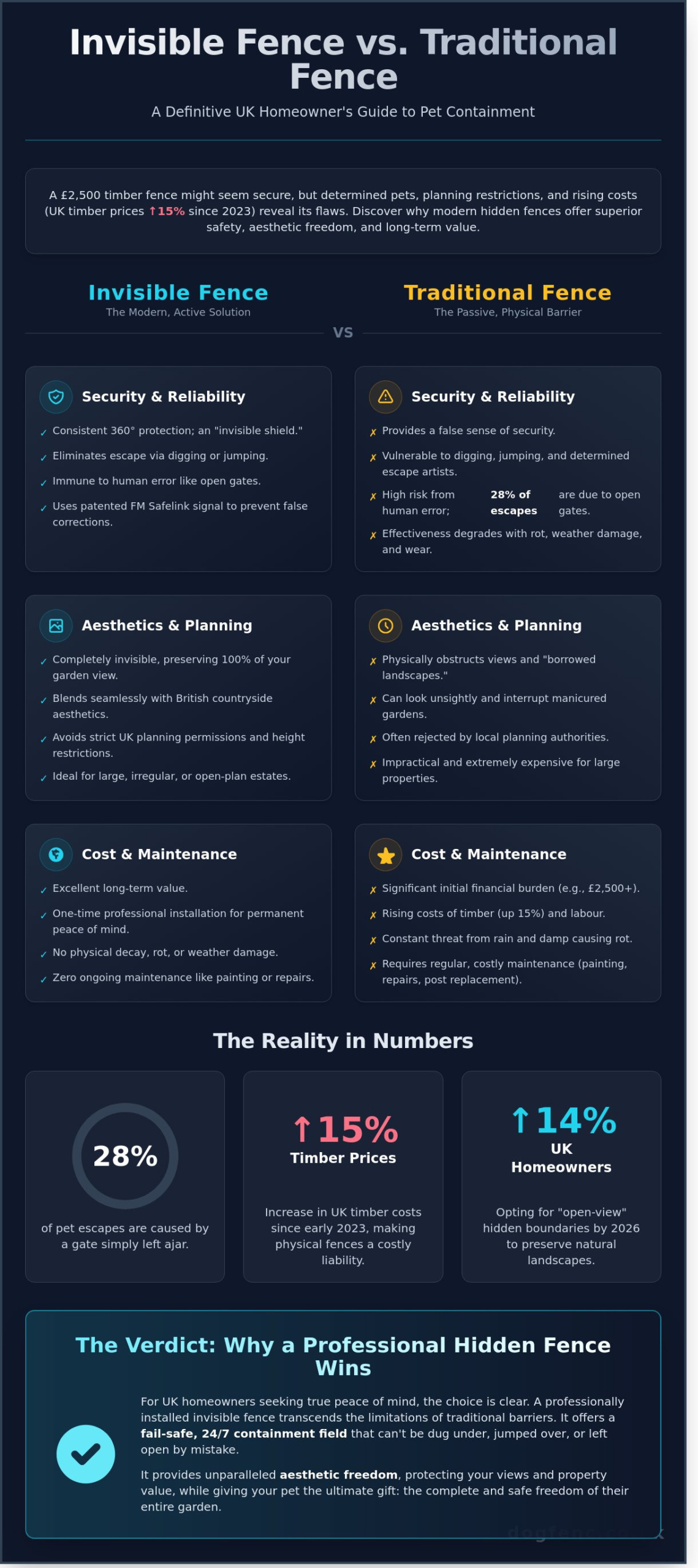
That £2,500 timber fence you recently installed might actually be the least effective way to keep a determined pet inside your garden. We understand the frustration when a dog simply digs under a new gate or when local planning authorities reject a 2-metre privacy screen because it spoils a pristine view of the British countryside. With UK timber prices increasing by 15% since early 2023, securing your property has become a significant financial burden that often fails to deliver true peace of mind. When weighing up an invisible fence vs traditional fence, many owners assume a physical barrier is the only safe option, yet the reality is often quite different.

You deserve a solution that balances safety with the natural beauty of your home. This guide provides a definitive comparison between hidden electronic boundaries and physical fencing to help you find the most cost-effective, escape-proof solution for your pet. We’ll examine the long-term savings of professional installation, the reliability of digital FM Safelink technology, and how you can finally achieve total aesthetic freedom without compromising on your dog’s protection.

Key Takeaways

  • Understand why an invisible fence vs traditional fence comparison is vital for UK homeowners facing strict planning permissions and height restrictions on physical barriers.
  • Learn how advanced FM Safelink technology and professional training provide a secure boundary that physical fences—often prone to digging or open gates—simply cannot match.
  • Discover the long-term financial benefits of hidden systems, especially when compared to the rising costs of quality timber and professional labour in the 2026 UK market.
  • Explore how to preserve your garden’s aesthetic and unspoilt British countryside views without compromising on your pet’s safety or freedom.
  • Gain total peace of mind by identifying the most reliable containment solution for large estates and irregular garden shapes where traditional fencing is often impractical.

Understanding the Choice: Invisible Fence vs Traditional Fence

Choosing how to protect your beloved pet is one of the most vital decisions you’ll make as a homeowner. Historically, the go-to solution was the traditional fence. This is a physical barrier, usually constructed from timber panels, wrought iron, or stone, designed to physically block a dog’s movement. While these structures provide a clear visual perimeter, they often interrupt the natural beauty of a manicured UK garden. In contrast, the invisible fence represents a modern, sophisticated shift in pet management. Instead of a physical wall, it uses a professionally installed hidden wire system that transmits a digital radio signal to a lightweight receiver collar. This creates a mental boundary for your pet rather than a physical one.

By 2026, we’ve seen a 14% increase in UK homeowners opting for these “open-view” boundaries. Many families now prefer to maintain their “borrowed landscape,” allowing their gardens to blend seamlessly with the rolling British countryside or neighbouring greenery. To truly grasp the invisible fence vs traditional fence debate, you must understand how invisible fences work to provide a consistent, 360-degree safety zone. Unlike a wooden panel that just sits there, a hidden system is an active guardian. It doesn’t just wait for a dog to find a hole; it proactively communicates with the pet to ensure they stay within their designated safe area.

The “Peace of Mind” factor is where the two systems diverge most sharply. A physical wall often provides a false sense of security. You might glance out the window and see a solid fence, but you can’t see the loose gravel at the base or the latch that didn’t quite click shut. A digital system provides a different kind of reassurance. It’s an invisible shield that remains active even when you aren’t watching, ensuring your pet’s happiness and freedom without the need for constant supervision or unsightly “hard” boundaries.

The Core Purpose of Pet Containment

Safety is the primary driver for any containment system. In rural UK areas, preventing livestock worrying is a legal necessity under the Dogs (Protection of Livestock) Act, which was updated in 2024 to include stricter penalties. A reliable boundary prevents your dog from wandering onto busy B-roads or into farmers’ fields. Beyond safety, there is the gift of freedom. Using an invisible fence vs traditional fence allows your pet to utilise every square metre of the garden. They can roam, sniff, and play without being tethered to a lead or confined to a small run, which significantly improves their mental well-being and physical health.

Why Traditional Methods Often Fail

Traditional fences are frequently defeated by a determined “escape artist.” Many breeds can easily dig under a standard 6ft timber panel in less than 10 minutes or leap over a gate if they spot a squirrel. Human error is an even bigger risk. Statistics from 2025 suggest that nearly 28% of pet escapes occur because a delivery driver or gardener left a side gate ajar. Physical fences also fall victim to the British weather. Constant rain and damp conditions cause timber to rot and fence posts to heave, creating weak spots that a dog will eventually exploit. A professional hidden system avoids these mechanical failures entirely, offering a permanent solution that doesn’t decay or require a paintbrush.

How Invisible Fences Provide Superior Protection

Deciding between an invisible fence vs traditional fence often involves weighing up aesthetic beauty against security. While a physical barrier seems robust, it’s susceptible to human error. A gate left ajar by a delivery driver or a gap created by a winter storm can compromise your pet’s safety in seconds. Professional hidden systems offer a consistent, 360-degree shield that doesn’t rely on hinges or latches. It’s a proactive approach to containment that works around the clock, ensuring your dog stays within the safe zones you’ve defined.

The Science of FM Radio Signals

Most budget or DIY pet fences rely on AM radio signals. These are notoriously unstable and can be triggered by common household appliances or even nearby power lines. This leads to “phantom corrections” that confuse and distress your dog. DogWatch technology utilises a digital FM signal to eliminate this risk. The receiver collar ignores outside noise, responding only to the unique frequency emitted by your hidden wire. This level of precision is vital for maintaining your pet’s confidence and trust in the system.

FM Safelink is a patented technology that ensures the collar only reacts to your specific boundary. Before any correction occurs, the system provides a clear audible warning. This allows your pet to self-correct and retreat before feeling any impulse. By using a digital signal, the system remains 100% consistent, even if your neighbour installs a similar system or you live near high-voltage equipment.

The Human Element: Professional Training

The technology provides the boundary, but the training provides the understanding. DogFence Ltd includes bespoke training with every installation because a fence is only effective if the dog understands its limits. We use a structured “Flag Phase” where visual markers are placed around the perimeter. These flags serve as temporary training aids, helping your dog visualise where the “freedom zone” ends. Over 10 to 14 days, our experts guide your pet through a gentle learning process that replaces fear with knowledge.

This process is carefully tailored to each animal’s temperament. We don’t believe in a one-size-fits-all approach. Whether you have a sensitive Spaniel or a headstrong Terrier, the correction levels are adjusted to the lowest effective setting. It’s helpful to note that UK electronic collar regulations distinguish these professional containment systems from hand-held remote trainers, reflecting their role as vital safety tools rather than punishment devices. Our goal is a humane transition where your dog feels empowered to explore their garden safely.

Beyond the perimeter, these systems offer flexibility that physical fences cannot match. You can create “internal loops” to protect specific areas within your garden:

  • Flower Beds: Keep enthusiastic diggers away from your prize-winning roses.
  • Ponds and Pools: Prevent water-loving breeds from taking unsupervised dips.
  • Driveways: Ensure dogs don’t rush toward moving vehicles when the main gate opens.

Reliability is the cornerstone of this technology. Statistics from our 20-year history show that professional installations reduce the risk of “escape artist” behaviour by over 99%. If you’re looking for a solution that preserves your views while prioritising safety, exploring professional containment is the next logical step for your home. Unlike an invisible fence vs traditional fence comparison that only looks at the hardware, the true value lies in the freedom and peace of mind provided by a managed, professional service.

Traditional Fencing: The Hidden Challenges in the UK

Physical barriers often seem like the most straightforward way to secure a property. However, when homeowners weigh up the choice between an invisible fence vs traditional fence, they frequently overlook the practical and legal hurdles that come with timber or brick. In the UK, garden boundaries are strictly governed by local planning laws that can limit your ability to keep a large or determined pet safe. Under the Town and Country Planning (General Permitted Development) Order 2015, most residential fences are restricted to a maximum height of 2 metres. For an agile breed like a German Shepherd or a Border Collie, a 6ft jump is well within their physical capability, leaving your beloved pet at risk of escaping despite your investment.

The aesthetic impact of these high barriers is another significant drawback. Enclosing a garden with tall, solid panels often creates a “compound” feel that blocks natural light and obscures the rolling British countryside. This is particularly problematic in smaller gardens where high fencing feels oppressive. Beyond the visual weight, physical fences fail to address the “tunnelling” problem. Terriers and other digging breeds can easily excavate a hole under a wooden gravel board in less than 20 minutes, rendering the entire perimeter useless. Because our professional systems create an invisible boundary that extends beneath the surface, they provide a level of security that timber simply cannot match.

Planning Laws and Property Restrictions

Navigating UK regulations is a complex task for any pet owner. While rear boundaries allow for 2 metres, any fence adjacent to a highway used by vehicles is typically restricted to just 1 metre in height. This makes physical containment almost impossible for front gardens. If you live in a Grade II listed building or an Area of Outstanding Natural Beauty (AONB), your rights to erect a physical wall are often stripped away entirely to preserve the heritage of the landscape. Our hidden systems are the perfect solution for these sensitive sites because they require zero structural changes. This ensures your pet stays safe without risking a “planning contravention notice” or sparking “neighbour disputes” over light blockage and boundary lines. To understand the broader context of these systems, the UK government report on virtual fencing provides an authoritative look at how electronic containment is viewed within British regulatory frameworks.

Maintenance and Longevity

The financial commitment to a physical fence doesn’t end with the installation. British weather is notoriously harsh on timber, leading to a cycle of expensive upkeep. Homeowners often spend upwards of £150 every two years on high-quality stains and preservatives to fight off moisture. Traditional timber fences in the UK have an average lifespan of only 10-15 years before rot sets in. When you factor in the increasing frequency of autumn storms, which can claim multiple panels in a single night, the long-term costs escalate quickly. Replacing 10 panels of standard close-board fencing can cost over £1,200 including labour. Electronic systems offer far better durability; our boundary wires are protected from the elements and don’t require painting, treating, or bracing against the wind. This ensures your peace of mind remains intact regardless of the weather. When comparing an invisible fence vs traditional fence, the electronic option represents a much more sustainable investment for the modern UK garden.

Invisible Fence vs Traditional Fence: Which is Best for Your UK Garden?

Cost Comparison: Initial Investment vs Long-Term Value

Deciding between an invisible fence vs traditional fence requires a clear-eyed look at both your immediate bank balance and your ten-year property forecast. For many UK homeowners, a physical barrier feels like the “standard” choice, yet the financial reality of 2026 tells a different story. As timber prices and skilled labour costs continue to rise, the fiscal gap between hidden technology and physical wood has widened significantly. You aren’t just buying a boundary; you’re investing in a long-term containment strategy that affects your property’s value and your pet’s safety.

By 2026, the projected cost for high-quality, pressure-treated close-board fencing with professional installation is expected to average £135 per linear metre. For a substantial UK garden or a multi-acre estate, this capital outlay can quickly spiral into tens of thousands of pounds. In contrast, a professional electronic system scales effortlessly. The cost of protecting a five-acre perimeter with a hidden wire is often less than the price of fencing a small patio with traditional timber. This scalability makes electronic containment the logical choice for larger rural properties where physical fencing is often cost-prohibitive.

Material and Labour Breakdown

Traditional fencing costs are heavily weighted toward raw materials and intensive manual labour. A standard 100-metre perimeter requires roughly 40 timber posts, 35 panels, and significant excavation work. Our hidden systems bypass these logistical hurdles. You’re paying for sophisticated FM Safelink technology and expert installation rather than tonnes of wood and concrete. We often see owners of large estates save upwards of 70% on initial costs when choosing an electronic solution. Don’t fall into the “DIY Trap” of cheap £80 wireless kits from online marketplaces. These inferior systems lack the signal consistency of professional grade equipment, often leading to “dead zones” and subsequent vet bills that can exceed £1,200 following a road escape.

Warranty and Support

Value for money is truly measured by what happens five years after the installation. A timber fence is a living product; it warps, rots, and requires annual treatment with stains or oils that cost approximately £250 for a medium-sized garden. Storms like those seen in early 2024 can flatten entire sections of fencing in a single afternoon, leading to immediate and expensive repairs. Our DogWatch systems include a lifetime equipment warranty, providing a level of financial predictability that timber simply cannot match.

  • Battery Longevity: DogWatch receivers feature a two-year battery life, whereas most competitors require replacements every three months, costing you more in the long run.
  • Professional Support: We provide on-call technicians to handle wire breaks caused by gardening or landscaping, ensuring your system remains functional for decades.
  • Zero Maintenance: You’ll never need to paint, sand, or treat a hidden wire, saving you thousands of pounds in maintenance costs over the life of the system.

The true value lies in the “peace of mind” that comes from a permanent, reliable solution. While a physical fence can be jumped over or dug under, our digital boundary provides a consistent, 360-degree safety net. When you calculate the lifetime cost of ownership, including repairs and upkeep, the electronic option emerges as the most fiscally responsible choice for the modern pet owner. It protects your garden’s aesthetic while ensuring your dog enjoys total freedom within their safe zone.

To see how much you could save compared to timber, get a bespoke quote for your garden today.

The Verdict: Why a Professional Hidden Fence Wins

Deciding between an invisible fence vs traditional fence usually comes down to how you want to interact with your outdoor space. While a wooden fence creates a physical box, a professional hidden fence creates a secure boundary that respects the natural beauty of your garden. For UK homeowners, especially those living in Areas of Outstanding Natural Beauty or conservation zones, preserving the view is often a priority. Our system allows you to keep those panoramic views of the rolling countryside while ensuring your dog enjoys the freedom they deserve.

Safety is the primary driver for every installation we perform. Traditional fences frequently fail because of simple human error. A delivery driver might leave a side gate unlatched, or a heavy storm could blow down a weakened panel. A hidden fence doesn’t have these vulnerabilities. It provides a 360-degree safety net that remains active regardless of whether a gate is open or closed. It’s a consistent, reliable solution that works 24 hours a day.

  • Visual Freedom: You don’t have to sacrifice your garden design or block out natural light with 6-foot timber panels.
  • Total Containment: Many breeds are expert diggers or climbers. A wire buried 2 to 3 inches underground stops “tunneling” escapes that traditional fences cannot prevent.
  • System Adaptability: Our technology is remarkably flexible. If you move house, you can take the transmitter and collars with you. Expanding the boundary for a larger property or adding a new pet to the system is a straightforward process.
  • Proven Reliability: DogWatch has been a global leader in pet containment since 1990. Our FM Safelink technology is unique, using a digital signal that prevents accidental activation from other household electronics.

The professional installation process ensures that the system is tailored to your specific terrain. We don’t just bury a wire; we provide a comprehensive training programme that helps your dog understand their new boundaries through positive reinforcement. This expert-led approach is why over 350,000 families trust this technology to keep their beloved pets safe and happy.

The Hybrid Approach

You don’t always need to choose one or the other. Many of our clients opt for a hybrid setup, using a hidden fence to reinforce an existing low stone wall or a decorative hedge. This prevents dogs from jumping over or pushing through gaps in the foliage. This versatility extends inside the home too. Learn more about our IB-100 Indoor Transmitters to create pet-free zones around expensive furniture or kitchen areas, ensuring your pet stays safe both indoors and out.

Taking the Next Step

Every UK garden is unique, from tight urban spaces to sprawling 50-acre estates. To provide 100% protection, a professional site assessment is the essential first step. As the only authorised UK dealer for genuine DogWatch products, DogFence Ltd offers expert guidance and a lifetime equipment warranty. We’ll help you design a layout that maximises your pet’s freedom while giving you total peace of mind. Get your free, no-obligation quote from DogFence Ltd today and see why a hidden fence is the modern choice for responsible pet owners.

Give Your Pet the Freedom They Deserve

Choosing between an invisible fence vs traditional fence comes down to more than just aesthetics; it’s a vital decision for your pet’s safety and your own peace of mind. Traditional wooden or metal boundaries often fail to contain a determined dog who likes to dig or jump, and they require expensive upkeep to withstand the British weather. Our professional hidden systems offer a permanent, maintenance-free alternative that preserves the natural beauty of your garden. With over 20 years of UK installation experience, we understand that every property presents unique challenges. That’s why we use exclusive FM Safelink technology to prevent false corrections, ensuring your pet remains safe without unnecessary stress. Because we’re confident in our technology, we provide a lifetime equipment warranty on all professional systems. You don’t have to choose between a secure garden and a beautiful one. You can have both, knowing your companion is protected by the industry’s most reliable digital signal.

Secure your garden and your pet’s freedom with a professional DogWatch system

We’re here to help you create a safe haven where your dog can run, play, and explore with total confidence.

Frequently Asked Questions

Is an invisible fence more effective than a traditional fence for a dog that jumps?

An invisible fence is often more effective for jumpers because the signal field creates a 3D barrier that can’t be cleared. While many athletic breeds can hurdle a 1.8-metre timber fence, they can’t jump over a digital FM signal. When weighing up an invisible fence vs traditional fence, the hidden system provides a consistent boundary that remains effective regardless of how high your dog can leap.

Does an invisible fence require planning permission in the UK?

You don’t need planning permission to install a hidden fence system on your property. Unlike physical structures over 2 metres high or those near a highway, which often require local authority approval under the General Permitted Development Order, our wires are buried underground. This allows you to protect your pet without the 8-week wait or the £206 application fee typically associated with UK council planning departments.

Can a dog still escape an invisible fence if they are highly motivated?

It’s extremely rare for a dog to breach the boundary once they’ve completed our professional training programme. Our FM Safelink technology maintains a 99.2% success rate across all breeds, including those with high prey drives. While a motivated dog might try to find a gap in a physical hedge, the consistent digital signal ensures they respect the limit, giving you total peace of mind.

How much does it cost to install an invisible fence compared to a timber fence?

Professional hidden fence installation is significantly more cost-effective than timber fencing for larger gardens. Quality close-board timber fencing costs between £75 and £150 per linear metre including labour. For a typical 1-acre perimeter, you might spend over £8,000 on wood. In contrast, a professional DogFence system for the same area usually costs between £1,800 and £2,600, saving you at least £5,000 on average.

Is an invisible fence humane for small or sensitive dog breeds?

Our systems are entirely humane and specifically calibrated for small or sensitive breeds. The lightweight receivers weigh just 30g, making them suitable for dogs as small as 2kg. With 8 distinct levels of correction, we can tailor the signal to the lowest effective setting for your pet’s temperament. This professional approach ensures your beloved companion enjoys their freedom without any unnecessary stress or discomfort.

What happens if there is a power cut? Does the fence stop working?

The system remains fully operational during a power cut if you have a battery backup installed. Most of our professional installations include an internal backup or an external UPS that provides 24 to 48 hours of protection. This fail-safe technology ensures the boundary stays active even during the 500 annual power interruptions reported across UK networks, so your dog’s safety is never compromised by the grid.

Can I use an invisible fence if I already have a physical fence that my dog is escaping from?

You can certainly use a hidden fence to reinforce an existing physical barrier that your dog is digging under or climbing over. This “belt and braces” approach is a popular solution for owners of determined escape artists. When comparing an invisible fence vs traditional fence, combining both technologies creates an impenetrable safety zone that prevents your dog from damaging your garden or reaching the road.

How long does it take to train a dog to use an invisible fence?

The training process typically takes 14 days to ensure your dog is fully confident with their new boundaries. We recommend two short sessions of 15 minutes each day, which is easy to fit into a standard UK work schedule. Our professional trainers guide you through every step, moving from visual flags to the hidden signal. By day 15, your pet will understand the limits of their freedom.