
Wireless dog fence – the truth – do they work?
Wireless Dog Fence vs Wired Dog Fence: Which Is Best for Your Garden?
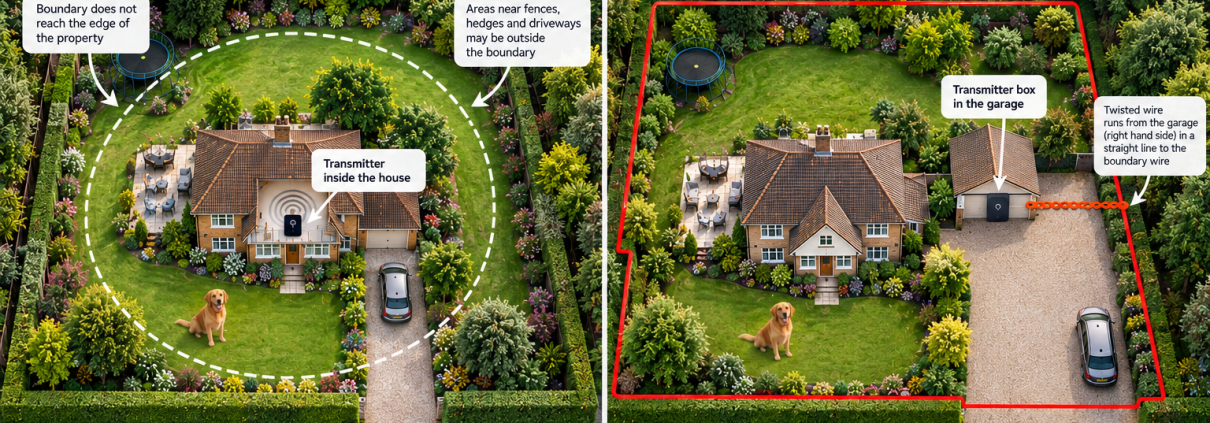
A wireless dog fence and a wired dog fence are both designed to help keep a dog safely within a defined area, but they create that boundary in very different ways. A wireless dog fence generally creates a circular boundary around a transmitter, while a wired dog fence follows a boundary cable positioned around the actual shape of your garden.
That difference can be particularly important in UK gardens, where boundaries are rarely perfect circles and properties may include slopes, woodland, outbuildings, open driveways or neighbouring roads. Your dog’s personality, behaviour and drive also matter when choosing any form of electronic dog containment.
At DogFence, we have specialised in electronic pet containment in the UK for more than 20 years and professionally install wired dog fence systems. We don’t believe one solution is right for every dog or every property, so this guide explains the practical differences between a wireless dog fence and a wired dog fence – including situations where a wireless system may be perfectly suitable.
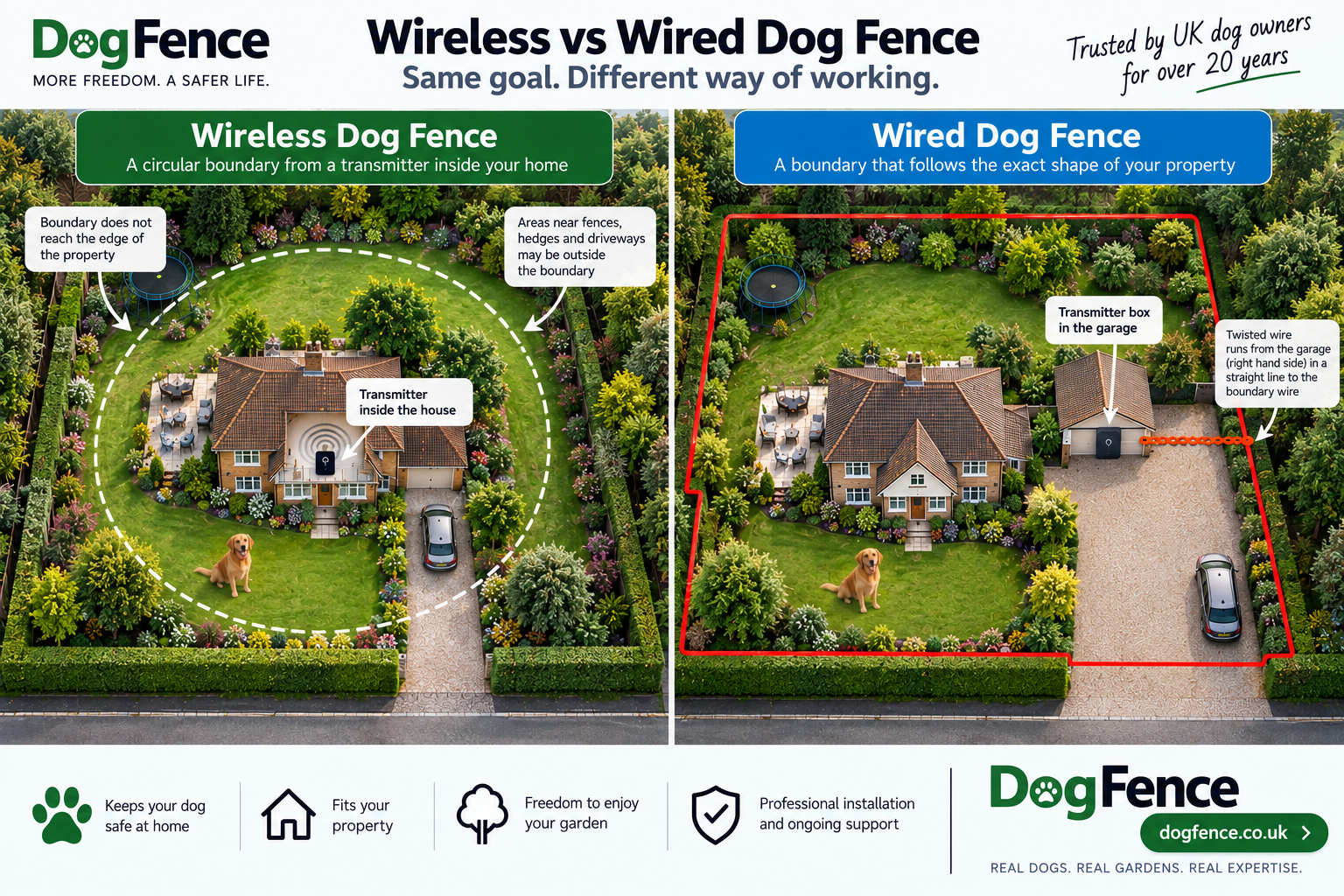
Wireless vs wired dog fence: a wireless system typically creates a circular boundary around the transmitter, while a wired dog fence can follow the full shape of your property, including gardens, hedges and driveways.
What is a wireless dog fence?
A wireless dog fence uses a transmitter to create an electronic containment area without installing a boundary wire around the perimeter of the property.
The transmitter is normally positioned inside the property and sends out a radio signal. The dog wears a compatible receiver collar and is trained to recognise the warning given as it approaches the edge of the permitted area.
Because there is no perimeter wire to install, wireless dog fences can be relatively quick and simple to set up. For the right dog and the right property, this can be a significant advantage.
However, a traditional wireless dog fence generally creates a circular or radial boundary around the transmitter. The electronic boundary therefore does not necessarily follow your fences, hedges, driveway or actual property line.
Wireless systems can also be more affected by the environment in which they are used. Uneven or undulating ground, dense woodland, trees and buildings can potentially affect how consistently a wireless signal reaches different parts of a property.
What is a wired dog fence?
A wired dog fence uses a boundary cable to establish the containment area. The cable can be positioned around the perimeter of the garden or property, allowing the electronic boundary to follow its actual shape.
The dog wears a receiver collar and, just as with a wireless dog fence, must be properly trained to recognise the boundary and respond appropriately to its warning.
Because the boundary is determined by the position of the wire rather than the transmission of a wireless signal across the whole property, a wired electric dog fence can be designed around:
- irregularly shaped gardens
- existing fences and hedges
- driveways and entrance gates
- long or narrow gardens
- woodland and heavily wooded areas
- undulating or sloping ground
- outbuildings
- large gardens and rural properties
- farms and equestrian properties
- areas within the property where the dog should not have access
- ponds, swimming pools and other exclusion zones
This flexibility is one of the principal reasons DogFence specialises in professionally installed wired dog fence systems.
Wireless vs wired dog fence: what’s the difference?

Wireless vs wired dog fence comparison. Wireless systems typically create a circular radio boundary, while a wired dog fence can follow the actual shape of a property, including irregular gardens, woodland, slopes, driveways and outbuildings.
When can a wireless dog fence work well?
A wireless dog fence can be a practical option where the property has plenty of relatively level, open space and a circular containment area can be positioned safely away from roads and other hazards.
It may also appeal to owners who want a system that can be installed relatively quickly without laying a boundary cable.
The important question is not simply whether a wireless dog fence works. It is whether the boundary created by that particular system works for your property and your dog’s personality, behaviour and drive.
If the permitted wireless area fits comfortably within the safe part of the garden and the property is suitable for a radio-based boundary, a wireless dog fence may be sufficient.
When is a wired dog fence more suitable?
A wired dog fence can be particularly useful when the electronic boundary needs to follow the actual shape and features of the property.
This is common in UK properties where a garden may have hedges on one side, fencing on another, an open driveway at the front, neighbouring properties nearby or uneven ground.
Instead of fitting the garden inside a predetermined wireless containment area, the wired boundary can be designed around the property.
A wired dog fence can be particularly suitable for:
- long or narrow gardens
- L-shaped or irregular plots
- open driveways
- properties bordered by roads
- dogs escaping through hedges
- dogs digging underneath existing fencing
- dogs jumping or climbing physical fences
- properties requiring specific exclusion areas
- properties with undulating or sloping ground
- properties with outbuildings
- woodland and heavily wooded properties
- farms and equestrian properties
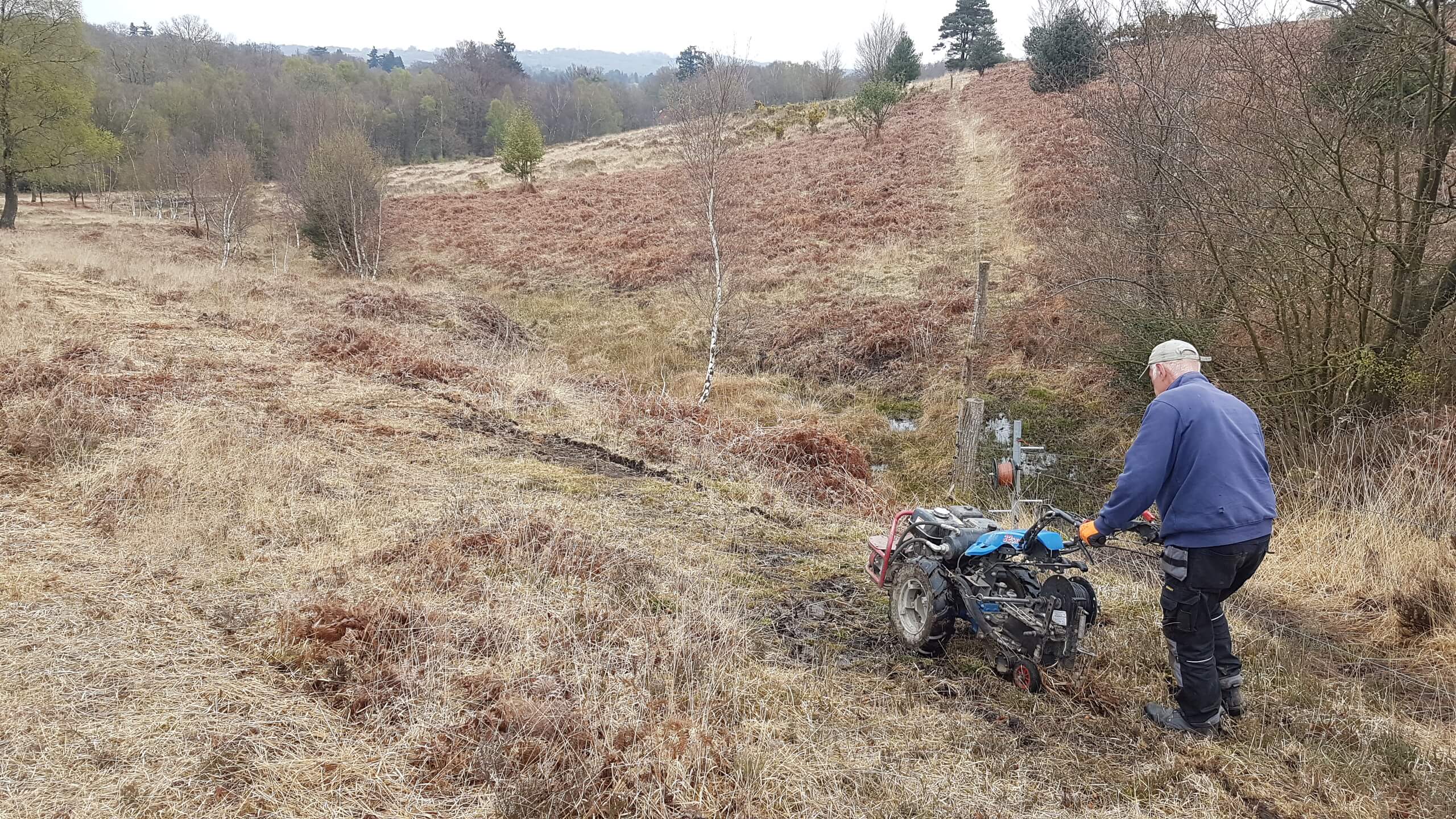
Unlike wireless systems, a wired dog fence can follow the contours of steep and undulating ground. Here, the DogFence boundary wire is being installed across challenging rural terrain.
Can a wireless dog fence follow the shape of my garden?
A traditional wireless dog fence generally cannot follow an irregular property boundary in the same way as a wired dog fence. Its containment area is determined by the radio signal produced by the transmitter and is typically circular or radial.
This may not matter on a large, open property. However, it becomes much more important when the safe boundary needs to run close to fences, hedges, roads, neighbouring gardens or an open driveway.
A wired dog fence provides greater control because the boundary is established by the position of the cable.
Can a dog fence create exclusion zones within the garden?
One of the advantages of a properly designed wired dog fence is the ability to create boundaries around specific areas within a property, not just around its outer perimeter.
Depending on the system design, dogs can be kept away from areas such as swimming pools, ponds, children’s play areas, vegetable gardens, flower beds or other places where you don’t want them to go.
This can be particularly useful on larger or more complex properties where the dog can have considerable freedom without necessarily having access to every part of the land.
Read more about using DogFence to create dog exclusion zones around areas of your garden.
Can wireless and wired dog fences work with existing fencing?
Yes. An electronic dog fence does not necessarily replace an existing fence or hedge.
Many DogFence customers already have physical boundaries but have a dog that has discovered a way to escape – perhaps by digging underneath a fence, jumping or climbing it, squeezing through gaps or pushing through a hedge.
In these situations, a wired dog fence can be positioned to work alongside the existing physical boundary and provide an additional layer of containment.
Read our guide to dog-proofing your garden and preventing common escape routes.
Can I install a wireless dog fence myself?
Yes. Many wireless dog fences are specifically designed for DIY installation, and this is one of their main attractions. Some wired dog fence systems can also be self-installed, while others are supplied as part of a professional installation and training service.
However, installing the equipment is only one part of establishing a successful electronic containment system. The position of the boundary is important, but training is one of the most important parts of any dog fence set-up.
Whether the dog fence is wired or wireless, the complete recommended training programme should be carried out. The dog needs to learn where the boundary is, understand the warning and know exactly how to respond to it. Good training helps create a successful outcome in which the dog can confidently enjoy the freedom available within its safe area.
If you are installing a system yourself, check that it is supplied with enough training flags to mark the boundary clearly. As a practical guide, we recommend at least 20 training flags for every 100 metres of boundary, together with comprehensive, easy-to-follow training instructions.
Support is also worth considering before choosing where to buy your dog fence. If purchasing through a general third-party online retailer, check what specialist dog-fence training and technical support will actually be available after purchase. A reputable specialist dog fence supplier should be able to help not only with the initial set-up and training, but also with questions and ongoing support after the system has been installed.
At DogFence, our professionally installed systems include an assessment of the property, boundary design, installation and structured training with the dog and owner, together with ongoing support.
Why is training so important with a wireless or wired dog fence?
Training is fundamental whether you choose a wireless dog fence or a wired dog fence. The technology establishes the boundary, but the training teaches the dog what that boundary means.
A receiver collar should never simply be placed on a dog and the dog left to discover the boundary for itself. The dog should be introduced to the boundary in a structured way so that it learns to recognise the warning and retreat confidently into the safe area.
DogFence has always regarded training as part of the containment system rather than an optional extra.
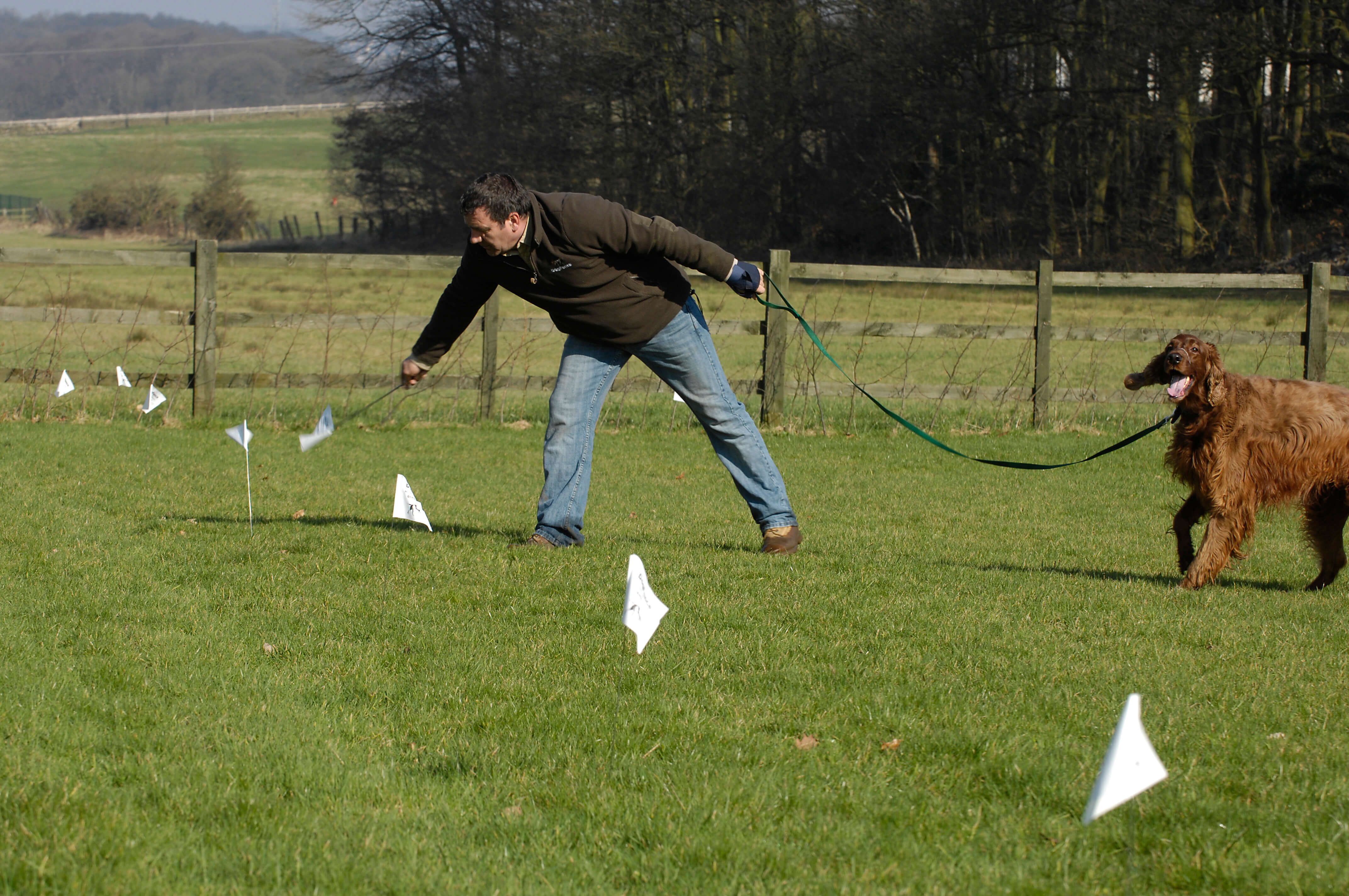
Training the dog using the marker flags
DogFence and the UK Government: why installation and training matter
DogFence consulted directly with the UK Government in 2018 during discussions surrounding electronic training collars and electronic containment fences.
At that time, the Government’s proposals envisaged electronic containment systems being supplied with professional installation and training, reflecting the importance placed on correct system set-up and proper training when using this type of containment.
That principle remains central to the way DogFence works today. When an electronic dog fence is correctly specified, installed and introduced through appropriate training, it can help prevent dogs escaping from their property, becoming lost or reaching hazards such as nearby roads, while allowing them greater freedom to enjoy their garden.
Whether you choose a wired or wireless dog fence, the technology is only part of the solution. Correct boundary design and thorough training are fundamental to a successful outcome and a confident, happy dog.
Can a dog run through a wireless or wired dog fence?
Because neither a wireless nor a wired electronic boundary is a physical barrier, a dog can technically cross it. Effective electronic containment therefore depends on appropriate system design and, importantly, the dog learning where the boundary is and how to respond to its warning.
The objective is for the dog to recognise the warning and turn back before crossing the containment boundary.
The dog’s personality and drive also need to be considered. A dog with a strong chase instinct, for example, needs to be assessed and trained appropriately rather than assuming that simply installing a dog fence will solve the problem.
Read our full guide: Can a Dog Run Through an Invisible Fence?
Why does DogFence use a wired dog fence?
DogFence has specialised in electronic pet containment in the UK for more than 20 years. We use professionally installed wired dog fence technology because it allows us to design the containment boundary around the individual property rather than requiring the property to fit within a predetermined wireless boundary.
That can be particularly important around roads, driveways, neighbouring properties, woodland, undulating terrain, outbuildings, irregular garden boundaries and areas within the property where access needs to be restricted.
For farms, equestrian properties and larger rural homes, it also means the containment boundary can be designed around the way the property is actually used.
But we don’t believe that means everyone should buy a wired DogFence.
A wireless dog fence may be perfectly adequate for some dogs and properties. Equally, there are dogs and circumstances where we may advise that an electronic containment system isn’t appropriate at all.
Find out when an electronic dog fence may not be suitable for your dog.
Wireless dog fence vs wired dog fence: which should I choose?
If you have a large, relatively level and open area where a circular containment zone can sit comfortably inside the safe part of your property, a wireless dog fence may offer a convenient solution without installing a boundary cable.
If your garden is irregularly shaped, has an open driveway, sits close to a road, contains woodland or outbuildings, has undulating ground, or you need the electronic boundary to follow existing fences and hedges accurately, a wired dog fence offers considerably more flexibility over where the boundary can be positioned.
The most important consideration is not simply whether the system is wireless or wired. It is whether the containment system, boundary design and training programme are appropriate for your dog, your dog’s drive and personality, your property and the hazards around it.
Wireless vs wired dog fence FAQs
Is a wired dog fence better than a wireless dog fence?
Not in every situation. A wired dog fence offers much greater flexibility over the shape and position of the containment boundary. A wireless dog fence can be quicker to set up and may work well on a relatively level, open property where a circular containment area is appropriate.
What is the main disadvantage of a wireless dog fence?
One of the principal limitations of a traditional wireless dog fence is the shape and consistency of its containment area. Because the boundary is created by a radio signal from a transmitter, it cannot normally follow an irregular garden perimeter as precisely as a wired boundary, and terrain, trees or buildings may affect some systems.
What is the main advantage of a wired dog fence?
A wired dog fence allows the containment boundary to be designed around the actual shape and features of the property. This provides greater flexibility around fences, hedges, driveways, gates, woodland, uneven ground and outbuildings.
Does a wired dog fence have to be underground?
Not necessarily. Although wired systems are sometimes called underground dog fences, the purpose of the boundary cable is to establish the electronic boundary. The most appropriate installation method depends on the property and the particular system.
Do wireless dog fences work in UK gardens?
Yes. A wireless dog fence can work in a UK garden where its containment area can be positioned safely within the property and the site conditions are appropriate. For irregularly shaped gardens, woodland, undulating ground or properties where the boundary needs to follow existing fences, hedges or driveways closely, a wired system may provide greater flexibility.
How many training flags do I need for a dog fence?
The boundary should be clearly marked during training so that the dog has a strong visual reference while learning where it is. As a practical guide, DogFence recommends at least 20 training flags per 100 metres of boundary. Follow the training programme supplied with your particular system and make sure you have enough flags before beginning.
Are wireless and wired dog fences suitable for every dog?
No. No dog containment method is appropriate for every dog. The dog’s age, health, temperament, behaviour, personality and drive, together with the property itself, should all be considered before choosing an electronic dog fence.
The aim of any dog fence is to give your dog freedom while keeping them safe. DogFence has been surrounding pets with freedom since 2003 and has safely contained more than 20,000 pets – real-world evidence that hidden dog fencing can work effectively when it is correctly set up and supported by thorough training and ongoing support.

Dog running freely within a hidden dog fence boundary marked by training flags
Wireless or wired? Not sure what’s right for your dog?
Tell us about your dog, your garden and what you’re trying to achieve. With more than 20 years’ experience in pet containment, we’ll tell you whether we think a DogFence is suitable – and we’ll tell you if we don’t.
📞 Call us on 01628 476475
💬 Chat to us on WhatsApp
No pressure. No one-size-fits-all solution. Just experienced advice about the safest way to give your dog more freedom.
Image note: Some images used in this article may be AI-generated for illustrative purposes. They are not intended to show a specific DogFence installation, product or individual dog. All advice and information in this article is written and reviewed by DogFence based on more than 20 years’ experience in electronic pet containment.