
How Does a Dog Fence Collar Work? A Simple Guide for Dog Owners
How Does a Dog Fence Collar Work? A Simple Guide for Dog Owners
How does a dog fence collar work is one of the first questions owners ask when considering an electronic pet containment system. Understanding how the collar communicates with the boundary, how your dog learns the safe zone, and why the system is so effective helps reassure owners that the technology is both safe and humane.
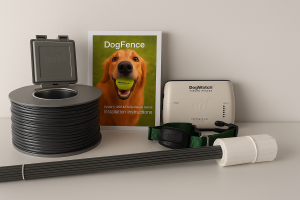
At DogFence Ltd, we’ve safely contained over 20,000 dogs and cats across the UK. Our invisible dog fence collars are part of a modern, reliable FM radio containment system that gives pets complete freedom in the garden while preventing escapes. This guide explains exactly how the collar works and why it is one of the safest options available for dog owners.
How Does an Invisible Dog Fence Collar Work?
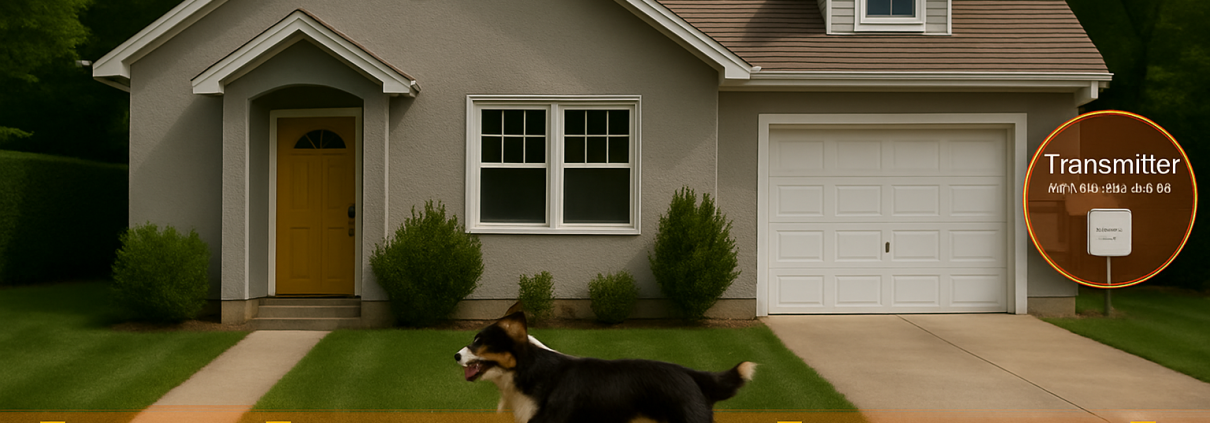
An invisible dog fence collar works by communicating with a buried boundary wire powered by a small transmitter box, usually installed in a garage or outbuilding. The transmitter sends a coded FM radio signal around the boundary. The collar detects this signal and responds with:
- A warning beep as your dog approaches the boundary.
- A gentle static sensation if they continue moving forward.
- Retreat behaviour, which your dog is trained to perform by stepping back into the safe area.
This clear sequence teaches your dog exactly where the boundary is. You can see the full system layout on our detailed How It Works page.
The Role of the Boundary Wire and Transmitter
The invisible dog fence relies on a strong, stable perimeter signal. This is produced by the transmitter, which sends a continuous FM radio frequency through the buried wire. FM technology is much more reliable than AM or GPS, which is why DogFence systems activate faster, avoid interference, and prevent false corrections.
Because the system uses a closed loop, it is accurate to within inches — something GPS dog collars cannot achieve.
What Happens When the Dog Approaches the Boundary?
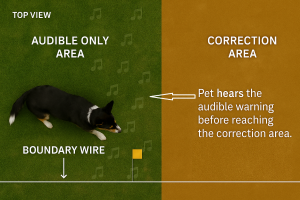
When your dog enters the alert area near the boundary, the collar gives a clear warning beep. This is the main training cue and the one dogs learn to respond to most quickly.
If your dog ignores the beep and continues forward, the collar gives a gentle, harmless static sensation — similar to a light TENS pulse. This sensation is enough to encourage your dog to step back. Once they retreat, both the beep and the sensation stop immediately.
With correct training, dogs quickly learn to stop at the beep, making physical corrections rare.
How the Collar Makes Contact: Stainless Steel Posts or Comfort Contacts
The collar uses either rounded stainless-steel contacts or our optional Smooth Comfort Contacts (for short-coated dogs). Just like a TENS machine pad, the collar needs gentle skin contact to allow the communication to work consistently. The probes are not spikes or prongs — they are simply contact points.
Good contact means the collar can be set to gentle, low levels, keeping training calm and humane. For more on achieving the correct fit, see our guide How Tight Should a Dog Fence Collar Be?.
Training: How Dogs Learn the Boundary
Training is simple, positive, and structured. During the training sessions, your dog is introduced to the warning beep, shown how to retreat to the safe zone, and rewarded with praise. Most dogs learn their boundary within just a couple of sessions.
Because the system is predictable and clear, dogs understand exactly what is expected of them. This is one of the key reasons invisible dog fences are so effective for escape artists and determined roamers.
Is the Collar Safe for Dogs?
Yes. Multiple independent scientific studies — including Newcastle University’s DEFRA-funded research (Cooper et al.) and the UK Government’s own analysis (DEFRA) — confirm that invisible dog fence collars are safe when used correctly.
They do not cause long-term stress, behavioural problems, anxiety, or physical harm. Dogs learn quickly, become confident in their boundaries, and enjoy the freedom to explore safely.
For a full breakdown of the research and safety features, read our main guide: Are Dog Fence Collars Safe?
Why Invisible Dog Fence Collars Work Better Than Physical Fencing
Invisible dog fence collars are ideal for dogs who:
- dig under or jump over fences
- chase livestock or wildlife
- bolt through gates
- live on large or uneven properties
- cannot use physical barriers due to layout or planning restrictions
Because the system creates a consistent, invisible boundary, your dog always knows where the “edge” is — even when gates are open.
Professional Installation Ensures Reliability
Our Professional Installation service includes boundary design, collar fitting, system tuning, and complete dog training. This ensures your system works perfectly from day one and that your dog learns gently and confidently.
Keep Your Dog Safe With a Trusted DogFence System
Call us on
01628 476475
|
Chat to us on WhatsApp
|
Request a Free Quote Online