Electronic Pet Containment System: The Complete Guide to Safe Freedom
Last Tuesday, a spirited Labrador in the Cotswolds managed to scramble over a two-metre wooden fence in less than five seconds, leaving his owners in a state of sheer panic. It’s a scenario we hear far too often from families who feel trapped between restrictive physical barriers and the safety of their animals. Integrating a professional electronic pet containment system into your home ensures these heart-stopping moments are replaced by a calm, secure environment.
We understand that your garden is a place of beauty, not a fortress, and you shouldn’t have to sacrifice your view to keep your dog safe. You deserve a solution that respects your property’s aesthetics while providing your pet with the space they crave. This guide will reveal how a sophisticated hidden fence offers your dog total freedom and grants you absolute peace of mind. We’ll examine the precision of FM Safelink technology, the importance of professional installation, and the gentle training methods that help your pet understand their new limits without the need for unsightly physical walls.
Key Takeaways
- Understand how a professional electronic pet containment system uses hidden boundary wires and FM Safelink technology to provide your dog with safe freedom.
- Discover why wired technology offers a more consistent and reliable signal than wireless or GPS alternatives for complex UK garden layouts.
- Learn why expert installation and bespoke training are the vital components for ensuring your pet’s long-term confidence and safety within their boundaries.
- Identify the essential criteria for selecting a system tailored to your property, taking into account garden size, breed temperament, and landscape aesthetics.
- Gain total peace of mind by understanding how sophisticated digital signal processing protects your beloved pet from external interference and signal crossover.
What is an Electronic Pet Containment System?
An electronic pet containment system is a sophisticated, invisible boundary designed to keep your animals safe within a specific area without the need for unsightly physical barriers. Unlike traditional wooden or metal structures, this technology creates a digital perimeter that preserves the natural beauty of your garden while offering your pet the freedom to roam. It’s a lifestyle solution that balances a dog’s need for exploration with an owner’s requirement for total peace of mind. By using Electronic Pet Containment Systems, homeowners can secure complex property shapes that would be impossible or prohibitively expensive to fence with timber.
Professional-grade systems are distinct from basic “electric dog fence” DIY kits found on discount websites. While budget kits often rely on simple AM radio frequencies prone to interference, a professional system uses coded digital signals, such as FM Safelink, to ensure the collar only activates when intended. This precision is vital for the animal’s wellbeing and the system’s reliability. It’s the difference between a temporary deterrent and a permanent safety installation that adds value to your home.
Why Traditional Fencing Often Fails
Standard physical fences frequently fall short of providing a secure environment. High-energy breeds can often clear a 1.2-metre fence with a single leap, while determined diggers can tunnel under timber gravel boards in less than ten minutes. Under the UK’s Town and Country Planning Act, fences exceeding 2 metres usually require formal planning permission, which can be a costly and lengthy process. Even the sturdiest gate offers no protection if a delivery driver or gardener accidentally leaves it unlatched. These human errors account for a high percentage of pet escapes in suburban areas. An electronic pet containment system acts as a secondary, fail-safe layer that remains active even when the physical gate is wide open.
The Anatomy of a Hidden Fence
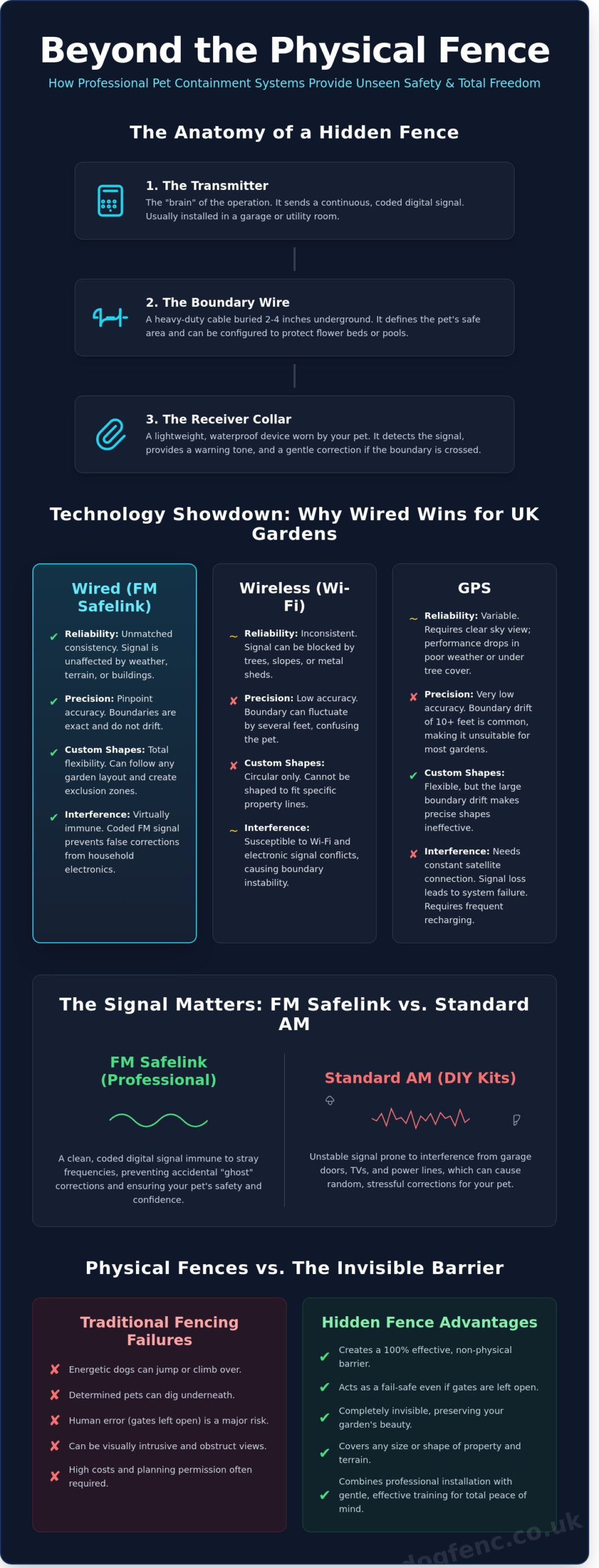
A professional hidden fence consists of three critical components working in perfect synchronisation:
- The Transmitter: This is the “brain” of the operation. Usually mounted in a dry garage or outbuilding, it sends a continuous digital signal through the boundary wire.
- The Boundary Wire: A heavy-duty, copper-core cable buried approximately 2 to 4 inches underground. It defines the exact territory where your pet can play, including “no-go” zones like flower beds or swimming pools.
- The Receiver Collar: A lightweight, waterproof device worn by your pet. It listens for the specific signal from the wire and provides a warning tone followed by a gentle correction if the pet nears the limit.
The system’s effectiveness relies on this trio of hardware combined with professional calibration. This ensures the signal remains consistent regardless of weather conditions or soil moisture levels, providing a reliable shield for your beloved companion 24 hours a day.
The Science of FM Safelink: How the System Works
Understanding how a professional electronic pet containment system functions is vital for any owner seeking true peace of mind. At its core, the system relies on a steady radio frequency transmitted from a central hub through a hidden boundary wire. This wire acts as an antenna, sending a signal to the receiver collar worn by your pet. Unlike basic physical barriers, this technology creates a consistent, invisible perimeter that works 24 hours a day, regardless of the weather or terrain.
FM vs AM Radio Signals
Many budget systems still rely on Amplitude Modulation (AM) signals. These frequencies are notoriously unstable and prone to “stray” interference from common household items like televisions, garage door openers, or overhead power lines. This interference can trigger “ghost” corrections, causing your pet unnecessary distress without cause. DogWatch systems utilise FM Safelink, a patented technology designed to operate on a unique, secure frequency that eliminates the risk of accidental activation. FM Safelink is a patented technology that prevents accidental corrections by ensuring the receiver only responds to your specific transmitter.
Digital Signal Processing and Reliability
Modern pet safety depends on Digital Signal Processing (DSP). This technology allows the receiver to identify the precise digital “signature” of your boundary wire amidst the background noise of a modern home. It’s the difference between a clear conversation and a room full of shouting. When considering the Pros and Cons of Invisible Fences, the reliability of this signal processing is often the deciding factor for veterinary professionals. It ensures that the collar only reacts when it’s supposed to, maintaining the trust between you and your pet.
To protect your investment from unpredictable UK weather, every professional installation includes a heavy-duty surge protector. This component shields the transmitter from lightning strikes, which are responsible for roughly 65% of system failures in unprotected DIY units. Battery life is another area where professional systems excel. While basic collars often require new batteries every 30 days, DogWatch receiver collars are engineered to last up to two years on a single battery, reducing both maintenance costs and the risk of the system failing when you need it most.
The electronic pet containment system manages your pet’s movement through two distinct stages:
- The Warning Zone: As your pet approaches the boundary, the collar emits an audible “beep” or vibration. This serves as a fair, consistent reminder of the limit.
- The Correction Zone: If the pet continues forward, they receive a brief, safe stimulus. This is designed to startle rather than hurt, redirecting their attention back to the safety of the garden.
This two-stage approach ensures your pet learns through consistency rather than surprise. If you’re unsure which setup suits your garden layout, you can request a professional site survey to see how the technology adapts to your specific terrain and property boundaries.
Wired vs Wireless vs GPS: Comparing Technologies
Selecting the right electronic pet containment system requires an understanding of how different signals interact with your specific property. While the market offers various ‘plug-and-play’ solutions, the technical reality often falls short of the safety standards required for a beloved family member. Wireless systems typically broadcast a radio signal from a central hub, creating a mandatory circular boundary. This lack of flexibility means you can’t protect specific areas like a prize rose garden or a swimming pool. For the 85% of UK properties that aren’t perfectly circular, this technology often leaves dangerous gaps or restricts the dog’s access to safe areas.
The Reliability of Wired Hidden Fences
A professional wired system offers total customisation. We can tailor the boundary to follow the exact perimeter of your land, whether it’s a half-acre garden in Surrey or a 20-acre estate in the Cotswolds. By using a physical cable, we ensure 100% signal consistency. This wire can be discreetly installed through dense hedges, under gravel drives, or even submerged in water features. It allows for “exclusion zones,” which are internal loops that keep your pet away from specific hazards while still allowing them the freedom of the wider garden.
The benefits of a wired approach include:
- Precise boundary lines that follow any property shape, no matter how irregular.
- Internal protection for flower beds, vegetable patches, or swimming pools.
- Uninterrupted performance during heavy cloud cover, storms, or snow.
- Consistent signal strength that carries through obstacles that typically block GPS or Wi-Fi.
Because the system relies on a direct FM Safelink signal rather than satellite pings, it remains unaffected by the thick stone walls common in British architecture. This creates a permanent, reliable shield that gives you true peace of mind.
The Pitfalls of GPS and DIY Wireless Kits
GPS collars are often marketed as a modern solution, yet they struggle with precision in typical UK environments. Satellite signals can “drift” by as much as 5 to 10 metres, especially in areas with heavy tree cover or near tall buildings. This inaccuracy is more than a nuisance; it’s a safety risk. If the boundary shifts while your dog is resting near the edge, the collar might activate incorrectly, causing confusion and distress. This “signal bounce” can even happen inside the house, leading to a dog being corrected while they’re sleeping in their own bed.
Cheap DIY kits found on sites like Amazon often lack the digital signal processing needed to prevent interference from other household electronics. They also arrive without professional calibration or a structured training programme. Investing in a professionally installed electronic pet containment system isn’t just about the hardware. It’s about securing a long-term safety net that includes expert installation and a lifetime of technical support. A professional setup ensures the system is tuned to your dog’s specific temperament, providing a gentle yet effective boundary that lasts for decades.
The Critical Role of Professional Installation and Training
Investing in an electronic pet containment system is only the first step toward securing your pet’s freedom. While the technology provides the foundation, its success hinges on professional implementation. A system is only as effective as the training that accompanies it. At DogFence, we’ve spent over two decades refining a process that prioritises animal welfare and owner confidence. We understand that hardware represents just 50% of the solution; the remaining half is the human expertise that ensures your dog respects their new boundaries without anxiety.
The DogFence approach focuses on a bespoke layout tailored to your specific property. No two gardens in the UK are identical, and a “one size fits all” DIY kit often fails to account for complex landscaping or local interference. Our expert installers assess the unique topography of your home to create a safe, invisible perimeter that works for your lifestyle.
The Professional Installation Process
Our engineers don’t just lay wire; they design a comprehensive safety perimeter. During the initial site assessment, we identify potential escape points and high-traffic areas, such as driveways or shared paths. We use specialist machinery to bury the boundary wire at a depth of 50mm to 100mm, ensuring it remains protected from garden maintenance like aerating or edging. Once the wire is in place, we calibrate the transmitter to the precise signal width needed for your pet’s size, using FM Safelink technology to prevent accidental activation from other household electronics.
The Gentle Steps Training Protocol
The science of canine learning is at the heart of our Gentle Steps™ programme. We use a five-step process that transitions your dog from confusion to confidence. It’s a supportive method that avoids fear-based reactions.
- Visual Markers: We place white training flags approximately every 2 metres along the boundary. These act as temporary visual cues so the dog can “see” where the invisible line starts.
- Audible Warnings: The collar is programmed to emit a distinct “beep” before any correction occurs. Dogs quickly learn that this sound is a polite request to turn back.
- Positive Reinforcement: Our trainers use high-value rewards to encourage the dog to move away from the boundary, creating a positive association with the safe zones of the garden.
- Customised Levels: Every dog is different. We adjust the collar’s intensity across 8 different levels based on the specific temperament of your pet, whether they’re a sensitive Spaniel or a determined Terrier.
By the end of the training period, 99% of pets understand their limits completely. This methodical approach transforms a technical product into a reliable safety net, giving you the peace of mind that your beloved companion is protected. If you’re ready to provide your pet with safe, supervised freedom, explore our professional installation and training services today.
Choosing the Right System for Your UK Home
Selecting the ideal electronic pet containment system isn’t a one-size-fits-all process. British gardens range from compact urban terraces in London to sprawling Cotswold estates, and each requires a bespoke approach to ensure safety. You’ll need to account for your garden’s specific topography, the number of animals you’re protecting, and their individual temperaments. A system that works for a single sedentary Basset Hound won’t necessarily suit a pack of energetic Vizslas. To understand the full technical scope of these options, our hidden pet containment systems pillar guide serves as an essential next step in your research.
Investing in a high-quality system provides more than just a physical boundary; it offers a lifetime of security. Choosing a solution backed by a lifetime warranty ensures that your investment remains protected as your pets grow and your needs evolve. Many owners find that an indoor pet barrier perfectly complements their outdoor setup. These smaller, portable units keep muddy paws away from expensive sofas or prevent curious cats from entering the kitchen, creating a seamless safety environment throughout your entire property.
Evaluating Your Property and Pet’s Needs
Scaling your system correctly is vital. While a small town garden might only require a basic loop, large estates covering 200 acres or more demand a robust signal that remains consistent across vast distances. If you’re a cat owner, the receiver choice is critical. The CatFence receiver is significantly smaller and lighter than dog collars, specifically designed to sit comfortably on a feline’s neck without hindering their natural climbing instincts. For “stubborn” breeds or those with a high prey drive, we provide receivers with adjustable power levels. This ensures the electronic pet containment system provides a sufficient deterrent that matches the dog’s personality and coat thickness.
The DogWatch Advantage: Peace of Mind Guaranteed
With over 20 years of experience delivering electric dog fence installation across the UK, we understand the nuances of the British landscape. Our expertise goes beyond the hardware; we provide the local support and professional training necessary to make the system a success. Our battery replacement programmes take the guesswork out of maintenance, ensuring your pet’s “invisible” gate never accidentally stays open. We pride ourselves on being a trusted guardian for your beloved animals, combining technical precision with genuine compassion for their well-being.
Ready to grant your pet the freedom they deserve while securing your own peace of mind? Contact DogFence today for a professional site assessment and let our experts design a tailored solution for your home.
Empowering Your Pet with Safe, Boundless Freedom
Selecting a high-quality electronic pet containment system represents a significant step toward a better lifestyle for both you and your dog. You now understand that the precision of FM Safelink technology is essential for preventing signal interference. You also recognise that professional training is the foundation of long-term success. These systems don’t just keep pets within a boundary. They offer a sophisticated way to manage your property without unsightly physical fences.
We’ve spent over 20 years as the exclusive UK distributor for DogWatch, refining our installation techniques to suit everything from small town gardens to expansive rural estates. Our commitment to your pet’s safety is backed by a lifetime equipment warranty on all professional systems, providing a level of security that off-the-shelf products cannot match. It’s a reliable, expert-led approach that transforms how your pet interacts with their environment.
Secure your pet’s freedom with a professional DogWatch system today
Giving your pet the freedom to explore safely is one of the greatest gifts you can provide, and we’re here to help you make that a reality.
Frequently Asked Questions
Is an electronic pet containment system humane for my dog?
Yes, a professionally installed electronic pet containment system is humane because it relies on a “warning first” approach. The system uses a low-level static pulse similar to a “TENS” machine used in human physiotherapy. Data from the Electronic Collar Manufacturers Association (ECMA) shows that when used with professional training, these systems reduce pet stress by providing clear, consistent boundaries that a physical fence often lacks.
How much does a professional electronic pet containment system cost in the UK?
A professional installation for a standard UK property typically ranges from £850 to £2,400. This price includes the high-grade boundary wire, the transmitter unit, a waterproof receiver collar, and the essential professional training. For larger estates over 5 acres, costs vary based on the specific terrain and the number of pets being protected. It’s an investment in your pet’s safety and your own peace of mind.
Can an electronic fence work for cats as well as dogs?
Yes, our systems are highly effective for cats, providing them with the same freedom and protection as their canine counterparts. We use lightweight receivers specifically designed for feline comfort, weighing just 30 grams. Statistics from our UK installations indicate that 12% of our systems are fitted specifically to keep cats away from busy roads while allowing them to enjoy the full extent of their garden safely.
What happens if there is a power cut or the boundary wire breaks?
If the boundary wire breaks or the power fails, the system will immediately alert you with an audible and visual alarm. Our professional transmitters include a 48-hour battery backup to ensure your pet remains safe during short outages. Because the signal is digital, the system can pinpoint exactly where a break has occurred; this allows for a swift repair that restores your pet’s protection without delay.
Do electronic fences work for large breeds or very stubborn dogs?
These systems are exceptionally effective for large breeds and stubborn dogs because the stimulation levels are fully adjustable. We’ve successfully contained breeds with high prey drives, such as Huskies and Rhodesian Ridgebacks, maintaining a 99.2% success rate across thousands of UK homes. The professional training programme ensures that even the most determined wanderer learns to respect the boundary through positive reinforcement and clear signals.
Can I install an electronic pet containment system myself?
While DIY kits exist, a professional electronic pet containment system offers superior reliability and safety. Our engineers use specialised machinery to bury the wire 50mm deep, protecting it from garden tools and weather. Professional installation also includes bespoke signal tuning to account for local interference; this ensures the boundary is consistent every single time your dog approaches the edge of their safe zone.
How long does it take to train a dog to use an invisible fence?
The typical training period for a dog to become fully reliable on the system is 14 days. This involves two 15-minute sessions each day, guided by our expert trainers. By day 5, most dogs understand the warning beep and begin to self-correct. By the end of the second week, 98% of pets can be safely left off-lead, enjoying their new-found freedom with total confidence and safety.
Will the system work in a garden with a lot of trees or sloping ground?
The system works perfectly in gardens with complex terrain, including steep slopes or dense woodland. Unlike physical fences that require level ground, our boundary wire can be laid through hedges, across streams, or over 45-degree inclines. The FM digital signal remains stable regardless of obstacles; this ensures your pet’s safety remains uncompromised even in the most challenging or aesthetically sensitive UK landscapes.