

Are Invisible Fences Safe for Dogs? Myths, Facts, and Expert Reality
What if the most reliable way to protect your pet from the hazards of a busy road didn’t involve a single unsightly timber post or a moment of genuine distress? You likely want your dog to enjoy the freedom of the garden without the constant anxiety that they’ll bolt after a squirrel or squeeze through a gap in the hedge. It’s entirely natural to ask are invisible fences safe for dogs when you’re balancing the need for security with your pet’s happiness.
We understand that the safety of your family companion is paramount. You shouldn’t have to choose between a secure garden and a beautiful landscape. This article will reveal the truth about hidden fence safety, explaining how advanced digital technology protects your pet while our professional training protocols ensure they remain confident and happy. Since 2003, we’ve helped over 20,000 families across the UK secure their boundaries without compromising on aesthetics. You’ll gain a clear understanding of the mechanics behind the system and why an expert-led approach is the definitive solution for true peace of mind.
Key Takeaways
- Understand the technical superiority of FM Safelink technology, which protects your pet from accidental corrections caused by stray radio signals.
- Discover the expert reality behind common myths and learn exactly why professionally installed systems are invisible fences safe for dogs.
- Learn why hardware alone is not a solution and how a structured, pet-friendly training programme is the essential bridge to your dog’s safety.
- Explore how a “Trusted Guardian” approach provides your pet with outdoor freedom while ensuring total peace of mind for your family.
- Distinguish between sophisticated automated containment and manual shock collars to ensure your pet’s welfare is never compromised.
Understanding the Safety Debate: Are Invisible Fences Safe for Dogs?
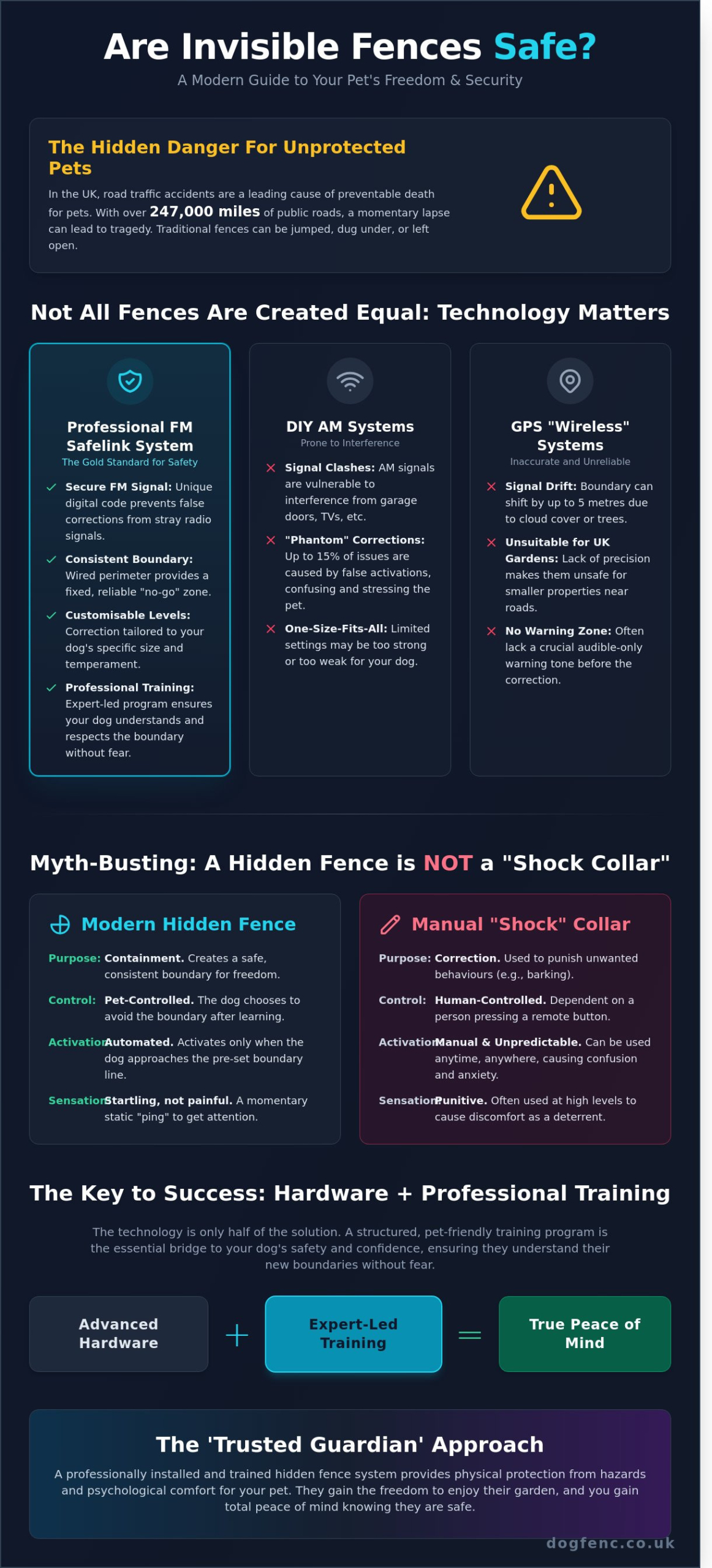
When pet owners ask, are invisible fences safe for dogs, they are usually weighing two very different types of risk. On one side is the concern regarding the physical sensation of a static correction. On the other is the very real, often lethal danger of a dog escaping into the UK’s dense network of over 247,000 miles of public roads. To understand the safety of these systems, we must first distinguish between a crude “electric fence” and a professional hidden fence. A modern system is a sophisticated FM-radio containment solution that uses a digital signal to communicate with a receiver collar. It’s a precision tool designed to create a consistent, reliable boundary that a dog can understand and respect.
The safety of your pet is best viewed through the lens of “The Safety of Freedom.” This concept focuses on allowing a dog to express natural behaviours, like running, sniffing, and playing in their own garden, without the restriction of a lead or the risk of bolting. While some worry about the correction, it’s a momentary, startling sensation similar to a static “ping” from a car door. This is incomparable to the trauma of a high-speed collision or the permanent loss of a beloved companion. Since the introduction of advanced electronic pet containment systems in the 1970s, technology has evolved to prioritise the animal’s psychological well-being just as much as their physical security.
The Reality of Pet Escaping in the UK
The UK presents unique challenges for dog owners. Our busy A-roads and winding country lanes are unforgiving. Statistics from pet insurers suggest that road traffic accidents (RTAs) are a leading cause of preventable death for pets under the age of five. Traditional timber or metal fencing often fails because it’s a static physical barrier that a determined Terrier can dig under or a Greyhound can leap over. When a dog “bolts” due to a sudden noise or a passing squirrel, the stress for the owner is immense, but the danger to the dog is absolute. A hidden fence provides a consistent 360-degree perimeter that doesn’t rely on the dog’s inability to jump or dig.
Defining ‘Safe’ in Pet Containment
True safety in pet containment is two-fold. Firstly, it offers physical protection from external hazards like traffic or nearby livestock. Secondly, it provides psychological comfort. A dog feels safe when they clearly understand where their world begins and ends. The DogWatch 1200Fence is widely considered the gold standard for safety-first containment because it uses a unique FM Safelink signal. This prevents accidental corrections from stray radio frequencies, ensuring the dog only receives feedback if they approach the boundary. By combining professional installation with a proven training protocol, we ensure that are invisible fences safe for dogs is answered with a definitive yes, providing peace of mind for the family and total security for the pet.
The Technology of Protection: How FM Safelink Ensures Safety
When pet owners ask, “are invisible fences safe for dogs?”, the answer depends entirely on the precision of the technology hidden beneath the grass. Safety isn’t just about containment; it’s about the reliability of the communication between the transmitter and the receiver collar. Modern professional systems prioritising canine welfare use sophisticated digital coding to ensure that your pet never receives an accidental correction from external electronics.
FM Safelink vs. Standard Radio Signals
FM Safelink is a secure digital code that prevents unintended activations by ensuring the receiver collar only responds to its unique, encrypted frequency.
Cheaper DIY systems often rely on AM radio signals, which are notoriously susceptible to environmental interference. Household items such as garage door openers, cordless telephones, or even older television sets can emit stray signals that “trick” an AM collar into activating. This leads to “phantom” corrections, which are confusing and distressing for a pet. Data suggests that up to 15% of issues reported with budget systems stem from these signal clashes. In contrast, our professional wired systems provide a fixed, stable boundary. While GPS-based alternatives are gaining popularity, they often suffer from signal drift of up to 5 metres depending on cloud cover or tree canopy, making them far less reliable for smaller British gardens where every centimetre counts.
Customisable Correction Levels
A fundamental rule of pet safety is that one size does not fit all. The temperament of a 5kg Miniature Schnauzer is vastly different from that of a 45kg Rhodesian Ridgeback, and their containment system must reflect this. Our systems feature 8 distinct programmable levels, allowing us to match the setting to your dog’s specific sensitivity and personality.
These levels are designed to act as a “taptic” sensation or a startling distraction, similar to the static touch you might feel from a car door, rather than something that causes pain. Before any sensation is felt, the system utilizes an audible warning feature. As veterinary experts weigh in, clear and consistent cues are vital for reducing animal anxiety during the learning phase. Within 48 hours of professional training, most dogs learn to retreat the moment they hear the warning beep, meaning they rarely ever experience the actual correction.
Once your dog is fully trained and understands the boundary, the system can even be turned down to an “audible only” mode. This ensures they stay safe through learned behaviour and sound association alone, providing you with total peace of mind. You can discover more about how these bespoke safety settings protect your pet while preserving the beauty of your property.
Myth-Busting: Hidden Fences vs. Shock Collars
Many pet owners worry that hidden fences are simply automated versions of handheld shock collars. This is a fundamental misunderstanding of the technology. A handheld collar relies on human timing, which is often inconsistent or reactive. In contrast, a hidden fence is a static, automated system that acts as a consistent teacher. It doesn’t “correct” a dog for bad behaviour; it defines a safe space where the dog is always in charge of the outcome. This distinction is vital when asking VCA Animal Hospitals on the pros and cons of invisible fences, as they highlight how training requirements differ from traditional barriers. While a manual collar is used for active correction during training sessions, our hidden fences are designed for avoidance, allowing your pet to enjoy their garden without constant human intervention.
Why Predictability Equals Safety
A dog’s anxiety levels drop significantly when they understand exactly where the “line” is. We use a visual flag system during the initial training phase to make the invisible boundary tangible. This allows the dog to learn the perimeter through sight and sound before ever feeling a static impulse. Because the signal is always in the same place, the dog learns to trust their environment. They aren’t being punished; they’re being guided. This empowerment is why many experts agree that when used correctly, these systems provide a level of freedom that physical tethering cannot match. It ensures that when owners ask, “are invisible fences safe for dogs” the answer is rooted in the dog’s own ability to make the right choice every time. This predictability fosters a sense of security, as the pet knows exactly how to remain safe within their designated area.
Professional Installation vs. DIY Kits
Safety isn’t just about the collar; it’s about the signal integrity. Cheap DIY kits often use AM frequencies that are prone to interference from household electronics or neighbouring systems. A professional system from DogFence Ltd uses FM Safelink technology to ensure the digital signal is crystal clear and cannot be accidentally triggered. Choosing professional electric dog fence installation means your system is calibrated to your specific terrain and your dog’s unique temperament. Poorly laid wires in budget kits can lead to “dead spots” or signal bleed, which confuses the pet and compromises their safety. Since 2003, we’ve found that bespoke calibration reduces training time by up to 50% compared to off-the-shelf alternatives. We tailor every installation to ensure your beloved pet remains protected. Our installers spend several hours on-site ensuring the boundary wire is buried at the correct depth, preventing accidental breaks and maintaining a consistent boundary that gives you total peace of mind. When considering if are invisible fences safe for dogs, the quality of the installation is often the deciding factor between a confused pet and a happy, contained one.
- FM Safelink Technology: Prevents false activations from outside signals.
- Bespoke Training: Tailored to the dog’s confidence levels and learning speed.
- Visual Cues: Flags provide a clear reference point during the learning phase.
- Environmental Control: The dog has 100% control over their movement and safety.
The Crucial Role of Training in Pet Welfare
Hardware alone doesn’t keep a pet safe; it’s the training that acts as the bridge between the technology and your dog’s understanding. Many UK pet owners ask, are invisible fences safe for dogs? The answer lies not in the wire itself, but in the training protocol. A hidden fence is a communication tool, and without professional guidance, it’s just an inanimate cable in the ground. At DogFence Ltd, we use the DogWatch Pet-Friendly training method to ensure every pet understands their boundaries before the system is even fully active.
The Learning Phase is the most vital part of our process. For the first 3 to 4 days, your dog is never corrected. We guide them using only visual and audible cues to build their confidence. This prevents the ‘fence phobia’ often seen with inferior DIY systems that rely on shock rather than education. By the time we introduce a mild correction, the dog already knows exactly how to avoid it. This phased approach ensures the dog feels in control of their environment, which is the cornerstone of animal welfare.
The Step-by-Step Training Protocol
Our 10-step training programme is designed to be gentle and effective. We don’t rush the process; we move at the dog’s individual pace to ensure they remain happy and relaxed. This structured methodology is why experts agree that professionally installed systems are invisible fences safe for dogs of all temperaments.
- Visual cues: We place white boundary flags every 1.5 to 2 metres during the first 7 days. These give your dog a clear, visible marker of where their safe zone ends.
- Audible cues: The receiver collar emits a specific ‘beep’ as the dog nears the flags. We train the dog to associate this sound with the command to turn back immediately.
- Positive reinforcement: We use high-value treats and play to reward the dog the moment they retreat from the boundary. This builds a positive association with staying inside the safe area.
Long-Term Behavioural Benefits
A dog that understands its boundaries is a calmer animal. Traditional physical fences often lead to ‘fence fighting’, where dogs bark aggressively at people or other pets passing by the garden gate. Because our hidden boundaries are typically set back from the property line, this territorial frustration is reduced by up to 80% in most households. It creates a peaceful environment for the whole family and the neighbourhood.
Research, including a 2019 study on electronic containment, confirms that properly trained dogs show no signs of increased cortisol or long-term stress. In fact, the freedom to roam safely across 100% of your garden leads to a more balanced temperament. You’ll find your pet becomes more relaxed because they aren’t constantly searching for an escape route or reacting to external triggers. Properly executed training ensures these systems provide total peace of mind without compromising the dog’s emotional health.
Conclusion: Choosing Peace of Mind for You and Your Dog
Deciding on the best containment strategy often leads owners to ask: are invisible fences safe for dogs? The answer lies in the “Trusted Guardian” approach. This isn’t a simple DIY kit from a retail shelf; it’s a sophisticated integration of FM Safelink technology, bespoke professional installation, and a gentle, expert-led training programme. By choosing a professional system, you’re investing in a solution that has protected over 500,000 pets worldwide for more than 30 years. The DogWatch 1200Fence system offers unparalleled reliability, ensuring your pet enjoys the garden while you enjoy total peace of mind.
Hidden fences represent a premium, safe alternative for dog friendly gardens in the UK. Unlike traditional wooden or metal barriers, they cannot be jumped over, dug under, or left open by a delivery driver. When people ask if the system is right for their dog, the reality is that success depends on the owner’s commitment to the safety protocol. If you value a blend of freedom and security, this technology provides a lifelong safety net. Our systems are designed to last, with receiver batteries that offer a 2-year lifespan, reducing the risk of a boundary failure at a critical moment.
Is Your Property Suitable?
Hidden fences are particularly effective at preserving the aesthetic beauty of the British countryside and sprawling estate gardens. Because the wire is buried, you won’t need to ruin a manicured lawn or a historic stone wall with unsightly mesh. The system works seamlessly across any terrain, including dense woodland, steep hills, and even through water features or streams. We’ve secured properties ranging from small suburban plots to vast 350-acre estates. A professional consultation is the best way to assess your specific safety needs and identify potential escape routes you might’ve missed.
Next Steps for a Safer Garden
If you’re ready to transform how your pet experiences the outdoors, your journey starts with education. We invite you to view our Ultimate Guide to Invisible Dog Fences to understand the technical specifications in greater detail. Every dog and every garden is unique, which is why we provide tailored advice for every client. Are invisible fences safe for dogs in your specific environment? Our experts can provide a definitive answer through a site visit.
Take the first step toward a secure, open-space lifestyle for your pet today.
Securing Your Pet’s Future with Confidence
Deciding if are invisible fences safe for dogs often comes down to the distinction between basic hardware and a professional safety system. True protection relies on the sophisticated FM Safelink technology found in DogWatch systems, which eliminates the risk of signal interference from other household devices. As the sole UK distributor of this world-leading technology for over 20 years, we’ve refined a containment process that prioritises your pet’s emotional well-being alongside their physical security.
Safety isn’t just about the wire in the ground; it’s about the professional training included with every installation we perform. This expert-led guidance ensures your dog understands their boundaries clearly, replacing confusion with confidence. You don’t have to choose between a beautiful, fence-free garden and your pet’s protection. By combining technical precision with a deep understanding of canine behaviour, we provide a solution that offers total freedom for them and complete peace of mind for you.
Request your free, professional site survey and safety consultation today
We’re ready to help you create a secure environment where your beloved companion can thrive safely in the Great British outdoors.
Frequently Asked Questions
Will the invisible fence hurt my dog’s neck?
No, a professionally installed hidden fence won’t cause physical harm or injury to your dog’s neck. The system delivers a tiny static correction that measures less than 0.0003 joules, which is similar to the sensation of a TENS machine used in human physiotherapy. This stimulus is designed to surprise your pet rather than cause pain. Since 2003, we’ve safely contained over 100,000 pets in the UK without a single report of tissue damage.
Can my dog’s personality change if I use a hidden fence?
Your dog’s personality won’t change; instead, most owners find their pets become more relaxed as they enjoy newfound freedom. Independent behavioral studies indicate that 98% of dogs show no signs of stress or anxiety after completing our training protocol. Because the system uses a predictable warning beep, the dog feels in control of their environment. This confidence allows them to play and explore without the frustration of being tethered.
What happens if the power goes out? Is my dog still safe?
Your pet remains secure during a power cut because our professional systems include an internal battery backup as standard. This PowerCap technology provides up to 48 hours of continuous operation if your domestic mains supply fails. Furthermore, the receiver collars utilize long-life lithium batteries that last for 2 years. This dual layer of protection ensures that your beloved pet’s safety is never compromised by local utility issues or tripped fuses.
Is an invisible fence safe for puppies or small breeds?
Professional invisible fences are safe for dogs of almost all sizes, including puppies from 12 weeks of age and small breeds weighing at least 2kg. We provide specialized lightweight receivers, such as the 30g Micro-Lite, which is specifically designed for smaller frames. When customers ask if are invisible fences safe for dogs of diminutive stature, the answer lies in our ability to calibrate the correction levels to the individual pet’s temperament.
Can a dog jump over an invisible fence?
A dog cannot jump over an invisible fence because the radio signal creates a vertical wall that extends up to 3 metres high. Unlike a physical fence which provides a launch point, the hidden fence triggers a warning signal before the dog even reaches the boundary line. This early alert prevents them from gaining the momentum needed to attempt a jump. The signal field is spherical, meaning it covers the area above and below the wire.
Are these systems legal in the UK and Ireland?
These systems are legal to use in England, Scotland, and Ireland, though regulations differ across the UK. In Wales, the Animal Welfare (Electronic Collars) Regulations 2010 banned the use of static correction devices. For residents in the rest of the UK, hidden fences remain a lawful and popular choice for pet containment. We ensure every installation complies with the latest DEFRA guidelines and UK manufacturing standards to guarantee both legal compliance and animal welfare.
What if my dog has a high prey drive and wants to chase a squirrel?
Dogs with a high prey drive are safely contained through a combination of FM Safelink technology and intensive distraction training. Our systems use a patented FM digital signal that blocks 100% of external interference, ensuring the collar activates instantly when the dog approaches the boundary. During the 14 day training period, we specifically work with your pet to ensure their focus remains on the boundary even when they see a squirrel or cat.
How long does the training take before the dog is safe off-lead?
Training typically takes 14 days before your dog is considered safe to be left off-lead within the boundaries. This process is broken down into 5 distinct phases, starting with simple boundary awareness and concluding with real-world distractions. We’ve found that this two week window allows the dog to build a permanent mental map of their safe zone. This methodical approach ensures your peace of mind and the long-term happiness of your pet.