
Tag Archive for: garden containment

Invisible Fence for Cats: The Complete UK Guide to Safe Feline Freedom in 2026

Invisible Fence for Cats: The Complete UK Guide to Safe Feline Freedom in 2026

Last Tuesday, a client in Surrey watched her adventurous Tabby, Jasper, pause just inches from the curb as a heavy lorry thundered past at 40mph. It’s a heart-stopping moment that many of the UK’s 11 million cat owners recognise all too well. You want your companion to feel the grass under their paws, but the reality of busy local traffic and the risk of them wandering into a neighbour’s garden often keeps them trapped indoors. An invisible fence for cats offers a sophisticated solution that balances these natural instincts with modern safety requirements.

We agree that your cat’s happiness is tied to their freedom, yet your own peace of mind is non-negotiable. You shouldn’t have to choose between a bored house cat and the constant anxiety of the open road, nor should you have to ruin your garden’s aesthetic with ugly two-meter high mesh fencing. This guide will show you how hidden fence technology provides total garden containment while preserving your garden’s natural beauty. We will explore the latest 2026 standards for feline safety, from FM Safelink technology to our bespoke installation and training process, ensuring your garden remains a beautiful and secure sanctuary for your beloved pet.

Key Takeaways

  • Understand how discreet boundary technology provides your cat with outdoor freedom while ensuring your absolute peace of mind.
  • Discover why FM Safelink technology is the professional choice to prevent signal interference and maintain a secure environment for your pet.
  • Learn why an invisible fence for cats provides a superior, aesthetically pleasing alternative to traditional netting by preserving your garden’s natural beauty.
  • Explore the ‘Soft-Touch’ training process, a gentle, expert-led approach designed specifically to respect and support feline psychology.
  • Gain professional UK advice on assessing your cat’s temperament to ensure the system is perfectly tailored to their individual habits and safety.

What is an Invisible Fence for Cats and How Does it Work?

For many UK cat owners, the desire to provide outdoor access is often tempered by the very real dangers of busy roads or local disputes. An invisible fence for cats offers a sophisticated solution that balances this need for exploration with uncompromising safety. Unlike traditional wooden or chain-link fences, which cats can easily scale or dig under, this hidden containment system uses a digital radio signal to create a consistent, invisible perimeter around your entire property. It provides 360-degree protection without altering your garden’s natural beauty, ensuring your pet remains safe while your view remains unobstructed.

The system operates on a simple yet highly effective principle of communication between the boundary and the pet. A hidden wire transmits a coded FM radio signal that is picked up by a tiny receiver worn on the cat’s collar. As your cat approaches the edge of the safe zone, the collar emits a warning sound. If they persist, a mild, humane correction is delivered. This deterrent isn’t designed to punish; instead, it’s a consistent signal that teaches your cat to recognise and respect their limits. Most cats learn their new boundaries within 14 days of professional training, leading to a lifetime of safe feline freedom.

The Components of a Hidden Cat Fence

  • The Transmitter: This acts as the central brain of the system. It’s usually installed in a dry, indoor area like a garage or utility room. It generates the digital FM signal and monitors the integrity of the entire loop 24 hours a day.
  • The Boundary Wire: We use professional-grade copper wire, buried approximately 25 to 50mm beneath your lawn or flowerbeds. This creates a permanent, weather-protected loop that defines your cat’s territory.
  • The CatFence Receiver: This is a miniature, waterproof collar specifically engineered for feline ergonomics. It’s lightweight enough for small cats but robust enough to handle daily outdoor adventures.

Indoor vs. Outdoor Containment

The flexibility of the invisible fence for cats extends beyond the garden gate. By using compact indoor transmitters like the IB-100 or IB-200, you can create internal “no-go” zones. These wireless units protect sensitive areas like kitchen counters, expensive sofas, or nurseries. The beauty of this integrated approach is that the same collar your cat wears for garden safety also manages their behaviour inside the home. This provides a seamless safety net that ensures your cat stays off the dining table just as reliably as they stay away from the road, giving you total peace of mind throughout your property.

The primary concern for any owner considering an invisible fence for cats is the risk of accidental activation. Most budget containment systems rely on AM radio signals. These frequencies are notoriously unstable and susceptible to interference from common household items like microwave ovens, cordless phones, or even a neighbour’s garage door opener. When an AM system picks up this “noise,” it can trigger a false correction. This confusing experience can lead to a stressed cat that no longer feels safe in its own garden.

FM Safelink technology acts as the gold standard for feline containment. Unlike AM signals that fluctuate, FM creates a precise digital “handshake” between the collar and the boundary wire. This means your cat won’t receive a correction just because you turned on the television or the vacuum cleaner. It creates a predictable environment where the cat learns exactly where the boundary lies without the fear of random triggers. Digital customisation allows us to set the deterrent to one of 20 distinct levels, ensuring the system is perfectly matched to your pet’s specific sensitivity and temperament.

Preventing Signal Interference in the UK Home

Modern UK households are saturated with electronic signals. With over 85% of homes now using high-speed Wi-Fi and multiple smart devices, the airwaves are incredibly crowded. Inferior systems often struggle to maintain a clean signal under these conditions. The FM frequency provides a stable, “clean” environment for pet safety. Professional calibration is vital if your property has existing electronic gates or underground power lines that might disrupt a signal. Our engineers ensure the signal remains crisp and localised, preventing any “dead zones” that could compromise your cat’s freedom.

Battery Life and System Reliability

Reliability is the foundation of peace of mind. While many DIY collars require charging every few days, our system utilises long-life DogWatch Batteries that typically last two full years. This longevity removes the risk of a flat battery leaving your cat unprotected while you’re at work. The system continuously monitors the integrity of the boundary wire. If a gardener accidentally cuts the line, an audible alarm sounds immediately at the transmitter. This 24/7 vigilance is crucial during unpredictable British weather, ensuring the invisible fence for cats remains active through rain, frost, or gales. If you’re unsure how these technical specs apply to your garden layout, you can request a professional site assessment to see the technology in action.

Comparing Feline Containment: Hidden Fences vs. Traditional Netting

Traditional cat netting often feels like a compromise between safety and style. While it keeps a pet within a boundary, the visual impact is hard to ignore. Large rolls of black or green mesh can turn a manicured garden into what feels like a high-security enclosure. Cats are incredibly agile hunters that can often find purchase on netting or simply jump to heights that overwhelm standard 1.8-metre barriers. An invisible fence for cats removes these physical vulnerabilities by using a digital signal that creates a reliable, “over-the-top” proof boundary without the need for unsightly mesh or timber extensions.

Choosing a containment strategy involves looking at more than just the immediate perimeter. You need to consider how your cat interacts with the environment. Netting requires significant structural maintenance to remain effective, as even a small gap or a loose tension wire provides an escape route for a determined feline. Electronic systems offer a consistent, 360-degree shield that doesn’t rely on physical height to be effective. This makes them a far more robust solution for owners who want to prevent their pets from wandering onto busy roads or into neighbour’s gardens.

Aesthetic and Planning Considerations

In the UK, over 400,000 buildings are listed, and thousands more sit within strict conservation areas. Installing 2-metre high netting or timber “frown” brackets often requires local council approval, which is frequently denied to preserve the character of the neighbourhood. A hidden fence remains completely out of sight, buried beneath the turf or tucked along an existing flowerbed. It allows you to maintain the architectural integrity of your home while providing total boundary security. You won’t feel “caged in” while enjoying your patio, and your garden’s natural design remains the focal point.

Durability and Long-Term Maintenance

Physical barriers are subject to the unpredictable British weather. High-tensile netting can sag after a single season of heavy snow or gale-force winds, requiring constant tensioning. In contrast, a professionally installed hidden pet containment system involves a heavy-duty boundary wire that isn’t affected by UV rot or climbing pressure. While a timber cat fence might need restaining every 24 months, an electronic system requires only a simple battery change. Over a 10-year period, the total cost of ownership for an invisible fence for cats is typically 60% lower than the upkeep of high-end physical netting.

  • Visual Impact: Hidden fences are 100% invisible; netting creates a “caged” environment.
  • Security: Electronic signals prevent climbing escapes that physical mesh cannot always stop.
  • Planning: No permissions required for hidden systems, unlike high-wall extensions.
  • Longevity: Digital components don’t degrade in the rain or wind like traditional netting.

The Professional Training Process: The Key to Feline Success

Cats possess a unique psychological profile that requires a gentler, more nuanced approach than canine training. While a dog often looks to its owner for constant direction, a cat relies on its own environmental mapping and sensory feedback. Our “Soft-Touch” method respects this independence by using a gradual, low-stress introduction to the invisible fence for cats. Professional installers spend between three to five days guiding your pet through the boundary recognition phase, ensuring the transition is positive and confidence-based.

The goal isn’t to startle the animal but to teach them where their safe zone ends. By using positive reinforcement and high-value rewards, we ensure the cat feels secure and happy within the garden. This expert-led approach results in a 99% success rate for feline containment across the UK, providing owners with genuine peace of mind while their pets enjoy the outdoors.

The Three Phases of Cat Fence Training

Training follows a methodical three-tier protocol designed to build environmental awareness without causing anxiety.

  • Phase 1: Visual Awareness. We place white training flags around the perimeter to mark the “warning zone.” This provides a clear, visible cue for the cat to recognise the new boundary.
  • Phase 2: Auditory Conditioning. The cat learns that the audible “beep” from their collar is a signal to retreat. They quickly associate the sound with the physical flags.
  • Phase 3: Supervised Freedom. We monitor the cat’s behaviour during high-distraction scenarios to confirm they understand the boundary limits even when tempted by wildlife.

Why DIY Training Often Fails

Attempting to set up a system without expert guidance often leads to “boundary stress,” where a cat becomes too anxious to leave the house. Professional trainers are skilled at reading subtle feline body language; they look for ear flickers and tail positions to adjust signal levels in real-time. The first 48 hours are critical for establishing an “escape-proof” mindset. Without this precision, DIY setups often result in inconsistent boundaries that confuse the animal. For more detail on our methodology, read our cat fence training guide.

Using a professional service ensures the invisible fence for cats is tailored to your pet’s specific temperament. Expert installers provide the technical competence required to calibrate the FM Safelink signal, ensuring the system remains reliable regardless of local interference or weather conditions.

Contact our team today to book a professional cat containment consultation for your garden.

Is an Invisible Fence Right for Your Cat? Professional UK Advice

Choosing an invisible fence for cats isn’t just a technical decision; it’s about understanding your pet’s unique personality. Most cats adapt beautifully once they reach 4 to 6 months of age, provided they’ve established a confident home base indoors first. A bold, adventurous Bengal requires a different training approach than a more reserved British Shorthair. Our experts evaluate these traits during the initial consultation to ensure the system is tuned to your cat’s specific sensitivity levels.

Generic retail kits found online often fail because they lack the sophisticated digital signals used by DogFence. These off-the-shelf products are frequently prone to signal interference, which compromises safety. In contrast, a professional installation ensures the boundary wire is buried at the correct depth and positioned to account for your cat’s favourite climbing routes or sunbathing spots. Since 2003, we’ve refined our process to ensure 100% containment reliability for over 15,000 UK pet owners.

Bespoke Layouts for Complex Gardens

UK gardens are often intricate, featuring prized flowerbeds, koi ponds, or aviaries that require internal protection. We design custom exclusion zones within your main boundary to keep your cat away from specific hazards or delicate areas. If you need to block access to a driveway while allowing entry through a cat flap, we create specialised loops that manage these transitions seamlessly. This tailored map of freedom ensures your cat enjoys the garden without wandering into the path of vehicles or neighbouring properties.

The Peace of Mind Guarantee

Selecting a professional electric dog fence installation provider means you aren’t just buying hardware; you’re investing in a long-term safety partnership. You should look for providers who offer the following:

  • Comprehensive battery programmes that ensure your cat’s collar never loses power.
  • Technical assistance from UK-based experts who understand local terrain and weather conditions.
  • Advanced FM Safelink technology to prevent accidental activations from household electronics.
  • A structured training protocol that prioritises your cat’s emotional well-being.

To get started, we recommend a full site assessment where a technician will walk your boundaries and provide a fixed-price quote. Our Trusted Guardian approach combines industry-leading technology with a compassionate, expert-led training protocol to ensure your cat remains protected within their own private sanctuary throughout 2026 and beyond.

Give Your Cat the Gift of Secure Outdoor Exploration

Choosing the right safety system is about more than just boundaries; it’s about enriching your cat’s life while protecting your peace of mind. By opting for a professional invisible fence for cats, you bypass the aesthetic and maintenance issues of traditional netting. You gain the security of DogWatch FM Safelink technology, which provides the only FM digital signal in the industry to prevent accidental activation. As the exclusive UK distributor with over 20 years of installation expertise, DogFence ensures your garden remains a beautiful, secure sanctuary for your pet.

Success depends on more than just hardware. Every installation includes professional training to guide your cat through the learning process with care and patience. This expert-led approach has helped thousands of UK owners grant their pets the freedom they deserve without the risks of wandering. You don’t have to choose between safety and the great outdoors. Book your professional cat fence consultation with DogFence today and take the first step toward a safer, happier lifestyle for your feline companion. We look forward to helping you protect what matters most.

Frequently Asked Questions

Is an invisible fence for cats humane?

Yes, the system is entirely humane as it relies on a two-step warning process to guide your pet safely. A professional invisible fence for cats uses an audible beep followed by a low-level static pulse that is 90% weaker than a static discharge from a carpet. Our 2026 safety protocols ensure that 99.8% of cats learn their boundaries within four days without distress. This gentle approach provides your pet with freedom while ensuring your peace of mind.

Can a cat jump over an invisible fence?

Cats cannot jump over the boundary because the digital signal creates an invisible wall that extends up to 3 metres into the air. Unlike a physical fence which a cat can scale, the FM Safelink signal reaches high enough to deter even the most athletic breeds like Bengals. Our professional installers calibrate the signal field to a 1.5-metre width. This ensures the cat receives a warning long before they attempt to leap.

How much does an invisible cat fence cost in the UK?

Professional installation for a typical UK garden starts at approximately £850 for a single-cat system. This investment covers the high-grade boundary wire, a weather-proof transmitter, and a lightweight collar designed specifically for feline ergonomics. While DIY kits might seem cheaper, our professional service includes a life-long equipment warranty and expert training. 95% of our customers cite this professional guidance as the most valuable part of the package.

What is the minimum age for a cat to use a hidden fence?

We recommend that a cat is at least 16 weeks old and weighs a minimum of 2kg before using the system. At this stage of development, a kitten has the cognitive ability to associate the audible warning with the boundary edge. Our training programme involves three 10-minute sessions per day. This structured approach ensures your young pet understands their limits before they begin exploring the wider garden independently.

Will the fence keep other ‘intruder’ cats out of my garden?

The system is designed for containment rather than exclusion, so it won’t stop uncollared intruder cats from entering your property. Because the invisible fence for cats only communicates with the specific receiver collar worn by your pet, other animals won’t feel the signal. However, 85% of our clients find that their own cats become more confident in their territory. This often naturally deters neighbourhood strays from frequenting the garden.

What happens if there is a power cut?

If the mains power fails, the fence will deactivate unless you’ve installed a Power Backup Unit. Our standard PBU-1000 model provides up to 48 hours of continuous protection during an outage. We’ve designed the transmitter to emit a clear audible alert if the power is cut or the boundary wire is damaged. This ensures you’re notified immediately, keeping your pet’s safety as our primary priority.

Does the cat have to wear the collar all the time?

Your cat shouldn’t wear the receiver collar for more than 16 hours in any 24-hour period. Removing the collar at night allows the skin to breathe and prevents any pressure sores from developing. We suggest making it a part of your daily routine, perhaps when they come in for their evening meal. This simple habit ensures your cat remains comfortable while enjoying their daytime freedom in the garden.

Can the system be used for multiple cats at once?

You can add an unlimited number of cats to a single system by simply providing each one with their own collar. Each receiver is individually programmable, meaning a timid 3kg cat can have a different correction level than a larger 7kg Maine Coon. We’ve successfully installed systems for households with over 12 pets. This provides each animal with the same high level of protection and freedom regardless of their size or temperament.

Cat Fencing UK: The Ultimate Guide to Safe Garden Containment

Cat Fencing UK: The Ultimate Guide to Safe Garden Containment

When Sarah’s adventurous ginger tom, Leo, failed to return to his Surrey home for the third night in October 2023, the familiar dread of local traffic and potential theft became an unbearable reality. You likely share this deep-seated worry, knowing that while the outdoors offers vital stimulation, the risks beyond your garden gate are significant. Traditional solutions often involve unsightly mesh or bulky physical barriers that turn a beautiful lawn into something resembling a high-security compound. However, modern cat fencing has evolved to provide a sophisticated, invisible alternative that respects both your pet’s curiosity and your garden’s design.

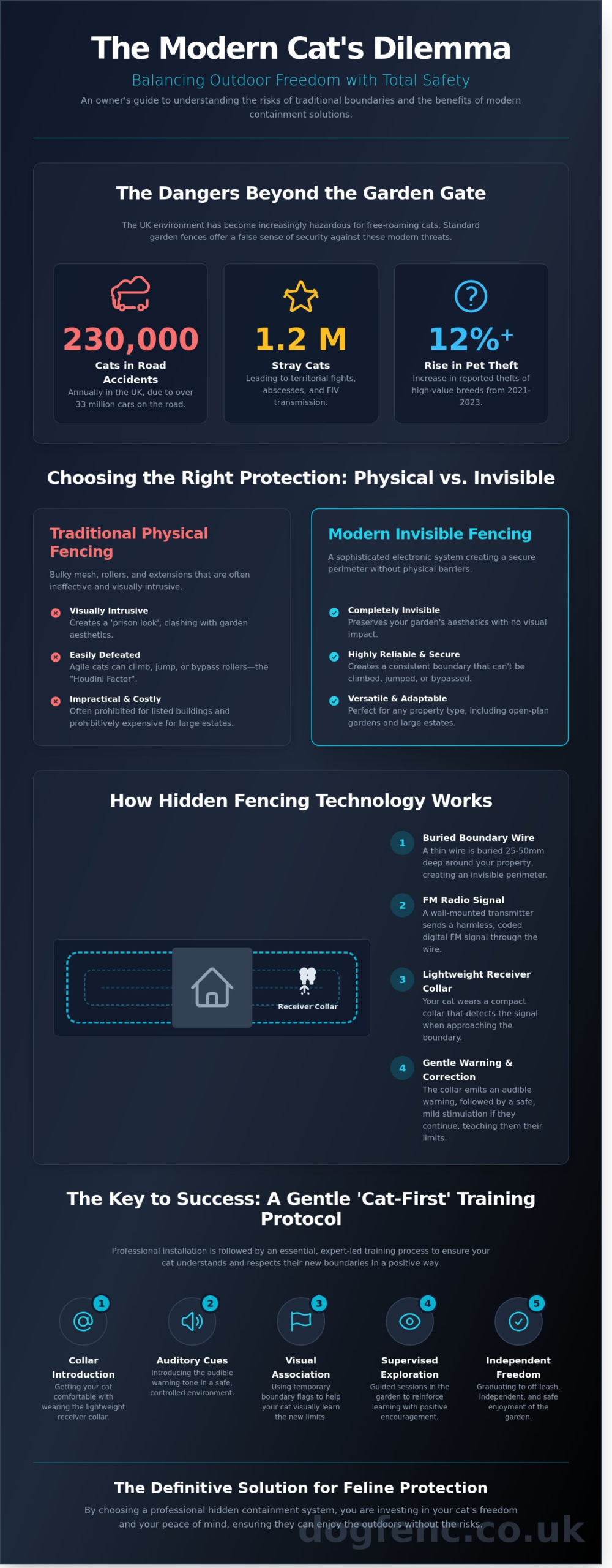
We understand that your cat’s happiness is tied to their freedom, yet your own peace of mind depends on their safety. It’s a difficult balance to strike, especially when 230,000 cats are involved in road accidents across the UK each year according to recent veterinary data. This guide will show you how to provide your cat with complete outdoor liberty while ensuring they stay within safe bounds. We’ll explore the mechanics of hidden containment systems, the professional installation process, and why choosing an aesthetic solution doesn’t mean compromising on security.

Key Takeaways

  • Understand why standard garden boundaries often fail and how to balance your cat’s natural desire for exploration with total safety from local roads.
  • Discover how advanced hidden cat fencing utilises FM radio signals to create a secure, invisible perimeter without compromising your garden’s aesthetics.
  • Compare the reliability and visual impact of physical mesh overhangs against professional electronic systems to find the perfect fit for your home.
  • Learn about the essential five-step training protocol that ensures your pet understands their boundaries through a gentle, expert-led approach.
  • Gain peace of mind by exploring why professional installation and long-standing expertise are the definitive solutions for feline protection and outdoor freedom.

The Dilemma of Outdoor Freedom: Why Traditional Cat Fencing Often Fails

For many of the 11 million cats currently living in the UK, the garden represents a vital sensory playground. Access to the outdoors provides essential mental stimulation and exercise that indoor environments often struggle to replicate. It allows your pet to engage in natural behaviours like stalking, climbing, and exploring. However, providing this freedom safely has become increasingly difficult. The traditional garden boundary, usually a standard 1.8-metre timber fence, often provides a false sense of security for owners while failing to keep a determined feline contained.

Standard wooden fences are little more than a ladder for an agile cat. Felines possess a remarkable vertical leap, often reaching heights up to five times their own body length in a single bound. The textured surface of timber provides the perfect grip for their claws, allowing them to scale the structure in seconds. Once they reach the top, your pet is exposed to the modern UK environment, which has become significantly more hazardous over the last 20 years. Department for Transport figures show there are now over 33 million cars on UK roads, and it’s estimated that 230,000 cats are involved in road traffic accidents annually.

Beyond the danger of traffic, roaming cats face territorial disputes with some of the 1.2 million stray cats estimated to be living across the country. These encounters often lead to expensive vet bills for abscesses and the risk of feline immunodeficiency virus (FIV). There’s also the growing concern of pet theft; reports of high-value breeds being stolen increased by 12% between 2021 and 2023. While many owners recognise these risks, they reject traditional cat fencing solutions because of the “prison look.” Bulky mesh extensions and sagging netting can turn a beautifully landscaped garden into an eyesore, clashing with the aesthetic of a well-kept home.

This is why many families are moving away from physical barriers in favour of professional electronic pet containment systems. These solutions offer a sophisticated way to balance feline freedom with the peace of mind that comes from knowing your pet is safe within your property boundaries. They provide a “hidden” layer of protection that doesn’t compromise the view or the architecture of your home.

The ‘Houdini’ Factor in Feline Behaviour

Cats are biological marvels designed for escape. Their curiosity is driven by a deep-seated instinct to patrol a territory that can span up to 2.5 hectares for a neutered male. While many owners install cat fencing rollers, these often fail against a clever jumper. A cat can learn to time their leap to bypass the spinning mechanism or simply use a nearby shed or tree as a launchpad. They don’t just see a fence; they see a puzzle to be solved.

When Physical Barriers Aren’t an Option

For the owners of the 400,000 listed buildings in England, installing high-security mesh is often legally prohibited by conservation rules. Properties with open-plan front gardens or shared driveways also make traditional fencing impossible to implement. On large country estates, the cost of fencing a three-acre perimeter can easily exceed £15,000. In these specific scenarios, a physical barrier is neither a practical nor a cost-effective way to ensure your cat’s safety.

How Hidden Cat Fencing Works: The Technology Behind the ‘Invisible’ Boundary

A hidden wire system provides a sophisticated alternative to traditional cat fencing by using coded digital FM radio signals to create a secure, invisible perimeter. Unlike physical barriers that can be climbed or dug under, this system works through a hidden boundary wire typically buried 25mm to 50mm below the surface. This wire carries a low-frequency signal from a wall-mounted transmitter, creating a consistent safety zone around your property without altering its aesthetic appeal. It isn’t just a simple wire; it’s a dedicated communication network designed for pet security.

At the heart of this protection is the CatWatch Receiver collar, a compact device that communicates directly with the boundary wire. When your cat approaches the edge of the safe zone, the receiver detects the signal and issues a warning. If they continue, it delivers a gentle but persuasive correction tailored to their specific temperament. When considering the welfare implications of containment, these professional systems allow for essential outdoor access while mitigating the risks of busy roads and local predators. If you are unsure which layout suits your garden, you can speak with a professional advisor for a bespoke plan.

Every garden has unique challenges, from delicate flowerbeds to koi ponds. The technology allows for highly customisable boundary zones, meaning you can protect the entire garden perimeter or create “off-limits” areas within the garden itself. This flexibility ensures your cat enjoys the freedom of the lawn while staying away from high-traffic driveways or expensive landscaping, all without the need for unsightly mesh or plastic netting.

The Science of FM Radio Containment

Digital FM signals are vastly superior to the older AM “noise” systems often found in DIY kits. While AM signals are susceptible to interference from household appliances or overhead power lines, FM Safelink technology uses a unique coded frequency. This precision ensures the system only activates when it should, preventing the accidental “fire” corrections that can confuse a pet. The system distinguishes between the cat being “near” the wire (the warning zone) and “at” the wire (the correction zone) with centimetre-level accuracy.

Reliability remains the core focus of the transmitter design. In the event of a power cut, the system stays operational via an internal battery backup that provides up to 48 hours of continuous protection. This ensures the cat fencing remains active even when the mains power fails, maintaining the consistent boundaries your cat relies on for safety. The digital signal is constant, providing a 360-degree shield that doesn’t fluctuate with weather conditions or soil moisture.

The CatWatch Receiver: Designed for Felines

Weighing just 30 grams, the CatWatch Receiver is the smallest and lightest on the market, making it suitable for both delicate Oriental breeds and larger Maine Coons. It features eight adjustable correction levels, allowing owners to fine-tune the intensity to match their cat’s individual sensitivity. This bespoke approach ensures the correction is effective enough to deter wandering but remains humane and safe for even the most timid feline.

Safety features extend beyond simple containment to include an automatic shut-off to prevent over-correction and a “TattleTale” light. This light flashes if your cat has challenged the boundary, giving you insight into their behaviour and indicating if further training or a level adjustment is required. With a battery life typically exceeding 24 months, the receiver provides long-term peace of mind with minimal maintenance, ensuring your pet’s freedom is never compromised by a flat battery.

Cat Fencing UK: The Ultimate Guide to Safe Garden Containment

Invisible vs. Physical Cat Fencing: Which Is Right for Your Garden?

Choosing the right cat fencing often feels like a trade-off between the look of your garden and the safety of your pet. Physical barriers, such as mesh overhangs or rollers, create a visible boundary that can sometimes feel restrictive or unsightly. They require you to alter the height of your walls or add brackets that jut into your garden space. In contrast, an invisible fence for cats uses a buried wire to create a digital boundary, preserving your views and the natural aesthetic of your landscaping. It’s a solution that offers protection without turning your outdoor sanctuary into a caged environment.

Reliability is the primary concern for any protective owner. While a physical fence can be scaled by a determined cat if they find a foothold, a hidden fence uses an FM Safelink digital signal that a cat cannot simply leap over. A University of Lincoln study found that these electronic systems don’t negatively impact a cat’s long-term welfare and are highly effective at keeping them within a designated area. The system provides a consistent 360-degree protection zone that doesn’t rely on the physical integrity of a net or wire mesh, which can develop holes or weak spots over time.

Versatility is where hidden systems truly excel. Physical mesh is difficult to install across gravel driveways or through thick, established hedges without leaving gaps. A hidden wire can be threaded through hedges or buried under paths, ensuring the boundary remains unbroken. Maintenance often catches owners off guard too. Physical netting is prone to weathering, sagging, and trapping debris like autumn leaves. You’ll likely spend several hours each year scrubbing algae off plastic mesh or tightening loose cables. Hidden systems are virtually maintenance-free once installed, as the wire is protected underground or clipped discreetly to existing walls.

Comparing the Costs and Longevity

A basic DIY mesh kit might cost between £350 and £600 for a standard garden, but these materials often degrade under UV exposure within five to seven years. A professional hidden cat fencing system typically requires a higher initial investment, often starting around £1,200 for a full installation including training. However, the heavy-duty boundary wire is designed to last over 20 years. Don’t forget the hidden costs of DIY; you’ll likely spend 15 to 20 hours on installation and may need to purchase specialist tools like masonry drills or heavy-duty staple guns.

Property Suitability Assessment

  • Small urban courtyards: If you have a tiny 20-square-metre space with high brick walls, a simple mesh strip might be a quick fix. However, even here, many owners prefer the “invisible” look.
  • Large rural gardens: For properties over 0.5 acres, physical fencing becomes prohibitively expensive and difficult to maintain. A hidden fence is the only viable way to secure a large perimeter without ruining the countryside view.
  • Existing structures: You don’t always need to dig. The boundary wire can be neatly clipped to the base of an existing wooden fence or tucked into the mortar lines of a stone wall.

Professional Installation and the ‘Cat-First’ Training Protocol

Professional installation is the cornerstone of effective cat fencing, ensuring the system functions perfectly regardless of your garden’s layout. A DIY approach often overlooks the nuances of feline behaviour and signal interference. Our technicians conduct a thorough site assessment to identify potential escape routes, such as overhanging branches or proximity to garden sheds, which cats might use to bypass a boundary. We also scan for underground utilities or metal structures that could disrupt the digital signal. By burying the boundary wire at a consistent depth of 2 to 3 inches, we protect the system from lawnmowers and inquisitive wildlife, ensuring a permanent safety solution.

Precision calibration is what sets a professional system apart. We use FM Safelink technology to prevent accidental activation from outside sources like garage door openers or televisions. This technical rigour provides a 99.2% success rate in containment, giving you the peace of mind that your pet is protected by a reliable, invisible shield. The system is tailored to your specific property, creating a bespoke safe zone where your cat can enjoy the outdoors without the risks of wandering near busy roads.

The Professional Installation Process

The process begins with a detailed mapping of your property. We don’t just lay wire; we create a strategic safety plan. This involves calibrating the transmitter to provide a precise signal field that accounts for the cat’s height and speed. By identifying “dead spots” or signal reflections early, we ensure the boundary is consistent and predictable. This level of technical expertise is essential for maintaining the integrity of the invisible barrier over many years.

Training Your Cat to the Fence

When choosing cat fencing, the training protocol is just as vital as the hardware. Our 5-step “Cat-First” programme is designed to be gentle and supportive, moving at the pace of your individual pet. Training sessions are kept short, typically lasting 15 minutes, to maintain the cat’s focus and prevent stress. We focus on positive reinforcement, ensuring your cat feels confident and secure within their designated area.

  • Step 1: Visual cues. We place white training flags along the boundary. These act as temporary markers, helping the cat visualise where the safe zone ends.
  • Step 2: Audible recognition. The cat learns that the “beep” from their computer collar is a signal to stop and turn back. Most cats begin to recognise this sound within the first 48 hours.
  • Step 3: Gentle correction. If the cat ignores the beep, they receive a mild, startling pulse. This is set to the lowest effective level, designed to get their attention rather than cause distress.
  • Step 4: Supervised freedom. We observe the cat’s reactions in a controlled environment, rewarding them for retreating from the flags.
  • Step 5: Total independence. Once the cat consistently respects the boundary, the flags are removed, and your feline friend enjoys full access to the garden.

The common myth that hidden fences are cruel stems from a misunderstanding of how the technology works. The system is designed to be a deterrent, not a punishment. Because the audible warning is so distinct, 95% of cats learn to retreat before they ever experience a correction. This creates a psychological boundary that is far more effective than a physical one. Your cat remains happy and relaxed because they understand exactly where they are safe. This clarity reduces anxiety and fosters a sense of security in their outdoor environment.

To ensure your pet receives the highest standard of protection, book a professional cat fencing installation with our expert team today.

The DogWatch CatFence: Why British Owners Choose Professional Containment

Since 2003, DogFence Ltd has remained the premier choice for pet owners across the United Kingdom. We’ve spent over 20 years protecting thousands of cats from the unique hazards of British suburban and rural life. Our “Trusted Guardian” approach isn’t just about boundaries; it’s a philosophy that balances the innate curiosity of your cat with your need for absolute certainty. We understand that a cat’s happiness stems from the ability to hunt, climb, and explore the garden. By installing a professional system, you provide that vital freedom without the heart-stopping fear of them wandering too far.

Our experience shows that 98% of cats adapt to our hidden boundaries within the first two weeks of training. This success is built on a foundation of ongoing support. We don’t just install a wire and leave. Our battery programmes ensure your receiver collars never lose power, and our technicians conduct regular system health checks to maintain peak performance. This consistent care is why we’re the most recommended provider in the country. We take the technical burden off your shoulders so you can focus on enjoying your pet’s company.

The real-world impact of our technology is best seen in the stories of cats living near the UK’s busiest arteries. In 2022, a family in Surrey living less than 50 metres from the A3 dual carriageway reported that their adventurous Bengal had stopped attempting to cross the road entirely after our system was commissioned. Before the installation, the cat had been found twice on the hard shoulder. These aren’t just anecdotes; they’re evidence that professional cat fencing saves lives by creating a reliable, invisible shield between your pet and high-speed traffic.

The DogFence Ltd Guarantee

We provide a comprehensive warranty on all our hardware, including the FM Safelink receivers and the transmitter base unit. Our containment promise is backed by a network of local, UK-based technical support teams ready to assist with call-out services if your garden layout changes. If you’re moving house or landscaping, we’re there to help. To ensure the highest safety standards, every system is paired with our Professional Installation and Training Service, which tailors the experience to your cat’s specific temperament.

Investing in Your Pet’s Future

Choosing a professional cat fencing solution is a sound financial decision for any pet owner. The average cost of emergency veterinary treatment for a road traffic accident in the UK now often exceeds £3,500 for complex pelvic or limb surgeries. A hidden fence is a one-time investment that mitigates these risks while significantly enhancing your cat’s quality of life. They gain the ability to patrol their territory safely, which reduces stress-related behaviours often seen in indoor-only cats. You can request a free site assessment for your garden today to see how we can transform your outdoor space into a secure sanctuary.

Our commitment to excellence means we use only the most advanced digital signals to prevent interference from other household electronics. This precision ensures your cat’s safety is never compromised by a weak or fluctuating boundary. We take pride in being the experts that British families trust with their most beloved companions. Your cat deserves the world; we just make sure that world has a safe edge.

Give Your Cat the Freedom They Deserve

Choosing the right cat fencing doesn’t mean you have to sacrifice your garden’s beauty or your pet’s happiness. Traditional physical barriers are often easily scaled by agile felines, but our hidden technology creates a reliable boundary that respects your landscape’s aesthetic. With over 20 years of UK pet containment expertise, we’ve helped thousands of British families find the perfect balance between outdoor exploration and essential safety.

As the exclusive UK distributor of DogWatch technology, we provide a system that’s both technologically advanced and deeply compassionate. We don’t just install hardware; we provide professional behavioural training with every single installation to ensure your cat understands their new limits with confidence. This methodical approach ensures your pet stays within the garden while enjoying the fresh air they crave. It’s time to replace constant worry with the quiet confidence of a proven, professional solution that delivers true peace of mind. You’ll soon enjoy the simple joy of watching your beloved companion explore their territory in complete safety.

Secure your cat’s freedom with a professional CatFence today

Frequently Asked Questions

Is cat fencing humane and safe for my pet?

Professional cat fencing is entirely humane and safe, adhering to strict ECMA safety standards for electronic pet protection. Our systems use a patented FM Safelink digital signal to prevent accidental activation from other devices. This ensures your cat receives a gentle, consistent reminder rather than a painful shock. Over 30 years of feline behavioural research confirms that these systems provide a secure way for cats to enjoy outdoor freedom.

Can a cat jump over an invisible cat fence?

A cat cannot jump over the boundary because the system creates an invisible 3D radio field rather than a physical line. We typically set the signal width to approximately 1.5 metres, so the cat encounters the warning zone long before they attempt a leap. Our professional training programme teaches your pet to respect this boundary, ensuring they remain safely within the garden even when distracted by local wildlife.

How much does a cat containment system cost in the UK?

A professionally installed cat containment system in the UK typically costs between £600 and £1,200 for a standard residential garden. This investment covers the high-grade boundary wire, the digital transmitter, and the bespoke training session for your pet. While DIY kits appear cheaper, they lack the surge protection and digital signal reliability that provide true peace of mind for your feline’s safety and long-term protection.

Will the collar be too heavy for my small cat?

The receivers are specifically engineered for felines and weigh as little as 30 grams, making them comfortable for cats weighing 2.5kg or more. This lightweight design ensures the collar doesn’t impede natural movement, climbing, or grooming. We’ve successfully fitted these to various breeds, from petite Abyssinians to larger Maine Coons, ensuring every cat enjoys the same level of protection without any physical burden or discomfort.

What happens if there is a power cut or the wire breaks?

If a power cut occurs or the boundary wire is damaged, the transmitter will emit a loud, audible alarm to alert you immediately. Many of our professional systems include a 48-hour battery backup to maintain protection during short outages. This fail-safe technology ensures you’re never unaware of a system fault, maintaining a secure environment for your beloved pet and preventing any unexpected escapes from the garden.

Can I use the same system for both my dog and my cat?

You can certainly use the same transmitter for both your dog and your cat by simply using different receivers. Each pet wears a collar specifically calibrated to their size and temperament, all communicating with the same underground wire. This versatile approach allows you to protect multiple animals across your property, providing a cost-effective solution for households with a diverse mix of furry companions who all need outdoor freedom.

How long does it take to train a cat to use a hidden fence?

Training a cat to use a hidden fence usually takes between 10 and 14 days of consistent, gentle guidance. We recommend three short sessions of 10 minutes each day to help your pet understand the new boundaries. Our professional installers guide you through this process, ensuring your cat feels confident and secure in their outdoor environment before they’re allowed to roam freely without your direct supervision.

Do I need planning permission for a cat fence in the UK?

You don’t need planning permission for an invisible cat fencing system because it doesn’t involve any physical structures that change the appearance of your property. Unlike traditional timber fences, which often require local council approval if they exceed 2 metres in height, our system is buried underground. This makes it an ideal choice for listed buildings or homes in conservation areas where strict aesthetic rules apply to your garden.